Most language learners quit before they can hold a simple conversation, not because the language is too hard, but because their study method never turns knowledge into speaking skill. Hours spent memorising word lists, watching grammar videos, and completing app streaks can still leave a learner frozen when a real person asks a simple question. If you want to know how to learn a language with AI, start with that gap.
AI does not make learning effortless, but it does solve the problems that cause most learners to stop: no speaking partner, no feedback on mistakes, no plan for what to practise next, and no way to review words at the right time. Used well, it gives you a patient tutor, a conversation partner, and a study planner in your pocket, every day.
This guide builds a complete system, not a list of apps. You will choose a realistic goal, set up a daily routine that balances listening, speaking, reading, and writing, use AI for conversation and correction without letting it do your thinking, and measure progress in conversations you can actually hold, not in streaks or points. It covers beginners, improvers, and learners returning after a break, and it explains how to choose tools, avoid common traps, and keep going past the early excitement phase when progress feels slower.
Why most plans fail, and how to learn a language with AI differently
Traditional self study often fails for three reasons. First, input without output: learners consume a lot of content but rarely produce sentences under pressure. Second, no feedback loop: learners repeat the same mistakes because no one corrects pronunciation, word choice, or grammar in context. Third, no spaced review: words learned on Monday are forgotten by Friday because they were never reviewed at increasing intervals. AI addresses all three, but only if you design practice around output and review, not around passive consumption.
A better model treats AI as a practice partner with four jobs. It generates conversation prompts at your level, so you speak about topics you care about instead of repeating textbook dialogues. It corrects your sentences and explains why a correction matters, so you learn patterns rather than single fixes. It creates listening material from texts you choose, so you hear natural speed and vocabulary in context. And it builds review sets from your own mistakes and new words, so revision targets what you actually forget. Your job is to show up daily, speak out loud, and use the language for real messages, even short ones, as early as possible.
Set a goal in terms of situations, not levels alone. “I want to order food, ask directions, and talk about my work in Spanish” is a usable goal. “I want to be fluent” is not, because it has no finish line and no daily test. Break the goal into 90 day outcomes: hold a five minute conversation about daily life, read a short news article with limited dictionary help, and write a 200 word message without translation for every sentence. Those outcomes guide tool choice and daily time far better than a generic level label.
Build your foundation in the first two weeks
The first two weeks should build habits and core vocabulary, not cover a whole grammar book. Choose one main course or app for structure, one AI conversation tool for speaking, and one review system for vocabulary. Too many resources split attention and make it hard to know what to do each day. Your daily session can be 30 to 45 minutes, split into three parts: 10 minutes of review, 15 minutes of new input (a lesson, a short article, or a dialogue), and 15 minutes of output (speaking or writing with AI feedback). Short, daily sessions beat long, irregular ones, because language skill depends on frequent retrieval and speaking practice.
Learn the highest frequency words first. In most languages, a few hundred words cover a large share of daily conversation. Focus on verbs for daily actions, question words, time expressions, and polite phrases for the situations in your goal. Learn words in phrases, not alone. “I would like” plus a noun is more useful than a list of food words with no sentence pattern. AI can generate example sentences for your core words in contexts you actually use, such as work, travel, family, or study, and it can quiz you by asking you to complete or correct those sentences, rather than simply showing a translation.
Pronunciation deserves attention from day one. Record yourself reading short sentences, compare with AI generated audio or a native speaker model in your chosen tool, and focus on sounds that change meaning in your target language. Do not aim for a perfect accent. Aim to be understood without the listener needing to guess. Ask your AI partner to flag only the two or three most important pronunciation issues per session, so feedback stays usable. Trying to fix everything at once makes speaking stressful and slow.
If you are choosing between dedicated language tools, this guide to the best AI language learning tools compares options by speaking practice, feedback quality, and review features, which are the three features that matter most for daily progress. Check official pricing and free trial limits before you commit to a paid plan, because the best tool is the one you will open every day, not the one with the longest feature list.
A daily routine that balances all four skills
A balanced week does not mean equal time every day. It means every skill gets regular practice across the week. A practical weekly pattern looks like this: speaking on four days, listening on five days, reading on three days, and writing on two days, with review every day. Speaking can be a five to ten minute AI conversation about your day, a role play such as ordering in a restaurant, or describing a photo in the target language. Listening can be a short podcast, a news clip, or an AI generated dialogue at slightly above your comfort level, listened to twice: once for gist, once for detail.

Reading should start with graded or simplified texts, then move to real texts you care about: news, blogs, or social posts in your field. Read for meaning first, then note five to ten useful words or phrases per text, and add only those to your review set. Trying to learn every unknown word slows reading and kills motivation. Writing can be short and useful: a diary entry, a message to a language partner, or a summary of an article you read. Ask AI to correct the writing and to explain two patterns you should reuse, not to rewrite the whole text in a style you cannot reproduce on your own.
Listening deserves special care because it is where many learners stall. If you only hear slow, clear textbook audio, real speech feels impossibly fast. Gradually increase speed and background realism: start with clear audio, then move to natural conversations, interviews, and short videos with subtitles in the target language, not in English. Use AI to create transcripts or summaries for difficult clips, then listen again without reading. That cycle of listen, check, listen again builds the ability to catch words in real time, which is the core listening skill.
Track progress by tasks, not by time alone. Each week, test yourself with a real task: Can you introduce yourself and answer three follow up questions without switching to English? Can you summarise a short article in your own words? Can you write a message asking for help with a booking? Record a one minute speaking sample each month and compare it with earlier samples. You will hear progress in fluency, vocabulary, and confidence that daily study hides. That evidence keeps motivation alive when the novelty fades.

Use AI conversation practice without becoming dependent
AI conversation is powerful because it never gets tired, never judges, and can adjust to your level instantly. Use it for three specific kinds of practice. First, structured role plays: ordering food, checking into a hotel, asking a colleague about a project, or explaining a problem to a doctor. Second, free conversation about your day, where you must find words for real events, not textbook topics. Third, correction sessions, where you speak for two minutes, then ask for feedback on grammar, word choice, and natural phrasing, with corrected versions you can repeat.
Dependence is the risk. If you always ask AI to translate your English sentence first, you train translation, not speaking. Break that habit with a simple rule: try the sentence in the target language first, even if it is imperfect, then ask for help only after you have attempted it. Use English for explanations of grammar, but use the target language for the practice itself. Another useful rule is to speak before you write. In conversation practice, say the sentence out loud before you type it or read the AI suggestion. That forces retrieval, which is how memory strengthens.
AI can also help you prepare for real conversations. Before a trip, a meeting, or a language exchange, ask it to simulate that exact situation and to list the ten phrases you are most likely to need. Practise those phrases until you can say them without reading. After a real conversation, note the words you missed and add them to your review set that day, while the gap is fresh. That loop, real use plus targeted review, is what turns app knowledge into usable skill.
For learners who also work with a human tutor, AI does not replace the tutor. It makes tutor time more valuable. Use AI for daily drilling and repetition, and use tutor sessions for nuanced feedback, cultural context, and conversation that requires real human judgment. If you are exploring tutor support, this overview of the best AI tools for tutors shows how tutors combine AI practice with human teaching, and you can adopt the same split for your own study: AI for volume, humans for depth.

Vocabulary that sticks: review, context, and retrieval
Vocabulary learning fails when it is only recognition. Recognising a word in a list is not the same as recalling it while speaking. Build review around retrieval: see a prompt in English or a picture, try to produce the target word or phrase from memory, then check. Space reviews over days and weeks, with more frequent review for words you miss and less frequent review for words you know well. Most review apps handle spacing automatically, but you must add words from your own speaking and reading, not only from preset lists. Your own words are the ones you need.

Context makes words stick. Learn a new verb with a person, a time, and a place: “I meet my friend at the cafe on Saturday” is easier to recall than a bare verb form. AI can generate five varied sentences for each new word, using your life contexts, and can quiz you by removing the target word and asking you to fill it in a new sentence. Also learn word families together: a noun, its common verb, and a useful adjective, so you can build sentences flexibly instead of memorising isolated forms.
Review sessions should be short and frequent. Ten minutes of focused review daily beats an hour on Sunday, because spacing works across days, not within a single session. Mix old and new words, mix directions (target to English and English to target), and include speaking: say each word aloud in a full sentence during review, not silently in your head. That extra speaking repetition connects vocabulary to the skill you actually want, which is talking, not test passing.
Be realistic about numbers. Learning ten solid new words per day, with review, is a strong pace for most adults with jobs and other commitments. Twenty words per day sounds impressive but often leads to shallow learning and quick forgetting. Quality matters more than quantity: ten words you can use in conversation beat fifty words you only recognise on a screen. Adjust the daily number to your time and energy, and protect review time even on busy days, because review is what preserves earlier work.

Tools compared: courses, conversation, and review
| Job | Good options | Best for | Watch out for |
|---|---|---|---|
| Structured courses | Duolingo, Babbel, Busuu, Rosetta Stone | Daily lessons, clear progression | Limited speaking depth; supplement with conversation |
| AI conversation | ChatGPT voice, Claude, language specific AI tutors | Unlimited speaking practice, instant correction | Overreliance on translation; speak first, then check |
| Vocabulary review | Anki, Memrise, Quizlet | Spaced repetition, custom decks | Preset lists only; add your own words from use |
| Listening | Podcasts, YouTube, news apps, AI audio | Natural speed, real topics | Subtitles in English; switch to target language subtitles |
| Human tutoring | italki, Preply, local language exchanges | Cultural nuance, real interaction | Cost; use for depth, AI for daily volume |
| Exam and study help | Study planners, AI summarising tools | Organising revision, testing recall | Passive reading; always test yourself after review |
Start with one tool per job, not three per job. A common effective stack is one course app for structure, one AI chat tool for speaking, and one spaced repetition app for vocabulary. Add a tutor once a week or every two weeks when you can hold basic conversations and need feedback on real interaction. If you are preparing for a test as well as general fluency, this guide on how to use AI to prepare for an exam shows how to turn AI into a revision and self testing system, which transfers directly to language test preparation.
Check official pricing before subscribing to several paid tools at once. Many learners pay for three apps and use one. Use free trials to test speaking quality, voice recognition, and review features on your actual target language, because quality varies by language. A tool that works well for Spanish may be weaker for a less commonly taught language. Test with your language, your accent, and your device before you commit.
How to choose your level, language focus, and study time
Choice starts with honesty about time. If you have 20 minutes per day, choose one language, one course, and one speaking routine, and protect review time. If you have 60 minutes per day, you can add reading and a weekly tutor session. Do not start two new languages at once unless you already have a strong routine in one. Split attention doubles forgetting and halves speaking confidence in both.
Level matters for tool settings. Beginners should set AI conversations to simple sentences, slow pace, and familiar topics, with corrections focused on basic word order and core verbs. Intermediate learners should raise the challenge: longer answers, follow up questions, opinions, and role plays that require negotiation or explanation. Advanced learners should focus on nuance: register (formal versus informal), idioms in context, and writing for different audiences, such as an email to a manager versus a message to a friend. Ask your AI partner to match that level explicitly in each session, and to increase difficulty only when you can handle the current level comfortably.
Your reason for learning should shape content. A traveller needs survival phrases, numbers, directions, and polite requests. A professional needs meeting language, email phrases, and industry vocabulary. A heritage learner reconnecting with family language needs family and cultural vocabulary and listening to natural family speech. Tell your AI tools that context at the start of each session, so examples, dialogues, and review words match your real use. Generic lessons teach generic language. Personalised practice teaches usable language.
Breaking through the intermediate plateau
Many learners reach a frustrating stage where they understand a lot but still struggle to speak smoothly. They know grammar rules, they recognise vocabulary in reading, and they can follow slow conversations, yet real speech feels fast and their own sentences come out halting and simple. This is the intermediate plateau, and it is normal. It happens because comprehension grows faster than production. You have stored a lot of passive knowledge that you have not yet practised retrieving under time pressure. The fix is not more input alone. It is more output, more retrieval, and more exposure to natural speed, in a structured way.
Start by changing how you practise speaking. Instead of answering single questions, practise extended answers. When an AI partner asks about your weekend, answer in five sentences, not one, and include a reason, a comparison, and a plan. When you describe a photo, describe what is happening, what happened before, and what might happen next. Extended answers force you to connect sentences, use linking words, and manage verb tenses in real time, which are the exact skills that feel weak on the plateau. Record these longer answers once a week and listen back. You will notice filler words, repeated phrases, and places where you switch to English. Those observations become your next practice targets.
Listening practice should also change at this stage. Move from learner audio to authentic material in small, manageable pieces. Choose a two minute news clip, interview segment, or video on a topic you already understand in English. Listen once without subtitles and note the main idea. Listen again with target language subtitles and note five phrases you missed. Then listen a third time without subtitles and try to summarise the clip aloud. That three pass method builds tolerance for speed and accent variation without overwhelming you. Over weeks, increase clip length and topic difficulty, but keep the same method, because the method is what trains your ear.
Reading can help break the plateau if you read for output, not just for understanding. After reading an article, close it and summarise it aloud in the target language for two minutes. Then write a short opinion paragraph: do you agree with the author, what would you add, and what experience do you have with the topic? This turns reading vocabulary into speaking and writing vocabulary, which is the transfer that passive reading alone does not create. AI can check your summary for missing points and for natural phrasing, but the first attempt must be yours, from memory, because retrieval is the training.
Finally, seek real interaction as soon as you can hold a basic conversation, even if it is imperfect. A weekly language exchange, a tutor session, or a conversation group adds pressure, unpredictability, and cultural cues that AI practice cannot fully simulate. Prepare for those sessions with AI role plays on the topics you expect to discuss, then use the real session to test what you practised.
Afterward, note the words and structures you needed but did not have, and drill those before the next session. That cycle, AI preparation, real use, targeted review, is the fastest reliable way past the plateau. Progress at this stage is often invisible day to day, but it becomes obvious when you compare a speaking sample from three months ago with one from today.
Mistakes that stall language learners
The first mistake is only studying, never speaking. If you have studied for a month and never spoken out loud for more than a minute, change the routine immediately. Speaking is a separate skill from reading, and it only improves with speaking practice. Start with short, scripted role plays, then move to free conversation as confidence grows.
The second mistake is perfectionism. Waiting until you can say a sentence perfectly before you say it at all prevents practice. Aim for understandable and brave, not perfect. Native speakers and AI partners can correct you, but only if you produce language for them to correct. Mistakes are data, not failure, provided you review them and try the corrected form again.
The third mistake is app hopping. Switching tools every week resets progress tracking, review history, and habit cues. Commit to one stack for at least 30 days, track what improves, and only change a tool if it clearly fails a specific job, such as poor voice recognition for your language. Consistency in one system beats novelty in many.
The fourth mistake is ignoring listening. Learners who read well but cannot follow speech often avoided natural audio because it felt hard. That avoidance makes the gap worse. Include daily listening, even five minutes, and accept that you will miss words. Listening improves by exposure plus checking, not by waiting until you understand everything.
The fifth mistake is reviewing only new words. Old words need review too, especially words you learned in the first month. If you stop reviewing, you lose the foundation while adding new vocabulary on top. Protect a daily review block, and treat it as non negotiable, even on days when you skip new lessons.
The sixth mistake is studying in English about the language, rather than in the language itself. Grammar explanations in English have a place, especially for beginners, but the majority of practice time should involve hearing, reading, speaking, or writing the target language. If your study session contains more English than target language, rebalance it.
Frequently asked questions
Can AI really help me become fluent?
AI can accelerate practice, feedback, and review, which are essential for fluency, but fluency also requires real interaction, listening to varied speakers, and using the language for real purposes. Think of AI as a daily training partner that prepares you for real conversations, not as a replacement for them. Learners who combine AI practice with real speaking, reading, and listening progress faster than learners who use only one method.
How long does it take to learn a language with AI?
Time depends on the language, your starting level, daily practice, and your goal. Reaching basic conversation in a language close to your own may take a few months of daily practice. Reaching comfortable professional or academic use takes much longer, often a year or more of consistent study. Measure progress in tasks you can do, such as holding a conversation or reading an article, rather than in calendar months alone, because daily time and method matter more than elapsed time.
Should I use AI translation while I learn?
Translation tools are useful for checking a word or understanding a difficult text, but they hinder learning if used to produce every sentence. Try first in the target language, then check with translation or AI correction. For reading, try to understand the gist before translating unknown words, and translate only words that block meaning. That habit builds independent comprehension.
What is the best daily time for language learning with AI?
Thirty to forty five minutes daily, split between review, input, and speaking output, works well for most adults. If you have less time, protect ten minutes of review and ten minutes of speaking, even if you skip new lessons that day. Consistency matters more than occasional long sessions. If you have more time, add listening and reading rather than simply adding more new vocabulary.
Do I still need a human tutor if I use AI?
A human tutor is not required, but it adds value that AI cannot fully replace: cultural context, nuanced feedback on naturalness, and real conversation pressure. Many learners benefit from AI daily plus a tutor weekly or biweekly, especially at intermediate level and above. If cost is a barrier, language exchanges and community conversation groups can provide real interaction at low cost.
How do I stop forgetting words I already learned?
Use spaced repetition, review daily, and use words in speaking and writing, not only in recognition tests. Add words from your own conversations and reading, review old words alongside new ones, and test recall by producing the word from a prompt, not just recognising it. Forgetting is normal. The system should catch it early, through review, before a word is fully lost.

A 90 day plan you can start today
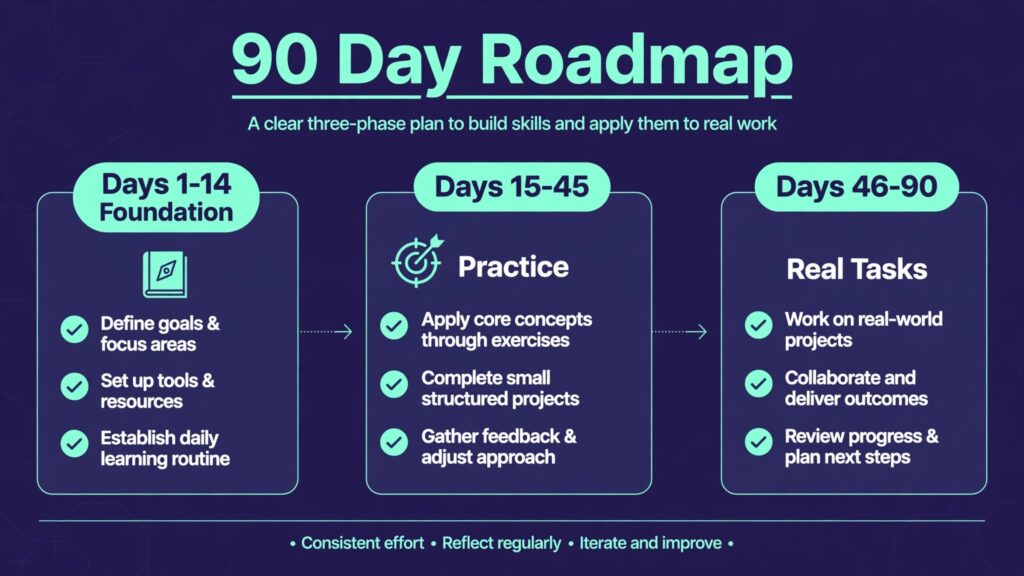
Days 1 to 14: choose your language goal in situations, set up one course, one AI conversation tool, and one review app, and learn core phrases and high frequency words. Speak out loud every day, even for five minutes. Days 15 to 45: add weekly reading and listening, start role plays for your goal situations, and record a short speaking sample to track progress. Days 46 to 90: increase conversation length, add a tutor or language exchange if possible, read real texts in your interest area, and test yourself with real tasks such as a simulated booking call or a written message without translation help.
After 90 days, review what worked. Keep the tools and routines that produced speaking progress, drop the ones you rarely opened, and set the next 90 day goal one level higher: longer conversations, more complex topics, or professional use. Language learning is a long project, but it is built from short, repeatable days. AI makes those days easier to fill with useful practice, feedback, and review. Your job is to keep showing up, speak before you check, and use the language for something real each week. Do that, and the progress that feels slow day by day becomes clear month by month.