

The best AI pricing tools in 2026 do one job that spreadsheets do badly: they connect what you charge to what customers actually do. A price that looked right at launch can quietly stop working. Discounts creep in through sales calls, competitors move, costs rise, and nobody owns the number until revenue stalls or churn spikes. The tools in this guide watch those signals, suggest a price, and show what changes if you move it. They do not remove judgment. They give you a cleaner basis for it, and they catch drift early.
This guide is built around a price leak audit. Before you buy anything, check four leaks. First, discount drift: what share of deals close below list price, and who approves it. Second, stale list prices: when was each price last reviewed against costs and competitors. Third, plan mismatch: which plan customers buy, which plan they actually use, and where upgrades stall. Fourth, competitor blind spots: which rival prices you never see until a customer quotes them back to you. The tool that fixes your biggest leak is the right first buy, even if a larger platform looks more impressive in a demo.
The 10 best AI pricing tools at a glance
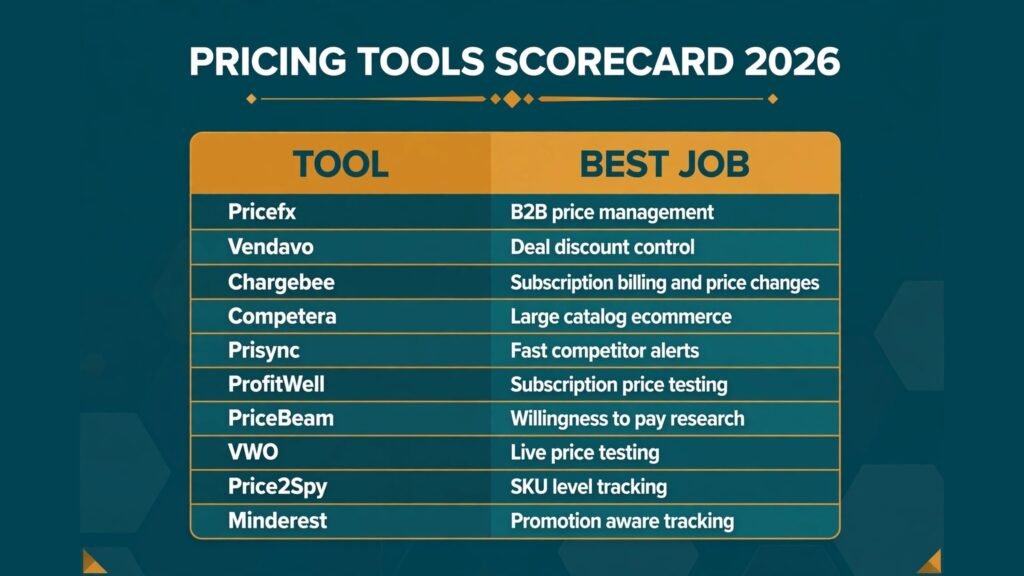
| Tool | Best job | Starting point |
|---|---|---|
| Pricefx | B2B and SaaS price management at scale | Check checkout |
| Vendavo | Enterprise B2B pricing and deal guidance | Check checkout |
| Chargebee | Subscription billing and price changes | Check checkout |
| Competera | Ecommerce price optimisation | Check checkout |
| Prisync | Ecommerce competitor price tracking | Check checkout |
| ProfitWell | Subscription price testing and metrics | Check checkout |
| PriceBeam | Willingness to pay research | Check checkout |
| VWO | Price and offer testing on live pages | Check checkout |
| Price2Spy | Competitor price and stock monitoring | Check checkout |
| Minderest | Competitor pricing and assortment tracking | Check checkout |
Best pick by job
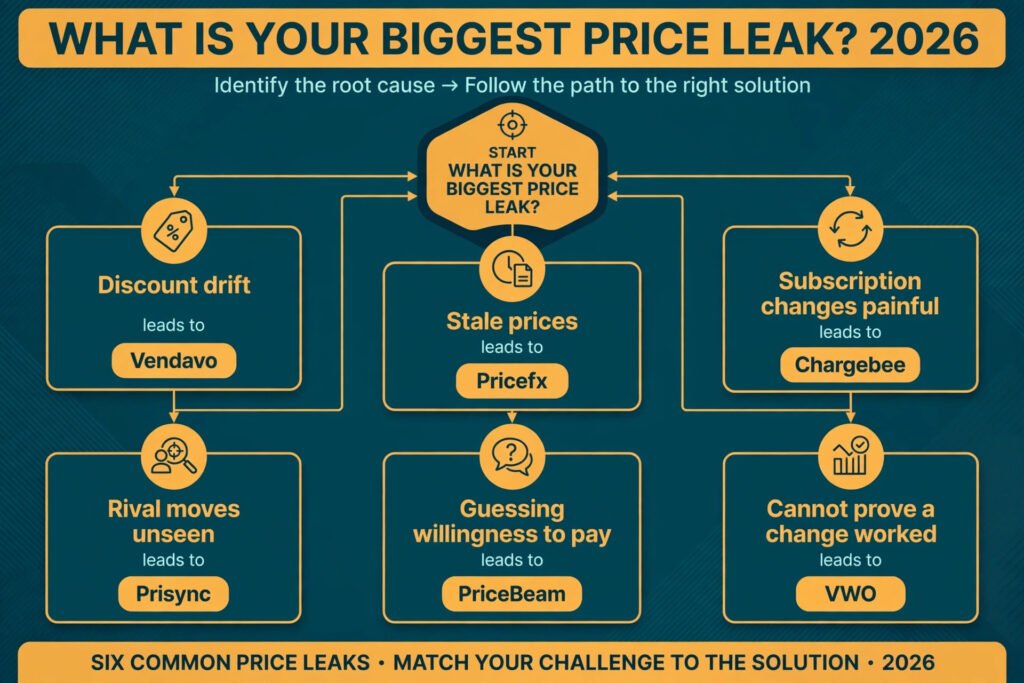
| Your biggest leak | Start here | Why |
|---|---|---|
| Discounts given away deal by deal | Vendavo | Deal level guidance shows what a discount really costs |
| Prices never reviewed in one place | Pricefx | One price list, with rules and approval, across channels |
| Subscription changes are painful to ship | Chargebee | Price changes, trials and billing stay in one system |
| Ecommerce margin lost to rivals | Competera | Repricing follows rules you set, not panic |
| You learn rival prices too late | Prisync | Alerts arrive when a tracked price moves |
| You guess what customers will pay | PriceBeam | Surveys measure willingness to pay before you commit |
| You cannot prove a price change worked | VWO | Live tests compare prices on real traffic |
| A rival undercuts one SKU at a time | Price2Spy | SKU level tracking catches small moves early |
SaaS and B2B pricing
These tools suit companies that sell plans, seats, usage, or negotiated deals. Their value is control: one source of truth for prices, rules for discounts, and a record of why a price changed.
1. Pricefx
Pricefx is a pricing platform for B2B and larger SaaS sellers that need to manage list prices, discounts, and quotes in one place. Its AI features analyse past deals, flag prices that sit far from similar deals, and suggest list or target prices based on customer segment, product, and history. For a team that currently prices in spreadsheets and email threads, the gain is less about a clever algorithm and more about ending the version chaos. One approved list, visible to sales, finance, and product, stops the quiet habit of inventing a price per deal.
Pricing: Check checkout. Pricefx prices by deployment and scope, so expect a quoted plan rather than a public starter price.
Best for: B2B sellers with many SKUs, segments, or discount rules.
Watch out for: Setup takes real work. Price history and deal data must be clean before the suggestions mean much, and a small team may not need this much platform.
Try it at: Pricefx

2. Vendavo
Vendavo focuses on deal level pricing for manufacturers, distributors, and B2B sellers. When a rep builds a quote, it shows the margin effect of each discount, compares the deal to similar past deals, and suggests a floor or target price. That matters because most B2B margin loss does not come from the list price. It comes from hundreds of small concessions that nobody totals up. Vendavo makes each concession visible at the moment it is offered, which is when a rep can still change it.
Pricing: Check checkout. Vendavo is sold as an enterprise platform with quoted pricing.
Best for: Negotiated B2B sales where discount control is the main profit lever.
Watch out for: It is built for complex B2B selling. A simple subscription business will find most of its depth unused.
Try it at: Vendavo
3. Chargebee
Chargebee is subscription billing software with pricing tools that matter more than they first appear. Changing a plan price, running a trial, adding usage billing, or grandfathering old customers all touch billing, and billing errors destroy trust faster than a wrong price. Chargebee handles plan changes, coupons, proration, and dunning, and its reporting shows how a price change affected signups, upgrades, and churn. Its AI assisted features help teams segment customers and test plan structures, but the core win is operational: you can actually ship a price change without a billing incident.
Pricing: Check checkout. Chargebee prices by billing volume and plan, so confirm the tier that covers your revenue and feature needs.
Best for: Subscription businesses that change prices, run trials, or bill by usage.
Watch out for: It is a billing system first. If you only need a price recommendation and already bill elsewhere, a lighter tool may fit better.
Try it at: Chargebee
Ecommerce pricing
Ecommerce prices move daily, sometimes hourly, and a price that is right on Monday can be uncompetitive by Friday. These tools watch rivals, protect margin, and reprice within rules you set.
4. Competera
Competera is built for ecommerce and retail teams that manage large catalogs. It collects competitor prices, analyses demand and elasticity signals, and recommends prices that balance revenue against margin. Instead of matching every rival move, you set guardrails: a floor price, a target margin, and rules for key products versus long tail items. Competera then works inside those guardrails. That distinction matters. Blind matching is a race to the lowest margin. Guardrailed repricing protects the products that pay the bills while staying competitive on the products customers compare first.
Pricing: Check checkout. Competera prices by catalog size and scope.
Best for: Online stores and brands with hundreds or thousands of SKUs.
Watch out for: Results depend on competitor data coverage in your market. Check coverage for your exact categories before committing.
Try it at: Competera
5. Prisync
Prisync tracks competitor prices for ecommerce stores and sends alerts when a tracked price changes. You add competitor URLs, map them to your products, and watch a dashboard of who is cheapest, who moved, and by how much. Its strength is focus. It does not try to run your whole pricing strategy. It answers one question fast: what did rivals do today. For a small or mid sized store, that daily view is often enough to stop reactive discounting, because you can see whether a rival move is broad or limited to a few products.
Pricing: Check checkout. Prisync prices by number of tracked products and competitors.
Best for: Ecommerce stores that want fast, readable competitor price alerts without enterprise software.
Watch out for: Product matching needs care. Similar but not identical products can create false comparisons if mapping is sloppy.
Try it at: Prisync
Price testing and willingness to pay
A price recommendation is a hypothesis until customers meet it. These tools test that hypothesis, either by asking customers directly or by running live experiments.
6. ProfitWell
ProfitWell, now part of Paddle, gives subscription businesses free and paid metrics plus price testing tools. Its Price Intelligently features survey customers about willingness to pay and segment the answers by customer type, so you see not one average price but what different segments value. Combined with its subscription metrics, you can connect a price test to retention and expansion rather than judging it by signups alone. A price that lifts signups but raises churn in month three is not a win, and ProfitWell is built to catch that pattern.
Pricing: Check checkout. Core metrics are widely offered at no cost, while price testing and advanced features sit in paid plans.
Best for: Subscription teams that want willingness to pay data tied to real retention metrics.
Watch out for: Survey answers are stated intent, not purchases. Treat them as a range to test, not a final price.
Try it at: ProfitWell
7. PriceBeam
PriceBeam runs pricing research studies that measure willingness to pay, price sensitivity, and the effect of features on perceived value. You define the product, the segments, and the price points, and PriceBeam collects and analyses responses. The output is practical: an acceptable price range, the point where demand drops sharply, and which features justify a higher price. That is useful before a launch or a major reprice, when a live test would be slow or risky. Research cannot replace a live test, but it stops you from testing a price range that customers already told you is wrong.
Pricing: Check checkout. PriceBeam prices by study scope and sample size.
Best for: Teams setting a price for a new product, new market, or major repositioning.
Watch out for: Good research needs a clear product description and a representative sample. Vague concepts produce vague price ranges.
Try it at: PriceBeam
8. VWO
VWO is a testing and optimisation platform that teams use to test prices and offers on live pages. You can show one group of visitors one price and another group a different price, then compare conversion, revenue per visitor, and downstream behaviour. Because the test runs on real traffic, it answers the question surveys cannot: what do customers actually do at this price. VWO also supports testing bundles, discounts, and page layouts around the price, which matters because presentation changes how a price is read.
Pricing: Check checkout. VWO prices by tested traffic and plan, so confirm the tier that covers your monthly visitors.
Best for: Websites and stores with enough traffic to reach a clear test result in reasonable time.
Watch out for: Low traffic sites will wait a long time for a trustworthy result. Run fewer, larger tests rather than many small ones.
Try it at: VWO

Competitor price tracking
Tracking tools are narrower than optimisation platforms, and that is their advantage. They watch rivals closely, including stock and promotions, and alert you before a small move becomes a lost sale.
9. Price2Spy
Price2Spy monitors competitor prices and stock availability at SKU level. You track specific products across chosen rivals, set alerts for price drops or stock changes, and view price history over time. Stock alerts matter as much as price alerts: when a rival runs out, your price can hold or even rise, and when a rival restocks at a discount, you need to know the same day. Price2Spy also supports repricing rules, so smaller stores can automate routine adjustments inside margin limits.
Pricing: Check checkout. Price2Spy prices by number of monitored links and features.
Best for: Ecommerce stores that compete SKU by SKU and want stock plus price alerts.
Watch out for: Coverage depends on rival sites being accessible to monitoring. Test your key competitors during trial before paying for a large plan.
Try it at: Price2Spy

10. Minderest
Minderest tracks competitor prices, promotions, and assortment for retailers and brands, with a focus on actionable alerts rather than raw data dumps. Its dashboards show price positioning by category, promotion intensity, and availability, so a pricing manager can see the story in minutes: where the market moved, whether promotions or shelf prices drove it, and which categories need attention. Minderest also supports dynamic pricing rules, letting teams automate responses within guardrails while keeping human review for strategic products.
Pricing: Check checkout. Minderest prices by scope and data volume, so confirm coverage for your markets.
Best for: Retail and brand teams that want promotion aware competitor tracking with clear alerts.
Watch out for: Promotion data adds complexity. Agree how your team treats a promo price versus a shelf price before you automate around it.
Try it at: Minderest
Pricing compared
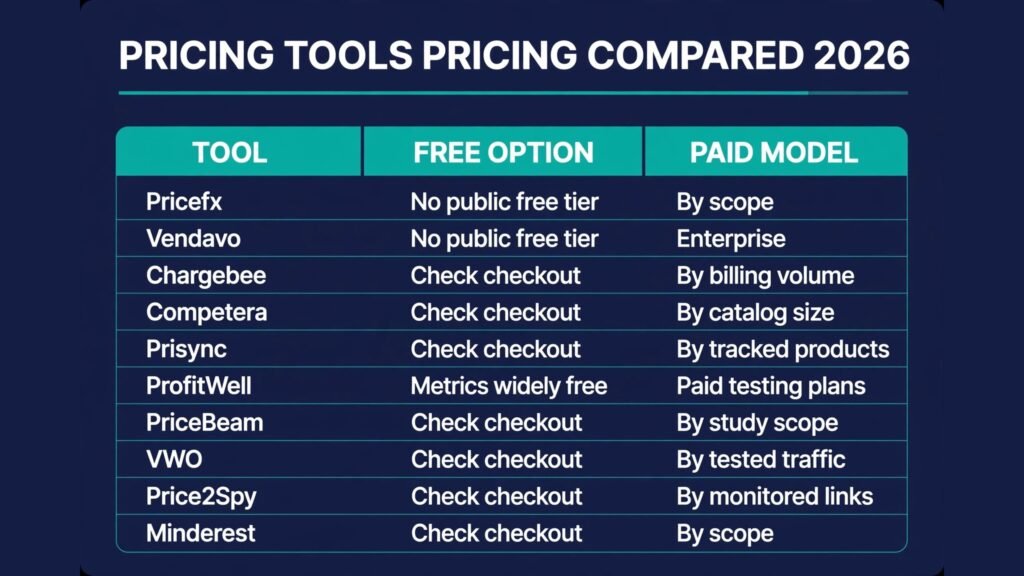
| Tool | Free option | Paid model | Best for |
|---|---|---|---|
| Pricefx | No public free tier | Check checkout, by scope | B2B price management |
| Vendavo | No public free tier | Check checkout, enterprise | Deal discount control |
| Chargebee | Check checkout | Check checkout, by billing volume | Subscription billing and price changes |
| Competera | Check checkout | Check checkout, by catalog size | Large catalog ecommerce |
| Prisync | Check checkout | Check checkout, by tracked products | Fast competitor alerts |
| ProfitWell | Metrics widely free | Check checkout, paid testing plans | Subscription price testing |
| PriceBeam | Check checkout | Check checkout, by study scope | Willingness to pay research |
| VWO | Check checkout | Check checkout, by tested traffic | Live price testing |
| Price2Spy | Check checkout | Check checkout, by monitored links | SKU level tracking |
| Minderest | Check checkout | Check checkout, by scope | Promotion aware tracking |
Pricing in this table reflects October 2026 vendor practice as described on vendor sites: most enterprise and tracking tools quote by scope rather than publishing a single headline price. Where a vendor offers a free tier or trial, confirm the limits at checkout, because limits on tracked products, traffic, or seats decide the real cost. The cheapest tool is not the one with the lowest plan. It is the one whose coverage, alerts, and integrations your team actually uses every week.
How to Choose
Start with the leak, not the feature list. Run the four part audit from the introduction and rank the leaks by money at stake. Discount drift usually tops the list for B2B sellers, stale prices for ecommerce, and plan mismatch for subscription businesses. Buy the tool that fixes the top leak first, and set a review date ninety days out. If the leak has not shrunk by then, find out whether the tool, the data, or the workflow was wrong.
Next, check data before you buy. A pricing tool is only as good as its inputs: clean product matching for ecommerce, clean deal history for B2B, and enough traffic or survey sample for testing. During trial, feed it your real top twenty products or your real last quarter of deals, not demo data. If the output looks wrong on data you know well, it will look wrong on data you do not.
Then set guardrails before automation. Decide a floor price, a margin floor, and which products a tool may reprice on its own. Strategic products, key accounts, and launch prices stay under human review. Automation should handle routine moves on routine products, freeing people for the decisions that actually need judgment. Teams that automate everything on day one usually spend month two undoing it.
Finally, assign one owner. Pricing fails when everyone can suggest a price and nobody owns the result. The owner reviews alerts weekly, approves guardrail changes, and reports one number to leadership: margin per order or per customer after discounts. If that number is not moving, the tooling is decoration.
Solo operators and freelancers face a simpler version of the same problem: setting a rate and holding it. For a closer look at tools built around solo service work, see the guide to best AI tools for freelance writers.
Mistakes to avoid
First, matching every rival move. A competitor may discount to clear stock, test a price, or lose money on a loss leader. Matching without knowing why hands them control of your margin. Match on products customers compare, hold on products where you win on service, speed, or bundle value, and check promotion context before reacting.
Second, testing prices without enough data. A test that runs three days on thin traffic proves nothing, and acting on it can lock in a worse price. Decide the sample size and runtime before launch, and judge tests on revenue per visitor and retention, not clicks alone.
Third, letting discounts hide in the CRM. If reps can discount without a reason code, you will never learn which discounts win deals and which just give away margin. Require a reason, review the top reasons monthly, and fix the underlying cause, whether it is a missing plan tier or a competitor claim nobody verified.
Fourth, pricing once and forgetting it. Costs, rivals, and customer mix change every quarter. A price review calendar, even one hour a month for a small store, beats a grand annual pricing project that never happens.
Fifth, buying breadth before depth. A platform that covers pricing, billing, and analytics sounds efficient, but if your team uses only its tracking view, you paid for three tools and use one. Start narrow, prove value, then expand.
Sixth, ignoring the customer experience of a price change. Grandfathering, clear communication, and a reason customers understand protect trust. A silent increase that customers discover at checkout costs more in churn than the increase earns.
Frequently asked questions
What are the best AI pricing tools for a small ecommerce store?
Start with a tracking tool such as Prisync or Price2Spy, which show rival moves at SKU level for a manageable cost. Add an optimisation tool such as Competera only when your catalog grows large enough that manual review takes hours each week. Small stores gain most from visibility, not automation.
Can AI pricing tools replace a pricing manager?
No. They replace manual data collection and surface patterns a person would miss, but guardrails, strategy, and key account decisions still need a human. The best results in this guide come from teams that pair a tool with one clear owner and a weekly review habit.
How long does it take to see results from a pricing tool?
Tracking tools show value in the first week, because alerts replace manual checking. Optimisation and testing tools usually need four to twelve weeks: time to clean data, set guardrails, and run tests to a trustworthy result. Judge them on margin and retention over a quarter, not on week one activity.
Do these tools work for services and freelancers?
Partly. Subscription and research tools such as Chargebee, ProfitWell, and PriceBeam transfer well to service pricing, because plans, retainers, and willingness to pay work the same way. Ecommerce repricing tools do not, since they assume rival SKUs and catalogs. Service sellers should focus on testing and billing tools first.
Is competitor price tracking legal?
Tracking publicly listed prices is a normal market practice, and every tool in this guide works with public price data. Rules differ by market and by site terms, and scraping a site that blocks automated access can breach its terms. Use a vendor that respects site access rules, and check local rules if you operate in a regulated market.
Should I let a tool reprice automatically?
For routine products inside clear guardrails, yes, with alerts and a margin floor. For strategic products, key accounts, and launch pricing, keep human approval. Automatic repricing without a floor is how a pricing war starts, and wars are easy to enter and hard to exit.
Conclusion
The best AI pricing tools are not the ones with the longest feature lists. They are the ones that fix your biggest leak first, work on your real data during trial, and stay inside guardrails your team trusts. B2B sellers should start with discount control, ecommerce sellers with competitor visibility, and subscription sellers with billing plus testing. Set a floor, assign an owner, review weekly, and judge the tool on margin and retention after a quarter. Price is the fastest lever most businesses never pull, because it feels risky to touch. With clean data, a tested range, and a human in charge of the exceptions, it becomes the most controllable lever you have. Start with one leak, one tool, and one review date, and let the results decide what comes next.