
A missed call at a law firm is rarely just a missed call. Industry surveys put the share of first-time callers who hang up and ring the next firm at roughly 40 percent when nobody answers, and a single signed case can be worth thousands of dollars in fees. That math is why the best ai receptionist software for law firms has become a serious purchase rather than a nice extra, because the phone is still where most new clients first reach a firm.
The problem is not a lack of callers. It is the hours when nobody is free to answer, the lunch break, the court appearance, the day a paralegal is out sick. An AI receptionist answers on the first ring, takes the caller’s details, books the consultation, and sends a written summary to the right person. The firm keeps the lead, and the caller feels heard instead of ignored.
This guide compares fifteen tools that answer phones for law firms, from pure AI agents to hybrid services with live humans behind them. You will see what each one does, what it costs, where it falls short, and which kind of firm each one suits, so the choice comes down to evidence rather than a sales call.
Why a Law Firm Phone Line Works Differently
A law firm caller is not shopping for a pizza. The person on the line may be hurt, worried about a deadline, or calling about a case that carries real stress, and the first voice they hear shapes their trust in the firm. A receptionist who rushes the call or asks the wrong question can lose a client who was ready to sign.
Intake quality matters as much as speed. A good intake captures the caller’s name, the matter type, the urgency, and the conflict check details, then routes the call to the right attorney without making the caller repeat the story three times. A bad intake collects a name and a number, and the attorney calls back blind.
The best ai receptionist software for law firms has to handle that weight. It needs to sound calm, ask the right questions in the right order, know when a matter is urgent, and hand over to a human when the caller is distressed or the facts get complicated. A tool built for a pizza shop will answer the phone, but it will not run a legal intake.
The 15 Tools at a Glance
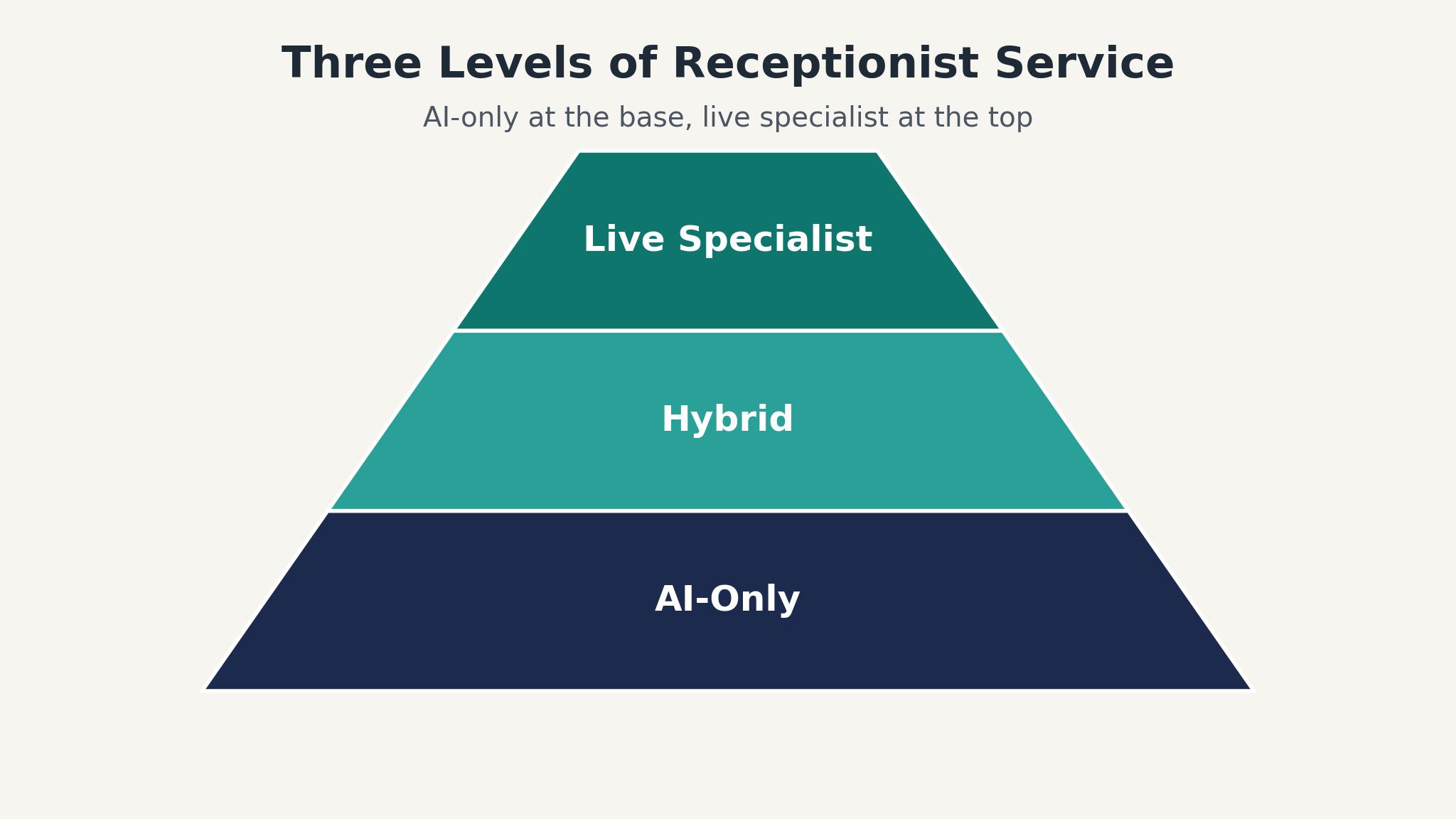
Fifteen tools is a long list, and they split into three groups. Pure AI agents answer every call themselves, hybrid services mix AI with live agents, and human-first services use AI only to support their people. The best ai receptionist software for law firms in the table below shows the starting price and the main job of each one.
| Tool | Main job | Best for | Starting price |
|---|---|---|---|
| Smith.ai | Hybrid AI and live intake | Firms wanting humans as backup | 95 dollars a month |
| Goodcall | AI phone agent | High call volume on a flat rate | 79 dollars a month |
| Ruby | Live US receptionists | Callers who want a person | 250 dollars a month |
| Answering Legal | Legal-only live intake | Firms wanting legal specialists | Quote |
| Nexa | Live and AI-assisted answering | Firms wanting 24/7 coverage | Quote |
| Abby Connect | Live receptionist team | Small firms wanting a named team | Quote |
| AnswerConnect | Live answering service | Firms needing round-the-clock cover | Quote |
| PATLive | Live virtual receptionists | Firms wanting US-based agents | Quote |
| VoiceNation | Live answering service | Budget live coverage | Quote |
| Davinci Virtual | Virtual receptionist plans | Firms wanting a virtual office feel | Quote |
| Rosie | AI phone agent | Small firms on a budget | 49 dollars a month |
| Dialzara | AI receptionist | Solo firms wanting a low entry price | 29 dollars a month |
| LEX Reception | Legal live receptionists | Firms wanting legal-trained staff | Quote |
| Moneypenny | Live receptionists | Firms wanting a premium service | Quote |
| CallHero | AI call handling | Firms wanting call tracking | 99 dollars a month |
Best Pick by Job
| Job type | First pick | Second tool | Why this pair works |
|---|---|---|---|
| High volume intake | Goodcall | Smith.ai | Goodcall bills by caller, not by the minute, and Smith.ai adds humans for hard calls |
| Callers who insist on a person | Ruby | Answering Legal | Ruby gives US-based live agents and Answering Legal adds legal intake training |
| Solo firm on a budget | Dialzara | Rosie | Dialzara starts cheap and Rosie adds a simple AI agent for overflow |
| Premium client experience | Moneypenny | LEX Reception | Moneypenny brings polish and LEX Reception brings legal knowledge |
The best ai receptionist software for law firms depends on the callers you already have. A firm that takes fifty calls a day needs a flat rate, while a firm that takes five calls a day needs a low entry price and a careful intake. Match the billing model to the call volume first, and the features will follow.
How to Judge the best ai receptionist software for law firms
Start with a test call on your own number, and make it a hard one. Ring the service as a new client with a personal injury matter, give a partial story, ask a question the script does not cover, and listen to how the agent recovers. The tools that handle a messy call gracefully are the ones worth paying for, because real callers never follow the script.
Next, read the billing model as carefully as the feature list. Some tools bill per call, some per minute, some per unique caller, and some per month with a minute allowance, and the cheapest headline price can become the dearest bill at your volume. Work out your monthly call count, your average call length, and your busiest week, then price each tool against those three numbers.
Finally, check the handoff. A good receptionist knows when to stop and pass the call to a person, and a good tool makes that handoff fast and warm. Ask the vendor how a caller reaches a human, how long the transfer takes, and what happens when nobody at the firm answers. The best ai receptionist software for law firms treats the handoff as a feature, not as a failure mode.
The 15 Tools in Detail
The fifteen tools below cover the full range from a 29 dollar AI agent to a premium live service. The best ai receptionist software for law firms is the one that fits your call volume, your intake needs, and your budget at the same time.
1. Smith.ai
Smith.ai pairs an AI receptionist with live agents based in North America, and that pairing is the core of the product. The AI answers routine calls, takes the intake details, and books the consultation, while a live agent steps in when the caller is upset or the matter needs judgment. The AI plans start at 95 dollars a month, and the live plans start at 300 dollars a month for 30 calls.
The legal track record is the strength. Smith.ai has served law firms for years, and its intake scripts cover matter types, conflict checks, and urgency flags that a generic answering service misses. The per-call pricing is itemized, so a firm can see exactly what each call cost.
The cost climbs fast at real volume. A firm running 150 calls a month can land near 700 to 900 dollars, and the per-call rate adds up when calls run long.
Smith.ai fits a firm that wants AI speed with a human safety net and can pay for it. A small firm with light call volume gets the best value, while a high-volume firm should price the live plans carefully before signing.
2. Goodcall
Goodcall is a pure AI phone agent that answers instantly and books appointments through the firm’s calendar. The billing model is unusual, because the firm pays per unique caller rather than per minute, with unlimited minutes on each call. Plans start at 79 dollars a month for 100 unique callers, then 129 dollars for 250, and 249 dollars for 500.
The flat billing is the main draw for a busy firm. A long intake call costs the same as a short one, which removes the worry that a talkative caller will blow the budget.
The limit is the human voice. Goodcall has no live agent to take over, so a distressed caller or a complex matter stays with the AI until the call ends. A firm that wants a person on hard calls will need a second service or a different tool.
Goodcall fits a firm with high call volume and repeat callers, where the per-caller billing saves real money. It also fits a firm that wants 24/7 coverage without paying for a night shift.
3. Ruby
Ruby has served law firms since 2003 with live receptionists based in the United States, and the human voice is the whole product. A Ruby receptionist answers the call, takes the intake, books the appointment, and transfers the caller to the attorney when needed. Plans start at 250 dollars a month for 50 minutes, rising to 1,725 dollars a month for 500 minutes.
The quality of the live agents is the strength. Ruby trains its people to handle legal callers with care, and the service includes call summaries, sentiment notes, and an in-call assistant that helps the agent find the right answer. A caller who wants a person gets one on every call.
The price per minute is the drawback. At 5 dollars a minute on the entry tier, a firm with long intake calls can burn through its allowance in a week, and overage charges add up quickly.
Ruby fits a firm where every caller expects a person and the budget allows it. A boutique firm with a premium client base will value the service most, while a high-volume firm should watch the minute allowance closely.
4. Answering Legal
Answering Legal only serves law firms, and that focus shows in the intake. Its agents are trained on legal matter types, conflict checks, and the urgency signals that matter to a firm, from a statute deadline to a client in custody. Pricing is quoted per firm, so the cost depends on call volume and intake depth.
The legal-only focus is the advantage. A generic answering service asks the caller’s name and number, while Answering Legal asks the questions an attorney actually needs answered before the callback. The service covers 24/7, so a firm never misses a call from a client who rings at midnight.
The drawback is the quote-only pricing, which makes comparison slow. A firm has to sit through a sales call to learn the price, and the final number can be higher than a published plan from a rival.
Answering Legal fits a firm that wants intake done by people who understand legal work and can pay for a specialist. A personal injury or criminal defense firm will get more from the trained intake than a general practice with simple calls.
5. Nexa
Nexa runs a large live answering operation with AI assistance layered on top, and it covers law firms alongside medical and service businesses. The live agents answer around the clock, take messages, book appointments, and transfer urgent calls to the attorney on call. Pricing is quoted, with no published starting price.
The scale is the strength. Nexa has the staff to cover nights, weekends, and holidays without a gap, and the AI tools help agents find information faster during a call. A firm with uneven call volume gets coverage that scales without hiring.
The weakness is the lack of a published price and the generalist background. Nexa serves many industries, so the legal intake training is thinner than a legal-only service, and the firm may need to write its own scripts.
Nexa fits a firm that needs reliable 24/7 coverage and values scale over specialization. A mid-size firm with several practice areas will find the coverage useful, while a niche firm may prefer a legal-only provider.
6. Abby Connect
Abby Connect gives small firms a named team of live receptionists who learn the firm’s name, its attorneys, and its intake script. The agents answer calls, take messages, schedule consultations, and send a summary after each call. Pricing is quoted per firm, based on call volume and the hours covered.
The personal touch is the selling point. Callers speak to a small team that knows the firm, rather than a large pool of strangers, and the intake quality improves as the team learns the firm’s preferences. The service suits a firm that wants callers to feel like they reached the office.
The cost is opaque, and the firm has to negotiate to learn it. The service also scales less smoothly than a pure AI tool, since a sudden spike in calls needs more agent hours rather than more software.
Abby Connect fits a small firm that wants a steady, familiar voice on the phone and can pay for a live team. A solo attorney who wants callers to reach a real person will like the service, while a firm chasing the lowest cost should look at AI options.
7. AnswerConnect
AnswerConnect is a live answering service that covers firms around the clock, with agents who take calls, book appointments, and route urgent matters to the right person. The service is built for businesses that cannot afford a missed call, and it offers plans based on minutes used. Pricing is quoted per firm.
The coverage is the strength. AnswerConnect answers nights, weekends, and holidays, and the agents follow the firm’s script for intake and transfers. A firm that runs ads in the evening gets the calls answered when the attorney is at home.
The drawback is the generalist background and the minute-based billing. The agents handle many industries, so legal intake needs a clear script from the firm, and long calls eat the minute allowance quickly.
AnswerConnect fits a firm that needs round-the-clock live coverage and has a clear intake script ready. A firm with evening marketing or a wide service area will value the coverage, while a firm that wants legal specialists should look elsewhere.
8. PATLive
PATLive offers live virtual receptionists based in the United States, with plans that cover call answering, message taking, appointment booking, and transfers. The service targets small businesses that want a professional phone presence without hiring a receptionist. Pricing is quoted per firm.
The US-based agents are the draw. Callers reach a person who sounds like part of the firm, and the service includes a mobile app that lets the attorney see messages and return calls quickly. The plans are flexible, with options for part-time and full-time coverage.
The weakness is the lack of legal specialization and the opaque pricing. PATLive serves many industries, so the firm must supply the intake script and train the agents on legal matters.
PATLive fits a small firm that wants a US-based live voice and a flexible plan. A firm with a modest call volume and a clear script will get good value, while a firm that needs deep legal intake should consider a specialist.
9. VoiceNation
VoiceNation is a live answering service that has run for decades, and it prices itself as a budget option for firms that want a person on the phone. The agents answer calls, take messages, and transfer urgent callers to the attorney. Pricing is quoted, with plans based on minutes.
The longevity and the low cost are the strengths. VoiceNation has answered phones for small businesses for a long time, and the entry price sits below several rivals. A firm that wants live coverage without a premium bill can start here and upgrade later.
The drawback is the dated feel and the thin legal training. The service covers many industries, and the intake is basic unless the firm writes a detailed script.
VoiceNation fits a firm on a tight budget that still wants a live voice. A solo attorney starting out will find the price workable, while a firm that needs detailed intake or calendar booking should test the service first.
10. Davinci Virtual
Davinci Virtual sells virtual office plans that include a live receptionist, a business address, and meeting room access, so the phone service sits inside a wider package. The receptionist answers calls in the firm’s name, takes messages, and patches urgent callers through. Pricing is quoted per plan.
The bundle is the appeal. A firm that wants a professional address and a receptionist in one package gets both from a single vendor, and the receptionist service is priced as part of the plan rather than alone. The service covers many cities, which helps a firm with a virtual presence.
The weakness is that the phone service is not the main product. The intake is lighter than a legal specialist, and the firm may find the receptionist hours and the minute allowance tighter than a dedicated service.
Davinci Virtual fits a firm that wants a virtual office and a receptionist together. A new firm building a professional image will like the bundle, while an established firm that only needs phones should buy a dedicated service.
11. Rosie
Rosie is an AI phone agent built for small businesses, and it answers calls, books appointments, and takes messages without a live agent. The tool is simple to set up, with a short configuration that lets a firm go live in a day. Plans start at 49 dollars a month.
The simplicity is the strength. A solo firm can configure Rosie in an afternoon, and the AI handles the routine calls that would otherwise go to voicemail. The price is low enough to try without a long commitment.
The limit is the depth of the intake. Rosie handles standard calls well but struggles with the layered questions a legal intake needs, and there is no live agent to take over a hard call.
Rosie fits a solo firm or a small practice that wants a cheap AI agent for overflow calls. It works well as a backup to a human receptionist, and as a first step into AI answering before a bigger investment.
12. Dialzara
Dialzara is an AI receptionist with one of the lowest entry prices in this group, starting at 29 dollars a month. The AI answers calls, takes messages, books appointments, and sends a summary to the firm, with a setup that takes less than an hour. The tool targets small firms that want AI answering without a big bill.
The price is the headline. At 29 dollars a month, a solo attorney can afford AI answering from the first month, and the tool covers the basic intake that a voicemail never could. The setup is fast, and the AI sounds natural on short calls.
The drawback is the limited depth. Dialzara handles routine calls well, but a long legal intake with several matter types can confuse it, and there is no human backup on the plan.
Dialzara fits a solo firm on a tight budget that wants every call answered. It also fits a firm testing AI reception for the first time, since the cost of trying it is small.
13. LEX Reception
LEX Reception is a live receptionist service built for law firms, with agents trained on legal intake, conflict checks, and the urgency of a legal call. The service covers 24/7, takes detailed messages, and books consultations directly into the firm’s calendar. Pricing is quoted per firm.
The legal training is the advantage. LEX agents know the difference between a consultation request and an emergency, and they ask the follow-up questions that save the attorney a wasted callback. The service feels like an extension of the firm rather than a generic call center.
The weakness is the quote-only pricing, which makes a quick comparison impossible. The service is also live-only, so a firm pays for agents on every call, including the simple ones an AI could handle for less.
LEX Reception fits a firm that wants legal-trained live agents and can pay for a specialist. A criminal defense or family law firm with urgent callers will value the training most.
14. Moneypenny
Moneypenny is a premium live receptionist service with a reputation for polished call handling, and it serves law firms alongside other professional businesses. The agents answer in the firm’s name, take detailed messages, and transfer calls with a warm handoff. Pricing is quoted per firm.
The polish is the selling point. Moneypenny trains its people to sound like the firm’s own staff, and the service includes call handling, diary management, and overflow cover. A firm that wants callers to feel looked after will notice the difference.
The cost is the trade. Premium service carries a premium price, and the quote-only model means the firm cannot see the number without a sales conversation.
Moneypenny fits a firm where the client experience justifies a higher phone bill. A high-end practice with demanding clients will get the most from it, while a budget-conscious firm should start with an AI tool.
15. CallHero
CallHero combines AI call handling with call tracking, so the firm can see which marketing channel produced each call. The AI answers, takes the intake, and logs the call source, giving the firm a record of what its advertising actually delivers. Plans start at 99 dollars a month.
The tracking is the strength. A firm running ads on several channels can see which one brings real cases and which one brings tire-kickers, and the AI intake captures the details that make the tracking useful. The call recordings also help the firm review intake quality.
The drawback is the price and the focus. At 99 dollars a month, CallHero costs more than several AI rivals, and the call tracking features matter less to a firm that does not run paid ads. The AI intake is solid but not the deepest in this group.
CallHero fits a firm that spends on marketing and wants to know what each dollar brings back. A firm with active ad campaigns will value the tracking, while a referral-driven firm can skip it.
What the Monthly Bill Really Looks Like
The monthly bill for a phone service depends on how the vendor counts a call. A per-call price looks cheap until the firm counts its real call volume, and a per-minute price looks fair until the intake calls run long. The best ai receptionist software for law firms in this group bills in four different ways, so the firm has to price each one against its own numbers before choosing.
Start with three numbers from your own phone records. Count the calls in a normal month, the average length of an intake call, and the number of unique callers. A firm with 200 short calls pays very differently on a per-caller plan than on a per-minute plan, and the difference can run to hundreds of dollars a month. Pull the numbers from the phone bill, not from memory.
Then add the extras that sit outside the headline price. Some tools charge for calendar booking, some for SMS follow-ups, some for the AI features that were free in the trial, and some for overage minutes that kick in mid-month. Ask each vendor for the total bill at your call volume in writing, and confirm the number on the vendor page before you pay, because a quoted price can change when the contract arrives.
Mistakes That Lose Clients on the Phone
The first mistake is letting the AI answer a call it should have passed to a person. A caller in distress, a caller with a deadline that day, or a caller who keeps repeating the same question needs a human voice, and an AI that keeps asking scripted questions will lose that caller. The best ai receptionist software for law firms is configured with clear handoff rules, so set them on day one and test them with a real call.
The second mistake is a script that asks too much too soon. A caller who rings for the first time does not want a ten-question intake before anyone listens to the problem, and a long script drives people to hang up. Keep the first questions short, capture the name and the matter, and let the attorney gather the detail on the callback.
The third mistake is never listening to the call recordings. The recordings show where callers get confused, where the AI mishears a name, and where the intake misses a detail the attorney needed. Listen to five calls a week for the first month, fix the script each time, and the intake quality will climb faster than any feature upgrade could manage.

Frequently Asked Questions
How much does an AI receptionist cost a small law firm?
A small firm usually pays between 29 and 250 dollars a month, depending on whether the service is pure AI or live agents. Pure AI tools start near 29 dollars, hybrid services near 95 dollars, and live services near 250 dollars.
Can an AI receptionist book consultations directly?
Most AI receptionists in this group can book a consultation into the firm’s calendar, either through a direct calendar link or through an integration with tools like Calendly or Google Calendar. The booking works best when the calendar shows real availability, so keep the attorney’s calendar current.
Is a caller told they are speaking to an AI?
Most vendors recommend a short disclosure at the start of the call, and several tools include it by default. A simple line that the caller is speaking with the firm’s AI assistant sets the right expectation and avoids a surprise later.
What happens when the AI cannot answer a question?
A good system transfers the call to a person, takes a detailed message, or offers a callback at a time the caller chooses. The tools in this group handle the failure differently, so test the handoff before launch.
Do these tools integrate with legal practice software?
Several tools in this group integrate with practice management software such as Clio, and most can send call summaries by email or webhook to any system that accepts them. The depth of the integration varies, so check the specific tool against the software your firm already uses.
How long does setup take?
A pure AI tool can go live in a day, while a live service with trained agents usually needs a week to learn the firm’s script and intake rules. The fastest setup comes from having the intake questions, the calendar link, and the handoff rules written before the vendor call.
The Shortlist for Your Next Hire
Start with Goodcall if your firm takes a high volume of calls and wants a predictable bill, and add Smith.ai when the intake needs a human on the hard calls. A solo firm should test Dialzara first, because the low price makes the experiment cheap and the lessons learned will shape the bigger purchase. The best ai receptionist software for law firms is the one your callers actually enjoy speaking to, so run a test call on your own number this week and listen to it like a client would.