

The top 10 ai tools for orthodontists in 2026 put Pearl Second Opinion first for most practices, because its FDA cleared X-ray analysis shows patients the finding on their own scan during the same visit. An orthodontist who needs to explain why treatment is needed, a practice that wants remote aligner checks and a team that spends hours on charts all need the same thing, which is AI that saves chair time without replacing clinical judgment. The eleven tools below differ on whether they read X-rays, monitor aligners, chart notes or run the front desk.
Orthodontic AI splits into two kinds, and confusing them is the most common buying mistake. Clinical AI reads radiographs and needs FDA clearance in the United States, with every finding reviewed and signed off by a licensed dentist, while administrative AI books appointments, writes notes and answers phones with no clearance needed.
The second test is the workflow the tool actually changes. An X-ray tool that adds two minutes to every exam will be abandoned, while a remote monitoring tool that cuts in person visits in half will pay for itself in freed chair time.
The 12 Tools at a Glance
| Tool | Main job | Best for | Starting price |
|---|---|---|---|
| Pearl Second Opinion | FDA cleared X-ray analysis chairside | Practices that want patients to see the finding | Reported from 299 dollars a month per location |
| Overjet | FDA cleared X-ray analysis with claims support | Practices whose biggest pain is insurance claims | Quote based, reported from 500 dollars a month |
| VideaHealth | FDA cleared imaging with practice analytics | Large practices and groups that want a platform | Quote based |
| DentalMonitoring | Remote aligner and treatment monitoring | Practices that want fewer in person check visits | Quote based |
| Denti.AI | X-ray detection with voice charting | Practices that want the lowest published price | Detect from 49 dollars a month |
| Diagnocat | AI analysis of X-rays and CBCT scans | Practices that take CBCT scans | Quote based |
| Grin | Remote orthodontic monitoring with a scope | Practices that monitor patients from home | Quote based |
| SmileMate | AI virtual consultation and monitoring | Practices that want online consultations | Quote based |
| uLab Systems | Digital treatment planning for aligners | Orthodontists who plan aligners in house | Quote based |
| 3Shape | Digital scanning and treatment planning | Practices that scan rather than take impressions | Quote based |
| Align iTero | Intraoral scanning for aligner treatment | Practices that run Invisalign treatment | Quote based, scanner hardware |
| Bola AI | Voice charting for perio and clinical notes | Practices that want hands free charting | Quote based |
Best Pick by Job
| Job type | First pick | Second tool | Why this pair works |
|---|---|---|---|
| Show patients the X-ray finding | Pearl Second Opinion | Overjet | Pearl leads on chairside display and Overjet adds claims support |
| Remote aligner monitoring | DentalMonitoring | Grin | DentalMonitoring leads on scale and Grin adds a simple scope |
| Lowest published X-ray price | Denti.AI | Pearl Second Opinion | Denti.AI leads on price and Pearl adds wider clearance |
| Plan aligners in house | uLab Systems | 3Shape | uLab Systems leads on in house planning and 3Shape adds scanning |
| Hands free clinical notes | Bola AI | Denti.AI | Bola AI leads on voice charting and Denti.AI adds X-ray detection |
A solo orthodontist and a multi location group ask for opposite things from AI. The solo needs one tool that pays for itself in a month, with a simple setup and a clear price, while the group needs a platform that works the same way in every location, with reporting across the group and a vendor that can support dozens of chairs. Buying for the wrong half means paying enterprise prices for one chair, or fighting a single location tool to serve ten practices.
Patient volume decides the second cut. A practice that sees twenty patients a day needs AI that saves minutes per patient, while a practice that sees five needs AI that wins new patients. The top 10 ai tools for orthodontists match the practice as it runs today, with a clear path to the next tier when the patient count grows.
Which AI tool is best for showing patients their X-ray findings?
Pearl Second Opinion is the best pick for showing patients their X-ray findings, because it analyses bitewing, periapical and panoramic X-rays chairside and highlights caries, bone loss, calculus, periapical lesions and worn restorations in real time. The dentist can show the patient the finding on their own X-ray during the same appointment, which is why practices report higher case acceptance, with Pearl reporting an average 30 percent lift from its own customer data. The price is reported from about 299 dollars a month per location, with quotes reported between 250 and 500 dollars.
Overjet takes a different route to the same X-ray, with FDA cleared analysis that emphasises payer ready documentation and insurance claims beside detection. It suits a practice whose biggest pain is claims rather than chairside explanation, because Overjet quantifies bone levels and caries in a form insurers accept. The price is quote only, with third party reports placing it at about 500 to 1,200 dollars a month depending on practice size and modules.
The honest test is a month of real appointments. Run the trial with the actual patient flow, count how many patients accept treatment after seeing the AI finding and compare the rate with the previous month. The tool with the higher acceptance rate wins, and the top 10 ai tools for orthodontists should prove that lift before any practice pays.
How to Choose the Top 10 AI Tools For Orthodontists
Start with the job the practice actually needs, because that decides the shortlist before price does. Write down the three pains from last month, such as patients declining treatment, too many aligner check visits or hours lost to charting, and keep only the tools that solve one of those three. A tool that reads X-rays will not fix a front desk problem, and a tool that books appointments will not fix a case acceptance problem.
Next, check the FDA clearance. Pearl, Overjet and VideaHealth all hold FDA 510(k) clearance for radiograph analysis, but every clearance covers detection assistance rather than diagnosis, and every finding still needs review and sign off by a licensed dentist. Ask the vendor for the current clearance list before buying, because counts move as modules are cleared.
Then look at the integration with the imaging and practice management systems the practice already runs. A tool that cannot read the current X-ray sensor or write to the current chart will need workarounds that cost more than the subscription. Finally, count the true monthly cost per location, because most imaging tools price per location rather than per user, and a group with five locations pays five times the headline price.
The 12 Tools in Detail
The order below follows the patient journey, so the chairside X-ray tool opens the list and the voice charting tool closes it. Each entry states the price as published or reported, the clearance that matters and the job it fits, because the top 10 ai tools for orthodontists earn their place on the chair time they save.
1. Pearl Second Opinion
Pearl Second Opinion is the FDA cleared X-ray analysis tool for chairside patient communication. It analyses bitewing, periapical and panoramic X-rays and highlights caries, bone loss, calculus, periapical lesions and worn restorations in real time, with clearance for both 2D X-rays and 3D CBCT imagery. The price is reported from about 299 dollars a month per location, with quotes reported between 250 and 500 dollars and a setup fee of about 1,500 dollars, while the full bundle with Practice Intelligence is reported at roughly 700 to 900 dollars a month.
The drawback is the quote only price and the vendor reported results. Pearl does not publish a price, so the practice must ask for a quote, and the 30 percent case acceptance lift is a vendor figure rather than a guarantee.
Pearl suits practices that want patients to see the finding. It fits an orthodontist who explains treatment chairside, a practice that wants higher acceptance and a team that shows the X-ray rather than describing it.
Trial Pearl for a month, count the acceptance rate against the previous month and check whether the lift covers the monthly price.
2. Overjet
Overjet is the FDA cleared X-ray analysis platform for practices whose biggest pain is insurance claims and documentation. It was the first dental AI to receive FDA clearance, back in 2018, and it holds multiple clearances covering caries detection, bone level quantification, charting, CBCT assistance and image enhancement. The platform overlays findings on periapical and bitewing X-rays, flagging bone loss and suspected caries for the dentist to review, with pricing quote only and third party reports at about 500 to 1,200 dollars a month.
The drawback is the quote only price and the claims focus. A practice that only needs chairside display will find Overjet heavier and pricier than Pearl, and the wide reported price range means the quote is the only number that counts.
Overjet suits practices that need payer ready documentation. It fits a group that wants consistent reads across locations, a practice that fights claim denials and a team that values the documentation as much as the detection.
Ask Overjet for a written quote at the real location count, trial it on a month of claims and check whether the denial rate moves.
3. VideaHealth
VideaHealth, now called Videa, is the FDA cleared imaging platform for large practices and groups that want a full picture. Clinical Assist analyses radiographs for caries, bone loss, calculus and periapical radiolucency, with the company reporting 35 cleared indications, and the platform adds dashboards, claims support and verification beside the imaging. Pricing is quote only, with the platform leaning toward multi location groups rather than single chairs.
The drawback is the group focus and the quote only price. A solo practice will find Videa heavier than Pearl, and the buyer cannot budget it from the website.
Videa suits large practices and groups. It fits a DSO with many locations, a practice that wants imaging plus analytics and a team that needs one platform for clinical and business insight.
Book a demo with the group data, ask Videa to show the dashboard for three locations and check the integration with the current imaging system.
4. DentalMonitoring
DentalMonitoring is the remote aligner and treatment monitoring platform for practices that want fewer in person check visits. Patients scan their teeth at home with a phone, the AI checks aligner fit and treatment progress, and the orthodontist reviews the scans remotely, intervening only when the AI flags a problem. Pricing is quote based, with the platform used by practices that want to free chair time for new patients.
The drawback is the quote only price and the patient compliance need. The system only works when patients scan regularly, so a practice with low compliance will see little value, and the buyer cannot budget it from the website.
DentalMonitoring suits practices that monitor aligners remotely. It fits an orthodontist with many aligner patients, a practice that wants to cut routine check visits and a team that can review scans daily.
Trial DentalMonitoring with twenty aligner patients, count the in person visits saved in a month and check whether the chair time freed covers the price.
5. Denti.AI
Denti.AI is the X-ray detection and voice charting platform for practices that want the lowest published price. Detect costs a published flat 49 dollars a month, which makes it the cheapest FDA cleared X-ray AI in this guide, and the platform adds voice perio charting and auto charting beside detection. The company reports that Voice Perio finishes a chart in about five minutes at 99 percent accuracy, which is a vendor claim.
The drawback is the narrower coverage and the vendor claims. Denti.AI covers fewer indications than Pearl or Overjet, so a practice that needs the widest clearance will find it thinner, and the accuracy figures are vendor reported rather than independently verified.
Denti.AI suits practices that want the lowest published price. It fits a solo orthodontist, a practice that wants X-ray AI without a quote process and a team that values voice charting beside detection.
Trial Detect for a month, compare its findings with the dentist own reads and check whether the accuracy holds on real cases.
6. Diagnocat
Diagnocat is the AI analysis platform for X-rays and CBCT scans in practices that take three dimensional imaging. It analyses 2D and 3D scans, flags findings for the dentist to review and produces reports the patient can understand, with a focus on CBCT data that many X-ray tools handle poorly. Pricing is quote based, so the practice must ask for a number.
The drawback is the quote only price and the CBCT focus. A practice that does not take CBCT scans will get less value, and the buyer cannot budget Diagnocat from the website.
Diagnocat suits practices that take CBCT scans. It fits an orthodontist who plans treatment from 3D data, a practice that wants AI on every scan type and a team that needs patient friendly reports.
Ask Diagnocat for a written quote, trial it on a month of CBCT cases and check whether the findings match the dentist own reads.
7. Grin
Grin is the remote orthodontic monitoring platform with a scope for practices that monitor patients from home. Patients use the Grin scope with a phone to capture high quality scans, the AI checks treatment progress and the orthodontist reviews remotely, which cuts routine visits while keeping the quality of the scan high. Pricing is quote based.
The drawback is the quote only price and the hardware need. Patients need the Grin scope, which adds a logistics step, and the buyer cannot budget the platform from the website.
Grin suits practices that monitor patients from home with high quality scans. It fits an orthodontist with many aligner patients, a practice that wants better scans than a bare phone and a team that reviews remotely each day.
Trial Grin with twenty aligner patients, count the visits saved and check whether the scan quality holds up in real use.
8. SmileMate
SmileMate is the AI virtual consultation and monitoring platform for practices that want to meet patients online first. Prospective patients send photos and information, the AI assesses the case and the orthodontist reviews remotely, which qualifies leads before they book a chair. Pricing is quote based, with the platform aimed at practices that want more consultations without more chair time.
The drawback is the quote only price and the qualification limit. AI assessment is a screening step rather than a diagnosis, so the orthodontist must still examine the patient in person, and the buyer cannot budget the platform from the website.
SmileMate suits practices that want online consultations. It fits an orthodontist who wants to qualify leads remotely, a practice that markets online and a team that needs more consultations without more chairs.
Trial SmileMate with a month of online enquiries, count how many convert to booked consultations and check whether the qualification saves chair time.
9. uLab Systems
uLab Systems is the digital treatment planning platform for orthodontists who plan aligners in house. The software lets the orthodontist design the aligner sequence, control tooth movements and order aligners without sending the case to an external lab, which keeps the planning and the profit inside the practice. Pricing is quote based.
The drawback is the quote only price and the learning curve. In house planning needs training and time, so an orthodontist who plans few aligner cases will find the setup heavy, and the buyer cannot budget the platform from the website.
uLab Systems suits orthodontists who plan aligners in house. It fits a practice with high aligner volume, an orthodontist who wants control over tooth movements and a team that values keeping the planning fee.
Ask uLab for a written quote, trial it on five real aligner cases and check whether the planned movements match the clinical goal.
10. 3Shape
3Shape is the digital scanning and treatment planning platform for practices that scan rather than take impressions. The Trios intraoral scanner captures accurate digital impressions, the software plans treatment and the data flows to aligner and appliance labs, which suits a practice that has gone fully digital. Pricing is quote based, with scanner hardware beside the software.
The drawback is the quote only price and the hardware cost. A scanner is a capital purchase, so the total cost is far higher than a software subscription, and the buyer cannot budget it from the website.
3Shape suits practices that have gone fully digital. It fits an orthodontist who scans every patient, a practice that wants accurate digital impressions and a team that plans treatment from scan data.
Book a demo with a real patient, scan and compare the digital impression with the physical one before committing to the hardware.
11. Align iTero
Align iTero is the intraoral scanner for practices that run Invisalign treatment. The iTero scanner captures the digital impression, the software shows a treatment simulation and the data flows directly to Align for aligner production, which suits a practice whose aligner volume runs through Invisalign. Pricing is quote based, with scanner hardware beside the software.
The drawback is the quote only price and the Invisalign focus. The iTero workflow is built around Align, so a practice that uses other aligner systems will get less value, and the scanner is a capital purchase on top of the software.
Align iTero suits practices that run Invisalign at volume. It fits an orthodontist with many Invisalign cases, a practice that wants a treatment simulation at the first visit and a team that values the direct Align workflow.
Ask Align for a written quote that includes hardware and software, trial the scanner on real patients and check whether the simulation lifts acceptance.
12. Bola AI
Bola AI is the voice charting platform for practices that want hands free clinical notes. The dentist speaks while examining, Bola AI transcribes the perio chart and clinical notes, and the data lands in the chart without typing, which saves minutes per patient. Pricing is quote based, with the platform focused on voice rather than imaging.
The drawback is the quote only price and the single job. Bola AI charts notes but does not read X-rays, so a practice that needs imaging AI must buy a second tool, and the buyer cannot budget it from the website. The voice accuracy also needs checking on real accents and terminology before the practice relies on it.
Bola AI suits practices that want hands free charting. It fits an orthodontist who charts while examining, a practice that loses hours to typing and a team that wants notes finished before the patient leaves the chair.
Trial Bola AI for a week of real exams, check the chart accuracy against the dentist own notes and count the minutes saved per patient.
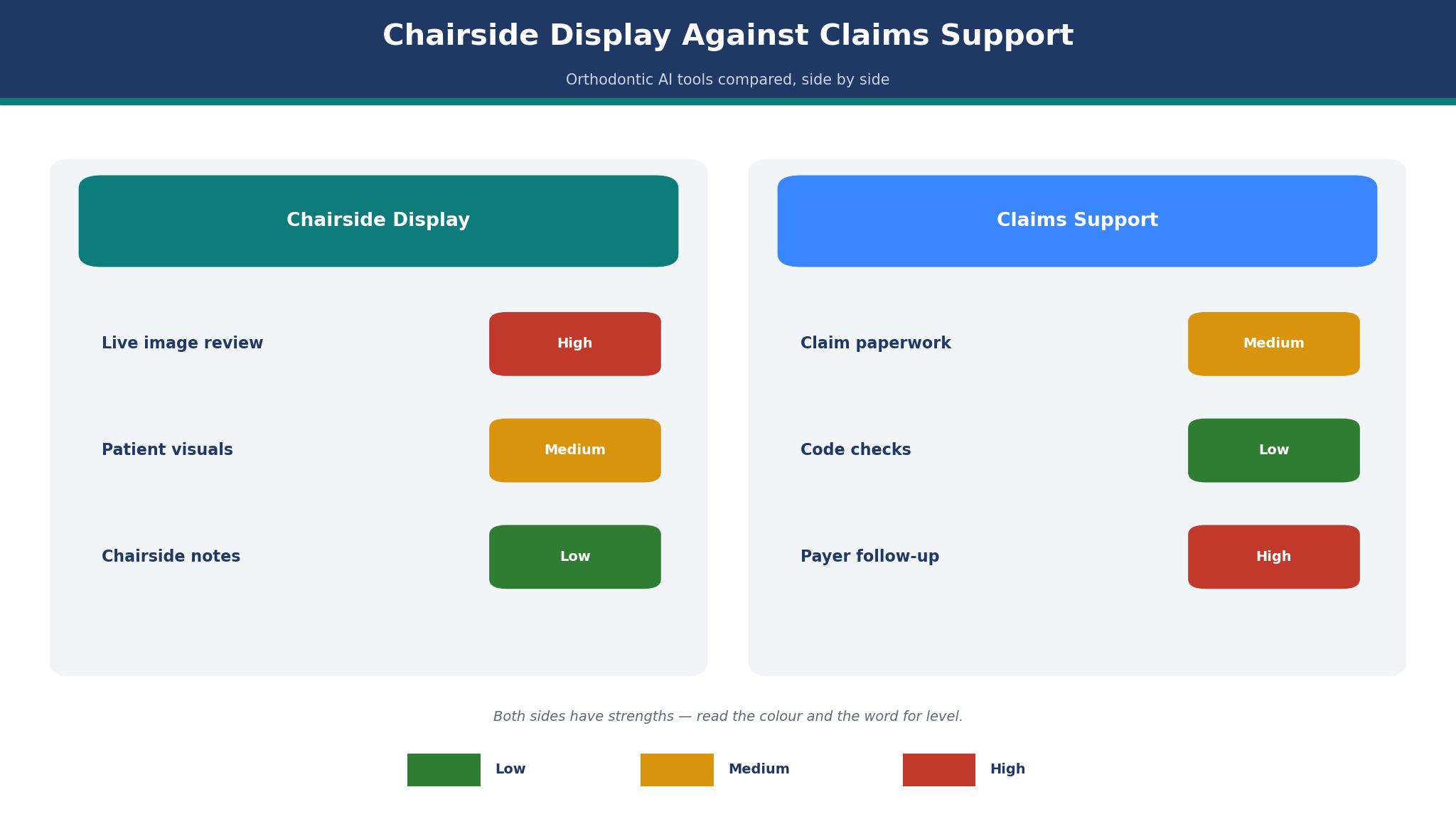
Pearl Second Opinion vs Overjet: Chairside Display Against Claims
Pearl Second Opinion wins on chairside display. It shows the patient the finding on their own X-ray during the same appointment, with clearance for both 2D and CBCT imagery, which is why practices report higher case acceptance. The trade is claims depth, since Pearl offers less payer ready documentation than Overjet, so a practice that fights denials will need more.
Overjet wins on claims and documentation. Its multiple FDA clearances cover caries, bone levels, charting and CBCT, and the quantified findings suit insurers, which is why groups with claim problems pick it. The trade is price and chairside focus, since Overjet is quote only with reports at 500 to 1,200 dollars a month, and the display is less patient facing than Pearl.
Pick Pearl when the practice needs patients to accept treatment after seeing their own scan, and pick Overjet when the practice needs claims paid and consistent reads across locations. Many practices end up with Pearl for the operatory and Overjet for the back office, and that split is the pairing the top 10 ai tools for orthodontists most often land on.
What does orthodontic AI cost a practice per year?
A practice should budget by location, not by user, since most imaging tools price per location. Pearl Second Opinion reported from 299 dollars a month per location costs about 3,588 dollars a year for one location, Denti.AI Detect at 49 dollars a month costs 588 dollars a year and Overjet reported from 500 dollars a month costs from 6,000 dollars a year. Those figures look far apart, but the value differs, since Pearl covers chairside display and CBCT while Denti.AI covers detection at the lowest price.
The second cost is the chair time the tool saves. A remote monitoring tool that cuts one in person visit per aligner patient saves the chair for a new patient, and a voice charting tool that saves five minutes per exam saves an hour a day across twelve patients. That maths is why the cheapest tool is not always the cheapest outcome, and why the top 10 ai tools for orthodontists are judged on chair time saved rather than on monthly price.
Budget for the location count first, then the modules, and ask each vendor for a written quote at the real location count before comparing. A tool that looks cheap for one location can be the most expensive for five, and a tool that looks pricey can be the cheapest when it frees a chair a day.
Can an orthodontist use AI without FDA clearance?
An orthodontist can use administrative AI without FDA clearance, but clinical AI that reads X-rays needs it. Front desk tools, voice charting and scheduling AI need no clearance, since they do not diagnose, while Pearl, Overjet, VideaHealth and Denti.AI Detect all hold FDA clearance for radiograph analysis. A practice should ask every imaging vendor for the current clearance list before buying, because the clearance is the line between a diagnostic aid and an unregulated claim.
The clearance does not replace the dentist. Every FDA clearance in this category covers detection assistance rather than diagnosis, and every finding still needs review and sign off by a licensed dentist, which is why the tools are sold as a second opinion rather than a verdict. A practice that lets AI diagnose without review is practising outside the clearance and outside safe care.
The smart path is to buy cleared tools for imaging and unregulated tools for admin, and to keep the dentist in the loop on every finding. A practice that follows that rule gets the efficiency of AI without the risk of an unreviewed diagnosis, and the clearance list is the document that proves which side of that line each tool stands on.
The First 30 Days of Orthodontic AI
Rolling out orthodontic AI works best as a single month rather than a big launch. Week one belongs to the clearance check, so confirm the FDA clearance list, check the integration with the imaging system and train the team on how to present the AI finding to patients. Week two belongs to the pilot, so run the tool on every patient for a week and compare the AI findings with the dentist own reads.
Week three belongs to the patient flow, so measure how long the AI adds to each appointment, count the acceptance rate against the previous month and fix any step that slows the chair. Week four belongs to the decision, so compare the acceptance lift and the chair time saved with the monthly price, and ask the team what slowed them down. A tool that adds minutes to every exam will show up in week three, while a clearance problem will show up in week one.
Keep the rollout to one month and one metric, which is case acceptance rate. A practice that measures that number will know within thirty days whether the AI earns its keep, and the acceptance lift is the proof that decides whether the top 10 ai tools for orthodontists earn a second month.

Frequently Asked Questions
Which AI tool is best for an orthodontist?
Pearl Second Opinion is the best pick for most orthodontists, because its FDA cleared X-ray analysis shows patients the finding chairside at a reported price from 299 dollars a month per location. Overjet is the second pick for practices whose biggest pain is insurance claims, while DentalMonitoring is the best pick for remote aligner checks.
How much does Pearl Second Opinion cost?
Pearl Second Opinion is reported from about 299 dollars a month per location, with quotes reported between 250 and 500 dollars and a setup fee of about 1,500 dollars. The full bundle with Practice Intelligence is reported at roughly 700 to 900 dollars a month, so the practice should ask for a written quote before budgeting.
Is Overjet FDA cleared?
Overjet holds multiple FDA clearances, including bone level detection cleared in May 2021 and caries detection cleared in March 2023, with further clearances covering charting, CBCT assistance and image enhancement. Every clearance covers detection assistance rather than diagnosis, and every finding still needs review by a licensed dentist.
Can AI monitor aligners from home?
DentalMonitoring and Grin both monitor aligners from home, with patients scanning their teeth on a phone and the orthodontist reviewing remotely. DentalMonitoring suits larger practices that want scale, while Grin adds a scope for higher quality scans, and both cut routine in person check visits when patients scan regularly.
What is the cheapest AI X-ray tool for a practice?
Denti.AI Detect is the cheapest published X-ray AI in this guide at a flat 49 dollars a month, with FDA clearance reported for detection and voice charting beside it. Pearl Second Opinion is reported from 299 dollars a month per location, while Overjet and VideaHealth are quote only and cost more.
Do AI findings replace the dentist diagnosis?
AI findings do not replace the dentist diagnosis, because every FDA clearance in this category covers detection assistance and every finding needs review and sign off by a licensed dentist. A practice that treats an AI flag as a diagnosis is practising outside the clearance, and the tools are sold as a second opinion rather than a verdict.
The Final Word for Orthodontists Who Want AI That Earns Its Keep
Pearl Second Opinion takes the top spot for most practices because it shows patients the finding on their own X-ray during the same visit, at a reported price from 299 dollars a month per location.
Overjet is the pick for claims, DentalMonitoring is the pick for remote monitoring and Denti.AI is the pick for a low published price. The top 10 ai tools for orthodontists are not the set with the most clearances, they are the set that saves chair time and helps patients say yes.
Choose by the job first, check the FDA clearance list and measure the acceptance rate in the trial month. A practice that picks this way will spend less time explaining treatment and more time delivering it to patients who already understand why they need it.