
Start with Mangomint if the clinic is past the solo stage and needs one predictable system for booking, charting and payments. That verdict is the starting point for this guide to best booking software for med spas, where the winner depends on provider count, location count and how much clinical documentation the booking tool must carry.
A med spa is not a salon with fancier services. Injectables, laser treatments and chemical peels carry consent forms, before and after photos, treatment notes and medical director sign off. A booking tool that cannot hold that record safely creates a second job for the front desk and a compliance risk for the owner. The tools below were judged on booking strength, clinical depth, payment cost and the real monthly bill at a realistic provider count.
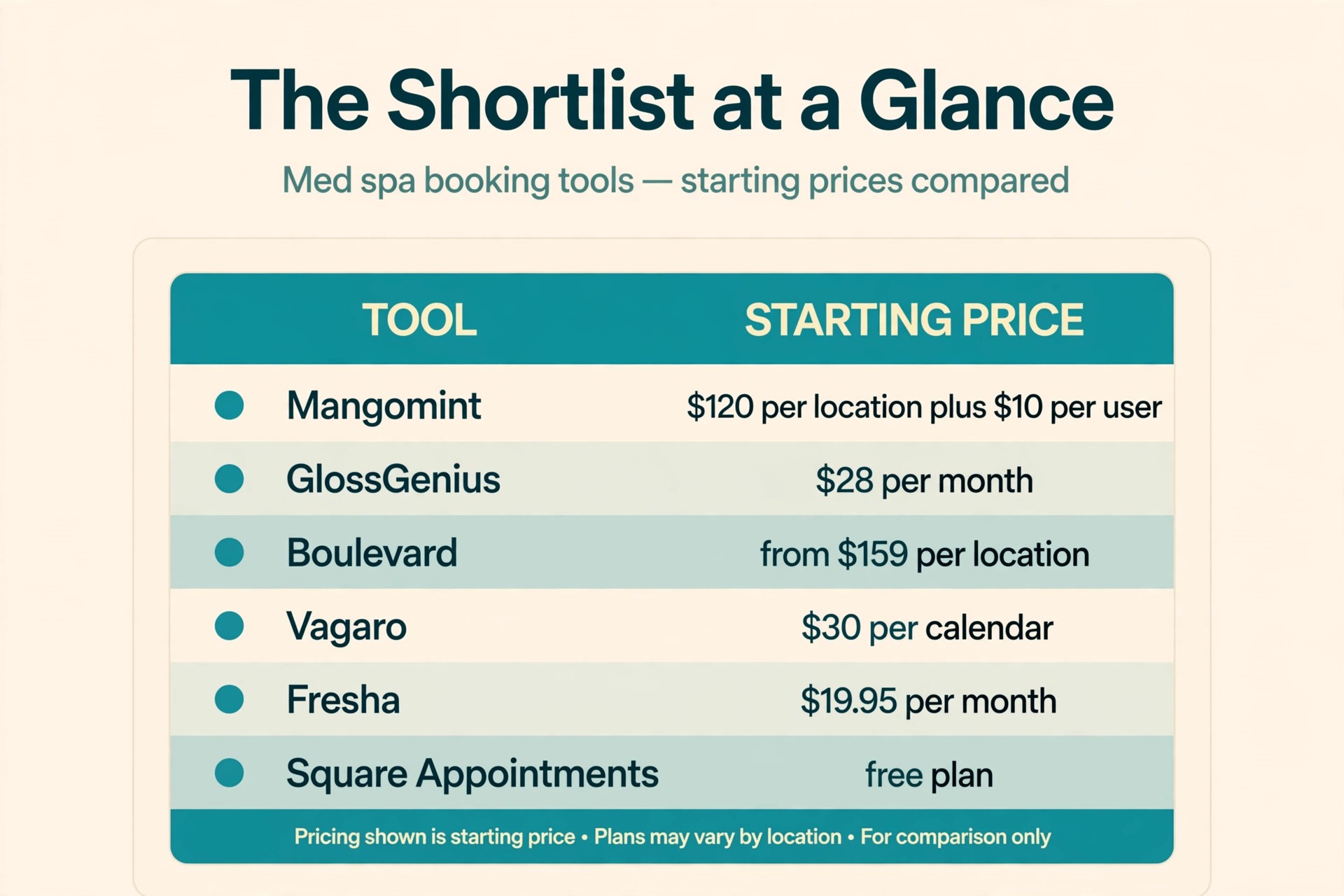
The Shortlist at a Glance
| Tool | Starting price | Best for |
|---|---|---|
| Mangomint | $120 a month per location plus $10 a month per user | mid size clinics wanting one simple price |
| GlossGenius | $28 a month, or $24 billed annually | solo providers and small teams |
| Boulevard | from $159 a month per location | premium client experience |
| Vagaro | $30 a month for one bookable calendar | value focused teams |
| Fresha | $19.95 a month for independent owners | budget starts with marketplace reach |
| Booksy | $29.99 a month plus $20 a month per extra team member | providers with an established book |
| Mindbody | from $99 a month per location | multi-location and class hybrid practices |
| Square Appointments | free plan, paid plans from $49 a month per location | clinics already on Square |
| Zenoti | priced by quote | large multi-location operations |
| Acuity Scheduling | from $16 a month | simple scheduling without the extras |
| DaySmart | from $29 a month | appointment heavy practices |
| Aesthetic Record | priced by quote | clinical depth first |
Read the table as a shortlist, not as a ranking. The cheapest tool may suit a solo injector perfectly, while the most expensive tool may be the only one that handles a specific clinical workflow. Use the table to pick three finalists, then read their full sections below before deciding.
Why the best booking software for med spas Is Not a Salon Scheduler
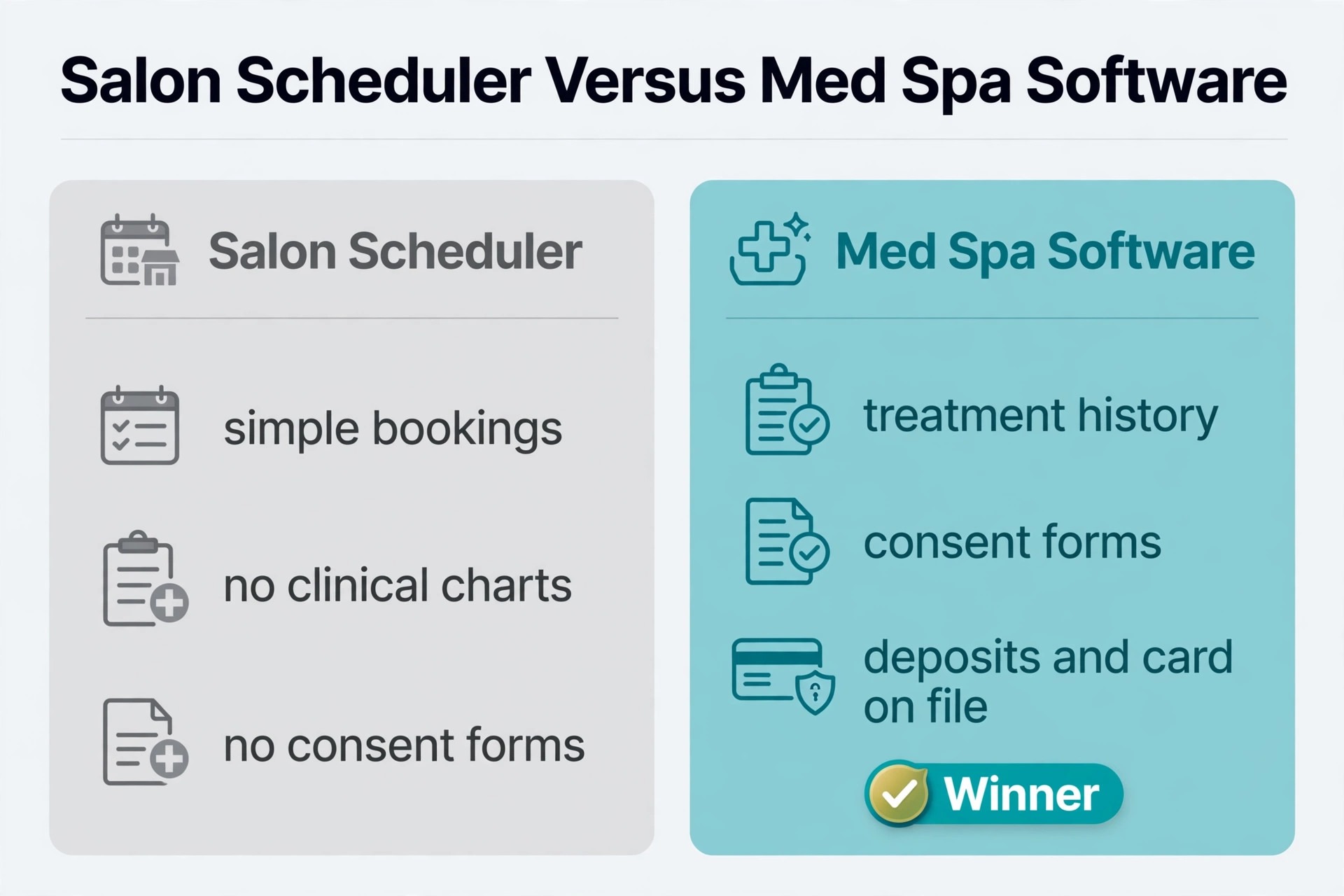
The gap starts with the client record. A salon booking holds a name, a service and a stylist. A med spa booking must hold a medical history, a consent form signed before treatment, photos that show change over time, and notes on units used or device settings. A tool without that depth forces staff to keep charts in a second system, and two systems always drift apart.
The second gap is compliance. Health information needs protection, and a signed business associate agreement is the floor, not a bonus. GlossGenius and Mangomint both offer HIPAA aligned handling with a signed agreement, while general schedulers without one should never hold health history or treatment notes. Check the agreement before the first real client record goes in, because moving charts later is painful.
The third gap is money. Med spa tickets are large, deposits matter, and no shows cost far more than a missed haircut. Card on file, deposits, cancellation policies and packages are not extras here. They are the difference between a full book and a calendar full of holes. A best booking software for med spas decision should weigh those money tools as heavily as the calendar itself.
Twelve Tools, Tested One by One
Mangomint
Mangomint is the pick for mid size clinics that want one simple price and a clean front desk. Since August 2026 it charges a single plan of $120 a month per location plus $10 a month per user, with forms, charting, memberships, express booking and HIPAA aligned handling included. Phone costs $70 a month per line, marketing starts at $30 a month, and payroll costs $50 a month plus $8 per worker. In person card processing runs 2.45 percent plus 15 cents, and virtual payments run 2.90 percent plus 30 cents.
The strength is the absence of tier games. Every clinic gets the same features, so the front desk never discovers that the tool it needs sits on a higher plan. The weakness is the per user charge, which grows with every provider and front desk login, and the lack of a public API or Zapier connection, which limits custom integrations.
Choose Mangomint if the clinic has two or more providers and wants charting included in the base price. Skip it if the clinic is solo and the per location base feels heavy for one chair.
GlossGenius
GlossGenius is the pick for solo providers and small teams that want a predictable bill and a polished booking page. Standard costs $28 a month, or $24 billed annually, and Gold costs $56 a month, or $48 billed annually, for teams up to 9 staff. Platinum costs $168 a month, or $148 billed annually, for teams of 10 or more. For aesthetics practices, Practice Essentials costs $168 a month, or $148 billed annually, and Practice Advanced costs $298 a month, or $248 billed annually, with a fuller clinical suite. Online invoicing runs 2.9 percent plus 30 cents, and instant payouts add a flat 1.8 percent fee.
The strength is simplicity with real clinical tools. SOAP notes, before and after photo reminders, custom forms and HIPAA aligned handling sit inside a system that a solo provider can set up in a day. The weakness is scale. Multi-location management is a separate conversation, and a group adding locations should confirm the multi-location price before committing.
Choose GlossGenius if the clinic is solo or small and wants the lowest friction start with clinical tools included. Skip it if the business is a multi-location group that needs enterprise reporting.
Boulevard
Boulevard is the pick for premium clinics where the client experience is part of the brand. It offers a modern booking flow, precision scheduling, client profiles, memberships and payments, with a polished interface that suits high end med spas. Essentials starts from $159 a month per location on monthly billing, with lower pricing on annual billing. Digital forms are a paid add on from $65 a month per location on lower tiers, while higher tiers include them.
The strength is the booking experience itself. Clients see a refined flow, providers see a precise schedule, and the front desk spends less time fixing bookings. The weakness is the add on structure. Med spa charting and forms cost extra on lower tiers, so the real bill for a clinical practice is higher than the headline plan price.
Choose Boulevard if the clinic competes on experience and can absorb the add on cost. Skip it if the budget is tight and charting must be included in the base price.
Vagaro
Vagaro is the pick for value focused teams that want a broad feature set at a low entry price. It starts at $30 a month for one bookable calendar, with $10 a month per additional calendar. That price covers online booking, a marketplace listing, payments, marketing tools and reporting, which is a wide net for the money.
The strength is the ceiling. Vagaro caps costs as calendars grow, and its marketplace brings discovery to clinics that still need new clients. The weakness is clinical depth. HIPAA aligned handling is limited compared with the med spa specialists, so a clinic storing detailed treatment records should verify exactly what is covered before relying on it.
Choose Vagaro if the clinic needs a low cost all rounder and clinical notes live elsewhere. Skip it if the booking tool must be the system of record for treatment charts.
Fresha
Fresha is the pick for budget starts that also want marketplace reach. The Independent plan costs $19.95 a month for one bookable team member, and the Team plan costs $14.95 a month per bookable team member. It offers unlimited bookings, automated reminders, intake and consent forms, before and after photos, and payments, with no minimum commitment and a 7 day team trial.
The strength is discovery. Fresha connects clinics to millions of marketplace searchers, which suits a new clinic building its book. The weakness is the marketplace fee. A one-time fee applies to new clients found through the marketplace, so a clinic that already fills its book from referrals pays for reach it does not need.
Choose Fresha if the clinic is new and needs clients more than it needs advanced operations. Skip it if the book is already full and the priority is clinical depth or multi-location control.
Booksy
Booksy is the pick for providers with an established book who want marketplace visibility plus booking. Booksy Biz costs $29.99 a month for a solo provider, with $20 a month per extra team member. It pairs a booking system with a consumer marketplace, client messaging, payments and marketing tools.
The strength is the existing client base. Providers who already have regulars can move them onto a booking flow they recognise, while the marketplace adds new faces. The weakness is clinical fit. Booksy is built for beauty bookings first, so consent forms, treatment notes and medical director workflows are thinner than on the med spa specialists.
Choose Booksy if the clinic leans beauty and the book is already strong. Skip it if injectables and laser work dominate and charts must live in the booking system.
Mindbody
Mindbody is the pick for multi-location practices and wellness hybrids that mix appointments with classes and memberships. Starter plans start from $99 a month per location, with higher tiers by quote. It brings a large consumer marketplace, class scheduling, memberships, payments and reporting in one system.
The strength is reach and breadth. A practice that runs classes alongside treatments, or operates several locations, gets one system for both, plus discovery through a marketplace and class booking apps. The weakness is price and complexity. Processing rates run higher than the low cost specialists, and the system carries features a pure med spa will never touch.
Choose Mindbody if the practice mixes classes, memberships and treatments across locations. Skip it if the clinic is a pure med spa that only needs appointments and charts.
Square Appointments
Square Appointments is the pick for clinics already running Square for payments or retail. The free plan covers online booking, calendar sync and email reminders, while paid plans start from $49 a month per location and add cancellation policies, no show fees, multi-staff booking, waitlists and resource management. Premium adds service cost tracking and future bookings reporting.
The strength is the free start and the payment ecosystem. A clinic already taking Square payments can add booking without a new vendor, and the free tier is genuinely usable for a solo provider. The weakness is clinical depth. Treatment notes, consent forms and HIPAA aligned handling are not its core, so a clinical practice will still need a second system for charts.
Choose Square Appointments if the clinic is small, budget conscious and already on Square. Skip it if the booking tool must hold the clinical record.
Zenoti
Zenoti is the pick for large multi-location operations that need enterprise controls. Pricing is by quote and scales with footprint, which suits groups rather than solo clinics. It covers booking, payments, memberships, inventory, marketing automation and deep analytics, with HIPAA aligned handling for clinical work.
The strength is scale. A group with ten locations gets consolidated reporting, centralised marketing and consistent workflows across sites, which small tools cannot match. The weakness is access. Quote only pricing, annual contracts and a heavier implementation make it a poor fit for a clinic that just needs booking and charts.
Choose Zenoti if the business is a group or a chain planning serious growth. Skip it if the clinic is small, because the cost and setup only make sense at scale.
Acuity Scheduling
Acuity Scheduling is the pick for simple scheduling without the extras. Plans start from $16 a month, and it covers calendar sync, custom booking pages, intake forms, reminders and payments through third party processors. It suits a clinic that already has a charting system and only needs a booking layer on top.
The strength is focus and price. It does one job well, stays cheap, and connects to the tools a clinic already uses. The weakness is everything else. There is no built in med spa charting, no membership engine and no marketplace, so a clinic expecting an all rounder will be disappointed.
Choose Acuity Scheduling if booking is the only gap and charts live elsewhere. Skip it if the clinic wants booking, charts and payments in one place.
DaySmart
DaySmart is the pick for appointment heavy practices that want strong scheduling at a fair price. Plans start from $29 a month, and it covers online booking, reminders, client records, payments and reporting, with versions tuned for salons, spas and med spas.
The strength is scheduling depth for the price. Recurring appointments, double booking rules and provider calendars all work without the premium price tag of the top tier tools. The weakness is brand polish and marketplace reach, which trail the bigger consumer platforms.
Choose DaySmart if the calendar is the bottleneck and the budget is mid range. Skip it if the clinic needs marketplace discovery or deep clinical charting.
Aesthetic Record
Aesthetic Record is the pick for clinical depth first. It is built around aesthetic medicine, with treatment records, consent forms, before and after photos, provider notes and compliance workflows at its core, and booking sits alongside the chart rather than apart from it. Pricing is by quote.
The strength is the chart. A clinic whose main risk is documentation quality gets a system designed for exactly that, with provider sign off and photo tracking built in. The weakness is breadth. Booking, marketing and payments are thinner than on the all round platforms, so a clinic may still need companion tools for growth.
Choose Aesthetic Record if clinical documentation is the top priority. Skip it if the clinic needs a full booking and marketing engine in one system.
The Right Tool for Each Clinic Shape
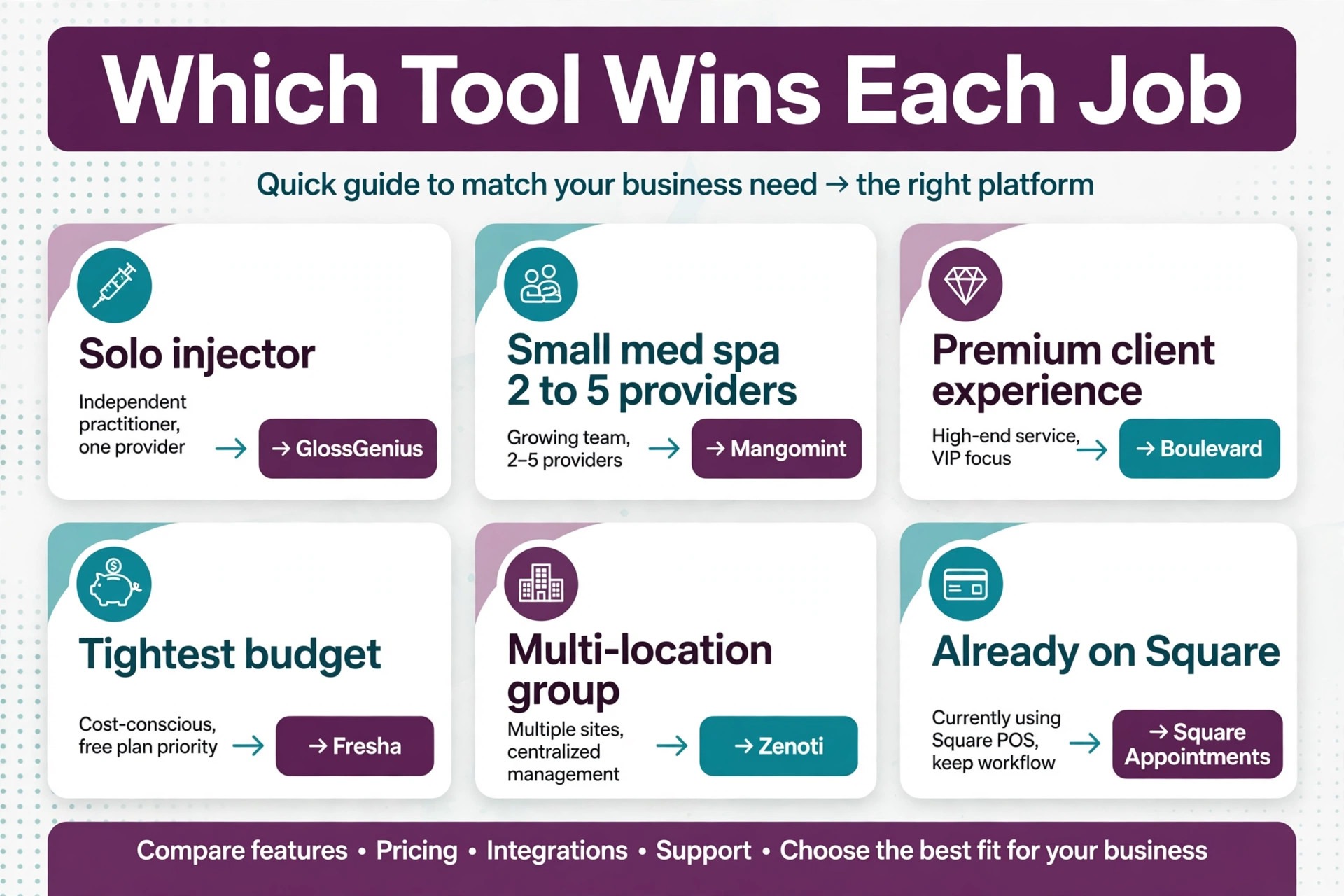
Use this table to match the tool to the job, because the best overall tool is not always the best tool for a specific business. The choice should follow the job that matters most to the clinic, whether that job is saving money, handling compliance, or covering several locations.
| Job | Best pick | Why it wins for that job |
|---|---|---|
| Solo injector | GlossGenius | Lowest friction start with clinical tools included |
| Small med spa, 2 to 5 providers | Mangomint | One price, charting included, clean front desk |
| Premium client experience | Boulevard | Most polished booking flow and client tools |
| Tightest budget | Fresha | Low entry price plus marketplace discovery |
| Multi-location group | Zenoti | Enterprise reporting and consistent workflows |
| Already on Square | Square Appointments | Free start inside a payment system the clinic already uses |
Per-User Versus Per-Location Pricing
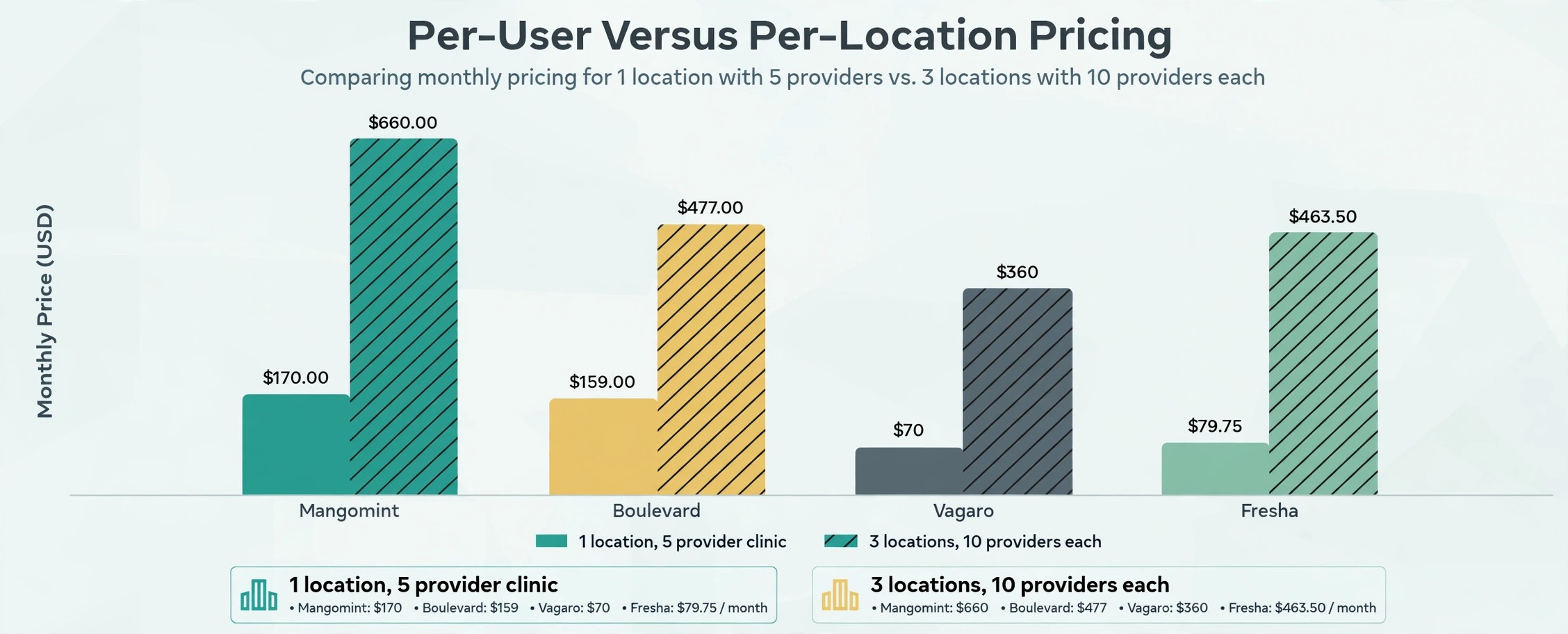
Med spa software bills in two different ways, and the difference decides the real monthly cost. Per-user pricing charges for every login, so the bill grows with every provider and front desk hire. Per-location pricing charges for each site, so adding providers costs nothing extra but adding a site costs a full plan. A best booking software for med spas comparison must model both, because the same clinic can pay very different totals on the two models.
| Setup | Mangomint per user plus per location | Boulevard per location | Vagaro per calendar | Fresha per team member |
|---|---|---|---|---|
| 1 location, 5 providers | $170 a month | $159 a month | $70 a month | $79.75 a month |
| 1 location, 10 providers | $220 a month | $159 a month | $120 a month | $154.50 a month |
| 3 locations, 5 providers each | $510 a month | $477 a month | $210 a month | $239.25 a month |
| 3 locations, 10 providers each | $660 a month | $477 a month | $360 a month | $463.50 a month |
The table leaves out add ons, so treat it as a floor, not a final bill. Boulevard forms add $65 a month per location on lower tiers, Mangomint phone adds $70 a month per line, and processing fees sit on top of every subscription. Model the cost at the provider count and location count you expect in twelve months, and add the add ons the clinic will actually use, before comparing headlines.
The Switch Checklist
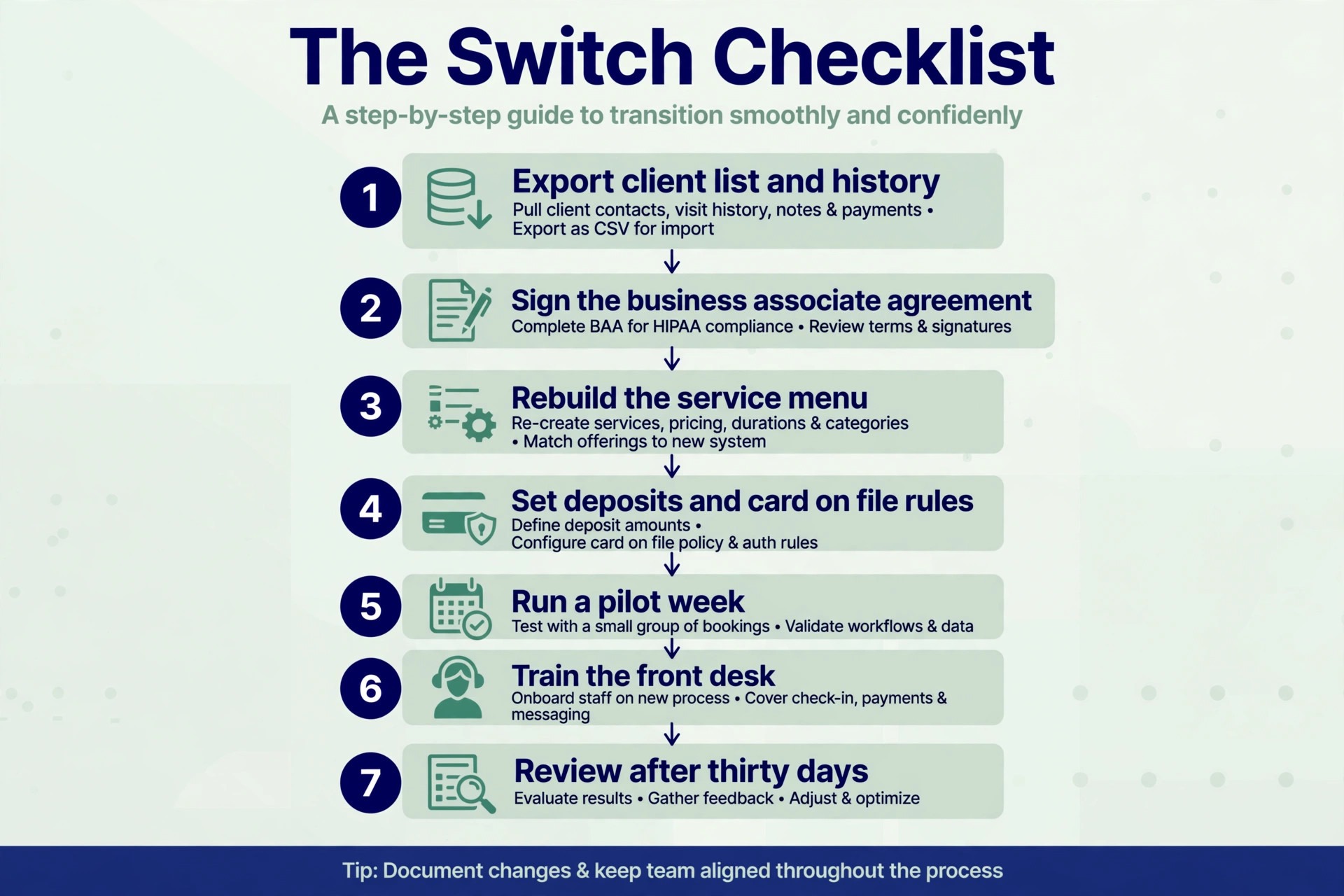
Switching booking tools fails most often from rushing the chart migration, not from choosing badly. A short, careful sequence protects the client list, the treatment history and the bookings that depend on the system every day.
1. Export the full client list, treatment history and consent forms, and confirm the new tool can import them intact. 2. Confirm the business associate agreement is signed before any health information moves. 3. Rebuild the service menu with correct durations, buffers, rooms and provider rules. 4. Set deposits, cancellation policies and card on file rules before opening online booking. 5. Run a pilot week with one provider and real clients, and check that reminders, forms and payments all fire correctly. 6. Train the front desk on three tasks only, then expand training once those habits feel automatic. 7. Review the bill, the no show rate and staff feedback after thirty days, and fix the setup before blaming the tool.
How to Run the Trial Week
A trial only helps if it mirrors real work. Book real clients through the new system for one provider, with real consent forms, real deposits and real reminders, and let the front desk run the whole week on it. A demo with test data hides the slow step, the confusing screen and the missing form, while a real week exposes all three before money changes hands.
Measure four numbers during that week. Count how many online bookings arrived without a phone call, how many reminders went out on time, how many deposits were collected automatically, and how many minutes the front desk spent fixing bookings. Those four numbers tell you more than any feature list, because they describe the actual job the tool will do every week for years.
Test the hard cases deliberately. Book a client who needs two providers in one visit, move a laser appointment that needs a room change, and process a cancellation inside the deposit window. If the tool handles those three cases cleanly, the ordinary days will take care of themselves. If it struggles, that struggle will repeat weekly.
Finally, ask the providers, not just the owner. A best booking software for med spas choice lives or dies on whether providers trust the calendar, because a provider who keeps a paper diary alongside the system creates double bookings. If providers say the calendar is clear and the charts are easy to find, the trial has passed. If they complain, believe them over the sales demo.
Mistakes That Cost Bookings
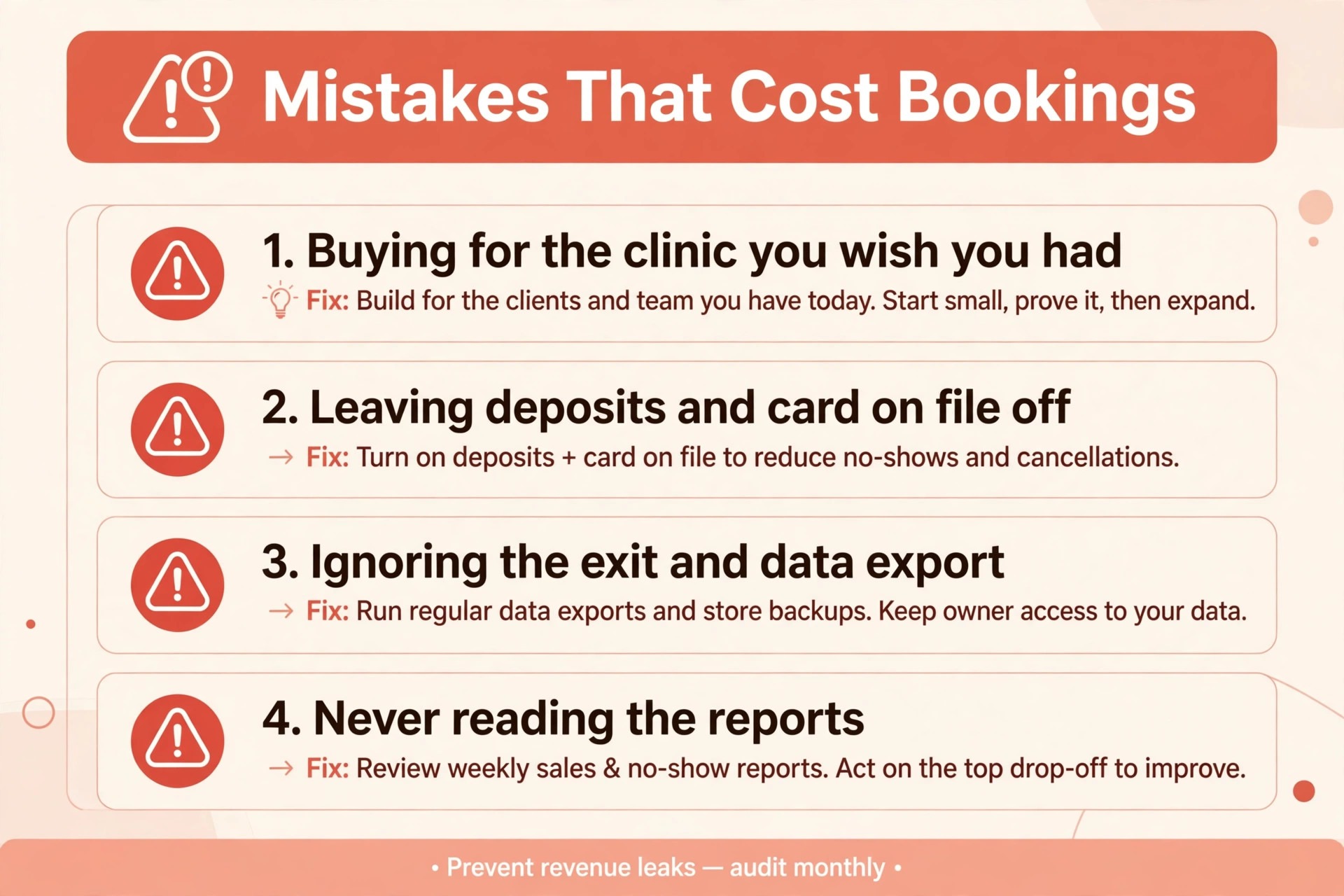
The most common mistake is buying for the clinic you wish you had, instead of the clinic you actually run. A solo injector does not need enterprise reporting, and a single location clinic does not need a multi-location dashboard. Buy for the next twelve months, not for a future that may never arrive, and upgrade when growth demands it.
The second mistake is leaving deposits and card on file off. Med spa no shows are expensive, and a booking tool without deposit rules invites them. Turn on deposits for high value treatments, require card on file for new clients, and set a cancellation window the front desk can actually enforce.
The third mistake is ignoring the exit. A tool that holds treatment records hostage, charges heavily to export, or breaks every integration on cancellation will cost far more at exit than it saved at entry. Export client and treatment data monthly, keep a copy outside the system, and know the cancellation terms before you sign.
The fourth mistake is never reading the reports. A booking tool records which services fill, which providers run full, and which hours sit empty, and that data should drive the price list and the rota. Check utilisation and rebooking rates monthly, move weak hours to promotions or training, and let the numbers, not habit, set the schedule.
The Verdict for Med Spas
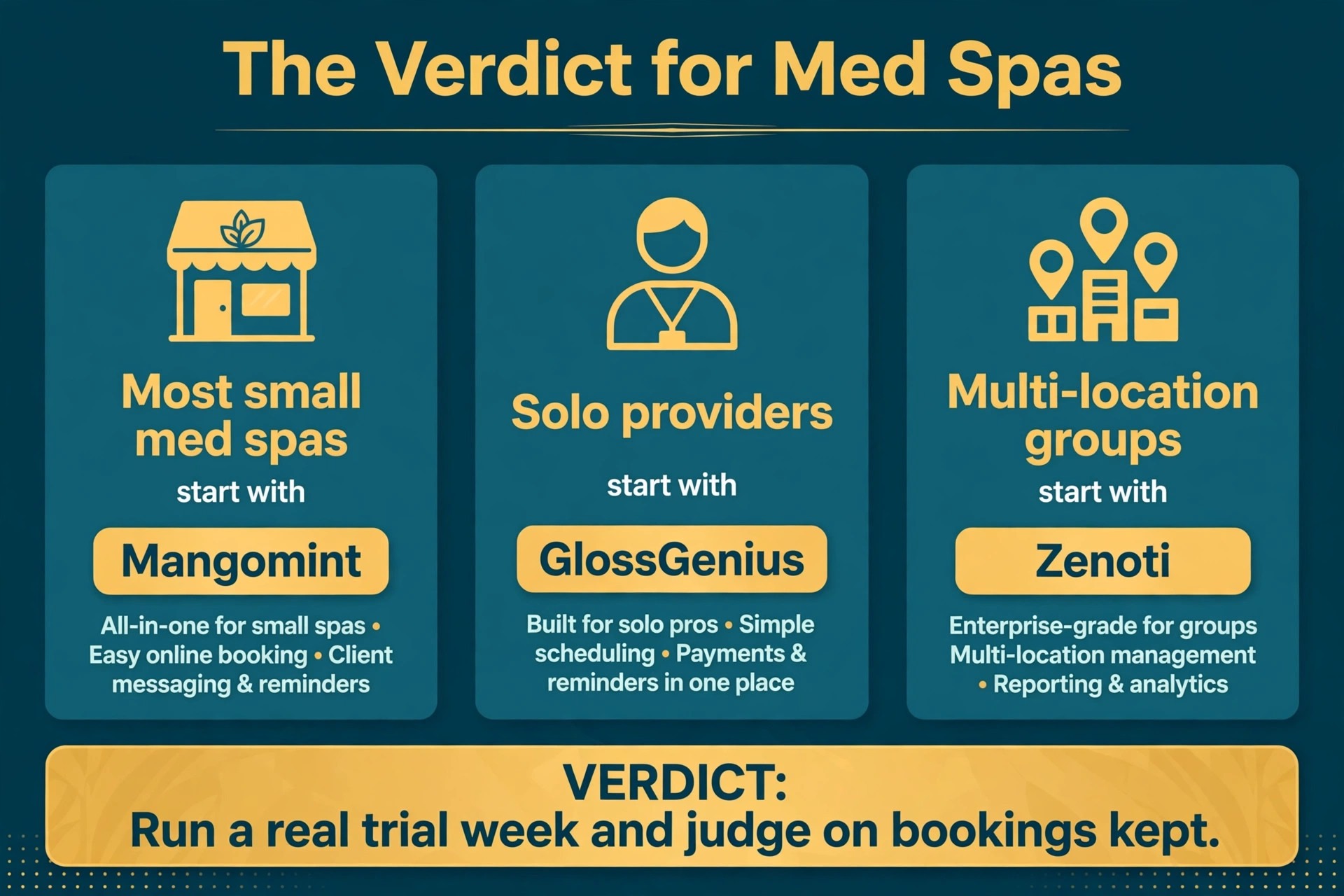
Start with the job, then the budget, then the trial. For most small med spas, Mangomint is the safest first trial, because it balances booking strength, clinical depth and a simple price better than the extremes. A solo provider should start with GlossGenius instead, and a multi-location group should start with Zenoti, because the best pick by job table above points to the tool built for that exact situation.
The best booking software for med spas decision does not need to be perfect, it needs to be tested. Run a real trial week, price the tool at next year’s provider and location count, and judge it on whether the front desk saves time and no shows fall. A tool that passes that test is worth keeping, even if a rival looks better on a pricing page, because daily work is the test that actually matters.
For a final check, compare the shortlist on price at your real size before you pay for a year, and confirm that deposits, forms and the business associate agreement all work in the trial. A shortlist built around best booking software for med spas should still be tested in a real trial week, because a pricing page cannot show how a tool feels in daily work. When the trial ends, judge the choice by bookings kept and charts completed, not by the length of the feature list.
More Reading on Stratilyze
Readers comparing tools usually check the neighbouring guides next. The guide to scheduling software for salons covers a closely related decision, the guide to setting up a small salon booking system explains the setup around it, and the guide to AI tools for nail salons helps with the wider beauty business around it.
Frequently Asked Questions
Does med spa software need to be HIPAA compliant
Yes, whenever it stores health information such as medical history, treatment notes or photos tied to a client record. Get a signed business associate agreement before entering real client data, and confirm the tool encrypts records and controls staff access. A general scheduler without an agreement should never hold health information.
How much should a small med spa pay for booking software
A solo provider can start near $20 to $30 a month. A clinic with five providers should expect roughly $70 to $225 a month before add ons and processing fees, depending on whether pricing is per user, per calendar or per location. A multi-location group will pay several hundred a month, and should price the tool at the full location count.
Should a med spa take deposits on bookings
Yes, for high value treatments such as injectables, laser sessions and peels. Deposits cut no shows sharply and protect provider time. Set the deposit as a share of the treatment price, state the cancellation window clearly at booking, and make sure the tool can charge card on file automatically when the window passes.
Can clients book without downloading an app
Yes, on most tools in this guide. GlossGenius, Fresha, Vagaro and Square all offer browser based booking with no app download required. Every extra step loses bookings, so test the booking flow on a phone before committing, and count the taps from landing page to confirmed appointment.
What happens to treatment records if I cancel
That depends on the tool, which is why export terms matter before you sign. Most tools allow a client and treatment export, but the format and completeness vary. Export records monthly, keep a copy outside the system, and test the export during the trial rather than discovering a problem on cancellation day.
Is a marketplace worth the commission
It is worth it when the clinic still needs new clients, because marketplace discovery fills chairs that referrals cannot. It is poor value when the book is already full, because the clinic pays for reach it does not need. Compare the marketplace fee against the cost of filling the same chair through ads or referrals, and switch the marketplace off once the book fills.