
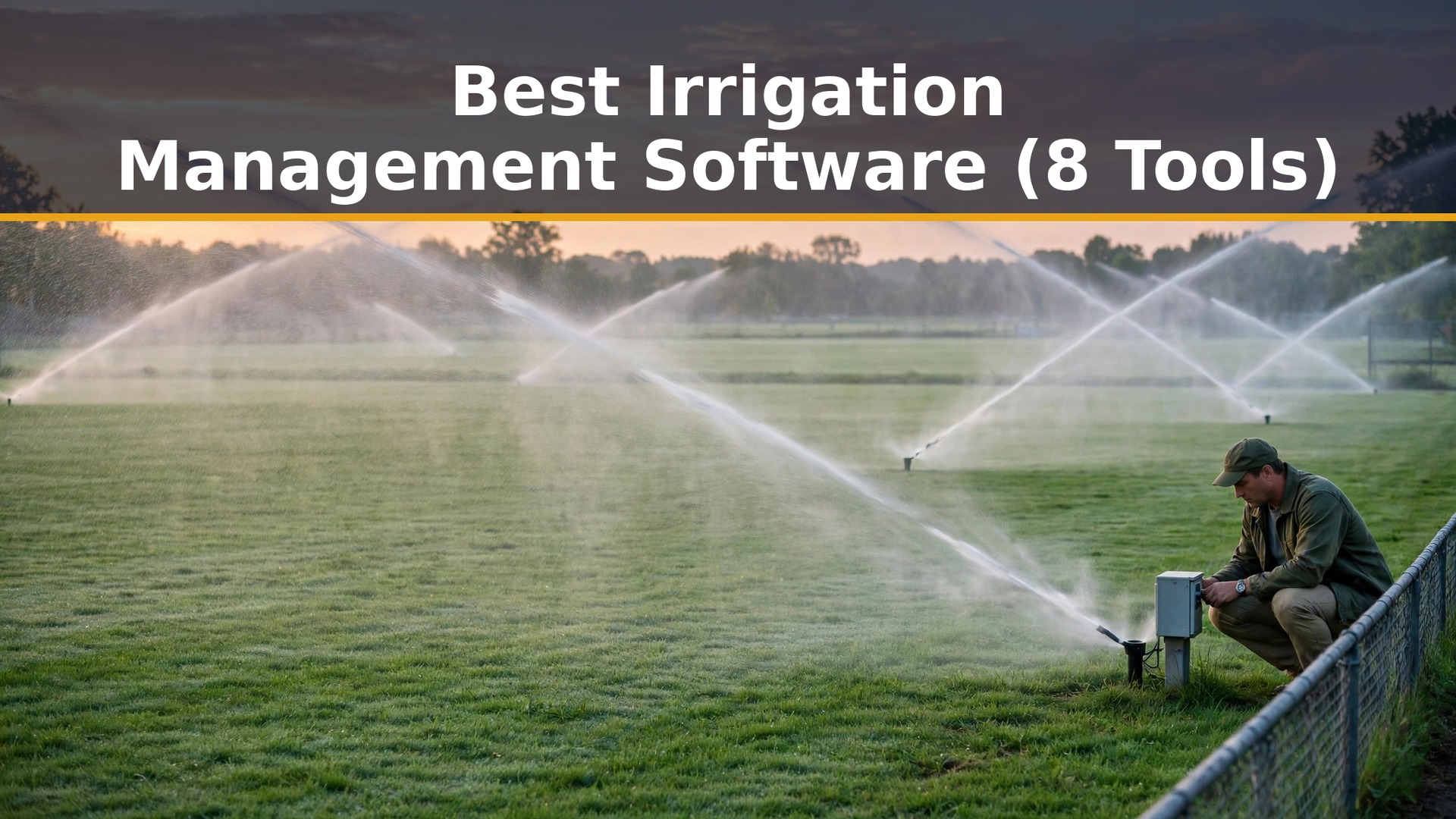
Week 1: we decided to leave the manual valves behind, and the best irrigation management software is the tool that makes that decision stick. The old system watered on a fixed timer, rain or shine, and the field showed it, with one zone drowned and another dried out. Rachio leads this list for a small field, because its app is the easiest to live with and its price starts near $200. HydroPoint leads for a large complex, because it controls many zones from one central system.
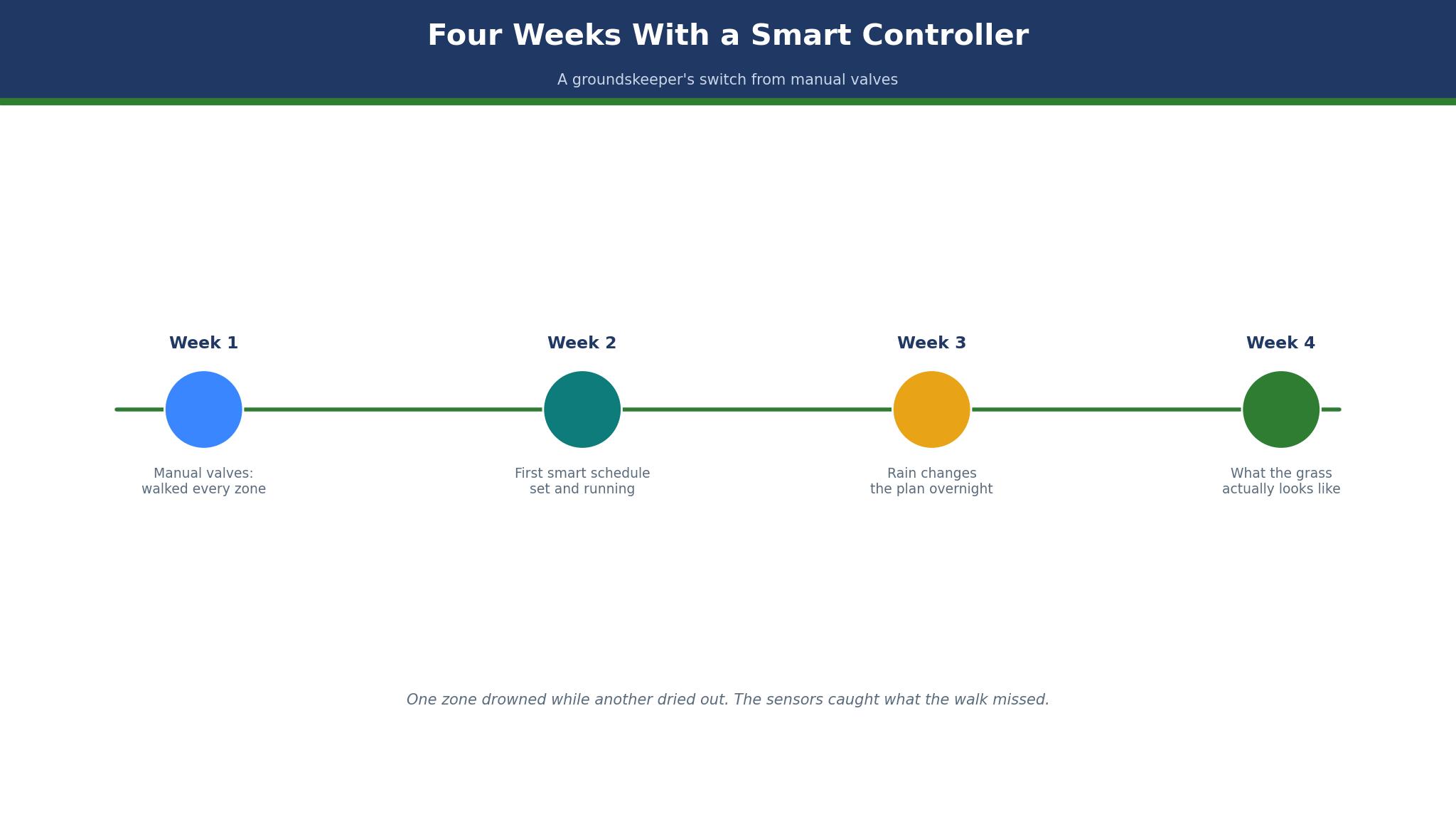
Four Weeks With a Smart Controller
The best irrigation management software proves itself over four weeks, not in a demo, so this guide follows a groundskeeper through a real switch. Week 1 brings the manual valves, Week 2 brings the first smart schedule, Week 3 brings the rain that changes everything, and Week 4 brings the grass itself, which is the only judge that matters.
| Week | What happened | What the software must do |
|---|---|---|
| Week 1 | The manual valves | Replace a fixed timer with a smart schedule |
| Week 2 | The first smart schedule | Water each zone by soil and sun, not by clock |
| Week 3 | The rain that changed everything | Skip the cycle and adjust the next one |
| Week 4 | What the grass looked like | Show even growth across every zone |
That month is the test. A controller that waters well in Week 2 and fails in Week 3, when the rain arrives, has not solved the problem, because the rain is the whole point of a smart controller. The groundskeeper who watches the grass in Week 4 knows which tool worked, and the diary below says how each one did.
The 8 Tools at a Glance
The table puts price and best job side by side for every controller, which lets a groundskeeper settle on two finalists quickly and read their detail before buying hardware.
| # | Tool | Starting price | Best for |
|---|---|---|---|
| 1 | Rachio | Rachio 3 from about $200 | Small fields and groundskeepers who want an easy app |
| 2 | HydroPoint | Quote-based, commercial pricing | Large sports fields and commercial sites |
| 3 | Hunter Hydrawise | Pro-HC from about $280 to $650 reported | Contractor-managed properties |
| 4 | Rain Bird | Controllers from about $150 reported | Sites that already run Rain Bird valves |
| 5 | Toro | Controllers from about $200 reported | Golf courses and large turf sites |
| 6 | Netafim | Quote-based | Drip irrigation for fields and crops |
| 7 | Weathermatic | Quote-based | Commercial sites that want smart controllers |
| 8 | Orbit B-hyve | From about $100 reported | Budget buyers who want smart scheduling |
How the Tools Compare on Price and Zones
Zone count is the hard limit in this market, and the best irrigation management software splits along it. Rachio tops out at 16 zones, Hunter reaches 24, and HydroPoint controls many more from one central system. The table that follows matches each price to the tool’s strongest feature and the limit that decides the buy.
| Tool | Price | Standout strength | Watch out |
|---|---|---|---|
| Rachio | Rachio 3 from about $200 | Best app, weather-aware scheduling and no monthly fee | Tops out at 16 zones |
| HydroPoint | Quote-based, commercial pricing | Commercial-grade weather-based irrigation with central control | Quote-based and built for professionals |
| Hunter Hydrawise | Pro-HC from about $280 to $650 reported | Professional hardware with predictive watering | Pro channel pricing varies by zone count |
| Rain Bird | Controllers from about $150 reported | Wide range, from homes to golf courses | Smart features vary by model |
| Toro | Controllers from about $200 reported | Commercial turf irrigation with strong sensors | Commercial models are quoted |
| Netafim | Quote-based | Drip expertise and precise water delivery | Drip-focused, not a sprinkler controller |
| Weathermatic | Quote-based | SmartLink controllers with remote management | Quote-based and pro-focused |
| Orbit B-hyve | From about $100 reported | Lowest price with weather-aware watering | App and build feel cheaper than Rachio |
Two figures in that table need a note. Rachio 3 is reported from about $200 for 8 zones, while some sources list $230 for the same model, so the figure is a range rather than a single price. Hunter Pro-HC is reported from about $280 to $650, depending on zones, because the pro channel prices by model and by installer.
Best Pick by Job
A small field needs a different controller from a large complex, and the best irrigation management software changes with that job. A small field needs a different controller from a large complex, and the rows below match the controller to the site rather than to the brand.
| Job | Pick | Why |
|---|---|---|
| Small field, easy app | Rachio | Best app and no monthly fee |
| Large sports complex | HydroPoint | Central control for many zones |
| Contractor-managed site | Hunter Hydrawise | Pro hardware and remote tools |
| Budget buyer | Orbit B-hyve | Lowest price with smart watering |
| Drip-fed beds | Netafim | Precise drip delivery |
| Golf course | Toro | Commercial turf irrigation |
How to Choose the Best Irrigation Management Software?
Start with the zone count. A site with fewer than 16 zones can use Rachio, a site with 20 to 24 zones needs Hunter, and a site with 40 zones needs HydroPoint or a commercial system. Count the zones first, and the shortlist shrinks fast, because the controller cannot grow past its limit.
Then check the flow sensing. A broken head at 2 a.m. can waste more water in one night than a smart schedule saves in a month, so a controller with flow monitoring pays for itself on the first break it catches. Worked example. A field that spends $1,000 a year on water and loses $200 in one night to a broken head has lost a fifth of its annual bill in eight hours. A flow sensor that costs $100 would have caught it, and the maths is that simple.
Check the rebate before you buy. Many water utilities offer $100 to $300 for a smart controller, which can cover a Rachio entirely in year one. Ask the utility, check the model list, and buy the controller that qualifies, because the rebate is the cheapest saving on this list.
What I would do is count the zones, check the rebate, and buy the controller that fits both. Then I would set the soil, the plant type and the sun exposure for each zone on day one, because the schedule is only as good as the data behind it. A controller with wrong zone data will water the wrong amount, however smart it claims to be.
The 8 Tools in Detail
The diary continues below, week by week, with each controller judged on the grass it produces rather than the features it lists, and the best irrigation management software is the one the grass approves in Week 4. Hardware prices move with retailers, so the figures below are November 2026 ranges, and the exact price should be checked at the till. Give the first two controllers a full read, and check the other six only if one of those two cannot cover your zones.
1. Rachio
Rachio 3 is the smart controller most groundskeepers meet first, because it replaces a fixed timer with weather-aware watering that skips rain and adjusts for heat. A controller costs from about $200 for 8 zones, with 4, 8 and 16-zone models, and the core smart watering carries no monthly fee. The app walks a new user through each zone, with soil type, plant type, sun exposure and nozzle type shaping the schedule.
Weather Intelligence Plus builds Flex Daily schedules that water only when the soil moisture model says a zone needs it, and the rain skip stops a cycle when rain is coming. A groundskeeper who has watered on a fixed timer for years will see the difference in the first dry week, because the controller stops watering a field that does not need it.
The limit is zone count. Rachio 3 tops out at 16 zones, which covers a small sports field and most residential systems, yet it cannot run a large multi-field complex without more than one controller. A groundskeeper with 24 zones should look at Hunter or HydroPoint instead, because the system should grow with the site, not against it.
Worked example. A small sports field that spends $800 a year on outdoor water and cuts use by 30% with weather-aware scheduling saves $240 a year, against a $200 controller that lasts years. A utility rebate of $100 to $300, which many water utilities offer, can cover the controller entirely in year one. The saving is real, yet it depends on the starting point, because a careful owner who already waters well will save less than a fixed timer that waters in the rain.
I would start here for a single field or a small complex, because the app is the easiest to live with and the price is the lowest honest one on this list. Rachio wins on the day-to-day experience, and it loses only when the site outgrows 16 zones. Buy the zone count the site needs today, and check the rebate before paying full price.
2. HydroPoint
HydroPoint, through its WeatherTRAK system, is commercial irrigation built for sports fields, parks and large sites. It calculates watering from local weather station data and evapotranspiration, and it controls many zones from one central system, with flow monitoring that can catch a broken head. A grounds team that manages several fields can run them all from one dashboard.
The commercial grade is the reason to pick it and the reason to skip it. HydroPoint suits a site with many zones, a professional installer and a budget for a quoted system, while a small field will find it heavy and expensive. Pricing is quoted, so a buyer should ask for the full figure, including the controller, the sensors and the installation, before comparing it with a $200 Rachio.
Worked example. A sports complex with 40 zones that spends $5,000 a year on water and cuts use by 20% saves $1,000 a year, against a commercial system that can cost several thousand dollars installed. The saving grows with the site, because the water bill is larger and the zones are more numerous. A single field will not see that return, while a complex will.
Pick HydroPoint when the site is large enough to need central control, flow monitoring and professional support. It is the right tool for a sports field that must stay playable through a dry summer, and the wrong tool for a home lawn. The vs section below says the same thing in more detail, because the choice between Rachio and HydroPoint is the choice between a small site and a large one.
3. Hunter Hydrawise
Hunter Hydrawise, through the Pro-HC and HPC controllers, is professional irrigation with predictive watering based on evapotranspiration from local weather stations. A contractor can manage many properties remotely, with alerts for flow, faults and wiring problems. The Pro-HC costs from about $280 to $650 reported, depending on zones, with 6 to 24 zones and an HCC model that expands further.
The pro channel is the trade-off. Hydrawise is sold and installed through contractors, so a buyer gets professional installation and remote management, yet pays a pro price for it. The core predictive watering carries no subscription, while the hardware costs more than a Rachio, and the difference is the build quality and the remote tools.
Worked example. A property with 20 zones on a Pro-HC at about $500 pays more than twice a Rachio 3 at $200, yet gains four more zones, flow sensing and contractor remote access. If the flow sensor catches one broken head at 2 a.m., the water saved can exceed the price gap in a single night. That is the number that justifies the pro hardware.
The honest comparison is Rachio for the owner who installs it themselves, and Hydrawise for the owner who hires a contractor. Both water well, and the difference is who holds the spanner. A groundskeeper who manages the site daily should take Hydrawise, because the remote tools and the flow alerts earn their keep.
4. Rain Bird
Rain Bird makes irrigation controllers from small residential timers to large commercial systems, with smart features on its Wi-Fi models. A site that already runs Rain Bird valves and heads can add a smart controller without changing the rest of the system, which is a real saving. Controllers are reported from about $150, with commercial models costing far more.
The range is also the confusion. Rain Bird sells many models, and the smart features vary between them, so a buyer should check the exact model rather than the brand. A residential controller and a golf course controller share a name and little else, and the price gap between them is large.
Worked example. A site that replaces a fixed timer with a Rain Bird smart controller at about $200 and cuts water use by 20% on an $800 annual bill saves $160 a year, which pays for the controller in 15 months. The saving is the same shape as Rachio, and the choice between them turns on which valves the site already runs and which app the groundskeeper prefers.
5. Toro
Toro builds irrigation for golf courses, sports fields and large turf sites, with controllers, sensors and central control that manage many zones. A golf course that waters fairways, greens and roughs differently needs a system that treats each area as its own zone, and Toro is made for that. Residential controllers are reported from about $200, while commercial models are quoted.
The golf focus is the limit for a small site. Toro suits a large turf site with a professional team, and it overwhelms a small sports field that only needs 12 zones. A buyer should ask whether the site has enough turf to need a golf-grade system, because the platform rewards scale and punishes simplicity.
The sensor tools deserve a closer look. Toro pairs its controllers with soil sensors and weather stations, so the watering follows the ground rather than the calendar. A site that has lost turf to overwatering will feel the difference, because the sensor stops the cycle before the damage, not after it.
6. Netafim
Netafim is a drip irrigation company, and its systems deliver water precisely to the roots, which suits fields, crops and landscaped beds far better than sprinklers. A sports field with drip-fed borders or a training ground with planted areas can water the plants without watering the paths. Pricing is quoted, because the system is designed per site.
The drip focus is also the limit. Netafim does not replace a sprinkler controller for a grass field, and a buyer who needs both should plan for two systems. It suits a site where drip is the main method, and it is less suited to a site that is mostly turf.
Worked example. A landscaped area that uses sprinklers and wastes 30% of its water on paths can cut that waste with drip, and the saving on a $1,000 annual water bill is $300 a year. The drip system costs more to install than a sprinkler timer, yet it pays back on the water it does not waste. A groundskeeper should count the paths, not just the plants, before deciding.
7. Weathermatic
Q. What does Weathermatic actually sell? A. SmartLink controllers that a contractor can manage remotely, with weather-based scheduling and flow monitoring for commercial sites. Q. Who should buy it? A. A commercial site with many zones and a contractor who manages it. Q. What is the catch? A. Pricing is quoted and the system is pro-focused, so a home owner or a small field will find it heavy.
Weathermatic sits between Rachio and HydroPoint, with more zones than Rachio and less scale than a full commercial system. A site with 20 to 30 zones and a contractor on call will find it a natural fit, while a site with 8 zones will not. The remote management is the feature that matters, because the contractor can fix a schedule without visiting the site.
8. Orbit B-hyve
Orbit B-hyve is the cheapest smart controller on this list, reported from about $100 for an 8-zone model, with weather-aware watering and voice control. A budget buyer who wants to stop watering in the rain can do it for half the price of a Rachio, and the WeatherSense system adjusts the schedule from local forecasts.
The price shows in the app and the build. B-hyve works, yet it feels cheaper than Rachio, and the app is less polished. A buyer who values the daily experience should pay the extra $100 for Rachio, while a buyer who values the price should take B-hyve and spend the saving on a flow sensor.
Worked example. A home lawn that spends $400 a year on water and cuts use by 20% saves $80 a year, against a $100 controller that pays for itself in 15 months. The maths is the same as Rachio, and the difference is the experience, not the saving. B-hyve is the honest budget pick, and it earns that place on price alone.
Rachio vs HydroPoint: Which One Waters a Sports Field Better?
Rachio and HydroPoint answer different questions, and the head-to-head turns on the size of the field. Rachio wins for a small field, because its app is the easiest to live with, its price starts near $200, and its weather-aware scheduling needs no professional installer. HydroPoint wins for a large sports field, because it controls many zones from one central system, with flow monitoring and commercial-grade hardware.
The zone count decides it. Rachio tops out at 16 zones, while HydroPoint suits a complex with 40 zones or more, and a field that needs 24 zones sits between them. The best irrigation management software is not the one with the best app, it is the one that covers the site, and a controller that cannot reach every zone cannot water the field.
The honest trade-off is ease against scale. Rachio is easy to install, easy to use and cheap to buy, while HydroPoint is powerful, centralised and expensive to install. A groundskeeper with one field should take Rachio, and a grounds team with a complex should take HydroPoint. A field in between should take Hunter Hydrawise, which reaches 24 zones with pro hardware.
Worked example. A small field that spends $800 a year on water and cuts use by 30% with Rachio saves $240 a year, against a $200 controller. A complex that spends $5,000 a year and cuts use by 20% with HydroPoint saves $1,000 a year, against a commercial system costing several thousand dollars installed. The saving grows with the site, and the right tool grows with it.
The Zone That Drowned While Another Dried Out
One zone drowned while another dried out, and the best irrigation management software exists to prevent exactly that. A fixed timer waters every zone the same way, yet the zones are not the same, because one sits in full sun on sandy soil and another sits in shade on clay. The first needs more water, the second needs less, and the timer gives them both the same.
The fix is zone data. A smart controller should know the soil type, the plant type, the sun exposure and the nozzle type for each zone, and it should water each one differently. Rachio asks for all four during setup, Hunter uses predictive watering by zone, and HydroPoint calculates by weather station and zone. A controller that treats every zone the same is a timer with an app, not a smart system.
Worked example. A field with 12 zones, where four sit in full sun and eight sit in shade, wastes water on the shaded zones and starves the sunny ones when it waters them equally. A smart schedule that gives the sunny zones 30% more water and the shaded zones 30% less can cut total use by 15% while improving the grass in both. The saving is in the difference, and the difference is the point of the software.

Can a Smart Controller Really Save 30% of Your Water?
Yes, against a bad fixed timer, and no, against a careful owner who already waters well. The honest range is 30% to 50% against a timer that waters in the rain, and 10% to 20% against an owner who watches the weather and adjusts by hand. A controller cannot fix bad hydraulics, broken heads or zones that were designed wrong, and a buyer who expects it to will be disappointed.
The test is the starting point. A site that waters on a fixed timer, rain or shine, will save the most, while a site that already skips rain days will save less. Check the rebate, count the zones, and set the zone data properly, because those three steps decide the saving more than the brand on the controller.
Worked example. A field that spends $1,200 a year on water and cuts use by 25% saves $300 a year, against a $200 Rachio that lasts five years or more. The controller pays for itself in eight months, and the saving continues for years after. A field that spends $400 a year and cuts use by 10% saves $40 a year, against a $100 B-hyve that pays for itself in 30 months. The saving is real in both cases, yet the payback time is very different, and a buyer should run the numbers on their own bill before choosing.
Frequently Asked Questions
Rachio or HydroPoint — which waters a sports field better?
HydroPoint waters a large sports field better, because it controls many zones from one central system with flow monitoring and commercial hardware. Rachio waters a small field better, because its app is easier and its price starts near $200. Count the zones first, and the answer follows, because Rachio tops out at 16 zones.
How many zones do I need for a sports field?
A small field needs 8 to 16 zones, a large field needs 24 or more, and a complex needs a central system that can control 40 or more. Count the zones on the site before buying, because the controller cannot grow past its limit. Rachio covers up to 16, Hunter up to 24, and HydroPoint covers a complex.
Do smart controllers need a monthly subscription?
No, Rachio and Hunter Hydrawise offer core smart watering with no monthly fee, while Rachio offers an optional premium tier reported at about $49 a year. Check the current terms before buying, because subscription packaging changes, and the core features should work without a fee.
Can I get a rebate for a smart controller?
Yes, many water utilities offer $100 to $300 for a smart controller, which can cover a Rachio entirely in year one. Check the utility’s model list before buying, because the rebate depends on the exact model, and the programme changes often.
What happens when a sprinkler head breaks?
A controller with flow sensing catches the break, alerts the groundskeeper and stops the zone, while a controller without it can waste water all night. Flow sensing deserves priority over small differences in the watering algorithm, because one caught break can pay for the system.
Can I install a smart controller myself?
Yes, Rachio is designed for a homeowner or groundskeeper to install in an afternoon using the existing valve wiring. Hunter and HydroPoint are usually installed by a contractor, because the hardware and the zone count are larger. Check the wiring and the Wi-Fi signal near the controller before buying.
The Field That Waters Itself
Rachio is the pick for a small field, HydroPoint is the pick for a large complex, and Hunter Hydrawise is the pick for a contractor-managed site in between. Orbit B-hyve wins for a budget buyer, and Netafim wins for drip-fed beds. The best irrigation management software is the controller that covers every zone, knows the soil in each one, and skips the rain without being asked.
What I would do is count the zones, check the rebate, and buy the controller that fits both. Then I would set the zone data on day one, run the system for four weeks, and judge it on the grass in Week 4, because the grass is the only judge that matters.