

A 12-person agency pays $43,200 a year for one policy system and $3,600 a year for another, and the best policy administration software is the tool that justifies the gap. Applied Epic leads this list, because it is the standard that large agencies, carriers and buyers all know. Vertafore AMS360 leads for a mid-size agency in the Vertafore world, because its accounting and its ecosystem are the strongest at its price.
The First-Year Bill at a 12-Person Agency
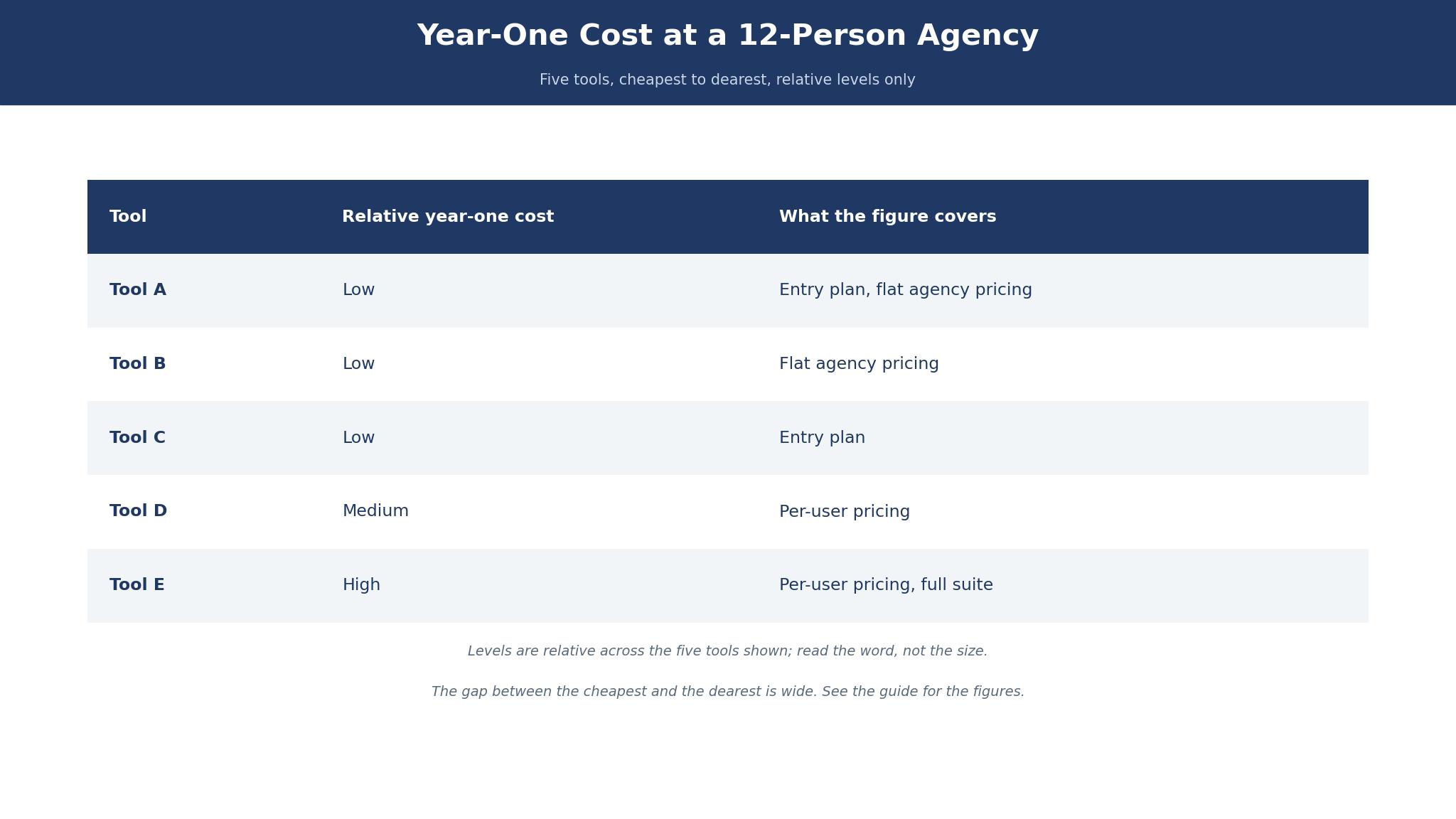
The best policy administration software costs very different amounts at the same size, so this guide opens with the bill. The table below shows the year-one cost for five tools at a 12-person agency, using the published or reported figures from November 2026, and the gap between the cheapest and the dearest is more than $40,000.
| Tool | Year-one cost at 12 users | What the figure covers |
|---|---|---|
| HawkSoft | About $3,600 | Flat agency pricing, reported $300 a month |
| EZLynx | About $4,200 | Entry plan, reported $350 a month |
| NowCerts | About $1,188 | Entry plan, reported $99 a month |
| Vertafore AMS360 | About $14,256 | Reported $99 a user a month |
| Applied Epic | About $28,800 | Reported $200 a user a month |
That table is the whole guide in miniature. NowCerts is the cheapest, HawkSoft is the cheapest honest agency system, AMS360 sits in the middle, and Epic is the dearest. The dearest is not the worst, and the cheapest is not the best, because the agency that buys the cheapest system and outgrows it in a year will pay twice. Read the bill, then read the detail, and buy the system the agency will still use in three years.
The 10 Tools at a Glance
The rows show what each system costs to start and what it does best, so an agency can settle on two finalists and read their detail before asking for a written quote.
| # | Tool | Starting price | Best for |
|---|---|---|---|
| 1 | Applied Epic | Quote-based, reported from about $200 a user a month | Large agencies with deep commercial lines |
| 2 | Vertafore AMS360 | Quote-based, reported from about $99 a user a month | Mid-size agencies in the Vertafore world |
| 3 | Guidewire PolicyCenter | Quote-based, implementations reported from $500,000 | Carriers that need a core policy platform |
| 4 | Duck Creek | Quote-based, consumption-based reported | Carriers that want cloud-native policy tools |
| 5 | HawkSoft | From about $200 to $350 a month reported, flat agency pricing | Independent agencies that want simple pricing |
| 6 | EZLynx | From about $350 a month reported | Startup and growth agencies |
| 7 | NowCerts | From about $99 a month reported | Small agencies that want a low entry price |
| 8 | Jenesis | Quote-based | Agencies that want a modern cloud system |
| 9 | QQCatalyst | Quote-based, Vertafore platform | Mid-market agencies in the Vertafore world |
| 10 | Majesco Policy | Quote-based, from about $100,000 a year reported | Carriers that want a modern core platform |
What Each Policy System Costs and Where It Falls Short
Price is the hardest part of this market, because the best policy administration software rarely publishes a price. Applied Epic and AMS360 are both quoted, and only HawkSoft, EZLynx and NowCerts publish a clear figure. The table that follows pairs each price with the strongest feature and the flaw an agency should verify.
| Tool | Price | Standout strength | Watch out |
|---|---|---|---|
| Applied Epic | Quote-based, reported from about $200 a user a month | Industry standard with deep carrier connectivity | Quote-based, with implementation reported at $50,000 or more |
| Vertafore AMS360 | Quote-based, reported from about $99 a user a month | Strong accounting and the wider Vertafore ecosystem | Quote-based and the interface feels dated to some |
| Guidewire PolicyCenter | Quote-based, implementations reported from $500,000 | Policy administration for more than 570 insurers | Carrier software, not agency software |
| Duck Creek | Quote-based, consumption-based reported | Cloud-native policy, billing and claims | Quote-based and carrier-only |
| HawkSoft | From about $200 to $350 a month reported, flat agency pricing | Flat agency pricing and a system built for independents | Less depth than Epic on large commercial lines |
| EZLynx | From about $350 a month reported | Rating, policy management and client tools in one | Price rises with the agency |
| NowCerts | From about $99 a month reported | Low price with policy and certificate tools | Lighter than Epic or AMS360 |
| Jenesis | Quote-based | Cloud-native agency management | Quote-based and smaller than the big names |
| QQCatalyst | Quote-based, Vertafore platform | Vertafore ecosystem at a mid-market price | Absorbed into Vertafore, check the current name |
| Majesco Policy | Quote-based, from about $100,000 a year reported | Cloud policy platform with strong configuration | Quote-based and carrier-only |
Two figures in that table need a note. AMS360 is reported from about $99 a user a month by one source, while other reports put it at $200 to $450 a user a month, so the figure is reported as a range and an agency should get a written quote. Applied Epic is reported from about $200 a user a month, with implementation reported at $50,000 to $150,000, so the first year costs far more than the subscription alone.
Best Pick by Job
A large agency needs a different system from a small one, and the best policy administration software changes with that job. A large agency needs a different system from a small one, and the rows below match the system to the agency rather than to the vendor.
| Job | Pick | Why |
|---|---|---|
| Large agency, commercial lines | Applied Epic | Industry standard and carrier connectivity |
| Mid-size agency, Vertafore shop | Vertafore AMS360 | Accounting and the Vertafore ecosystem |
| Small agency, flat price | HawkSoft | Flat agency pricing |
| Startup agency | EZLynx | Rating and retention together |
| Small agency, lowest price | NowCerts | Low entry price |
| Carrier, core platform | Guidewire PolicyCenter | Policy for more than 570 insurers |
How to Choose the Best Policy Administration Software?
Start with the seat. An agency should pick from Epic, AMS360, HawkSoft, EZLynx and NowCerts, while a carrier should pick from Guidewire, Duck Creek and Majesco. The seat decides the shortlist before any feature does, because the two kinds of software do different jobs.
Then count the cost at your size, not at the vendor’s example size. Worked example. A 12-person agency at a reported $200 a user a month pays $28,800 a year for Epic, against $3,600 a year for HawkSoft at a reported $300 a month flat. The $25,200 gap buys a lot of training, yet it only matters if Epic does a job HawkSoft cannot, because the cheaper system that frustrates the team costs more in lost hours than the dearer one that works.
Check the carrier downloads before you buy. An agency that writes with ten carriers needs downloads from all ten, and a system that covers eight of them will leave the team retyping the other two. Ask for the carrier list in writing, and test the download on your largest carrier during the trial.
What I would do is pick the system that matches my size, test the largest account on a trial, and budget the implementation as well as the subscription. The subscription is the price you see, and the implementation is the price you pay, so an agency that budgets only the first will be surprised by the second.
The 10 Tools in Detail
The detail works through the bill in order, judging each system on cost, carrier downloads and the renewal flow, and the best policy administration software is the one the agency will still use in three years. Most of these systems are quoted rather than priced, so the figures below are reported ranges and the quote is the number that matters. Read the first two systems in full, and use the remaining eight to check the job that matches your agency.
1. Applied Epic
Applied Epic is the agency management system that large agencies standardise on, with policy management, accounting, reporting and carrier connectivity in one platform. An agency can manage a commercial account, download carrier data, run its accounts and report on the book without leaving the system. Pricing is quoted, with third-party reports putting it from about $200 a user a month, and implementation reported at $50,000 to $150,000 for a large migration.
The carrier connectivity is the reason to pick it. Applied connects an agency to its markets, exchanges policy data and retrieves carrier information inside the workflow, which saves the retyping that kills a busy agency. The trade-off is the learning curve, because Epic is deep, and a new user needs training before the depth helps rather than hinders.
Worked example. A 12-person agency at a reported $200 a user a month pays $2,400 a month, or $28,800 a year, before implementation. If the carrier downloads save each user two hours a week, at $40 an hour, the saving is $49,920 a year, which covers the subscription and leaves money over. The saving only appears when the team actually uses the downloads, so training is part of the price.
I would pick Epic for a mid-size to large agency with complex commercial lines, because it is the standard that carriers, staff and buyers all know. I would not buy it for a small personal-lines shop, because the price and the implementation assume a large agency. The decision is about size, and Epic is the answer when the agency is large enough to need it.
2. Vertafore AMS360
Vertafore AMS360 is the agency management system at the centre of the Vertafore ecosystem, which runs on 98 of the top 100 agencies and 96 of the top 100 carriers. An agency gets policy management, accounting, workflows and reporting, with links to Vertafore rating and other Vertafore tools. Pricing is quoted, with third-party reports putting it from about $99 a user a month, while other reports put it at $200 to $450 a user a month, so the figure is reported as a range.
The accounting module is the strongest part. AMS360 handles agency accounting natively, which matters for an agency that lives on commissions and carrier statements. The drawback is the interface, which some agencies find dated next to cloud-native tools, and the cloud migration that has run for several years.
Worked example. A 12-person agency at a reported $99 a user a month pays $1,188 a month, or $14,256 a year, against $28,800 a year for Applied Epic at $200 a user. The $14,544 gap is real, yet it only matters if AMS360 does the job the agency needs, because the cheaper system that frustrates the team costs more in lost hours than the dearer one that works.
Pick AMS360 when the agency already runs Vertafore tools, because the ecosystem is the product. A Vertafore shop gets rating, benefits and agency management that share data, while a shop outside Vertafore gets a solid system without the ecosystem advantage. The vs section below calls the head-to-head in detail.
3. Guidewire PolicyCenter
Guidewire PolicyCenter is part of InsuranceSuite, and it runs policy administration, claims and billing for more than 570 insurers. A carrier can quote, bind, endorse and renew a policy on one cloud platform, with rating and regulatory filing built in. Pricing is quoted, with third-party reports putting enterprise implementations from $500,000 to $5 million or more.
The carrier focus is the point to understand. Guidewire is not agency software, and an independent agency should not buy it as an agency management system. It suits a carrier that needs a core platform, and it is the wrong tool for an agency that needs to manage clients and commissions.
Worked example. A carrier that moves 100,000 policies a year onto Guidewire pays a large implementation figure, yet gains a single policy record that serves underwriting, billing and claims together. The saving is in the errors avoided and the time saved on each policy, which adds up across a hundred thousand policies. An agency with 5,000 policies will not see that return.
4. Duck Creek
Duck Creek offers cloud-native policy administration, billing and claims for carriers, with consumption-based pricing reported by third parties. A carrier can start with one line of business and expand, paying for what it uses rather than for a fixed licence. The platform suits a carrier that wants modern cloud tools without a legacy migration.
The carrier focus is the same limit as Guidewire. Duck Creek serves insurers, not agencies, so an agency that buys it as a management system will be disappointed. A carrier should compare Duck Creek with Guidewire on the lines it writes, and an agency should look at Epic, AMS360 or HawkSoft instead.
The consumption model deserves a closer look. A carrier that pays by use can start small and grow, yet it should forecast the consumption carefully, because a busy month can cost more than a fixed licence. Ask for a forecast based on real policy volumes before signing, and check the minimums in the contract.
5. HawkSoft
HawkSoft serves independent agencies, with policy management, client records and carrier downloads at a flat agency price reported from about $200 to $350 a month. An agency pays for the agency, not per user, which makes the bill predictable as the team grows. That flat model is the reason small and mid-size agencies pick it.
The depth is the trade-off. HawkSoft handles personal and small commercial lines well, yet it offers less depth than Epic on large commercial accounts. An agency that writes complex commercial business will feel the limit, while an agency that writes personal lines will find it enough.
Worked example. A 12-person agency on HawkSoft at a reported $300 a month pays $3,600 a year, against $28,800 a year for Applied Epic at $200 a user. The $25,200 gap is the largest on this list, and it is the reason a small agency should start here. The saving only matters if HawkSoft does the job, so a commercial agency should test its largest account on a trial before deciding.
6. EZLynx
EZLynx combines rating, policy management, client communication and retention tools for startup and growth agencies. An agency can quote, bind and manage a policy, then follow up with the client, without leaving the system. Entry pricing is reported from about $350 a month, with higher tiers for larger agencies.
The growth focus is the strength and the limit. EZLynx suits an agency that is growing fast and needs rating and retention together, while a large agency with complex commercial lines will need more depth. A buyer should ask which features sit on the higher tiers, because the entry price is not the whole story.
Worked example. A five-person agency on EZLynx at $350 a month pays $4,200 a year, or $840 per person. If the retention tools save ten clients a year, each worth $1,000 in commission, the saving is $10,000, which covers the subscription twice over. Retention is the number that pays for EZLynx, and an agency that never reads it is paying for a feature it does not use.
7. NowCerts
NowCerts offers policy management, certificates and client tools for small agencies at a reported $99 a month. An agency that needs to issue certificates fast and manage policies without a large system will find it enough, and the price is the lowest honest one on this list for a full agency system.
The lighter feature set is the trade-off. NowCerts does the basics well, yet it lacks the depth of Epic or AMS360 on accounting and commercial lines. A small agency will be happy, while a growing agency should check whether the system will still fit in two years, because a move later costs more than a better choice now.
8. Jenesis
Jenesis is a cloud-native agency management system with policy, client and commission tools, built for agencies that want a modern interface without a legacy migration. An agency can run it from any browser, with no server to maintain, and the setup is faster than a legacy system.
The smaller name is the trade-off. Jenesis offers fewer integrations than Epic or AMS360, so an agency should check the carrier downloads and the accounting links before switching. A small agency that values a modern interface will be happy, while an agency that needs the widest carrier network should stay with a bigger name.
9. QQCatalyst
Q. Is QQCatalyst still sold? A. It is now absorbed into Vertafore, so a buyer should check the current name and the current platform before budgeting, because the product may be sold under a Vertafore label. Q. Who should consider it? A. A mid-market agency that wants the Vertafore ecosystem at a lower entry point than AMS360. Q. What is the catch? A. Pricing is quoted, and the absorption means the roadmap may change, so ask the vendor what the platform will be called in two years.
QQCatalyst is the mid-market entry to Vertafore, and that is its place. An agency that cannot justify AMS360 can start here and move up, while an agency that needs AMS360 depth should go straight there. The name change is a warning to confirm the product before paying, not a reason to dismiss it.
10. Majesco Policy
- A cloud policy platform for carriers, with configuration tools that let a carrier shape products without code.
- A reported entry from about $100,000 a year, which puts it firmly in carrier territory rather than agency territory.
- Strong rating and underwriting tools, which suit a carrier that writes many lines.
- A carrier-only focus, so an agency should not buy it as a management system.
- A modern interface that feels newer than some legacy core systems, yet still needs a proper implementation.
Majesco is the last tool in the list, and it earns its place as a carrier alternative to Guidewire and Duck Creek. A carrier should compare all three on the lines it writes, while an agency should ignore all three and pick from the agency tools above. The seat decides the buy, and the carrier seat is not the agency seat.
Applied Epic vs Vertafore: Which One Fits an Agency?
Applied Epic and Vertafore AMS360 answer different questions, and the head-to-head turns on the size of the agency and the ecosystem it already runs. Epic wins on depth and on carrier connectivity, because it is the standard that large agencies standardise on, with the deepest commercial lines tools. AMS360 wins on accounting and on the Vertafore ecosystem, because its native accounting and its links to Vertafore rating suit a mid-size agency that already runs Vertafore tools.
The price maths splits the same way. A 12-person agency at a reported $200 a user a month pays $28,800 a year for Epic, against $14,256 a year for AMS360 at a reported $99 a user, a gap of $14,544. The best policy administration software is not the cheapest, it is the one whose price matches the agency’s real work, and Epic earns its higher price when the agency writes complex commercial business that AMS360 handles less deeply.
The honest trade-off is depth against ecosystem. Epic does commercial lines better, while AMS360 does accounting and Vertafore integration better. An agency that writes large commercial accounts should take Epic, and an agency that already runs Vertafore rating should take AMS360. An agency that needs both should run Epic for the commercial book and keep AMS360 for the personal lines, rather than forcing one system to do both perfectly.
Worked example. A 12-person agency that writes $2 million in commission a year pays 1.4% of commission for Epic at $28,800, against 0.7% for AMS360 at $14,256. The difference is 0.7% of commission, which is small next to the cost of a missed renewal or a lost carrier download. The fee is not the decision, the work is, and the agency should count the work before it counts the money.
What Happens When a Policy Renews Itself?
A policy that renews itself without anyone checking is the quietest risk in an agency, and the best policy administration software exists to catch it. A policy can renew at the wrong rate, with the wrong cover, or with a client who has moved, and the agency will not know until the claim arrives. The renewal is the moment the system should ask a question, not the moment it should stay silent.
The fix is a renewal workflow that starts 90 days before the date, with a task for the account manager, a check of the cover and a call to the client. Epic and AMS360 both offer renewal workflows, while the smaller tools offer alerts that are lighter. An agency should test the renewal flow during the trial, and check that the task lands with the person who owns the account, not in an inbox nobody reads.
The renewal is also where the client relationship is won or lost. A client who hears from their agent before the renewal, with a clear explanation of what changed and why, will stay, while a client who first learns of a change from a bill will shop around. The system should prompt that call, and the agent should make it, because the call is the service the client actually pays for.
Worked example. An agency with 1,000 policies that renews 5% of them at the wrong rate, with an average error of $200, loses $10,000 a year in corrections and goodwill. A renewal workflow that catches half of those errors saves $5,000, which pays for a year of EZLynx and leaves money over. The renewal is not admin, it is revenue protection, and the system either helps or it does not.

Frequently Asked Questions
Is Guidewire agency management software?
No, Guidewire is carrier software that runs policy, billing and claims for more than 570 insurers. An independent agency should not buy it as an agency management system, and should choose Applied Epic, AMS360, HawkSoft or EZLynx instead. Guidewire is the platform the agency’s carrier partners run on.
How much does policy administration software cost per user?
Applied Epic is reported from about $200 a user a month, Vertafore AMS360 from about $99 a user a month by one source and $200 to $450 by others, and HawkSoft from about $200 to $350 a month flat for the agency. A 12-person agency pays about $28,800 a year for Epic, $14,256 for AMS360 at $99 a user, and $3,600 for HawkSoft. Get a written quote before budgeting.
How long does it take an agency to move to a new policy system?
HawkSoft, EZLynx and NowCerts can run in weeks, while Applied Epic and AMS360 need three to six months for implementation, training and data migration. Guidewire and Duck Creek need months or longer. Budget the implementation time as well as the price, and start with a pilot book before moving the whole agency.
Do I need carrier downloads?
Yes, an agency that writes with ten carriers needs downloads from all ten, because retyping policy data is slow and error-prone. Applied Epic has the deepest carrier connectivity, while AMS360 and HawkSoft cover the carriers most independent agencies use. Ask for the carrier list in writing before buying.
Can a small agency afford Applied Epic?
A small agency can afford Epic only if it writes enough commercial business to need its depth, because the price and the implementation assume a large agency. A small personal-lines agency should take HawkSoft or EZLynx, which cost a fraction of Epic and do the job better at that size.
What happens when a policy renews at the wrong rate?
The agency must correct it, tell the client, and absorb the difference or the goodwill cost. A renewal workflow that starts 90 days before the date prevents most errors, because the account manager checks the cover before the renewal, not after the claim.
The System the Agency Still Uses in Three Years
Applied Epic is the pick for a large agency with complex commercial lines, Vertafore AMS360 is the pick for a mid-size agency in the Vertafore world, and HawkSoft is the pick for a small agency that wants a flat price. EZLynx wins for a startup agency, and Guidewire wins for a carrier that needs a core platform. The best policy administration software is the system the agency will still use in three years, with a bill it can explain and a renewal flow it can trust.
What I would do is pick the system that matches my size, test the largest account on a trial, and budget the implementation as well as the subscription. The subscription is the price you see, and the implementation is the price you pay, so an agency that budgets only the first will be surprised by the second, and the surprise is the most expensive part of the whole purchase.