

The best paypal alternatives split into two jobs, and the right pick depends on which job you are paying for. Stripe takes the top spot for online checkout at 2.9 percent plus 30 cents per domestic card payment with no monthly fee, while Wise is the cheapest way to receive money across borders at the mid-market rate. A seller who mixes the two jobs up pays the wrong fee on every sale.
PayPal earned its place because almost every buyer already has an account, and that familiarity still closes sales. The cost shows up quietly, in the 3.49 percent plus 49 cents charged on invoiced payments and the 3 to 4 percent currency conversion spread on international money. A freelancer who invoices 2,000 dollars a month loses about 70 dollars to the invoice fee alone, then more on every foreign payment.
Switching away is not a single decision. A store needs a checkout that buyers trust, a freelancer needs a payout route that keeps the most money, and a marketplace seller often has no choice at all because the platform picks the payout method. This guide compares ten options on the fee you actually pay, the job each one does best, and the limit that should stop you from choosing it.
The 10 Tools at a Glance
PayPal charges 3.49 percent plus 49 cents on invoiced payments, so the table below starts from that baseline. Every fee is a US list rate checked in November 2026, and card rates vary by country, card type and volume, so confirm the current figure on the provider page before you move your income.
| Tool | Main job | Best for | Starting price |
|---|---|---|---|
| Stripe | Online checkout | Online stores and SaaS teams | 2.9% + 30 cents per domestic card, no monthly fee |
| Wise | Cross border transfers | Freelancers paid abroad | From 0.24% per transfer, reported as 0.33% by some guides |
| Square | In person and online sales | Shops and service businesses | 2.6% + 15 cents in person, 3.3% + 30 cents online, no monthly fee |
| Payoneer | Marketplace payouts | Freelancers on marketplaces | Free to receive, withdrawal 1% to 2% |
| Skrill | Digital wallet transfers | People who need a wallet | 1.45% per transaction |
| Adyen | Enterprise payments | High volume multi country businesses | Quote, reported as interchange plus 0.60% plus 13 cents |
| Braintree | Online checkout with PayPal | Stores that want PayPal and cards | 2.59% + 49 cents per transaction |
| Helcim | Card processing | US and Canadian sellers | Interchange plus, from about 1.92% plus 8 cents reported |
| Paddle | SaaS billing | Software teams selling worldwide | 5% + 50 cents per transaction |
| Zelle | Bank to bank payments in the US | US sellers paid directly | Free |
Best Pick by Job
| Job type | First pick | Second tool | Why this pair works |
|---|---|---|---|
| Online checkout | Stripe | Braintree | Stripe leads on developer tools and Braintree adds PayPal and Venmo in the same checkout |
| Cross border pay | Wise | Payoneer | Wise leads on the exchange rate and Payoneer covers marketplaces that only pay through it |
| In person sales | Square | Stripe | Square leads on counter hardware and Stripe adds online checkout when the shop goes digital |
| SaaS billing worldwide | Paddle | Stripe | Paddle leads on tax handling and Stripe adds lower card fees for domestic sales |
| Free bank transfer in the US | Zelle | Wise | Zelle leads on zero fees inside the US and Wise adds the cross border route |
The best paypal alternatives that fit a store are not the ones that fit a freelancer, and the table above keeps the two jobs apart. A store that takes cards needs a processor, a freelancer who gets paid by transfer needs a payout route, and a business that does both needs two tools rather than one compromise. The best paypal alternatives in this guide are ranked by the fee on the job they actually do.
Volume changes the answer fast. A seller taking 500 dollars a month barely notices a half point difference, while a seller taking 50,000 dollars a month loses 250 dollars a month to the same half point. Run your last three months of sales through the fee table in the cost section before you switch, because the cheapest headline rate is not always the cheapest bill.
Which PayPal alternative is best for online sellers?
For most online sellers the answer is Stripe, because the 2.9 percent plus 30 cents domestic card rate undercuts PayPal checkout at 3.49 percent plus 49 cents, and the checkout, subscriptions and payment links all live in one account. Stripe also settles in two days for most US sellers and adds ACH at 0.8 percent capped at 5 dollars, which suits larger invoices. The best paypal alternatives that win on price still need a checkout buyers trust, and Stripe is now familiar enough that most buyers do not hesitate.
Braintree is the closer pick when PayPal itself must stay on the page. It takes cards, PayPal, Venmo and wallets through one integration at 2.59 percent plus 49 cents, so a store keeps the PayPal button without paying PayPal rates on every card. The rate is higher than Stripe on small tickets, so a store with a low average order should price both before choosing.
Square fits sellers who also meet customers in person. The free plan charges 2.6 percent plus 15 cents at the counter and 3.3 percent plus 30 cents online, with hardware, appointments and an online store in the same account. A shop that sells mostly online should not pick Square for the counter rate alone, because the online rate is the one that will dominate the bill.

How to Choose the Best Best Paypal Alternatives
Answer four questions before you pick, because the best paypal alternatives that look cheapest on a comparison page can cost the most on your actual sales. Write down how you get paid, where your buyers live, your average sale size and your monthly volume, then match the tool to those four numbers.
How do you get paid today. Card checkout, bank transfer, marketplace payout or cash at the counter each point to a different tool, and a processor cannot fix a payout problem.
Where do your buyers live. US only sales favour Stripe or Square, while cross border income favours Wise or Payoneer, because the conversion spread matters more than the headline fee.
What is your average sale. A 10 dollar sale loses a bigger share to the fixed 30 to 49 cent fee than a 200 dollar sale does, so low ticket sellers should favour low fixed fees.
How much do you sell each month. At 500 dollars a month any tool works, at 50,000 dollars a month a half point difference is 250 dollars, and at that point a quoted rate from Adyen or Helcim is worth the call.
The 10 Tools in Detail
The ten tools below are ordered by the job they do best, starting with online checkout and ending with free bank transfers. Prices are US list rates from November 2026.
1. Stripe
Stripe handles checkout, subscriptions and payment links that fit a website or app. 2.9% + 30 cents per domestic card, no monthly fee.
The trade off with Stripe is international cards add 1.5 percent and currency conversion adds 1 percent, so cross border sales cost more.
If you are online stores and SaaS teams that want developer tools, Stripe is a sensible shortlist entry.
Open a Stripe account free and run a test payment before moving any live sales.
Before paying for Stripe, run one real job through checkout, subscriptions and payment links that fit a website or app and check the result against the old way of working.
The value of Stripe at 2.9% + 30 cents per domestic card, no monthly fee depends on whether international cards add 1.5 percent and currency conversion adds 1 percent, so cross border sales cost more affects your daily work or only a rare edge case.
2. Wise
Wise is known for transfers at the real mid-market exchange rate with the fee shown before you confirm, and from 0.24% per transfer, reported as 0.33% by some guides.
it is not a checkout processor, so it cannot take card payments on a store is the part buyers most often mention after the first month.
Wise works best for freelancers and remote workers paid by bank transfer.
Create a free Wise account and check the fee on your exact currency route before invoicing.
The first test for Wise is a real job that uses transfers at the real mid-market exchange rate with the fee shown before you confirm, not a demo with sample data that hides the rough edges.
Wise at from 0.24% per transfer, reported as 0.33% by some guides is worth the money only when it is not a checkout processor, so it cannot take card payments on a store does not block the workflow you actually run.
3. Square
For in person and online sales, Square covers point of sale hardware, online store and appointments in one account. 2.6% + 15 cents in person, 3.3% + 30 cents online, no monthly fee.
The weak spot is online card rates are higher than in person rates and cross border payments are limited, so check it against your own workflow before paying.
Square suits shops and service businesses that sell face to face.
Set up Square free and take one in person payment to see the settlement timing.
Try Square on the job you do most often, because point of sale hardware, online store and appointments in one account only earns its price when it is used every day.
At 2.6% + 15 cents in person, 3.3% + 30 cents online, no monthly fee, Square is a fair price when online card rates are higher than in person rates and cross border payments are limited is a limit you can live with, and a poor price when it is not.
4. Payoneer
Payoneer puts payouts from marketplaces such as Upwork, Fiverr and Amazon into a local bank at the centre of the product. Free to receive, withdrawal 1% to 2%.
One cost to weigh is currency conversion runs 1.2 to 4 percent and a 29.95 dollar yearly fee is reported under 6,000 dollars received.
The best fit for Payoneer is sellers paid through marketplaces that require it.
Open Payoneer free and confirm the withdrawal fee for your country before routing income through it.
A team that picks Payoneer should test payouts from marketplaces such as Upwork, Fiverr and Amazon into a local bank on a real job in the first week, because that feature is what the price is paying for.
Weigh free to receive, withdrawal 1% to 2% against currency conversion runs 1.2 to 4 percent and a 29.95 dollar yearly fee is reported under 6,000 dollars received before choosing Payoneer, because the limit matters more than the headline price.
5. Skrill
The core of Skrill is wallet transfers in more than 40 currencies with a prepaid card option. 1.45% per transaction.
The limit to watch is fees stack on currency conversion and some countries face higher charges.
Buyers who match people who need a wallet rather than a checkout get the most from Skrill.
Open a Skrill wallet free and send a small test transfer to check the total fee.
Before paying for Skrill, run one real job through wallet transfers in more than 40 currencies with a prepaid card option and check the result against the old way of working.
The value of Skrill at 1.45% per transaction depends on whether fees stack on currency conversion and some countries face higher charges affects your daily work or only a rare edge case.
6. Adyen
Choose Adyen when one platform for online, in store and international card payments at volume matters most to the job. Quote, reported as interchange plus 0.60% plus 13 cents.
Where Adyen falls short is pricing is quoted by sales and small sellers face a steep setup.
high volume multi country businesses is where Adyen earns its keep.
Ask Adyen for a written quote based on your actual monthly volume before comparing it with Stripe.
The first test for Adyen is a real job that uses one platform for online, in store and international card payments at volume, not a demo with sample data that hides the rough edges.
Adyen at quote, reported as interchange plus 0.60% plus 13 cents is worth the money only when pricing is quoted by sales and small sellers face a steep setup does not block the workflow you actually run.
7. Braintree
Braintree handles card, PayPal, Venmo and wallet payments through one integration. 2.59% + 49 cents per transaction.
The trade off with Braintree is the headline rate is higher than Stripe on small tickets.
If you are stores that want PayPal and cards together, Braintree is a sensible shortlist entry.
Start a Braintree sandbox account and test the checkout flow before signing a live agreement.
Try Braintree on the job you do most often, because card, PayPal, Venmo and wallet payments through one integration only earns its price when it is used every day.
At 2.59% + 49 cents per transaction, Braintree is a fair price when the headline rate is higher than Stripe on small tickets is a limit you can live with, and a poor price when it is not.
8. Helcim
Helcim is known for interchange plus pricing with no monthly fee and free invoicing tools, and interchange plus, from about 1.92% plus 8 cents reported.
the rate varies by card type, so the headline number is not the bill is the part buyers most often mention after the first month.
Helcim works best for US and Canadian sellers who want transparent card costs.
Run one month of real sales through Helcim and compare the effective rate with your last processor statement.
A team that picks Helcim should test interchange plus pricing with no monthly fee and free invoicing tools on a real job in the first week, because that feature is what the price is paying for.
Weigh interchange plus, from about 1.92% plus 8 cents reported against the rate varies by card type, so the headline number is not the bill before choosing Helcim, because the limit matters more than the headline price.
9. Paddle
For saas billing, Paddle covers checkout, tax handling and subscriptions for software sellers in one merchant of record service. 5% + 50 cents per transaction.
The weak spot is the flat 5 percent fee beats Stripe only when tax handling would cost more elsewhere, so check it against your own workflow before paying.
Paddle suits software teams selling worldwide without a tax team.
Create a Paddle account and price one subscription plan to see the tax handling in the checkout.
Before paying for Paddle, run one real job through checkout, tax handling and subscriptions for software sellers in one merchant of record service and check the result against the old way of working.
The value of Paddle at 5% + 50 cents per transaction depends on whether the flat 5 percent fee beats Stripe only when tax handling would cost more elsewhere affects your daily work or only a rare edge case.
10. Zelle
Zelle puts free bank to bank payments inside US banking apps with no processor fee at the centre of the product. Free.
One cost to weigh is it is US only, has no buyer protection and cannot take cards.
The best fit for Zelle is US sellers paid directly by trusted customers.
Send a small Zelle payment to a trusted contact and confirm it lands the same day.
The first test for Zelle is a real job that uses free bank to bank payments inside US banking apps with no processor fee, not a demo with sample data that hides the rough edges.
Zelle at free is worth the money only when it is US only, has no buyer protection and cannot take cards does not block the workflow you actually run.
Stripe vs Wise: which one actually saves you money?
Stripe and Wise do different jobs, so comparing their headline rates directly misleads. Stripe takes card payments on a store at 2.9 percent plus 30 cents, while Wise moves money between bank accounts at about 0.24 to 0.33 percent plus a small fixed fee at the mid-market rate. A seller who takes cards needs Stripe, a freelancer who gets paid by transfer needs Wise, and a business that does both should use both rather than forcing one tool to do the other job.
On a 1,000 dollar international payment the gap is stark. PayPal would take about 75 dollars after the transaction fee, the international surcharge and the conversion spread, Stripe would take about 54 dollars, and Wise would take roughly 8 dollars plus a small fixed fee. The best paypal alternatives that save the most money are the ones that match the payment method, not the ones with the lowest headline rate.
Pick Stripe when buyers pay by card on your site, pick Wise when a client pays you by bank transfer from another country, and pick both when your income arrives both ways. Keep PayPal as a secondary button if buyers ask for it, but do not let it carry the whole business, because its invoice and conversion fees are the highest in this guide.
Is Stripe cheaper than PayPal?
Yes, on almost every domestic card sale. Stripe charges 2.9 percent plus 30 cents while PayPal checkout charges 3.49 percent plus 49 cents, so a 100 dollar sale costs 3.20 dollars on Stripe and 3.98 dollars on PayPal. The gap widens on international sales, where PayPal adds a 1.5 percent surcharge and a 3 to 4 percent conversion spread against Stripe at 1.5 percent plus 1 percent.
The exception is buyer trust. Some buyers will only pay through PayPal, and losing the sale costs far more than the 78 cent fee difference on a 100 dollar order. Keep PayPal as an option on the checkout page, but make Stripe the default, and watch the share of sales that still choose PayPal before removing it.
Disputes also differ. Stripe charges 15 dollars per dispute, PayPal charges a similar fee on most cases, and both hold funds during a dispute. Read the dispute and reserve policy before moving your main income, because account holds are the most common reason sellers switch processors.
A buyer who shortlists Stripe and Wise should run the same test on both, using one real job from last week rather than a demo. Price the test on Stripe and Wise at the same volume, time the work from start to finish, and ask the person who will use Stripe every day which one felt easier. The answer from that test on Stripe and Wise is worth more than any feature list, because a tool that is easy in a demo can be slow on a real job.
What is the cheapest way to receive money from another country?
Wise is the cheapest widely available route, because it converts at the mid-market rate and charges a stated fee from 0.24 percent, with the exact fee shown before you confirm. A 1,000 dollar transfer from the US to the UK costs roughly 8 dollars plus a small fixed fee, against about 40 dollars in conversion spread alone on PayPal. The fee varies by currency route, so check your exact pair before quoting a client.
Payoneer is the cheapest route only when the payer insists on it. Marketplaces such as Upwork, Fiverr and Amazon pay through Payoneer, and the withdrawal fee of 1 to 2 percent plus conversion of 1.2 to 4 percent is the cost of that requirement. If a client can pay by bank transfer instead, Wise keeps more of the money.
Zelle costs nothing but only works inside the US, and Skrill at 1.45 percent sits between the two. For a one off payment from a trusted client, a bank transfer through Wise is the best value, and for regular marketplace income, Payoneer is the tool the platform chose for you.
What a 1,000 dollar payment costs on each tool
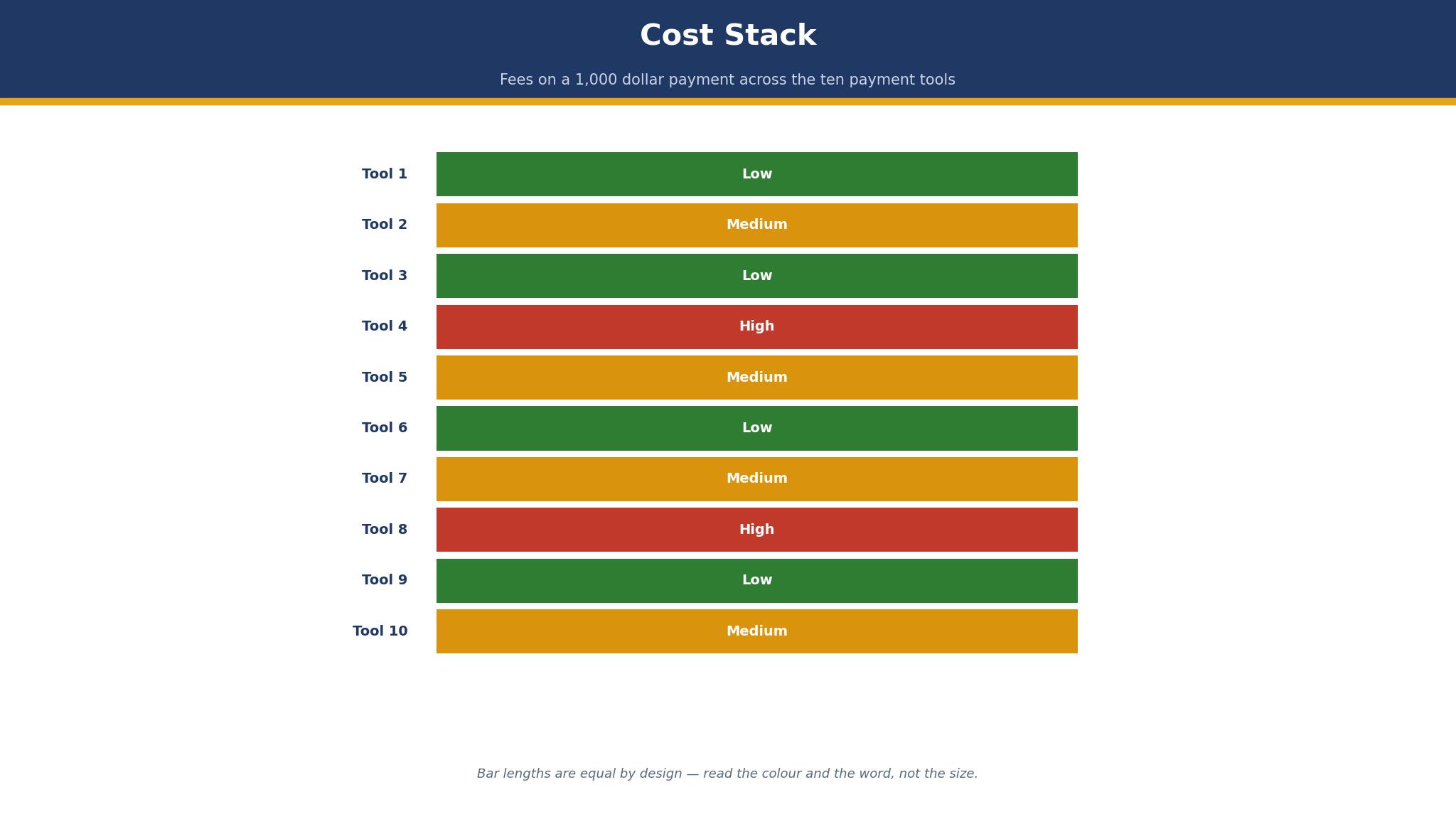
A fee table only makes sense on a real amount, so this section prices a 1,000 dollar payment on each tool. On a domestic card sale Stripe takes 29.30 dollars, Square takes 26.15 dollars in person and 33.30 dollars online, and PayPal checkout takes 35.39 dollars. The differences look small on one sale and add up to hundreds of dollars a month at volume.
On an international transfer the order flips. Wise takes roughly 8 dollars plus a small fixed fee at the mid-market rate, Payoneer takes 10 to 20 dollars to withdraw plus conversion, and PayPal takes about 75 dollars once the transaction fee, surcharge and conversion spread are added. A freelancer who earns 5,000 dollars a month from abroad saves about 300 dollars a month by moving from PayPal to Wise.
Use the numbers as a starting point, not a quote. Card rates vary by card type, Wise fees vary by currency route, and every provider changes rates without notice. Run your own last month of sales through the table before you switch, and keep the old account open for a month so a failed payout has somewhere to go.
The second test on Stripe and Wise is the bill at your real volume. Take the price of Stripe and the price of Wise, multiply each by the users, clients or parcels you actually have, and add the add ons that the job needs. A tool such as Stripe that is cheaper at one user can be more expensive at ten, and Wise that looks expensive can be cheaper once the add ons are counted. Run the numbers for Stripe and Wise for three months, not one, because the first month often hides a setup fee or a free trial.
- Price one domestic card sale of 1,000 dollars on Stripe, Square and PayPal before choosing a checkout
- Price one international transfer of 1,000 dollars on Wise, Payoneer and PayPal before invoicing abroad
- Check the dispute fee and the reserve policy on the tool you pick, because holds cost more than fees
- Keep the old account open for one month after the switch so a failed payout has a fallback
Frequently Asked Questions
Which PayPal alternative has the lowest fees?
For the best paypal alternatives, Wise has the lowest fee for bank transfers, from 0.24 percent at the mid-market rate. For card checkout, Square at 2.6 percent plus 15 cents in person is the lowest in this guide, followed by Stripe at 2.9 percent plus 30 cents online.
Can I use Stripe and PayPal together?
Yes. Many stores run Stripe as the default checkout and keep PayPal as a secondary button for buyers who ask for it. Braintree also takes both through one integration at 2.59 percent plus 49 cents.
Is Wise free to use?
Opening a Wise account is free, and receiving local bank details in more than 20 currencies is free. Transfers carry a stated fee from 0.24 percent, shown before you confirm, with no markup on the exchange rate.
Does Square work outside the US?
Square works in the US, Canada, the UK, Ireland, France, Spain, Japan and Australia, but its cross border payment support is limited. Sellers who take many international cards should use Stripe or Adyen instead.
Why do sellers leave PayPal?
The two reasons most often given are fees and account holds. Invoiced payments cost 3.49 percent plus 49 cents, currency conversion adds 3 to 4 percent, and holds during disputes can freeze funds for weeks.
Is Payoneer safe for freelancers?
Payoneer is a regulated payout network used by Upwork, Fiverr and Amazon, and it is the required payout route on those platforms. Its withdrawal fee is 1 to 2 percent and conversion runs 1.2 to 4 percent, so check your corridor before routing income through it.
The bottom line on leaving PayPal
Stripe is the best PayPal alternative for most online sellers, Wise is the best for getting paid across borders, and Square is the best for shops that sell face to face. The best paypal alternatives that win are the ones matched to the payment method, not the ones with the lowest headline rate on a comparison page.
Start with one switch, not five. Move card checkout to Stripe, move international invoicing to Wise, and keep PayPal as a secondary button for the buyers who insist on it. Price your last month of sales on the new tool first, keep the old account open for a month, and the switch pays for itself in the first few weeks.