

My Music Staff is the best music school software pick for most private teachers and small studios, because it costs $16.95 a month with unlimited students, every feature included, and no transaction fees on the payments you collect. Duet is the pick for a solo teacher on the tightest budget at $9 a month, and Opus1 is the pick for a school with hundreds of students. The twelve tools below compare flat fees, per-lesson charges and payment costs, so a teacher can buy the studio system that fits the student count rather than the one with the longest feature list.
Music teaching software prices run from $9 a month to $98 a month at the published entry, and the gap is not about quality. Duet costs $9 a month plus 1 percent of digital payments, My Music Staff costs $16.95 flat with no transaction fees, Teachworks starts at $16.49 a month plus $0.35 per student-lesson, and Opus1 starts at $98 a month for a school. The right price depends on how many students pay and how they pay, so this guide works out the real monthly cost for each teaching size.
The work itself decides the winner. A solo piano teacher needs scheduling, invoicing and reminders, a studio with four teachers needs payroll and teacher logins, and a school with 300 students needs enrolment, waitlists and a front desk. The tools below split cleanly along that line, and the guide names the split for every entry.
The 12 Tools at a Glance
| Tool | Main job | Best for | Starting price |
|---|---|---|---|
| My Music Staff | Studio scheduling and billing | Private teachers and studios | $16.95 per month |
| Duet | Flat-fee studio management | Solo teachers on a budget | $9 per month |
| Teachworks | Lesson scheduling with usage fees | Growing or seasonal studios | $16.49 per month |
| Opus1 | School-scale management | Music schools, hundreds of students | $98 per month |
| Jackrabbit Music | Class and student management | Schools scaling by student count | $49 per month |
| MakeMusic Studio | Monthly tuition billing | Studios on monthly tuition | $19.95 per month |
| Fons | Scheduling and payments | Studios that want simple billing | Quote-based |
| TutorCruncher | Tutoring business management | Studios with many tutors | Quote-based |
| Sawyer | Class bookings and camps | Class-based music programs | Quote-based |
| ClassForKids | Class management for kids | Children’s music classes | Quote-based |
| Bizzly | Flat-fee class management | UK studios and class providers | £19 per month |
| MOOZ | Practice app plus admin | Teachers who want practice tools | Quote-based |
Best Pick by Job
| Job type | First pick | Second tool | Why this pair works |
|---|---|---|---|
| Solo teacher, tight budget | Duet | My Music Staff | Duet is $9 a month, My Music Staff has no fees |
| Private teacher or small studio | My Music Staff | MakeMusic Studio | My Music Staff is flat, MakeMusic adds built-in payments |
| Growing studio, seasonal | Teachworks | Jackrabbit Music | Teachworks scales by lesson, Jackrabbit scales by student |
| Music school, hundreds of students | Opus1 | Jackrabbit Music | Opus1 covers the front desk, Jackrabbit covers classes |
| Class-based children’s program | ClassForKids | Sawyer | ClassForKids is built for kids, Sawyer books classes |
A private teacher should start with My Music Staff. It costs $16.95 a month with unlimited students, every feature included, plus $4.95 a month per additional teacher or staff member, and the teacher uses their own Stripe or PayPal, so there are no transaction fees from the software. The 30-day free trial needs no card, and the 90-day money-back guarantee is the longest in this guide.
A solo teacher on the tightest budget should start with Duet instead. It costs $9 a month or $99 a year, with a 1 percent fee on all digital payments, and the break-even point against My Music Staff sits near $600 a month in digital payments. When you compare the best music school software side by side, the split is clear, because Duet wins below $600 a month in payments and My Music Staff wins above it, and a teacher has to count the tuition before choosing.
Which Music School Software Is Best for a Solo Teacher?
Duet is the best pick for a solo teacher, because $9 a month is the lowest flat fee in this guide and the whole studio fits in one simple system. Scheduling, billing, invoicing, lesson notes, repertoire assignments and parent communication all sit in one place, and the 30-day free trial lets a teacher test it on real students. New teachers receive 50 percent off their first year, which makes the first-year cost lower still.
My Music Staff is the better pick if the teacher collects more than $600 a month in digital payments. The $16.95 flat fee has no transaction fees, so a teacher collecting $2,000 a month in tuition pays $16.95 in total, while Duet costs about $29 a month at the same volume, with $9 plus $20 in payment fees. The break-even is the number that decides the pick, and a teacher should work it out from last month tuition before choosing.
MakeMusic Studio is the third option for a teacher on monthly tuition. It costs $19.95 a month plus $4.95 per extra teacher, with built-in payments at 2.9 percent plus $0.30 per card charge, and a 14-day trial. That built-in convenience is the trade to weigh when a teacher compares the best music school software, because card fees are the hidden cost of never setting up a processor.
How to Choose the Best Music School Software
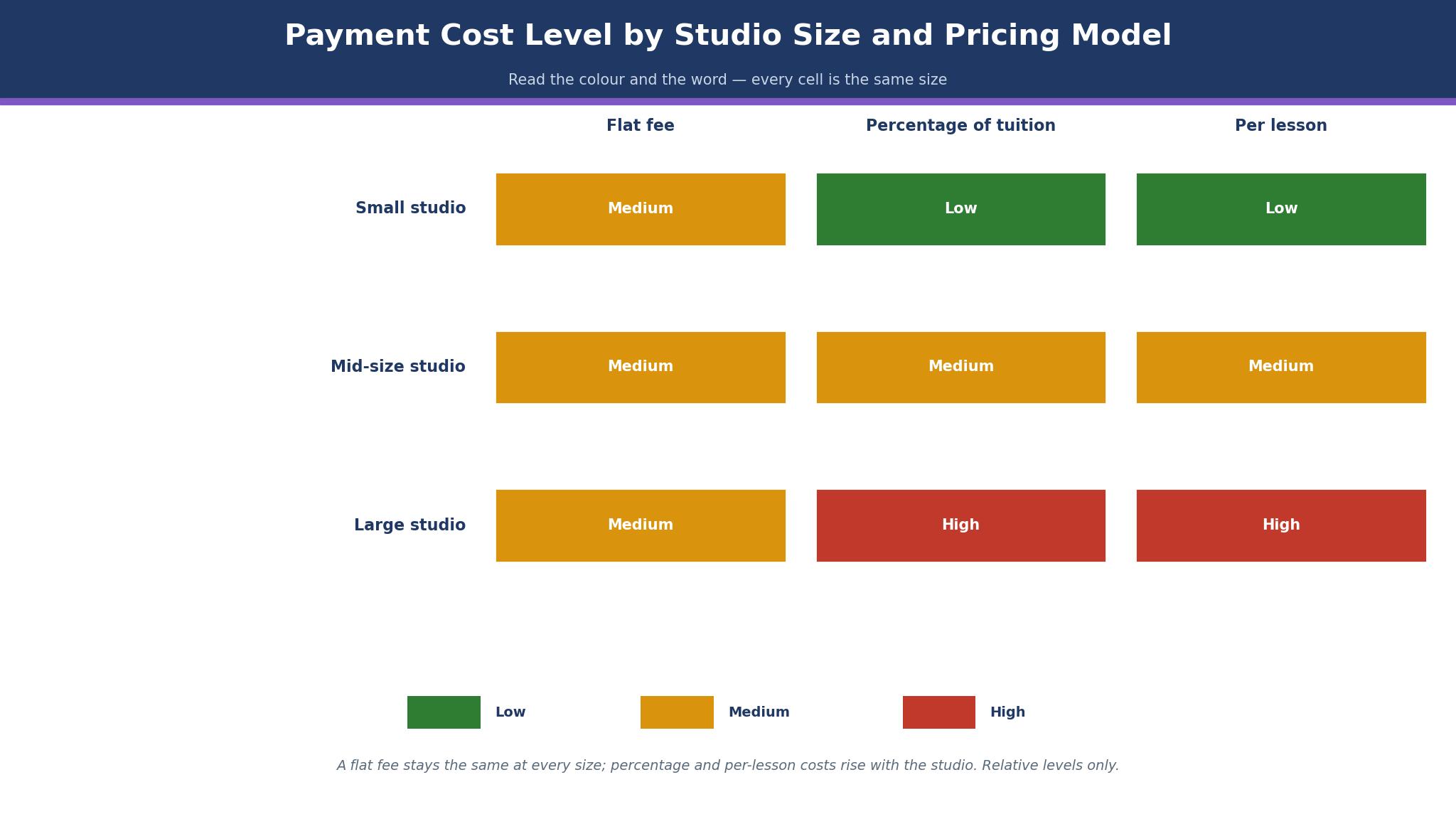
Start with the payment math, not the feature list. Duet costs $9 a month plus 1 percent of digital payments, My Music Staff costs $16.95 flat with no transaction fees, and Teachworks starts at $16.49 a month plus $0.35 per student-lesson. A teacher collecting $2,000 a month pays about $29 on Duet, $16.95 on My Music Staff and $51.49 on Teachworks Starter at 100 lessons, so the same studio costs three different amounts on three tools.
Next, count the teachers. My Music Staff and MakeMusic Studio both add $4.95 a month per extra teacher, so a four-teacher studio pays $31.80 on My Music Staff and $34.80 on MakeMusic Studio, while Duet stays flat at $9 a month at any studio size. A school with ten teachers should price the per-teacher charge, because it is the number that grows with the team.
Then check the student count and the school features. Opus1 covers up to 200, 500 or 1,000 active students from $98 a month, Jackrabbit Music scales from $49 to $245 a month by student count, and Teachworks adds a per-lesson fee that grows with every lesson taught. A school with 100 or more students and several teachers should look at a school system rather than a teacher tool, because the enrolment, waitlist and payroll features only exist there.
Finally, test the parent experience with one real family. Book a lesson, send the invoice, collect the payment and send the reminder, then check that the parent can do it all from a phone.
The 12 Tools in Detail
The twelve tools below cover solo teacher systems, studio platforms and school-scale software. Each one is judged on payment math, teacher costs and school features, so this roundup of the best music school software stays honest about the real monthly cost at each teaching size.
1. My Music Staff
My Music Staff is the best-known and cheapest music-specific option for solo teachers and small studios. It costs $16.95 a month with unlimited students, all features included, plus $4.95 a month per additional teacher or staff member, and the teacher uses their own Stripe or PayPal, so there are no transaction fees from the software. The 30-day free trial needs no card, and the 90-day money-back guarantee is the longest in this guide.
The feature set is the reason teachers stay. Scheduling, billing, invoicing, makeup credits, a student portal, practice tracking, a lending library, a website builder and Zoom and Google Meet links all come in the single plan, with SMS reminders and website hosting at no extra cost. There is no native app, so the teacher works from the browser on every device, though the mobile web experience is fully featured.
It suits private teachers and studios that want one flat price for everything. The unlimited students and the absence of transaction fees make the monthly cost predictable, and the feature depth covers the whole studio.
Start the 30-day trial with real students, and count the tuition before you compare it with Duet.
2. Duet
Duet, formerly Music Teacher’s Helper, is the cheapest flat-fee tool for an independent teacher. It costs $9 a month or $99 a year, with a 1 percent charge added to digital payments made by families, and the subscription includes a library of worksheets, webinars, podcasts and templates. The 30-day free trial lets a teacher test the whole studio, and new teachers receive 50 percent off their first year.
The payment fee is the thing to work out. A teacher collecting $2,000 a month in tuition pays about $29 a month in total, with $9 plus $20 in fees, while My Music Staff costs $16.95 flat, so the break-even sits near $600 a month in digital payments. Below that line Duet is cheaper, above it My Music Staff wins, and a teacher should check last month tuition before choosing.
It suits solo teachers who want the lowest monthly fee and a simple studio. The flat $9 covers any studio size, the worksheets and templates add value, and the text-first communication keeps parents close.
Try the 30-day trial with real students, and work out the break-even from last month tuition.
3. Teachworks
Teachworks is the scheduling and billing system for growing or seasonal studios, with a usage-based price that scales with lessons taught. Starter costs $16.49 a month plus $0.35 per student-lesson, Growth costs $131.99 a month at higher volumes, and the 21-day trial lets a studio test the workflow on real lessons. Stripe payments are built in, including ACH, so the money flow is handled inside the system.
The per-lesson fee is the thing to model. A studio teaching 100 student-lessons a month pays $51.49 on Starter, which is dearer than My Music Staff at $16.95 and Duet at $9, so a busy studio should price the lesson count before choosing.
4. Opus1
Opus1 is the school-scale system, built for music schools with a front desk, several teachers and hundreds of families. Plans cover up to 200, 500 or 1,000 active students, with packages from $98 a month, month to month, and a free trial with free migration from the old system. Scheduling, billing, family communication, enrolment and payroll share one system, with its own payments built in.
The price is the barrier for a small studio. Opus1 starts at $98 a month, which is six times My Music Staff, so a teacher with 20 students should not buy it. A school with 100 or more students and several teachers is the right buyer, because the enrolment, waitlist and front-desk tools only exist at this scale, and the migration help makes the switch manageable.
It suits music schools with hundreds of students and a front desk. The enrolment flow, the family portal and the payroll tools cover the school work, and the monthly billing keeps the commitment short.
Ask Opus1 for a quote by student count, and confirm the migration help covers your current data.
5. Jackrabbit Music
Jackrabbit Music is the class and student management system that scales by student count, with plans from $49 to $245 a month. The system covers class scheduling, enrolment, billing, attendance and parent communication, with a focus on the class workflow that a school runs daily. The price rises with the student count, so a small school pays $49 and a large school pays $245, which makes the cost easy to model.
The per-student scaling is both the strength and the limit. A growing school sees the bill rise with every enrolment, which is fair, though the price can surprise a school that grows fast. The class tools are the deepest in this guide for group lessons, while the private-lesson tools are thinner than My Music Staff.
It suits schools that run classes and scale by student count. The enrolment and attendance tools keep a busy class schedule organised, and the parent portal keeps families informed.
6. MakeMusic Studio
MakeMusic Studio is the monthly-tuition system, built for studios that bill families once a month rather than per lesson. It costs $19.95 a month plus $4.95 per extra teacher, with built-in payments at 2.9 percent plus $0.30 per card charge, 1.8 percent on ACH and an extra 0.4 percent on subscriptions. The 14-day trial lets a studio test the billing flow on real families.
The card fees are the thing to price. A studio collecting $2,000 a month by card pays about $58 in card fees on top of the $19.95 subscription, while My Music Staff at $16.95 lets the teacher bring their own Stripe account. The built-in payments are convenient, though, because the teacher never sets up a processor, and the monthly tuition model fits studios that bill by the month.
It suits studios on monthly tuition that want payments built in. The billing, the scheduling and the practice tools cover the studio work, and the price is fair for the convenience.
Start the 14-day trial with real families, and compare the card fees against your own Stripe account.
7. Fons
Fons is the scheduling and payments platform for studios that want simple billing without a large system around it. The platform covers online scheduling, invoicing, payments and client management, with a focus on the money flow rather than the teaching tools. Pricing is quote-based, so the vendor sets the figure after a demo and a look at the studio size.
The narrow focus is both the strength and the limit. Fons handles scheduling and payments well, but a teacher who wants practice tracking, repertoire and a lending library will need a second tool. The quote-only pricing also means no number to compare before the sales call, so a small studio should shortlist My Music Staff first.
It suits studios that want simple billing above all else. The scheduling and payment flow cover the admin work, and the interface is plain enough to learn in an afternoon.
8. TutorCruncher
TutorCruncher is the tutoring business platform, built for studios with many tutors and a pipeline of students. The system covers scheduling, billing, tutor management, payroll and client communication, with a focus on the business side of teaching. Pricing is quote-based, with the figure set by tutor count and student volume, so a studio has to ask for the number.
The tutoring focus is the boundary. TutorCruncher is built for tutoring businesses rather than music schools, so the music-specific tools like repertoire and practice tracking are absent. A studio with many tutors will find the payroll and tutor management useful, while a solo music teacher will find the wrong tool entirely.
It suits studios with many tutors that need business management. The tutor pipeline and the payroll tools cover the operations, and the client management keeps families organised.
Ask TutorCruncher for a quote by tutor count, and confirm the music-specific gaps before you sign.
9. Sawyer
Sawyer is the class booking platform for music programs that sell sessions, camps and classes. The system covers online booking, scheduling, payments and parent communication, with a focus on the class workflow. Pricing is quote-based, with the figure set by booking volume and payment processing, so a program has to ask for the number.
The class focus is the limit for private teaching. Sawyer books classes well, but a teacher who gives one-to-one lessons will find the private-lesson tools thinner than My Music Staff or Duet. A music program that runs group classes, holiday camps and ensembles will find the booking flow fits the work.
It suits class-based music programs that sell sessions. The booking page converts well, the parent communication keeps families informed, and the scheduling handles the weekly churn.
10. ClassForKids
ClassForKids is the class management system for children’s music classes, built for providers who teach kids in groups. The system covers class scheduling, enrolment, payments and parent communication, with a focus on the children’s class workflow. Pricing is quote-based, so the vendor sets the figure after a demo and a look at the class count.
The children’s focus is both the strength and the limit. ClassForKids handles kids classes well, with parent tools built for families, but a teacher who gives adult lessons or one-to-one tuition will find the wrong tool. A provider running weekend kids classes will find the enrolment flow fits, while a private teacher will not.
It suits children’s music class providers that run group sessions. The enrolment and payment tools cover the class work, and the parent communication keeps families close.
11. Bizzly
Bizzly is the flat-fee class management platform, with plans at £19, £29 and £49 a month, or £190, £290 and £490 a year. The base plan covers the core class tools, the higher tiers add more capacity and features, and the flat fee means no per-teacher or per-lesson charge. The 14-day free trial needs no card, and the multi-currency support suits a studio with international families.
The UK focus is the thing to check. Bizzly prices in pounds, so a US studio should work out the converted cost before comparing it with My Music Staff at $16.95. The class tools are strong, though the private-lesson depth is thinner than the teacher-first tools, so a solo teacher should compare carefully.
It suits UK studios and class providers that want a flat fee. The price is predictable, the class tools cover the work, and the annual billing saves two months.
Start the 14-day trial with real classes, and work out the pound-to-dollar cost before you commit.
12. MOOZ
MOOZ is the practice app plus admin platform, built for teachers who want practice tools inside the studio system. The app covers lesson practice, assignments and student progress, with admin tools for scheduling and billing alongside. Pricing is quote-based, so the vendor sets the figure after a demo, and the teacher subscription price should be confirmed on the pricing page before budgeting.
The practice focus is the appeal and the gap. MOOZ covers the lesson itself better than any admin-first tool, with practice tracking that students actually use, though the billing and payroll depth is thinner than Opus1 or Jackrabbit. A teacher who wants students to practise more will value the app, while a school that needs enrolment and payroll will need a second system.
It suits teachers who want practice tools with their admin. The app keeps students practising between lessons, and the admin covers the scheduling and billing underneath.
My Music Staff vs Duet: Flat Fee Against One Percent
The payment math is the first difference, and it decides the winner before any feature comparison. My Music Staff costs $16.95 a month flat with no transaction fees, while Duet costs $9 a month plus 1 percent of digital payments. A teacher collecting $2,000 a month in tuition pays $16.95 on My Music Staff and about $29 on Duet, so the flat fee wins above $600 a month in payments and Duet wins below it.
The feature gap runs the other way on depth. My Music Staff includes every feature in the single plan, with a student portal, practice tracking, a lending library, a website builder and SMS reminders, while Duet adds a worksheet library, webinars and templates. A teacher who wants the deepest studio will take My Music Staff, while a teacher who wants the simplest studio will take Duet.
The deciding factor is last month tuition. A teacher who collected more than $600 in digital payments should take My Music Staff, because the flat fee is cheaper and the feature depth is greater. A teacher who collected less should take Duet, because $9 a month is the lowest honest price in this guide. That split is the cleanest way to read the best music school software when the choice narrows to two.
What Does Music School Software Cost per Month?
The honest range in this guide runs from $9 a month to $98 a month for a published plan. Duet costs $9 a month, My Music Staff costs $16.95, Teachworks starts at $16.49 plus $0.35 per student-lesson, MakeMusic Studio costs $19.95, Jackrabbit Music runs $49 to $245 by student count, and Opus1 starts at $98. Bizzly costs £19 to £49 a month, while Fons, TutorCruncher, Sawyer, ClassForKids and MOOZ are all quote-based.
The payment model changes the real cost more than the headline does. A teacher collecting $2,000 a month pays about $29 on Duet, $16.95 on My Music Staff, $51.49 on Teachworks Starter at 100 lessons, and about $78 on MakeMusic Studio with card fees. The best music school software is the one where the total monthly cost, including payment fees and per-teacher charges, is lowest at the real student count, not the one with the lowest headline price.
The honest way to budget is to price the real month, including every fee. Count last month tuition, count the student-lessons, count the teachers, and work out the total on each finalist before choosing. A four-teacher studio pays $31.80 on My Music Staff, $34.80 on MakeMusic Studio and $9 on Duet, before payment fees, so the teacher count alone can change the winner.
Can Music School Software Handle Payments and Makeup Lessons?
Yes, on the best music school software tools in this guide that build billing into the core. My Music Staff handles invoicing, Auto Pay and makeup credits, with the teacher using their own Stripe or PayPal, Duet handles invoicing and digital payments with a 1 percent fee, and MakeMusic Studio handles built-in payments with card and ACH. Teachworks handles Stripe payments including ACH, and Opus1 handles its own payments for a school.
The makeup workflow decides whether the billing stays honest. A student who cancels should get a makeup credit automatically, and the credit should apply to the next lesson without the teacher doing admin. My Music Staff handles makeup credits in the single plan, which is the reason teachers praise it, while a tool without makeup credits will force the teacher to track them by hand.
The limit is the payment fee. A teacher who collects by card pays 2.9 percent plus $0.30 per charge on MakeMusic Studio, 1 percent on Duet, and nothing to the software on My Music Staff, because the teacher brings their own processor. The fee is the number that decides the real cost, and a teacher should work it out from last month tuition before choosing a tool.
A 30-Day Music Studio Switch Plan
Days one to seven are the list. Export every student, every teacher and every recurring lesson, and write down the real schedule, because the switch is only as good as the data it starts with. Days eight to fourteen are the clean-up. Merge duplicate student records, agree the lesson naming rule, and set the makeup credit policy, because a messy list will teach the families that the new system cannot be trusted.
Days fifteen to twenty-one are the parallel run. Run the new system alongside the old one, send invoices from both, and check that the payment totals match at the end of each week. Days twenty-two to thirty are the cutover. Switch the payment link to the new system, train the teachers on rescheduling, and reconcile the student count on day thirty against a hand count of ten families.
The switch earns its keep when the day-thirty count matches the hand count on nine of the ten families. A switch that skips the parallel run will import the old errors, and the teachers will go back to the old system within a week. Keep the list clean, keep the makeup policy clear, and let the reconciliation decide the cutover.

Frequently Asked Questions
Which music school software is cheapest for a solo teacher?
Duet is the cheapest for a solo teacher, at $9 a month or $99 a year, with a 1 percent fee on digital payments. My Music Staff costs $16.95 a month flat with no transaction fees, so the break-even sits near $600 a month in digital payments. A teacher collecting less than $600 a month should take Duet, and a teacher collecting more should take My Music Staff.
Does My Music Staff charge per student?
No. My Music Staff costs $16.95 a month with unlimited students, all features included, plus $4.95 a month per additional teacher or staff member. The teacher uses their own Stripe or PayPal, so there are no transaction fees from the software. A four-teacher studio pays $31.80 a month in total.
Can Teachworks handle a seasonal studio?
Yes. Teachworks starts at $16.49 a month plus $0.35 per student-lesson, so a quiet month costs less and a busy month costs more. A studio teaching 100 student-lessons a month pays $51.49 on Starter, which is dearer than My Music Staff at $16.95. A seasonal studio should price the lesson count before choosing.
Is Opus1 worth $98 a month for a small studio?
No, not for a small studio. Opus1 starts at $98 a month and covers up to 200, 500 or 1,000 active students, with enrolment, waitlists and payroll built in. A teacher with 20 students should take My Music Staff at $16.95 instead. A school with 100 or more students is the right buyer for Opus1.
Does Duet really cost only $9 a month?
Duet costs $9 a month or $99 a year, plus a 1 percent charge on all digital payments made by families. A teacher collecting $2,000 a month in tuition pays about $29 a month in total, with $9 plus $20 in fees. New teachers receive 50 percent off their first year, which makes the first-year cost lower still.
Can music school software track practice?
Yes, on the tools that build practice into the core. My Music Staff includes practice tracking in the single plan, MOOZ is built around a practice app, and Duet includes repertoire assignments and lesson notes. A teacher who wants students to practise more should test the practice tools with two real students before choosing.
The Music School Pick by Studio Size
A solo teacher should take Duet at $9 a month, because the flat fee is the lowest in this guide among the best music school software, and the break-even against My Music Staff sits at $600 a month in payments. A private teacher or small studio should take My Music Staff at $16.95 a month, because the unlimited students and the absence of transaction fees make the cost predictable. A growing studio should take Teachworks from $16.49 a month, because the price follows the lesson count.
A music school with hundreds of students should take Opus1 from $98 a month, because the enrolment, waitlist and payroll tools only exist at that scale. Count last month tuition, count the teachers, trial one tool for thirty days, and let the break-even decide.