
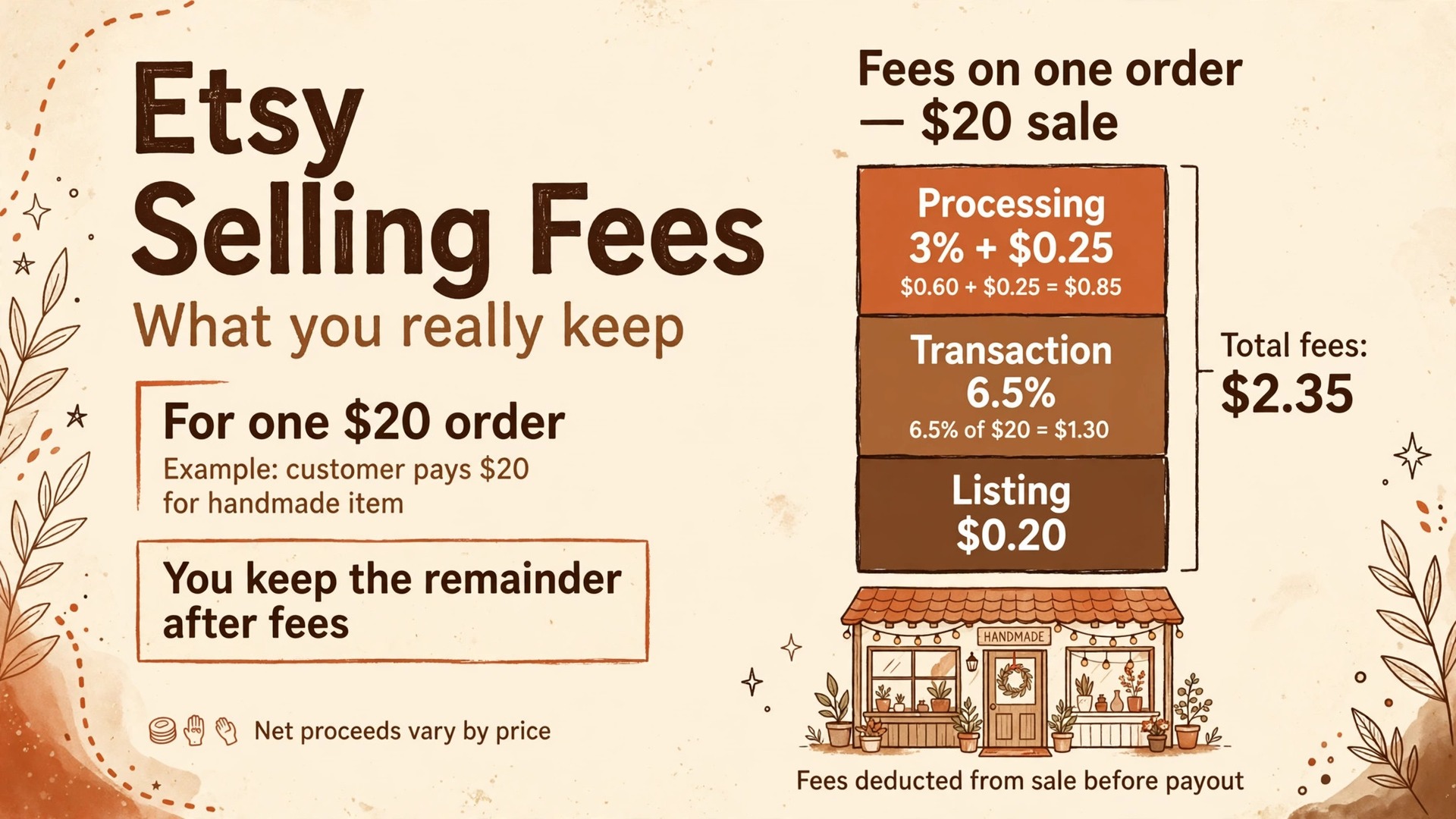
Etsy against your own website is a trade of fees for traffic, because Etsy charges on every sale while your own store charges a flat monthly price plus payment processing. That comparison hook frames the cost of Etsy selling fees small business honestly. Etsy makes sense when its built in shoppers bring sales you would not otherwise win, and it stops making sense when those same sales could have come through your own store at a lower fee.
Most new sellers quote only the 6.5 percent transaction fee, then feel surprised when the real deduction lands near ten percent before advertising. Listing fees, payment processing, and the occasional offsite ads fee stack on top of the transaction fee, and the stack grows with order count, not just with revenue. A seller who prices from the headline fee alone will underprice almost every product in the shop.
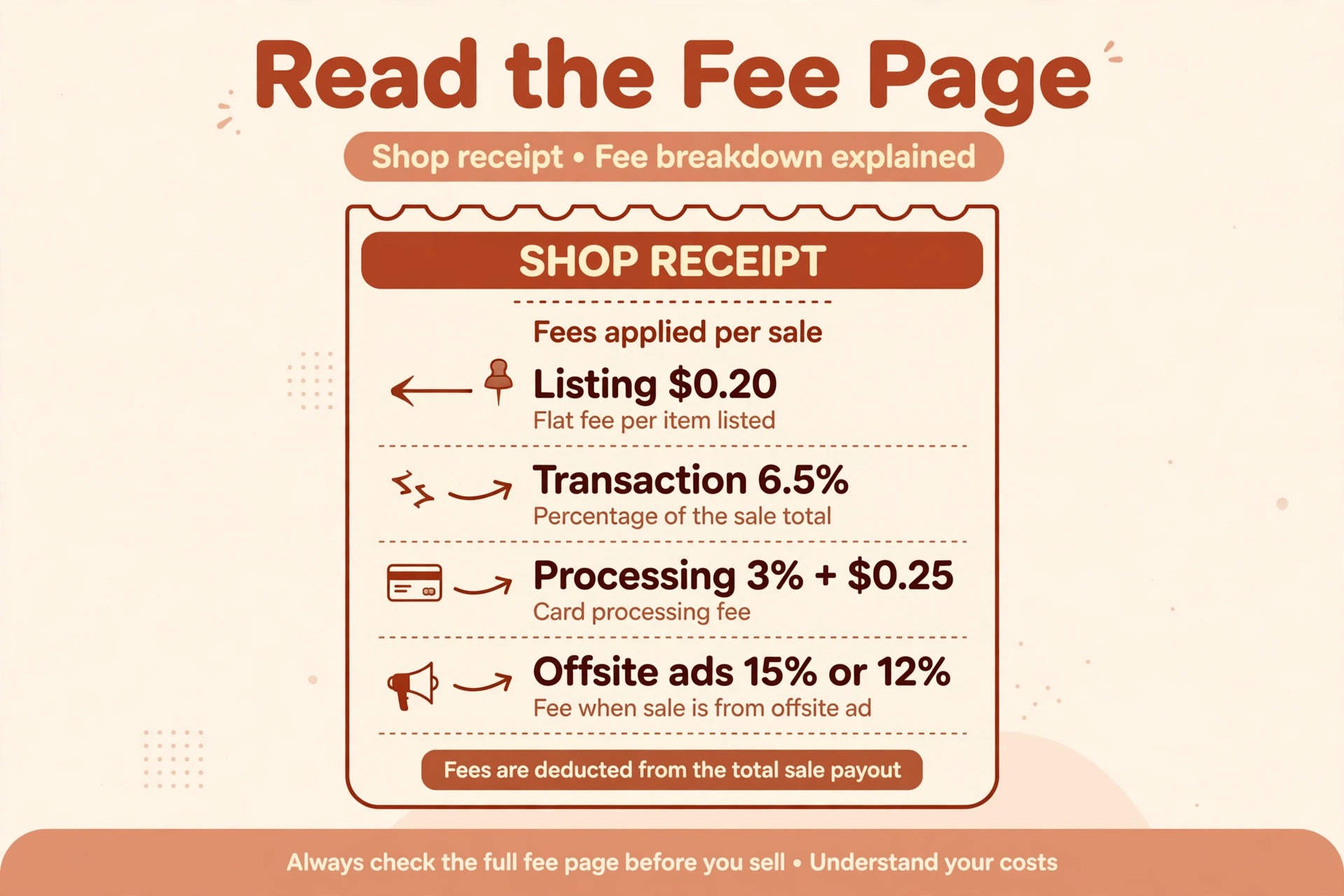
Fees in this guide use published United States rates at writing time, with listing at 0.20 dollars, transaction at 6.5 percent, payment processing at 3 percent plus 0.25 dollars per order, and offsite ads at 15 percent or 12 percent depending on annual sales. Rates vary by country and change from time to time, so check the vendor page for your country before you set prices. Use the worked totals here to size the cost, then confirm the live fee page before you list.
What the cost of Etsy selling fees small business Really Includes
Four charges make up the core Etsy stack. A listing fee of 0.20 dollars is charged when you publish, again when a listing renews after four months, and again each time an item sells and relists from a multi quantity listing. A transaction fee of 6.5 percent applies to the price you display plus shipping and gift wrapping you charge, not just the item price alone.
Payment processing through Etsy Payments costs 3 percent plus 0.25 dollars per order for United States sellers, calculated on the total the buyer pays, including shipping and tax where applicable. Offsite ads add 15 percent for shops under 10,000 dollars in annual sales, or 12 percent for shops at or above that level, but only on orders that come from an Etsy placed external ad within thirty days of a click, and the offsite fee is capped at 100 dollars per order.
Currency conversion at 2.5 percent applies when your shop currency and payment account currency differ, and it sits outside the worked totals in this guide. A seller who prices in one currency and banks in another should add that line to every estimate. Small fees matter most on low priced items, because a fixed 0.25 dollar processing charge plus a 0.20 dollar listing fee takes a larger share of a 5 dollar sale than of a 50 dollar sale.
Etsy Fees, One Charge at a Time
The table below lists each core fee, its rate, and when it applies, using United States rates at writing time. Read it as a stack, not as a choice, because most sales pay the first three charges together.
| Fee | Rate | Applies to |
|---|---|---|
| Listing fee | 0.20 dollars | Each listing, on publish, renewal, and each sale from a multi quantity listing |
| Transaction fee | 6.5 percent | Item price plus shipping plus gift wrapping |
| Payment processing | 3 percent plus 0.25 dollars | Total buyer payment per order, United States rate |
| Offsite ads | 15 percent or 12 percent | Orders from an Etsy external ad within 30 days, capped at 100 dollars |
Shipping is the line that catches new sellers, because the transaction fee applies to shipping you charge, and payment processing applies to the total including shipping. Free shipping does not remove the fee, since the shipping cost is then inside the item price, which is also fee bearing. Price shipping as a cost that carries fees, not as a pass through that Etsy ignores.
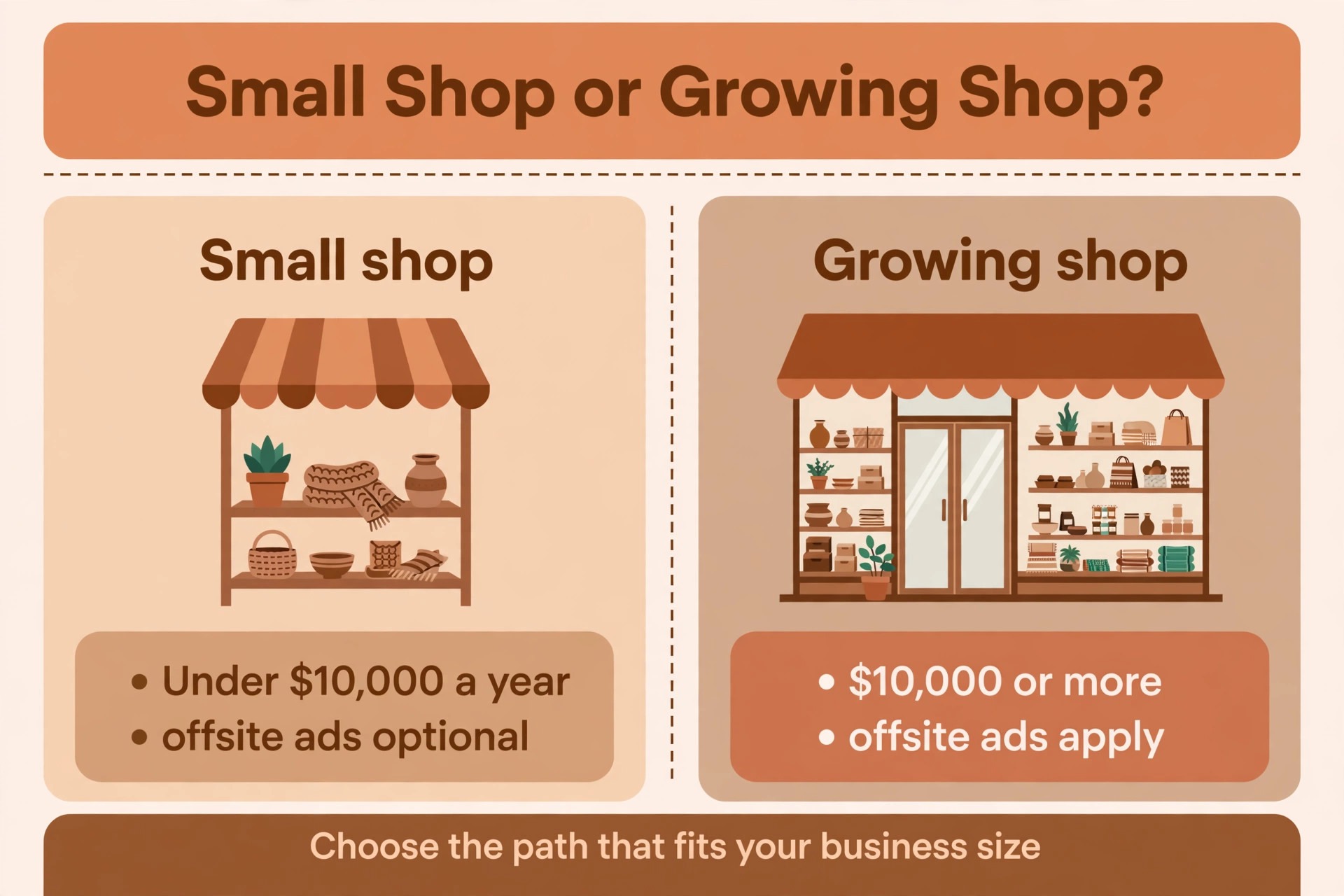
Offsite ads deserve special care, because shops under 10,000 dollars a year can opt out, while shops at or above that level cannot. A growing shop should therefore plan for the moment when offsite ads become mandatory, since a sale that previously kept about ninety percent can suddenly keep closer to seventy eight percent if it came from an external ad. That change should be priced into the product before the shop crosses the threshold, not after.
Use this table as the starting point for judging the cost of Etsy selling fees small business against the work the team actually does each week, rather than against a rival headline price alone.

Worked Fees on One Hundred, One Thousand and Ten Thousand Dollar Months
The totals below assume a 25 dollar average order, no separate shipping charge, United States rates, and no offsite ads, so the reader can see the core stack clearly. They show the cost of Etsy selling fees small business at three monthly revenue levels, before materials, postage, packaging, and tax.
| Month revenue | Orders | Listing fees | Transaction 6.5 percent | Processing 3 percent plus 0.25 dollars | Total Etsy fees | You keep before product costs |
|---|---|---|---|---|---|---|
| 100 dollars | 4 orders | 0.80 dollars | 6.50 dollars | 4 dollars | 11.30 dollars | 88.70 dollars |
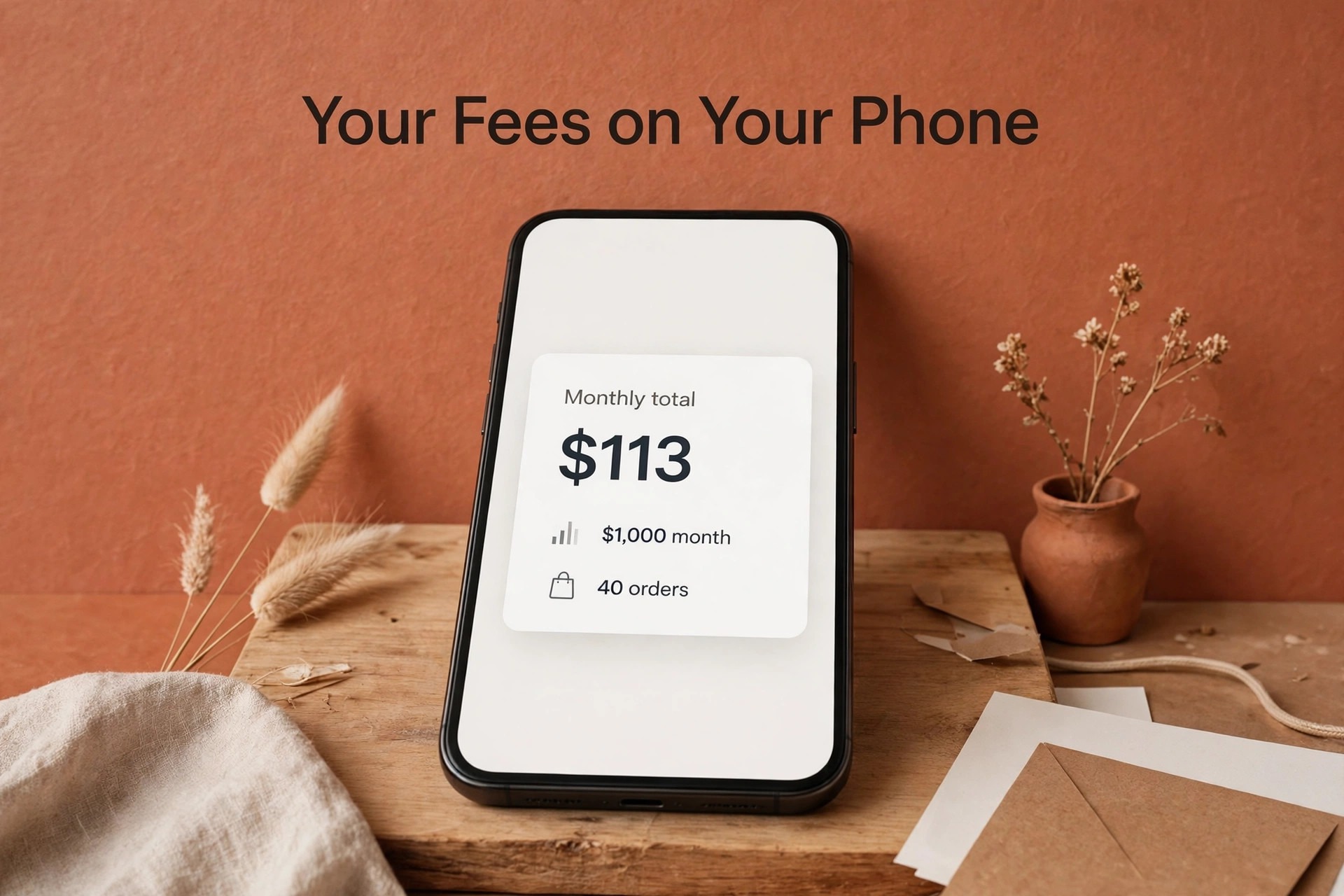
| 1,000 dollars | 40 orders | 8 dollars | 65 dollars | 40 dollars | 113 dollars | 887 dollars |
| 10,000 dollars | 400 orders | 80 dollars | 650 dollars | 400 dollars | 1,130 dollars | 8,870 dollars |
At each level the core stack lands near 11.3 percent of revenue under these assumptions, because the fixed charges scale with order count while the percentage charges scale with revenue. A 25 dollar average order keeps the fixed charges modest, but a shop selling 5 dollar items will see a higher percentage, since 0.45 dollars of fixed charges per order is nine percent of a 5 dollar sale before any percentage fee. Low priced sellers need higher volume or a higher average order to make the same stack work.
Offsite ads change the picture sharply when they apply. If twenty percent of a 1,000 dollar month came from offsite ads at 15 percent, that slice adds 30 dollars in fees, lifting the month total from 113 dollars to 143 dollars. At 12 percent for a larger shop, the same slice on a 10,000 dollar month adds 240 dollars, lifting the total from 1,130 dollars to 1,370 dollars. Track which orders carry the offsite fee in the shop dashboard, because an average fee hides the fact that some orders are far more expensive than others.
Fees That Catch New Sellers by Surprise
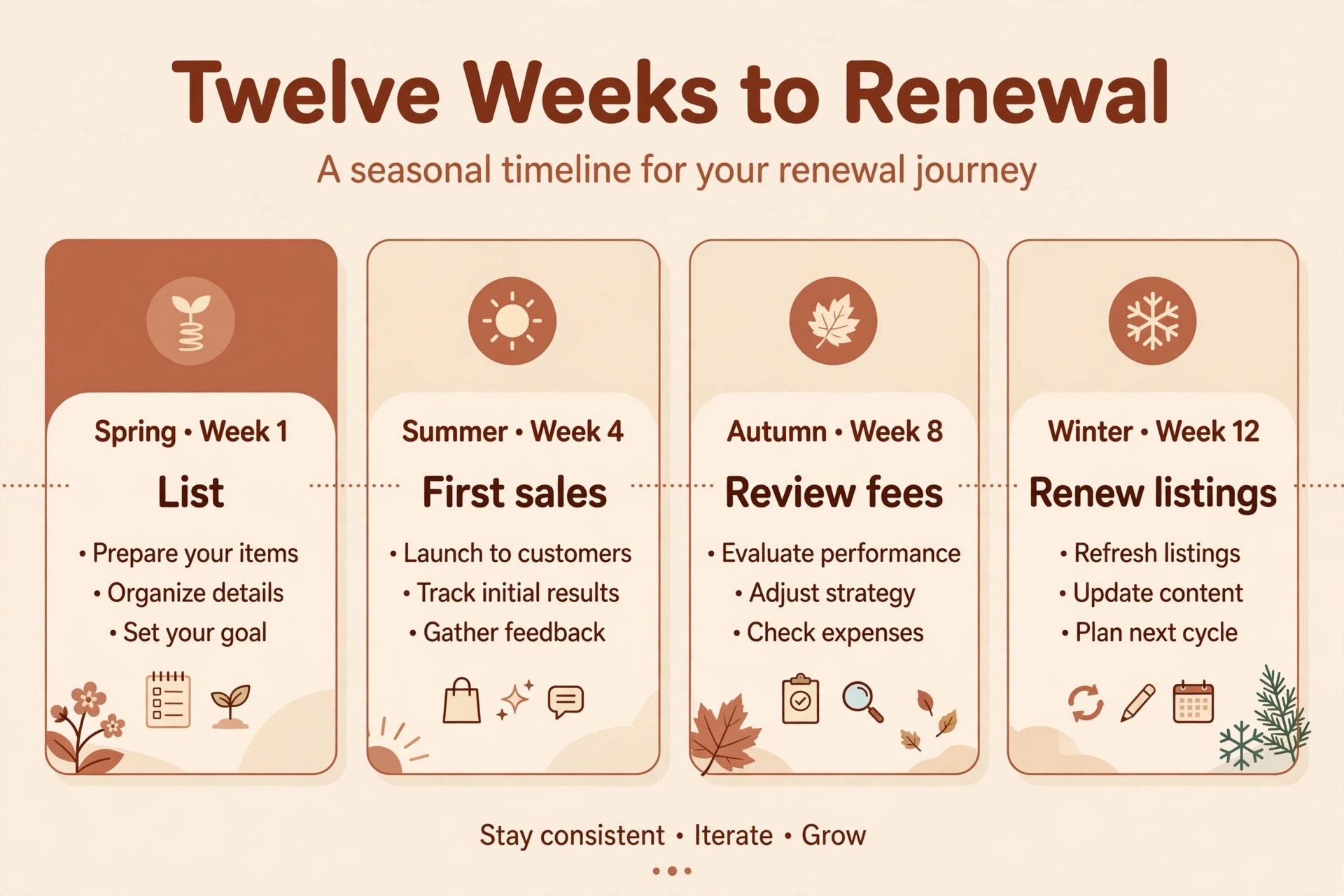
Renewal fees catch sellers who list widely and sell slowly. A listing that sits unsold for four months costs another 0.20 dollars to renew, and a shop with two hundred slow listings pays 40 dollars every four months before a single sale. Audit slow listings each quarter, improve or remove the ones that never sell, and keep the active catalogue focused on products with real demand.
Multi quantity listings also surprise sellers, because each unit sold from one listing triggers another 0.20 dollar listing fee. A listing with five in stock that sells all five costs 1 dollar in listing fees, not 0.20 dollars. That rule is fair, since each sale uses a listing slot, but it means a popular product carries more listing cost than a slow product, and the price should reflect that.
Returns, refunds, and currency conversion add further lines that the core stack does not show. A refunded order still leaves some fee handling to check on the current policy page, and a seller banking in a different currency pays conversion on top of the sale fees. Check the current refund and currency rules before pricing a product that carries a high return rate or an international audience.

How Etsy Fees Change as a Shop Grows
The gap between monthly and annual billing looks small on one seat and large on a whole team. Multiply the per seat difference by every person who will log in, then multiply that by twelve, and the saving becomes a number worth deciding on properly. Even so, a saving only counts if the tool is still in daily use at month nine. A discounted tool that nobody opens is still a wasted bill.
Annual billing suits a settled team with steady volume. Monthly billing suits a team that is still testing, hiring, or changing how it works. A practical middle path is to start on monthly billing for one quarter, review who actually used the tool and what it delivered, and then move to annual billing for the saving once the habit is proven. That review is the step most small businesses skip.
That choice between monthly and annual billing is a core part of the cost of Etsy selling fees small business, because the same team can pay a very different total for the same service depending on the cycle chosen.

Which Sales Level Changes the Etsy Decision
The right tier is usually the cheapest tier that covers the work the team actually does every week. Extra features sound useful in a sales demo, but they only earn their price when they remove a weekly task, prevent a lost customer, or replace another paid tool. List the five tasks the team repeats most often, then check which tier covers all five without add ons. If the cheapest tier covers them, the higher tier is a luxury, not a need.
| Shop stage | Main fee pressure | Sensible response |
|---|---|---|
| Starting shop, under 100 dollars a month | Fixed charges on low priced items | Raise average order or bundle small items |
| Growing shop, 1,000 dollars a month | Transaction plus processing stack | Price from the full stack, not the headline rate |
| Established shop, 10,000 dollars a month | Mandatory offsite ads at 12 percent | Price the offsite slice into every product |
| High volume shop | Renewals plus offsite plus conversion | Audit listings quarterly and review channel mix |
Team size matters less than workload shape. A solo owner with heavy message volume can need a higher tier sooner than a five person team with light volume. Count conversations, channels, or orders per week before counting heads. A tier chosen on headcount alone often buys seats for people who rarely log in, while the person doing the real work hits a limit on the cheaper plan.
Matching the tier to the team shape is the simplest way to control the cost of Etsy selling fees small business without losing a feature the team actually uses every week.
Budget Mistakes That Inflate Etsy Costs
A third mistake is letting a free trial roll into a paid plan without a decision. Trials end quietly, annual billing starts loudly, and the first invoice arrives after the chance to step back has passed. Set a trial end reminder on the day you start, decide before that date, and cancel or downgrade in the same week if the tool did not earn its place. A tool that needs a forgotten trial to keep you is not the right tool.
Avoiding these mistakes is the fastest way to lower the cost of Etsy selling fees small business without changing tools or cutting a feature the team needs.
How to Keep Etsy Fees Under Control
A simple monthly review keeps a subscription bill honest. Once a month, check who logged in, which limits were hit, and what the tool delivered that could not have been done with a cheaper option. Remove seats for people who left, close channels that no longer post, and downgrade a tier that is only half used. Fifteen minutes of review can save more than any discount code.
Write the renewal date and the cancellation steps in the same place you track other bills. Many small businesses lose money not on the price itself but on renewals that nobody noticed. A shared calendar entry with the price, the billing cycle, and the vendor support link turns renewal from a surprise into a decision. Review the bill before it renews, not after it lands.
A monthly review like this keeps the cost of Etsy selling fees small business tied to real use, and it catches seats, channels, or profiles that no longer earn their price.
Review the bill against actual use at the end of the first month, and write down which features were used daily, which were used once, and which were never opened. That short note becomes the evidence for the renewal decision, and it stops the team from paying for a tier chosen on a demo rather than on real work.
Ask the vendor what happens to your data if you downgrade or cancel, and test an export before you rely on the tool for anything important. A clean export turns a subscription into a reversible choice, while a blocked export turns a monthly bill into a trap. This check takes minutes in a trial and can save weeks later.
Keep one owner for each paid tool, even in a tiny team. That person tracks the renewal date, the seat count, and the monthly usage, and they approve any upgrade. Shared ownership usually means nobody owns the bill, and bills without an owner tend to grow quietly.
Negotiate from usage, not from hope. A vendor is more likely to help on price when you can show steady use, a clear seat count, and a renewal date you are willing to walk away from. A polite note before renewal, with the competing price in hand, often beats a complaint after the invoice arrives.
Separate the cost of the tool from the cost of the work around it. Setup time, training, and the weekly habit of checking a new inbox all carry a price in hours. A tool that saves ten hours a month at a higher price can still be cheaper than a free tool that nobody uses properly.
Watch for seasonal swings before choosing a billing cycle. A business with a busy summer and a quiet winter may prefer monthly billing through the slow months, even if annual billing looks cheaper on paper. The right cycle follows the revenue pattern, not just the discount.
Document the reason for the chosen tier in one sentence and keep it with the bill. When a new team member asks why the business pays for a higher tier, that sentence answers the question without a fresh debate. It also makes the downgrade decision easier when the reason no longer applies.
Test the support response during the trial, not after a problem hits a live customer. Send a real question, time the reply, and judge whether the help matches the price. Support quality is part of the monthly cost, because slow help turns into lost customers and extra staff time.
Compare the tool price against the price of doing the same work by hand, including the hours spent on manual posting, inbox triage, or fee arithmetic. A tool that looks expensive on a price page can still be cheap against ten hours of staff time a month, while a cheap tool that nobody uses is expensive at any price. Time, not headline price, is the real budget line.
Run a trial with a clear pass mark written down before the trial starts, such as a reply time, a posting count, or a report built in under an hour. A trial without a pass mark tends to drift into a paid plan by default, because nobody wants to admit the test was inconclusive. A written pass mark makes the renewal decision a fact check, not a feeling.
Check what happens when a team member leaves, since seats, channels, and logins often stay active after the person has gone. A quarterly seat audit that removes departed users and reassigns their work prevents the slow creep that inflates many small business bills. Treat every login as a cost, even on a plan that charges per channel rather than per user.
Keep the billing email in a shared inbox that more than one owner can see, so renewal notices and price change emails do not sit unread in a departed employee mailbox. Many price rises are announced by email weeks before they take effect, and a business that misses the notice loses the chance to downgrade or switch before the new rate starts.
Ask whether a lower tier plus a small second tool beats a higher tier of one tool, since the best combination is not always a single vendor. A cheap scheduler plus a separate reporting sheet can beat a premium all in one plan for a team that only needs one premium feature. Price the combination honestly, including the extra login and the extra weekly habit it creates.
When Etsy Still Pays and When Your Own Store Wins
Upgrade when a specific limit blocks real work three times in one month, not when a feature looks interesting. A blocked approval, a profile cap, or a missing report that forces manual work is a clear trigger. Write the trigger down, price the next tier for the actual team size, and check whether a cheaper workaround covers the same task. If no workaround exists, the upgrade is justified.
Stay on the current tier when the pain is occasional and the workaround takes minutes. Many teams upgrade for one busy week and then pay the higher price through quiet months. A better test is to ask whether the limit will still bite in ninety days at normal volume. If the answer is no, wait. The higher tier will still be there when volume genuinely grows.
How Etsy Fees Compare With Close Alternatives
Alternatives matter here because switching costs are low at small scale and high once a team builds habits around one tool. A short trial of two rivals, run on the same real tasks, usually tells more than a week of reading reviews. Use the table as a starting shortlist, then test the finalists on identical work before committing to a year.
| Channel | Fee shape | Best for |
|---|---|---|
| Etsy | Per sale stack near 11 percent before ads | Sellers who need built in shoppers |
| Shopify plus payment processing | Monthly plan plus processing per sale | Sellers with their own traffic |
| Amazon Handmade | Referral fee per sale plus plan | Sellers who want Amazon shoppers |
| Own website with Stripe or PayPal | Processing per sale, no marketplace fee | Sellers with email and social traffic |
Test the finalists on the same real tasks for one week each, and score them on time saved, errors caught, and reports delivered, rather than on feature count alone. A tool that wins on identical work is the tool that will still win in month six, when the novelty has worn off and only the daily habit remains.
Frequently Asked Questions About Cost of Etsy Selling Fees for a Small Business
How much does Etsy take from a typical sale?
On a typical United States sale without offsite ads, Etsy takes a 0.20 dollar listing fee, 6.5 percent transaction fee on price plus shipping, and 3 percent plus 0.25 dollars payment processing on the total. Together that lands near 9.5 percent plus fixed charges, or about 10 to 11 percent on a 25 dollar order under the assumptions in this guide. The exact share moves with price, shipping, and order count.
A 25 dollar order with no shipping charge pays 0.20 dollars listing, 1.63 dollars transaction, and 1 dollar processing, for a total of 2.83 dollars, leaving 22.17 dollars before product costs. A 50 dollar order pays 0.20 dollars listing, 3.25 dollars transaction, and 1.75 dollars processing, for a total of 5.20 dollars. Work every product this way before setting its price. That trial measurement gives a realistic estimate for the cost of Etsy selling fees small business before any annual commitment.
What is the offsite ads fee, and can I turn it off?
Offsite ads is the fee Etsy charges when a buyer clicks an Etsy placed external ad and buys from your shop within thirty days. The rate is 15 percent for shops under 10,000 dollars in annual sales and 12 percent for shops at or above that level, capped at 100 dollars per order. Smaller shops can opt out, while larger shops cannot, which makes growth planning important.
A shop approaching 10,000 dollars should price the mandatory offsite slice into products before crossing the threshold. If a fifth of sales come from offsite ads, the extra fee at 12 percent adds 2.4 percent of total revenue on average, but it adds the full 12 percent to the affected orders. Track affected orders separately in the dashboard.
Does Etsy charge a monthly fee?
Etsy has no general monthly subscription fee for a standard shop in the way a website builder does. The shop pays listing fees as it lists and renews, plus per sale transaction and processing fees. Optional extras, such as promoted listings inside Etsy or a Plus subscription where offered, carry their own charges, so check the current extras page before adding them.
That no monthly fee shape suits a starting seller, because a quiet month costs little beyond renewals. It also means a busy month costs more in fees than a flat priced store would, so a high volume seller should compare the per sale stack against a monthly plan plus processing at their actual order count.
Why do low priced items feel so expensive on Etsy?
Fixed charges hit low priced items hardest, because 0.20 dollars listing plus 0.25 dollars processing is 0.45 dollars before any percentage fee. On a 5 dollar sale that fixed slice alone is nine percent, and the percentage stack lifts the total deduction well above fifteen percent. On a 50 dollar sale the same fixed slice is under one percent, so the total stays near ten percent.
Low priced sellers have three honest fixes, which are to bundle small items into a higher priced set, raise the price to cover the fixed stack, or move very low priced items to a channel with a lower fixed charge. Selling a 5 dollar item at a loss and hoping volume fixes it rarely works, because volume increases the fixed charges too.
How do I price a product to cover Etsy fees?
Start from the price you need after fees, then work backwards through the stack, or use a simple forward check on a target price. For a 25 dollar product with no shipping, deduct 0.20 dollars listing, 6.5 percent transaction, and 3 percent plus 0.25 dollars processing, which leaves 22.17 dollars before product costs. If that remainder does not cover materials, packaging, postage, and time, the price is too low.
Add an offsite ads allowance to any product that may sell through an external ad, especially once the shop nears 10,000 dollars a year. A product priced only for the core stack will lose margin on every offsite order. Price for the worst likely fee mix, not the best, and review prices quarterly as volume and ad share change.
Should I stay on Etsy or move to my own store?
Stay on Etsy while its shoppers bring sales you would not win alone, and while the per sale stack stays below the cost of buying that traffic yourself through ads and content. Move toward your own store when repeat customers, email subscribers, and social followers already drive most sales, since those sales pay a marketplace fee for traffic you already own.
Many sellers run both, using Etsy for discovery and their own store for repeat buyers, with a clear note in packaging that invites the next order direct where platform rules allow. That mix keeps discovery open while lowering the fee on repeat sales. Review the channel split each quarter and shift effort toward the channel with the better net return.
A Sensible Budget for Etsy Selling Fees for a Small Business
For most small sellers, the sensible Etsy path is to price from the full stack, not the headline rate, to bundle low priced items, and to track offsite orders separately from the first month. Audit slow listings quarterly, plan for mandatory offsite ads before crossing 10,000 dollars a year, and compare the per sale stack against your own store at your real order count and average price. That sequence is a practical way to manage the cost of Etsy selling fees small business as the business grows, without paying for a tier before it is needed.
Etsy earns its fees when its shoppers find products a small shop could not promote alone, and it stops earning them when repeat buyers pay a marketplace fee for traffic the seller already owns. Count your orders, work the stack on every product, and let the net remainder choose the channel. A price built that way protects margin in busy months as well as quiet ones.
More Reading on Stratilyze
These related guides cover the work around the price, from choosing a tool to running the weekly routine that makes it pay.
- How to write Etsy listings that get found, with titles, tags, and photos judged by shopper search behaviour.
- A small seller guide to product photography on a phone, with light, background, and scale shots that cut questions.
- When to open a second sales channel as a small maker, and how to keep stock counts honest across two shops.
- How to handle Etsy messages and reviews so a small shop keeps its rating while staying polite under pressure.