

An hourly rate of 12 dollars sounds cheap until you multiply it by a real workload, and a retainer of 1,480 dollars sounds expensive until you compare it with what an in-house hire costs. That gap between a quoted rate and a monthly bill is exactly where most first hires go wrong. The cost of hiring a virtual assistant monthly depends less on the headline rate than on how many hours you actually use, who vets and manages the person, and what sits on top of the rate in fees, tools and your own management time.
This guide turns those variables into numbers you can budget from. It uses published 2026 rates from marketplaces such as Upwork and Fiverr and from agencies such as Time Etc, Zirtual and Boldly, plus regional rate ranges from current market guides. Where sources disagree, the guide shows the range and says why, so you can check the live price before you commit rather than trusting a single snapshot. Every figure is in United States dollars unless stated otherwise.
The cost of hiring a virtual assistant monthly at a glance
Most buyers land in one of three bands. A light, part-time arrangement with an offshore freelancer or a small task service runs roughly 200 to 800 dollars a month. A steady part-time arrangement, meaning 40 to 80 hours a month with a vetted assistant, runs roughly 800 to 2,200 dollars a month.
The cheapest band is not automatically the best value. A 5 dollar an hour assistant who needs every task explained twice, misses messages and quits after six weeks costs more in rework and rehiring than a 15 dollar an hour assistant who works without supervision. The most useful way to read every price in this guide is therefore as a total cost, meaning rate plus platform fees plus tools plus the hours you spend managing the work. A managed service looks expensive per hour and cheap per finished task.
Hourly, retainer, and task pricing compared
Hourly pricing is the simplest model and the most common on freelance marketplaces. Upwork lists general virtual assistant hiring at roughly 10 to 20 dollars an hour, with project prices that give a better sense of real spend. Administrative support projects on Upwork run roughly 250 to 750 dollars, customer service management runs 500 to 1,500 dollars, bookkeeping and invoicing runs 300 to 1,200 dollars, social media management runs 500 to 2,000 dollars, and ecommerce operations runs 750 to 3,000 dollars. Those project ranges matter because a buyer who budgets only for an hourly rate often forgets that a single project can span several weeks.
Hourly billing has two hidden costs. The first is the platform fee. Upwork charges clients a marketplace fee of about 3 to 5 percent on its Basic tier, according to current marketplace summaries, and Fiverr adds a service fee of 5.5 percent plus 3.50 dollars on orders under 200 dollars. On a 1,000 dollar month, that adds roughly 30 to 55 dollars before you count anything else. The second hidden cost is idle and uneven time. Hours vary week to week, invoices vary with them, and a month with a product launch or a busy inbox can cost double a quiet month. Hourly suits irregular work, short trials and tasks you cannot yet scope.
It suits a predictable weekly workload poorly. That swing is why the cost of hiring a virtual assistant monthly on hourly billing is hard to predict from the rate alone.
Retainer pricing fixes the hours and usually lowers the effective rate. Time Etc, a United States and United Kingdom agency, publishes a clear retainer ladder. Ten hours a month costs 390 dollars, or 39 dollars an hour. Twenty hours costs 760 dollars, or 38 dollars an hour. Forty hours costs 1,480 dollars, or 37 dollars an hour. Sixty hours costs 2,160 dollars, or 36 dollars an hour. Unused hours roll over on plans of 20 hours and above, but not on the 10 hour plan, so a buyer who regularly uses only 7 hours on a 10 hour plan is paying for 3 hours of nothing. Zirtual follows a similar pattern with larger bundles.
Twelve hours costs 549 dollars, 24 hours costs 849 dollars, 36 hours costs 1,249 dollars and 50 hours costs 1,699 dollars, working out at roughly 34 to 46 dollars an hour. Boldly sits at the premium end, with 40 hours at 2,600 dollars, or 65 dollars an hour, and specialist work at 79 dollars an hour.
Task pricing is the third model and the one most buyers misunderstand. Fancy Hands, a task service, charges 35 dollars for 3 requests, 55 dollars for 5 requests and 125 dollars for 15 requests a month, with each request covering roughly 20 minutes of work. That is excellent value for one-off jobs such as booking a restaurant, researching a supplier or making a phone call. It is poor value for ongoing work, because 15 requests cover only about 5 hours of work a month, and anything longer must be split into awkward pieces or handed to someone else.
Rates by region, and what the gap really buys
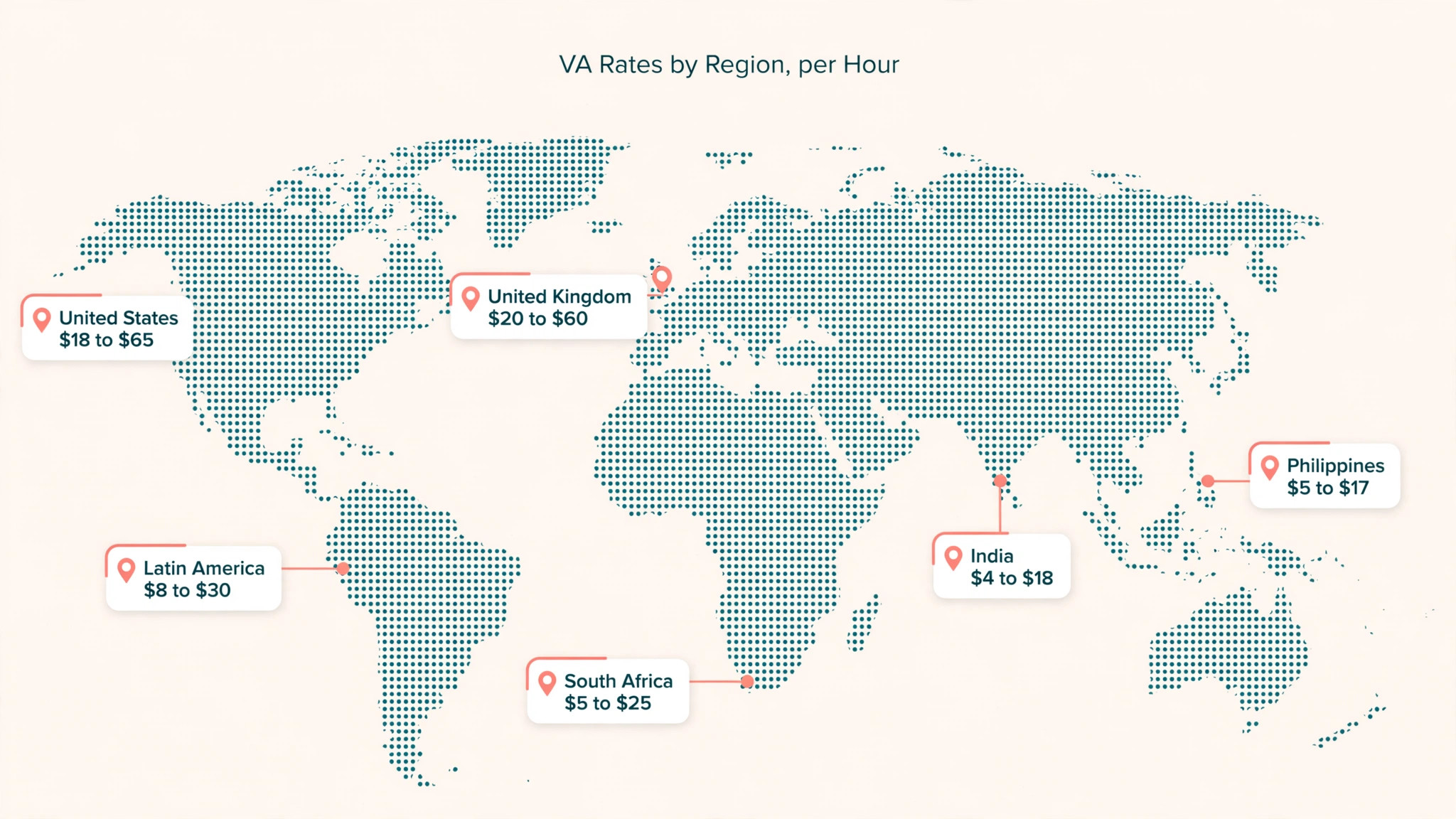
Geography is the single largest driver of price. Current 2026 market guides put the Philippines at roughly 5 to 17 dollars an hour, India at 4 to 18 dollars an hour, Latin America at 8 to 30 dollars an hour, South Africa at 5 to 25 dollars an hour, the United States at 18 to 65 dollars an hour and the United Kingdom at 20 to 60 dollars an hour. Those are wide ranges, and the width is honest. A general admin assistant in the Philippines and a senior executive assistant in the United States are not the same product, even though both carry the virtual assistant label.
Those regional gaps explain most of the variation in the cost of hiring a virtual assistant monthly.
The Philippines is the default choice for English-speaking admin work for a practical reason. English proficiency is high, the business process outsourcing industry is mature, and cultural alignment with United States business norms is strong. A general admin assistant there typically runs 5 to 10 dollars an hour, with specialist work at 10 to 25 dollars an hour. Full-time monthly cost for a Philippines-based assistant commonly lands between 800 and 2,720 dollars through an agency, and lower for a direct hire.
India offers similar pricing, roughly 4 to 9 dollars an hour for general admin and 8 to 18 dollars an hour for specialist work, and it is particularly strong for technical tasks such as WordPress management, data work and automation support. English consistency varies more by individual than in the Philippines, so client-facing writing and phone work need a stricter screening test. Latin America costs more, roughly 8 to 18 dollars an hour for general work and 15 to 30 dollars an hour for specialist work, and the premium buys live overlap with United States hours.
South Africa is the middle option many buyers overlook. Rates run roughly 5 to 25 dollars an hour, English is native level, and the timezone covers the full United Kingdom working day plus United States East Coast mornings. For a United Kingdom buyer, South Africa often gives the best mix of price, language and live hours. The United States and United Kingdom are the premium markets. A United States general assistant runs roughly 20 to 40 dollars an hour, with specialist and executive work at 35 to 65 dollars an hour. A United Kingdom assistant runs roughly 19 to 38 dollars an hour for general work and 30 to 60 dollars an hour for specialist work.
Rates by task type, where specialist work changes the bill
Task type moves price almost as much as region. General admin and data entry is the cheapest category, roughly 3 to 12 dollars an hour offshore and 18 to 30 dollars an hour in the United States and United Kingdom. That covers inbox management, calendar scheduling, travel booking, document formatting, file organisation and expense tracking. It is also the category where a lower rate is safest, because the work is easy to check and easy to correct. Task mix therefore moves the cost of hiring a virtual assistant monthly as much as region does.
Social media and content support costs more, roughly 8 to 25 dollars an hour. The work needs judgement about tone, timing and brand voice, and a mistake is public in a way that a misfiled document is not. Upwork project pricing for social media management, at 500 to 2,000 dollars per project, reflects that judgement premium.
Bookkeeping and finance support runs roughly 12 to 40 dollars an hour, depending on region and software skill. Monthly reconciliation in QuickBooks or Xero, invoice creation and payment tracking, expense categorisation and financial reports all need accuracy and software fluency. Upwork lists bookkeeping projects at 300 to 1,200 dollars, but a business with real transaction volume should budget at the upper end and ask for a software test before hiring.
Customer service sits in a similar band, roughly 10 to 25 dollars an hour for chat and email support, higher for phone support in a native English market. Upwork customer service projects run 500 to 1,500 dollars, and the range reflects coverage hours as much as skill. Evening and weekend coverage costs more than weekday inbox replies, and phone work costs more than chat work.
Technical and automation work is the most expensive category, roughly 15 to 60 dollars an hour and above for advanced work. Setting up automations, managing a WordPress site, building spreadsheet systems and handling integrations needs a different hire from a general assistant, and buyers should budget accordingly rather than expecting a generalist to grow into it at a generalist rate. Executive assistance is also premium, roughly 35 to 65 dollars an hour in the United States market, because it involves judgement, discretion, complex scheduling and stakeholder communication.
Agency versus freelancer costs, and what each fee includes
A freelancer on a marketplace is the cheapest headline rate and the most work for you. Upwork virtual assistants commonly list at 10 to 20 dollars an hour, and direct hires from a job board such as OnlineJobs.ph can run lower still, with the board itself charging 69 dollars a month for a Pro subscription or 99 dollars a month for Premium access to contact workers, while you agree pay directly with the worker. The freelancer model suits buyers who know how to screen, test and manage, and who have time to do it.
An agency charges more per hour and takes the recruiting, vetting, payroll and replacement work off your plate. Time Etc at 36 to 39 dollars an hour, Zirtual at roughly 34 to 46 dollars an hour, Belay at roughly 42 to 50 dollars an hour with monthly totals commonly reported at 2,000 to 5,500 dollars, and Boldly at 65 dollars an hour are all United States and United Kingdom managed services.
Remote staffing agencies that place dedicated offshore assistants charge less, with Virtustant listing rates from 7 dollars an hour all-in and a median client rate of 10.10 dollars an hour in the first half of 2026, and VA Masters listing 7 to 15 dollars an hour for staffing agency placements against 15 to 35 dollars an hour for fully managed services. That included support is part of the cost of hiring a virtual assistant monthly through an agency, not an extra on top of it.
What an agency fee buys is worth listing in full, because buyers often compare only the hourly number. A managed service typically includes candidate screening, skills testing, a replacement guarantee if the match fails, payroll and compliance handling, ongoing supervision and a manager you can escalate to. A marketplace gives you profiles, reviews and a payment rail, and leaves screening, contracting and replacement to you. A job board gives you access to candidates and leaves everything else to you. When a freelancer quits mid-project, you start again. When an agency assistant leaves, the agency replaces them, usually without a new placement fee. For a business where continuity matters, that guarantee alone can justify 10 dollars an hour or more.
A final agency cost to check is the startup or placement fee. Some premium services charge one, some do not, and Time Etc lists no setup fee on its published plans. Ask three questions before signing with any agency. First, is there a setup, placement or minimum term fee beyond the monthly plan. Second, what happens to unused hours at month end, and do they roll over.
Monthly cost table by hours and tasks
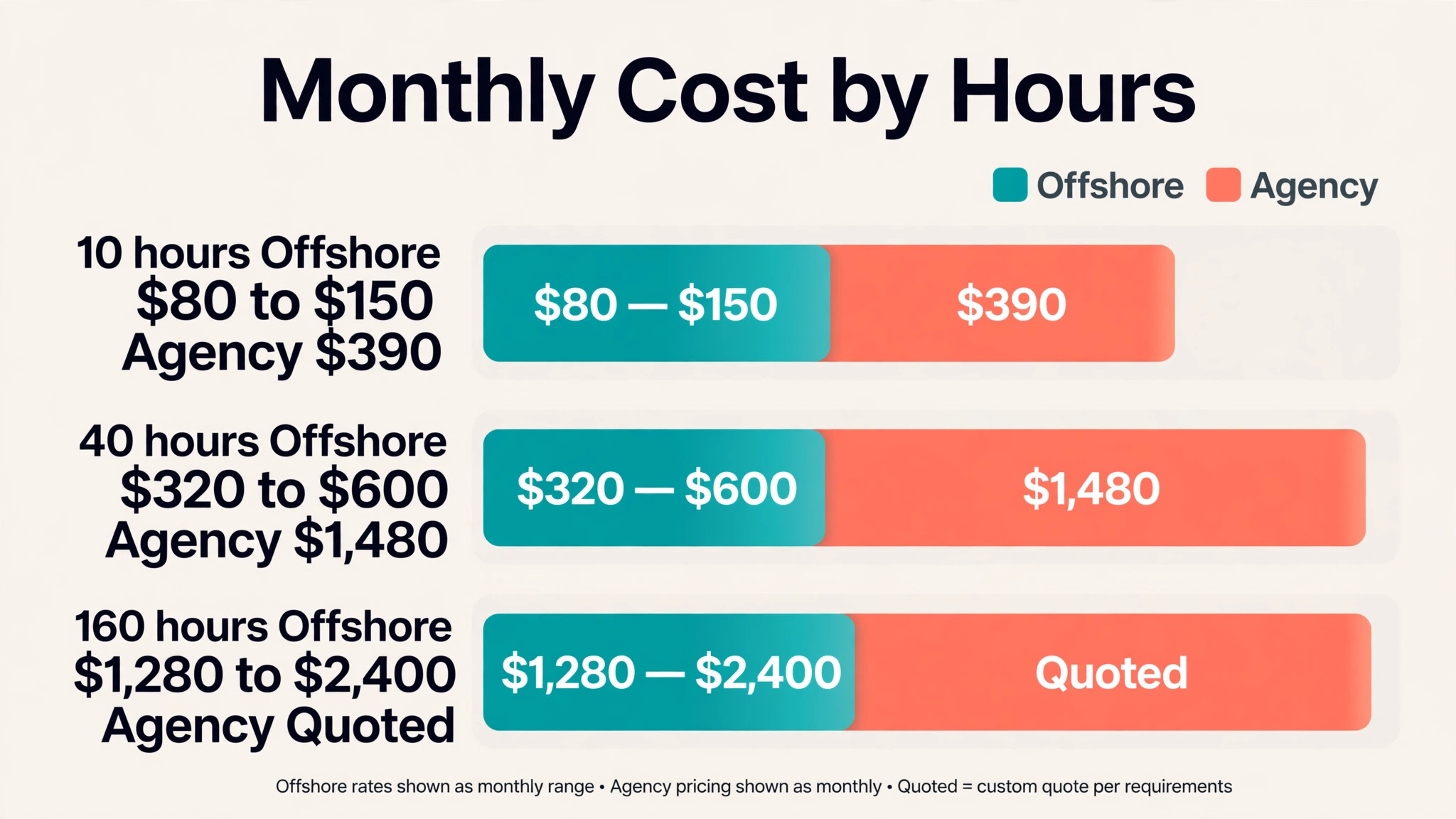
The table below converts hourly rates into monthly totals at the hour bands buyers actually purchase. It uses a four-week month for part-time bands and roughly 160 hours for full time. Platform fees, tools and management time are excluded here and added in the next section, so read the table as the assistant pay line, not the full bill. Use the table to estimate the cost of hiring a virtual assistant monthly at your real hours before you compare quotes.
| Hours per month | Typical work that fits | Offshore freelancer, 8 to 15 dollars an hour | United States agency retainer, 36 to 39 dollars an hour | Premium United States agency, 50 to 65 dollars an hour |
|---|---|---|---|---|
| 10 hours, about 2.5 hours a week | Inbox triage, light scheduling, one small weekly task | 80 to 150 dollars | 390 dollars on a 10 hour plan | 500 to 650 dollars |
| 20 hours, about 5 hours a week | Inbox and calendar, travel booking, basic research | 160 to 300 dollars | 760 dollars on a 20 hour plan | 1,000 to 1,300 dollars |
| 40 hours, about 10 hours a week | Admin plus social scheduling or customer email | 320 to 600 dollars | 1,480 dollars on a 40 hour plan | 2,000 to 2,600 dollars |
| 80 hours, about 20 hours a week | A genuine part-time role, two or three task areas | 640 to 1,200 dollars | About 2,880 to 3,120 dollars at retainer rates | 4,000 to 5,200 dollars |
| 160 hours, full time | A dedicated full-time assistant | 1,280 to 2,400 dollars | Not sold as a standard retainer, quoted on request | About 8,000 to 10,400 dollars at hourly equivalents |
Read the table with two cautions. First, agency retainers above 60 hours a month are usually quoted on request rather than sold as standard plans, because the retainer model is built for fractional help. A buyer who needs 80 hours a month from a United States agency should expect a custom quote, not the 60 hour rate extended neatly. Second, the offshore freelancer column assumes a mid-range generalist. A specialist offshore assistant at 20 to 30 dollars an hour doubles those figures, and a senior United States freelancer at 50 dollars an hour lands close to the premium agency column without the replacement guarantee.
Worked examples make the choice concrete. A solo founder who needs 10 hours a month of inbox and scheduling help pays about 80 to 150 dollars with an offshore freelancer, or 390 dollars with Time Etc. The 240 to 310 dollar monthly gap buys native English, a vetted match and rollover protection on larger plans, and it is worth it when the assistant writes to clients. It is not worth it when the work is internal filing that nobody else sees.
A full-time comparison is starker still. A full-time Philippines-based assistant at 8 dollars an hour costs about 1,280 dollars a month. A full-time United States assistant at 30 dollars an hour costs about 4,800 dollars a month. An employed United States administrative assistant, with payroll taxes, benefits and onboarding, costs considerably more again, with market guides putting the all-in annual cost at 65,000 to 75,000 dollars for a typical hire, or roughly 5,400 to 6,250 dollars a month.
Onboarding and tool costs most budgets miss
The assistant pay line is only part of the first month bill. Onboarding is the first extra cost, and it is mostly your time rather than cash. Expect to spend 5 to 10 hours in the first two weeks writing processes, recording short walkthroughs, granting access and reviewing early work. If your time is worth 50 dollars an hour, that is 250 to 500 dollars of founder time in month one, falling sharply in month two as the assistant works from written guides. Buyers who skip this step usually pay for it later in corrections, so budget the time honestly and treat it as a one-off investment, not a recurring cost.
Onboarding time belongs in the cost of hiring a virtual assistant monthly for month one, even though it fades after that.
Tool costs are the second extra line, and they are smaller than most buyers fear. Most assistants work inside tools you already pay for, such as email, calendar and a project board. The extra seats are where the money goes. Asana Starter is listed at 10.99 dollars per user per month on annual billing, Trello Premium at 10 dollars per user per month on annual billing, Toggl Track Starter at 9 dollars per user per month on annual billing, and Clockify Standard at 5.49 dollars per seat per month on annual billing.
Platform and payment fees are the third extra line. On a 1,000 dollar month through Upwork at a 5 percent client fee, that is 50 dollars. On Fiverr, a 5.5 percent service fee on a 500 dollar order is 27.50 dollars, plus 3.50 dollars on smaller orders.
The fourth extra cost is the one nobody budgets, and it is the cost of a bad hire. Agency guides put the bad hire risk at 20 to 30 percent for marketplace freelancers and 30 to 40 percent for direct hires, against under 5 percent for a managed agency placement. A bad hire costs a month of pay, plus rework, plus a second round of recruiting.
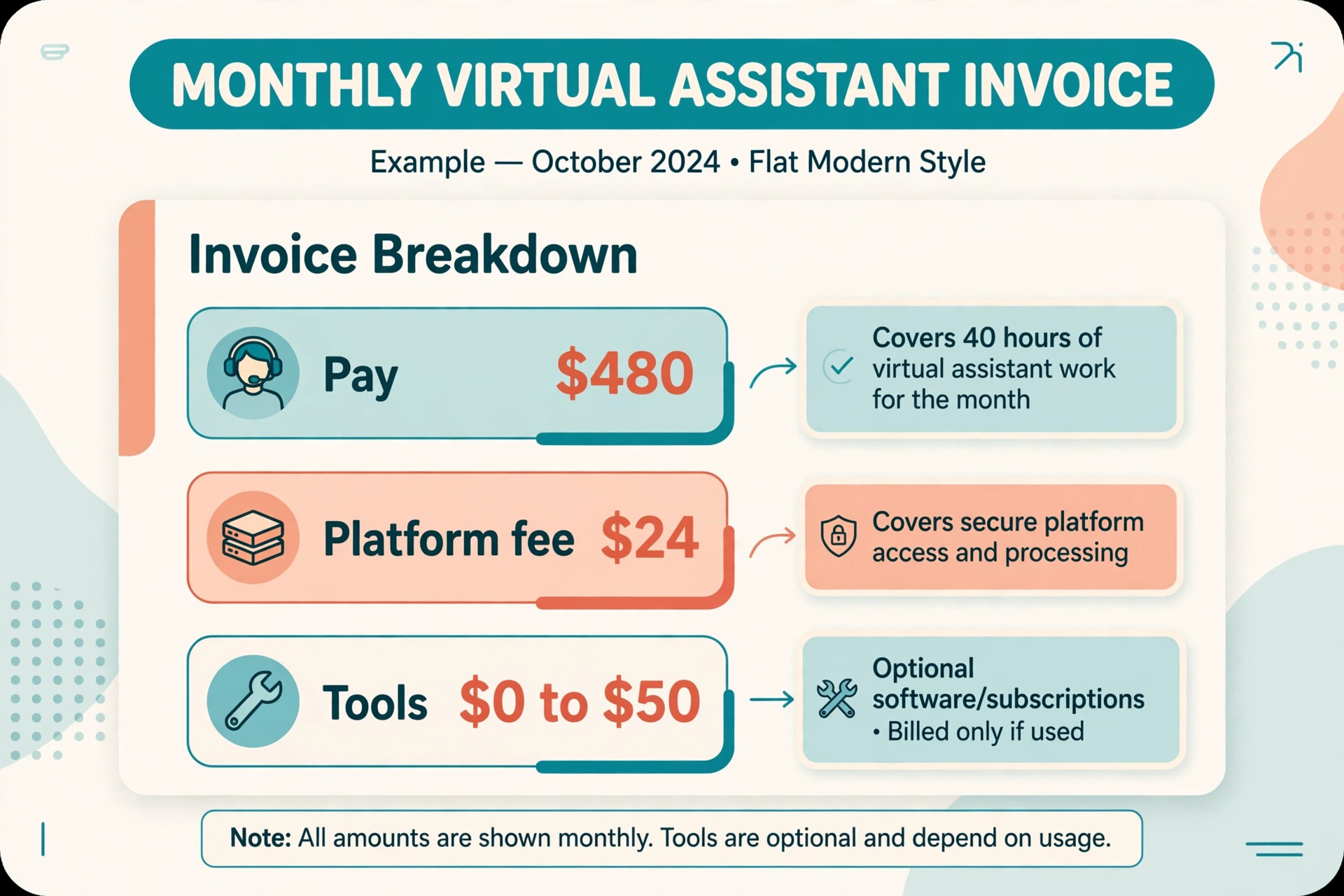
Add those lines together for a realistic first month. A 40 hour offshore hire at 12 dollars an hour costs 480 dollars in pay, plus roughly 24 dollars in platform fees at 5 percent, plus 0 to 50 dollars in tools, plus your onboarding time. The cash total lands near 500 to 550 dollars, with onboarding time on top.
How to scope your first month without overbuying
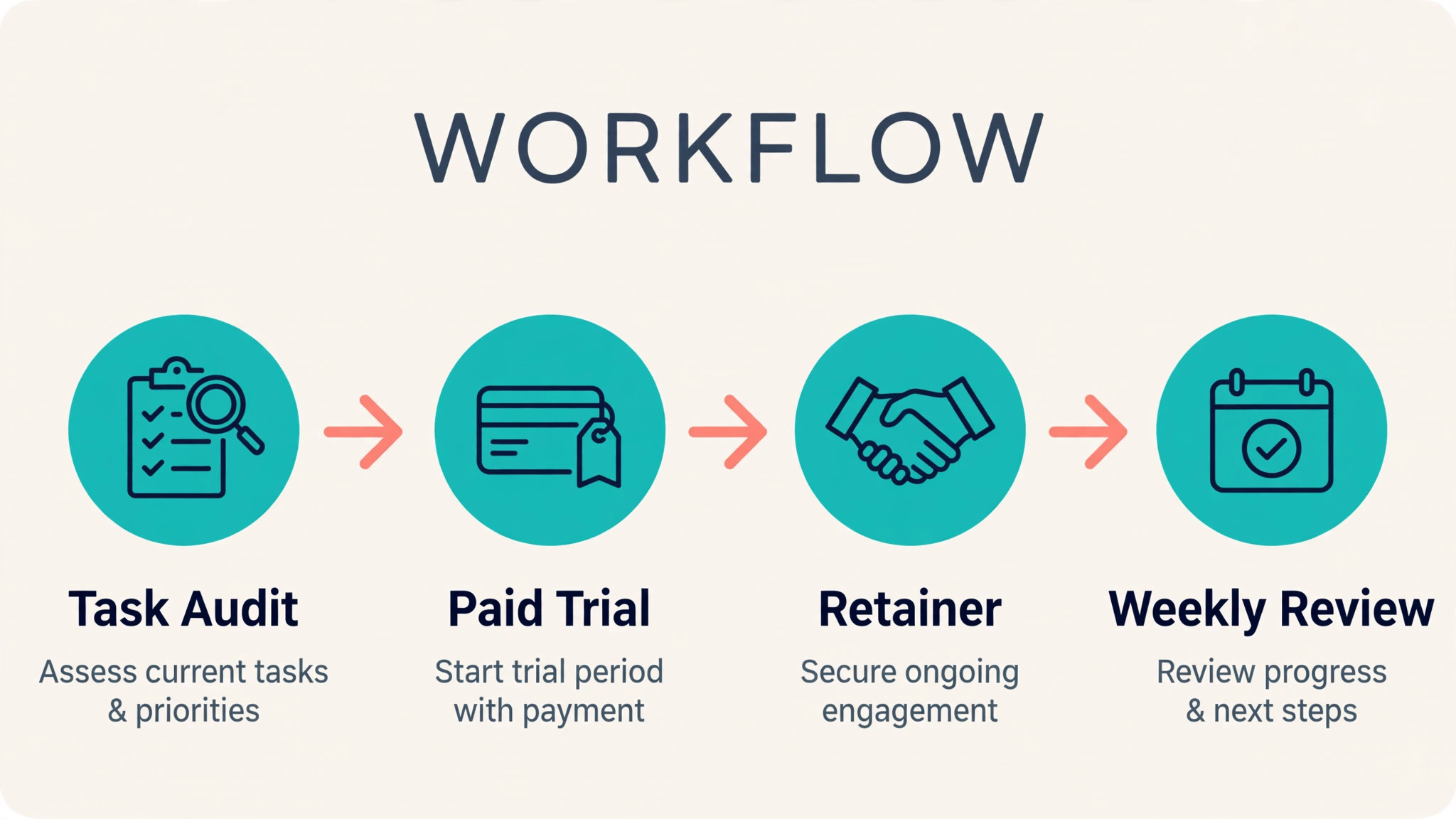
Scoping is where most buyers either overbuy hours they never use or underbuy and overload a good assistant until they quit. Start from your actual week, not an ideal one. Track every task you do for one week, note how long each takes, and mark the ones someone else could do with a written guide. A tracked week gives the honest starting point for the cost of hiring a virtual assistant monthly.
Next, split the list into three groups. Group one is recurring admin that happens every week, such as inbox triage, scheduling and expense logging. Group two is recurring specialist work, such as bookkeeping, social scheduling or customer replies. Group three is one-off projects, such as research, data cleanup or event planning. Group one sets your retainer floor, because it never goes away.
Then set a trial scope before you set a monthly scope. Give the assistant 10 hours of real work across two weeks, covering one task from each group, and judge the output on accuracy, communication and initiative, not speed alone. A trial that only tests easy tasks tells you nothing about the hard ones. At the end of the trial, decide on hours from evidence.
Build in a review rhythm from day one. A 30 minute weekly review in month one, dropping to 15 minutes in month two, catches drift early and costs less than fixing a month of wrong work. Use that review to adjust hours up or down before the retainer renews. Most agencies allow plan changes month to month, and most freelancers accept hour changes with a week of notice, so there is no need to lock in a large number on day one.
Finally, write the scope down in one page before hiring. The page should list the tasks, the weekly hours, the tools, the response time you expect, the quality bar for each task, and what success looks like at 30 days. That page becomes the job post, the trial brief and the review checklist, and it prevents the most common scope failure, which is a hire that drifts into random tasks because nobody defined the job.
Hiring checklist, the questions that protect your budget
Use this checklist before you pay anything, and keep it beside you during screening calls.
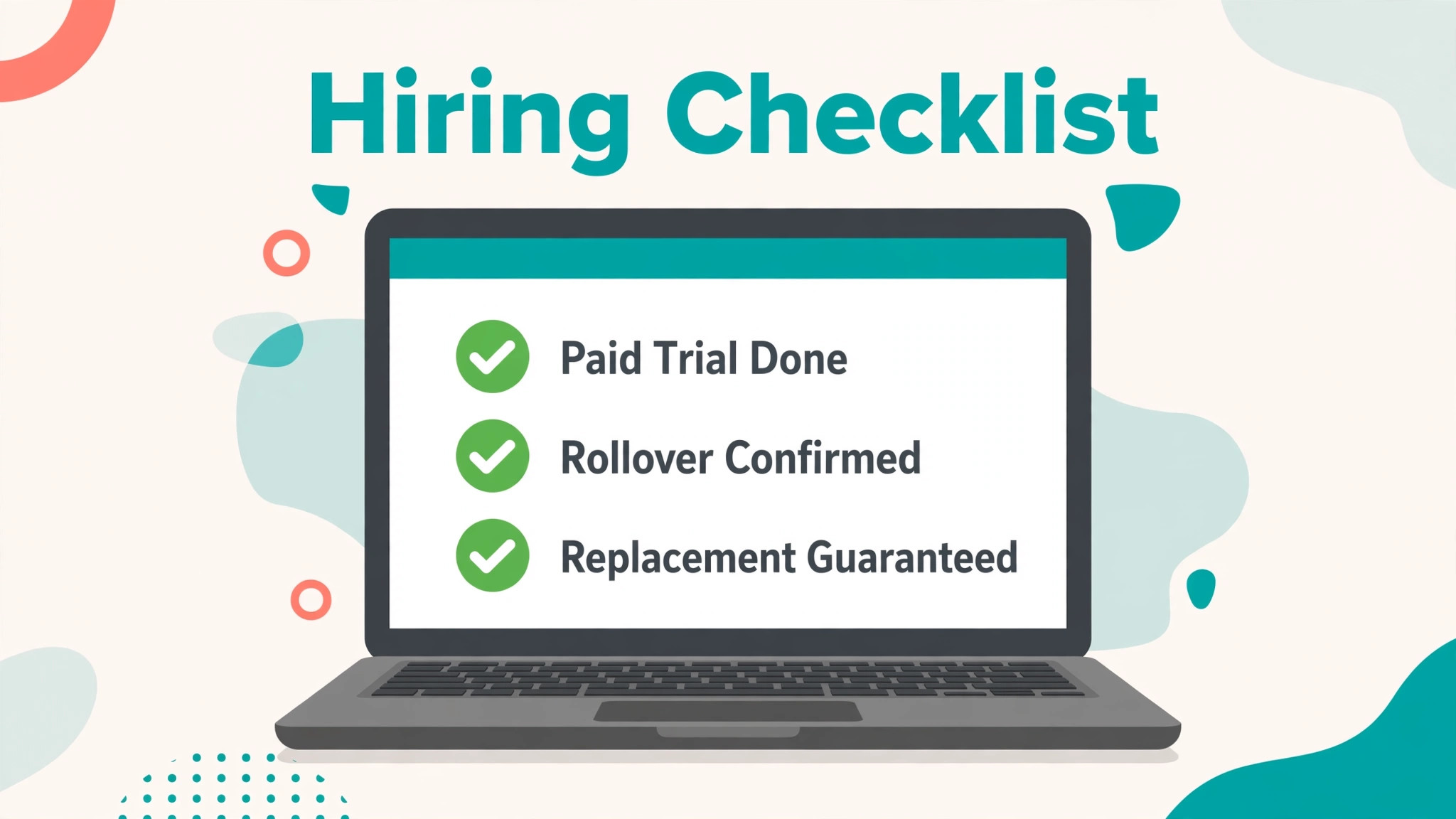
- Confirm the total monthly figure in writing, including platform fees, agency fees and any setup charge, not just the hourly rate.
- Confirm what happens to unused retainer hours at month end, and whether they roll over or expire.
- Confirm who replaces the assistant if they leave, how fast a replacement arrives, and whether a new fee applies.
- Confirm the assistant working hours and timezone overlap, and test it with a live call at a time you will actually work together.
- Run a paid trial of 10 hours over two weeks, covering one easy task, one hard task and one task that needs judgement.
- Test the exact tools the job needs, including email, calendar, bookkeeping software or social scheduling, on a live task.
- Check references or reviews for reliability and communication, not just skill, because missed messages cost more than slow work.
- Agree access rules in writing, including a password manager, separate logins where possible, and removal of access on the last day.
- Agree a weekly review time and a simple way to track hours, tasks completed and issues raised.
- Set a 30 day decision point in advance, with clear criteria for continuing, changing hours or ending the arrangement.
- Review the bill on the first day of each month, and cancel any tool seat, job board subscription or unused retainer hours that no longer earn their place.
For related reading, see how to keep freelance admin tidy with Google Sheets for freelance invoicing, plan client time with Calendly for consultation bookings, organise recurring work in Trello for a content calendar system, and cut follow-up busywork with Zapier for lead follow-up automation. Those guides cover the tools and habits that make a new assistant productive in week one rather than month three.
Frequently Asked Questions
How much does a virtual assistant cost per month for 10 hours a week?
Ten hours a week is about 40 hours a month. An offshore freelancer at 8 to 15 dollars an hour costs roughly 320 to 600 dollars a month, while a United States agency retainer for 40 hours costs 1,480 dollars with Time Etc. Add platform fees of about 3 to 5 percent on a marketplace hire, or nothing extra on an agency plan where fees are included, plus 0 to 50 dollars for tool seats.
Is a retainer cheaper than hourly billing?
A retainer is usually cheaper per hour, because the effective rate falls as hours rise, and it is cheaper in total when the workload is steady. Time Etc drops from 39 dollars an hour at 10 hours to 36 dollars an hour at 60 hours. Hourly billing is cheaper in total when work is irregular, because you pay only for hours used and never pay for idle retainer hours that expire.
What is the cheapest reliable way to hire a virtual assistant?
The cheapest reliable route for most buyers is a dedicated offshore assistant through a staffing agency at roughly 7 to 15 dollars an hour, with a paid trial before committing. Direct hiring from a job board can cost less per hour, but it takes far more of your time to screen and manage, and the replacement risk sits entirely with you.
Do agencies cost more than freelancers for the same hours?
Yes, on headline rate, and often no on total cost. A United States agency at 36 to 39 dollars an hour looks expensive beside a freelancer at 10 to 20 dollars an hour, but the agency price includes screening, payroll, supervision and replacement. A freelancer price excludes your recruiting time, your management time and the cost of rehiring if the match fails.
How many hours should I buy in my first month?
Start with the hours your tracked week proves you can delegate, usually 20 to 40 hours a month for a first hire, and run a 10 hour paid trial first. Start one band lower than you think you need, review weekly, and scale up once the workflow is proven. Buying 60 hours before the processes exist wastes money and overloads a new assistant.
Budget for platform fees of 3 to 5 percent on marketplace hires, tool seats of roughly 5 to 11 dollars each per month, job board access of 69 or 99 dollars a month while hiring, and 5 to 10 hours of your own onboarding time in the first two weeks. The largest hidden cost is a bad hire, which is why a paid trial and a replacement guarantee matter more than a small hourly saving.
Buy Back Your Week Without Buying a Problem
The best hire is rarely the cheapest quote and rarely the most expensive one. It is the hire whose hours match your real workload, whose skills match your hardest tasks, and whose channel matches how much management you are willing to do yourself. An offshore freelancer at 8 to 15 dollars an hour is excellent value for defined admin work with a written process. A United States retainer at 36 to 39 dollars an hour is excellent value for client-facing work where language, timezone and continuity matter. Judge every option by the cost of hiring a virtual assistant monthly in total, including fees, tools and your management time.
Start this week with the one-week task audit, write the one-page scope, and run a 10 hour paid trial with your top candidate. Price the trial, the retainer and the full-time equivalent side by side before you commit, and review the bill on the first day of every month.