

If you want to know how to build a personal brand with AI, start with an uncomfortable fact: most personal brands fail not because the creator lacks talent, but because nobody can say in one sentence what the creator is for. AI can help you write faster, design better, and publish more often, but it cannot decide your position for you. That decision is the work. Everything else in this guide, from tools to posting schedules, exists to support it.
A personal brand is simply what people expect from you before they meet you. When a hiring manager, a client, or a potential customer sees your name, they should be able to predict the kind of problem you solve and the kind of result you deliver. AI tools in 2026 make the production side of that reputation cheaper than ever. A single person can now publish a polished newsletter, a short video, and a set of social posts in the time it once took to write one blog article. The risk is that cheaper production tempts people to publish more and think less. The creators who win are the ones who use AI to sharpen a clear message, not to multiply a vague one.
This guide takes a proof first approach. Instead of starting with a logo, a colour palette, or a posting streak, you will start with evidence: real work, real results, and real opinions that a specific audience can check. AI then helps you package that evidence into content people can find, trust, and remember.
Quick Answer: What a Personal Brand Is, and How Long It Takes
A personal brand is a reputation you manage on purpose. It has three parts. First, a niche: the specific group of people you serve. Second, a promise: the outcome those people get from following you. Third, proof: public work that shows you can deliver it. If any of the three is missing, the brand wobbles. A niche with no promise is just a hobby account. A promise with no proof is just a claim.
How long does it take? Plan on 90 days to see the first real signals, and 6 to 12 months to build something that brings inbound opportunities on its own. In the first 90 days, the honest goal is not virality. It is 20 to 30 pieces of content, a small audience that comments rather than just scrolls past, and one or two conversations that turn into work, clients, or collaborations. Anyone promising a personal brand in a weekend is selling a template, not a reputation.
AI shortens the production part of that timeline, not the trust part. You can draft a week of posts in an afternoon. You cannot compress the weeks it takes for strangers to decide you are worth following. Expect the first month to feel quiet. That is normal, and it is where most people quit.
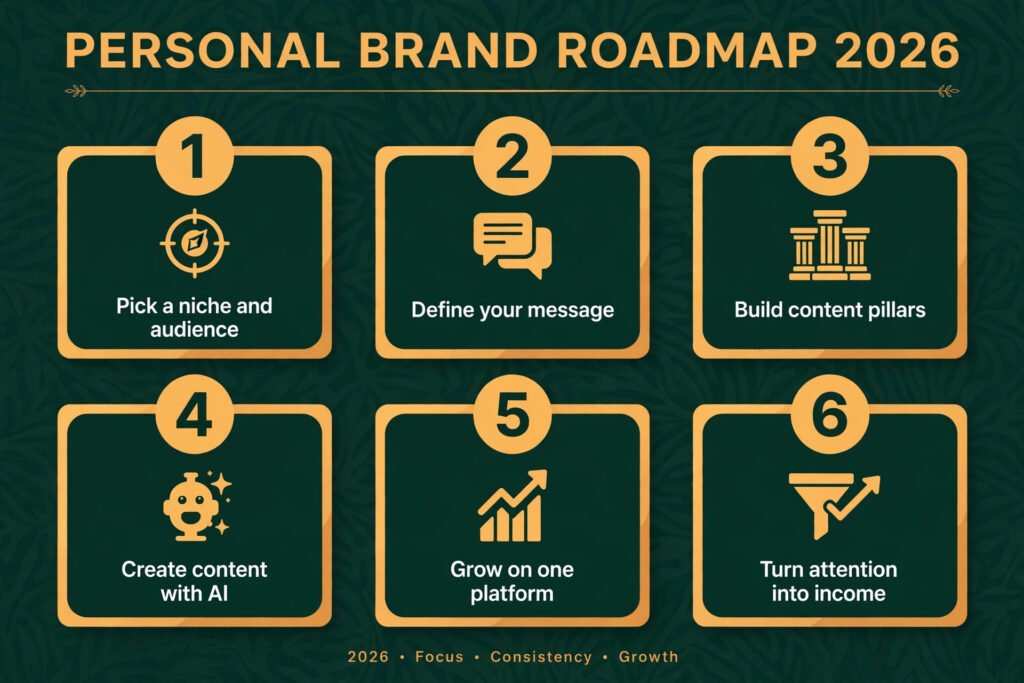
Step 1: Pick a Niche and an Audience You Can Name
A niche is not a topic. “Marketing” is a topic. “Email marketing for independent gyms” is a niche. The difference is whether you can picture one real person reading your work and thinking, “this was written for me.”
Start with three filters. First, what have you actually done? A brand built on experience you do not have will collapse the first time someone asks a hard question. Second, what do people already ask you for help with? Those questions are market research you did not have to pay for. Third, can you name 50 content ideas in this niche without repeating yourself? If you run dry at idea twelve, the niche is too narrow or too far from your real interests.
AI can help you test a niche before you commit to it. Ask a chatbot to list the top 30 questions beginners ask in your niche, then check which ones you can answer from experience. Search social platforms for creators in the space and note what their audiences complain about in comments. Complaints are gaps. If ten people say “everyone explains the theory but nobody shows the numbers,” you have found your angle.
Write your niche down in one sentence: “I help [audience] get [outcome] without [common pain].” For example: “I help freelance designers get steady clients without cold pitching.” If you cannot fill in the blanks, you are not ready to post yet. Keep narrowing until you can.
One warning: do not pick a niche only because it looks profitable. Personal brands run on consistency, and consistency runs on interest. A niche you find boring will beat you in month three, when the novelty wears off and the audience is still small. Pick the overlap of what you know, what people need, and what you can still care about after 100 posts.
Step 2: Define Your Message in One Clear Promise
Your message is the promise your content keeps making. It should fit in a bio, a headline, and a conversation. If a stranger reads your profile and cannot tell what they will get by following you, your message is not finished.
A useful message has three ingredients. The audience, the outcome, and the proof style. Audience tells people whether they belong. Outcome tells them why they should stay. Proof style tells them how you will convince them: data, case studies, tutorials, teardowns, or opinionated takes. A data driven creator and a story driven creator can serve the same niche and attract different audiences. Pick the style that matches how you actually think.
Use AI as a drafting partner here, not a decision maker. Feed it your niche sentence and ask for ten bio variations, then reject most of them. The point is not to accept the first polished line. It is to see which version makes you slightly uncomfortable, because the uncomfortable ones are usually the specific ones. “I write about productivity” is comfortable and forgettable. “I help remote managers run fewer, better meetings” is specific enough to attract the right people and repel the rest. Repelling the rest is a feature, not a bug.
Test your message before you build around it. Post five pieces of content that each deliver on the promise, then watch what happens. Do the right people comment? Do they ask follow up questions? Do they share it with someone like them? If the response is silence from everyone, the message may be too broad. If the response comes from the wrong audience, the message may be aimed at the wrong people. Adjust once, then commit for at least 30 posts before judging again. Constant rebranding is the most common way to stay unknown.
Step 3: Build Content Pillars So You Never Run Out of Ideas
Content pillars are the three to five themes you return to again and again. They solve the most common beginner problem: staring at a blank calendar with no idea what to post. With pillars, every week has a shape. Without them, every week starts from zero.
A practical set of pillars for most personal brands looks like this. Teach: how to guides, frameworks, and breakdowns that solve a real problem. Prove: case studies, results, before and after comparisons, and client work with numbers. Opine: strong views on trends, tools, and common advice in your niche. Behind the scenes: your process, your mistakes, and what you are learning right now. Answer: direct responses to questions your audience actually asks.
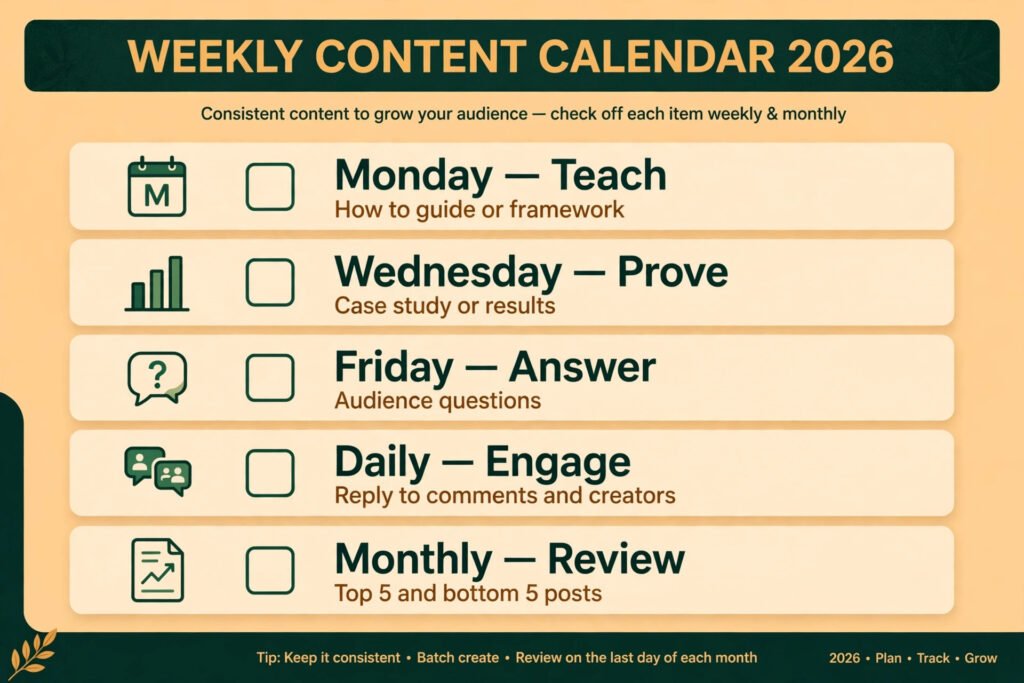
Pick three pillars to start, and assign each one a day or a slot. For example, teach on Monday, prove on Wednesday, and answer questions on Friday. This rhythm matters more than volume. An audience learns when to expect you, and you learn what to make next without a daily debate.
AI is genuinely useful at the pillar stage. Give it your niche and ask for 20 topic ideas per pillar, then keep the ten that you can answer from experience and delete the rest. The goal is a backlog of 30 to 50 ideas before you publish anything. A backlog removes the panic that leads to low effort posts, and it lets you batch production, which is where AI tools save the most time.
Revisit your pillars every quarter. Drop the pillar that gets the weakest response and double down on the one that brings comments, shares, and inbound messages. A personal brand is not a fixed identity. It is a hypothesis you refine with evidence.
Step 4: Create Content with AI Tools Without Sounding Like Everyone Else
This is where most AI assisted brands go wrong. They generate generic posts, publish them unchanged, and wonder why nobody engages. AI output is a first draft, not a finished voice. Your job is to add the three things AI cannot fake: your experience, your opinion, and your evidence.
Use a simple workflow. First, write your own rough point in two or three sentences: what you believe, and what happened that made you believe it. Second, ask an AI writing tool to expand that point into a draft, a hook, or a set of variations. Third, edit hard. Cut anything you would not say out loud. Add a specific number, a real example, or a counterintuitive detail. If the draft could have been written by any creator in your niche, it is not ready.
Different formats need different tools. Written posts and newsletters benefit from AI writing assistants that help with structure and editing. Short video benefits from AI editing tools that cut silences, add captions, and turn one long recording into several clips. Design benefits from AI assisted templates that keep your visuals consistent without a designer on staff. Scheduling tools then handle the boring part: publishing at the right time, on the right platform, without you babysitting the queue.
One rule protects your credibility: never publish an AI claim you have not checked. AI tools invent statistics, misquote sources, and confidently describe features that do not exist. If a post includes a number, a price, or a quote, verify it before it goes live. Your audience will forgive a plain post. They will not forgive a false one.

Step 5: Grow on One Platform First
The biggest beginner mistake is launching on five platforms at once. Each platform has its own format, its own audience behaviour, and its own algorithm. Spreading thin across all of them produces five weak presences instead of one strong one. Pick one primary platform, grow there for 90 days, and only then repurpose the best content elsewhere.
Choosing the platform is a practical decision, not a popularity contest. If your strength is writing, start with a newsletter or a text first platform. If you are comfortable on camera, short video will compound faster. If your audience is visual, a design led platform makes sense. If your buyers are businesses, a professional network will bring better leads than a larger but less relevant audience.
A realistic 90 day plan on one platform looks like this. Weeks 1 to 2: publish three times a week, study which posts get comments, and reply to every comment within a day. Weeks 3 to 6: increase to four or five posts a week, start one recurring series so followers know what to expect, and engage daily with ten creators in your niche. Weeks 7 to 12: double down on the top performing format, start a small email list to own part of your audience, and pitch one collaboration or guest appearance.
Engagement is not optional. Algorithms reward creators who create conversations, not just content. Spend at least 20 minutes a day commenting thoughtfully on other people’s posts in your niche, not with generic praise but with a real addition: a question, a counterpoint, or a relevant example.
Repurposing comes second. Once a post performs well on your primary platform, turn it into a newsletter section, a short video script, or a carousel. AI tools make this conversion fast, but the order matters: prove the idea once, then spread it. Repurposing unproven ideas just multiplies silence.
Step 6: Turn Attention into Income Without Selling Out Your Audience
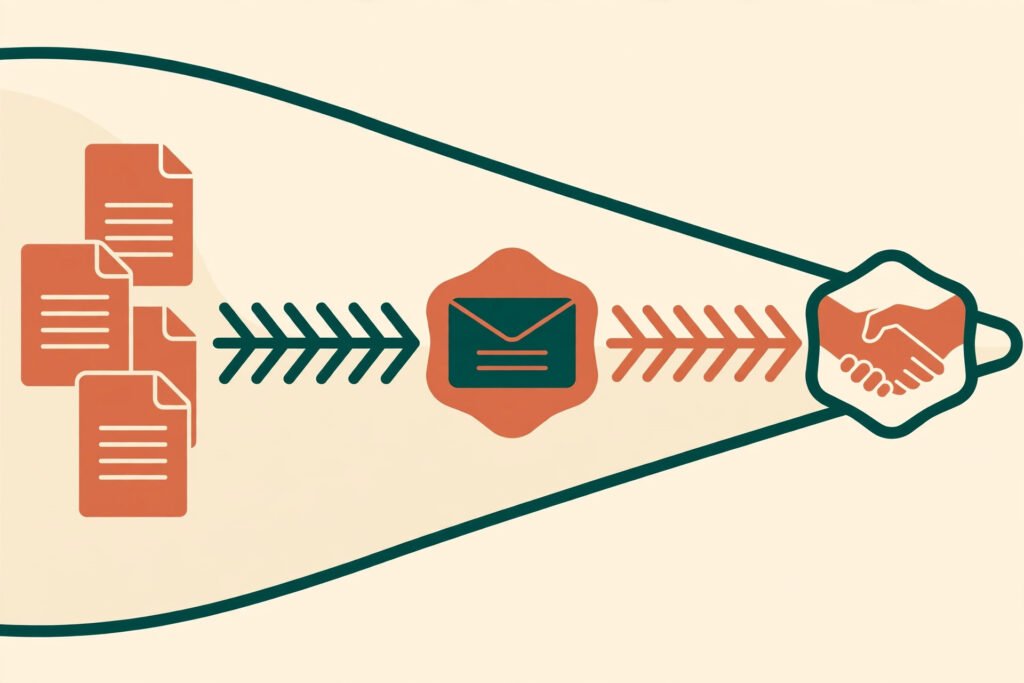
Attention is not income. Plenty of creators have large followings and empty bank accounts, because they never built a bridge between content and an offer. The bridge should be built early, even before you feel ready, because it shapes what you create.
There are four common income paths, and most successful creators combine two or three. Services: consulting, coaching, or freelance work for people who want your help directly. This is usually the fastest first income, because it needs the smallest audience. Digital products: templates, courses, or guides that package what you teach. These scale, but they need a proven topic and a warm audience. Affiliate income: recommending tools you genuinely use and earning a commission. This works only if your recommendations are honest and selective. Sponsorships: brands paying for access to your audience. These come last, because brands buy reach and trust, and trust takes time.
Price your first offer by the result, not by the hour. A client who pays for “four coaching calls” is buying your time. A client who pays for “a personal brand launch in 30 days” is buying an outcome. Outcome based offers are easier to sell, easier to price, and easier to deliver well, because both sides know what success looks like.
Use AI to support the business side too. AI tools can draft sales pages, write email sequences, and summarise client feedback into testimonials and case studies. But keep the relationship human. Reply to client messages yourself. Show up on calls yourself. The moment your audience feels they are talking to a machine, the trust that makes everything else work starts to leak.
Set one honest milestone: your first paying client or your first 100 email subscribers, whichever comes first. Celebrate it, document how it happened, and turn that story into content. Proof of one real result beats a hundred posts about future success.

AI Tools Compared: What to Use for Writing, Video, Design, and Scheduling
The tools below cover the four jobs a personal brand needs. Prices are October 2026 plan models; check checkout for current rates, since vendors change tiers often. Pick one tool per job and learn it properly before adding another.
| Job | Tool | Free option | Paid model | Best for |
|---|---|---|---|---|
| Writing and drafting | ChatGPT | Yes, limited models | Subscription, check checkout | Outlines, hooks, and first drafts |
| Writing and editing | Jasper | Trial | Subscription, check checkout | Brand voice templates and long form posts |
| Writing polish | Grammarly | Yes, basic checks | Subscription, check checkout | Grammar, tone, and clarity checks |
| Short video editing | Descript | Trial | Subscription, check checkout | Editing video by editing text, captions |
| Short video editing | CapCut | Yes, core features | Subscription, check checkout | Fast vertical video for social platforms |
| Design | Canva | Yes, core templates | Subscription, check checkout | Consistent carousels, thumbnails, and covers |
| Scheduling | Buffer | Yes, limited channels | Subscription, check checkout | Simple multi platform scheduling |
| Scheduling | Later | Yes, limited posts | Subscription, check checkout | Visual planning for image led platforms |
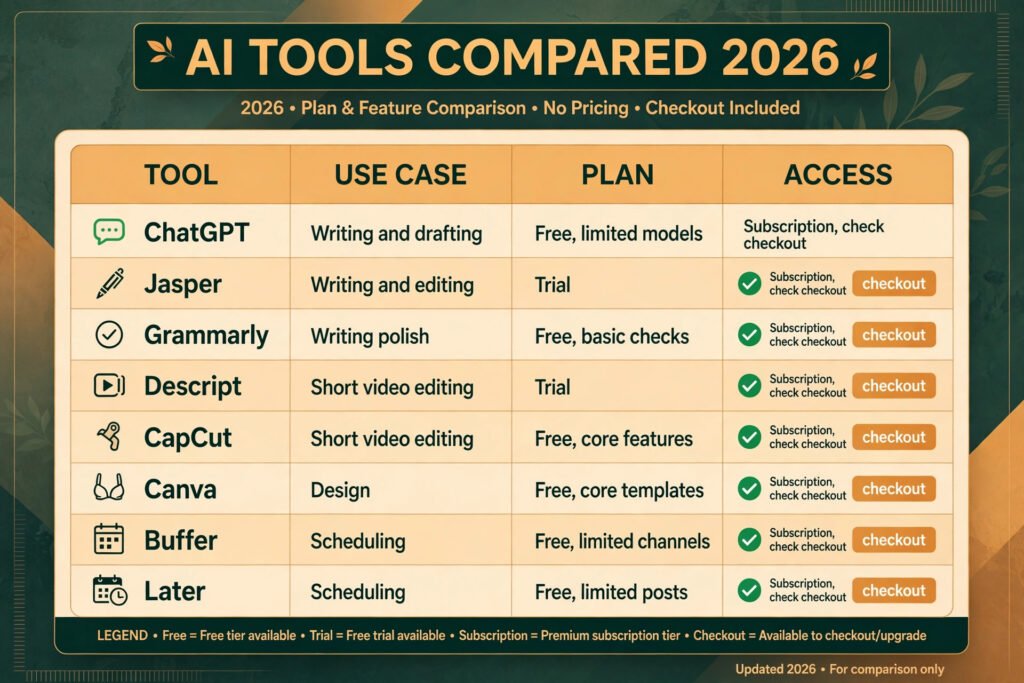
For writing, ChatGPT is the most flexible starting point, and a dedicated writing assistant like Jasper suits creators who publish long form content every week. For editing and polish, a tool like Grammarly catches the errors that undermine credibility. For video, Descript suits creators who think in words, while CapCut suits creators who shoot on their phone and want speed. For design, Canva is the default choice for non designers, and for scheduling, Buffer keeps a simple queue running while Later suits visual planners.
If you are starting out, the minimum stack is three tools: one writing assistant, one design tool, and one scheduler. Add video editing when you commit to video, not before. Every tool you add costs learning time, and learning time is the real budget.
Writers building a newsletter or a blog will also benefit from the tools covered in our guide to the best AI tools for freelance writers. Creators growing on a visual platform should read our guide to the best AI tools for Instagram for platform specific tactics.
How to build a personal brand with AI: Choosing Your Platform
Platform choice should follow your audience, not the latest trend. Ask three questions. Where does your audience already spend time? What format do you enjoy making enough to sustain for a year? Where can a stranger discover you without already knowing your name?
A professional network suits business services and consulting, because buyers search for expertise there. A video platform suits creators whose personality and teaching style carry the content. A newsletter suits writers who want to own their audience rather than rent attention from an algorithm. A visual platform suits design, food, travel, and lifestyle niches where the work speaks in images.
Do not confuse audience size with audience value. A thousand followers who buy, refer, and reply are worth more than fifty thousand who scroll past. Look at who engages, not just who follows. If your comments come from potential clients, you are on the right platform even if your growth looks slow. If your comments come only from other creators chasing growth, you may be entertaining your competitors instead of serving your buyers.
Whatever you choose, build an email list in parallel from day one. Social platforms change their rules, reach, and algorithms without warning. An email list is the one channel you control. Offer something small and useful in exchange for an address: a checklist, a template, or a short guide. Even a list of 100 engaged readers is an asset no algorithm can take away.
Mistakes to Avoid
Copying a bigger creator’s voice. Studying successful creators is smart. Sounding like them is not. Audiences follow people, not imitations. Borrow structure, not personality.
Posting without a point of view. Safe, generic advice gets ignored because it could come from anyone. Take a position, even a small one. “Post every day” is generic. “Post three times a week and spend the saved time replying to comments” is a position someone can agree or disagree with, and disagreement drives engagement.
Chasing followers instead of conversations. Follower counts look good in screenshots. Comments, replies, and direct messages are what lead to clients, collaborations, and sales. Optimise for replies.
Letting AI publish unchecked. AI drafts with invented statistics, wrong prices, or claims about tools you never used will damage your credibility faster than a quiet month ever could. Check every fact, and only recommend tools you have actually tried.
Rebranding every month. A new niche, a new name, and a new visual style every few weeks signals uncertainty. Commit to one niche and one message for at least 90 days before judging the results.
Selling too early, or never selling at all. Pitching a course to an audience of twelve feels desperate. Never offering anything to an audience of twelve thousand wastes the trust you built. Introduce a small, useful offer once you have proof and a few dozen engaged followers.
Ignoring analytics. You do not need complex dashboards. Once a month, look at your top five posts and your bottom five. The pattern in the top five tells you what to make more of. The pattern in the bottom five tells you what to stop making.

Frequently Asked Questions
How long does it take to build a personal brand with AI?
Expect 90 days for the first real signals, such as regular comments and inbound conversations, and 6 to 12 months for steady inbound opportunities. AI speeds up production, but trust still builds over weeks and months of consistent, useful content.
Do I need to show my face to build a personal brand?
It helps, because faces build trust faster than logos. But it is not required. Many successful creators build brands around their work, their writing, or their voice. If you prefer not to appear on camera, use written content, screen recordings, and voiceovers, and let your results carry the credibility.
How much money do I need to start?
Very little. A free writing assistant, a free design tool, and one social platform are enough to start. Pay for tools only when a free plan limits something you actually do every week. Most beginners overspend on tools and underspend on time spent engaging with their audience.
Can AI write all my content for me?
It can draft, but it should not publish unchecked. AI lacks your experience, your opinions, and your evidence, which are exactly what make a personal brand worth following. Use AI for outlines, variations, and editing, then add your own examples and judgment before publishing.
Which platform should I start on?
The one where your audience already spends time and where you enjoy creating. Writers do well with newsletters and text platforms, video creators do well with short video, and business sellers do well on professional networks. Pick one, commit for 90 days, and build an email list alongside it.
How do I stand out if everyone uses the same AI tools?
By being specific. Same tools, different proof. Share your real numbers, your real mistakes, and your real opinions. Two creators can use the same writing assistant and produce completely different brands, because the differentiator is what they know and what they are willing to say.
Conclusion
Learning how to build a personal brand with AI comes down to a simple order of operations: decide what you are for, prove it in public, and use AI to package that proof faster and more consistently than you could alone. Skip the decision and the proof, and AI will only help you publish generic content at scale. Get them right, and AI becomes a genuine advantage: more output, better packaging, and more time for the conversations that actually grow a brand.
Start this week with three actions. Write your one sentence niche statement. Draft your content pillars and a backlog of 30 ideas. Publish your first five pieces on one platform, and reply to every comment you receive. Ninety days from now, you will not have a finished brand, but you will have something far more valuable: evidence about what your audience wants, and a system for delivering it. That evidence is the foundation every lasting personal brand is built on.