

Most legal consumers start with an online search before they ever call a firm, and in 2026 that search often happens inside an AI answer engine as well as Google. A firm that is invisible to both is invisible to the market, and that is the blunt reason to learn how to use ai for law firm marketing now rather than next year. Firms with a structured AI strategy are 3.9 times more likely to report meaningful business benefits than firms without one, according to the Thomson Reuters and Georgetown Law State of the Legal Market report, and the gap between early adopters and laggards keeps widening.
This guide gives a small firm a practical 90 day plan. It covers intake automation, AI assisted content, local search and AI citation, paid ads, reviews, and the ethics rules that govern all of it. Prices come from vendor pages and comparisons checked in late 2026, so check the vendor pricing page before committing, because AI tool pricing changes often. Nothing here replaces attorney judgment. Every AI draft needs a lawyer review before it reaches a client or the public.
The plan works because law firm marketing follows patterns AI handles well. Content, intake, and client alerts are repeatable jobs with clear inputs and outputs, and AI makes each one faster without removing the lawyer from the decision. The firms gaining share right now use AI for four high value tasks. They publish local landing pages for each city and practice area. They qualify and respond to inbound leads in under two minutes. They publish client alerts the day a new rule or opinion drops. And they draft paid search ad variants that reflect practice scope without breaking advertising rules.
Why AI Fits Law Firm Marketing
Law is a knowledge business with a trust problem. A prospective client cannot judge legal skill before hiring, so they judge signals instead. A website that answers their exact question, a fast reply to their enquiry, reviews from past clients, and clear practice area pages all signal competence before the first call. AI speeds up the production of every one of those signals, which is why it fits this market so well.
The second reason is speed of response. Leads contacted within minutes convert far better than leads contacted the next day, and most small firms still take hours to reply. AI intake tools answer the phone, screen the caller, capture the facts, and book the consultation in seconds, day or night. That single change lifts conversion more than any new ad campaign, because it fixes the leak at the point where interested people currently go quiet.
The third reason is cost. Marketing spend at small firms averages 6.2 percent of revenue, according to the 2026 Thomson Reuters State of the US Legal Market report, yet more than 70 percent of firm leaders say they cannot tell which marketing dollars are working. AI tools that track intake source, response time, and conversion give a small firm the measurement that used to need a marketing department. A firm that knows which channel brings signed cases can stop paying for the channels that bring only clicks.
The Plan: How to Use AI for Law Firm Marketing in 90 Days
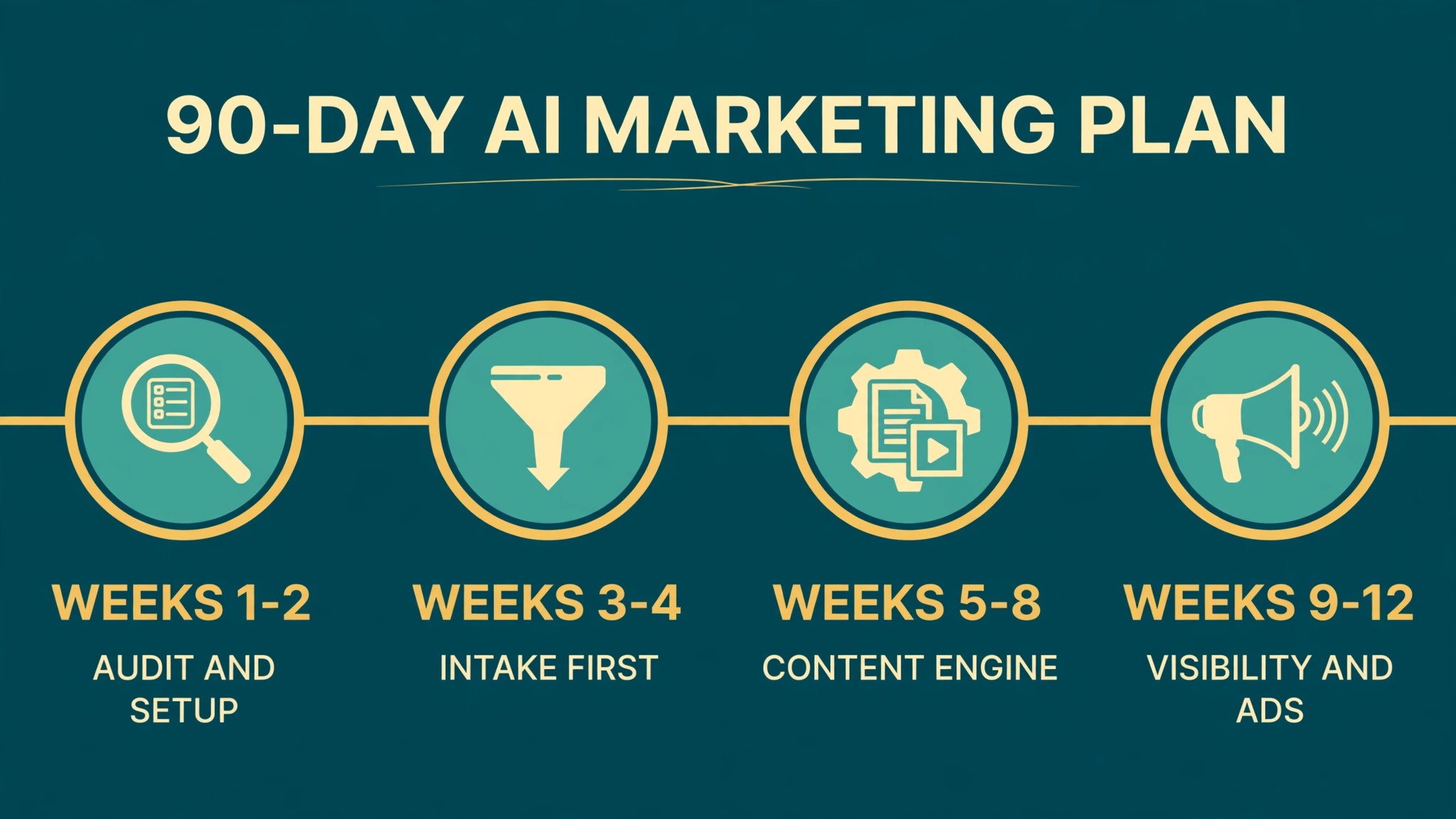
| Phase | Weeks | Main job | Done looks like |
|---|---|---|---|
| Audit and setup | 1 to 2 | Measure the baseline | Intake sources, response times, and top pages listed |
| Intake first | 3 to 4 | Answer every lead fast | AI intake live, consults booked in minutes |
| Content engine | 5 to 8 | Publish answers weekly | 8 practice pages live, each reviewed by a lawyer |
| Visibility and ads | 9 to 12 | Win local search and AI citations | Google Business Profile current, ads tested, reviews flowing |
The plan starts with measurement because a firm cannot improve what it does not count. Count where enquiries come from, how fast each one gets a reply, and how many become signed cases. Most firms discover that one channel brings most signed cases and two channels bring almost none, and that discovery alone saves money. Set up call tracking and a simple CRM before buying any AI tool, since the tools are only useful if their results are measured.
Phase two fixes intake before spending more on traffic. There is no point buying clicks that sit unanswered for a day. Phase three builds the content that earns search and AI citation, one practice area at a time. Phase four adds local visibility and paid ads once the intake and content foundations hold. A firm that follows this order spends less and learns faster than a firm that buys ads first and fixes intake later.
Step 1: Audit Your Current Marketing
Start by listing every way a client can reach the firm. Website forms, phone, email, Google Business Profile, social messages, and referrals each need a named owner and a response time target. Pull the last 90 days of enquiries and tag each one by source, practice area, and outcome. The pattern that emerges usually surprises partners, because the channel they believe works best is rarely the one that signs the most cases.
Next, test the website as a stranger would. Search for your top practice area plus your city, click the result, and try to book a consultation from a phone in under two minutes. Note every step that feels slow, every page that hides the phone number, and every form that asks for too much. A prospective client with an urgent problem will not fight a bad form. They will call the next firm on the list.
Then check the numbers that decide the budget. Cost per enquiry, cost per signed case, and average case value by practice area tell you where AI spending earns its keep. A personal injury firm with a high case value can afford a 150 dollar a month intake tool easily. A firm with low value matters needs a cheaper stack and stricter tracking. Write the three numbers down and revisit them monthly, because the whole plan is judged against them.
Step 2: Put AI on Intake First
Intake is the highest return AI job in a law firm, and it should come before content. AI intake software automates client intake, qualifies leads, and schedules consultations, and the tools built for this job include Clio Grow, Lawmatics, and Intaker. AI receptionists such as Smith.ai answer calls, run the intake script, and send the retainer, with Smith.ai pricing from free for 25 calls, then 3 dollars a call, up to Pro at 150 dollars a month plus 2 dollars a call.
Build a ten question intake script for each practice area that a non attorney intake specialist can run in under five minutes. The script should capture the caller name, contact details, matter type, urgency, location, and whether the caller has spoken to another firm. Keep it short. A script that takes fifteen minutes loses callers, and a script that misses the urgency question loses cases.
Set the automation rules before launch. Every web form gets an instant acknowledgement and a call back within five minutes during business hours. Every after hours enquiry gets an AI chat reply and a morning call slot. Every qualified lead gets a consultation booked on the calendar, not a promise that someone will call back. Measure response time weekly, because a five minute response target that nobody measures becomes a next day response within a month.

Step 3: Build an AI Assisted Content Workflow
Content is the second AI job, and the rule is simple. AI drafts, a lawyer reviews, and nothing publishes without that review. Bar association guidelines in most jurisdictions require that marketing communication be accurate and not misleading, and AI drafts need human oversight to ensure claims are accurate, practice area scope is correct, and no client information slips in. ABA Formal Opinion 512 from July 2024 confirms lawyers may use generative AI provided they maintain competence, protect confidentiality, and supervise the work.
Start with the pages that bring cases. One service page per practice area per city the firm serves, each answering the questions clients actually ask. Use AI to draft the outline, the FAQ, and the first pass, then have the responsible attorney rewrite the substance, check every statute and deadline cited, and add a real example from practice. A page that reads like a template earns no trust and no ranking. A page with a specific local example, a clear next step, and a named attorney earns both.
Publish on a steady rhythm rather than in bursts. Two reviewed pages a week beats ten unreviewed pages in a month, because quality and accuracy decide whether a page ranks and converts. Keep a simple log for every page. Who drafted it, who reviewed it, what changed, and when it was last checked. That log is also the compliance record if anyone ever asks how the firm supervises its AI output.
Step 4: Win Local Search and AI Citations
Most legal consumers search locally, so local visibility is where small firms win. Keep the Google Business Profile complete and current, with correct hours, practice areas, photos, and a steady flow of review replies. Publish one local landing page per city and practice area, and make sure the firm name, address, and phone number match everywhere they appear online. Inconsistent listings confuse both Google and prospective clients.
AI citation is the newer channel and the fastest growing one. AI search engines such as ChatGPT, Claude, Perplexity, and Gemini now cite law firms directly in their answers, and generative engine optimisation is the fastest return channel for case growth within 60 to 90 days, according to 2026 practice guides. The way to earn citations is the same as the way to earn rankings, and learning how to use ai for law firm marketing for this channel means writing pages that answer one question directly, with a clear answer at the top and supporting detail below.
Measure both channels monthly. Track local pack rankings for your top five practice area plus city searches, track how often the firm appears in AI answers for the same questions, and track which pages bring consultation bookings. A page that ranks but never books needs a better call to action. A page that books but never ranks needs better internal links and a clearer title.
Step 5: Use AI for Ads Without Breaking the Rules
Paid search still brings high intent cases fast, and AI makes ad testing cheaper. Draft ten ad variants per practice area with AI, each reflecting a different client concern, then test two at a time and keep the winner. A variant that promises an outcome the firm cannot guarantee is a compliance problem, so every ad passes the same attorney review as a web page. No AI tool knows your state advertising rules, and the firm owns every claim the ad makes.
Targeting matters more than copy. Bid on high intent local searches, such as the practice area plus the city, and send the click to the matching service page, not the home page. A click that lands on a generic page bounces. A click that lands on a page answering that exact problem books a consultation. Set a daily budget cap, track cost per signed case rather than cost per click, and pause any ad group that brings enquiries but no signed cases after two weeks.
AI also helps with the follow-up that ads need. Most ad clicks do not convert on the first visit, so build a retargeting sequence and an email follow-up for enquirers who did not book. A short sequence of three useful messages, such as what to bring to a consultation and what the first meeting costs, converts more late deciders than a discount ever will. Keep the sequence honest and specific, and stop it the moment someone books or asks to be removed.
Step 6: Turn Reviews and Referrals Into a System
Reviews are the trust signal that AI cannot fake and clients read first. Build a simple system, and treat it as part of how to use ai for law firm marketing rather than an afterthought. After a matter closes, send a short message asking the client to share their experience, with a direct link to the Google Business Profile. Make it easy, make it timely, and never offer anything in return, since paid reviews break platform rules and bar rules alike. Reply to every review, including the unhappy ones, with a calm and professional tone.
AI can draft review replies and referral thank you notes, but a partner should read each one before it sends. A generic reply to a detailed review looks worse than no reply, and a reply that discusses a matter in public is a confidentiality breach. Keep replies short, grateful, and free of any client detail. The goal is a profile that shows a firm that listens, not a firm that argues in public.
Referrals deserve the same system. Track who refers cases, thank them promptly, and keep a note of what they sent. A firm that thanks referrers and reports back on outcomes gets more referrals than a firm that takes them silently. AI can draft the thank you, but the relationship is the point, and a personal note from the partner beats a template every time.
The Tools at a Glance
| Job | Tools | Typical cost | Watch out for |
|---|---|---|---|
| Writing and research | ChatGPT, Claude, Copilot | 20 to 60 dollars per user a month | Never paste client details into a general tool |
| Intake and CRM | Clio Grow, Lawmatics, Intaker | 100 to 300 dollars per user a month | Prices often unpublished, ask for a quote |
| AI receptionist | Smith.ai, Ruby | Free to 500 dollars a month plus per call fees | Per call costs add up on high volume |
| Content and SEO | Jasper, Surfer, Clearscope | 30 to 100 dollars a month | AI drafts still need lawyer review |
| Reviews and local | Birdeye, Podium | Quote only in most cases | Check bar rules before automating review asks |
The minimum 2026 stack for a firm of 3 to 25 attorneys is a writing capable model, a Google Business Profile, and a CRM and intake tool such as Lawmatics, Clio Grow, or Litify. That stack costs roughly 150 to 400 dollars a month for a small firm, and it covers the three jobs that matter most. Add ad tools and review tools only after the core stack is running and measured, because extra tools without measurement just add cost.
Confidentiality decides which tool handles which job. Client intake content is almost certainly confidential under ABA Model Rule 1.6, so keep matter specific work inside a tenant boundary tool such as Microsoft 365 Copilot inside your tenant, Claude for Work with enterprise terms, or a purpose built legal platform such as Harvey, Paxton, or Lexis Plus AI. General marketing drafts can live in a general tool. Client facts never should.
What a Good Monthly Budget Looks Like
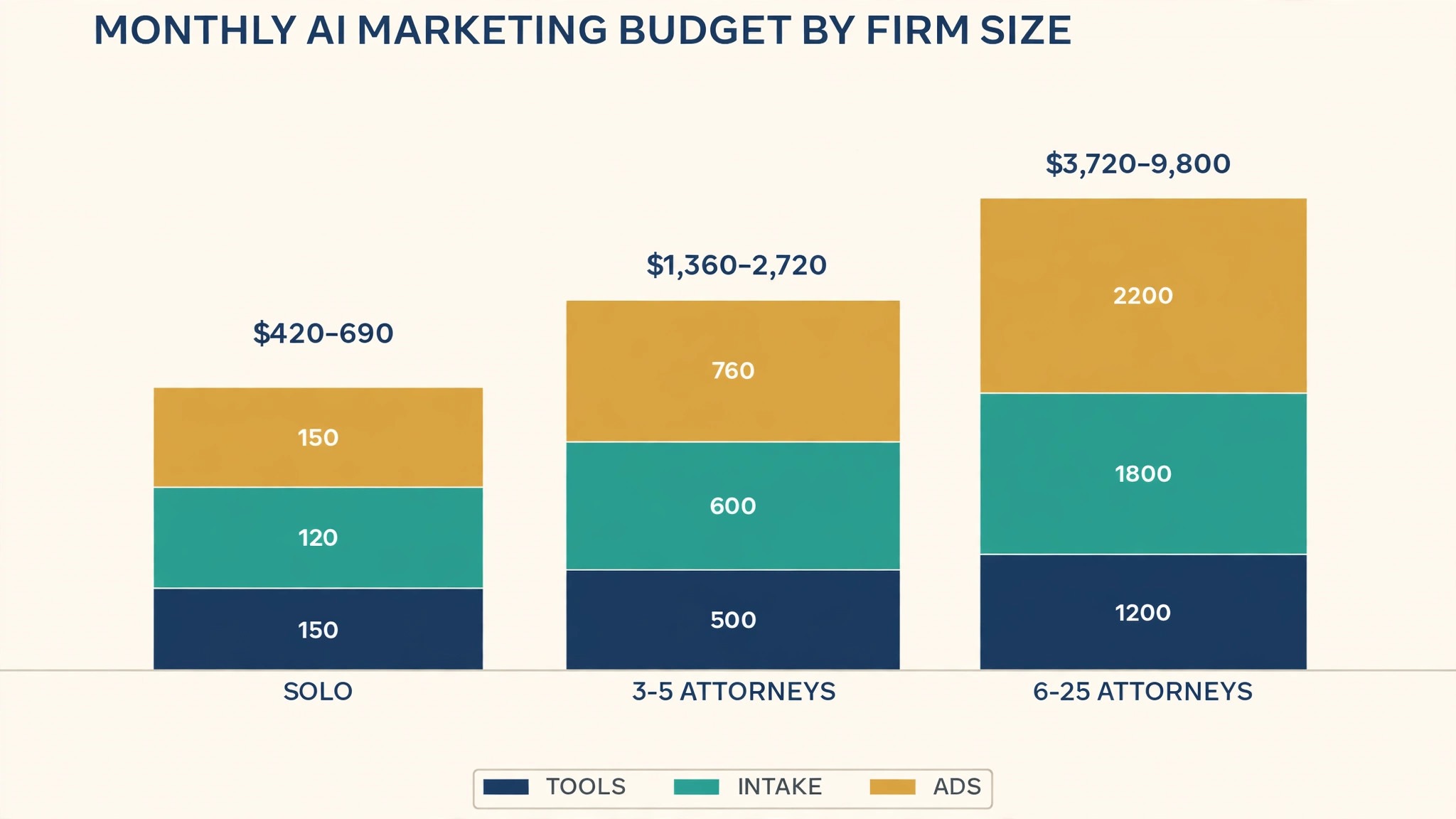
| Firm size | Writing tools | Intake and CRM | Ads test budget | Total per month |
|---|---|---|---|---|
| Solo | 20 to 40 dollars | 100 to 150 dollars | 300 to 500 dollars | 420 to 690 dollars |
| 3 to 5 attorneys | 60 to 120 dollars | 300 to 600 dollars | 1,000 to 2,000 dollars | 1,360 to 2,720 dollars |
| 6 to 25 attorneys | 120 to 300 dollars | 600 to 1,500 dollars | 3,000 to 8,000 dollars | 3,720 to 9,800 dollars |
A solo firm should start at the low end and prove the intake return before raising the ad budget. A firm of 3 to 5 attorneys can afford the full stack and a real ad test in one practice area. A larger firm should treat AI marketing as a line item with a named owner and a monthly report, not as a set of subscriptions nobody reviews. How to use ai for law firm marketing at any size comes down to the same discipline. Spend where signed cases come from, measure weekly, and cut what does not convert.
The most common budget mistake is spending on ads before intake is fixed. A firm that buys 2,000 dollars of clicks and answers half of them in a day has wasted 1,000 dollars. The second mistake is buying five tools that overlap. One writing tool, one intake system, and one review tool cover the plan. The third mistake is paying for a tool for a year before testing it for a month. Trial every tool on real enquiries for 30 days before committing to annual billing.
How to Measure Whether AI Marketing Works
Measurement is the part most firms skip, and it is the part that decides whether the plan survives its first quarter. Set up a simple weekly report with five numbers. Enquiries by source, response time in minutes, consultations booked, signed cases, and cost per signed case. Those five numbers tell you more than any traffic dashboard, because they connect marketing spend to the outcome that pays the bills.
Review the report at the same weekly meeting, with the same people, and make one decision each week. Pause an ad group that brings enquiries but no signed cases. Double the budget on the page that books consultations. Rewrite the intake script question that callers keep misunderstanding. Small weekly decisions compound into a marketing system that improves every month, while a firm that reviews numbers quarterly makes the same mistakes for three months before noticing.
The discipline of measuring cost per signed case also protects the firm from tool sprawl. Every new AI tool should answer one question before it is bought. Which of the five numbers will it improve, and by how much. A tool that cannot answer that question is a subscription looking for a problem. How to use ai for law firm marketing well is mostly this habit. Measure the five numbers, act on them weekly, and let the results decide the budget rather than the sales pitch.
Mistakes Firms Make With AI Marketing
The first mistake is publishing AI drafts without review. An AI page that cites a repealed statute, invents a case outcome, or promises a result the firm cannot deliver is a compliance problem and a trust problem at once. Every page, ad, and client alert needs a named attorney reviewer, and the reviewer needs time in their week to do it properly. A firm that treats review as a formality will publish an error, and errors in legal marketing travel fast.
The second mistake is putting client information into a general AI tool. Intake notes, matter facts, and client names belong only in tools with proper confidentiality terms, and staff need training on which tool is which. One paste into the wrong chat can breach confidentiality, and no productivity gain is worth that risk. Write the rule down, train every new hire on it, and check compliance quarterly. How to use ai for law firm marketing safely starts with this boundary, because a confidentiality breach costs more than any marketing gain.
The third mistake is chasing volume instead of signed cases. Ten thousand page views that bring no consultations are worth less than one hundred views that bring five. Measure cost per signed case by channel, and move budget toward the channel that signs cases, even if it looks less impressive in a traffic report. A firm that optimises for traffic will buy traffic. A firm that optimises for signed cases will grow, and it will know exactly why.
90 Day Implementation Checklist
Use this checklist to run the plan, and review it at the weekly partner meeting.
- List every enquiry channel, its owner, and its response time target.
- Pull 90 days of enquiries and tag each by source, practice area, and outcome.
- Choose one intake tool and one writing tool, and set up confidentiality rules for both.
- Write a ten question intake script for each practice area and test it on real calls.
- Put AI intake live with a five minute response target during business hours.
- Publish two reviewed service pages a week, starting with the highest value practice area.
- Update the Google Business Profile and start the review ask system.
- Launch one ad test in one practice area with a daily cap and a cost per signed case target.
- Review response time, cost per signed case, and AI citation appearances every week.
- Cut the lowest performing channel at day 90 and move its budget to the winner.
Related Guides
Keep exploring with these guides on Stratilyze:
- Use AI for Law Firm Intake Screening
- Law Firm Client Intake with AI Tools
- Law Firm Document Drafting with AI Tools
Frequently Asked Questions
Is AI content allowed in law firm marketing?
Yes, with human oversight. ABA Formal Opinion 512 confirms lawyers may use generative AI provided they maintain competence, protect confidentiality, and supervise the work. Bar rules require marketing to be accurate and not misleading, so every AI draft needs attorney review before publication. The firm owns every claim, even one the AI wrote.
What is the best first AI tool for a small law firm?
Intake, not writing. An AI intake tool or AI receptionist answers every lead fast and books consultations, which lifts conversion more than any content tool. How to use ai for law firm marketing well starts with fixing the leak at intake, because content that brings enquiries nobody answers is wasted effort. Add a writing tool once intake is measured and working.
How much should a small firm spend on AI marketing tools?
A solo firm can run the core stack for 120 to 190 dollars a month before ads. A firm of 3 to 5 attorneys should budget 360 to 720 dollars a month for tools plus 1,000 to 2,000 dollars for an ad test. Start small, measure cost per signed case, and raise the budget only on the channel that signs cases.
Can AI answer client enquiries on its own?
AI can answer general questions, capture details, and book consultations, but it should not give legal advice or discuss a specific matter without attorney supervision. Set clear boundaries in the script, escalate anything substantive to a lawyer, and review AI conversations weekly. A client who receives confident but wrong advice from a chatbot will not become a client.
How do I get cited by AI search engines?
Answer specific questions clearly on pages built for that purpose, with direct answers, FAQs, and original local guidance. AI engines cite pages that answer the question directly and show expertise, so a page that says what the law is in your state, what it costs, and what happens next earns citations. How to use ai for law firm marketing for AI visibility means writing for the question, not for keywords alone.
What should never go into a general AI tool?
Client names, matter facts, intake notes, documents, and anything covered by confidentiality. Use only tenant boundary tools or purpose built legal platforms for matter specific work. General tools are for marketing drafts and public information only. Train every staff member on the boundary and check it quarterly.
A Final Word Before You Start
AI will not save a firm with no intake discipline and no measurement, but it will make a disciplined firm faster at every job that matters. Answer leads in minutes, publish reviewed answers weekly, keep local listings current, and test ads against signed cases rather than clicks. That is the whole plan, and a small firm can run it with three tools and a weekly review meeting.
Start with intake this week, not with a new website or a bigger ad budget. The firm that answers first wins the case more often than the firm with the prettiest site, and AI makes answering first a system rather than a hope. Put the five numbers on a single page, review them every week, and let the results decide where the next dollar goes. A small firm that does this for ninety days will know exactly which channels sign cases and which ones only cost money, and that knowledge is worth more than any single tool in the stack.