A traditional business plan used to take weeks of blank page staring, spreadsheet wrestling, and second guessing. A plan built with AI can take days, and in many cases it reads better, because the founder spends time on decisions instead of drafting. That contrast is the reason so many founders now ask how to write a business plan with AI, and it is also the reason the quality gap between a good AI assisted plan and a weak one has grown so wide.
The tool does not decide whether your business makes sense. It only speeds up your thinking. Bring clear thinking, and AI turns into a research assistant, a structure editor, a financial model helper, and a ruthless first reviewer. Bring vague thinking, and AI will happily produce ten polished pages that say very little.
This guide gives you the full workflow. You will learn what to prepare before you open any tool, how to prompt for each section of a standard plan, how to check the numbers AI produces, how to compare the main tools, and how to finish with a document a bank, an investor, or a partner can actually use. It also covers the mistakes that make AI plans easy to spot and easy to dismiss, from invented market sizes to generic strategy claims that could apply to any company in any industry.
What a Strong Business Plan Must Prove
Before any tool enters the picture, be clear about the job of the document. A business plan is not a brochure. It is an argument, supported by evidence, that a specific product can reach specific customers, earn more than it spends, and grow. Lenders read it for risk. Investors read it for return and for proof that the founder understands the market. Partners read it for clarity about who does what. A founder reads it, or should read it, as a test of their own assumptions.
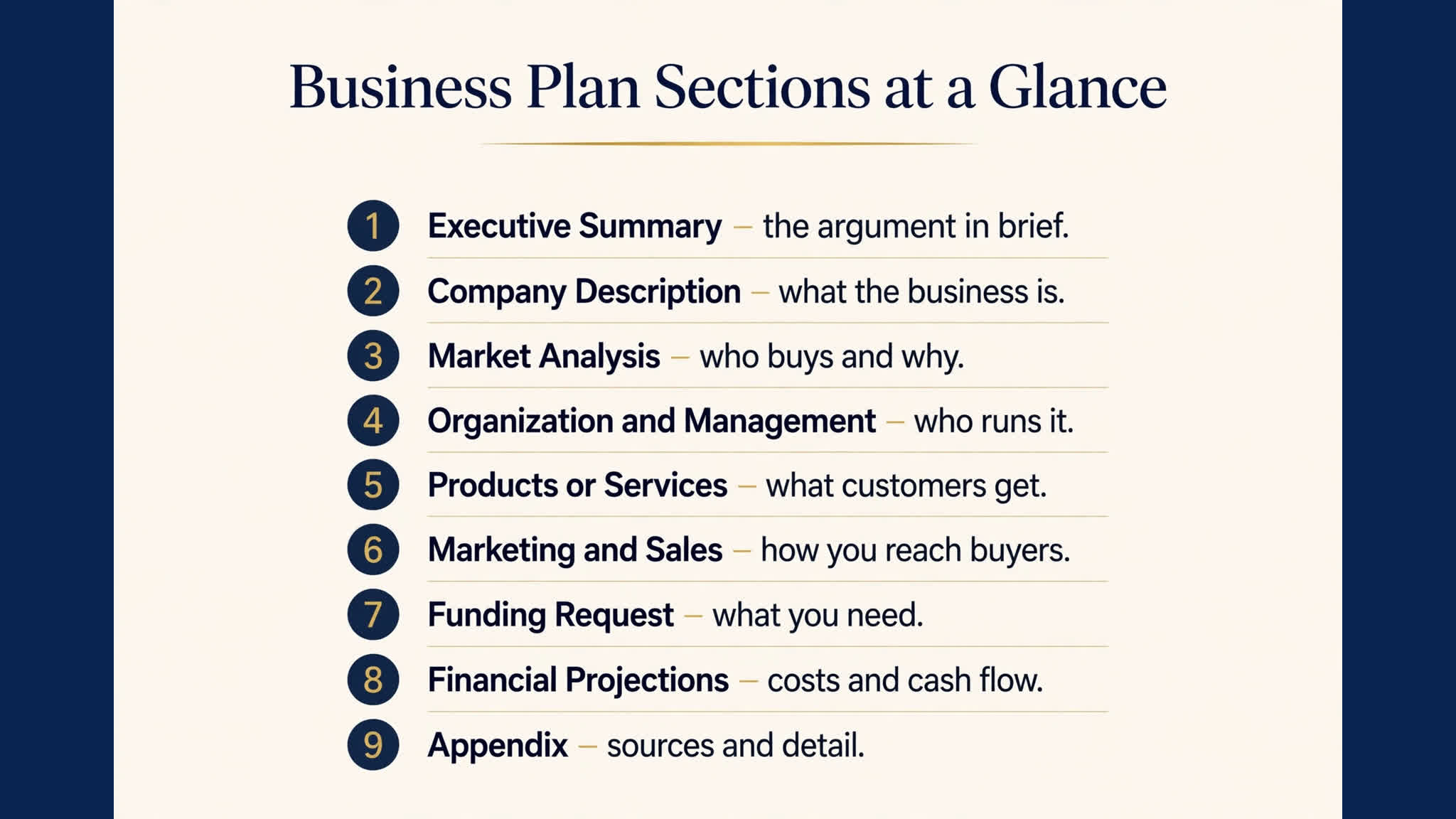
A complete plan usually contains an executive summary, a company description, a market analysis, an organization and management section, a description of products or services, a marketing and sales strategy, a funding request if relevant, financial projections, and an appendix. Shorter plans for internal use can compress some of these sections, but they should not skip the core questions: who is the customer, what problem do you solve, why will customers choose you, how will you reach them, what will it cost, and when does the money turn positive.
AI helps most when you treat each section as a separate task with its own inputs and its own check. Asking one prompt to write my whole business plan is the fastest way to get a generic document. Working section by section, feeding AI your real facts, and then editing the output in your own voice is slower in the moment and much faster in total, because you avoid rewrites later.
Before You Open an AI Tool: Gather Your Raw Material
AI output quality tracks input quality almost exactly. Spend one focused hour gathering facts before you draft. You need a one sentence description of the product, the exact customer you serve first, the price you intend to charge, the main alternative customers use today, and your starting budget. You also need any facts you already know from experience: past sales, waitlist signups, conversations with buyers, supplier quotes, rent quotes, and wage rates in your area. If you do not have a fact, write that down too, so you know what to research rather than letting AI fill the gap with a confident guess.
Write down your constraints as well. A plan for a side business with 10 hours a week looks different from a plan for a venture seeking outside funding. A plan for a local service business needs local demand evidence, while a plan for a software product needs evidence about acquisition cost and churn. Tell AI these constraints early, because otherwise it will default to a generic startup template that assumes venture funding, rapid hiring, and national scale.
A useful preparation exercise is to answer five questions in plain sentences, without AI help. What do you sell. Who buys it first. Why do they buy it from you instead of the current option. How do you reach them at a cost you can afford. What has to be true in twelve months for the business to survive. Those five answers become the backbone of every section. When AI drafts a section that contradicts one of them, you have caught an error worth fixing.

The Full Workflow for how to write a business plan with AI
The workflow below works with almost any general AI writing tool, plus a spreadsheet tool for the financial section. You do not need a specialized business plan generator to get a strong result, although those tools can save formatting time. The steps matter more than the brand.
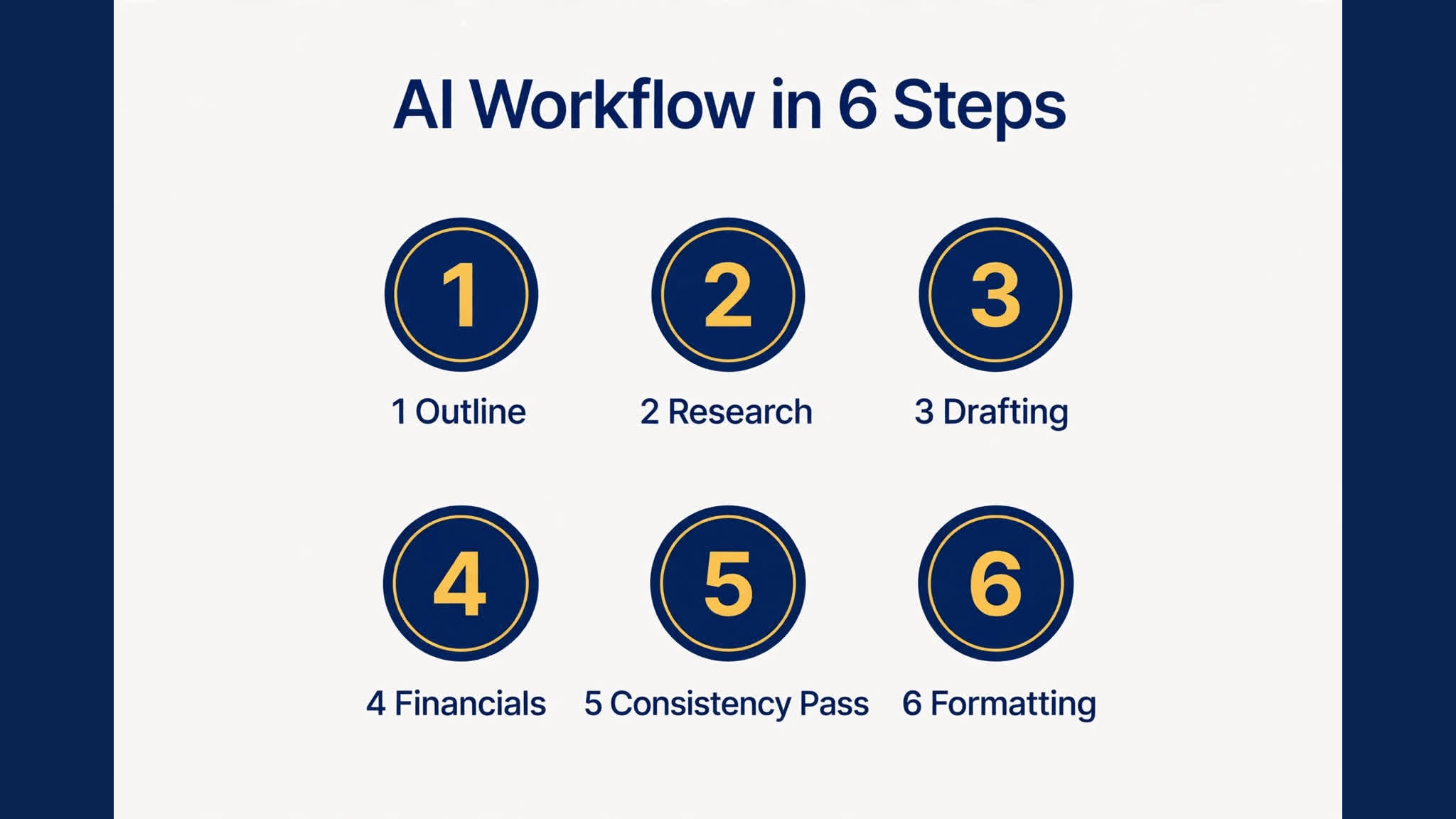
Step one is the outline. Ask AI to propose an outline based on your business type, audience, and purpose, then edit that outline before any drafting starts. Delete sections that do not fit, add sections your reader will expect, and reorder so the strongest proof appears early. For a loan application, financial strength and repayment ability belong near the front in the summary. For an investor pitch, market size and differentiation matter more. For an internal plan, operations and milestones matter most.
Step two is research with verification. Use AI to list competitors, market trends, regulations, and pricing benchmarks, then verify every material claim against a primary source. Check competitor pricing on the competitor website. Check market size claims against the original report, not a summary of a summary. Check licensing rules against a government source. AI is excellent at telling you where to look and what questions to ask. It is unreliable as a final source for numbers that a lender will check.
Step three is section drafting with your facts pasted in. For each section, give AI the outline point, your raw facts, your constraints, and the length you want. Ask it to flag any claim it cannot support from the facts you gave, rather than inventing support. That single instruction reduces invented detail dramatically. After each section, edit for accuracy and voice before moving on. Do not draft all sections and edit at the end, because errors compound and voice drifts.
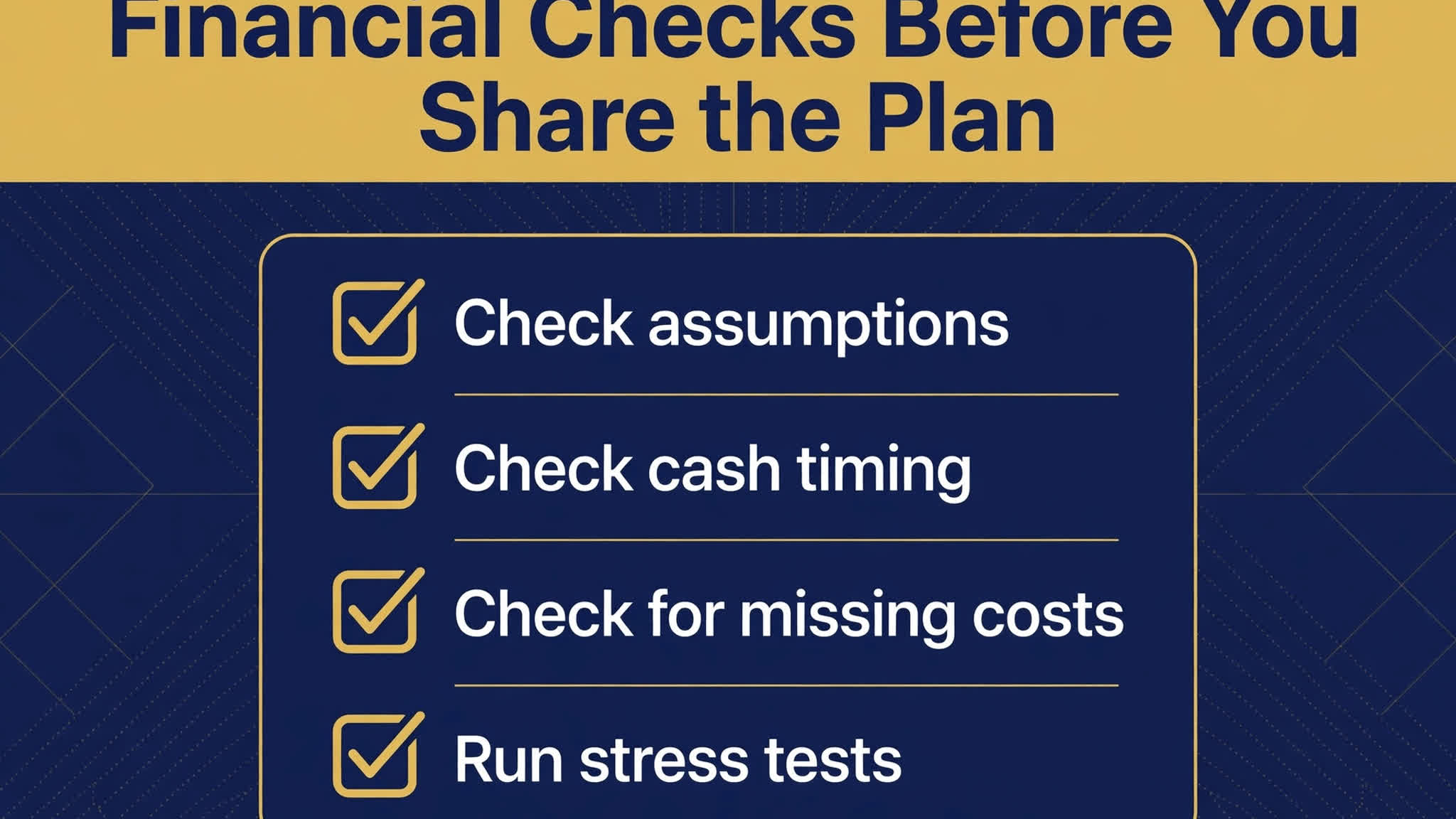
Step four is the financial model, handled separately and with more care than the prose. AI can suggest line items, explain formulas, and sanity check results, but the model itself should live in a spreadsheet you control. Enter your own price, volume, and cost assumptions, then use AI to review the logic and to stress test it. What happens if sales are 30 percent lower in the first six months. What happens if a key supplier raises prices. What breaks first. Those stress tests are what separate a serious plan from a hopeful one.
Step five is the consistency pass. Read the whole document as a skeptical outsider. Does the marketing section promise growth the operations section cannot deliver. Does the hiring plan match the payroll in the financials. Does the executive summary match the detail sections, or does it promise something the body never proves. AI can help with this pass if you ask it to list contradictions, unsupported claims, and vague statements, but you make the final calls.
Step six is formatting and appendix. Add a table of contents, clear headings, charts for the financials, and an appendix with sources, resumes, quotes, and detailed assumptions. A clean appendix signals that the main document is a summary of real work, not a substitute for it.
Executive Summary: Write It Last, Lead With It
The executive summary is the most read section and the worst section to write first. Write it after the rest of the plan exists, then place it at the front. It should fit on one page, or two at most, and it should answer the core questions in order: what the business does, who it serves, why it will win, what it needs, and what return or repayment the reader can expect.
A strong summary uses specific numbers tied to the body of the plan. Say how many target customers exist in your launch area and what share you plan to serve in year one, with the source noted. Name relevant experience in one line each. Say how much you seek, what it buys, and what milestone it unlocks.
When you use AI for the summary, paste in the finished sections and ask for a tight summary that uses only facts present in those sections. Then compare every number in the summary against the body. Summaries are where AI most often upgrades a cautious forecast into a bold promise, because summary language rewards brevity and confidence. Keep the confidence, remove the upgrade.
Company Description and Products That Sound Real
The company description should explain what the business is, what form it takes, where it operates, and what stage it has reached. If you already have a product, say so. If you have a prototype, a waitlist, or early sales, say so with numbers. If you are still at idea stage, say that plainly and explain what validation comes next. Readers trust a plan that names its stage more than one that hides it behind grand language.
The product section needs the same discipline. Describe what the customer gets, how it works in practical terms, what it costs the customer, and what makes it different in a way the customer can feel. A feature list is not a product description. A customer outcome is. If you sell a service, describe the service steps, the time it takes, and the result the customer can check. If you sell a physical product, describe materials, production, packaging, and delivery. If you sell software, describe the core workflow, who uses it daily, and what task becomes faster or cheaper.
AI can help you test clarity here. Paste your product description and ask AI to explain it back as if to a customer who knows nothing about your industry, then read that explanation for jargon, missing steps, and claims a customer could not verify. If AI cannot explain it simply from your text, a reader will struggle too. Revise until the explanation is simple without losing accuracy.
For naming and early brand work, a focused tool can help you test options quickly. If you are still choosing a name, see our guide to the best AI business name generators for a structured way to compare naming tools before you lock in a name that appears in the whole plan.
Market Analysis Without Invented Numbers
Market analysis is where AI plans most often fail, because AI can produce market size figures that sound precise and are wrong, outdated, or misattributed. The fix is to separate three kinds of evidence and treat each differently. First, total market context from published reports, cited with publisher and year. Second, your serviceable market, meaning the slice you can realistically reach given geography, price, and channel. Third, your early target, meaning the specific customers you will pursue first, often a narrow group you can name and reach directly.
Start with the early target, not the total market. A plan that says it will serve everyone in a large market proves nothing. A plan that says it will serve 200 independent cafes in one city, reached through a specific channel, with a specific offer, is testable. From that testable starting point, you can expand in stages, and each stage can carry its own evidence and cost.
Use AI to build a competitor table with columns for competitor, offer, price, strengths, weaknesses, and who they serve best. Then verify price and offer details on competitor sites and review pages. Look for gaps that are real, not just gaps in your knowledge. A competitor may not serve a segment because that segment is unprofitable, hard to reach, or already served well by a different kind of solution. Name the reason you believe the gap is an opportunity, and name the evidence behind that belief, such as customer complaints, long wait times, or prices that exclude a group.
Organization, Management, and Operations
Readers fund people and operations, not just ideas. The management section should name each key person, their relevant experience in one or two lines, and their role. If a role is unfilled, say so and describe the hire you need, when you need them, and what they must have done before. A plan that pretends a solo founder will simultaneously sell, deliver, manage finances, and hire a team in month one loses credibility. A plan that sequences hires against revenue milestones gains it.
Operations deserves similar concreteness. Walk through a normal day or a normal order from start to finish. Where do supplies come from. How long does delivery take. What happens when something goes wrong. What systems track orders, money, and customer follow up. AI can turn your rough notes into a clear operations flow, and it can spot missing steps, such as who handles refunds, who answers messages after hours, and how quality is checked before delivery.
If your plan will later become a pitch, the same clarity pays off again. A strong pitch deck draws directly from a strong plan, and our comparison of the best AI pitch deck generators can help you convert the finished plan into slides without rewriting the argument from scratch.
Marketing and Sales: Channels, Costs, and Proof
A marketing section should name channels, not just goals. Social media, search, referrals, partnerships, local outreach, marketplaces, and direct sales each have different costs, timelines, and proof requirements. For each channel you plan to use in the first year, state what you will do, how often, what it costs, and what result would tell you to continue, change, or stop. That last part matters, because a plan without kill criteria is a plan that keeps spending on a channel that does not work.
AI can help you draft channel plans, content calendars, and sales scripts, and it can suggest metrics for each channel. Use it to brainstorm, then narrow to a small number of channels you can actually run well. Three channels executed consistently beat eight channels started and abandoned. For a new business, one channel that reaches buyers directly, such as partnerships or local outreach, plus one channel that compounds over time, such as search content or email, is often a stronger start than paid ads alone.
Sales deserves a separate paragraph in the plan, even for product businesses. How does a stranger become a buyer. What is the first conversation, the trial, the quote, or the checkout step. What objections appear most often, and what answer works. If you have sold before, use real objection examples. If you have not, use AI to role play buyer objections, then test those conversations with real prospects before you finalize the plan.
Financial Projections AI Can Help Build and You Must Own
Financial projections are the section where AI assistance needs the tightest boundaries. AI should suggest categories, explain calculations, and review your logic. It should not invent your sales volume, price, or costs, and it should not produce a final forecast you have not checked line by line.
Build the model in a spreadsheet with separate sections for assumptions, revenue, costs, and cash flow. Start with assumptions you can defend: price, units per month, growth by month, fixed costs such as rent and software, variable costs per unit, and payroll. Keep the first year monthly, because monthly detail exposes cash problems that annual totals hide. A business can be profitable on paper for the year and still run out of cash in month four if customers pay late and suppliers demand payment early.
Ask AI to review the finished model for common errors: revenue growing without matching marketing cost, headcount growing without payroll cost, inventory building without cash outflow, and profit appearing without tax or owner pay. Ask it to build three cases: a base case, a slow case, and a strong case, each with the same structure but different assumptions. Present the base case in the main plan and summarize the slow case honestly, because a lender will ask what happens if sales disappoint, and a founder who has already answered that question looks prepared.
Funding requests follow from the model, not the other way around. State how much you seek, what it funds in specific items, how long it lasts, and what milestone it buys. If you seek a loan, state repayment source and timing. If you seek investment, state what the investor receives and what the next milestone unlocks. Vague funding asks, such as funding for growth and marketing, signal that the model was not finished.
Tools Compared: What Each Type Does Best
Different tools serve different parts of this workflow, and choosing by category saves money and frustration. General chat tools are best for drafting, brainstorming, outlining, and review. They are flexible, fast, and strong at turning rough notes into clear prose, but they need your facts and your checking. Specialized business plan software is best for structure, financial templates, and professional formatting, and some include guided questionnaires that help a first time founder cover every section. Spreadsheet tools remain essential for the financial model, regardless of which writing tool you choose. Design tools help with charts and final presentation, but they should come last, after the argument is sound.
When you compare options, test them on the same task: give each tool the same business facts and ask for the same section, then compare accuracy, specificity, and how much editing each draft needs. The best tool for you is the one whose drafts need the least correction on your facts, not the one with the longest feature list. Also check export options, because a plan that cannot export cleanly to a document format your reader can open creates friction at the exact moment you want a smooth review.
Useful official starting points include ChatGPT for general drafting and review, Claude for long document editing and consistency checks, Notion for organizing research and drafts, and LivePlan for guided plan structure and financial templates. Check current pricing and plan limits on each checkout page before you commit, because pricing and included features change and a plan built around a feature that sits behind a higher tier wastes time.
| Tool type | Best for | Watch out for | Good starting test |
|---|---|---|---|
| General chat AI | Drafting, outlining, review, objection practice | Invented numbers, generic strategy | Draft one section from your facts only |
| Business plan software | Guided structure, financial templates, formatting | Template language that sounds alike | Export a full draft and edit it freely |
| Spreadsheet app | Financial model you control | Formula errors, hidden assumptions | Rebuild one month by hand |
| Research and notes app | Sources, competitor notes, version control | Notes that never become decisions | Link every claim to a source note |
| Design app | Charts, cover, final polish | Polish that hides weak numbers | Polish only after numbers are checked |
How to Choose the Right Setup for Your Plan
Choose based on audience, complexity, and your own strengths, in that order. If the plan goes to a bank, prioritize financial clarity, a professional format, and a complete appendix. If it goes to investors, prioritize market evidence, differentiation, and a credible path to scale. If it is internal, prioritize operations, milestones, and decision rules, and keep it shorter so you actually use it.
If you write well but dislike spreadsheets, pair a chat tool with plan software that guides the financials. If you like numbers but struggle with prose, let AI draft prose from your detailed notes, then edit for voice. If you have almost no business facts yet, do not buy a premium tool first. Use a free general tool to outline and to list research questions, gather answers from real sources, and only then decide whether a specialized tool saves enough time to justify its cost.
Set a time budget too. A solid first draft with AI help can take a few focused days. If drafting drags past two weeks, the problem is usually missing facts or an unclear customer, not the tool. Pause, talk to ten potential customers, get one supplier quote, and return with facts.
Mistakes to Avoid When AI Writes Your Plan
The most common mistake is letting AI invent market data. A market size figure with no source, a competitor price that changed last year, or a growth rate copied from a different industry can destroy trust in the whole document. Every number that matters needs a source you can show, and every number you cannot source should be labeled as an assumption with a reason.
The second mistake is generic differentiation. Phrases like high quality, customer focused, and innovative solution appear in thousands of plans and prove nothing. Differentiation must be specific and checkable: a faster turnaround measured in days, a price point competitors do not offer, a service step competitors skip, a niche audience competitors ignore, or a distribution channel competitors cannot use easily. If your differentiation could be pasted into a competitor plan without sounding wrong, rewrite it.
The third mistake is a strategy that does not match the budget. A plan that promises national advertising on a local startup budget, or a large team on first month revenue, signals that the financials and the strategy were written separately. Read them together and cut until they agree.
The fourth mistake is voice drift. AI drafts often shift between formal, casual, and sales language across sections, which makes the plan feel assembled rather than authored. Do a final voice pass in your own words. Read sections aloud. If a sentence sounds like something you would never say to a lender or partner, rewrite it. Your plan should sound like you on your clearest day.
The fifth mistake is hiding weaknesses. Every business has risks: dependence on one supplier, a seasonal market, a long sales cycle, or a skill gap on the team. Name the top three risks and your response to each. Readers expect risks. They distrust plans that claim none.
The sixth mistake is treating the plan as finished. A plan is a living document for the first year. Set a review date each quarter, update actual results against forecast, and revise assumptions when reality differs. AI can help with quarterly updates if you feed it actual results and ask what changed, what to keep, and what to stop. That habit turns the plan from a funding document into a management tool.
Prompt Patterns That Produce Better Sections
Good prompts share a pattern: role, facts, constraints, output shape, and a check instruction. For example, tell AI it is editing a plan for a lender, paste your facts, state the audience and length, ask for a specific structure, and ask it to list any claim that lacks support in your facts. That last instruction is the most valuable, because it turns AI from a confident writer into a careful reviewer.
For market research, ask for a list of sources to check, not just conclusions. For competitor analysis, ask for a table with a source column, then fill that column yourself. For financial review, paste your assumptions and ask for errors, missing costs, and stress tests, not for a new forecast. For the final review, ask for contradictions, vague claims, and sections where a skeptical reader would ask for proof. Each of these prompts uses AI strength, which is pattern finding and drafting, while keeping final judgment with you.
Frequently Asked Questions
Can AI write a complete business plan on its own
AI can draft every section, but a complete plan still needs your facts, your decisions, and your verification. Use AI for drafting and review, keep ownership of numbers, strategy, and claims, and edit the final document in your voice before anyone else reads it.
Will a lender or investor know AI helped
They may notice generic language or invented numbers, which is why editing matters more than the tool choice. A plan with specific facts, sourced numbers, consistent financials, and a clear voice reads as a serious founder document regardless of which tool helped draft it.
How long should an AI assisted business plan be
Length follows audience. An internal plan can be strong at 10 to 15 pages. A loan or investor plan often runs 20 to 30 pages including financials and appendix. Length alone proves nothing. Completeness, specificity, and consistency prove much more.
Should I use a specialized business plan tool or a general chat tool
Use a general chat tool if you already have strong facts and want flexible drafting and review. Use specialized plan software if you want guided structure, financial templates, and a polished format, especially for a first plan. Many founders use both: chat for drafting and review, plan software for structure and financial presentation.
How do I keep AI from inventing financial projections
Keep the model in your own spreadsheet, enter your own assumptions, and ask AI only to review logic and stress test results. Never paste an AI generated forecast into a plan without checking every assumption behind it.
What should I do if I have no market data yet
Start with your early target customers, talk to them, and gather direct evidence: interviews, waitlist signups, preorders, or letters of interest. Small direct evidence beats a large invented market figure, and it gives you a story a reader can verify.
Conclusion: A Plan You Can Defend in a Meeting
The test of a good plan is simple. Can you defend every major claim in a meeting without reading the document. If you can explain who buys, why they buy, how you reach them, what it costs, and when cash turns positive, without hesitation, the plan has done its job. AI can help you reach that point faster, by drafting quickly, finding gaps, and forcing consistency checks, but it cannot replace the conversations, quotes, and decisions that make those answers true.
Start with your five core answers, gather real facts, draft section by section, verify every material number, and finish with a summary that uses only facts from the body. Then use the plan. Review it quarterly, update it with actual results, and let it guide hiring, spending, and channel choices. A plan that lives in a drawer after funding was never really a plan. A plan that guides weekly decisions is an asset, and AI, used with discipline, can help you build one in days rather than weeks.