
Nobody leaves Mailchimp because email stopped working. They leave because the bill changed. A list that was free becomes a paid tier, then a higher tier, then a surprise charge for contacts who never open anything. Add a clunky automation builder and a template editor that fights you, and the switch becomes a matter of time. The best Mailchimp alternatives fix the pricing model, the automation or both, and the right one depends on whether you sell products, grow a creator audience or run a newsletter.
This guide compares 12 tools grouped by the job each one does best: creator email, ecommerce email, newsletter email, and budget email. Prices are October 2026 figures in US dollars. Where a vendor does not publish pricing, or where sources disagreed, the guide says check checkout rather than guessing. One rule runs through the whole guide: judge an email tool by delivered revenue per subscriber, not by how pretty its templates look. A plain email that lands in the inbox beats a beautiful one in spam.
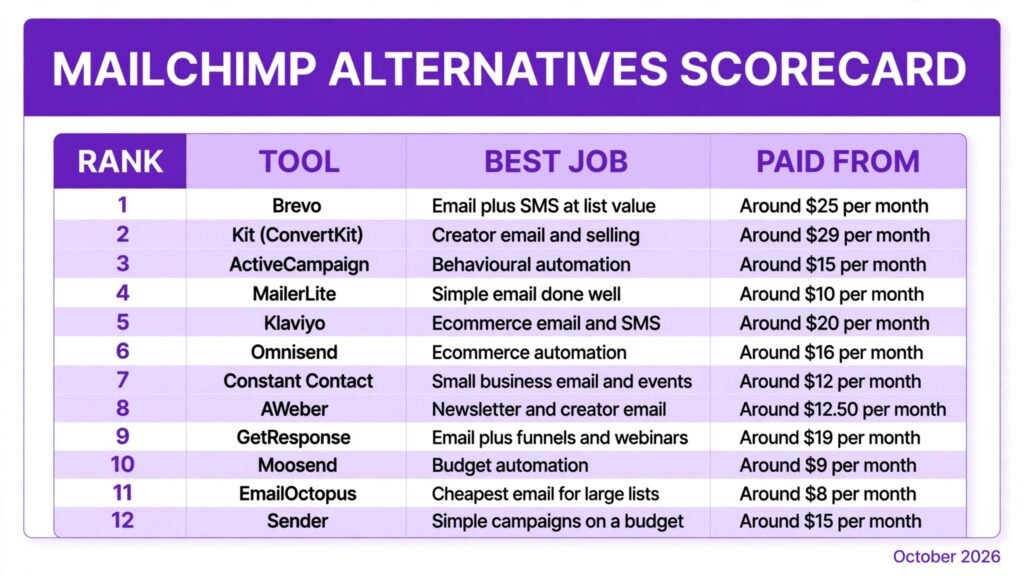
The 12 best Mailchimp alternatives at a glance
| Tool | Best job | Free option | Paid from |
|---|---|---|---|
| Brevo | Email plus SMS at list value | Free tier | Around $25 per month |
| Kit (ConvertKit) | Creator email and selling | Free tier | Around $29 per month |
| ActiveCampaign | Behavioural automation | Free trial | Around $15 per month |
| MailerLite | Simple email done well | Free tier | Around $10 per month |
| Klaviyo | Ecommerce email and SMS | Free tier | Around $20 per month |
| Omnisend | Ecommerce automation | Free tier | Around $16 per month |
| Constant Contact | Small business email and events | Free trial | Around $12 per month |
| AWeber | Newsletter and creator email | Free tier | Around $12.50 per month |
| GetResponse | Email plus funnels and webinars | Free trial | Around $19 per month |
| Moosend | Budget automation | Free trial | Around $9 per month |
| EmailOctopus | Cheapest email for large lists | Free tier | Around $8 per month |
| Sender | Simple campaigns on a budget | Free tier | Around $15 per month |
Best pick by job
| Your job | Start with | If that fails, try |
|---|---|---|
| Cheapest email for a big list | EmailOctopus | Brevo |
| Creator selling courses and products | Kit | ActiveCampaign |
| Automation that reacts to behaviour | ActiveCampaign | GetResponse |
| Simple email without the learning curve | MailerLite | AWeber |
| Ecommerce email that drives revenue | Klaviyo | Omnisend |
| Ecommerce automation on a budget | Omnisend | Brevo |
| Small business email plus events | Constant Contact | MailerLite |
| Newsletters and creator content | AWeber | Kit |
| Email plus funnels and webinars | GetResponse | ActiveCampaign |
| Budget automation for a startup | Moosend | MailerLite |
| Simple campaigns for a tiny list | Sender | EmailOctopus |
| Email plus SMS in one bill | Brevo | Klaviyo |
Creator email: audiences that buy
Creators need email that sells: landing pages, digital products, paid newsletters and simple automation that runs while they create. These three are built for that job.
1. Kit (ConvertKit)
Kit is the creator standard. It is built for writers, YouTubers, podcasters and course sellers who need landing pages, forms, email sequences and digital product sales without a marketing degree. Its visual automation builder is simple enough to use in an afternoon, and its deliverability for creator audiences is consistently strong.
Pricing: A free tier covers up to 1,000 subscribers. Paid plans start at around $29 per month for Creator, priced by subscriber count. Check checkout for current subscriber pricing.
Best for: Creators, coaches, authors and course sellers building an audience and selling directly to it.
Watch out for: Kit’s templates are plain by design, so brands that want highly designed emails will find it limiting. Its ecommerce features are also lighter than Klaviyo or Omnisend for a product store.
Try it at: kit.com

2. ActiveCampaign
ActiveCampaign is the automation depth pick for creators and businesses whose revenue comes from behaviour. Its builder reacts to opens, clicks, purchases, page visits and tags, so a subscriber who browses a product gets a different journey from one who just joined. For creators with a product range, that targeting pays for itself quickly.
Pricing: A free trial is offered. Paid plans start at around $15 per month for Starter, priced by contact count. Check checkout for current contact pricing.
Best for: Creators with products, ecommerce sellers and service businesses that earn from segmented, behaviour driven email.
Watch out for: Pricing grows with contact count, so clean your list before migrating. Its learning curve is also steeper than MailerLite or Kit, and beginners should budget a day to learn the builder.
Try it at: activecampaign.com
3. AWeber
AWeber is the veteran newsletter tool, and still one of the simplest ways to run a regular newsletter. It covers signup forms, autoresponders, newsletters, landing pages and basic automation with a famously helpful support team. For writers and small organisations that send on a schedule and want no surprises, it is a steady pick.
Pricing: A free tier covers up to 500 subscribers. Paid plans start at around $12.50 per month. Check checkout for current subscriber pricing.
Best for: Newsletter writers, clubs, churches and small businesses sending regular updates to a loyal list.
Watch out for: AWeber’s automation and design tools are simpler than ActiveCampaign or Klaviyo, so power users will outgrow it. Its template library also feels dated next to newer rivals.
Try it at: aweber.com
Ecommerce email: revenue per subscriber
For a store, email is a sales channel, not a newsletter. These three connect to the store, track what customers buy and automate the journeys that recover carts and repeat orders.
4. Klaviyo
Klaviyo is the ecommerce email standard. It plugs into Shopify, WooCommerce and other stores, syncs purchase and browsing data, and builds flows for abandoned carts, post purchase follow up, winback and VIP segments automatically. Stores that switch to Klaviyo usually see email revenue rise, because the segmentation is simply deeper than Mailchimp’s.
Pricing: A free tier covers up to 250 contacts. Paid plans start at around $20 per month for Email, priced by contact count. Check checkout for current contact and SMS pricing.
Best for: Ecommerce stores, especially on Shopify, that earn a large share of revenue from email and SMS.
Watch out for: Klaviyo gets expensive as a list grows, and its SMS pricing adds up fast. It is also overkill for a business that only sends a monthly newsletter; buy it for revenue, not for announcements.
Try it at: klaviyo.com

5. Omnisend
Omnisend is the ecommerce automation pick for stores that want Klaviyo style flows at a lower price. It covers email, SMS and push notifications with prebuilt automation for carts, welcome series, order follow up and product recommendations, and it integrates with the major store platforms. For a growing store, it delivers most of Klaviyo’s value for less money.
Pricing: A free tier covers up to 250 contacts. Paid plans start at around $16 per month for Standard. Check checkout for current contact pricing.
Best for: Growing ecommerce stores that want automation and SMS without Klaviyo’s price tag.
Watch out for: Its reporting and segmentation are a step behind Klaviyo for very large stores, and its template editor is simpler. Large stores with complex segments will eventually want Klaviyo.
Try it at: omnisend.com
6. Brevo
Brevo is the value pick for email plus SMS. It prices by emails sent rather than contacts stored, which makes it unusually cheap for large lists with low send frequency, and it adds SMS, WhatsApp, chat and a light CRM in the same account. Stores and businesses that send campaigns and transactional email together get a particularly good deal.
Pricing: A free tier covers 300 emails a day. Paid plans start at around $25 per month for Starter. Check checkout for current email volume pricing.
Best for: Stores, small businesses and newsletters with large lists that send campaigns plus transactional email and SMS.
Watch out for: Brevo’s automation builder is simpler than Klaviyo or ActiveCampaign, and its templates need more work to look polished. It is a value platform, not a design showcase.
Try it at: brevo.com

Simple and budget email: campaigns without the fuss
Not every business needs automation depth. These six cover the straightforward job: build a list, send a good campaign, see who opened it, and pay a fair price.
7. MailerLite
MailerLite is the simplicity pick. It does the core job, forms, campaigns, automation, landing pages and basic segmentation, with a clean interface that new users learn in an hour. It is the tool most often recommended to small businesses leaving Mailchimp, because it feels familiar but costs less and fights you less.
Pricing: A free tier covers up to 1,000 subscribers. Paid plans start at around $10 per month for Growing Business. Check checkout for current subscriber pricing.
Best for: Small businesses, bloggers and nonprofits that want dependable email without a learning curve.
Watch out for: Its automation is solid but not as deep as ActiveCampaign, and its approval process for new accounts can be slow. It suits regular campaigns better than complex behavioural journeys.
Try it at: mailerlite.com
8. Constant Contact
Constant Contact suits small businesses that also run events. Alongside email campaigns it covers event registration, social posting, surveys and a simple website builder, which makes it a practical all rounder for local businesses, clubs and associations that email customers and fill rooms.
Pricing: A free trial is offered. Paid plans start at around $12 per month for Lite. Check checkout for current contact pricing.
Best for: Local businesses, nonprofits and event organisers that need email plus event and social tools in one account.
Watch out for: Its automation is basic next to ActiveCampaign, and its price per contact is higher than MailerLite or EmailOctopus for large lists. Buy it for the event tools, not for automation depth.
Try it at: constantcontact.com
9. GetResponse
GetResponse is the all in one pick: email, landing pages, funnels, webinars and basic automation in a single subscription. For a business that sells a course or a service and needs the whole funnel, from landing page to webinar to email follow up, it replaces two or three tools and one bill.
Pricing: A free trial is offered. Paid plans start at around $19 per month for Email Marketing. Check checkout for current contact pricing.
Best for: Course sellers, coaches and service businesses that need funnels and webinars alongside email.
Watch out for: Its email editor and deliverability are good but not best in class, and its breadth means no single feature is the deepest here. Specialists beat it on pure email or pure webinars alone.
Try it at: getresponse.com
10. Moosend
Moosend is the budget automation pick. It offers a surprisingly capable automation builder, segmentation, landing pages and reporting at a price that undercuts almost every rival, which makes it the best value for a startup or small business that wants real automation without a real budget.
Pricing: A free trial is offered. Paid plans start at around $9 per month for Pro. Check checkout for current subscriber pricing.
Best for: Startups, small businesses and side projects that want automation depth on the smallest budget here.
Watch out for: Moosend’s template library and integrations are smaller than MailerLite’s or Brevo’s, and support is email based on lower tiers. It rewards users who are comfortable setting things up themselves.
Try it at: moosend.com
11. EmailOctopus
EmailOctopus is the cheapest email for large lists. Built on Amazon SES, it keeps costs low by cutting the extras, and it covers campaigns, forms, automation and reporting well enough for most senders. A newsletter with 50,000 subscribers that would cost hundreds elsewhere can run here for a fraction of that.
Pricing: A free tier covers up to 2,500 subscribers. Paid plans start at around $8 per month for Pro. Check checkout for current subscriber pricing.
Best for: Newsletters, bloggers and businesses with large lists and straightforward sending needs.
Watch out for: Its feature set is deliberately lean: fewer integrations, simpler automation and plainer templates than rivals. It is a sending engine, not a marketing suite.
Try it at: emailoctopus.com
12. Sender
Sender is the simple campaign pick for tiny lists and tight budgets. It covers campaigns, forms, automation and segmentation with a generous free tier, and its interface is among the easiest here. For a business sending its first campaigns, it removes every excuse not to start.
Pricing: A free tier covers up to 2,500 subscribers and 15,000 emails a month. Paid plans start at around $15 per month for Standard. Check checkout for current pricing.
Best for: New businesses, side projects and tiny lists sending their first regular campaigns.
Watch out for: Sender’s automation and integrations are basic, and larger senders will outgrow it. It is a starting tool, not a forever platform for a fast growing list.
Try it at: sender.net
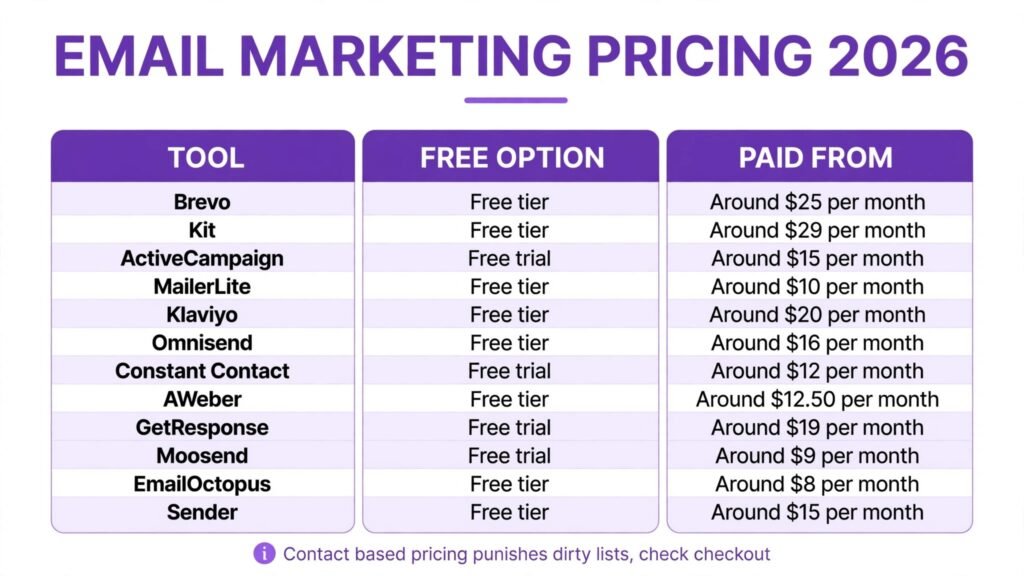
Pricing compared: what email marketing really costs
| Tool | Free option | Paid from | Pricing note |
|---|---|---|---|
| Brevo | Free tier | Around $25 per month | Priced by emails sent |
| Kit | Free tier | Around $29 per month | Priced by subscribers |
| ActiveCampaign | Free trial | Around $15 per month | Priced by contacts |
| MailerLite | Free tier | Around $10 per month | Priced by subscribers |
| Klaviyo | Free tier | Around $20 per month | Priced by contacts, SMS extra |
| Omnisend | Free tier | Around $16 per month | Priced by contacts |
| Constant Contact | Free trial | Around $12 per month | Priced by contacts |
| AWeber | Free tier | Around $12.50 per month | Priced by subscribers |
| GetResponse | Free trial | Around $19 per month | Priced by contacts |
| Moosend | Free trial | Around $9 per month | Priced by subscribers |
| EmailOctopus | Free tier | Around $8 per month | Priced by subscribers |
| Sender | Free tier | Around $15 per month | Priced by subscribers |
A realistic small list setup costs $0 to $15 a month on a free tier or a starter plan. A growing creator or store list lands around $20 to $50 a month, and a large ecommerce list can run into hundreds on contact based pricing. The pricing model matters more than the headline price: contact based tools punish dirty lists, email volume tools punish frequent senders. Clean your list before you migrate, and in every case check checkout for renewal terms, because free tier limits change often.
How to Choose the right Mailchimp alternative
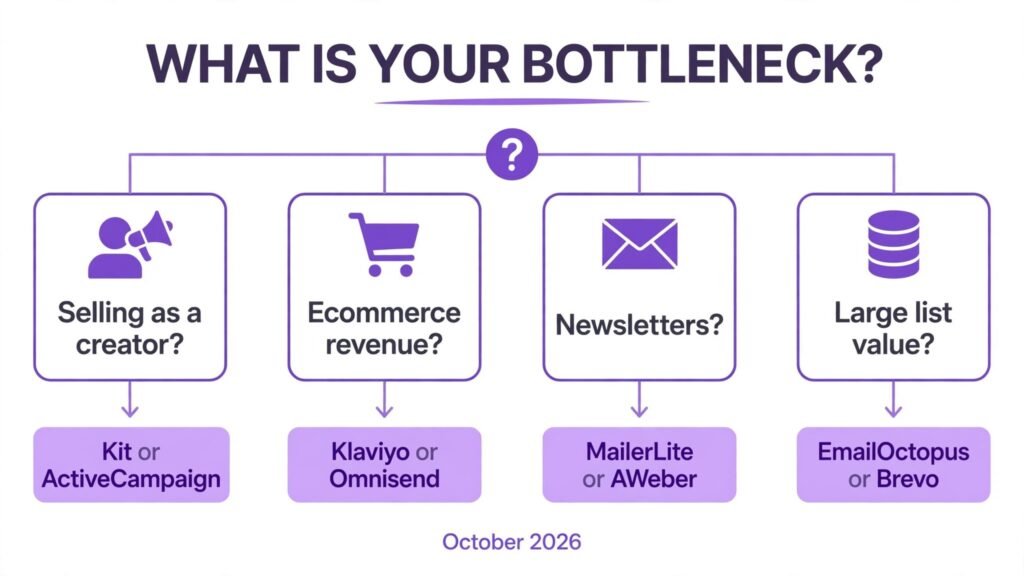
Start with the revenue job. If email sells products, pick an ecommerce tool: Klaviyo for depth, Omnisend for value, Brevo for email plus SMS. If email builds an audience that buys courses or memberships, pick a creator tool: Kit for simplicity, ActiveCampaign for automation depth. If email is announcements and newsletters, pick a simple tool: MailerLite for ease, EmailOctopus for large list value.
Next, price the tool on your real list, not the starter tier. Export your subscriber count, your monthly send volume and your SMS needs, then compare the same numbers across three finalists. A tool that looks cheap at 500 subscribers can be the most expensive at 10,000, and the reverse is true for volume priced tools like Brevo.
Then test deliverability before you migrate the whole list. Warm up the new sender domain, send to your most engaged segment first, and watch inbox placement and open rates for two weeks. A cheaper tool that lands in spam costs more than an expensive one that lands in the inbox. Finally, check the migration path: list import, tags, segments, automations and templates rarely move perfectly, so budget a day to rebuild the top three automations by hand.
Mistakes to avoid
Migrating a dirty list is the top mistake. Unengaged contacts cost money on contact based pricing and hurt deliverability on every platform, so suppress or remove cold subscribers before you move. A second mistake is choosing on template beauty instead of inbox placement and automation; test both with a real campaign before committing. A third is forgetting transactional email: order confirmations and password resets often stay on the old platform or need a separate setup, so plan that move too. Finally, do not skip the warm up. Blasting a full list from a brand new domain on day one is the fastest way to land in spam on any tool.
Frequently Asked Questions
Is there a free Mailchimp alternative?
Yes. Brevo, Kit, MailerLite, Klaviyo, Omnisend, AWeber, EmailOctopus and Sender all offer free tiers, usually up to 500 to 2,500 subscribers. Free tiers limit sends or features, so growing lists will still want a paid plan, but starting out costs nothing.
Which Mailchimp alternative is best for ecommerce?
Klaviyo for depth of segmentation and revenue automation, and Omnisend for similar flows at a lower price. Brevo suits stores that also need SMS and transactional email on one bill.
Which Mailchimp alternative is best for creators?
Kit for simplicity and creator focused selling, and ActiveCampaign for deeper behavioural automation. Newsletter writers should also compare AWeber and MailerLite.
Which Mailchimp alternative is cheapest for a large list?
EmailOctopus for contact based value and Brevo for volume based value, depending on how often you send. A large list that sends rarely suits Brevo, while a large list that sends often suits EmailOctopus.
Can I migrate my list from Mailchimp?
Yes. Every tool here imports Mailchimp contacts by CSV or direct import, including tags where supported. Automations, templates and segments usually need rebuilding, so budget time for the top three journeys.
Which single tool should most businesses start with?
MailerLite for most small businesses, because it is easy, fairly priced and familiar to Mailchimp users. Creators should start with Kit, and stores with Klaviyo or Omnisend. Businesses building a website alongside email should also see our how to build a website with AI guide.
Conclusion
The best Mailchimp alternatives do not try to beat Mailchimp at everything. They win one job: Brevo wins email plus SMS value, Kit wins creator selling, ActiveCampaign wins behavioural automation, MailerLite wins simplicity, Klaviyo wins ecommerce revenue, Omnisend wins ecommerce value, Constant Contact wins events, AWeber wins steady newsletters, GetResponse wins funnels, Moosend wins budget automation, EmailOctopus wins large list value, and Sender wins starting out.
Start with the revenue job, price the tool on your real list size, and test deliverability with your best segment first. The right alternative is the one that lands in the inbox, grows with your list and costs fairly as you grow, not the one with the prettiest templates.