

Square rebuilt its pricing in October 2025, and most comparisons you will find online still describe the old structure. That is the first thing to know about square pricing for small business in 2026. The old Square charged every seller the same processing rate whatever plan they were on. The new Square ties lower rates to paid plans, and the free plan online rate rose from 2.9 percent to 3.3 percent in January 2026. A small business that picks a plan from an old guide will budget the wrong number, and this guide exists to fix that.
The short version is this. Square Free costs zero dollars a month and charges 2.6 percent plus 15 cents in person and 3.3 percent plus 30 cents online. Square Plus costs 49 dollars a month per location and charges 2.5 percent plus 15 cents in person and 2.9 percent plus 30 cents online. Square Premium costs 149 dollars a month per location and charges 2.4 percent plus 15 cents in person and 2.9 percent plus 30 cents online. Hardware, payroll, and add-ons sit on top, and the plan that saves you money depends on your monthly card volume, not on the headline rate.
Prices here come from Square pricing pages and comparisons checked in late 2026, so check the vendor pricing page before committing, because Square changes rates without much warning and the new tiers are still rolling out to existing sellers. Square is the payments and point-of-sale business of Block, Inc., and it charges no long-term contract, with a 30 day free trial on Plus and Premium. That makes testing a paid plan cheap, and this guide shows how to work out whether the test pays for itself.
Square Pricing for Small Business at a Glance
| Plan | Monthly cost | In person rate | Online and invoice rate | Keyed rate |
|---|---|---|---|---|
| Square Free | 0 dollars | 2.6 percent plus 15 cents | 3.3 percent plus 30 cents | 3.5 percent plus 15 cents |
| Square Plus | 49 dollars per location | 2.5 percent plus 15 cents | 2.9 percent plus 30 cents | 3.5 percent plus 15 cents |
| Square Premium | 149 dollars per location | 2.4 percent plus 15 cents | 2.9 percent plus 30 cents | 3.5 percent plus 15 cents |
The table shows the whole story in four rows. The free plan is still the best entry point for a new business, with no monthly fee and no contract, and you can start taking payments in minutes. The paid plans buy lower rates, and the saving only beats the subscription above a certain volume. Plus starts saving money over Free at around 12,000 to 13,000 dollars a month in card sales, and Premium does not beat Plus until you are well above 50,000 dollars a month. A business below those volumes should stay on Free and spend the subscription money elsewhere.
Every plan charges the same rate for Visa, Mastercard, Amex, and Discover, which keeps the maths simple. Cards issued outside the United States add 1.5 percent. ACH bank payments on invoices cost 1 percent, with a 1 dollar minimum and a 10 dollar cap on Plus and Premium. Afterpay costs 6 percent plus 30 cents, and EBT costs 1.8 percent plus 5 cents. Businesses processing more than 250,000 dollars a year can ask Square for custom rates, and that is worth doing before you accept the published tiers.

Square Free: The Zero Dollar Start
Square Free costs nothing a month, and that is its whole pitch. You get the point-of-sale app, online checkout, invoicing, and a free magstripe reader, with no contract and no monthly minimum. In person card payments cost 2.6 percent plus 15 cents, online and invoice payments cost 3.3 percent plus 30 cents, and manually keyed or card on file payments cost 3.5 percent plus 15 cents. Those are the rates to remember, because the online rate is the one that changed most in 2026.
Free suits a new business, a market stall, a food truck, a solo service provider, and any seller whose card volume is low and mostly in person. A seller doing 3,000 dollars a month in person pays about 78 dollars in processing on Free, and the same seller on Plus would pay 49 dollars plus about 75 dollars in processing, which is more. The free plan is not a trial. It is a real plan that many small businesses run on for years, and it only becomes expensive when online sales grow.
Free has limits worth knowing. Online payments cost more than on any other plan, and the paid plans unlock advanced inventory, loyalty, staff management, and reporting tools that used to be separate add-ons. A seller who only ever used the free point-of-sale app and never bought an add-on will feel the January 2026 online rate rise as a direct cost increase with no offsetting benefit. That is the trade off, and it is why the volume maths in this guide matters.
Square Plus: The Working Small Business Plan
Square Plus costs 49 dollars a month per location, and it is the plan most working small businesses should test first. It drops the in person rate to 2.5 percent plus 15 cents and the online and invoice rate to 2.9 percent plus 30 cents, while the keyed rate stays at 3.5 percent plus 15 cents. It also unlocks advanced inventory, loyalty, and staff management tools that used to be separate add-ons, which is how Square frames the new structure, as eighteen different subscriptions simplified into three tiers.
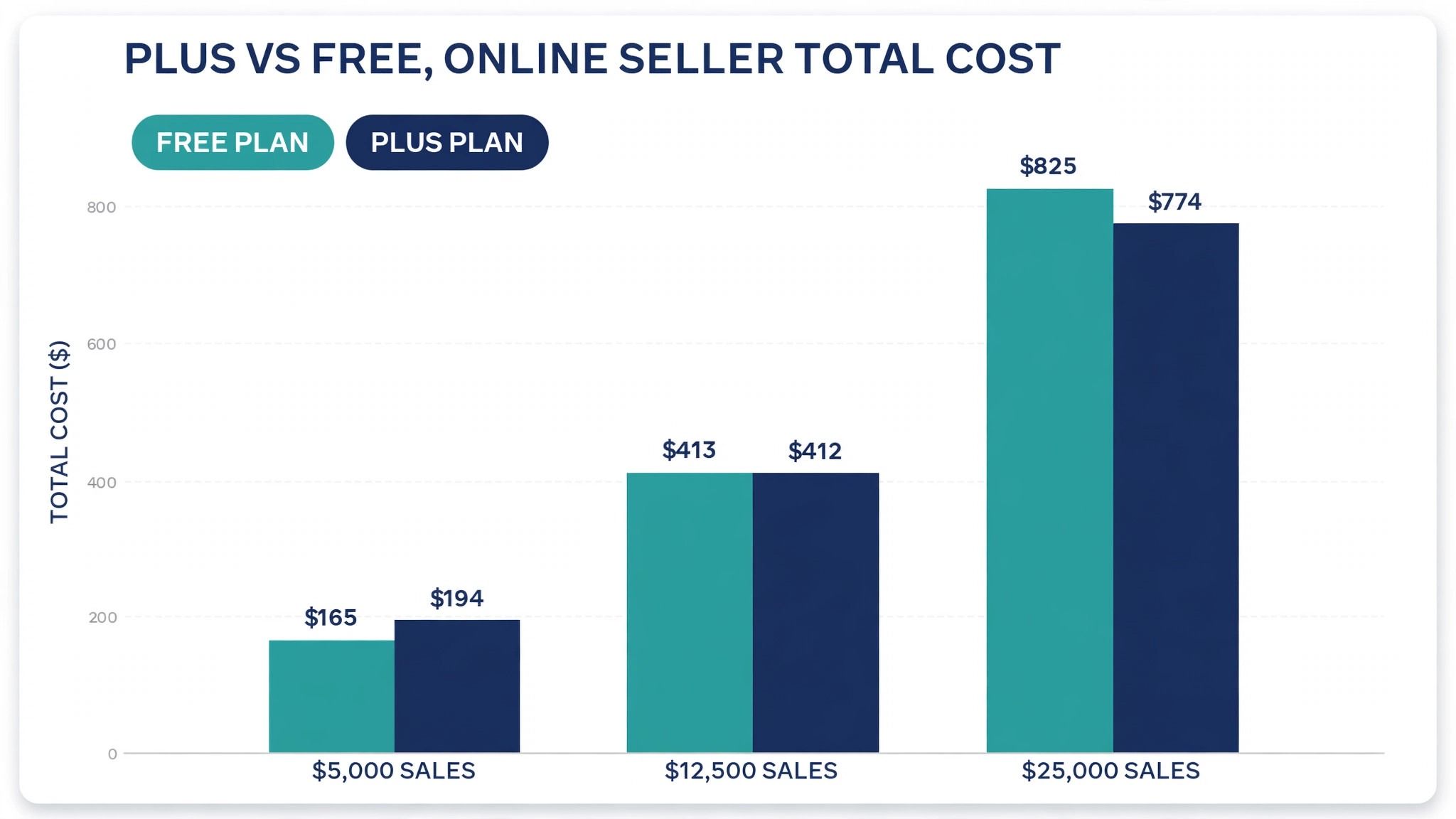
Plus suits a shop, cafe, salon, or service business doing steady card volume, especially one with meaningful online sales. The crossover point sits at around 12,000 to 13,000 dollars a month in card sales, where the lower rates save more than the 49 dollar subscription costs. A business doing 15,000 dollars a month in person saves about 15 dollars on the rate difference alone, and more again on online sales, where the gap is 0.4 percent. Work out your own crossover with the calculator in the cost section below.
Plus also adds a 30 day free trial, so a business can test it for a month and measure the saving directly. Switch the plan, run a normal month, and compare the total cost against the previous month on Free. That test is more reliable than any comparison article, because your mix of in person, online, and keyed payments is unique to your business. If the test saves money, keep Plus. If it does not, switch back.
Square Premium: The High Volume Plan
Square Premium costs 149 dollars a month per location, and it is the plan for businesses with high card volume and a team that needs support. It drops the in person rate to 2.4 percent plus 15 cents, the lowest published rate, while the online and invoice rate stays at 2.9 percent plus 30 cents and the keyed rate stays at 3.5 percent plus 15 cents. It adds 24/7 phone support, advanced reporting, 2,500 marketing texts a month, then 1.5 cents per text, waived gift card load fees, and cheaper kitchen display and kiosk add-ons.
Premium suits a busy restaurant, a multi-location retailer, or a service business processing well above 50,000 dollars a month, where the 0.1 percent in person saving over Plus finally beats the extra 100 dollars a month. A business doing 60,000 dollars a month in person saves about 60 dollars on the rate gap against Plus, which still does not cover the 100 dollar difference, so the real value sits in the support, the texts, and the add-on discounts rather than the rate alone. Work out the full value before you buy, because the rate alone rarely justifies Premium.
Premium also suits a business that needs help fast. A restaurant that loses its point of sale on a Friday night needs a phone answer, not an email ticket, and 24/7 phone support is the feature that earns the subscription for those businesses. A small business that never calls support should stay on Plus and spend the 100 dollars elsewhere. The plan is honest about who it serves, and the volume maths in this guide shows whether that is you.
Processing Fees by Payment Type
| Payment type | Free | Plus | Premium |
|---|---|---|---|
| Tap, dip, or swipe | 2.6 percent plus 15 cents | 2.5 percent plus 15 cents | 2.4 percent plus 15 cents |
| Online or invoice card | 3.3 percent plus 30 cents | 2.9 percent plus 30 cents | 2.9 percent plus 30 cents |
| Keyed or card on file | 3.5 percent plus 15 cents | 3.5 percent plus 15 cents | 3.5 percent plus 15 cents |
| ACH via invoice | 1 percent, 1 dollar minimum | 1 percent, 1 dollar minimum, 10 dollar cap | 1 percent, 1 dollar minimum, 10 dollar cap |
| Afterpay | 6 percent plus 30 cents | 6 percent plus 30 cents | 6 percent plus 30 cents |
| International card | Plus 1.5 percent | Plus 1.5 percent | Plus 1.5 percent |
The table shows why payment mix matters more than the headline rate. A business that takes mostly in person payments will feel the Plus and Premium savings directly. A business that takes mostly keyed payments, such as phone orders typed into a dashboard, will feel nothing, because the keyed rate is 3.5 percent plus 15 cents on every plan. A business that takes mostly online payments will feel the Plus saving, because the online rate drops from 3.3 to 2.9 percent, but will feel no extra saving on Premium, because the online rate is the same on both paid plans.
Work out your mix before you choose. Count your last month of payments by type, multiply each type by its rate on each plan, and add the subscription. That calculation takes ten minutes and it is the only reliable way to pick a plan. A business that guesses will pick the wrong plan half the time, and the wrong plan costs real money every month. Square pricing for small business is simple on the surface and specific in practice, and the specific numbers are yours, not the average.

Hardware: What It Costs to Start
| Hardware | Price | Best for |
|---|---|---|
| Magstripe reader | Free | Testing the system |
| Contactless and chip reader | 59 dollars | Market stalls and mobile sellers |
| Square Stand | 149 dollars | Counter with an iPad |
| Square Terminal | 299 dollars | Counter without a separate tablet |
| Square Handheld | 399 dollars | Tableside and line busting |
| Square Register, second generation | 899 dollars | Busy counter with a dedicated till |
Hardware is sold separately, and it is a one-off cost rather than a monthly one. A market stall can start with the free magstripe reader and the 59 dollar contactless reader, which is the cheapest credible start in this guide. A cafe can start with the Terminal at 299 dollars, which runs the till without a separate tablet. A busy restaurant can buy the Register at 899 dollars, which is the full counter system with a dedicated screen.
Hardware does not lock you into a plan. A business on Free can use the same readers as a business on Premium, and the processing rate follows the plan, not the device. That separation is useful, because it means you can buy the hardware once and change plans as your volume grows. Start with the cheapest hardware that does the job, and upgrade the device only when the counter workflow demands it. The square pricing for small business decision is about the plan, not the reader, and the reader you buy today should still work when you move up a tier.
Add-Ons and Hidden Costs
Square Payroll costs 35 dollars a month plus 6 dollars per person, and it is sold separately from the three tiers. A business with five staff pays 65 dollars a month for payroll, which is more than the Plus subscription itself. Factor payroll into the total before you compare Square against a competitor, because a payroll add-on changes the maths for any business with staff.
Other costs sit in the corners. Instant transfers cost a fee, while free transfers land the next business day. Square payment terms let it delay payouts or require a reserve when it sees risk, and held funds and sudden account closures are the most common complaints about Square in reviews. A business that depends on next day cash flow should keep a reserve of its own, because a payout hold on a busy weekend is a real risk, not a theoretical one.
Gift card load fees are waived on Premium, and cheaper on Plus through the add-on discounts. Marketing texts are included at 2,500 a month on Premium, then 1.5 cents per text. Kitchen display and kiosk add-ons are cheaper on Premium. None of these costs appear in the headline rate, and each one matters to a different business. List the add-ons you actually use, price them on each plan, and add them to the total before you decide, because square pricing for small business is the total bill, not the subscription alone.
Monthly Cost Worked Out for Four Businesses
| Business | Monthly card sales | Mix | Free cost | Plus cost | Premium cost |
|---|---|---|---|---|---|
| Market stall | 3,000 dollars | All in person | 82 dollars | 124 dollars | 221 dollars |
| Cafe | 15,000 dollars | 80 percent in person | 404 dollars | 398 dollars | 486 dollars |
| Online shop | 20,000 dollars | All online | 720 dollars | 629 dollars | 729 dollars |
| Restaurant | 60,000 dollars | 90 percent in person | 1,617 dollars | 1,599 dollars | 1,589 dollars |
| Service business | 8,000 dollars | Half online, half keyed | 258 dollars | 252 dollars | 352 dollars |
A market stall doing 3,000 dollars a month all in person pays about 82 dollars on Free, 124 dollars on Plus, and 221 dollars on Premium, so Free is the clear winner. A cafe doing 15,000 dollars a month, mostly in person, pays about 404 dollars on Free and 398 dollars on Plus, so Plus wins by a little, and the extra features tip the balance. An online shop doing 20,000 dollars a month all online pays 720 dollars on Free and 629 dollars on Plus, so Plus saves about 91 dollars a month, which is a real saving.
A restaurant doing 60,000 dollars a month, mostly in person, pays about 1,617 dollars on Free, 1,599 dollars on Plus, and 1,589 dollars on Premium, so Premium wins by 10 dollars on rates alone, and the support and texts decide the rest. A service business doing 8,000 dollars a month, half online and half keyed, pays about 258 dollars on Free and 252 dollars on Plus, so Plus wins by a little, but the keyed half gains nothing from any plan. Work out your own row in this table, because the plan that fits your mix is the plan that saves you money.
The calculation is simple. Take your monthly card sales, split them by payment type, multiply each type by its rate, add the per transaction cents, and add the subscription. Do it for all three plans, and the cheapest total wins. A business that does this calculation once a quarter will always be on the right plan, because volume and mix change with the seasons.
Square Against Stripe for Small Business
| Point | Square | Stripe |
|---|---|---|
| Entry monthly fee | 0 dollars | 0 dollars |
| In person rate | 2.6 percent plus 15 cents on Free | 2.7 percent plus 5 cents |
| Online rate | 3.3 percent plus 30 cents on Free | 2.9 percent plus 30 cents |
| Keyed rate | 3.5 percent plus 15 cents | 3.4 percent plus 30 cents |
| Hardware | Own readers and tills | Terminal, third party hardware |
| Point of sale | Built in, free app | Needs a third party POS |
| Payouts | Next business day, free | Two business days, free |
Square wins for a business that sells in person first, such as a retail counter, a salon chair, a food truck, or a market stall. Its free point-of-sale software, reader lineup starting near free, next business day deposits, and zero dispute fee are built for card present life. Stripe wins for a business that sells online first, because its 2.9 percent online rate undercuts Square free plan 3.3 percent rate, and on 20,000 dollars a month of 50 dollar online sales, Stripe costs about 700 dollars while Square free costs about 780 dollars.
Square pricing for small business looks expensive online and cheap in person, while Stripe looks the opposite, and the right choice follows where your sales happen. A business that sells both ways should compare the blended rate, not the headline rate, and should test both for a month if the volume justifies it. A business that already owns Square hardware will find switching to Stripe expensive, and a business that already runs on Stripe will find Square hardware an extra cost. The switching cost matters as much as the rate.
Square for Restaurants, Retail, and Services
Restaurants feel the new pricing most, because they take high volume in person payments and need kitchen displays, kiosks, and support. A restaurant doing 60,000 dollars a month mostly in person pays about 1,599 dollars on Plus and 1,589 dollars on Premium, so the rate saving is small, but the Premium support, texts, and add-on discounts decide the choice. A restaurant that loses its till on a Friday night needs a phone answer, and that is what Premium sells. A small cafe doing 15,000 dollars a month should stay on Plus and spend the difference on ingredients.
Retail shops feel the pricing differently, because they take a mix of in person and online sales and need inventory. Plus unlocks advanced inventory and loyalty, which used to be separate add-ons, so a shop that was paying for those add-ons separately will save money on Plus even before the rate saving. A shop that never used those add-ons will feel only the rate saving, which needs about 12,000 dollars a month to beat the subscription. Check which add-ons you already pay for before you compare plans.
Service businesses, such as salons, repair shops, and home services, feel the pricing through invoices and keyed payments. Online and invoice payments cost 3.3 percent on Free and 2.9 percent on Plus, which is a real saving for a business that invoices clients. Keyed payments cost 3.5 percent on every plan, so a business that takes phone payments gains nothing from a paid tier on those sales. Square pricing for small business in services comes down to the invoice share, and a business that invoices half its sales should test Plus for a month and measure the saving directly.
Mistakes Small Businesses Make With Square
The first mistake is picking a plan from an old guide. Square rebuilt its pricing in October 2025, and the free plan online rate rose in January 2026, so any guide written before then describes a different Square. Check the current pricing page, confirm the rates for your plan, and re-check them every quarter. A business that budgets on old rates will be surprised by the bill, and the surprise is avoidable.
The second mistake is ignoring payment mix. A business that takes mostly keyed payments gains nothing from Plus or Premium, because the keyed rate is the same on every plan. A business that takes mostly online payments gains the most from Plus, because the online rate drops by 0.4 percent. A business that takes mostly in person payments gains a little from each paid tier. Count your mix before you choose, because the mix decides the saving.
The third mistake is forgetting the add-ons. Payroll, hardware, instant transfers, gift cards, and marketing texts all sit outside the headline rate, and each one can cost more than the subscription itself. A business with five staff pays 65 dollars a month for payroll, which is more than Plus. List every add-on, price it on each plan, and add it to the total before you decide. The cheapest plan on paper is often the most expensive plan in practice.
Choosing Checklist
Use this checklist when you pick a Square plan, and review it every quarter as your volume changes.
- Count last month card sales by payment type, in person, online, and keyed.
- Work out the total monthly cost on Free, Plus, and Premium with your real mix.
- List every add-on you use, including payroll, hardware, and marketing texts.
- Test Plus for one month on the free trial and compare the real bill against Free.
- Check hardware needs and buy the cheapest device that does the job.
- Confirm payout timing and keep a cash reserve for a possible payout hold.
- Ask Square for custom rates if you process more than 250,000 dollars a year.
- Re-check your plan every quarter, because volume and mix change with the seasons.
Related Guides
Keep exploring with these guides on Stratilyze:
- Sprout Social Pricing for Small Business
- Notion Pricing for Small Business
- Mailchimp Pricing for Small Business
Frequently Asked Questions
How much does Square cost per month for a small business?
Square Free costs zero dollars a month, Plus costs 49 dollars a month per location, and Premium costs 149 dollars a month per location. Processing is charged on top, at 2.6 percent plus 15 cents in person on Free, 2.5 percent on Plus, and 2.4 percent on Premium, with online rates of 3.3 percent on Free and 2.9 percent on both paid plans. The total monthly cost depends on your card volume and payment mix, not just the subscription.
Is Square free really free?
Yes, for the plan itself. Square Free charges no monthly fee and no contract, and you pay only processing fees on the sales you make. Hardware is sold separately, though the magstripe reader is free, and add-ons such as payroll cost extra. A business on Free that only takes in person payments pays about 2.6 percent plus 15 cents per sale and nothing else.
When does Square Plus pay for itself?
Plus starts saving money over Free at around 12,000 to 13,000 dollars a month in card sales, where the lower rates save more than the 49 dollar subscription costs. The exact crossover depends on your mix, because online sales save 0.4 percent and in person sales save 0.1 percent, while keyed sales save nothing. Work out your own crossover with last month numbers, or test Plus for a month on the free trial and compare the real bill.
What is the Square processing fee in 2026?
On Free, in person cards cost 2.6 percent plus 15 cents, online and invoice payments cost 3.3 percent plus 30 cents, and manually keyed or card on file payments cost 3.5 percent plus 15 cents. On Plus, in person costs 2.5 percent plus 15 cents and online costs 2.9 percent plus 30 cents. On Premium, in person costs 2.4 percent plus 15 cents and online costs 2.9 percent plus 30 cents. Square pricing for small business changed in October 2025 and January 2026, so confirm the current rates on the vendor page.
Is Square better than Stripe for a small business?
Square is better for a business that sells in person first, because its free point-of-sale app, cheap readers, and next business day payouts are built for counter life. Stripe is better for a business that sells online first, because its 2.9 percent online rate undercuts Square free plan 3.3 percent rate. The right choice follows where your sales happen, and a business that sells both ways should compare the blended rate rather than the headline rate.
Does Square charge for hardware?
Yes, except for the free magstripe reader. The contactless and chip reader costs about 59 dollars, the Stand costs 149 dollars, the Terminal costs 299 dollars, the Handheld costs 399 dollars, and the Register costs 899 dollars. Hardware is a one-off cost, and the processing rate follows your plan rather than your device, so you can change plans without changing hardware.
A Final Word Before You Choose
Square is the easiest way for a small business to start taking card payments, and the new three tier pricing is fair once you understand it. Free is the right plan below about 12,000 dollars a month in card sales. Plus is the right plan for a working small business with steady volume and meaningful online sales. Premium is the right plan for a high volume business that needs support, texts, and the lowest in person rate.
Whichever you choose, work out your total cost with your real payment mix, test Plus for a month before you commit, and re-check your plan every quarter. A plan that fits your volume today may not fit your volume in six months, and the cheapest plan is the one that matches your business, not the one with the lowest headline rate. Square pricing for small business rewards the owner who does the maths, and the maths takes ten minutes.