

Manual tab hopping and AI assisted search both surface rival prices, but only one delivers a sourced summary in minutes, and speed decides whether research happens quarterly or never. A customer mentions a rival price, a social post reveals a new offer, and the owner files it away mentally until it is forgotten. That accidental research produces confident guesses, not strategy. When you use Perplexity for competitor research small business owners get fast, sourced answers about rivals, pricing, positioning and customer sentiment, provided every claim is verified before it shapes a decision.
This guide builds a competitor brief that a small team can refresh quarterly. It covers the questions that matter, the prompt patterns that surface sourced answers, a brief template you can copy, and a verification checklist that stops AI errors from becoming business decisions.
Why a System Beats a Pile of Notes
Speed is the first gain. A research question that took an afternoon of tab hopping now takes minutes of prompted searching, with sources listed beside each answer. That speed matters for small teams, because research that takes all day gets postponed, while research that takes an hour gets done quarterly.
Breadth is the second gain. Perplexity searches across news, reviews, pricing pages and social discussion in one pass, surfacing signals a manual search misses, such as a rival quietly raising prices or a pattern of complaints about delivery. Breadth turns competitor watching from a chore into a scan.
The third gain is only real with verification. AI answers can mix dates, confuse similar companies and overstate claims, so a brief built on unverified answers is worse than no brief. The verification checklist in this guide is therefore not an optional extra, it is the part that makes the whole method trustworthy.
How to Use Perplexity For Competitor Research Small Business
This section shows how to use Perplexity for competitor research small business in practice, starting from the setup decisions that matter most and ending with a routine you can repeat weekly.
Start with one competitor and one question, not with the whole market. Ask what the rival charges, who it serves and what customers complain about, and verify each answer against a primary source before moving on. A brief that is right about one rival beats a market map that is wrong about five.
Then define the decision the research must serve. A brief for pricing decisions needs different facts from a brief for product decisions, so name the decision first and let it filter the questions. Research without a decision attached becomes trivia, however interesting it reads.
Success in the first month looks ordinary, which is a good sign. The system is built, the first entries are real, the weekly review happens on schedule, and the numbers start to tell a story. If the first month feels messy, that usually means the system is being used honestly, since a tidy system with no real entries helps nobody.
What Else Could Do This Work
The main tool here is Perplexity, and the table below compares it with two other routes to the same result. Start with the option that fits your current setup, run it for a month, and only add a second tool when a clear gap appears, because stacking tools before the routine is settled creates confusion that no software can fix.
| Option | What it does | Best for |
|---|---|---|
| Perplexity | an AI search tool with cited answers | a small team that wants fast, sourced competitor scans |
| Google Search | a search engine with direct page access | a researcher who wants to read primary pages directly |
| SEMrush style tools | SEO and traffic tools with competitor data | a team that needs traffic and keyword numbers |
Perplexity
Perplexity wins on speed and synthesis. It answers in paragraphs with sources, which suits quarterly briefs and quick scans. Its limit is accuracy, since citations can be stale or mismatched, so every decision shaping claim needs a primary source check.
Google Search
Google Search wins on direct evidence, since you read the pricing page or review yourself. Its cost is time, since synthesis across many pages falls to you, so use it as the verification layer for Perplexity findings, not as a replacement for the scan.
SEMrush style tools
SEO tools win on numbers, such as traffic estimates, keywords and backlinks, which AI search cannot reliably provide. Their cost is subscription price, so use them when traffic and keyword decisions matter, and pair them with AI search for positioning and sentiment.
A final test before committing is the handover test. Ask whether a second person could run the setup from the template and the notes alone, without asking the founder. If the answer is no, the setup is not yet a system, it is a personal habit with a tool attached. Fix that gap first, since holidays, sick days and busy weeks will expose it at the worst moment.
From Blank Page to Working System
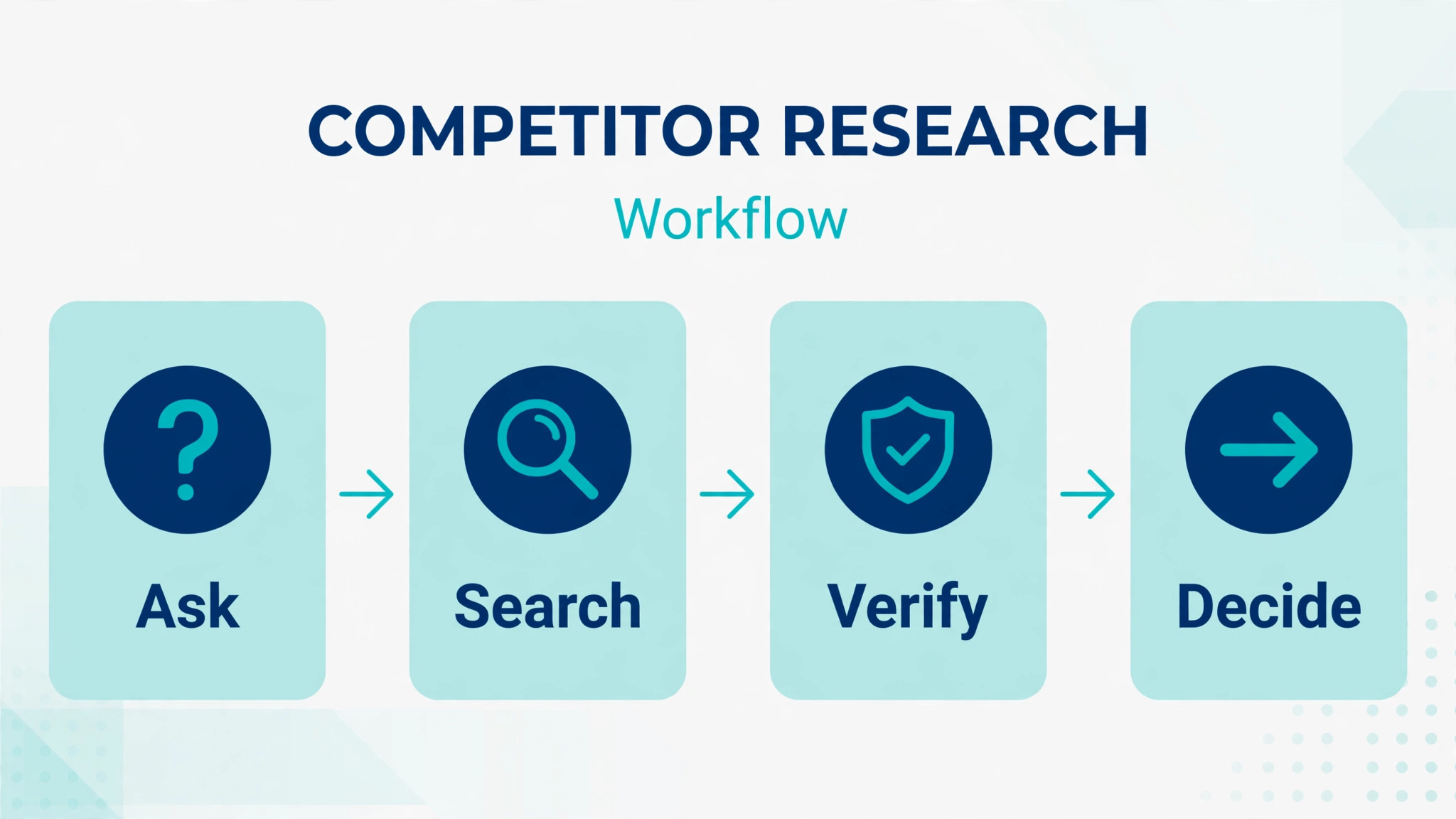
Use this workflow to use Perplexity for competitor research small business in order, because the order matters. Skipping ahead to extras before the basics are recorded creates work that has to be redone, while following the steps in order means each step builds on a finished earlier step. Tick each step off, and do not move on until the current step works with a real task.
- **List the five competitors that matter.** Name the rivals customers actually mention, not every firm in the sector. Five focused rivals produce a usable brief, while twenty produce a directory nobody reads. Include one larger rival and one newcomer, since both reveal different threats.
- **Ask pricing, positioning and complaint questions.** For each rival, ask what it charges, who it serves, what it claims as its edge, and what customers complain about. Those four questions cover the decisions a small business actually makes, from pricing to messaging.
- **Save answers with their sources.** Copy each answer with its cited source and date into the brief, so verification later does not require re-searching. An answer without a source is a rumour, however plausible it sounds, and rumours should never shape pricing.
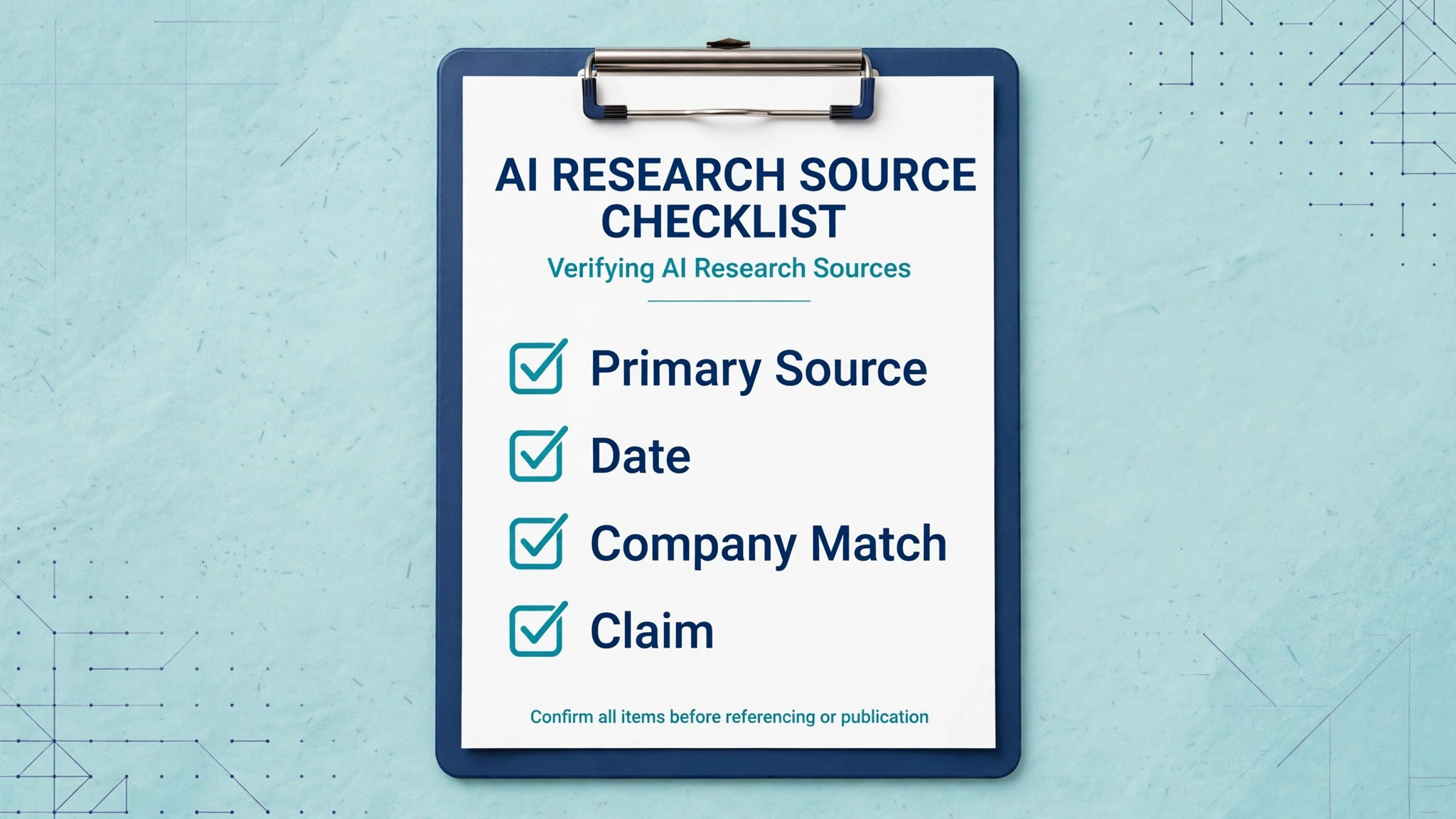
- **Verify decision shaping claims.** Open the primary source for every claim that could change a price, a product or a message, and confirm the date and context. The verification checklist in this guide lists exactly which claims need checking and how.
- **Write the brief in one page per rival.** Summarise pricing, positioning, strengths, weaknesses and the implication for your business on one page each. A brief longer than that will not be read, and an unread brief cannot influence decisions.
- **Decide one action per rival.** For each rival, name one action, whether to match a price, counter a claim, copy a feature or ignore the rival entirely. Research without an action is trivia, while one action per rival turns the brief into strategy.
- **Refresh quarterly and track changes.** Re-run the same questions each quarter and note what changed, since change is the signal. A rival that raises prices, drops a product or gains complaints is telling you something, and quarterly tracking catches it while response is still cheap.
What a Real Week Looks Like
Imagine the system after a month of real use, with a filled template, a history of weekly reviews and a set of numbers that mean something. The value at that point is not the tool, it is the record, because the record shows patterns that memory smooths over. Which items stall repeatedly, which weeks go well, and which kinds of work take longer than expected are all visible in the record, and visible patterns can be fixed.
The record also changes conversations with other people. Instead of saying the workload feels heavy, the owner can show which items are live, which are overdue and what the trend looks like over four weeks. Facts make requests for help, for time or for a change of priority easier to grant, because the other person can see the same picture. A system that produces shareable facts is therefore also a communication tool, not just an organisation tool.
That is why the first month matters more than the first day. A system set up perfectly and abandoned in week two teaches nothing, while a system set up plainly and reviewed four times teaches a great deal about the work itself. Judge the system at the end of month one, on the record it produced and the decisions it improved, not on how impressive it looked on day one.
The Template Plus the Weekly Checklist
Use this template when you use Perplexity for competitor research small business without starting from a blank page each time. Copy it, fill it in with your own details, and keep the filled version where the people who use it can see it. A template that lives in a drawer helps nobody, while one that sits beside the work becomes the way the job actually gets done.
| Item | What to write down |
|---|---|
| Rival profile | name, size, market, pricing, positioning, in one page |
| Customer sentiment | common praise and complaints, with sources and dates |
| Strengths and gaps | what the rival does well and where it is weak, verified |
| Implication | what this means for your pricing, product or message |
| Action | one action per rival, with an owner and a date |
Fill the table in with real details from your own setup, not with guesses, because a plan filled with guesses gives confident answers that are wrong. If a detail is unknown, write unknown and find it before you act on that row, since a single guessed cost or time can undo an otherwise sound plan. Review the filled version every month for the first quarter, then every quarter after that, and update it when prices, people or suppliers change.
Keep the filled version where the work happens, whether that is a shared folder, a printed page or the tool itself, and name one person who owns updating it. Ownership matters because a template without an owner goes stale within a quarter, while one with a named keeper stays current through staff changes and price changes alike. When the owner changes, hand the template over explicitly, like any other responsibility.
- Each rival answer carries a source and a date
- Pricing claims were checked against the rival pricing page
- Complaint patterns were checked against review sources, not one review
- Dates are current, not stale pages from years ago
- Similar company names were not confused with each other
- Each rival has one page, not a sprawling dossier
- Each rival has one named action with an owner
- The brief is dated and scheduled for quarterly refresh
Keeping the Template Honest
A template that never changes is probably not being used honestly, while one that changes weekly is probably not stable enough to trust. The healthy middle is a template that changes monthly, in small deliberate steps, driven by review evidence. Track the changes in a short log, even just a dated line per change, so the evolution stays visible and reversible if a change turns out to be a mistake.
Finally, test every template change with real work before rolling it out to a team. A change that looks tidy in the abstract can slow entry in practice, and entry speed decides whether a template survives busy weeks. One week of real use by one person beats a month of discussion by a committee, because real use reveals friction that discussion only imagines.
Pricing and Practical Limits
Before you commit money or time, write down the costs of the current way of working, because when you use Perplexity for competitor research small business you need a baseline to judge the new way against. Count the time spent, the errors made and the opportunities missed under the old way, then compare that total with the same total after one month of the new routine. If the new total is not lower, or the experience is not clearly better, change one thing and measure again rather than adding more tools.
Perplexity offers a free tier that covers basic competitor scans, with paid tiers adding higher limits and more models, so check the vendor pricing page before paying and start free. For a quarterly brief, the free tier usually suffices, and the real cost is the hour spent verifying claims, which is the work that makes the brief trustworthy.
Compare that with agency research, which costs hundreds or thousands per brief and still needs internal judgment to act on. A small team that runs its own quarterly scan with verification gets most of the value at a fraction of the cost, provided verification is never skipped.
Watch for the cost that appears only after launch, such as extra seats as a team grows, premium features on higher tiers, or the time spent maintaining a setup that looked simple at first. Read the pricing page for the tier you will actually land on in six months, not the starter tier you land on today, because a tool that is cheap at small volume and expensive at larger volume can punish growth. Set a calendar reminder to review the bill every quarter, and compare it with the time saved, since a subscription that no longer saves time should be renegotiated or dropped.

Errors That Creep In Over Time
The mistakes below are common because each one feels reasonable at the time, and when you use Perplexity for competitor research small business it helps to name them before they happen. Read the list with anyone who will use the routine, agree which mistake your setup is most likely to make, and put one guard in place against it, because a named mistake is far easier to avoid than a vague warning to be careful.
- Trusting AI answers without verification. Citations can be stale, mismatched or overstated, so check primary sources.
- Researching twenty rivals shallowly. Five rivals researched well beat twenty researched thinly.
- Confusing similar company names. AI tools mix up similar names, so confirm the exact company every time.
- Writing a dossier nobody reads. One page per rival is the limit for a brief that influences decisions.
- Researching without a decision. A brief that ends without actions is trivia, however interesting.

Reviewing the Results Honestly
Pick a small set of numbers and track them monthly, because when you use Perplexity for competitor research small business you need evidence, not a feeling, about whether the change is paying. Choose numbers you can collect without extra admin, such as briefs completed per quarter, claims verified rate, actions completed per brief and pricing changes spotted, and record them in one place on the same day each month. A trend over three months tells you far more than a single good or bad week.
Track briefs completed, verification rate, actions completed and pricing changes spotted each quarter. If verification falls below full coverage for decision shaping claims, the brief is not trustworthy, however fast it was produced. If actions completed stays at zero, the brief is not connected to decisions, and the format needs changing.
Also track changes spotted, since a brief that never spots a change is either too infrequent or too shallow. Quarterly refresh with the same questions is the minimum rhythm that catches pricing and positioning moves while response remains cheap.
When a number moves the wrong way, change one element and watch the next period before changing anything else. Changing five things at once feels decisive, but it destroys the evidence, since nobody can tell which change helped. Single changes, measured honestly, are slower to announce and faster to learn from, which is the trade that matters over a year.

Where You Should Be in Three Months
After ninety days, a healthy setup shows up in small, boring ways, such as briefs completed per quarter, claims verified rate, actions completed per brief and pricing changes spotted trending in the right direction without heroic effort, and fewer messages asking where things stand. Nobody celebrates a routine that simply works, which is why it is worth naming those signs when they appear, so the people involved recognise the payoff and keep funding the habit.
The warning sign is different, and it is worth watching for, which is when people start working around the setup instead of through it. Workarounds usually mean one step no longer fits reality, so ask what changed, fix that step, and prune anything the workaround replaced. A setup that adapts to one real change survives, while one that demands loyalty to an outdated step gets quietly abandoned.
Set the ninety day review now, with a named owner and a date in the calendar. Without a named owner and a date, reviews slip, and a slipped review means a system that slowly stops matching the reality it was built for. The review itself need not take long, since one hour with the numbers and the honest answers is enough to decide what to keep, what to change and what to stop.
The First Month, Week by Week
Week one is the first brief. List five rivals, run the four questions per rival, verify the decision shaping claims and write one page each. Do not expand the rival list until the first brief produces actions.
Weeks two to four are action and routine. Complete the actions from the brief, set the quarterly refresh date, and note what the verification step caught. By month end, the business should own a dated brief, a set of actions and a refresh habit that survives busy quarters.
If the first month feels messy, resist the urge to rebuild the system from scratch, since the fault usually sits in one step rather than in the whole approach. Return to the numbers you tracked, find the step where results diverged from the plan, and change that step alone. System swaps feel decisive, but they reset learning to zero, while a single step fix preserves everything that already worked.
Day by Day in Week One
On day one, build the template and import what is already live, without redesigning anything. The goal for day one is a working system with real entries, not a beautiful system with sample data, since real entries reveal the flaws that sample data hides. End the day by checking that every live item has a status and a next action.
On day two, use the system for new work as it arrives, and note every moment of friction. Friction notes are gold, because they point at the exact field, step or view that needs fixing, while general complaints about the system point nowhere. Keep the notes short, one line each, and review them at the end of the week.
On day three, fix the single biggest friction from the notes, and leave the rest alone. One fix per week is the pace that improves a system without destabilising it, and a system that changes daily never gets learned properly by anyone, including its owner. Stability for a week beats improvement every day.
On day four, share the system with anyone else who touches the work, and watch them use it without help. Watching a second person reveals instructions that only made sense to the author, and those instructions need rewriting before the system can survive a holiday or a handover. A system that only its author understands is not yet a system.
On day five, run the first weekly review, record the numbers, and decide one change for next week. The review closes week one with evidence instead of feelings, and that evidence becomes the baseline for month one. A week that ends with a review has already succeeded, whatever the numbers say, because the habit is the achievement.
If Momentum Fades
When results stay flat after a month of honest use, check whether the system measures the right thing. A tracker that counts activity while the goal is outcome will show busy weeks and flat results, which feels like failure even when effort is real. Revisit the metrics, pick one outcome number that matters, and let that number drive the next change. If the outcome number still does not move after a further month, the approach itself, not the system, needs rethinking.
A stalled system usually fails at one of three points, which are entry, review or follow through, and diagnosing the right point saves a rebuild. If entries lag, the template is too heavy or entry takes too long. If reviews get skipped, the review is too long or it has no fixed slot. If actions do not follow, the numbers are not connected to decisions. Name the failing point plainly before changing anything, since a fix aimed at the wrong point adds complexity without restoring momentum.
When entry is the problem, simplify before adding features. Remove one field, shorten one checklist, or batch entry to a single sitting per day, and watch whether entries recover within a week. Entry friction is the most common stall, because a system that takes ten minutes per item will be abandoned in a busy week, while one that takes two minutes survives. Speed of entry matters more than completeness of record, especially in the first month.
Finally, if the stall came from a busy period rather than a design flaw, restart small instead of restarting perfectly. Pick the single most important item, enter it today, run a five minute review tomorrow, and let the habit rebuild from one live item rather than from a grand relaunch. Systems recover faster from small restarts, because a small restart can happen today, while a perfect restart keeps waiting for a quiet week that never arrives.
More Reading on Stratilyze
More Reading on Stratilyze. For the systems around this one, read the best crm software for small business guide, the best crm tool for small business sales guide, the perplexity alternatives guide. Read the guide that matches your next bottleneck first, because fixing the biggest bottleneck next gives a larger gain than polishing a part of the setup that already works well.
Frequently Asked Questions

Is Perplexity accurate enough for competitor research?
It is accurate enough as a scanning layer, provided every decision shaping claim is verified against a primary source. Treat its answers as leads, not as facts, and the verification checklist in this guide keeps the brief honest.
How many competitors should a small business track?
Five is a good number, covering direct rivals customers mention, one larger rival and one newcomer. More than that dilutes attention, while fewer risks missing a real threat. Expand only when the five are handled well.
How often should competitor research be refreshed?
Quarterly for most small businesses, since pricing and positioning move at that pace. Fast moving markets may need monthly scans for pricing only, while the full brief stays quarterly.
What if Perplexity cites a stale source?
Check the date on the primary page and discard stale claims, since prices and offers change. The verification step exists precisely for this, and a brief that notes stale sources explicitly is more trustworthy than one that hides them.
Should I track customer complaints about rivals?
Yes, since complaint patterns reveal gaps you can serve. Verify patterns across several reviews, not one angry post, and never repeat unverified claims publicly, since that creates legal and reputational risk.
Can I use competitor findings in my own marketing?
Yes for general positioning, such as emphasising a strength a rival lacks, but avoid repeating unverified claims about a rival and avoid copying protected material. When in doubt, claim your own strengths rather than attacking a rival weakness.
The Bottom Line on AI Competitor Research
Competitor research fails when it is slow, shallow or unverified, and small teams cannot afford any of the three. When you use Perplexity for competitor research small business owners get fast, sourced scans that become trustworthy only through verification, and a one page brief per rival that ends in a named action. Speed finds the signal, verification makes it safe, and action makes it strategy.
Pick five rivals this week, run the four questions, verify what would change a decision, and write one page each with one action. Refresh quarterly, track what changes, and let the brief become the quiet habit that keeps pricing and positioning honest.