
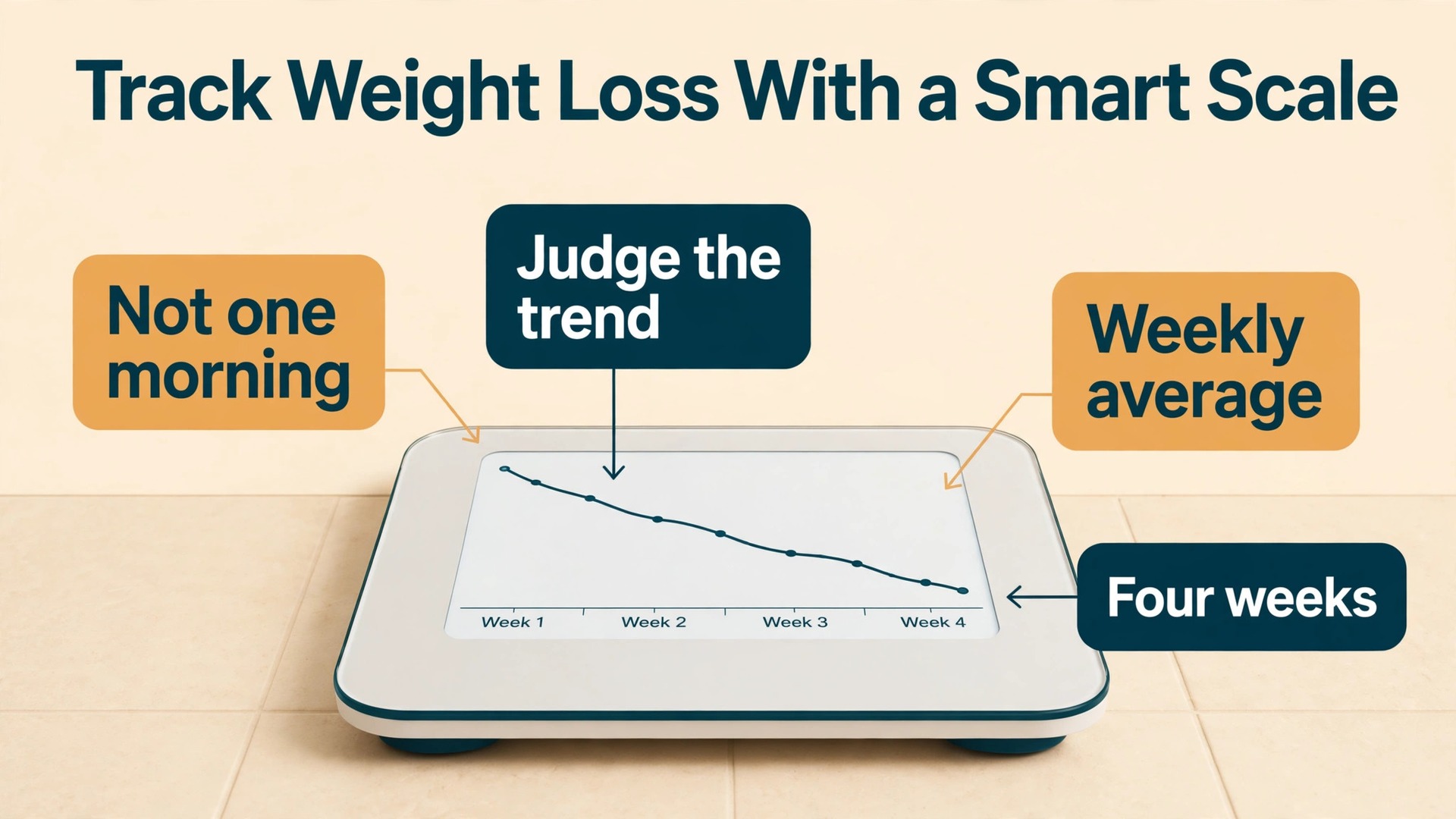
Judge a smart scale on four weeks of trend, not on one morning number, because a single weigh-in mostly measures water, food, and timing. If you want to use smart scale for weight loss tracking well, that one shift in thinking matters more than any feature on the box. Daily weight can move by a kilogram or more without any change in body fat, and reacting to each jump usually leads to either panic or false celebration. A trend, built from consistent weigh-ins and averaged over weeks, tells you whether fat loss is actually happening.
This guide gives you the full workflow. It covers scale setup and placement, a weighing routine that keeps readings comparable, a practical way to read trends, what body composition numbers can and cannot tell you, how to tell a real plateau from normal noise, and the app and privacy settings worth checking before you share health data with anyone. It uses real specifications from major makers where they matter, and it flags the limits plainly, so you do not mistake a clever estimate for a medical measurement.
Why Trends Beat Daily Weigh-Ins
A bathroom scale weighs everything in and on your body at that moment. That includes fat, muscle, bone, water, food still being digested, glycogen stored in muscle and liver, and the water held alongside that glycogen. Glycogen alone can hold roughly three to four times its own weight in water, which is why a high carbohydrate meal, a hard workout, a salty restaurant dinner, or a long flight can all push the number up for a day or two without any fat gain. Hormonal cycles, creatine use, illness, constipation, and even a hot day can move the reading in the same way.
Weekly averages solve most of this problem. When you average seven daily readings, one salty evening or one dehydrated morning has far less power to distort the result. When you compare this week average with last week average, and then with the week before that, you get a line that moves slowly and honestly. That line is the number to act on. A single morning reading is a data point. A four week trend is evidence.
There is also a behaviour point here. People who weigh daily but judge weekly tend to stay calmer and stick with a plan longer than people who judge every reading. If you use smart scale for weight loss tracking on a daily habit, keep the daily habit for data and reserve judgement for the weekly average. If daily weighing makes you anxious, weighing three to four times a week on the same routine still gives you a usable average, provided you do not cherry pick only the lowest readings. The rule is simple. Collect often, judge rarely, and change the plan only when the trend earns a change.
What a Smart Scale Actually Measures
Weight measurement is straightforward. Withings states weight accuracy to within 50 grams for its Body Smart model, which uses Wi-Fi or Bluetooth sync and recognises up to eight users. Renpho publishes a tolerance table for one of its Bluetooth body fat scales, at 50 kilograms plus or minus 0.3 kilograms, at 100 kilograms plus or minus 0.4 kilograms, and at 150 kilograms plus or minus 0.5 kilograms. Fitbit Aria Air, a simpler Bluetooth scale, carries a stated weight limit of 180 kilograms. These are different specifications from different makers, but they point to the same practical truth. Weight is the most trustworthy number on any smart scale, and it is the number your trend should rest on.
Body composition is estimated, not measured directly. Most smart scales use bioelectrical impedance analysis, usually shortened to BIA. The scale sends a small, imperceptible electrical current up one leg and down the other through the feet, then measures resistance. Lean tissue holds water and conducts electricity well. Fat tissue holds little water and resists the current. The scale feeds the resistance reading, together with your height, age, sex, and sometimes activity level, into a proprietary formula that estimates body fat percentage, muscle mass, body water, and related figures.
That method has real limits. First, foot to foot scales only send current through the lower body and then estimate the rest, so the upper body is modelled rather than measured. Second, the formulas assume average hydration for lean tissue, and your hydration is rarely average. Drinking a large amount of water, eating a meal, exercising, or being mildly dehydrated can shift a body fat estimate by one or two percentage points in a single day, even when body fat has not changed at all. Third, the formulas were built on specific test populations, so people far from that average, including very muscular people, very lean people, older adults, and people with fluid retention, tend to get larger errors.
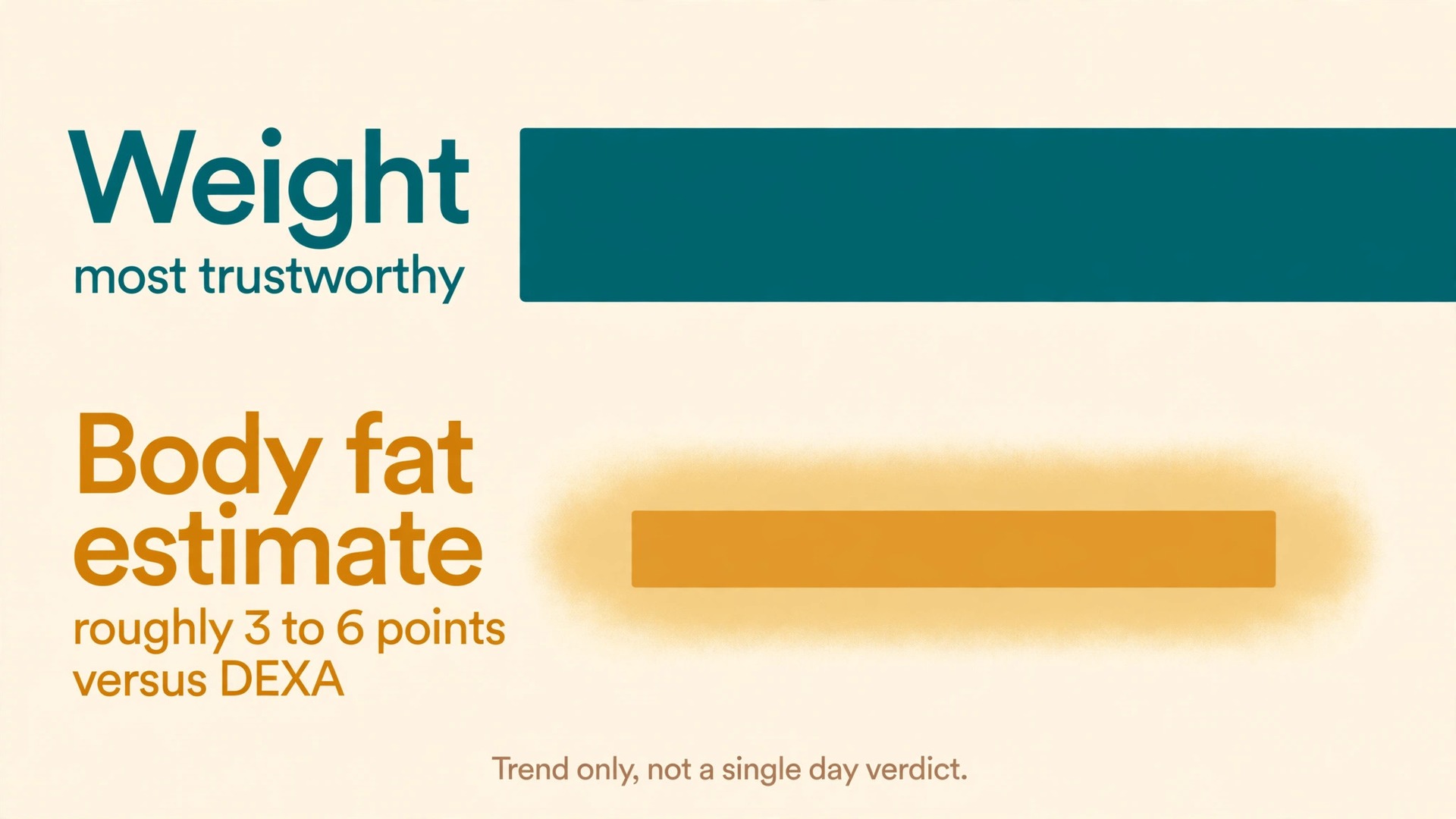
None of this makes body composition numbers useless. It makes them trend tools, not verdicts. If your scale says 28 percent body fat and a clinic scan says 24 percent, the scale may simply be biased for your body type. What matters is whether the scale estimate moves in the same direction as your weight trend, your waist measurement, and your photos over eight to twelve weeks. When you use smart scale for weight loss tracking with that mindset, a biased estimate can still be useful, because a consistent bias still shows direction. A single reading, however, proves almost nothing.
One safety limit is not optional. BIA scales should not be used for body composition measurement by people with a pacemaker, an implanted defibrillator, or another implanted electronic device. Withings and Fitbit both carry this warning for their body composition models. If that applies to you, use a scale for weight only, with body composition switched off where the app allows it, and ask your clinician what tracking method suits you.
The Setup Checklist to Use Smart Scale for Weight Loss Tracking
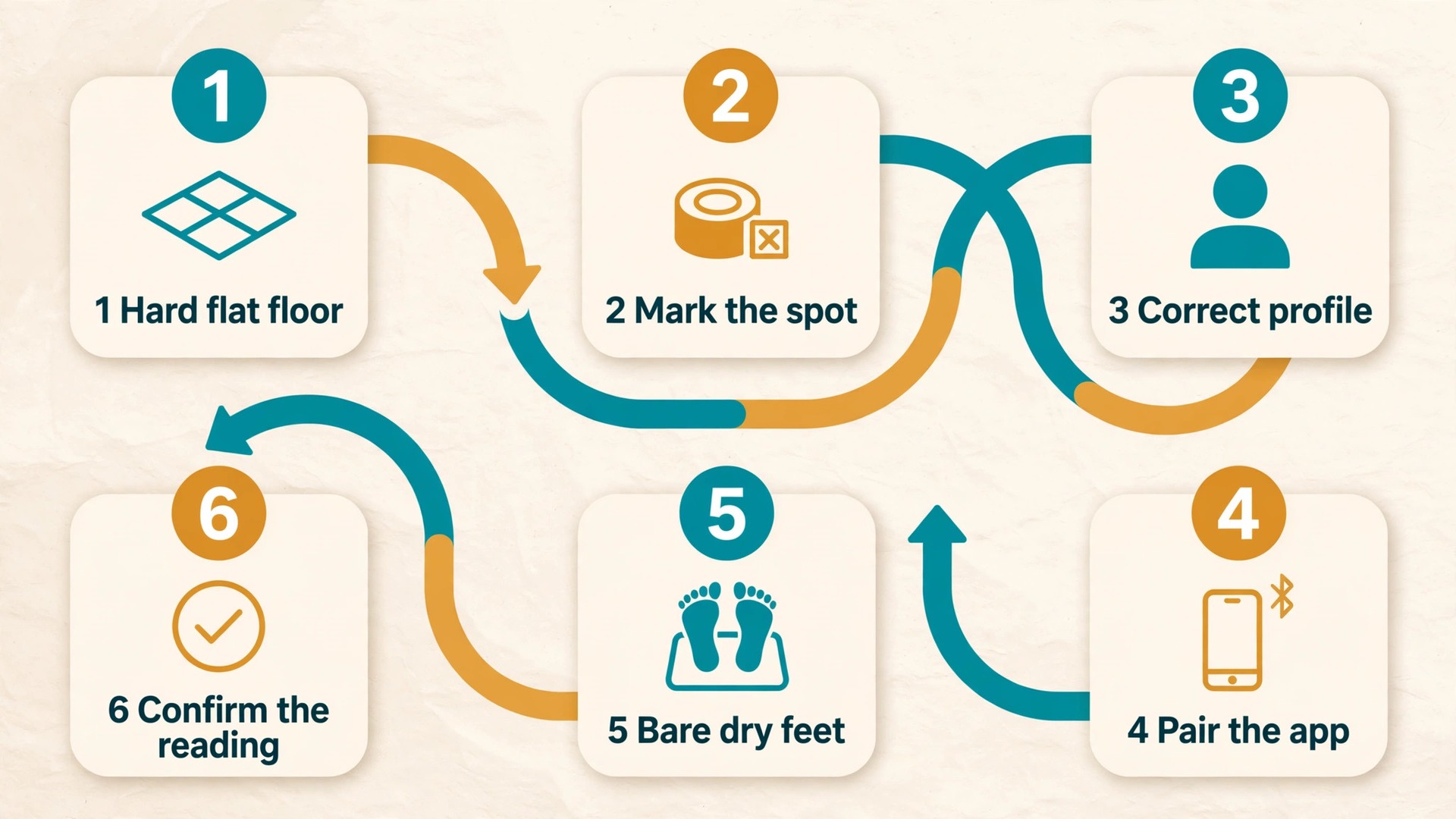
Work through this checklist in order before you count any reading as part of your trend. Skipping a step here is the most common reason a new scale owner concludes the scale is inaccurate, when the real problem is placement, pairing, or profile error.
- Place the scale on a hard, flat floor, never on carpet, a rug, a bath mat, or an uneven tile. If the only bathroom floor is carpeted, move the scale to a hard floor elsewhere in the home and keep it there.
- Mark the spot with a small piece of tape on the floor or a note in your phone, so the scale returns to the same place after cleaning.
- Check the batteries or charge level, and set the unit to kilograms or pounds before the first weigh-in.
- Download the maker app, create your profile with correct height, age, and sex, and set a realistic goal weight range rather than a single punishing target.
- Pair the scale exactly as the maker instructs. Withings pairs over Wi-Fi or Bluetooth through the Health Mate app. Renpho pairs over Bluetooth through the Renpho Health app with the app open and bare dry feet on the electrodes. Fitbit Aria Air pairs through the Fitbit app by adding a device, then needs the phone nearby during weighing.
- Step on barefoot, feet centred on the electrodes or footpads, standing still with weight even, arms relaxed, until the display settles and the app confirms the reading.
- Confirm the reading landed in the correct profile, especially in a shared household, and delete any guest or partner reading from your account straight away.
- Turn on the weekly and monthly trend chart in the app, and switch off any public sharing, social feed, or leaderboard feature you do not want.
- Check privacy settings now, not later. Decide which apps may receive your weight, whether friends or coaches can see it, and whether the maker may use aggregated data for product improvement.
- Take a baseline waist measurement and a baseline photo on the same day as your first clean weigh-in, so later comparisons have a starting point.
A Weighing Routine That Keeps Readings Comparable
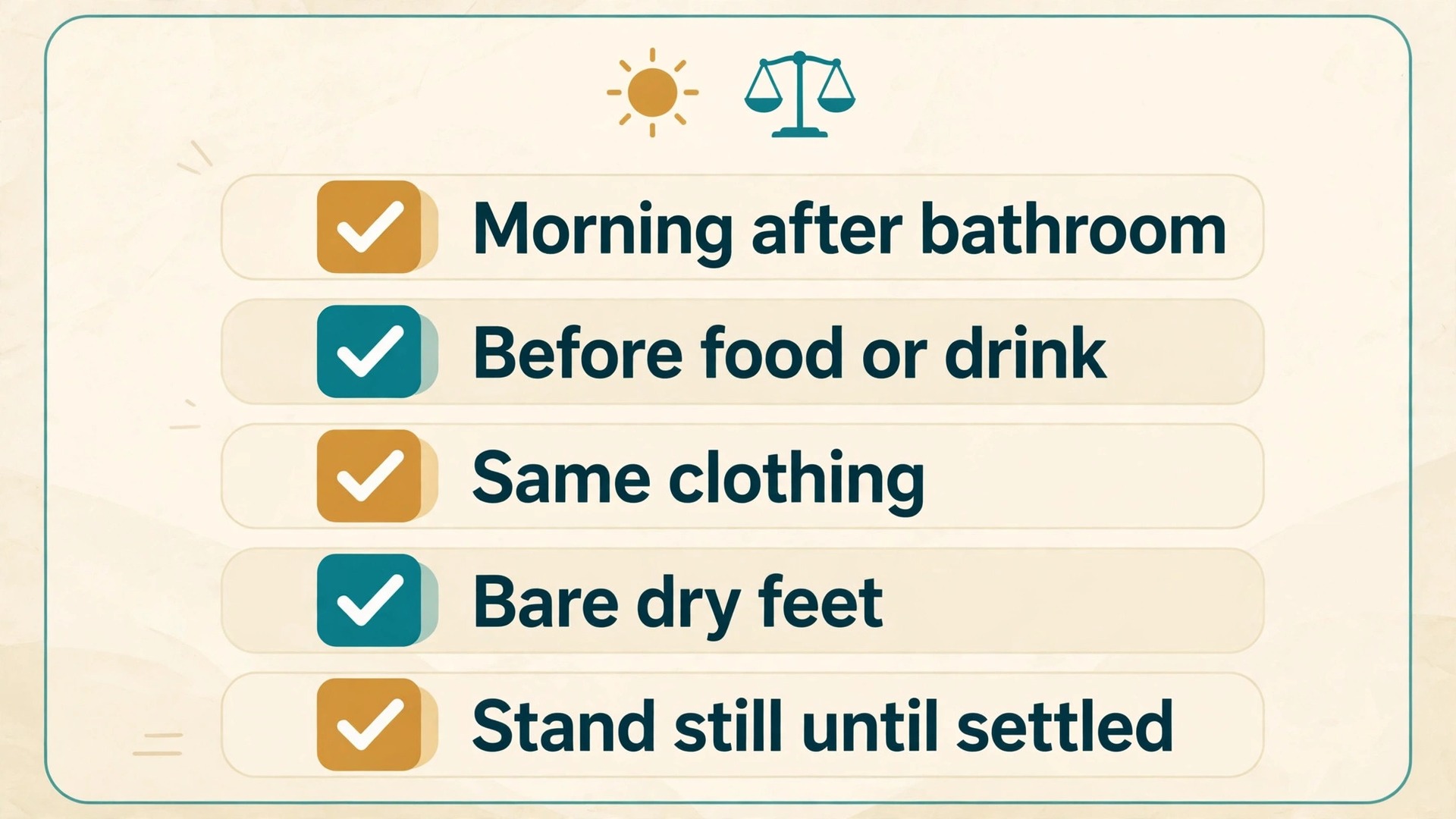
Consistency is the whole method. The routine below is deliberately boring, because boring is what makes readings comparable. Follow it the same way every time, and the trend will reward you with clarity.
Weigh first thing in the morning, after using the bathroom, before eating or drinking, and before exercise. Wear the same amount of clothing each time, ideally none or light underwear, and weigh before your shower, because a shower adds water to skin and hair and can nudge the reading. Step on barefoot with dry feet, because body composition readings need skin contact with the electrodes, and wet or lotioned feet change resistance. Stand still, look forward, and wait until the display stops changing before stepping off. Do not weigh again immediately to chase a lower number. If you must reweigh because you suspect an error, note the first reading, step off, let the scale reset, and step on again calmly.
Travel, illness, and holidays will break the routine, and that is normal. When you return, resume the morning routine without trying to compensate by weighing five times a day. A gap of a few days does not ruin a trend. A week of frantic catch-up weighing, with readings taken at different times and in different states, adds noise that takes another week to wash out. Keep the scale in the same spot, on the same floor, at a stable room temperature, because a moved scale or a cold bathroom can shift readings slightly until a few consistent days settle the trend again. If readings suddenly jump by several kilograms and stay there, check placement, batteries, and profile first.
Those three checks explain most sudden jumps without any drama. When you use smart scale for weight loss tracking with this routine, the data stays clean enough that a real change stands out clearly from daily noise.
The Trend Reading Guide
Start with the weekly average. Add your daily readings for a calendar week, or any rolling seven day block, and divide by the number of readings you actually took. If you weighed five days out of seven, divide by five, not by seven, and note the missing days. Missing days are fine. Invented or guessed readings are not. A week with only one or two readings is too thin to judge, so carry it forward and judge the next fuller week instead.
Next, compare week averages, not days. Write down each week average in a simple list, either in the scale app if it shows weekly averages clearly, or in a notes app or spreadsheet if it does not. After three weeks, you can see the slope. A fall of roughly 0.25 to 0.5 kilograms per week is a steady, sustainable pace for many adults, though the right pace depends on starting weight, health conditions, and professional advice. A fall faster than about 1 percent of body weight per week deserves a check that you are eating enough and preserving muscle, especially if strength is falling or fatigue is rising. A flat line for one week is normal.
A flat line for two weeks is still often normal. A flat line for three to four weeks, with consistent habits, is when the plateau check in the next section earns its turn.
A rolling average is a useful upgrade once daily weighing feels easy, and it is a natural next step when you use smart scale for weight loss tracking beyond the first month. A seven day rolling average takes today reading plus the previous six days, divides by seven, and plots that value each day. The rolling line moves more smoothly than daily points and shows turning points earlier than a calendar week average, because it updates daily rather than jumping once a week. Many scale apps and third party trend apps calculate this for you. If your app does not, a spreadsheet with a simple average formula does the same job in a few minutes.
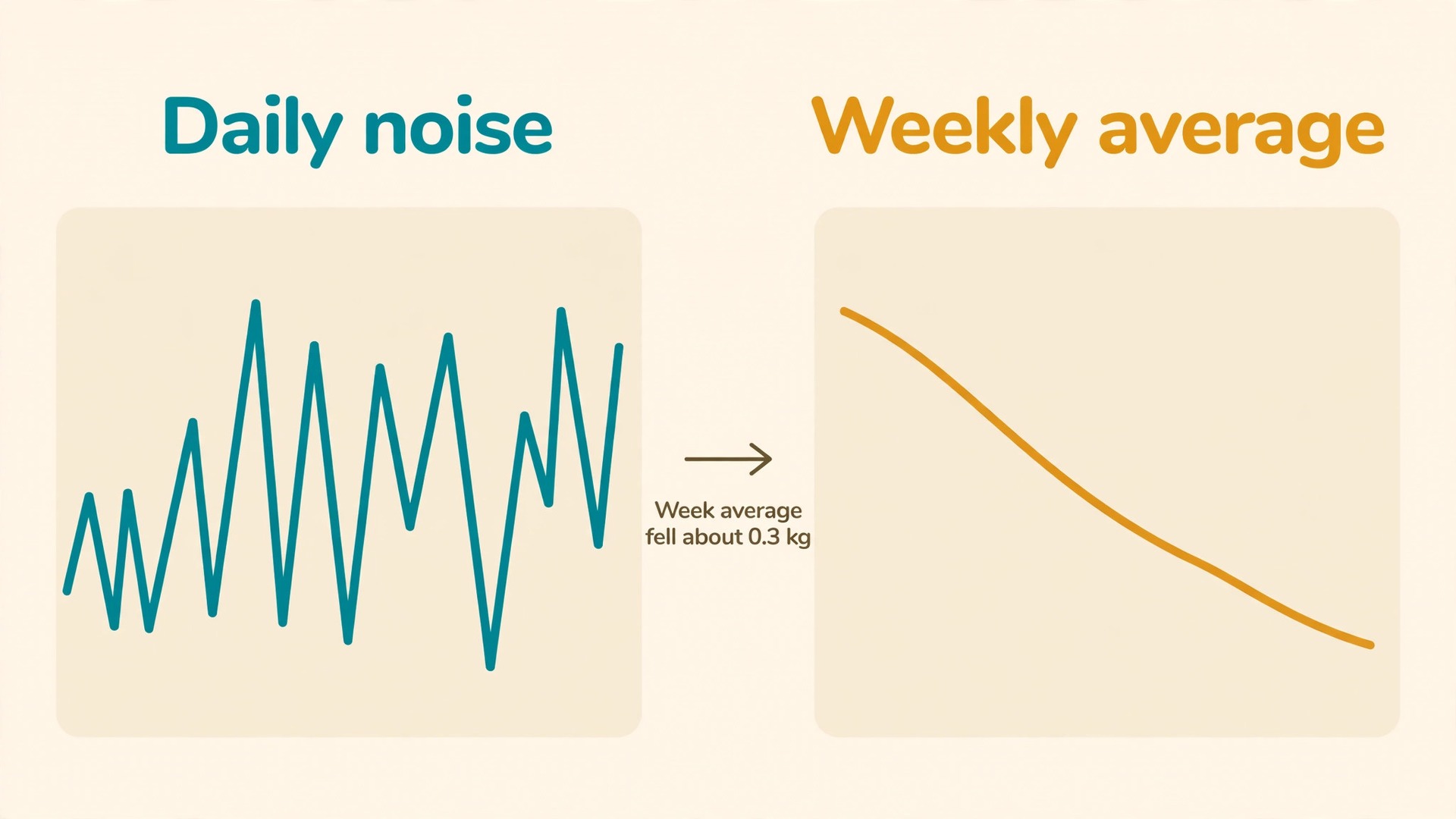
A worked example makes the method concrete. Imagine daily readings in kilograms across two weeks as follows. Week one readings are 84.2, 84.6, 84.1, 84.8, 84.3, 84.5, and 84.0, giving a week average of about 84.4. Week two readings are 84.5, 84.0, 84.3, 83.9, 84.4, 83.8, and 84.1, giving a week average of about 84.1. No single day in week two is dramatically lower than week one, and several days are actually higher. Yet the week average fell by about 0.3 kilograms, which is real progress hidden inside daily noise. A reader who judged only the highest day in each week would conclude nothing changed.
A reader who judged the averages would correctly keep the plan unchanged and let the trend continue.
Body Composition Metrics and Their Limits
Body fat percentage is the headline estimate, and it is also the most sensitive to hydration. Published comparisons put consumer BIA error in the range of roughly three to six percentage points against DEXA in many studies, with larger errors for some body types. That range means a scale reading of 30 percent could plausibly sit near a clinic value several points away. Use it only as a slow direction indicator, averaged over a month, and never as a pass or fail grade for a week.
Muscle mass on a home scale is derived from the same impedance reading, not measured by scanning muscle directly. If body water rises, estimated muscle mass often rises with it, because the formula treats water rich tissue as lean tissue. That is why a high sodium weekend can apparently add muscle overnight. It did not. The formula misread water as muscle. Judge muscle mass alongside strength. If your lifts or step count are stable or rising while weight falls slowly, muscle preservation is plausible. If strength is falling sharply, raise the question with a coach or clinician, even if the scale muscle figure looks fine.
Visceral fat estimates deserve extra caution. Visceral fat sits around internal organs and matters for health, but a foot to foot scale cannot measure it directly. It estimates it from total fat and population formulas. A falling visceral fat estimate alongside a falling waist is encouraging. A single visceral fat number, on its own, should never drive a medical decision. Body water percentage is useful mainly as a noise detector. When body water jumps up, expect weight to jump up and body fat estimates to fall, because the formula sees more conductive tissue. When body water falls after illness, heavy sweating, or low carbohydrate days, expect weight to fall and body fat estimates to rise.
Reading body water this way turns a confusing day into an explained day.
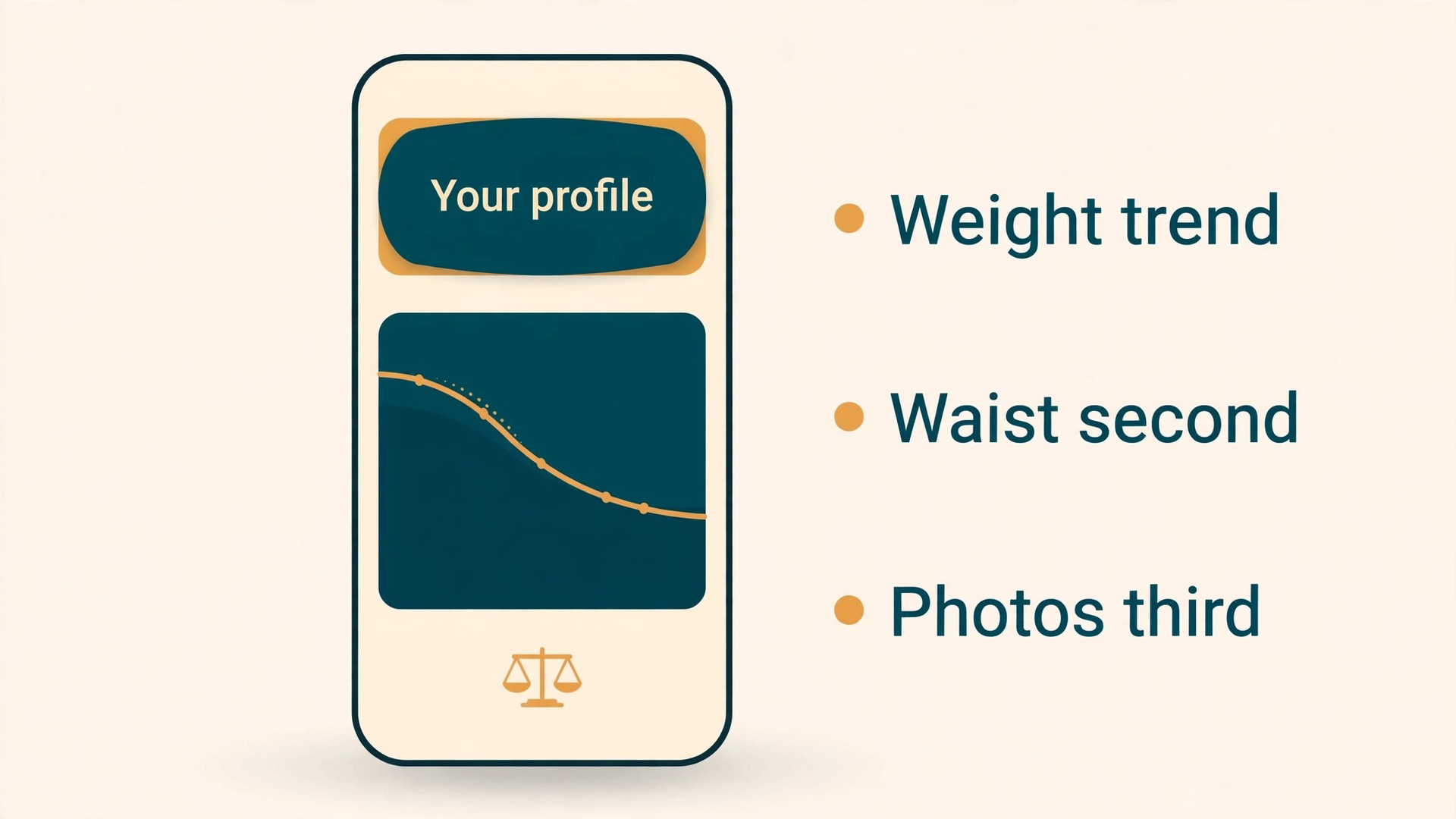
Bone mass and metabolic age are the metrics to ignore for weight loss decisions. Bone mass barely changes week to week on a home scale, and small changes in the reading are almost always formula noise. Metabolic age compresses several estimates into a single flattering or alarming number, and it moves when hydration moves. Basal metabolic rate estimates from scales are also rough, because they derive from estimated lean mass and standard formulas. Use them as a starting point for a conversation with a dietitian, not as a prescription. The practical hierarchy is therefore clear. Weight trend first, waist second, photos and strength third, body composition direction fourth, and single day composition numbers last, effectively ignored.
Plateau Diagnosis
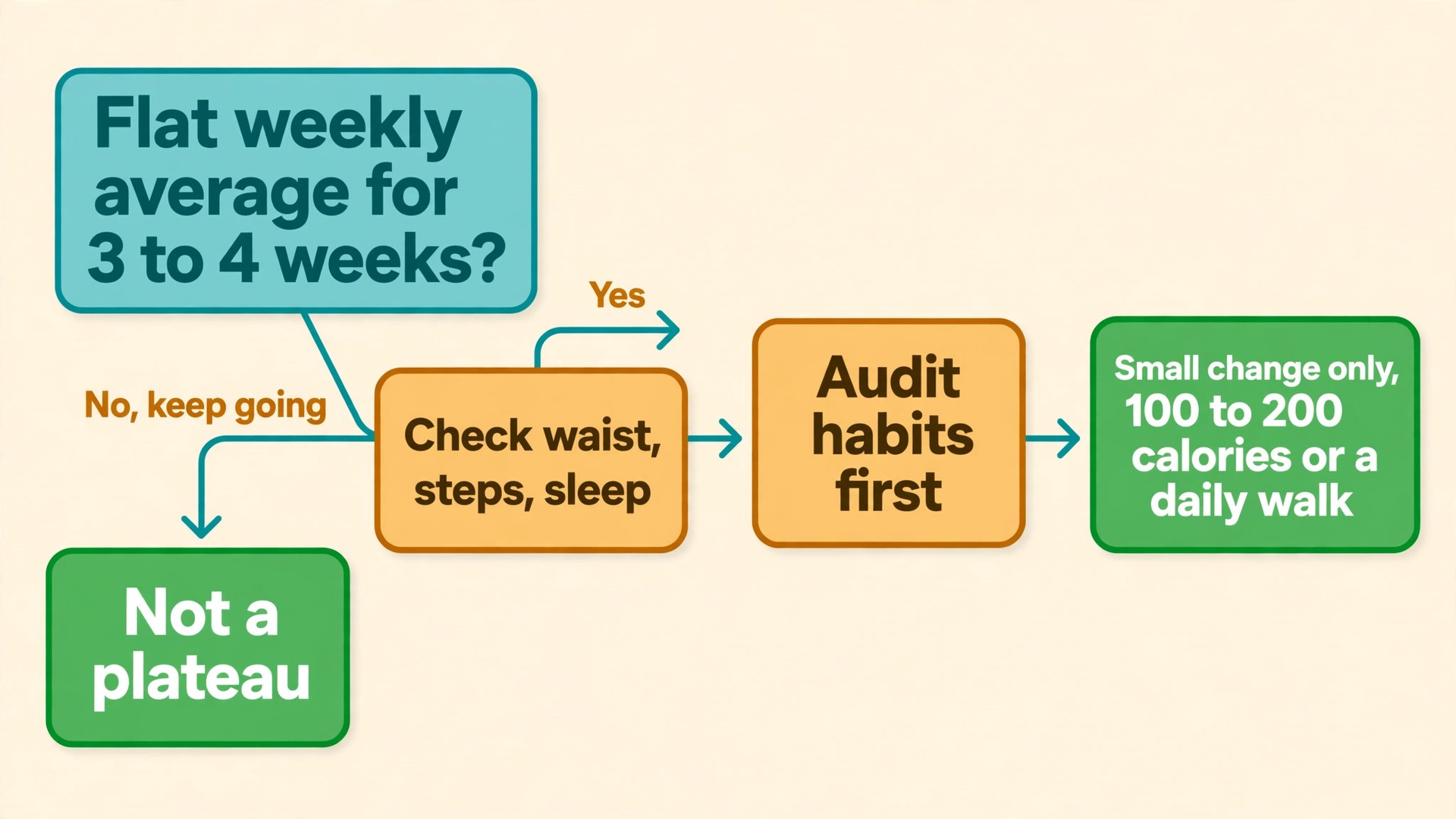
A plateau is one of the most misused words in weight loss, and misusing it causes real harm, because it pushes people to slash calories or quit just when the plan was working. The diagnostic rule from the trend section is the starting point. A real plateau is a flat weekly average for three to four weeks, with consistent eating, activity, sleep, and weighing conditions, and with other measures also flat. Anything shorter is usually noise, water, or a tracking slip, not a plateau.
Start the diagnosis by confirming the trend properly, because a careful trend check is what separates a real stall from noise when you use smart scale for weight loss tracking. Pull your last four week averages and check them side by side. If the averages are falling, even slowly, you do not have a plateau, whatever the last few daily readings suggest. If the averages are flat, check your second measures next. If waist is still falling, or photos show change, or clothes fit better, fat loss is probably continuing under a mask of water retention or muscle gain.
That is recomposition or water masking, not a stall, and the correct move is to keep going and recheck in two more weeks.
If weight and waist are both flat for three to four weeks, audit habits before cutting calories. The most common cause is silent calorie creep, not a broken metabolism. Cooking oil, dressings, drinks, snacks eaten while cooking, weekend meals estimated loosely, and larger portions as hunger rises all add up quietly. Check activity second. Daily steps often fall as weight falls, because a lighter body burns less moving and because people unconsciously move less when dieting. A step count that fell by two thousand a day since the start can erase a modest deficit on its own. Check sleep third, because short or broken sleep raises appetite and makes adherence harder, even when calories look correct on paper.
Only after that audit should you adjust the plan, and the adjustment should be modest. Trim intake by roughly 100 to 200 calories a day, or add a daily walk, or add two short resistance sessions a week if you are not already training. Resistance training matters here, because preserving muscle protects energy expenditure and body composition while weight falls. A large cut, down to a very low intake, tends to increase hunger, muscle loss, and rebound risk, and it rarely produces a better long term result than a modest, sustainable change. Hold the new plan for another three to four weeks and judge it on week averages again.
There are times to seek professional input rather than self adjusting. If weight, waist, and strength are all flat for six to eight weeks despite a careful audit, or if you have fatigue, cold intolerance, hair changes, or other new symptoms, raise it with a clinician. Thyroid and iron issues, medication effects, and other medical factors can stall progress, and a scale cannot diagnose them. If you are pregnant, managing an eating disorder history, or taking medication that affects weight, do not use a generic plateau protocol at all. Get individual advice. A smart scale is a tracking tool for a healthy adult weight loss plan.
It is not a substitute for medical guidance, and this guide does not replace it.
App and Privacy Settings Worth Checking
Weight data is health data, and it deserves more care than a step count. Most scale apps default to convenient sharing, not private tracking, so spend ten minutes on settings in the first week. The goal is simple. Your weight should go where you want it, to the apps and people you chose, and nowhere else by accident.
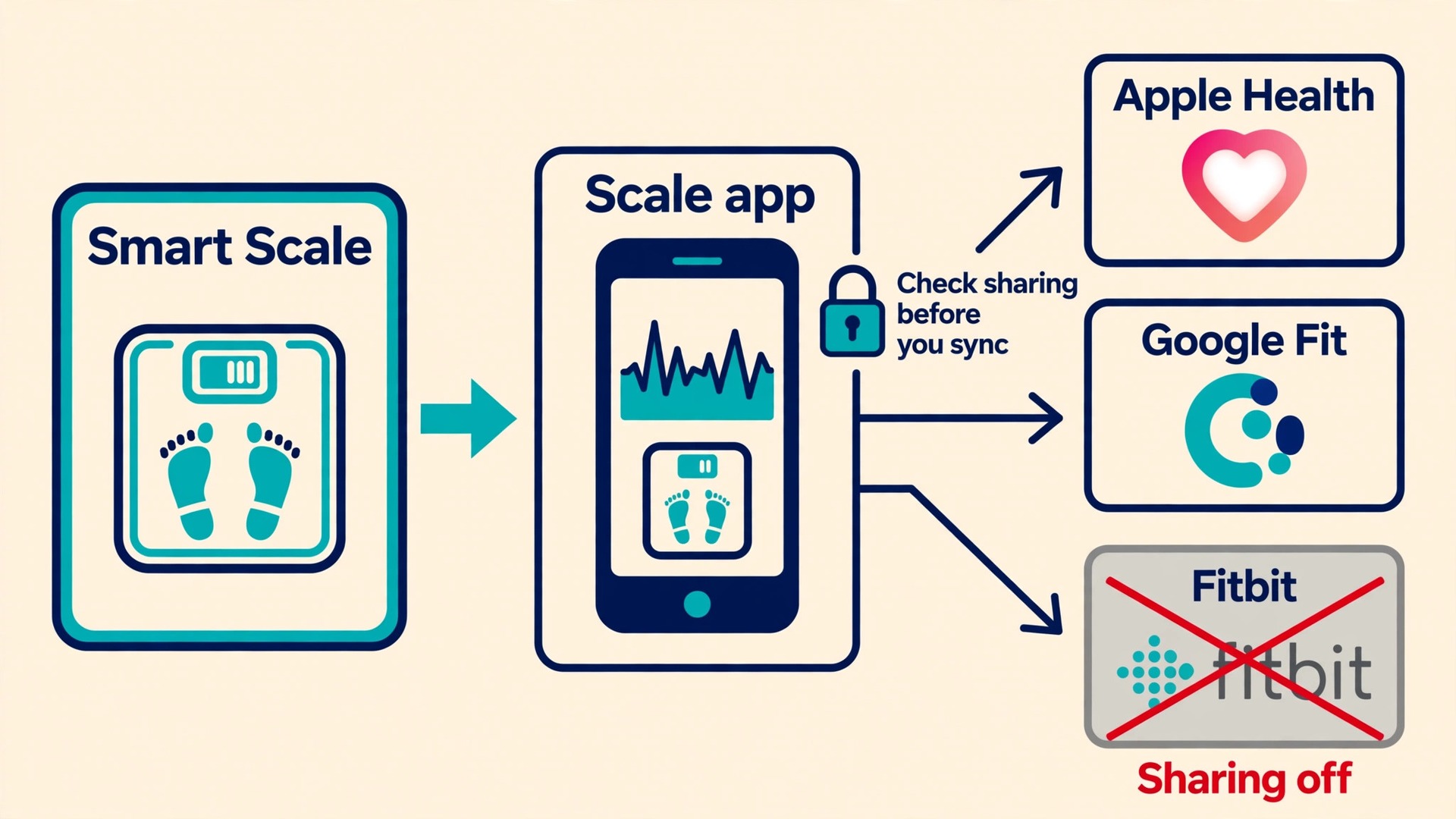
Start with account and sync settings, a step many people skip when they first use smart scale for weight loss tracking. Decide whether the scale app may sync to Apple Health, Google Fit, Fitbit, or another hub, and whether that hub then shares onward to other apps. Each link widens the circle of apps holding your weight history. Keep only the links you use. If you use a fitness coach app, link that one deliberately. If a social or challenge app got access during setup, remove it unless you actively want that sharing.
Check whether the scale app stores data in a cloud account, on the phone only, or both, and whether deleting the app deletes the cloud history or leaves it behind.
Next, check social and household settings. Many apps offer friends, leaderboards, challenges, and family sharing. Those features can motivate some people and embarrass others, especially when a household member sees a weight they were never meant to see. Turn off public profiles, friend feeds, and automatic challenge posts unless you chose them consciously. In a shared household, confirm each person has a separate profile and that guest mode exists for visitors. A guest weigh-in should not enter anyone trend, and the app should make deleting a mistaken reading easy. Test this once with a deliberate guest reading if you share the scale, so you learn the delete path before a real mistake matters.
Then check data control and retention. Look for settings covering data export, data deletion, and marketing use. A good app lets you export your full history, delete individual readings, and delete the account and its data. Read the privacy summary in plain terms. Does the maker sell personal health data, share it with advertisers, or use aggregated data for research and product improvement. Aggregated and de-identified use is common and lower risk than identified sharing, but you should still know which applies. If the app requires a subscription for basic export or deletion, that is a reason to prefer a different maker next time, because your own history should never be held hostage.
Finally, protect the phone and account holding the data. Use a strong passcode, biometric lock, and two factor authentication on the scale app account where available. Keep the app updated, because updates often patch security issues as well as adding features. If you sell or give away the scale, factory reset it and remove it from your account first, so the next owner cannot sync into your history or see past readings stored on the device.
For readers who track activity alongside weight, the same discipline around trends and privacy carries over. Related reading includes Apple Watch fitness tracking setup for building a daily activity record that pairs with scale trends, smartwatch sleep tracking accuracy for why sleep data also needs a weekly view rather than a nightly grade, and best AI tools for fitness coaches for how coaches use client trends without overreacting to single readings. Weight, activity, and sleep each tell a partial story. Together, read as trends, they tell a far more honest one.
Frequently Asked Questions
How often should I weigh myself for weight loss?
Daily weighing gives the smoothest weekly average, provided you judge the average and not each day. Weigh first thing in the morning, after the bathroom, before food, drink, or exercise, in the same clothing state each time. If daily weighing causes anxiety or obsessive checking, weigh three to four times a week on the same routine instead. What matters is consistency and averaging, not perfection. Avoid weighing at random times, because mixed morning and evening readings create a false trend.
Can I trust the body fat percentage on a smart scale?
Trust it only as a slow direction indicator, not as an exact figure. Consumer bioelectrical impedance estimates are sensitive to hydration, meals, exercise, and skin contact, and published comparisons show errors of several percentage points against clinic scans for many people. Average the estimate over four weeks and judge direction only, alongside weight trend and waist measurement. If the scale estimate and your waist disagree, trust waist and weight trend first, and never change your eating plan because of one body fat reading.
Why did my weight jump overnight when I ate well yesterday?
Overnight jumps are almost always water, food volume, glycogen, sodium, or hormonal fluid shifts, not fat gain. Gaining a kilogram of fat overnight would require eating several thousand calories above maintenance in a single day, which a normal good day does not do. A salty meal, a hard workout, a high carbohydrate day, travel, or poor sleep can each add a kilogram or more of water temporarily. Resume the normal routine, keep weighing consistently, and judge the week average. The jump usually fades within a few days.
How long should I wait before calling a stall a plateau?
Wait three to four weeks of flat weekly averages, with consistent habits and weighing conditions, before calling it a plateau. One flat week is normal fluctuation. Two flat weeks can still be water masking fat loss, especially if waist is falling. A true plateau also shows flat second measures, including waist, photos, and strength progress. Before adjusting calories, audit food logging for silent creep, check whether daily steps fell, and review sleep. Adjust modestly, then judge the new plan over another three to four weeks.
Should I buy a Wi-Fi scale or a Bluetooth scale?
Buy Wi-Fi sync if you often forget to open the app, if the phone charges away from the bathroom, or if several household members share the scale, because Wi-Fi scales sync without the phone nearby. Buy Bluetooth only if you always weigh with the phone close and the app open, and you are happy with that extra step every morning. Check subscription costs too, and confirm the free tier already includes weekly trend charts.
Is a smart scale safe for everyone?
No, and the exception matters. People with a pacemaker, an implanted defibrillator, or another implanted electronic device should not use bioelectrical impedance body composition measurement, because the small current could interfere with the device. Maker guidance from Withings and Fitbit carries this warning. If it applies to you, use a weight only scale, or switch body composition off in the app where that option exists, and ask your clinician for a suitable tracking method. Smart scales are wellness tools, not medical devices, and they do not diagnose health conditions.
Make the Trend Your Coach, Not Your Judge
A smart scale earns its place in a weight loss plan when it stops being a daily verdict and starts being a weekly record. Set it up on a hard floor, pair it correctly, build a boring morning routine, and let weekly averages do the talking. Read body composition as a slow direction signal, diagnose plateaus only after three to four flat weeks with an honest habit audit, and lock down privacy settings before your health data drifts somewhere you never chose. If you use smart scale for weight loss tracking in this disciplined way, the tool stops feeding anxiety and starts feeding decisions.
Start with the checklist in this guide, collect a clean baseline for two weeks, and add waist and photos as your second checks. When the trend falls, keep the plan steady and let it work. When the trend flattens, check water, logging, steps, and sleep before you cut calories. When a repeated warning or a new symptom appears, take the trend summary to a clinician rather than guessing from a single reading.