
The verdict is simple. A dumpster rental business that answers every enquiry fast, sizes the container from the debris described, and confirms placement, permits, and weight limits before the truck leaves will book more jobs and haul fewer problems than a rival that relies on phone tag and guesswork. Owners who decide to use AI for dumpster rental booking usually do so after a familiar week. The phone rings while a driver is on a route, a customer orders a container that is too small for roofing debris, and a street placement runs into a permit rule nobody checked.
Dumpster rental has a booking problem that a plain calendar cannot solve. A booking is not just a date. It is a container size, a debris type, a weight allowance, a rental period, a placement surface, a street or driveway question, a permit question, and a pickup date, and every one of those details changes the price, the truck, and the landfill fee. A system that books a generic delivery slot will send a 10 yard container to a full kitchen remodel and leave the customer paying for a second haul that could have been avoided with three better questions.
This guide builds a booking workflow that captures the right details before dispatch, answers calls and messages at any hour, and still leaves room for human judgment where it matters. It covers the intake questions that prevent size and weight surprises, the tools that handle roll off booking well, the pricing and permit rules that protect the margin, and the measures that show whether the system is earning its keep. Prices quoted here come from vendor pricing pages and reputable comparison guides checked at writing time, so confirm the current price on the vendor page before buying.
Why Dumpster Bookings Go Wrong
Most dumpster rental businesses lose money in three quiet places, and none of them shows up as a single large bill. The first is the unanswered call. Home service research consistently reports that a large share of callers do not leave a voicemail and do not call back, and dumpster rental is no exception, because a customer with a crew arriving Monday wants a container confirmed today, not a callback tomorrow. A hauler working a route or loading a truck will miss calls during driving, during landfill runs, and during lunch, and each missed call is a rental handed to whoever answered first.
The second leak is the wrong size. A customer who books online and writes only “cleanout” leaves the office guessing about volume and weight. The container fills on day two, the customer needs a swap, the truck makes an extra trip, and the landfill fee lands higher than quoted. The customer feels overcharged even when the charges were fair, because the size conversation never happened. A booking system that asks about debris type and project scope before confirming size prevents most of that friction in a few minutes.
The third leak is the failed delivery. A truck arrives to find a low wire, a narrow gate, a soft lawn after rain, or a street that needs a permit the customer never obtained. The driver leaves, the job slips a day, and the next delivery on the route slips with it. An automated system does not remove every field problem, but it does force the placement and permit questions before dispatch, which is where those problems are cheapest to fix.
How to Use AI for Dumpster Rental Booking Without Losing the Human Touch
The best way to use AI for dumpster rental booking is to let software handle the routine parts and keep people in charge of the judgment calls. Software should answer the phone, collect the intake details, check container availability, send the confirmation, and remind the customer before delivery and pickup. A person should decide the size for an unusual load, approve a price exception, handle a damage complaint, and judge whether a site needs a visit before a firm quote. When that split is clear, customers get fast answers and the business keeps its reputation for care.
Start by defining what the system may book on its own. Standard sizes, standard debris types, and standard rental periods with published prices are safe to automate, because the price and weight allowance are known in advance. Anything outside that list, such as concrete or dirt loads, mixed commercial debris, a site with tight access, or a container on a public street, should go to a human for a callback within a stated time. Customers accept a callback when the system tells them exactly when it will happen and keeps that promise.
The Booking Workflow, Step by Step
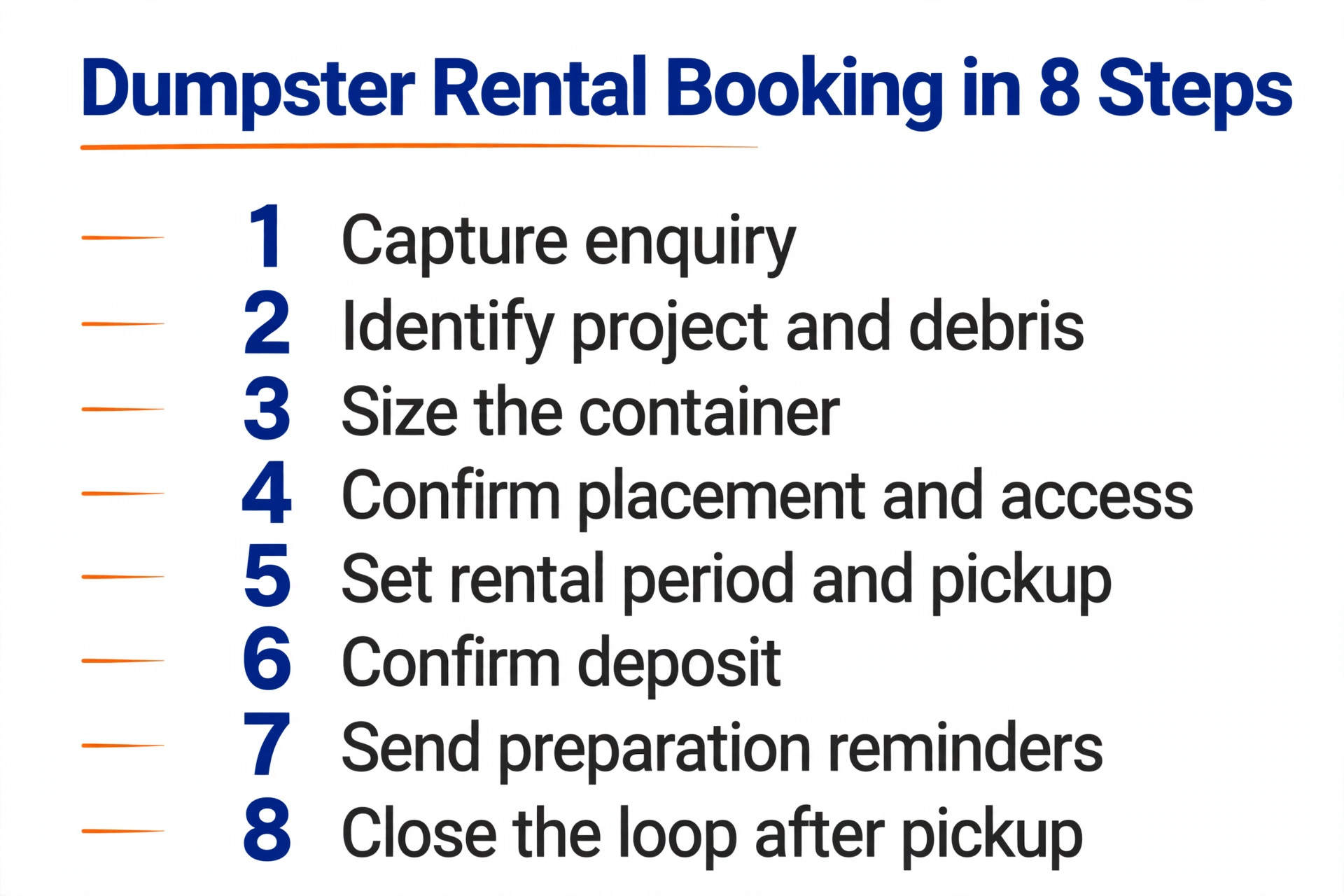
A strong booking workflow moves a customer from first contact to a confirmed, well placed rental in eight steps. Each step has one job, and skipping a step is what creates the surprises that ruin a route. The steps below work for a single truck hauler and for a small fleet, and they work whether the first contact is a phone call, a website form, or a message.
1. Capture the enquiry the moment it arrives. An AI phone answer service or a website booking form takes the name, phone number, delivery address, and preferred delivery dates before anything else, so no enquiry is lost to a missed call or an unanswered message. 2. Identify the project and the debris. Ask whether the job is a cleanout, a remodel, roofing, yard waste, or concrete, and ask what materials will go in the container. Debris type decides the size, the weight limit, and the disposal site. 3. Size the container from volume and weight. Use the debris answers to recommend a size, explain the included weight allowance in plain tons, and state the overage rate per ton before the customer confirms, so the weight charge never feels like a surprise. 4. Confirm placement and access. Ask whether the container goes on a driveway, a lawn, or a street, and ask about gate width, overhead wires, slope, and surface strength. Flag street placements for a permit check before confirming the delivery date. 5. Set the rental period and the pickup plan. Confirm how many days are included, the daily rate for extra days, and whether pickup should be automatic on a set date or triggered by a customer message when the container is full. 6. Confirm with a deposit or card hold where the business uses one. A deposit cuts no shows sharply, and it also filters out customers who were never serious, which protects the truck schedule. 7. Send preparation instructions and reminders. Tell the customer what may not go in the container, how high debris may be loaded, and what to clear before the truck arrives, then remind them the day before delivery and again before pickup. 8. Close the loop after pickup. Send a final invoice with the weight ticket details, a request for a review, and a note about repeat rentals for contractors, so one rental becomes a repeat account rather than a one off job.
The Rental Booking Checklist
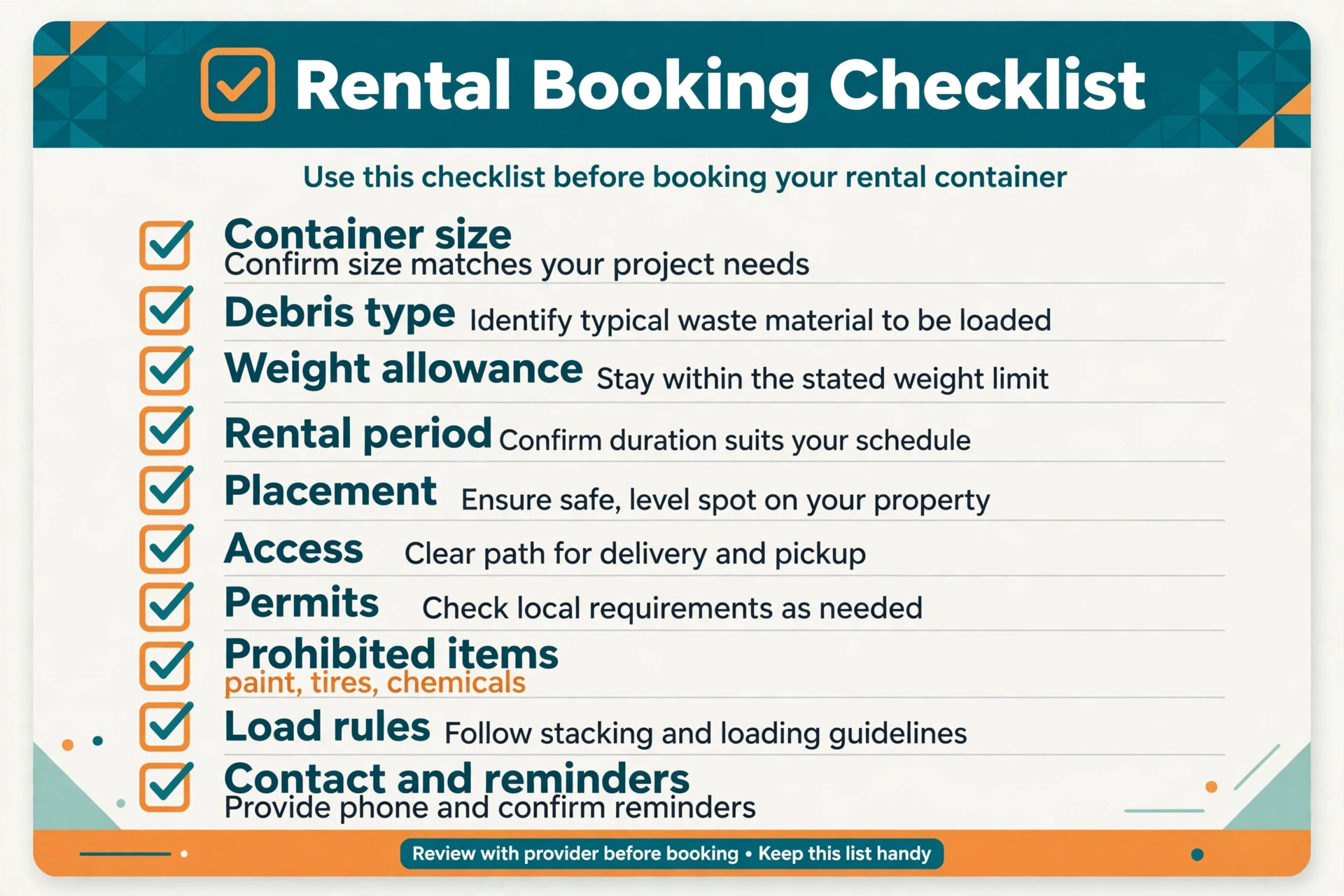
The booking checklist below is the heart of the system, because every question on it prevents a problem on the day. Use it as a booking form, as a phone script, and as a checklist the dispatcher checks before assigning a truck. If an answer is missing, the booking is not ready to confirm, and the system should chase it rather than leave it blank.
| Booking item | What to ask | Why it changes the job |
|---|---|---|
| Container size | Project scope and debris volume in plain terms | Decides whether one haul is enough |
| Debris type | Household, construction, roofing, yard, concrete | Decides weight, price, and disposal site |
| Weight allowance | Included tons and overage rate per ton | Decides the final invoice and disputes |
| Rental period | Included days, extra day rate, pickup trigger | Decides the truck schedule and revenue |
| Placement | Driveway, lawn, street, surface type | Decides damage risk and permit needs |
| Access | Gate width, wires, slope, parking room | Decides whether the truck can deliver |
| Permits | Street placement, local rules, who obtains it | Decides whether delivery is legal |
| Prohibited items | Paint, tires, chemicals, appliances, hazardous waste | Decides refusal risk at the landfill |
| Load rules | Fill level, no debris above the rim | Decides safe transport and extra fees |
| Contact and reminders | Best number, text or email preference | Decides how delivery updates arrive |
Sizes, Weight Limits and Prices That Change the Quote
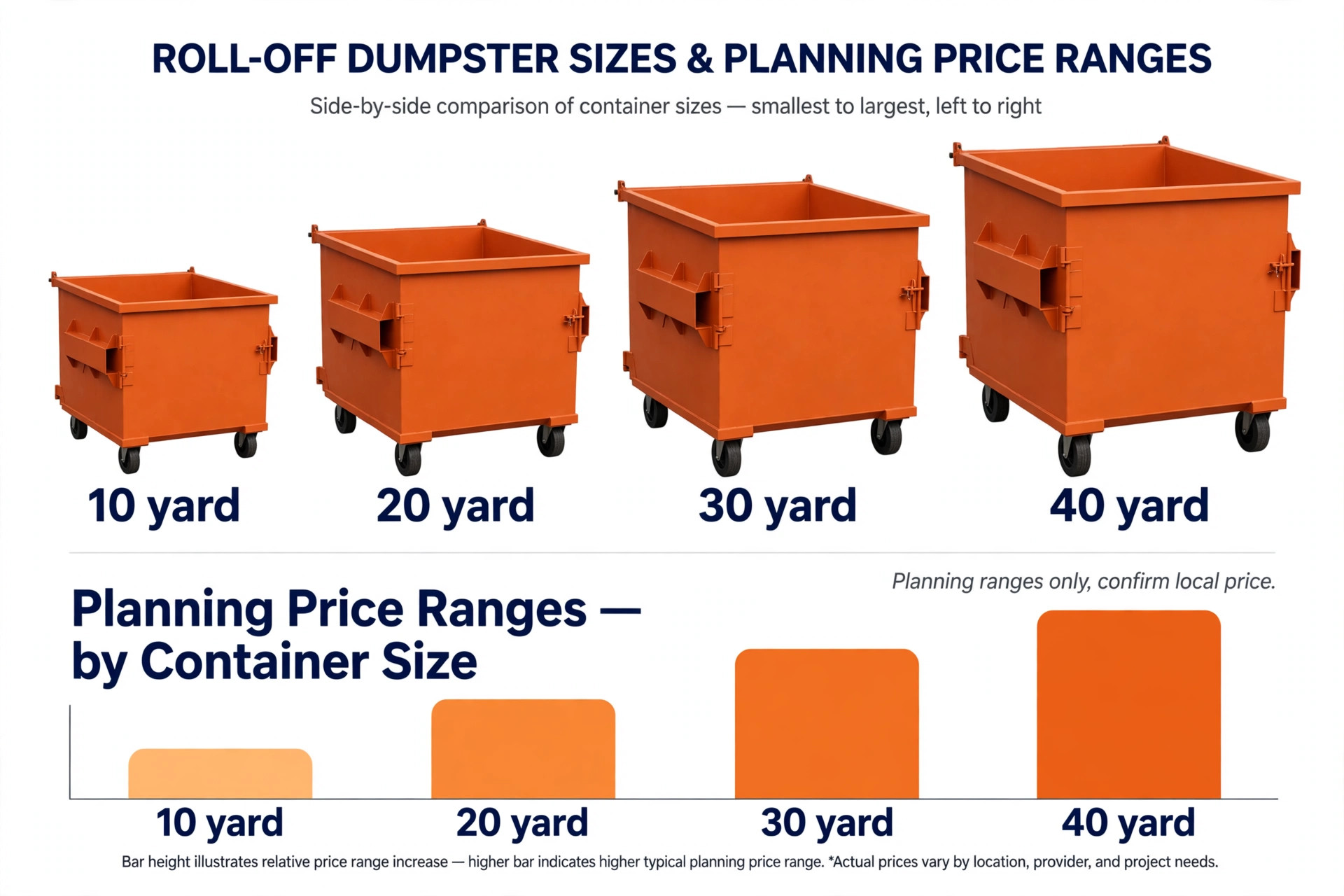
Container sizes follow a standard range in the United States, and a booking system should present them in plain language rather than in cubic yard jargon alone. In recent guides, a 10 yard container typically suits a small cleanout or a single room remodel, a 20 yard container suits a larger cleanout or a roofing job on a smaller home, a 30 yard container suits a major remodel or a full home cleanout, and a 40 yard container suits large construction or commercial work. The guide should show the length and height of each size beside the volume, because customers judge a container by what it looks like in a driveway, not by a number.
Weight matters more than volume for heavy debris. A 10 yard container full of concrete weighs far more than the same container full of household junk, which is why haulers set included weight allowances per size and charge an overage rate per ton beyond that allowance.
In recent guides, typical price ranges run roughly from $250 to $586 for a 10 yard rental, $275 to $679 for a 20 yard rental, $300 to $809 for a 30 yard rental, and $350 to $906 for a 40 yard rental, with weight overage reported at roughly $40 to $100 per ton and extra days at roughly $5 to $15 per day. Those ranges vary widely by market and landfill fees, so treat them as a planning range and confirm the local price before quoting.
Permits deserve a clear question at booking time. A container on a private driveway usually needs no permit, while a container on a public street often does, and the cost and the lead time vary by city. In recent guides, street permits are reported at roughly $10 to $100 where required. The booking system should ask about street placement early, tell the customer who obtains the permit, and hold the delivery date as provisional until the permit question is answered. That single rule prevents the most embarrassing failed delivery in the business.
Tools Compared for Dumpster Rental Booking
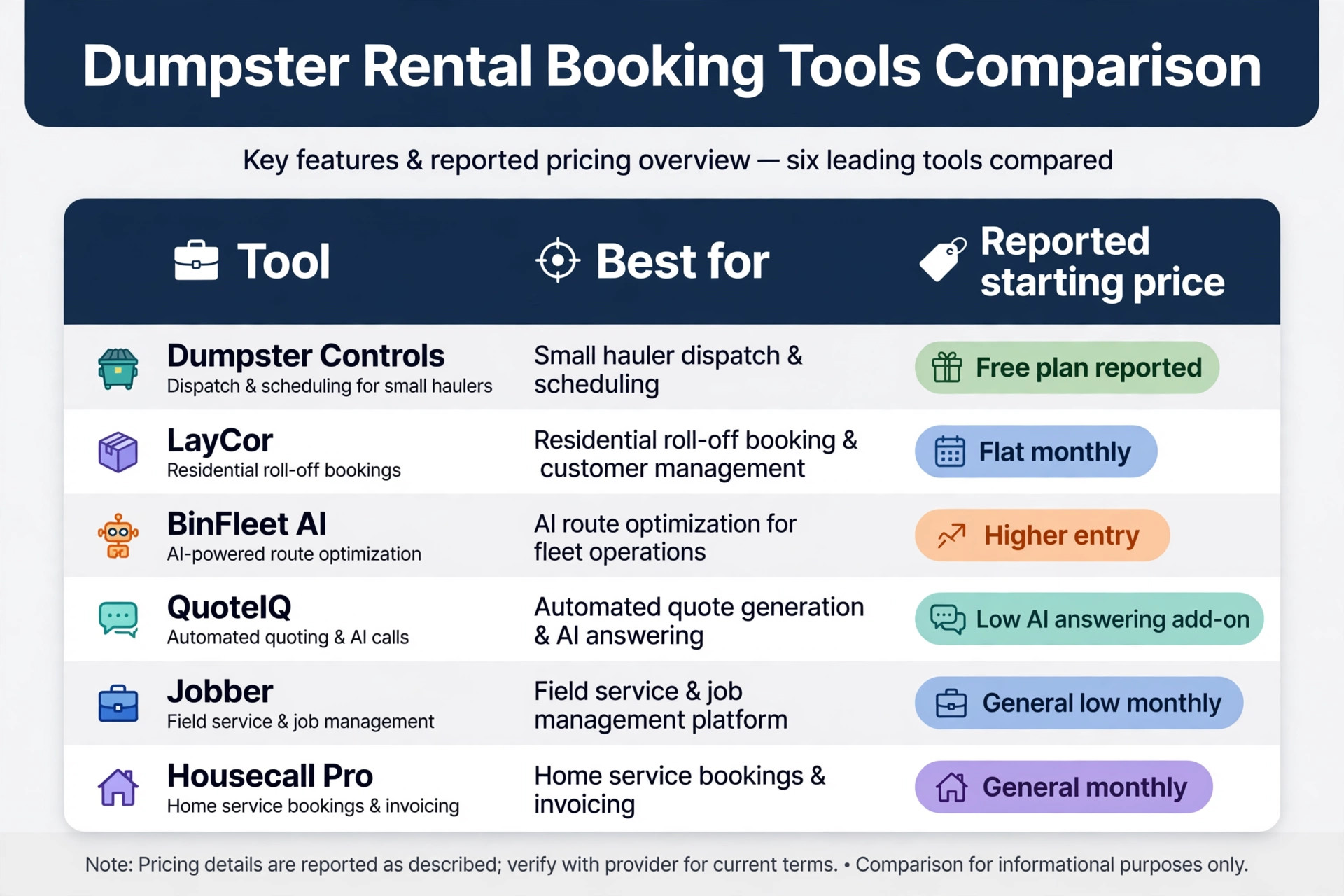
The tools below cover the main ways a dumpster rental business can run bookings, from roll off specific software to general field service systems. Prices are reported from vendor pages and comparison guides, and they change, so confirm the current price on the vendor page before choosing. The right choice depends less on the feature list and more on whether the business needs container inventory, weight tracking, and route dispatch in the same tool or only needs a booking page.
| Tool | Best for | Reported starting price | Trade off |
|---|---|---|---|
| Dumpster Controls | Small haulers wanting booking and dispatch free of a monthly fee | Free plan reported, optional $169 a month plan for lower card rates | Free core, but card processing fees apply on the free plan |
| LayCor | Roll off operators wanting a flat monthly price | About $49 a month reported | Simple flat price, but smaller vendor footprint than general tools |
| BinFleet AI | Haulers wanting container tracking plus a branded booking portal | From about $179 a month reported | Strong roll off depth, but higher entry price |
| QuoteIQ | Dumpster operators wanting AI answering plus tiered pricing | AI answering from about $29.99 a month reported | Dumpster specific, but full plans climb with features |
| Jobber | Multi trade firms that also run dumpster rentals | About $29 to $49 a month for one user on annual billing in recent guides | Strong all rounder, but no native roll off inventory depth |
| Housecall Pro | Mobile first teams wanting booking plus payments | About $59 a month for one user on annual billing in recent guides | Easy field use, but advanced features sit on higher tiers |
Dumpster Controls
Dumpster Controls suits a hauler that wants online booking, dispatch, a driver app, and invoicing without a monthly subscription, because its core app is reported as free for any fleet size, with card processing as the cost on the free plan. The booking page is branded with the company colors and logo, and customers select size, debris type, and delivery date themselves. Choose it if the budget is tight and the team can work inside one roll off system. Skip it if the business needs a vendor with a long enterprise track record, because the free model deserves a careful trial first.
LayCor
LayCor suits a roll off operator that wants one flat price and no per user charges, reported at $49 a month with no contracts and no setup fees. The system tracks every container by status, available, on site, in transit, or in maintenance, so the office never overbooks a size that is already out. Choose it if container availability is the daily headache. Skip it if the business needs deep accounting or marketing tools, because LayCor is built for operations first.
BinFleet AI
BinFleet AI suits a hauler that wants container management across multiple yard locations plus a branded customer booking portal, starting at about $179 a month reported for unlimited office users plus three driver seats. Payments run through Stripe, and the platform charges a small platform fee on processed payments while cash and check payments carry no platform fee in recent guides. Choose it if the fleet is growing and yard inventory matters. Skip it if the business is a single truck operation, because the entry price buys depth a small fleet may not use yet.
QuoteIQ
QuoteIQ suits a dumpster operator that wants tiered container pricing on a customer facing estimate, with 10 yard, 20 yard, 30 yard, and 40 yard options shown with rental period, weight allowance, and swap pricing on one page. Its AI answering is reported from about $29.99 a month, and higher plans add route optimisation and per haul costing. Choose it if phone answering and estimate presentation are the weak spots. Skip it if the business only needs a booking page, because the wider platform costs more than a simple form.
Jobber
Jobber suits a business that runs dumpster rentals alongside other services and wants one system for quoting, scheduling, invoicing, and payments. The trade off is that container inventory and weight tracking must be adapted rather than used natively, so a pure roll off operator should test whether the workaround holds up on a busy week. Choose Jobber if dumpsters sit beside other trades. Skip it if roll off inventory is the core daily problem, because a specialist tool tracks containers better.
Housecall Pro
Housecall Pro suits a team that works mostly from phones and wants customers to book, pay, and receive updates from the same flow. The trade off is that advanced features sit on higher tiers, so the entry price does not buy the full dispatch and automation set. Choose it if mobile field use and payments matter most. Skip it if the business needs roll off specific weight and container logic, because that depth lives in specialist tools.
Pricing, Deposits and Cancellation Rules
A business that decides to use AI for dumpster rental booking still needs pricing rules that customers can understand in one reading. Publish a size price, an included weight allowance, an overage rate per ton, an included rental period, and an extra day rate, with a note that concrete, dirt, and roofing loads carry different weight rules. Customers who can work out their own approximate price before booking are more likely to complete the booking, and less likely to argue about the final bill, because the price logic was visible from the start.
Deposits are the single most effective no show control for dumpster rental. A deposit or a card hold taken at booking makes the delivery real for the customer and gives the business something to hold if the customer disappears or cancels after the truck is loaded. State the deposit rule, the cancellation window, and the refund rule on the booking page itself, not buried in terms that nobody reads. A forty eight hour cancellation window with a deposit kept or moved to a new date is a fair balance for most residential work.
Handling Placement, Permits and Difficult Sites
Placement changes a dumpster job more than any other single factor, and a business that decides to use AI for dumpster rental booking must treat it as a normal part of the job rather than a surprise. Ask about placement at booking, not on arrival, and ask specifically about surface type, slope, gate width, and overhead wires. Some customers worry that mentioning a tight site will raise the price unfairly, so explain that placement questions protect their driveway and their neighbours, and that declaring a tight site early means the driver brings the right plan.
Permit problems are the second most common cause of a wasted trip. A truck that cannot legally place a container on a street will lose the slot and annoy the next customer. The booking form should ask about street placement, and the reminder message should ask the customer to confirm that the permit is in hand. For driveway protection, use a clear written process that the customer agrees to at booking, including boards under the container where the business uses them, rather than improvising on arrival.
Difficult sites need a human decision before the truck leaves. Sites with soft ground after rain, steep slopes, low wires, or weight restricted surfaces should trigger a callback or a photo review, even if the customer has booked online. The system should flag these cases automatically from the intake answers and hold the delivery as provisional until a person reviews it. That pause costs a few hours, but it prevents a driver arriving unprepared for a site that needed a different approach from the start.

Measuring What Dumpster Booking Earns
A booking system should pay for itself in recovered calls and filled trucks, and the only way to know is to measure a small set of numbers every month. Start with the answer rate, meaning the share of calls and messages that receive a reply within five minutes, because that is the number that decides how many enquiries become rentals. Then measure the booking conversion rate, meaning the share of enquiries that become confirmed rentals, and the failed delivery rate, meaning the share of deliveries that cannot be completed on arrival.
Add two money numbers to those three service numbers. The first is revenue per truck day, which shows whether the fleet is filling with real work or with short rentals that leave gaps. The second is repeat rental rate, meaning the share of customers who rent again within twelve months, because repeat contractors cost far less to win than new ones. If the answer rate rises but conversion does not, the problem is price or intake friction, not the phone. If conversion rises but failed deliveries rise too, the problem is placement and permit checks, not demand.

Mistakes That Undo a Good Rental Setup
The most common mistake is launching the booking page before the size guide is finished. Customers book the wrong size, the container fills early, the office spends the week arranging swaps, and the customer blames a system that was supposed to save time. Finish the size recommendations, the weight allowances, and the overage rates first, test them with five real past jobs, and only then open the page to customers. A week spent on the size guide saves a month of swap arguments.
The second mistake is letting the system book every debris type without limits. A business that allows online booking for concrete, hazardous waste, and mixed commercial loads will receive bookings it cannot safely fulfil at the quoted price, and the refusals that follow damage trust. Limit automated booking to standard residential and light construction debris, and route everything else to a callback with a clear time promise. When owners choose to use AI for dumpster rental booking in this limited way, the system feels helpful rather than reckless, because it knows its own limits.
The third mistake is ignoring the drivers. If the drivers do not trust the intake data, they will start calling customers themselves to double check every delivery, and the office will have two booking systems instead of one. Involve the drivers in designing the intake questions, show them how placement details now arrive before dispatch, and fix the first three intake errors they report. A system the drivers trust is a system that actually gets used, and a system they work around is just an extra cost.
Verdict, Is It Worth It for a Small Hauler
For a single truck hauler or a small fleet, the case is strong, provided the setup is done in the right order. Fix the size guide, build the booking checklist, set the permit and weight rules, and only then add automated answering and online booking. Done in that order, the system recovers missed calls, prevents wrong size rentals, and sends drivers out with the information they need to place the container properly the first time. The monthly software cost is usually smaller than the value of one recovered rental a week, and most businesses lose more than one rental a week to missed calls alone.
The case weakens when the business wants software to replace judgment entirely. No automated system can judge a soft lawn from a form, price a mixed commercial load from a photo alone, or calm an upset customer as well as a person can. The businesses that get the best return from this approach are the ones that use AI for dumpster rental booking for speed and coverage, while keeping people in charge of unusual loads, permits, and final prices. That split is not a compromise. It is the whole point, because speed wins the booking and judgment keeps the customer.
Start small if the budget is tight. A booking page with the rental checklist and automated reminders will already recover a large share of the losses, and an AI answering add on can wait until the size and permit rules are proven. Measure the five numbers from the earlier section for a month, compare them with the month before, and let the results decide the next spend. If the numbers move, expand. If they do not, fix the size guide or the intake form before buying more software, because another tool will not fix a broken size guide.

More Reading on Stratilyze
For a related field service system, read best CRM for cleaning companies and best route scheduling software for pool service companies. For a booking guide in a different trade, see use AI for carpet cleaning booking.
Frequently Asked Questions
How much does dumpster rental booking software cost
A small hauler can start free with a roll off specific tool or at a low monthly cost with a general field service system, while a full roll off platform with dispatch and container tracking typically starts around $49 to $179 a month in recent guides, before add ons. An AI answering add on can add about $29.99 a month depending on the vendor and plan. Confirm the current price on the vendor page before buying, because plans and add on prices change often.
What size dumpster should I book for a home cleanout
A 10 yard container usually suits a small cleanout or a single room, while a 20 yard container suits a larger cleanout or a multi room clear out in recent guides. The right size depends on volume and weight together, so describe the rooms, the furniture, and the heaviest items honestly at booking. When the choice sits between two sizes, the larger container is usually cheaper than a second haul, unless weight limits for heavy debris change the maths.
Do I need a permit for a dumpster on the street
In many cities, yes, a container placed on a public street needs a permit, while a container on a private driveway usually does not. Permit cost and lead time vary by city, with street permits reported at roughly $10 to $100 in recent guides. Ask the hauler who obtains the permit and how many days it takes, and hold the delivery date as provisional until that question is answered.
What items cannot go in a rented dumpster
Prohibited items commonly include paint, solvents, chemicals, tires, batteries, hazardous waste, and some appliances, though the exact list varies by hauler and landfill. When owners choose to use AI for dumpster rental booking, the intake form should list prohibited items clearly and ask the customer to confirm the load contains none of them. If an unusual item appears, route the booking to a human callback rather than letting software confirm a load the landfill will refuse.
How are weight overage charges calculated
The hauler weighs the container at the landfill, subtracts the included weight allowance for the booked size, and charges the overage rate per ton on the remainder. In recent guides, overage is reported at roughly $40 to $100 per ton. Ask for the included allowance and the overage rate in writing before booking, and ask for the weight ticket with the final invoice so the charge can be checked.
Can automated booking work for a one truck dumpster business
Yes, and it often helps a solo hauler more than a larger fleet, because a solo operator misses the most calls while driving or at a landfill. A booking page plus reminders can recover those calls without hiring office staff, and the rental checklist means the driver arrives prepared instead of guessing. Start with booking and reminders, add call answering when the volume justifies it, and keep unusual loads on a personal callback list.