
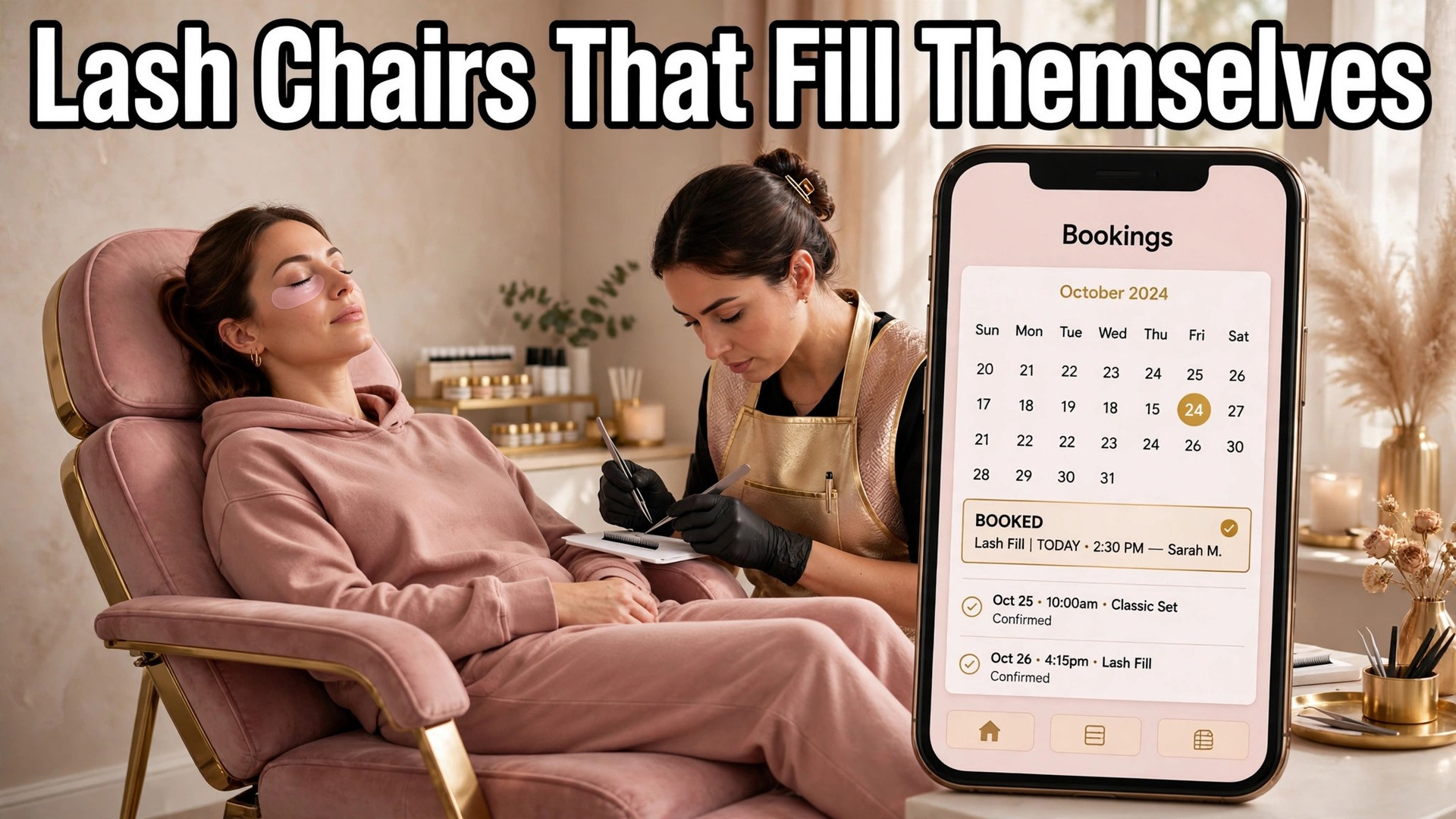
The verdict is simple. The technicians who use Booksy for lash technician appointment booking fill those chairs while competitors wait on replies. A lash technician who lets clients book online at any hour, times refills to the lash cycle, collects a deposit on every new set, and sends reminders that name the set type will fill more chairs and lose fewer appointments than a rival who runs bookings through direct messages and a paper diary. The difference shows up fast, because lash work is repeat work, and a client who cannot book a refill in thirty seconds will book it with someone else.
Lash booking has a problem that a plain calendar cannot solve. An appointment is not just a time slot. It is a set type, a refill timing, a lash style, an allergy and sensitivity history, an aftercare question, and a deposit question, and every one of those details changes the chair time, the price, and the retention result. A system that books a generic one hour slot will give a volume full set the time of a classic refill, and the day will run late before the second client arrives.
This guide shows how to use Booksy for lash technician appointment booking in a way that fits the trade, from the service menu to the refill timing to the no show protection. It covers the setup that makes Booksy work for lashes, the comparison with rival tools, the pricing and deposit rules that protect the diary, and the measures that show whether the system is earning its keep. Prices quoted here come from vendor pricing pages and reputable comparison guides checked at writing time, so confirm the current price on the vendor page before buying.
Why Lash Diaries Leak Appointments
Most lash technicians lose money in three quiet places, and none of them shows up as a single large bill. The first is the direct message booking trap. A client messages at midnight, the technician replies the next morning, and the client has already booked elsewhere or forgotten the conversation. Booksy solves that gap with 24 hour online booking, so the client books the slot while the wish is fresh, without waiting for a reply.
The second leak is the wrong chair time. In recent marketplace guides, a classic full set is reported at roughly 90 to 120 minutes, a volume full set at roughly 120 to 180 minutes, a standard refill at roughly 45 to 75 minutes, and a lash removal at roughly 20 to 30 minutes. A booking system that gives every service the same slot length will either rush a volume set or waste chair time on a refill, and both errors cost money. A service menu with honest durations per set type prevents most of that friction in a few minutes of setup.
The third leak is the no show with no deposit. A new client who books a two hour full set and never arrives costs the technician the most valuable slot in the day, with no way to refill it at short notice. A system with no show protection, deposits, and automated reminders cuts that loss sharply, because the client has money at stake and a reminder that names the appointment. An automated system does not remove no shows entirely, but it does turn a frequent loss into a rare one.
How to Use Booksy for Lash Technician Appointment Booking Without Losing the Personal Touch
The best way to use Booksy for lash technician appointment booking is to let software handle the routine parts and keep the technician in charge of the judgment calls. Software should take the booking, collect the set and allergy details, send the confirmation, and remind the client. A person should decide whether a damaged lash line needs a break, approve a style change, handle a reaction concern, and judge whether a new client needs a consultation before a full set. When that split is clear, clients get fast answers and the technician keeps a reputation for care.
Start by defining what Booksy may book on its own. Standard classic and volume sets, standard refills at two to three weeks, and lash lifts with published prices and durations are safe to automate, because the chair time and price are known in advance. Anything outside that list, such as a client with a past reaction, lashes damaged by a previous set, a mega volume request from a first time client, or a set needed urgently before an event with very short notice, should go to a consultation message before the appointment is confirmed. Clients accept a consultation step when the system tells them exactly what happens next and keeps that promise.
The Appointment Booking Workflow, Step by Step
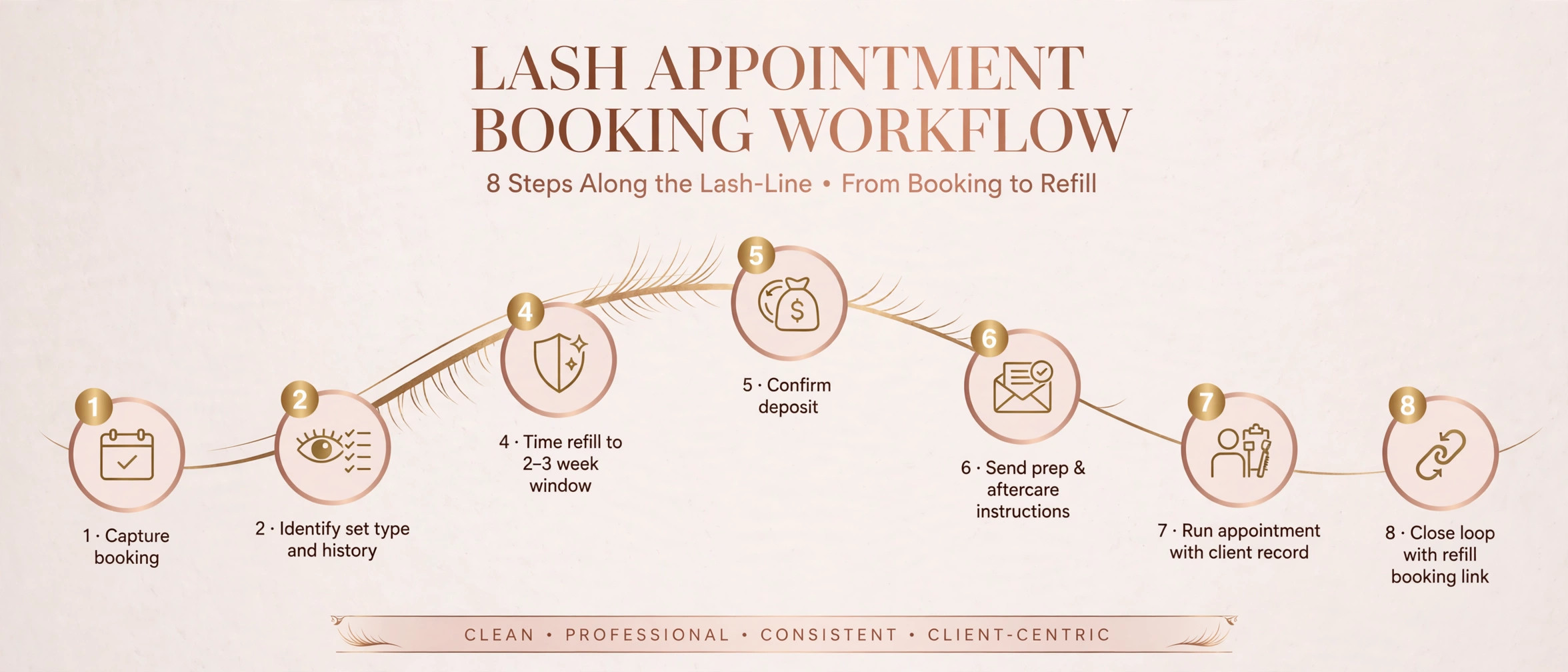
A strong appointment workflow moves a lash client from first contact to a confirmed, well prepared appointment in eight steps. Each step has one job, and skipping a step is what creates the chair time and retention problems that empty a diary. The steps below work for a solo technician and for a small studio, and they work whether the first contact is a Booksy search, a social media link, or a referral.
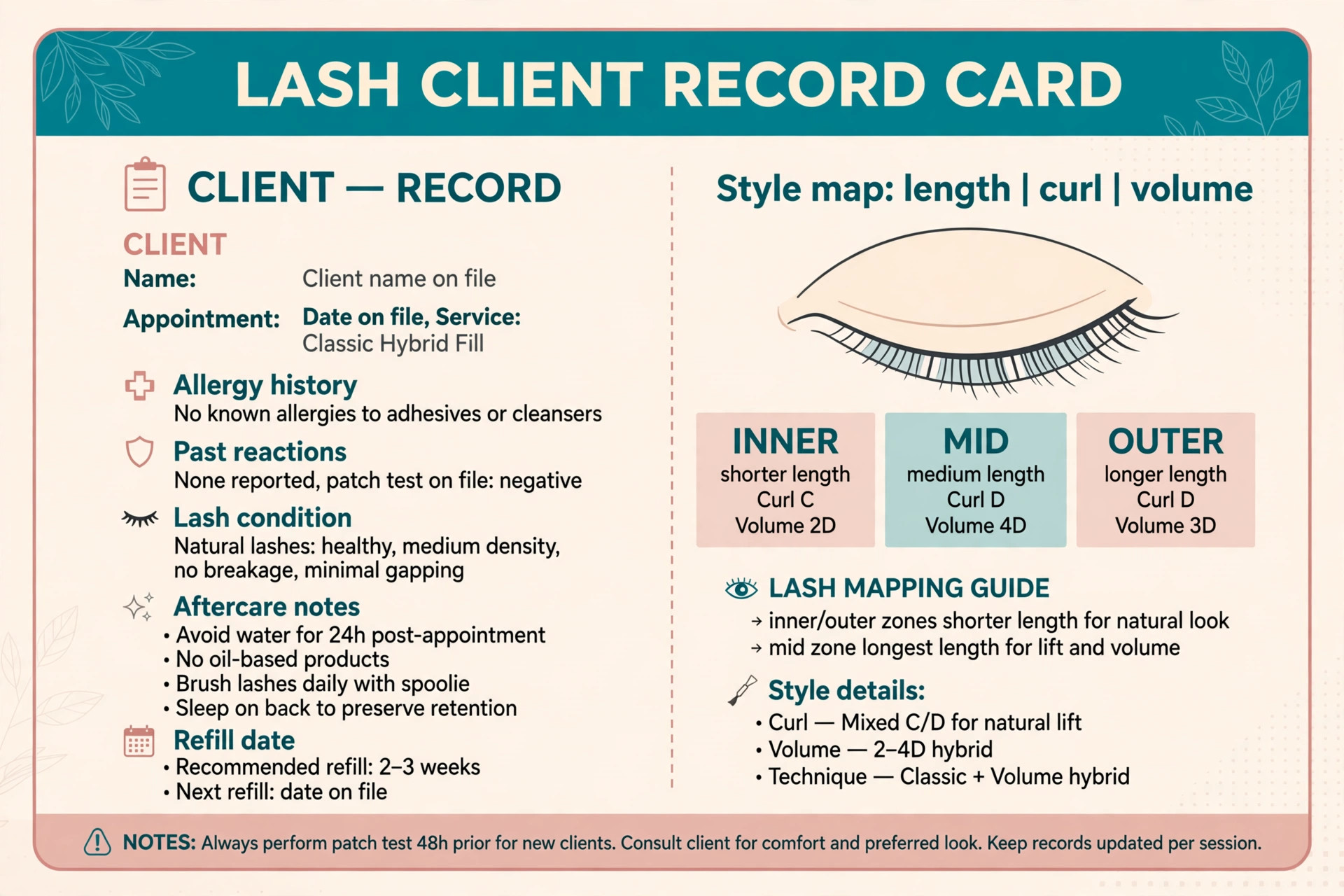
1. Capture the booking the moment the client is ready. A Booksy booking page with the service menu, real durations, and live availability lets the client book at any hour, so no enquiry is lost to a missed message or a slow reply. 2. Identify the set type and the client history. Ask whether the appointment is a new set, a refill, a lift, or a removal, and ask whether the client has had lashes before, because a new set and a refill need very different chair times. 3. Record allergies, sensitivities, and lash condition. Ask about eye sensitivity, past reactions, medications that affect lashes where relevant, and the current state of the natural lashes, and flag any concern for a consultation before confirming. 4. Time the refill to the lash cycle. For refills, ask when the last set was applied, and steer the client to a two to three week refill window, because a refill booked too late becomes a new set in chair time and price. 5. Confirm with a deposit or a card hold where the studio uses one. A deposit cuts no shows sharply, and it also filters out clients who were never serious, which protects the most valuable chairs in the day. 6. Send preparation and aftercare instructions. Tell the client to arrive without eye makeup, what to avoid in the first day after application, and how to care for the set, then remind them the day before and the morning of the appointment. 7. Run the appointment with a client record. Record the set type, the style, the products used, and any sensitivity notes in the client profile, so the next booking starts from facts rather than from memory. 8. Close the loop after the appointment. Send a thank you, a review request, and a refill booking link timed to the two to three week window, so one set becomes a repeat client rather than a one off visit.
The Lash Appointment Checklist
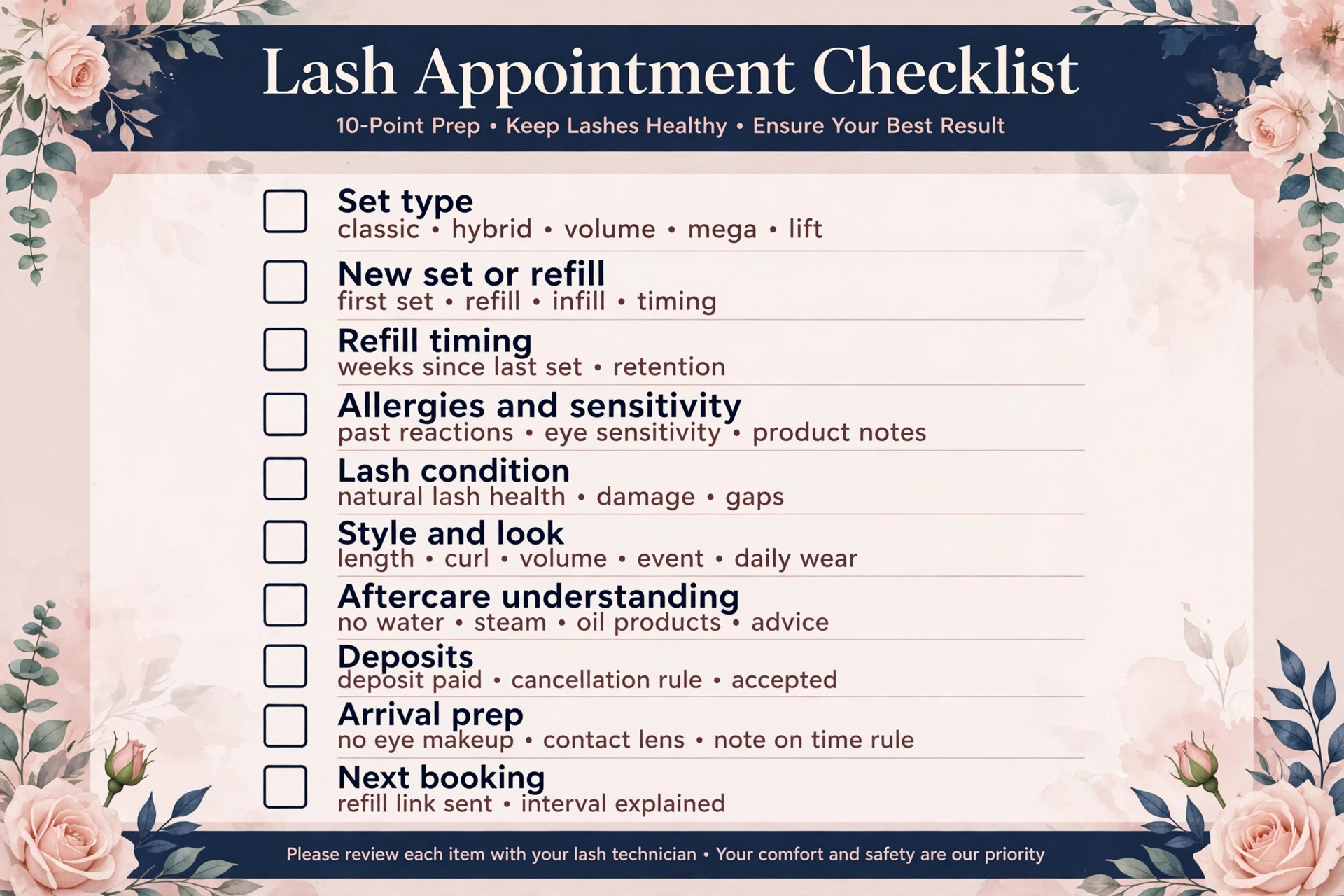
The lash appointment checklist below is the heart of the system, because every item on it prevents a problem in the chair. Use it as a Booksy intake form, as a consultation sheet, and as a checklist the technician checks before the client arrives. If an item is missing, the appointment is not ready to confirm, and the system should chase it rather than leave it blank.
| Checklist item | What to confirm | Why it changes the appointment |
|---|---|---|
| Set type | Classic, hybrid, volume, mega volume, lift | Decides chair time and price |
| New set or refill | First set, refill, infill timing | Decides duration and retention plan |
| Refill timing | Weeks since last set, lash retention | Decides whether a refill or a new set fits |
| Allergies and sensitivity | Past reactions, eye sensitivity, product notes | Decides safety and consultation need |
| Lash condition | Natural lash health, damage, gaps | Decides style suitability and honesty |
| Style and look | Length, curl, volume, event or daily wear | Decides the design and the client expectation |
| Aftercare understanding | No water, no steam, no oil products advice given | Decides retention and complaints |
| Deposits | Deposit paid, cancellation rule accepted | Decides no show protection |
| Arrival prep | No eye makeup, contact lens note, on time rule | Decides whether the chair starts on time |
| Next booking | Refill link sent, interval explained | Decides whether the client returns |
Set Types, Durations and Prices That Change the Chair
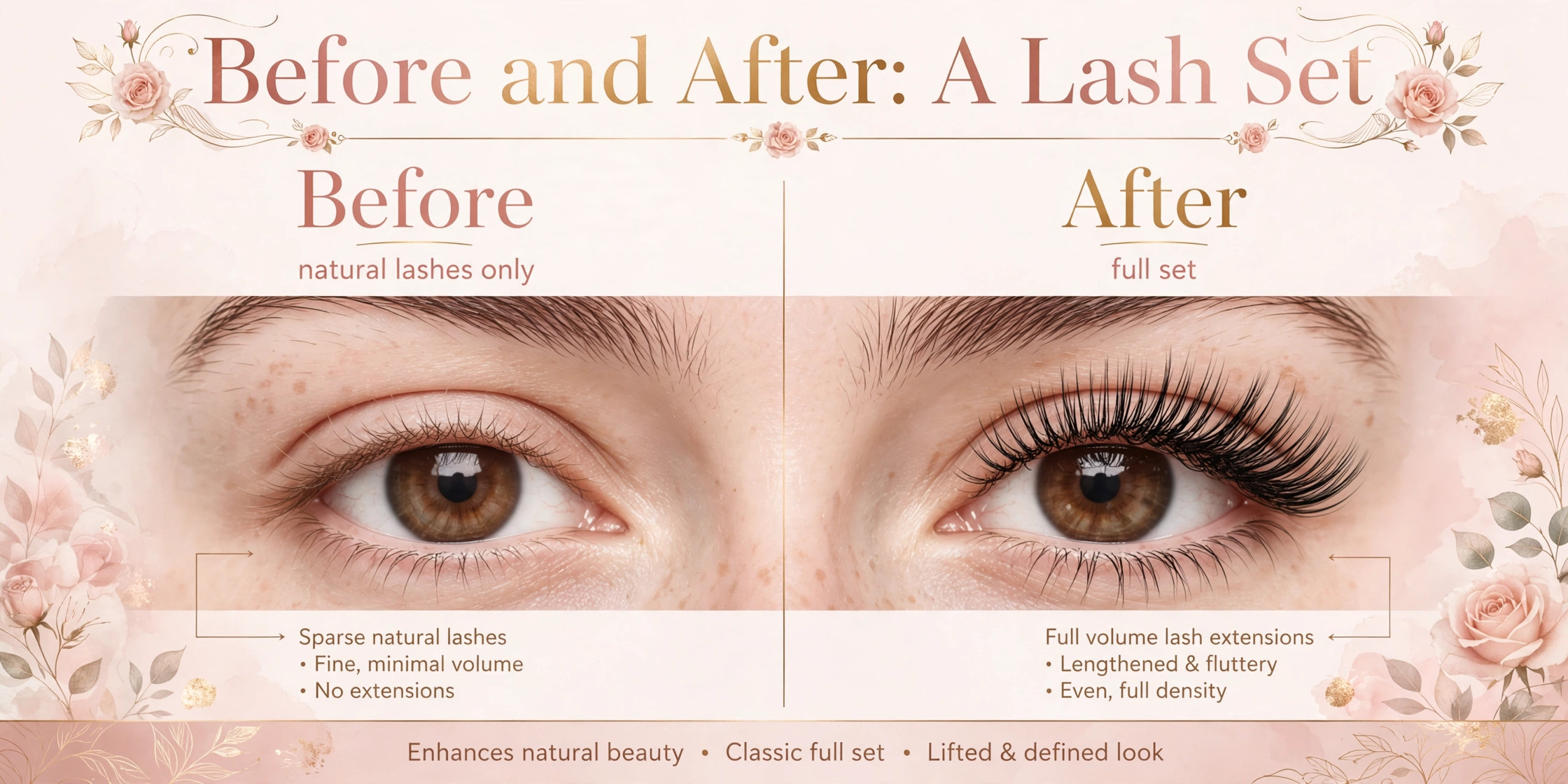
Lash pricing follows a pattern that recent marketplace guides repeat with useful consistency, and a Booksy service menu should mirror that pattern rather than invent a flat rate. In recent guides, a classic full set is reported at roughly $90 to $160, a volume full set at roughly $130 to $250 or more, a standard refill at two to three weeks at roughly $50 to $95, and a lash removal at roughly $20 to $40.
Durations run roughly 90 to 120 minutes for a classic full set, 120 to 180 minutes for a volume full set, and 45 to 75 minutes for a standard refill, with a brow tint or lash tint reported at roughly $20 to $45. Those ranges vary by city and by technician experience, so treat them as a planning range and confirm local competitor prices before setting the menu.
Refill timing deserves a clear rule on the booking page. A refill at two to three weeks keeps retention high and chair time predictable, while a refill booked at four or five weeks often needs the time and price of a new set, because too many extensions have shed. The booking system should ask for the last set date, calculate the interval, and steer late refills to a new set service with an honest explanation, rather than letting the client book a short refill slot for a long job. That single rule prevents the most common chair time argument in lashing.
Aftercare is the other half of the retention story. A client who hears the aftercare rules at booking, sees them again in the confirmation, and hears them once more in the chair will retain better than a client who hears them once while lying down with eyes closed. Booksy messages should carry the aftercare notes in plain words, including avoiding water and steam in the first period after application, avoiding oil based products near the lashes, and booking the refill on time. Retention is a booking system result as much as a technique result, because a client who returns on time keeps the set looking full.
Tools Compared for Lash Technician Appointment Booking
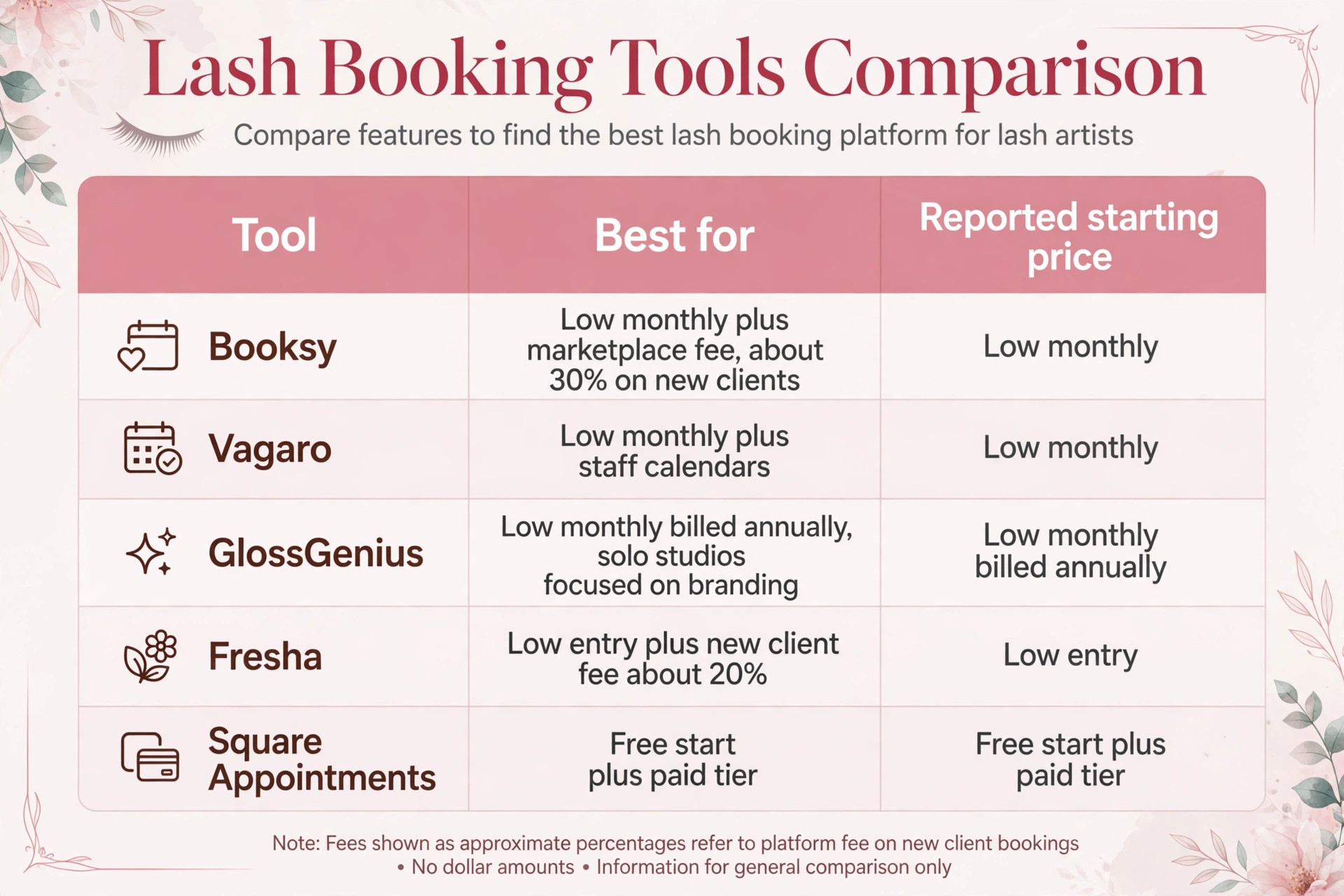
The tools below cover the main ways a lash technician can run appointment booking, from Booksy itself to rival salon platforms. Prices are reported from vendor pages and comparison guides, and they change, so confirm the current price on the vendor page before choosing. The right choice depends less on the feature list and more on whether the technician needs marketplace discovery, payments, marketing, and client records in the same tool or only needs a booking page.
| Tool | Best for | Reported starting price | Trade off |
|---|---|---|---|
| Booksy | Lash technicians wanting booking plus marketplace discovery | About $29.99 a month reported, plus about $20 per extra team member | Marketplace reach, but Boost new client fees apply |
| Vagaro | Small salons wanting an all in one platform | About $30 a month reported, plus about $10 per extra staff calendar | Broad features, but add ons stack up |
| GlossGenius | Solo technicians wanting a polished booking page | About $24 a month billed annually reported | Beautiful client page, but no marketplace |
| Fresha | Technicians wanting discovery with a low entry price | About $19.95 a month for a solo technician in recent guides | Low entry, but a 20 percent fee on new marketplace clients |
| Square Appointments | Technicians already using Square for payments | Free for limited features, Plus about $49 a month per location reported | Free start, but no show fees need the paid tier |
Booksy
Booksy suits a lash technician who wants 24 hour online booking, no show protection, digital client consent forms for lash mapping and tinting preferences, and a consumer marketplace where new clients can discover the studio. Its price is reported at about $29.99 a month plus tax, with about $20 per additional team member, and its Boost feature charges a one time fee on a new client first visit, reported at 30 percent with a $10 minimum and a $100 cap. Choose Booksy if new client discovery matters as much as booking itself. Skip it if the diary is already full from referrals, because the marketplace fee buys reach the technician may not need.
Vagaro
Vagaro suits a small salon that wants booking, payments, payroll, reporting, and a marketplace in one platform, with a starting price reported at about $30 a month, or a promotional $23.99 a month in some guides, plus about $10 per additional staff calendar. The trade off is that add ons stack up, so the bill at a realistic team size needs modelling before committing. Choose Vagaro if the studio needs payroll and reporting depth alongside booking. Skip it if the technician is solo and wants the simplest bill, because the wider platform costs more in add ons.
GlossGenius
GlossGenius suits a solo technician who wants a polished booking page, built in card processing, and predictable pricing, reported at about $24 a month billed annually, or about $28 a month billed monthly, for Standard, with Gold at about $48 a month billed annually. The trade off is that there is no marketplace, so new clients must come from the technician own marketing. Choose GlossGenius if the booking page itself is the shop window. Skip it if marketplace discovery is the main growth channel, because GlossGenius will not bring new clients on its own.
Fresha
Fresha suits a technician who wants marketplace discovery with a low subscription entry, reported at about $19.95 a month for a solo technician in recent guides, with team pricing at about $14.95 per bookable team member. The trade off is the new client fee, reported at 20 percent of the first booking with a $6 minimum, which makes the true cost depend on how many new clients the marketplace brings. Choose Fresha if low entry cost and discovery matter most. Skip it if most clients are already repeats, because the marketplace fee then buys little.
Square Appointments
Square Appointments suits a technician who already uses Square for payments and wants a free start, with a free tier for limited features and paid tiers reported at about $49 a month for Plus and about $149 a month for Premium per location. The trade off is that no show fees and waitlists need the paid tier, so the free tier leaves the strongest diary protection behind a paywall. Choose Square if payments already run through Square. Skip it if marketplace discovery matters, because Square has no client marketplace.
Pricing, Deposits and Cancellation Rules in Booksy
A technician who decides to use Booksy for lash technician appointment booking still needs service rules that clients can understand in one reading. Publish a service menu with set types, durations, and prices, a refill interval rule, a deposit rule, and a cancellation window, with a note that late refills are priced as new sets. Clients who can work out their own price and chair time before booking are more likely to complete the booking, and less likely to argue about the final bill, because the price logic was visible from the start.
Deposits are the single most effective no show control for lashing. A deposit taken at booking makes the appointment real for the client and gives the technician something to hold if the client disappears. State the deposit rule, the cancellation window, and the refund rule on the booking page itself, not buried in terms that nobody reads. A forty eight hour cancellation window with a deposit kept or moved to a new date is a fair balance for most lash work, and repeat clients with a clean record can earn deposit free booking as a loyalty benefit.
Handling Allergies, Retention Problems and Difficult Clients
Allergies change a lash appointment more than any other single factor, and a technician who decides to use Booksy for lash technician appointment booking must treat allergy history as a booking input rather than a chair surprise. Record past reactions, eye sensitivity, and product notes in the client profile at the first booking, not on arrival, and ask specifically about new sensitivities at every refill. Some clients worry that mentioning a reaction will lead to refusal, so explain that allergy notes protect their eyes and let the technician choose products and timing safely, and that declaring a concern early means the appointment can be planned properly.
Retention problems are the second most common cause of a difficult appointment. A client who returns at five weeks expecting a short refill, or who has used oil based products against advice, will leave unhappy unless the expectation is reset before the chair. The booking system should ask for the last set date, show the refill interval plainly, and explain that late retention needs a new set. For retention complaints, use a clear written process that the technician agrees to at booking, including a free fix window where the studio offers one, rather than improvising a discount in the chair.
Difficult appointments need a human decision before the client arrives. Clients with damaged natural lashes, a recent reaction, or a style request that their lash health cannot support should trigger a consultation message, even if they have booked online. Booksy should flag these cases from the intake answers and hold the appointment as provisional until the technician reviews it. That pause costs a few minutes, but it prevents a technician starting a set that should never have been booked, which is a safety and reputation problem no booking tool can fix.
Measuring What the System Earns in Booksy
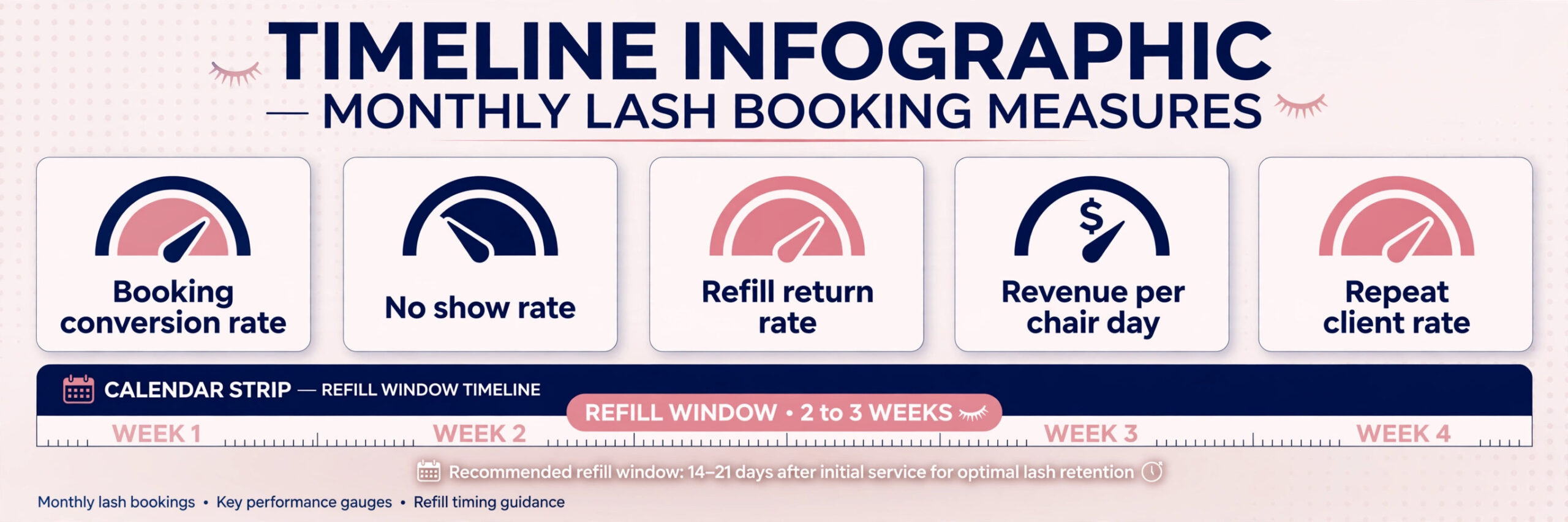
A booking system should pay for itself in filled chairs and kept clients, and the only way to know is to measure a small set of numbers every month. Start with the booking conversion rate, meaning the share of booking page visits that become confirmed appointments, because that is the number that decides whether the page sells or just informs. Then measure the no show rate, meaning the share of confirmed appointments that do not happen, and the refill return rate, meaning the share of clients who rebook within the two to three week window.
Add two money numbers to those three service numbers. The first is revenue per chair day, which shows whether the diary is filling with full sets and refills or with gaps that could have been booked. The second is repeat client rate, meaning the share of clients who book again within three months, because repeat clients cost far less to win than new ones. If the booking conversion rate rises but the no show rate rises too, the problem is deposits or reminders, not demand. If the no show rate falls but the refill return rate does not, the problem is aftercare or refill timing, not the booking page.
Mistakes That Undo a Good Booksy Setup
The most common mistake is launching the booking page before the service menu is finished. Clients book the wrong service, the chair time is wrong, the technician runs late, and the studio spends the week apologising for a system that was supposed to save time. Finish the set types, the durations, the refill rule, and the deposit rule first, test them with five real past appointments, and only then open the page to clients. A week spent on the service menu saves a month of chair time arguments.
The second mistake is letting Booksy book every service without limits. A studio that allows online booking for mega volume sets for first time clients, clients with past reactions, and urgent event sets will receive appointments it cannot safely fulfil at the quoted time, and the cancellations that follow damage trust. Limit automated booking to standard sets and refills with clean histories, and route everything else to a consultation with a clear next step. When technicians choose to use Booksy for lash technician appointment booking in this limited way, the system feels helpful rather than reckless, because it knows its own limits.
The third mistake is ignoring the client record. If the technician does not update the set type, style, and sensitivity notes after each appointment, the next booking starts from guesswork, and the client must repeat the same conversation every visit. Update the record before the client leaves, show the client that the record exists, and use it to personalise the next reminder. A record the technician trusts is a record that actually gets used, and a record nobody updates is just an extra cost.
Verdict, Is Booksy Worth It for a Lash Technician
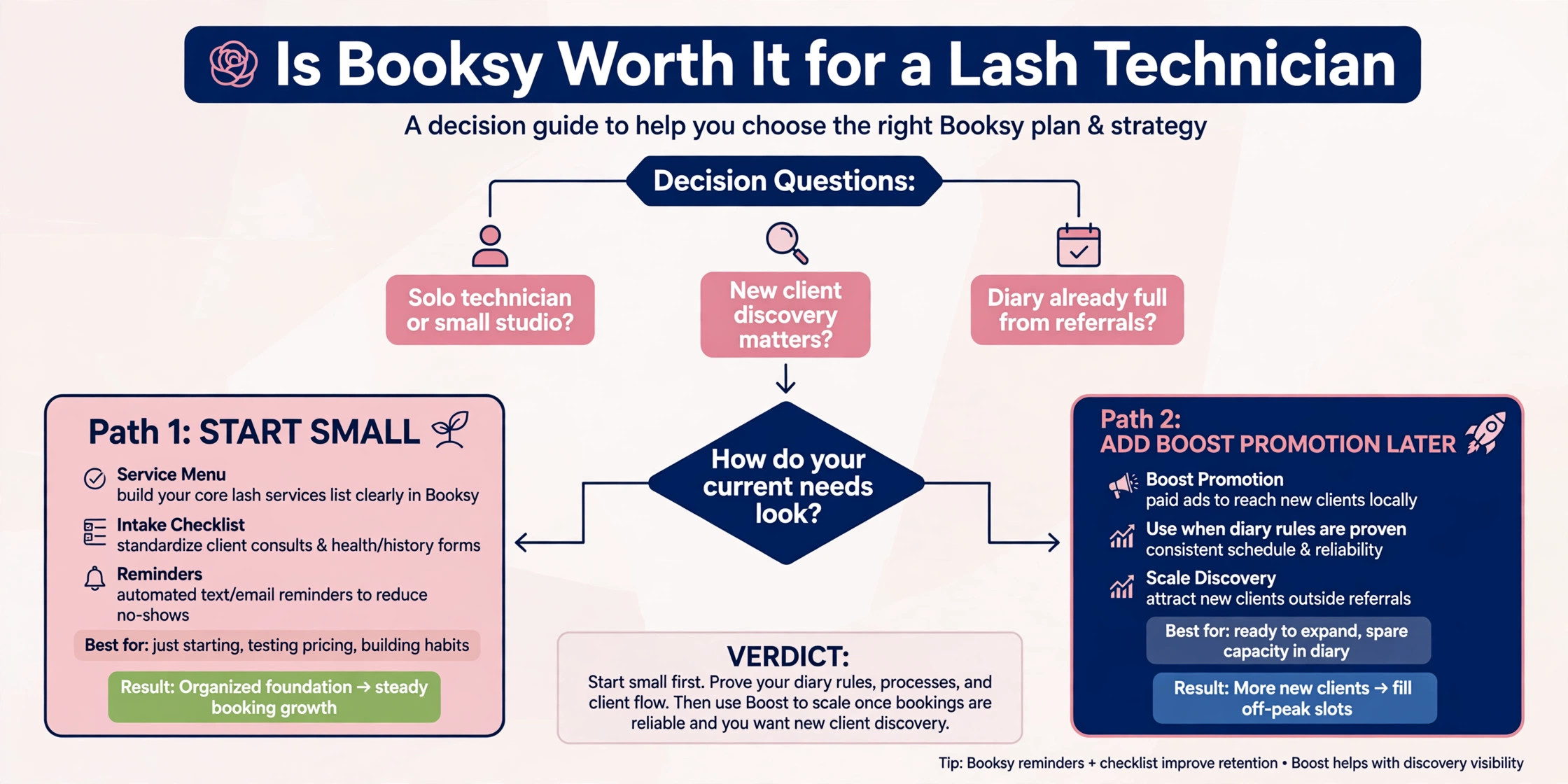
For a solo technician or a small studio, the case is strong, provided the setup is done in the right order. Fix the service menu, build the appointment checklist, set the deposit and refill rules, and only then open online booking and automated reminders. Done in that order, the system fills chairs at any hour, times refills to the lash cycle, and sends technicians into the chair with the set type, allergy history, and style notes they need to do the job properly the first time. The monthly software cost is usually smaller than the value of one recovered full set a week, and most technicians lose more than one appointment a week to slow replies and no shows alone.
The case weakens when the technician wants software to replace judgment entirely. No automated system can judge lash health from a form, choose a style from a photo alone, or calm a worried client as well as a person can. The technicians that get the best return from this approach are the ones that use Booksy for lash technician appointment booking for speed and coverage, while keeping people in charge of consultations, reactions, and final style decisions. That split is not a compromise. It is the whole point, because speed wins the booking and judgment keeps the client.
Start small if the budget is tight. A Booksy setup with the service menu, the intake checklist, and automated reminders will already recover a large share of the losses, and paid Boost promotion can wait until the diary rules are proven. Measure the five numbers from the earlier section for a month, compare them with the month before, and let the results decide the next spend. If the numbers move, expand. If they do not, fix the service menu or the intake form before buying more promotion, because another tool will not fix a broken service menu.
More Reading on Stratilyze
For a related field service system, read best CRM for cleaning companies and best scheduling software for home care agencies. For a booking guide in a different trade, see use AI for carpet cleaning booking.
Frequently Asked Questions
How much does Booksy cost for a lash technician
Booksy is reported at about $29.99 a month plus tax for a solo technician, with about $20 per additional team member in recent guides. Appointment confirmations and reminders are free in those guides, while optional Boost promotion and payment processing carry separate charges. Confirm the current price on the vendor page before buying, because plans and add on prices change often.
How long does a lash refill take
A standard refill at two to three weeks is reported at roughly 45 to 75 minutes in recent marketplace guides, compared with roughly 90 to 120 minutes for a classic full set and roughly 120 to 180 minutes for a volume full set. A refill booked late, at four or five weeks, often needs the time and price of a new set, because too many extensions have shed. Book the refill inside the two to three week window to keep chair time and price predictable.
Should a lash technician take deposits at booking
A deposit is usually worth it, because it cuts no shows and confirms that the client is serious about a chair that cannot easily be refilled at short notice. The deposit rule, the cancellation window, and the refund rule should all appear on the booking page before payment, so there is no surprise later. Studios that worry about losing price sensitive clients can offer deposit free booking for repeat clients with a clean record while requiring deposits from first time bookings.
What should I ask about allergies before a lash appointment
Ask about past reactions to lash products, eye sensitivity, and any current eye condition, and record the answers in the client profile before confirming the appointment. When technicians choose to use Booksy for lash technician appointment booking, the intake form should also ask whether the client has had lashes before and how the previous set was tolerated, so a concern triggers a consultation rather than an automatic confirmation. A client with a past reaction should always receive a human review before a new set.
How often should lash refills be booked
Refills work best at two to three weeks, timed to the natural lash cycle, so the set stays full and the chair time stays predictable. Booking later than that usually means more shed extensions, a longer appointment, and a price closer to a new set. Send the refill booking link after each appointment, timed to that window, so the client can book before the set starts to look thin.
Can Booksy work for a solo lash technician
Yes, and it often helps a solo technician more than a larger studio, because a solo technician misses the most messages while working in the chair. A booking page plus reminders can recover those bookings without hiring front desk staff, and the client record means the technician starts each appointment from facts instead of memory. Start with booking, the service menu, and reminders, add Boost promotion when the diary needs new clients, and keep consultations on a personal review list.