

Content agencies do not lose money on writing. They lose it on the work around writing: briefs that take a day to research, drafts that come back rewritten, SEO checks done after the client has already seen the piece, projects tracked in five spreadsheets, and reports assembled by hand at month end. The best AI tools for content agencies attack that surrounding work. They build research backed briefs in minutes, draft faster without flattening voice, check optimisation before delivery, keep every client project visible in one place, and turn reporting from a Friday chore into a link the client opens themselves.
This guide groups 12 tools by the agency job each one does best: briefs and research, writing and editing, SEO optimisation, project and client management, and reporting and billing. Prices are October 2026 figures in US dollars. Where a vendor does not publish pricing, or where sources disagreed, the guide says check checkout rather than guessing. One rule runs through the whole guide: AI output is a first draft, not a deliverable. An editor must check facts, voice and client requirements before anything reaches a client.
The 12 best AI tools for content agencies at a glance
| Tool | Best job | Free option | Paid from |
|---|---|---|---|
| Frase | Research backed briefs | No | $45 per month |
| MarketMuse | Content gap analysis | No | Custom, check checkout |
| Jasper | Brand voice drafting | 7 day trial | Around $39 per month |
| Copy.ai | Fast first drafts | Free tier | Around $49 per month |
| Grammarly | Editing and quality control | Free tier | Around $12 per month |
| Surfer SEO | On page optimisation | No | Around $79 per month |
| Clearscope | Brief grading and coverage | No | Around $170 per month |
| ClickUp | Project and client delivery | Free tier | Around $10 per user per month |
| Asana | Client project tracking | Free tier | Around $13.49 per user per month |
| StoryChief | Multi channel publishing | No | Around $100 per month, check checkout |
| AgencyAnalytics | Client reporting | 14 day trial | Around $79 per month |
| Harvest | Time tracking and invoicing | Free tier | Around $10.90 per user per month |

Best pick by job
| Your job | Start with | If that fails, try |
|---|---|---|
| Briefs that writers actually follow | Frase | MarketMuse |
| Find the topics competitors own | MarketMuse | Frase |
| Draft in a consistent brand voice | Jasper | Copy.ai |
| Draft fast on a small budget | Copy.ai | Jasper |
| Catch errors before the client does | Grammarly | Surfer SEO |
| Optimise a draft before delivery | Surfer SEO | Clearscope |
| Grade a brief against top results | Clearscope | Surfer SEO |
| Run all client projects in one place | ClickUp | Asana |
| Track client work simply | Asana | ClickUp |
| Publish one piece everywhere | StoryChief | ClickUp |
| Report results clients understand | AgencyAnalytics | Harvest |
| Track time and bill accurately | Harvest | AgencyAnalytics |
Briefs and research: start from evidence, not opinion
A weak brief produces a weak draft, and the agency pays for it in revisions. These two tools build briefs from what already ranks, so writers start with structure, questions, headings and coverage gaps instead of a blank document and a vague instruction.
1. Frase
Frase turns a target topic into a full brief in minutes. It analyses top ranking pages, pulls the questions people ask, suggests headings and word counts, and lets editors shape the brief before it reaches a writer. Its document editor also scores a draft against the brief as it is written, which cuts the usual back and forth between writer and editor.
Pricing: Plans start around $45 per month for a single seat, with team tiers above that. Check checkout for the current seat limits, since Frase has changed plan names before.
Best for: Agencies producing regular SEO content for several clients, where brief quality decides how many revision rounds each piece needs.
Watch out for: Frase briefs reflect what already ranks, so they can push every client toward the same structure. Editors should add the client’s angle, examples and expert quotes before the brief goes to a writer, or output starts to look interchangeable.
Try it at: frase.io

2. MarketMuse
MarketMuse works at the portfolio level rather than the single brief. It audits a whole site, scores topic authority, and shows which topics a client should cover next and which existing pages need updating. For agencies managing retainers, that turns content planning from guesswork into a ranked list of gaps worth closing.
Pricing: Custom, priced by site size and scope. There is no small agency self serve price to quote, so check checkout for a quote tied to the number of client sites.
Best for: Agencies running content strategy retainers for clients with large sites, where planning decisions matter more than any single draft.
Watch out for: MarketMuse is a planning tool, not a writing tool. Agencies that buy it expecting drafts will be disappointed. Pair it with Frase for briefs and a writing tool for drafts, and judge it on planning quality alone.
Try it at: marketmuse.com
Writing and editing: draft faster, keep the voice
Writing tools save agencies hours per piece, but only when editors stay in control. These three cover the full chain: drafting in a brand voice, drafting fast on a budget, and catching the errors that damage client trust.
3. Jasper
Jasper is the most established AI writing platform for teams. It stores brand voice profiles, produces drafts from briefs and templates, and supports campaigns, social copy and long form content from one workspace. Its team features, including shared voices and document collaboration, suit agencies that must keep several client voices distinct.
Pricing: Creator plans are reported from around $39 per month per seat, with Pro and business tiers above. Check checkout for the current seat and feature limits.
Best for: Agencies with several clients whose voices must stay distinct, and teams that want one drafting workspace rather than a tool per writer.
Watch out for: Jasper drafts are fluent but generic until the voice profile and brief are strong. Agencies that feed it thin briefs get thin drafts. Invest in the voice setup and the brief, and treat every draft as a first version that an editor shapes.
Try it at: jasper.ai
4. Copy.ai
Copy.ai is the budget friendly drafting option. It offers a free tier, a large template library for blogs, ads, emails and social posts, and a workflow builder that chains prompts into repeatable processes. For agencies testing AI drafting, or for smaller teams, it delivers most of the practical value at a lower monthly cost.
Pricing: A free tier covers basic use. Paid plans are reported from around $49 per month. Check checkout for the current workflow and seat limits.
Best for: Smaller agencies and teams starting with AI drafting, and agencies that need repeatable workflows for recurring content types.
Watch out for: Output quality varies more by prompt than by tool, and Copy.ai is no exception. Build and test a small set of proven workflows, and do not let writers run untested prompts on client work. Agencies hiring writers for this kind of work should also see our best AI tools for freelance writers guide for the writer side of the stack.
Try it at: copy.ai
5. Grammarly
Grammarly is the quality gate every agency should run before delivery. It checks grammar, clarity, tone and consistency, and its business tier adds style guides and brand tone checks that apply across a team. It does not write the piece, and that is the point: it catches the small errors that make a client question the whole deliverable.
Pricing: A free tier covers basic checks. Premium is reported from around $12 per user per month, with business tiers above. Check checkout for the current team pricing.
Best for: Every agency, as a final pass before delivery, and especially agencies with junior writers or large freelance pools.
Watch out for: Grammarly suggestions can flatten voice if accepted blindly. Train editors to accept clarity fixes and reject style suggestions that fight the client’s voice. It is a checker, not an editor, and the final judgment stays human.
Try it at: grammarly.com
SEO optimisation: check before the client sees it
Ranking work done after delivery is rework. These two tools check a draft against top ranking pages while it is still editable, so the agency delivers a piece that is already optimised instead of a piece that needs a second pass.
6. Surfer SEO
Surfer SEO scores a draft against the pages already ranking for its target term, then suggests word count, headings, terms to include and structure changes. Its content editor updates the score live as the writer edits, which makes optimisation a writing step rather than a separate review step. It also includes an audit tool for existing client pages.
Pricing: Plans are reported from around $79 per month for a single seat, with higher tiers for teams and more content editor credits. Check checkout for the current credit limits, since Surfer prices by usage as well as seats.
Best for: Agencies delivering SEO content at volume, where every piece needs a defensible optimisation score before it goes to the client.
Watch out for: Chasing a perfect score can produce keyword stuffed, unreadable copy. Set an internal target, usually in the high 70s or above, and let editors stop there. Readability and client voice outrank the last few points of score.
Try it at: surferseo.com

7. Clearscope
Clearscope takes a simpler approach: paste a draft or a brief, and it grades coverage against competing pages and lists the terms a thorough piece should address. Its reports are easy to share with writers and clients, which makes it useful as a briefing and review tool rather than a live editor.
Pricing: Plans are reported from around $170 per month, which makes it one of the pricier tools on this list. Check checkout for the current report credits, since Clearscope prices by usage.
Best for: Agencies that want a clear, shareable grade for each piece, and teams that brief and review in separate steps rather than editing live.
Watch out for: Price per report adds up fast on high volume retainers. Agencies producing dozens of pieces a month should compare the per piece cost against Surfer before committing, and reserve Clearscope for flagship content if budgets are tight.
Try it at: clearscope.io
Project and client management: one place for every deliverable
Content agencies fail on operations more often than on writing. Missed deadlines, unclear approvals and scattered feedback cost clients. These three tools keep projects, approvals and publishing in one visible system.
8. ClickUp
ClickUp is the most flexible project platform on this list. Agencies can build a workspace per client, track every piece from brief to delivery, automate status changes and reminders, and give clients a limited view of their own projects. Its docs, whiteboards and goals also replace several smaller tools an agency might otherwise pay for separately.
Pricing: A free tier covers basic use. Paid plans are reported from around $10 per user per month. Check checkout for the current storage and automation limits.
Best for: Agencies that want one system for briefs, drafts, approvals and client visibility, and that are willing to invest a day in setting it up properly.
Watch out for: Flexibility is also the risk. A ClickUp workspace built without a template becomes a mess within a month. Build one standard client template, copy it for every new client, and resist custom setups per account.
Try it at: clickup.com

9. Asana
Asana is the simpler project option. It tracks tasks, deadlines and approvals with less setup than ClickUp, and its timeline and portfolio views give agency leads a clear picture of every client at once. For agencies that do not need docs and whiteboards inside the project tool, Asana is faster to adopt and easier to keep tidy.
Pricing: A free tier covers small teams. Paid plans are reported from around $13.49 per user per month on annual billing. Check checkout for the current portfolio and reporting limits.
Best for: Agencies that want reliable task and deadline tracking without a heavy setup project, and teams that already use other tools for documents and reporting.
Watch out for: Asana is a task tracker, not a full agency operating system. Client approvals and feedback still need a clear process around it, or tasks get marked done while the client is still waiting on a revision.
Try it at: asana.com
10. StoryChief
StoryChief closes the gap between a finished draft and a published piece. It pushes one article to a website, social channels and newsletters, tracks where each piece went, and keeps approvals inside the publishing flow. For agencies that distribute client content across many channels, it removes the copy and paste step that eats hours and introduces errors.
Pricing: Plans are reported from around $100 per month, with higher tiers for more channels and seats. Check checkout for the current channel and user limits.
Best for: Agencies that publish client content across websites, social and email, and that currently lose time to manual distribution.
Watch out for: StoryChief is a distribution tool, not a project manager. Agencies still need ClickUp or Asana for the work itself, and should judge StoryChief only on publishing time saved, not on project visibility.
Try it at: storychief.io
Reporting and billing: prove the value, get paid on time
Clients renew when they see results and leave when reporting is vague. These two tools cover both sides of that problem: clear monthly reports and accurate time and invoicing.
11. AgencyAnalytics
AgencyAnalytics builds client dashboards and automated monthly reports from SEO, ads, social and analytics data. Clients get a live link they can open any time, and agencies stop building reports by hand in spreadsheets. White labelling keeps the agency brand on every report, which matters for retainer relationships.
Pricing: A 14 day trial is offered. Plans are reported from around $79 per month for a small number of client campaigns. Check checkout for the current campaign limits, since pricing scales with client count.
Best for: Agencies on monthly retainers that need professional, repeatable client reporting without a dedicated reporting role.
Watch out for: A dashboard full of metrics impresses no one if the client does not understand it. Limit each report to the metrics tied to the client’s goals, add a short written summary each month, and keep vanity metrics out of the headline view.
Try it at: agencyanalytics.com
12. Harvest
Harvest tracks time per client and project, then turns tracked time into invoices. For agencies billing hourly or tracking profitability per client, it answers the question every owner asks at month end: which clients actually make money. Its integrations with project tools keep time entry close to the work itself.
Pricing: A free tier covers one seat and two projects. Paid plans are reported from around $10.90 per user per month. Check checkout for the current project limits.
Best for: Agencies billing by the hour, and agencies that want honest profitability data per client before renewing or repricing a retainer.
Watch out for: Time data is only useful if the team logs it consistently. Make time entry part of the daily close, review it weekly, and do not use it as a surveillance tool, or the team will log fiction. Agencies pricing new work should also see our best AI proposal software guide for turning tracked costs into winning proposals.
Pricing compared
| Tool | Free option | Paid from | Pricing note |
|---|---|---|---|
| Frase | No | $45 per month | Single seat starting point |
| MarketMuse | No | Custom | Priced by site size |
| Jasper | 7 day trial | Around $39 per month | Per seat |
| Copy.ai | Free tier | Around $49 per month | Workflow limits apply |
| Grammarly | Free tier | Around $12 per user per month | Business tiers above |
| Surfer SEO | No | Around $79 per month | Usage credits apply |
| Clearscope | No | Around $170 per month | Priced by report credits |
| ClickUp | Free tier | Around $10 per user per month | Automation limits apply |
| Asana | Free tier | Around $13.49 per user per month | Annual billing figure |
| StoryChief | No | Around $100 per month | Channel limits apply |
| AgencyAnalytics | 14 day trial | Around $79 per month | Scales with client count |
| Harvest | Free tier | Around $10.90 per user per month | Per user |
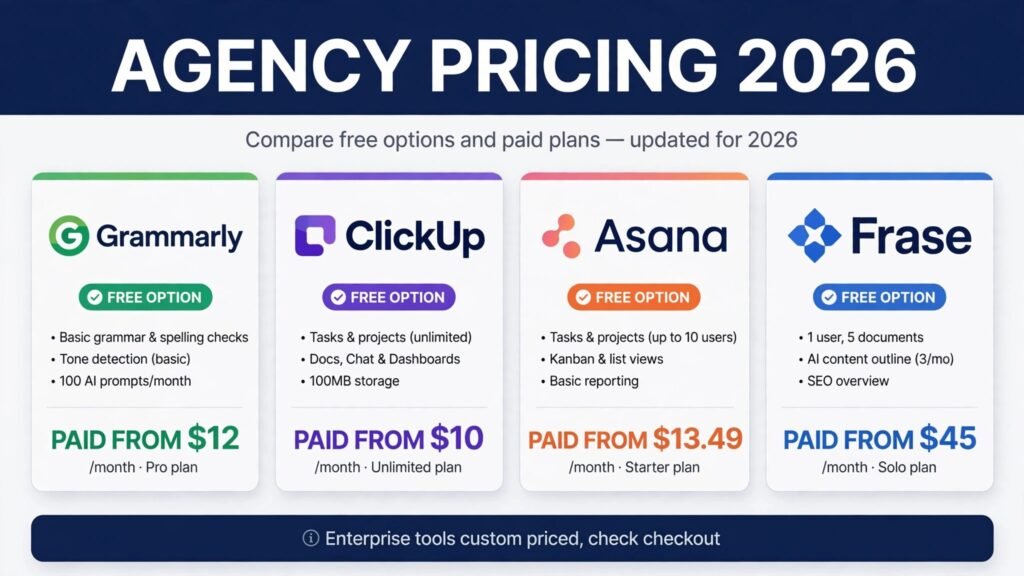
A realistic starter stack costs roughly $150 to $250 per month: Copy.ai for drafting, Grammarly for quality control, Frase for briefs and Surfer SEO for optimisation, plus a free tier of ClickUp or Asana for projects. A mid size agency stack adds Jasper for brand voices, Clearscope for flagship pieces and AgencyAnalytics for reporting, landing roughly $400 to $600 per month. An enterprise stack with MarketMuse and full team seats runs into custom contracts, so price the full configuration, including seats and usage credits, before signing. For agencies weighing the whole operating budget, our best AI tools for small business guide helps place content tools inside the wider stack.
How to Choose
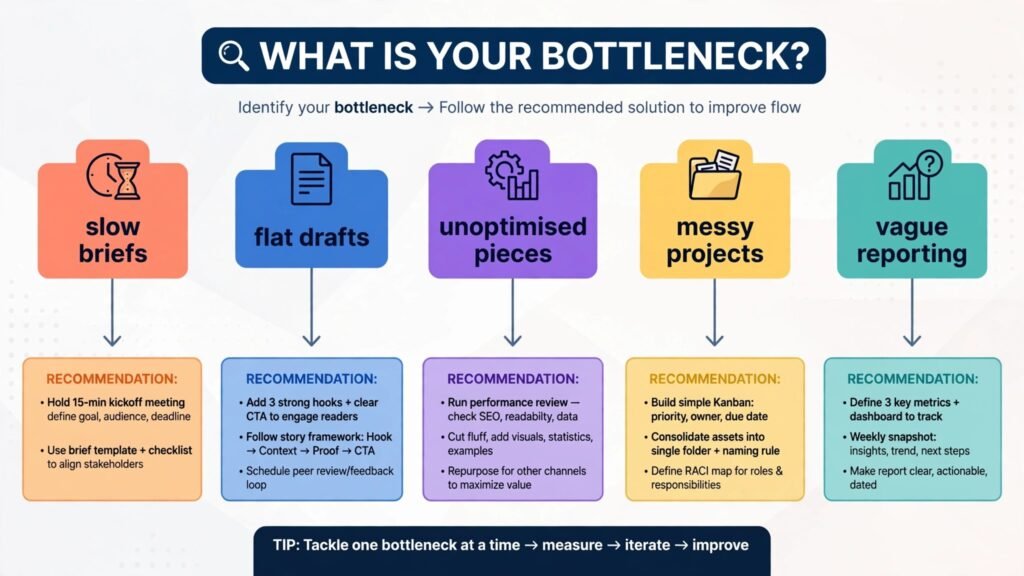
Start with the bottleneck, not the brand. If briefs take too long, start with Frase. If drafts come back flat, start with Jasper or Copy.ai and fix the brief first. If clients complain about results they cannot see, start with AgencyAnalytics before buying another writing tool, because a visible result keeps the client that pays for everything else.
Next, run a pilot on one real client, not on demo content. Give two writers the new tools for two weeks, measure revision rounds, delivery time and editor hours per piece, and ask the writers directly whether the output is easier to shape into client ready work. A tool that looks fast in a demo but adds editing time in practice is a cost, not a saving.
Then check the workflow fit before signing. Confirm seats, usage credits and integrations with the tools already in use, and confirm who owns the account if a writer leaves. Agencies that collect client details through their own site should also see our best AI form builders guide for the intake side of client onboarding.
Finally, set the human checks in writing. Every AI draft gets an editor pass for facts, voice and client requirements. Every optimised draft gets a readability read before delivery. Every report gets a short written summary, not just a dashboard link. The agencies that succeed with AI in 2026 treat the tools as a faster first step, not as a finished product.
Frequently Asked Questions
Will AI writing tools replace agency writers?
No. AI tools draft, research and optimise, but they do not know a client’s voice, strategy or audience the way a writer and editor do. Agencies that use AI well keep writers and editors, and give them faster first drafts and better briefs. Agencies that replace writers with raw AI output lose clients to quality problems within months.
How much should a small agency pay for AI content tools?
A small agency can start around $150 to $250 per month for drafting, editing, briefs and optimisation, using free tiers for project tracking. Add reporting and premium tools only when client count and revenue justify them, and judge every tool on revision rounds saved, not on features listed.
Do AI tools hurt SEO rankings?
Not when used properly. Search engines penalise low quality, thin and unoriginal content, not content that used AI in its production. Pieces that are researched, edited, fact checked and genuinely useful rank the same as any other piece. Pieces published without editing, whatever produced them, do not.
Which single tool should a new agency start with?
Frase, for most new agencies, because brief quality decides draft quality, revision rounds and editor hours. If drafting volume is the bigger pain, start with Copy.ai instead, and add Frase once briefs become the bottleneck.
Can one tool cover writing, SEO and reporting?
No tool on this list does all three well. Jasper drafts, Surfer SEO optimises and AgencyAnalytics reports, and each is best at its own job. Agencies should budget for a small stack of focused tools rather than one tool that does everything poorly.
How do agencies keep client voices distinct with AI?
Through voice profiles, per client briefs and editor review. Jasper stores separate voice profiles per client, and editors should check every draft against the client’s style before delivery. Never share one voice profile across clients, and never let a draft reach a client without a human read.
Conclusion
The best AI tools for content agencies do not write the agency. They remove the slow parts: the day long brief, the blank page, the unoptimised draft, the scattered project, and the hand built report. Frase and MarketMuse ground briefs and plans in evidence. Jasper, Copy.ai and Grammarly draft and polish faster. Surfer SEO and Clearscope check optimisation before delivery. ClickUp, Asana and StoryChief keep projects and publishing visible. AgencyAnalytics and Harvest prove results and get the agency paid.
Start with the bottleneck. Pilot on one real client. Measure revision rounds, delivery time and editor hours. Keep a human editor on every piece and a written summary on every report. The agencies that win with AI in 2026 are the ones whose writers spend their hours on ideas, voice and judgment, while the tools handle the rest.