

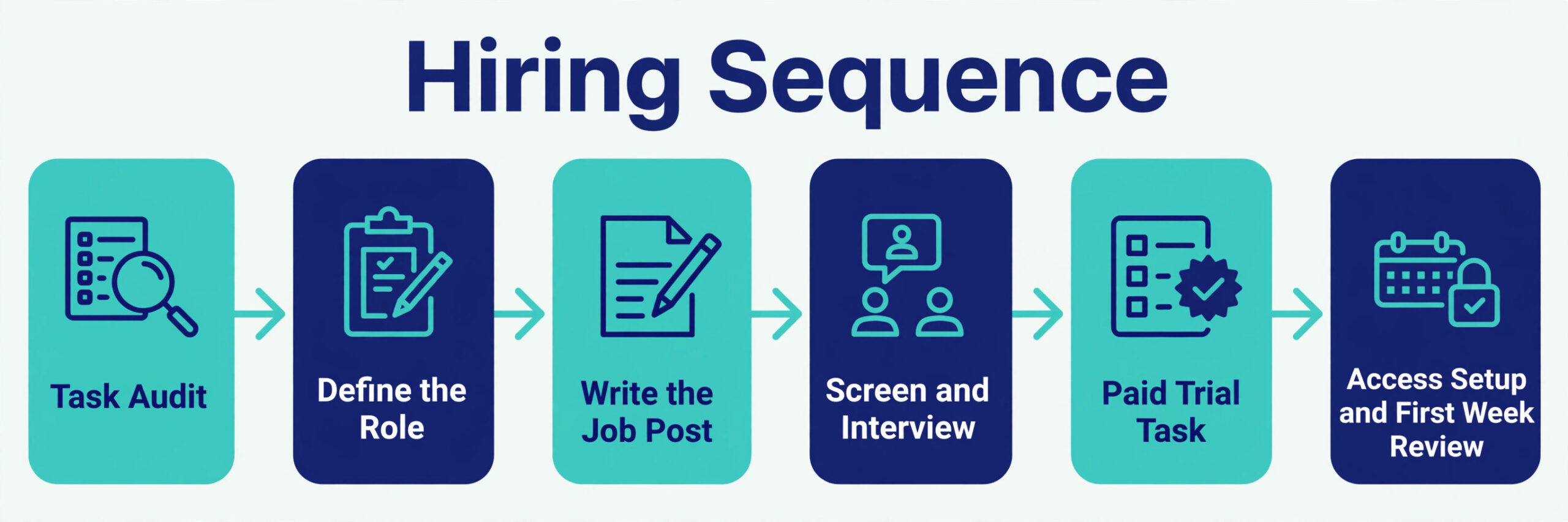
Your inbox is full, your calendar is double booked, and the work that actually grows the business keeps getting pushed to tomorrow. That is the moment most small business owners start thinking about a virtual assistant, and it is also the moment when a rushed hire can create more work than it removes. This guide explains how to hire first virtual assistant small business owners can rely on, starting with what to hand off, how to test a candidate on real work, and how to set up access and a first week plan that protects your time instead of consuming it.
A virtual assistant is a remote worker who handles defined operational tasks for your business, usually on a part time, project, or retainer basis. The role works best when the tasks are repeatable, teachable, and measurable. It works poorly when the brief is vague, the owner expects mind reading, or the assistant is given sensitive access on day one with no process to follow. The difference between those two outcomes is almost never talent alone. It is preparation, and preparation is entirely within your control before you post a single job ad.
Hiring a first assistant is also a management decision, not just a purchase. You are adding a working relationship, a communication routine, and a set of permissions inside your business. That sounds heavy for a hire of five or ten hours a week, but a light structure at the start prevents the common failure pattern where the owner spends more time explaining, correcting, and chasing than the assistant saves. The plan below keeps that structure small enough for a busy owner to run, while still covering the parts that matter, which are task selection, screening, a paid trial, access control, and review.
How to Hire First Virtual Assistant Small Business Starts With a Task Audit
Do not write the job post first. Write the task list first, because the task list decides the skills, hours, tools, and pay structure you actually need. Practitioner guides consistently start here for a good reason. A one week log of your work, rounded to the nearest quarter hour, usually reveals a clear pile of repetitive work that does not need your judgment, and a second pile that should stay with you for now.
For one week, note every task, how long it took, how often it repeats, and whether it needs your personal judgment, your signature, or a client relationship you personally hold. Include the five minute tasks, because five minute tasks repeated daily are where a week quietly disappears. At the end of the week, sort the list into three groups, which are tasks to hand off first, tasks to hand off later once trust is built, and tasks to keep.
| Task group | Examples | Hand off now or keep |
|---|---|---|
| Hand off first | Inbox sorting, calendar booking, data entry, invoice reminders, research lists, file organisation | Hand off first |
| Hand off later | Social post drafts, customer reply drafts, report preparation, supplier follow up | Hand off later, with approval before anything is sent |
| Keep for now | Pricing, contracts, final client decisions, hiring, brand voice sign off, strategy | Keep with the owner |
Use three tests before moving a task into the first group. First, can you write the steps down in a way another competent person could follow without calling you? Second, can you check the result quickly, for example by reviewing a sent list, a booked calendar, or an updated sheet? Third, if the task is done imperfectly once, is the damage small and fixable? Tasks that pass all three tests are ideal first delegations. Tasks that fail the first test need a short written process before anyone else touches them, which is work worth doing anyway, because it makes your business less dependent on your memory.
Estimate hours from the audit, not from a guess about what sounds reasonable. Add up the weekly time for the first group only, then add a small allowance for questions and review in the first month. If the first group totals six hours a week, a hire of five to ten hours a week is a sensible starting range. If it totals two hours, a small project or a few hours a week is a better fit than a large retainer you will struggle to fill. Hours that grow from real tasks are easier to manage than hours bought in hope.
Signs You Are Ready and Signs You Should Wait
Readiness is not about being busy. Every owner is busy. Readiness is about having repeatable work, a way to explain it, and time to review it for the first few weeks. You are ready when you can name three to five tasks that repeat weekly, when you can spare two short review windows a week at the start, and when you can accept that the first month will feel slower before it feels faster. That slower start is normal. Teaching takes time, and the return arrives when the assistant can run the tasks without daily guidance.
Wait, or narrow the hire, if every task in your week is different, if you cannot describe how a task should be done, or if you need someone to make judgment calls on your behalf from day one. In that case, the useful first step is not a hire but a process. Record yourself doing the task once, write the steps down, and turn that recording into a one page guide. Two or three such guides turn a vague wish for help into a hireable role, and they also protect you if the assistant is ill or leaves, because the process stays with the business.

Choosing Between a Direct Hire, an Agency, and a Project Start
There are three common routes, and each trades control, effort, and backup differently. A direct hire from a freelance marketplace gives you the widest choice and the most control over who you pick, but you do all the screening, and if the fit is wrong you restart the search yourself. A managed agency does screening and matching for you, and usually offers a replacement if the fit fails, but you have less direct choice and the rate often reflects that service. A project start, where you hire for one defined piece of work, gives you the lowest commitment way to test a person before any ongoing arrangement.
| Route | Best when | Main drawback |
|---|---|---|
| Direct hire | You know the exact tasks and want to choose the person | Screening and replacement are your job |
| Managed agency | You want screening and backup handled for you | Less direct choice, and the rate may be higher |
| Project start | You want to test fit before an ongoing commitment | It proves one task, not a full weekly routine |
Pay rates vary widely by location, skill, and task type, so treat any rate you see online as a starting point for research rather than a market fact. General administrative help and specialised help, such as bookkeeping support or technical setup, sit in different ranges, and a rate that looks cheap for specialised work often signals a skill gap you will discover later.
For your budget, work backwards from value. If the assistant frees five hours a week, what is an hour of your time worth when spent on sales, delivery, or client work? That comparison, not the lowest rate on a platform, should set your ceiling. All pay figures in this guide are illustrative ranges for planning, not claims about what any particular assistant charges.
Agree the engagement type in writing before work starts. State whether the person is engaged as a contractor or through an agency, the hourly or project rate, how hours are recorded, how payment is made, and how either side can end the arrangement. Employment and contractor rules vary by place, and misclassifying a worker can create tax and legal problems, so check the rules that apply where you and the assistant are based, and take professional advice if the arrangement is long term or full time. This guide is general business information, not legal or tax advice.

Writing a Job Post That Attracts the Right Person
A good job post is a filter, not a sales pitch. It should let the wrong candidates opt out and let the right ones picture the actual week. Start with the tasks from your audit, written as outcomes rather than vague duties. “Manage the inbox” is vague. “Sort the inbox each morning, reply to routine enquiries from approved templates, and flag anything needing the owner by midday” is a job a candidate can judge.
Name the tools the assistant will use, the hours and time zone overlap you need, and the working language requirements, because those details prevent the most common mismatches. That clarity is a practical part of how to hire first virtual assistant small business owners can rely on.
Include a small application instruction that tests attention to detail, such as asking candidates to include a specific word in the subject line or to answer one task related question. This is not a trick. It simply separates candidates who read the brief from candidates who apply to everything. Keep the application short, with a resume or profile, a short note on relevant experience, availability, and rate expectations. A long application form for a part time role discourages good candidates who already have work.
The template below is an original starting point you can adapt. Replace the bracketed parts with your own details, and delete any line that does not apply, rather than posting it with placeholders still in it.
Job post template, ready to adapt. Title, part time virtual assistant for a small business, with weekly hours and time zone. About the business, one or two sentences on what you sell and who you serve. Tasks, a short bullet list drawn from your task audit, each written as an outcome. Tools, the tools the assistant will use each week.
Hours and schedule, the days and overlap window you need. What success looks like in the first month, for example inbox sorted daily and invoice reminders sent on schedule. How to apply, resume or profile, availability, rate expectations, and the one short question you want answered. Closing date and next step, for example shortlisted candidates will be invited to a paid trial task.

Screening Without Spending Weeks on Interviews
Screen in stages, and use each stage to remove candidates for a clear reason, rather than keeping a large shortlist out of politeness. Stage one is the application itself. Remove candidates who ignore the brief, cannot show relevant experience, or are unavailable in the hours you need. Stage two is a short written exchange or a brief call, focused on communication clarity, reliability, and questions. A candidate who asks good questions about the tasks, tools, and priorities is usually a stronger hire than a candidate who promises to handle everything with no questions at all. That staged approach is a practical part of how to hire first virtual assistant small business owners use in real hiring.
Stage three is the paid trial task, covered in detail below, and it should carry the most weight. Interviews tell you how a person talks about work. A trial tells you how a person does your work, follows a written brief, handles an unclear point, and presents a finished result. If a candidate is excellent in interview but weak on the trial, trust the trial. If a candidate is quiet in interview but strong on the trial, trust the trial as well, provided communication during the trial was clear and timely.
Red flags worth taking seriously include no questions about the work at all, promises to cover any task at any hour with no process, vague answers about how hours are tracked, and requests for passwords by email or chat. None of these alone proves a bad hire, but together they point to a working style that will cost you supervision time. Also watch for a profile that claims deep expertise in many unrelated fields. For a first hire, depth in your core tasks matters more than breadth across a dozen services.
The Paid Trial Task That Predicts Real Performance
A paid trial is the single most useful step in this whole process, and it should be a real task from your audit, not a generic test. Pick a task that takes one to three hours, that you can judge against a clear standard, and that reflects the weekly work. Inbox sorting, a research list, a data cleanup, or a draft reply set all work well, provided the brief is written the way a real brief would be written, with the outcome, the source material, the format, and the deadline all stated. That real work test is a core part of how to hire first virtual assistant small business owners should trust.
Write the brief before you send it, and include four things. The outcome, stated as a finished result you can check. The inputs, meaning the files, accounts, or examples the candidate needs. The constraints, such as what not to change, what not to send, and what to flag rather than guess. The deadline and the pay for the trial, agreed in advance. Paying for the trial is both fair and diagnostic. It shows you value the candidate time, and it shows how the candidate treats paid work, which is the work you are actually buying.
Judge the trial on five points, and score each one simply, for example as strong, adequate, or weak. Accuracy, meaning the result matches the brief and the data is correct. Completeness, meaning nothing in the brief was skipped. Communication, meaning questions were asked early and updates were given without chasing. Presentation, meaning the result is tidy and ready to use, not a rough dump.
Judgment, meaning unclear points were flagged rather than guessed, and nothing sensitive was shared or sent without approval. A candidate who scores adequate or better on all five, with no weak score on accuracy or communication, is usually a safe hire. A candidate who is fast but inaccurate, or accurate but silent until the deadline, will cost you more supervision than the speed saves.

Access Setup That Protects Your Business From Day One
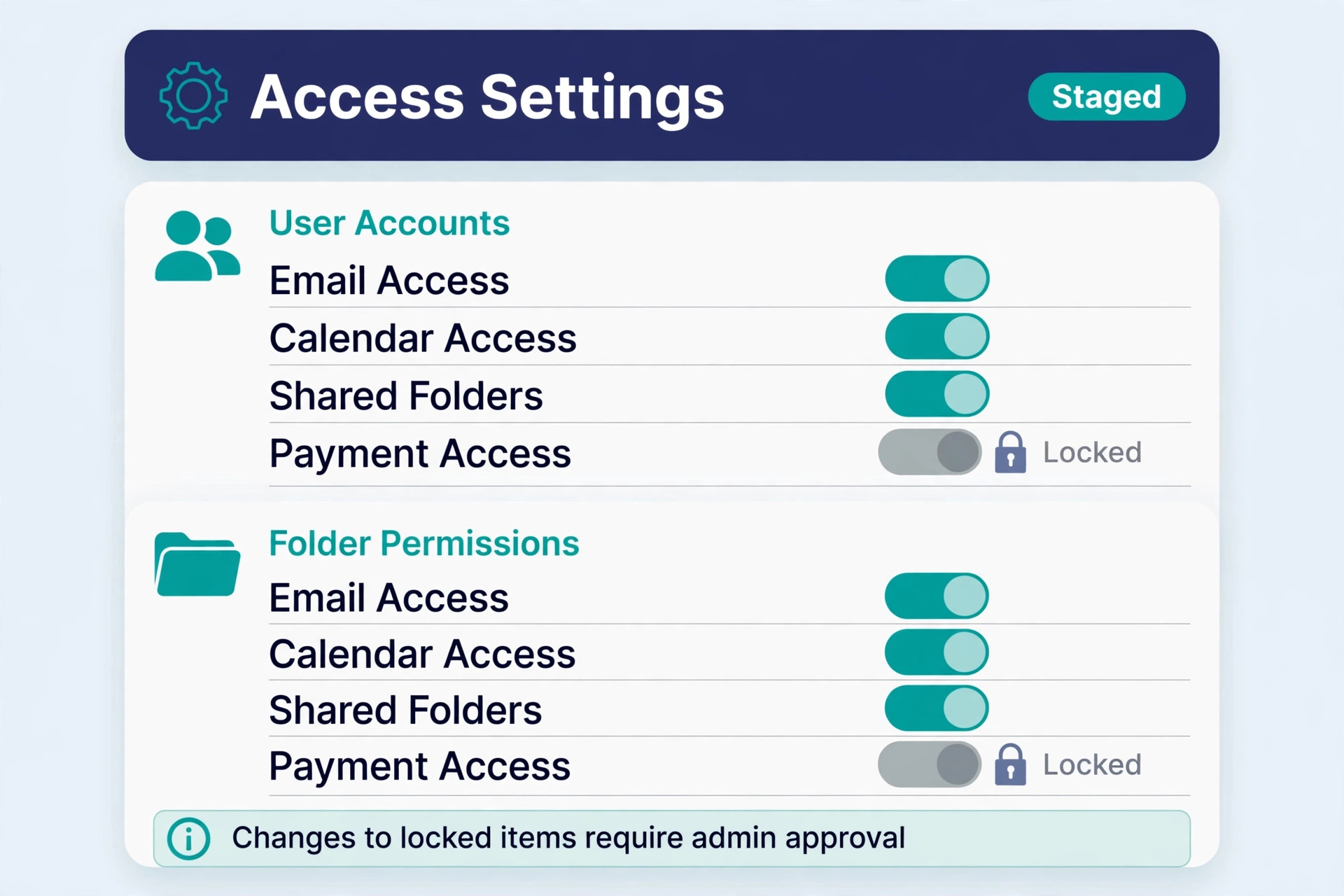
Access is where a first hire can quietly become a risk, so set it up in stages rather than handing over everything at once. The rule is simple. The assistant gets access only to the tools a current task needs, with their own login where the tool allows it, and with no shared passwords sent by email or chat. A password manager with shared folders is the practical way to do this, because you can grant access to one login, change it later, and remove it without changing passwords you use yourself.
If a tool does not support a separate login, consider whether the assistant truly needs that tool in the first month, or whether you can export the work instead.
Learning how to hire first virtual assistant small business owners can trust includes learning what not to share early. Do not share your main email password, your bank login, your payment processor admin access, or your personal accounts. For email, use delegation or a shared mailbox where possible, so the assistant can work in the inbox without holding your password. For social accounts, use role based access or a scheduling tool, so posting can be drafted and approved before anything goes live. For files, share a specific folder, not your whole drive, and set editing rights only where editing is part of the task.
A First Week Plan That Builds Trust Fast
The first week should be planned before the assistant starts, with one core task at a time and review built in, rather than a long list delivered on day one. A useful shape is to introduce one task on the first day, with a written guide and a short walkthrough, then let the assistant complete it while you review each result.
On the second and third days, add the second task in the same way, while the first task continues with review. By the end of the week, the assistant should be running two or three core tasks, with a short review meeting to discuss what worked, what was unclear, and what to add next. That planned start is a key part of how to hire first virtual assistant small business owners run well.
Daily communication in the first week should be short and predictable. A brief start of day note on priorities, and a brief end of day note on what was completed, what is waiting, and what needs a decision, is usually enough. Use one channel for routine updates and a different signal for urgent items, so urgent work is not buried in a long chat thread. Avoid checking in constantly through the day, because constant checking teaches the assistant to wait for permission, which is the opposite of the independence you are hiring for. Review the work, not the clock, and judge the week by completed outcomes and accuracy, not by how many messages were exchanged.
Set a clear end of week review, even if it is only thirty minutes. Cover three questions, which are what tasks are now running well, what parts of the guides need rewriting, and what task should be added next. Write the answers down, update the guides, and agree the priorities for week two. That review is also the moment to adjust hours if the audit estimate was wrong. If the core tasks take less time than expected, add the next task from your later group, rather than inventing filler work. If they take more time, check whether the guides are unclear or the task itself is larger than the audit suggested, before assuming the assistant is slow.

Managing, Feedback, and Measuring Whether It Is Working
Ongoing management for a part time assistant should be light, regular, and based on visible work. A short weekly check in, covering completed tasks, blockers, and next week priorities, is enough for most first hires. Keep a shared task list where work, deadlines, and status are visible to both of you, so progress does not depend on memory or chat history. When a task changes, update the list and the guide together, because a guide that no longer matches the task is worse than no guide, since it teaches the wrong routine with confidence. That light routine is a steady part of how to hire first virtual assistant small business owners keep working.
Measure the hire by time returned and work completed, not by hours logged alone. Once a month, compare the audit baseline with reality. How many hours of your week did the assistant actually take over, how many tasks were completed on time and to standard, and how many hours did you spend reviewing and correcting? If the time saved clearly exceeds the review time, and the work quality is steady, the hire is working.
If review time is eating the saving, narrow the tasks, rewrite the guides, or reduce hours until the balance improves. A small, well run hire that saves four reliable hours a week is worth more than a large hire that saves ten hours on paper and costs eight in supervision.
Mistakes That Turn a First Hire Into Extra Work
The most common mistake is hiring before the tasks are defined. An assistant hired to help generally will spend the first weeks waiting for instructions, and the owner will spend the same weeks feeling disappointed that help has not arrived. Define the tasks, write the guides, and then hire. The second mistake is handing over too much at once. Five new tasks in week one guarantee shallow learning and a long correction list. One or two tasks, learned well, build the foundation for the next five.
The third mistake is skipping the paid trial because a candidate interviewed well or came recommended. Recommendations help, but they describe work for someone else, with different tasks and standards. A short trial on your work is cheap insurance, and skipping it to save a few hours often costs far more in a bad first month. The fourth mistake is giving full access on day one out of convenience. Convenience at setup becomes risk at offboarding, and staged access costs very little extra time if the access list is written down from the start.
First Virtual Assistant Hiring Checklist
Use this checklist as the overview proof for the whole process, and work through it in order. Each item links to a section above, so the checklist is a summary, not a substitute for the preparation behind it.
1. Run a one week task audit, and sort tasks into hand off first, hand off later, and keep. 2. Total the hours for the first group, and set a starting weekly range from that total. 3. Choose a route, meaning direct hire, managed agency, or project start, and note why it fits. 4. Write a job post from the audit, with tasks as outcomes, tools, hours, time zone, and one application question. 5. Screen in stages, and keep notes on why each finalist was kept or removed.
Work through the first five items before the hire starts, and use the remaining items to run the first month well.
6. Run a paid trial on a real task, and score accuracy, completeness, communication, presentation, and judgment. 7. Agree the engagement in writing, covering rate, hours recording, payment day, and how either side can end it. 8. Set up staged access, with separate logins where possible, a password manager, and a written access list. 9. Plan the first week, with one core task at a time, daily short updates, and an end of week review. 10. Review monthly, comparing time saved against review time, and adjust tasks, guides, or hours accordingly.
Keep this checklist with the engagement note and the access list. When you hire a second assistant, the same checklist applies, with the task audit redone for the new role, because the second hire will usually take a different group of tasks. A checklist that is reused becomes a business asset. A checklist that is written once and filed away is just a document.
Frequently Asked Questions
How many hours a week should a first virtual assistant work?
Start from your task audit, not from a standard package. Many first hires work well in the range of five to ten hours a week, because that covers a small group of recurring tasks with room for review. If your first group totals only two or three hours, start smaller, or use a project, and grow hours as tasks are added. Growing from a working routine is easier than shrinking a large retainer that has no work to fill it.
Should I hire through an agency or directly for a first assistant?
It depends on how much screening time you can spare and how much choice you want. An agency suits owners who want matching and replacement handled for them. A direct hire suits owners who know the exact tasks and want to choose the person themselves. If you are unsure, a project start with a direct hire gives you a low commitment way to test the working relationship before committing to ongoing hours.
How do I know if a virtual assistant is doing good work?
Judge completed outcomes against the written brief, not message activity. Check accuracy, completeness, and timeliness on a schedule, sample the work once the routine is stable, and track time saved against review time each month. Good work looks like tasks completed to standard, problems flagged early, and guides improving over time, not like constant messages proving busyness.
What tasks should I never hand to a first virtual assistant?
Keep pricing decisions, contract sign off, final client commitments, and anything requiring your personal judgment or signature until trust and process are proven. Also keep tasks where a single mistake would cause serious financial or reputational harm and cannot be checked before it goes out. Those tasks can move to a later group once approval steps and checks are built in, but they are a poor starting point.
How much should I pay a first virtual assistant?
Set your ceiling from the value of the time returned, and research current rates for the skill and location you are hiring in, because rates vary widely and change over time. General administrative help and specialised help sit in different ranges, so compare like with like, and be wary of a rate far below the range for the skill you need. Pay figures in guides are illustrative for planning, not a promise about what any individual assistant will charge.
What do I do if the first hire does not work out?
Act early, be specific, and follow the written ending terms. Name the gap against the brief, give a short fair chance to correct it if the issue is process related, and end cleanly if the gap is about accuracy, reliability, or communication after that chance. Remove access promptly using your access list, pay for work completed, and keep the guides and task audit, so the next hire starts from a stronger position than the first one did.
The Verdict on a First Virtual Assistant Hire
A first virtual assistant hire pays off when it is treated as a small management project, not as a quick purchase. Audit the tasks, write the post from the audit, test on real work with a paid trial, stage the access, and plan a first week that builds trust one task at a time. Owners who follow that sequence usually find that the hardest part was not finding a person. It was deciding, clearly and in writing, what help actually looks like in their business.
Start small, review monthly, and grow the role from evidence. That is how to hire first virtual assistant small business help that stays useful beyond the first month, because the role grows from tasks that are real, guides that are tested, and a working relationship that has been proven on real work rather than promised in an interview. When the next task group is ready, you will already have the checklist, the access routine, and the review habit to add it without starting over.
More Reading on Stratilyze
– Best HR Software for Small Business Under 50 Employees – Best Time Tracking Software for Freelancers – Best CRM Software for Consultants – Automate Small Business with AI