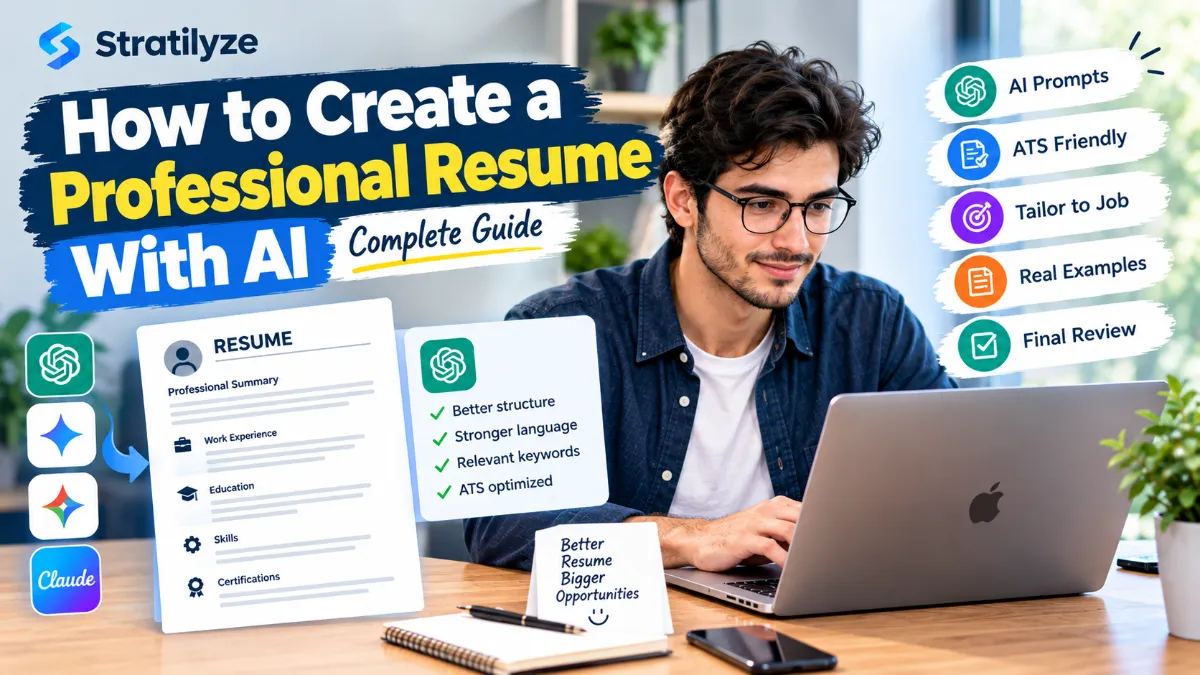
Creating a professional resume can take hours, especially when you are trying to turn a long list of jobs, skills, projects, and achievements into a document that is clear and relevant to a specific position.
AI can make that process much easier.
You can use AI to organize your experience, improve weak bullet points, write a professional summary, identify relevant skills, tailor your resume to a job description, check grammar, and create a cleaner final version. But there is an important difference between using AI to improve your resume and simply asking an AI tool to create an entire resume from scratch.
The best approach is to provide accurate information about your career and use AI as a writing and editing assistant. Your experience, accomplishments, qualifications, and career goals should remain the foundation of the resume.
This guide explains how to create a professional resume with AI, including what information to give an AI tool, which prompts to use, how to make your resume ATS-friendly, what mistakes to avoid, and how to review the final document before sending it to an employer.
Can AI Create a Professional Resume?
Yes. AI can help create many parts of a professional resume, including:
- Professional summaries
- Work experience bullet points
- Skills sections
- Career objective statements
- Project descriptions
- Achievement statements
- Resume headlines
- Job-specific keywords
- Resume formatting suggestions
- Grammar and spelling corrections
- Job-description analysis
- Resume tailoring
However, AI should not invent employment history, education, certifications, job titles, achievements, skills, or performance numbers.
For example, if you managed a team of five people, you can ask AI to describe that experience more professionally.
You should not ask AI to turn it into managing a team of 20 people simply because the larger number sounds more impressive.
A strong AI-assisted resume is accurate, specific, relevant, and easy to read.
Why Use AI to Create a Resume?
Writing a resume is partly a writing problem and partly a positioning problem.
You already know what you have done, but it can be difficult to decide which parts matter most for a particular job.
AI can help with that process.
1. It can turn rough notes into professional writing
Many people write things like:
Worked with customers and answered questions.
An AI tool can help turn that into something more polished:
Assisted customers with product questions, resolved common issues, and provided timely support to improve the overall customer experience.
The important information still comes from you. AI simply helps communicate it more clearly.
2. It can identify relevant keywords
Job descriptions often contain specific skills, tools, responsibilities, and qualifications.
For example, a marketing position might mention:
- SEO
- Google Analytics
- Content Strategy
- Email Marketing
- Social Media
- Conversion Optimization
AI can compare your existing resume with the job description and identify which relevant qualifications you already have.
3. It can help tailor your resume
One general resume may not be equally effective for every position.
A software developer applying for a backend role may want to emphasize APIs, databases, cloud services, and programming languages.
For a different position focused on frontend development, the same person may want to highlight JavaScript, React, UI development, and accessibility.
AI can help you reorganize and rewrite your existing information for each position without starting from zero.
4. It can improve clarity
AI is particularly useful when your resume contains long, repetitive, or unclear sentences.
You can ask it to:
- Remove unnecessary words
- Make bullet points more concise
- Replace weak verbs
- Improve grammar
- Reduce repetition
- Make descriptions more specific
- Use a professional tone
That can make a resume much easier for recruiters to scan.
Before You Ask AI to Write Your Resume
The quality of your AI-generated resume depends heavily on the information you provide.
Don’t start with:
“Write me a professional resume.”
That prompt is too vague.
Instead, collect your information first.
You should have the following details ready:
Contact Information
Include:
- Full name
- Phone number
- Professional email address
- City and state/country
- LinkedIn profile, if relevant
- Portfolio or personal website, if relevant
You generally do not need to include unnecessary personal information.
Work Experience
For every relevant position, collect:
- Company name
- Job title
- Employment dates
- Main responsibilities
- Important projects
- Achievements
- Tools and technologies used
- Measurable results, when available
Education
Include:
- Degree or qualification
- School, college, or university
- Graduation year, if relevant
- Relevant academic achievements
Skills
Make a list of skills that you actually have.
For example:
- Microsoft Excel
- Customer service
- Project management
- Python
- SEO
- Data analysis
- Graphic design
- WordPress
Certifications
Include relevant certifications, licenses, or professional training.
Projects
Projects can be particularly useful for:
- Students
- Recent graduates
- Career changers
- Freelancers
- Developers
- Designers
- Researchers
Describe what you built or contributed to, the tools you used, and the result.
Step 1: Choose the Job You Want
Before creating your resume, identify the position you are targeting.
Your resume should answer a simple question:
Why are you a good fit for this particular job?
For example, don’t create a generic resume for “marketing.”
Choose a more specific target such as:
- SEO Specialist
- Content Marketing Specialist
- Digital Marketing Manager
- Social Media Manager
- Marketing Coordinator
The more clearly you understand the target position, the easier it becomes to decide what belongs on your resume.
Step 2: Give AI Your Real Career Information
Now you can provide the AI tool with your information.
You don’t have to make it sound professional first.
Raw notes are fine.
For example:
Worked at ABC Company from 2023 to 2026.
Answered customer questions.
Managed email requests.
Used Excel every day.
Helped train two new employees.
Created weekly reports.
Reduced response time after changing the email process.
That’s enough information for AI to start helping.
A useful prompt
I am creating a resume for a Customer Support Specialist position. Below is my actual work experience. Rewrite it into concise, professional resume bullet points. Do not invent information, numbers, responsibilities, tools, or achievements. Focus on customer service, communication, problem-solving, reporting, and process improvement where supported by my information.
Then paste your experience.
This is much better than asking AI to invent a career history.
Step 3: Write a Strong Professional Summary
Your professional summary appears near the top of the resume.
It should quickly communicate:
- Who you are
- Your main area of experience
- Your strongest relevant skills
- What type of role you are targeting
A weak summary might say:
Hardworking professional looking for a challenging opportunity where I can grow and use my skills.
This doesn’t tell an employer much.
A stronger version might be:
Customer support professional with three years of experience handling customer inquiries, resolving service issues, preparing reports, and supporting day-to-day operations. Skilled in communication, problem-solving, Excel, and customer relationship management.
The second version provides actual information.
AI prompt for a professional summary
Write three professional resume summaries based only on the information below. Keep each summary between 50 and 70 words. Make them specific to the target job. Avoid clichés such as “hardworking,” “passionate,” “results-driven,” and “team player” unless the information genuinely supports them. Do not invent qualifications or achievements.
This gives you several options while keeping the content grounded in your actual background.
Step 4: Turn Responsibilities Into Achievement-Focused Bullet Points
This is one of the most useful ways to use AI when creating a resume.
Many resumes simply list responsibilities.
For example:
Responsible for managing social media accounts.
That’s not terrible, but it doesn’t tell the reader much.
If your real experience supports it, a stronger version could be:
Managed daily social media content across multiple platforms, coordinating posts, audience engagement, and performance reporting.
The goal isn’t to make every sentence sound complicated.
The goal is to make your contribution clear.
Use the Action + Task + Result Formula
A useful structure is:
Action + what you did + result
For example:
Created weekly sales reports in Excel, helping the management team track monthly performance.
Or:
Coordinated customer support requests through email and phone, helping maintain timely responses to customer questions.
You don’t need a numerical result for every bullet.
But when you have a real number, it can make the achievement more concrete.
For example:
Reduced average customer response time by 25% by reorganizing the support email workflow.
Only use numbers you can verify.
Step 5: Ask AI to Improve Weak Resume Bullets
You can give AI one bullet point at a time.
For example:
Original: Made reports for the manager.
Prompt:
Improve this resume bullet for a business operations position. Make it concise and professional. Focus on the action and business value. Do not invent numbers or achievements.
The result might be:
Prepared regular operational reports for management to support performance tracking and decision-making.
This is a much safer use of AI than asking it to create achievements you never had.
Step 6: Tailor Your Resume to the Job Description
This is one of the most important steps.
Take the job description and compare it with your resume.
AI can help identify:
- Required skills you already have
- Important job titles
- Technical tools
- Industry terminology
- Responsibilities that match your experience
- Qualifications that may need more emphasis
Use this AI prompt
Compare my resume with the job description below. Identify the most important skills, qualifications, tools, responsibilities, and keywords from the job description. Then show me which ones are already supported by my resume and which relevant areas I may be under-emphasizing. Do not recommend adding skills I do not actually have.
This keeps the process focused on truthful optimization.
Step 7: Make Your Resume ATS-Friendly
Many employers use applicant tracking systems, or ATS software, to process resumes before recruiters review them. Current resume guidance recommends straightforward formatting, standard section headings, relevant keywords, and readable file formats.
An ATS-friendly resume should generally be easy for software and humans to read.
Use standard section headings
Good examples include:
- Professional Summary
- Work Experience
- Education
- Skills
- Certifications
- Projects
Avoid overly creative alternatives that may make the document harder to interpret.
Keep the layout simple
A clean, single-column layout is usually a safer choice for ATS compatibility.
Avoid relying heavily on:
- Text boxes
- Complex tables
- Decorative graphics
- Charts
- Skill bars
- Large icons
- Important information inside headers or footers
Current ATS guidance also recommends avoiding layouts that can cause information to be parsed incorrectly.
Your resume does not need to look like a magazine.
It needs to communicate your qualifications quickly and clearly.
Step 8: Use Job Description Keywords Naturally
Suppose the job description says:
Experience with project management, Microsoft Excel, reporting, stakeholder communication, and process improvement.
If you genuinely have those skills, your resume should use the same terminology where appropriate.
For example:
Skills
- Project Management
- Microsoft Excel
- Reporting
- Stakeholder Communication
- Process Improvement
And your experience section can demonstrate those skills through actual work.
Don’t copy every keyword into your resume just to match an ATS.
Keyword stuffing can make your resume sound unnatural and may actually make it harder for a recruiter to understand.
The goal is relevance, not repetition.
Step 9: Ask AI to Check Your Resume Against the Job
After creating your first draft, give AI both documents:
- Your resume
- The job description
Then use a prompt such as:
Review my resume against this job description. Identify the five strongest matches, the five most important gaps, unclear sections, unnecessary content, and keywords I should consider using if they accurately describe my experience. Do not invent qualifications. Then suggest specific edits to improve the resume.
This turns AI into a resume reviewer instead of simply a resume writer.
Step 10: Improve Your Skills Section
A common mistake is creating a huge skills section containing everything you have ever used.
Instead, prioritize skills relevant to the position.
For example, a digital marketing resume might include:
Digital Marketing Skills
- SEO
- Content Strategy
- Google Analytics
- Keyword Research
- Email Marketing
- Social Media Marketing
- Conversion Optimization
If the position is focused on SEO, SEO-related skills should receive more attention than unrelated abilities.
Ask AI to organize your skills
Organize the following skills into logical categories for a professional resume. Prioritize skills relevant to a Digital Marketing Specialist position. Do not remove a skill unless it is irrelevant or redundant.
This can make a long list much easier to understand.
Step 11: Create a Resume for Career Changers
AI can be especially useful if you are changing careers.
Imagine someone moving from customer service into digital marketing.
Their previous job may not have included “Digital Marketing Specialist” in the title, but they may have relevant experience with:
- Customer communication
- Social media
- Content creation
- Reporting
- CRM software
- Email communication
- Data analysis
AI can help identify transferable skills and present them clearly.
Career-change prompt
I am changing careers from [current field] to [target field]. Analyze my experience and identify transferable skills that are relevant to the target position. Suggest honest ways to describe those skills on my resume. Do not claim that I have experience I do not have.
This can help you see connections between your existing experience and a new career direction.
Step 12: Create a Resume for Students or Recent Graduates
If you don’t have much professional experience, don’t ask AI to make your resume look like you have ten years of experience.
Instead, give it information about:
- Education
- Projects
- Internships
- Volunteer work
- Coursework
- Student organizations
- Freelance work
- Certifications
- Relevant technical skills
For example, a computer science graduate could highlight a university project:
Developed a web-based inventory management application using Python, SQL, and JavaScript as part of a final-year project.
The project can demonstrate practical skills even without full-time employment.
Step 13: Use AI to Improve Your Resume’s Language
Once your content is accurate, ask AI to edit the language.
A useful prompt is:
Proofread my resume for grammar, spelling, clarity, consistency, and professional tone. Keep my meaning and facts unchanged. Remove unnecessary words and repetitive phrases. Do not add new achievements or qualifications.
This is a simple but powerful final editing step.
Step 14: Don’t Let AI Make Your Resume Sound Like AI
This is an easy mistake to make.
AI-generated writing can sometimes become overly polished and repetitive.
Watch for phrases such as:
- Results-driven professional
- Dynamic self-starter
- Proven track record
- Passionate professional
- Strategic thinker
- Highly motivated individual
These aren’t automatically bad, but using too many generic phrases can make your resume less distinctive.
Your resume should sound like a clear description of your professional experience, not a collection of corporate buzzwords.
Try this prompt
Rewrite these resume bullets in clear, natural professional English. Make them specific and concise. Avoid corporate clichés, exaggerated claims, unnecessary adjectives, and repetitive sentence structures. Keep every fact accurate.
Step 15: Create a Clean Resume Layout
Content comes first, but presentation still matters.
A professional resume should generally have:
- Clear section headings
- Consistent spacing
- Consistent font sizes
- Easy-to-read typography
- Logical ordering
- Strong visual hierarchy
- Enough white space
- Consistent date formatting
For many job applications, a simple one-column layout is a safer option than a highly designed template.
Resume file format
If the employer gives specific instructions, follow them.
If no format is specified, a DOCX file or text-based PDF is commonly recommended for ATS-friendly applications.
Don’t upload an image of your resume when the application expects a document.
A Simple Professional Resume Structure
A straightforward structure can look like this:
Your Name
City, State/Country | Phone | Email | LinkedIn
Professional Summary
Two to four sentences describing your experience, strengths, and target role.
Work Experience
Job Title – Company Name
Location | Dates
- Achievement or responsibility
- Achievement or responsibility
- Achievement or responsibility
- Relevant tool, process, or result
Education
Degree or Qualification – Institution
Location | Graduation Year
Skills
- Relevant skill
- Relevant skill
- Relevant skill
- Relevant skill
Certifications
- Certification name
- Certification name
Projects
Project Name
- What you created or contributed to
- Tools or technologies used
- Relevant outcome
You don’t necessarily need every section. Choose sections that strengthen your application.
5 AI Prompts You Can Copy
Here are practical prompts you can use with ChatGPT or another AI writing tool.
Prompt 1: Build a First Draft
Create a professional resume based only on the information I provide below. Target the resume to the [JOB TITLE] position. Use clear, concise bullet points and standard resume sections. Do not invent any experience, qualifications, tools, achievements, dates, or numbers. Ask me for missing information instead of making it up.
Prompt 2: Improve Work Experience
Rewrite these work experience bullet points for a [JOB TITLE] position. Make them concise, specific, and achievement-focused. Start bullets with strong action verbs where appropriate. Keep all facts, numbers, responsibilities, and tools accurate. Do not exaggerate my experience.
Prompt 3: Tailor to a Job Description
Compare my resume with the following job description. Identify the most relevant skills, responsibilities, and keywords. Then suggest specific edits to my resume that improve relevance while remaining completely truthful. Do not add skills or experience that I do not have.
Prompt 4: Check ATS Compatibility
Review this resume for ATS compatibility. Check the section headings, formatting, keyword usage, readability, file structure, and potential parsing problems. Suggest improvements without adding false information.
Prompt 5: Final Resume Review
Act as a professional recruiter reviewing this resume for a [JOB TITLE] position. Identify the strongest parts, weakest parts, unclear statements, unnecessary information, missing relevant details, and opportunities to improve the resume. Give specific recommendations and do not invent information.
How to Use ChatGPT to Create a Resume
ChatGPT can be useful for the entire resume workflow.
Instead of asking it to produce a finished resume immediately, use a multi-step process.
Step 1: Provide your background
Give it your:
- Work history
- Education
- Skills
- Projects
- Certifications
- Achievements
Step 2: Add the target job
Paste the job description.
Step 3: Ask for a gap analysis
Ask AI to compare your experience with the job requirements.
Step 4: Rewrite relevant sections
Improve your summary and experience bullets.
Step 5: Check the final document
Ask AI to look for:
- Grammar mistakes
- Repetition
- Weak wording
- Missing information
- Unclear achievements
- ATS issues
Step 6: Review everything yourself
This final step matters.
AI should assist with your resume, but you remain responsible for the information you submit.
AI Resume Example: Before and After
Here’s a simple example.
Before
Worked in sales. Talked to customers. Made reports. Helped the sales team.
After
Supported daily sales operations by assisting customers, preparing performance reports, and coordinating with the sales team to address customer needs and maintain accurate sales information.
The second version is clearer without inventing a sales number or claiming responsibilities that were never provided.
If you actually increased sales by a measurable amount, you could make it more specific.
For example:
Supported daily sales operations and contributed to a 15% increase in monthly sales through improved customer follow-up.
But only use that version if the 15% figure is real and you can support it.
Common AI Resume Mistakes to Avoid
AI can save time, but it can also create problems if you use it without reviewing the output.
1. Inventing experience
Never let AI create fake jobs, projects, certifications, or achievements.
2. Adding fake numbers
AI may turn a general statement into a specific metric.
For example:
Improved customer satisfaction significantly.
should not automatically become:
Increased customer satisfaction by 35%.
Unless you actually know that number.
3. Copying the job description
Your resume should demonstrate that you have the required skills, not simply repeat the employer’s advertisement.
4. Keyword stuffing
Repeating the same keyword dozens of times makes the document unnatural.
5. Using a complicated design
A visually impressive resume can still create parsing problems.
6. Writing a generic resume for every job
Different positions emphasize different skills.
Tailoring matters.
7. Letting AI change your facts
Dates, job titles, company names, qualifications, and responsibilities should always be checked manually.
8. Using too much text
A resume is not your complete career history.
Keep the content relevant.
9. Using generic AI language
Your resume should communicate what you actually did, not what an AI thinks a “successful professional” sounds like.
10. Skipping the final human review
AI can miss context, misunderstand abbreviations, and make subtle factual errors.
Always read the final resume yourself.
Should You Put AI Skills on Your Resume?
Only if you actually have relevant AI experience or skills.
For example, if you regularly use AI tools for content creation, data analysis, automation, research, or customer support, you can mention the relevant tools or workflows when they are useful for the position.
You could list:
- Generative AI
- AI-assisted content creation
- Prompt writing
- AI workflow automation
- ChatGPT
- Google Gemini
- AI research tools
But don’t add “AI expert” simply because you used ChatGPT to write your resume.
The skill should be relevant and supported by your actual experience.
How to Make Your Resume More Professional With AI
The biggest improvement usually doesn’t come from asking AI to “make my resume professional.”
Instead, use AI for specific tasks.
A better workflow is:
Your experience → AI organization → AI editing → Job matching → ATS review → Human review
This keeps your actual career history at the center.
For example:
- Write down everything you actually did.
- Remove irrelevant information.
- Give the remaining information to AI.
- Ask AI to turn it into concise bullet points.
- Add the target job description.
- Identify relevant keywords.
- Tailor the resume.
- Check the formatting.
- Proofread it yourself.
- Save the final version in the required format.
This approach is much more reliable than generating a resume with one prompt.
A 10-Minute AI Resume Workflow
If you already have your career information organized, you can use this quick process.
Minute 1-2: Choose the target job
Identify the exact position you are applying for.
Minute 3: Collect the job description
Copy the full job posting into your AI tool.
Minute 4-5: Analyze the match
Ask AI to identify the most important qualifications and keywords.
Minute 6-7: Improve your resume
Rewrite only the relevant sections.
Minute 8: Check ATS formatting
Look for tables, graphics, unusual headings, and other potential parsing problems.
Minute 9: Proofread
Check every date, company name, job title, number, skill, and achievement.
Minute 10: Save and review
Read the entire resume as if you were the hiring manager.
Ask yourself:
Can someone understand what I can do within a few seconds?
If the answer is yes, your resume is moving in the right direction.
AI Resume vs. Traditional Resume Writing
| Task | Without AI | With AI |
|---|---|---|
| Organizing experience | Manual | AI can help structure notes |
| Writing bullet points | Manual | AI can rewrite and refine |
| Grammar checking | Manual/tools | AI can review quickly |
| Job description analysis | Manual | AI can identify themes and keywords |
| Resume tailoring | Time-consuming | AI can suggest targeted edits |
| Finding repetitive content | Manual | AI can identify repetition |
| Final fact checking | Required | Still required |
| Career judgment | Human | Human |
The important point is that AI does not replace your judgment.
It reduces some of the repetitive writing and analysis work.
What AI Should Not Do for Your Resume
There are some things you should keep under your control.
Your facts
You should decide what you actually did.
Your career goals
AI can suggest options, but you know which jobs you want.
Your achievements
Only you can confirm whether a result or number is accurate.
Your final application
You should review the resume before sending it.
Your personal voice
A resume doesn’t need to sound casual, but it should still feel authentic.
Frequently Asked Questions
Can I use ChatGPT to create my resume?
Yes. ChatGPT can help organize your experience, write and improve bullet points, create professional summaries, compare your resume with job descriptions, and suggest revisions. The information should come from your real experience, and you should review the final version carefully.
Is it okay to use AI to write a resume?
Yes, as long as the final resume accurately represents your qualifications and experience. AI is best used as a writing, editing, and tailoring assistant rather than a tool for creating fictional achievements.
Can AI make my resume ATS-friendly?
AI can review your resume for common ATS-related issues such as unclear headings, excessive formatting, missing relevant keywords, and difficult-to-read sections. However, no AI tool can guarantee that a resume will pass every employer’s screening system.
What is the best AI prompt for creating a resume?
A good prompt should include the target job, your actual experience, your skills, and clear instructions not to invent information. Giving AI specific context generally produces much better results than simply asking it to “write a professional resume.”
Should I use a resume template?
A simple, professional template can make your resume easier to read. For online applications, prioritize clean formatting and ATS compatibility over decorative design.
Should I include a photo on my resume?
Whether you should include a photo depends on the country, industry, employer, and application requirements. For many U.S. job applications, a professional resume normally does not require a photo. Follow the employer’s instructions and local hiring conventions.
How long should a professional resume be?
There is no single length that works for every candidate. A concise resume that highlights the most relevant experience is generally more useful than a long document filled with unrelated information. Your experience level, industry, and target position should determine how much information you include.
Can AI tailor my resume for every job?
Yes. AI can compare your resume with different job descriptions and suggest changes to emphasize relevant experience and skills. You should still review each version to make sure every statement is accurate.
Final Thoughts
Learning how to create a professional resume with AI is less about getting a chatbot to write everything for you and more about using AI intelligently throughout the resume-building process.
Start with your real experience.
Then use AI to organize it, improve the language, identify relevant skills, tailor your content to the target job, and check the final document for clarity.
Most importantly, don’t let AI turn your resume into a collection of exaggerated claims and generic corporate phrases.
A strong resume should make it easy for an employer to understand what you have done, what you can do, and why your experience is relevant to the position.
Use AI to make that message clearer. Don’t use it to create a career that isn’t yours.
Read More – How to Use AI to Write Better Emails | 10 Practical Tips