
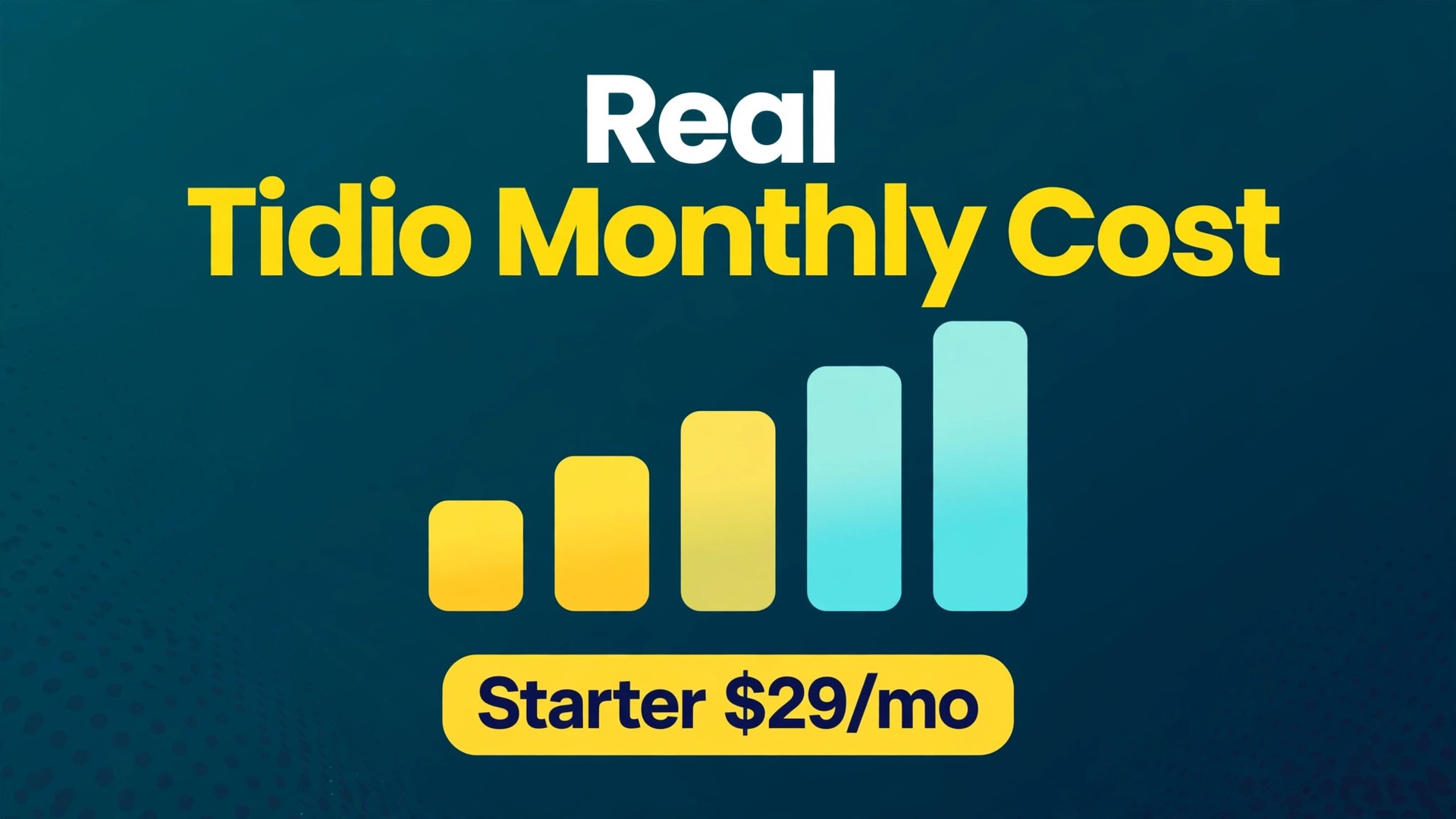
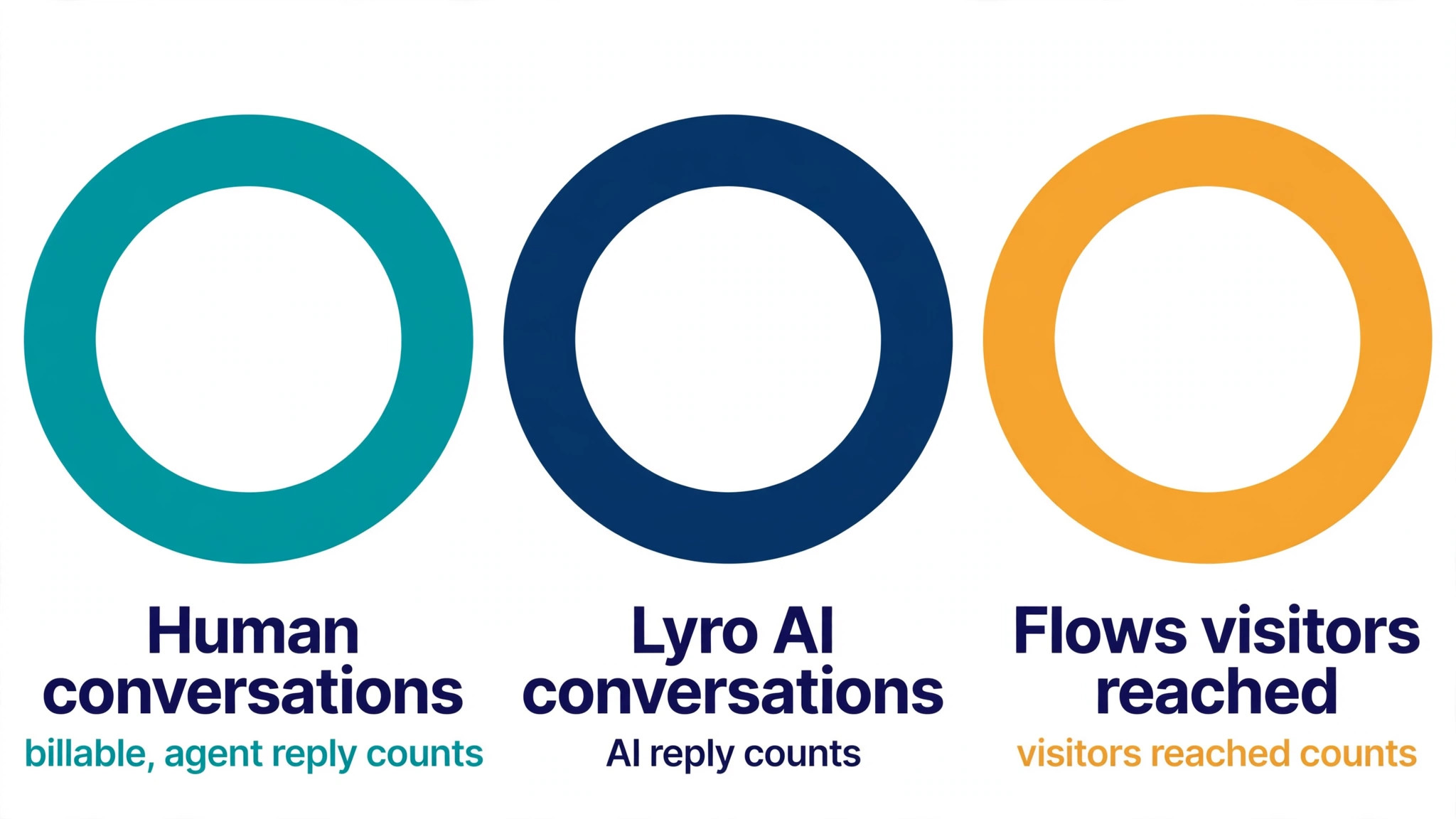
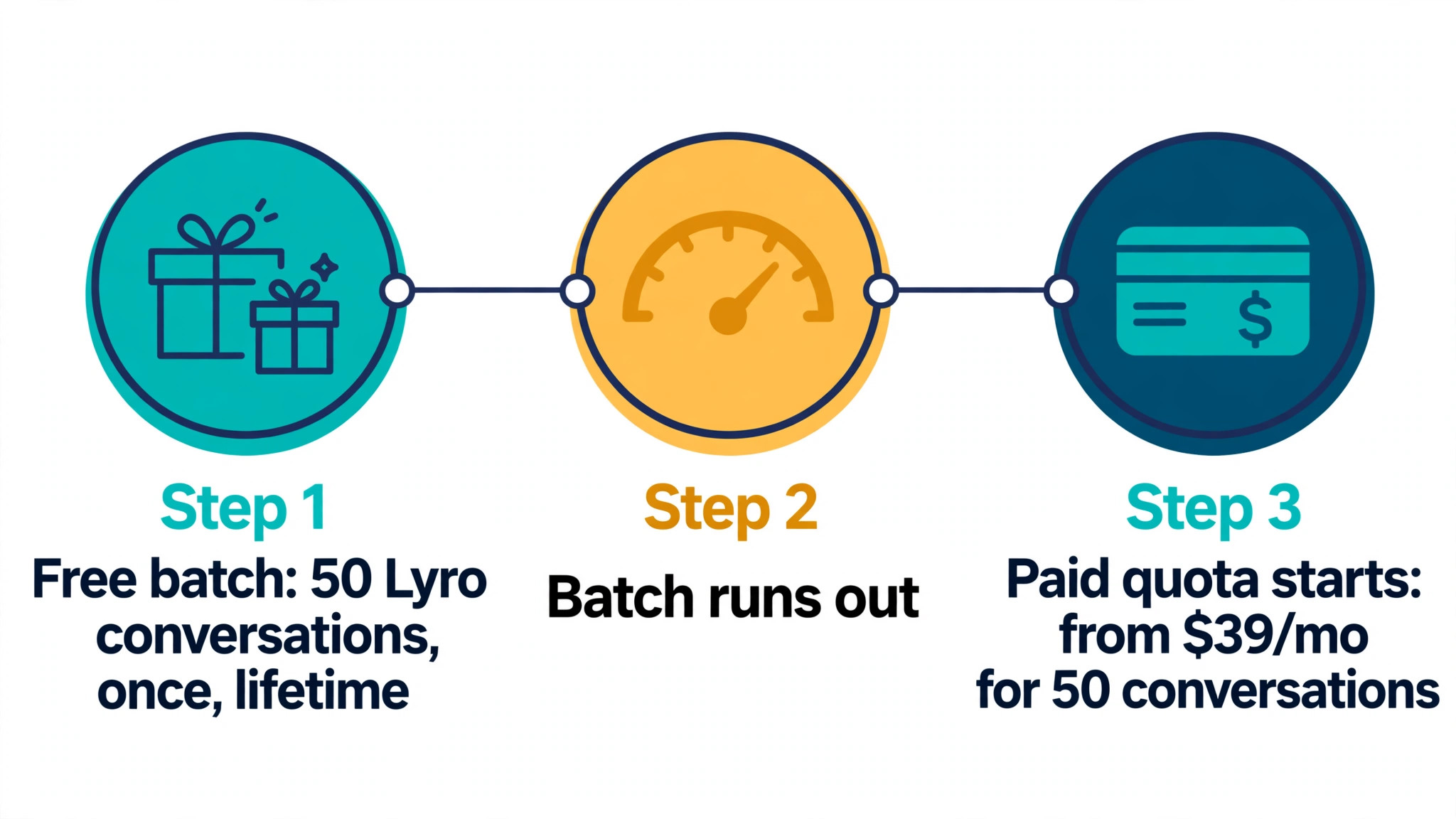
Fifty is the number that explains most Tidio billing surprises. A new account gets 50 billable conversations a month on the free plan, 50 Lyro AI conversations once for the lifetime of the account, and 100 visitors reached with Flows automations. Those three fifties look generous on a pricing page, and they are generous for a test week, but the cost of Tidio for small business monthly is set by what happens after that week.
They are not a monthly allowance for a trading business, because the Lyro batch does not refresh, the free conversation cap is small, and a busy first week can use all three allowances before the owner has learned how the tool works. That gap between a free trial and a real month is where the cost of Tidio for small business monthly budgets starts, and it is the reason this guide prices three meters instead of one subscription.
Tidio combines live chat, ticketing, and multichannel messaging with an AI agent called Lyro and a visual automation builder called Flows. The platform suits small shops and service businesses that want chat on their website without paying per agent seat, because self-serve plans include up to 10 seats. The pricing catch is that Tidio bills human conversations, AI conversations, and automation reach separately, so a business that only budgets the headline plan price will miss two of the three lines on the real bill.
Prices below come from pricing guides that cite the vendor pricing page in September and October 2026. Confirm the live pricing page before you pay, because Tidio changes conversation rungs and Lyro quotas from time to time, and because annual billing is described as two months free rather than as a percentage discount.
What the Cost of Tidio for Small Business Monthly Includes
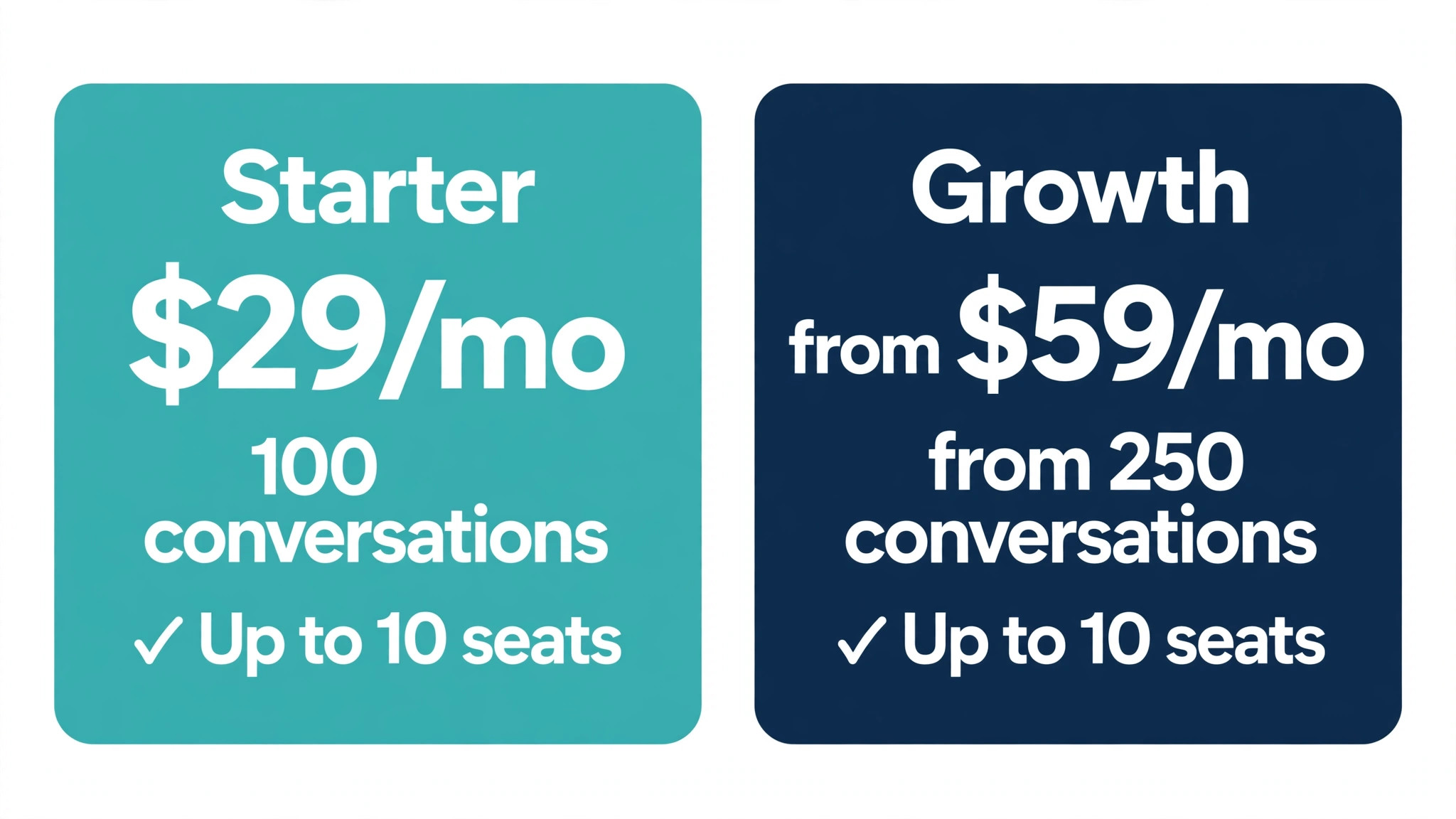
Tidio sells its customer service platform in five tiers. Free, Starter, and Growth carry published prices. Plus starts from 300 dollars a month plus usage, and Premium is priced by quote. Every paid plan is billed per month, and annual billing gives two months free, which means an annual buyer pays for ten months and receives twelve. That structure makes the annual equivalent easy to calculate. Divide the monthly price by twelve and multiply by ten, or simply take five sixths of the monthly price.
A billable conversation is the first meter, and it is defined precisely. It is any chat, ticket, email, or social media conversation that includes a reply from a human agent. Unanswered messages and spam that the team ignores do not count, and many messages inside one thread count as one conversation. Replies from Lyro and Flows do not count as agent replies, so they use their own quotas instead. That definition is good news for a team that receives many messages it never answers, and it is the reason a business should count human replied conversations, not total messages, when sizing a plan.
A Lyro conversation is the second meter. It is any conversation with at least one Lyro reply, billed per conversation, not per message. If Lyro replies a dozen times to solve one query, it still counts as one conversation, and nothing is deducted if Lyro hands straight over to a human without replying. That per conversation model is fairer than per message billing, but it still means a busy AI month costs a separate quota on top of the customer service plan. The 50 Lyro conversations on a free or Starter account are a lifetime batch, not a monthly allowance, so a business that leans on AI must buy a monthly Lyro quota once that batch runs out.
Flows visitors are the third meter. Flows are rule based automations that reach visitors proactively, and they are counted by visitors reached. The free allowance covers 100 visitors, and a paid Flows allowance starts at 29 dollars a month for 2,000 visitors, according to pricing guides checked in October 2026. A business that uses popups, proactive chat prompts, or automated offers widely will use Flows heavily, while a business that only answers incoming chats may never need a paid Flows allowance. Any complete estimate of the cost of Tidio for small business monthly use must include Flows where automations are planned, because a Flows line left out of the budget is a bill that arrives anyway.
Published Plans and Prices
The table below states the customer service plan prices first, because those are the headline figures most buyers compare. Lyro and Flows prices follow in the next table, because they are separate lines that must be added to the plan price for a true monthly total.
| Plan | Monthly billing | Annual billing equivalent per month | Billable conversations a month | Seats |
|---|---|---|---|---|
| Free | 0 dollars | 0 dollars | 50 | Up to 10 |
| Starter | 29 dollars | About 24.17 dollars | 100 | Up to 10 |
| Growth | From 59 dollars | From about 49.17 dollars | From 250 | Up to 10 |
| Plus | From 300 dollars plus usage | Custom | Custom | Custom |
| Premium | Priced by quote | Custom | Custom | From 3,000 Lyro conversations |
Growth is priced by conversation volume, not by a single flat price, and the steps matter for budgeting. On monthly billing, Growth costs 59 dollars for 250 billable conversations, 89 dollars for 400, 129 dollars for 600, 159 dollars for 800, 179 dollars for 1,000, 249 dollars for 1,500, and 349 dollars for 2,000, according to pricing guides checked in October 2026. Above 2,000 billable conversations, Tidio asks the buyer to contact sales for Plus. A business that grows from 250 to 1,000 conversations will therefore pay three times the Growth starting price, even though it has not changed tier, and that step pattern should be planned for in advance.
Lyro quotas are priced separately, and the steps are steep. On monthly billing, a Lyro quota costs 39 dollars for 50 conversations, 350 dollars for 500 conversations, and 700 dollars for 1,000 conversations, according to pricing guides checked in October 2026. On annual billing, those quotas work out at about 32.50 dollars, 291.67 dollars, and 583.33 dollars a month respectively.
There is no small Lyro step between 50 and 500 conversations published as a standard rung in those guides, so a business that needs 200 Lyro conversations a month must budget for the 500 conversation quota, not for a 200 conversation price that does not exist. That gap is one of the largest hidden costs in this guide, and it should be checked on the live pricing page before any AI budget is set.
Premium deserves a separate note, because it changes the AI billing model. Premium starts from 3,000 Lyro conversations, carries a guaranteed 50 percent Lyro resolution rate, and is the only plan with pay per resolution billing. On every self-serve plan, Lyro is billed per conversation whether it resolves the query or not. A business that wants to pay only when AI actually resolves a query must therefore reach Premium volume and pricing, which is a sales conversation, not a self-serve upgrade. That distinction belongs in every estimate of the cost of Tidio for small business monthly AI spending, because a buyer who assumes pay per resolution applies to all plans will understate the self-serve AI bill.
Real Monthly Cost by Team Size
Self-serve Tidio plans include up to 10 seats, so team size affects the conversation volume a business handles more than the seat count itself. A 25 seat team cannot stay on a self-serve plan, because the seat cap is 10, and must move to Plus with custom limits and seats. The table below pairs each team size with a conversation volume and a tier that fits, and it shows the plan price before Lyro and Flows, because those lines vary by AI and automation use. Add the Lyro and Flows columns for a true total, and never budget the plan price alone if AI is part of the plan.
| Team size | Assumed billable conversations a month | Fitting tier | Monthly billing for plan only | Annual billing equivalent per month for plan only | Add-ons to add for a true total |
|---|---|---|---|---|---|
| 2 seats | 100 | Starter | 29 dollars | About 24.17 dollars | Lyro quota from 39 dollars a month, Flows from 29 dollars a month |
| 5 seats | 250 | Growth | 59 dollars | About 49.17 dollars | Lyro quota from 39 dollars a month, Flows from 29 dollars a month |
| 10 seats | 1,000 | Growth | 179 dollars | About 149.17 dollars | Lyro quota up to 700 dollars a month, Flows from 29 dollars a month |
| 25 seats | Over 2,000 | Plus | From 300 dollars plus usage | Custom | Lyro and Flows by quote, branding removal as a paid extra |
Branding removal is a paid extra on Tidio, according to pricing guides, though the exact price is not published as a standard line in those guides, so a business that wants a clean widget without Tidio branding should confirm that price before budgeting. It is a small line beside Lyro, but it is still a line, and a business that forgets it will find the widget carries branding until the extra is paid.
When you total the cost of Tidio for small business monthly budgets, list branding removal beside Lyro and Flows, so no small line is left to surprise the invoice. Taxes are also excluded from the headline figures in pricing guides, so a buyer should confirm the tax treatment in its region before comparing Tidio with a rival that quotes tax inclusive prices.
Annual totals for the plan only, on annual billing, are about 290 dollars for the two seat model, about 590 dollars for the five seat model, and about 1,790 dollars for the ten seat model. Those totals exclude Lyro, Flows, branding removal, and taxes, so they are floors, not totals, for any business that uses AI or automations. A ten seat business that adds a 500 conversation Lyro quota on annual billing adds about 291.67 dollars a month, taking the true monthly equivalent to about 440.84 dollars before Flows. That single addition more than doubles the plan price, which is why Lyro must be priced before the plan is chosen, not after.
The 25 seat row carries no invented total, because Plus pricing starts from 300 dollars plus usage and the final figure depends on conversation volume, Lyro volume, and seat count. A 25 seat business should request a Plus quote with its real monthly conversation counts, including human and AI splits, rather than budgeting from the 300 dollar starting figure. That starting figure is a floor for a larger team, not a price for a 25 seat operation, and treating it as a total would understate the bill by a wide margin.
A Five Agent Team Worked Out in Conversations and Dollars
A five agent team that answers 1,000 conversations a month by hand and lets Lyro answer another 1,000 shows the full Tidio bill clearly. On monthly billing, Growth for 1,000 billable conversations costs 179 dollars, and a 1,000 conversation Lyro quota costs 700 dollars, giving a combined total of 879 dollars a month, according to pricing guides that checked the vendor calculator in October 2026.
On annual billing, the same combination works out at about 732.50 dollars a month, because Growth at 1,000 conversations is about 149.17 dollars on annual billing and the Lyro quota is about 583.33 dollars. Those two figures, 879 dollars billed monthly and 732.50 dollars billed annually, are the most useful totals in this guide for a team that uses AI heavily, because they show both the plan and the AI line together.
Compare that team with a team that answers the same 1,000 conversations by hand but uses no AI. That team pays 179 dollars a month on monthly billing, or about 149.17 dollars on annual billing, for Growth alone. The difference between the two teams is 700 dollars a month on monthly billing, which is the Lyro quota, not a difference in chat quality or seat count. That comparison forces a hard question.
Does Lyro resolve enough conversations, or save enough agent time, to justify 700 dollars a month on top of the plan, or would the same money hire more agent hours? A team that cannot answer that question with resolution and time data should not buy the 1,000 conversation quota. It should start with the 50 conversation quota, measure resolution, and scale only when the data supports it.
A smaller team shows the same logic at a lower scale. A two seat shop on Starter at 29 dollars a month with 100 billable conversations that adds a 50 conversation Lyro quota at 39 dollars a month pays 68 dollars a month in total, more than double the plan price alone. That total is still modest, but the ratio matters, because it shows that AI can cost more than chat itself even at small scale.
For that shop, the cost of Tidio for small business monthly use is really two bills, one for chat and one for AI, and the AI bill should be justified on its own before it is added. A shop that buys Lyro before it has 100 human conversations a month to learn from is paying for AI before it has the volume to justify it, and should wait until human conversations show a clear pattern of repeat questions that AI can answer well.
A ten seat team at 2,000 billable conversations shows the top of self-serve Growth. Growth at 2,000 conversations costs 349 dollars a month on monthly billing, or about 290.83 dollars on annual billing. Add a 500 conversation Lyro quota at 350 dollars a month, and the total reaches 699 dollars a month on monthly billing, before Flows. That team is close to Plus territory, and should compare Plus pricing, with its lower per conversation rates, against the self-serve total, because Plus can become cheaper once volume passes a certain point, even though it starts from 300 dollars plus usage.

The Auto Upgrade Trap and Other Limits
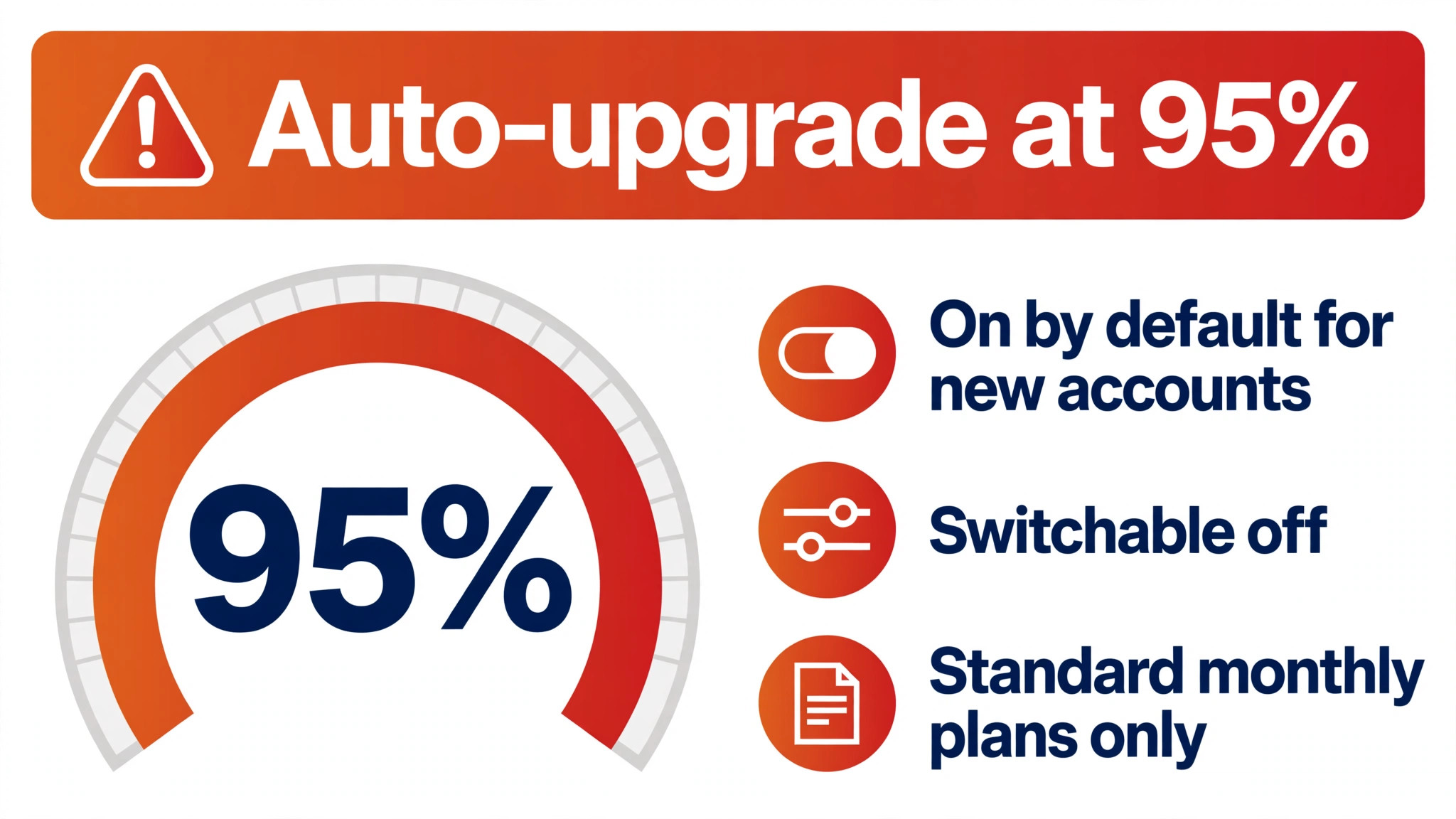
On standard monthly plans, Tidio automatically upgrades the conversation tier when an account reaches 95 percent of its allowance, according to pricing guides, and that setting is on by default for new accounts. It can be switched off, but a buyer who does not know it exists will find the bill rising automatically in a busy month. Annual and Plus plans do not auto upgrade in the same way, which is another reason to check the billing settings on day one. The auto upgrade is not dishonest, because it prevents conversations from stopping mid month, but it is a cost control that must be managed deliberately, not discovered on an invoice.
The one off Lyro batch is the second trap. A new account gets 50 Lyro conversations once, not every month, so a busy first week can use the whole batch, and from then on every AI conversation comes out of a paid quota. A business that tests Lyro heavily in week one and then assumes the free batch refreshes will face a paid quota sooner than expected. That timing trap is easy to miss in any first estimate of the cost of Tidio for small business monthly AI use, so treat the 50 conversations as a test budget and buy a quota before the batch runs out if AI is part of the long term plan.
The seat cap is the third limit. Self-serve plans include up to 10 seats, which suits most small teams, but a business that grows past 10 agents must move to Plus, with custom limits and seats, even if conversation volume stays modest. That move changes the pricing conversation from self-serve rungs to a sales quote, and it should be planned for when the team approaches 10 agents, not after the eleventh agent needs access. A team that hires quickly should ask for a Plus quote early, so the seat move does not arrive as a surprise in a hiring month.
Flows limits are the fourth item. The free Flows allowance covers 100 visitors, which is enough to test a popup or a proactive prompt, but a site with heavy traffic will pass 100 visitors quickly. A paid Flows allowance from 29 dollars a month for 2,000 visitors is modest beside Lyro, but it is still a separate line, and a business that runs several Flows across a busy site should count visitors reached, not Flows created, when sizing the allowance. Creating ten Flows that each reach few visitors costs less than creating one Flow that reaches thousands, because the meter counts reach, not creation.
When Tidio Is Worth It and When It Is Not
Tidio is worth the price when a small business wants live chat, ticketing, and AI in one tool without paying per seat, and when conversation volume is modest enough for self-serve rungs. A shop with 250 human conversations a month on Growth at 59 dollars, with up to 10 seats included, gets a strong deal, because a per seat rival would charge for every agent even if some agents answer few chats. That seat inclusion is Tidio real advantage, and it should be the first reason a buyer chooses Tidio, ahead of AI features or design.
Tidio is also worth the price when repeat questions dominate support. A store where most chats ask about order status, returns, or delivery times can train Lyro on those patterns and resolve a large share without agent time. That pattern justifies a Lyro quota, because each resolved conversation saves agent minutes that add up across a month.
Judged on the cost of Tidio for small business monthly value, a repeat question pattern is the strongest case for paying for AI, because the saving is measurable in agent minutes rather than promised in marketing. A business with varied, complex questions that need human judgment will not get the same return from Lyro, because AI will hand most conversations to humans anyway, and the quota will be paid without saving agent time.
Tidio is not worth the price when AI volume is high but resolution is low. A team that pays 700 dollars a month for 1,000 Lyro conversations, but where Lyro resolves only a small share, is paying for conversations that still need human handling. That team should either improve Lyro training and knowledge content before scaling the quota, or drop Lyro and spend the money on agent capacity. Paying for AI that does not resolve is the most expensive mistake in this guide, because it adds a full second bill without removing work.
Tidio is also a weak fit when the team will pass 10 seats quickly, or when conversation volume will pass 2,000 a month quickly, because both thresholds push the buyer into Plus pricing by quote. A business that knows it will hire past 10 agents within a year should price Plus from the start, rather than building on self-serve rungs that will soon be outgrown. The same logic applies to a business with seasonal peaks that regularly exceed 2,000 conversations, because the self-serve ceiling will be hit in every peak month.
A third weak fit is a business that needs pay per resolution billing at small scale. That billing model exists only on Premium, from 3,000 Lyro conversations, with a guaranteed 50 percent resolution rate. A small business that wants to pay only for resolved conversations cannot get that model on Starter or Growth, and should not budget as if it could. It should either accept per conversation billing, or choose a rival that offers pay per resolution at a lower volume, and compare the total honestly.
How to Cut the Bill Without Losing Chat Quality
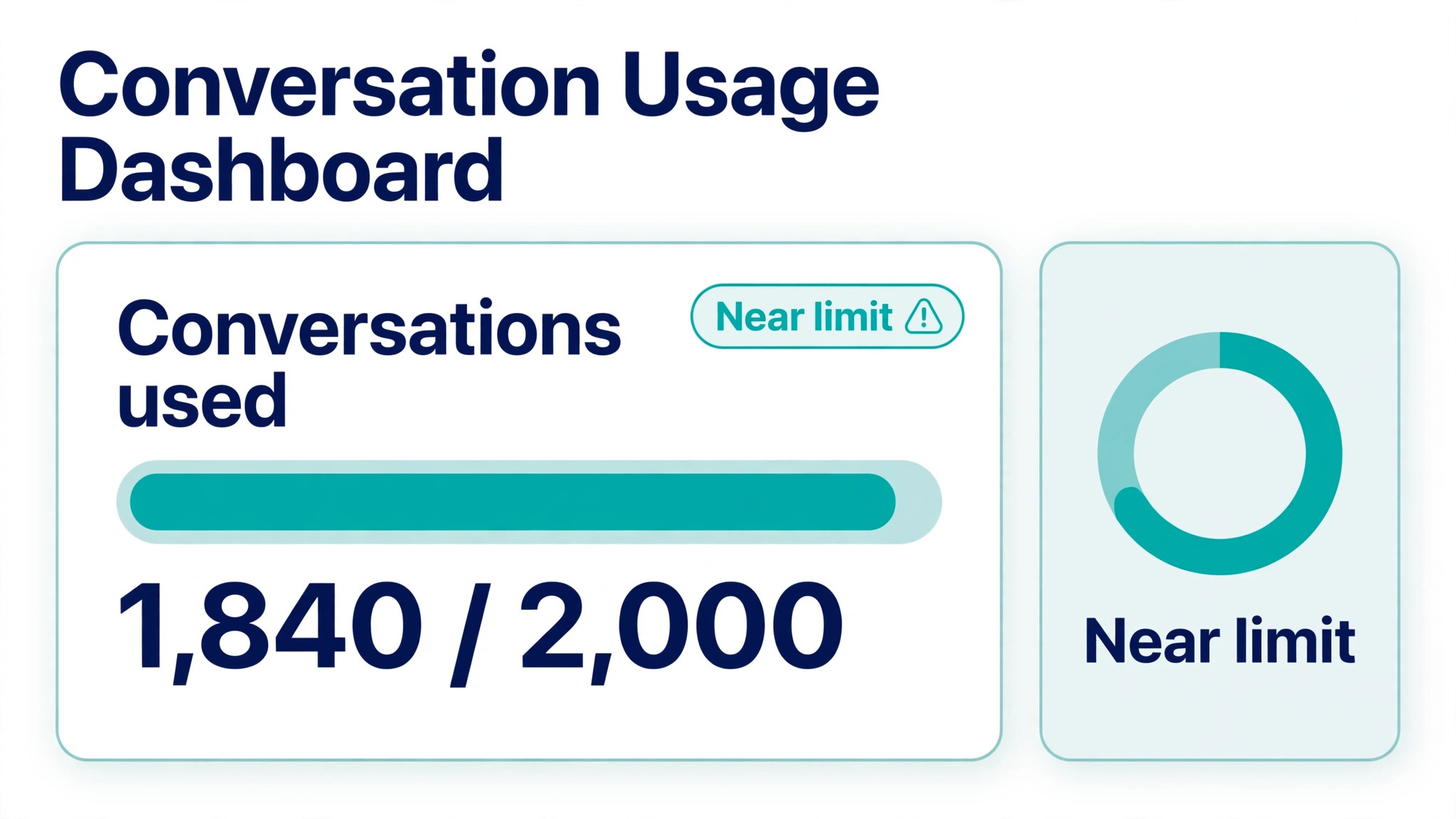
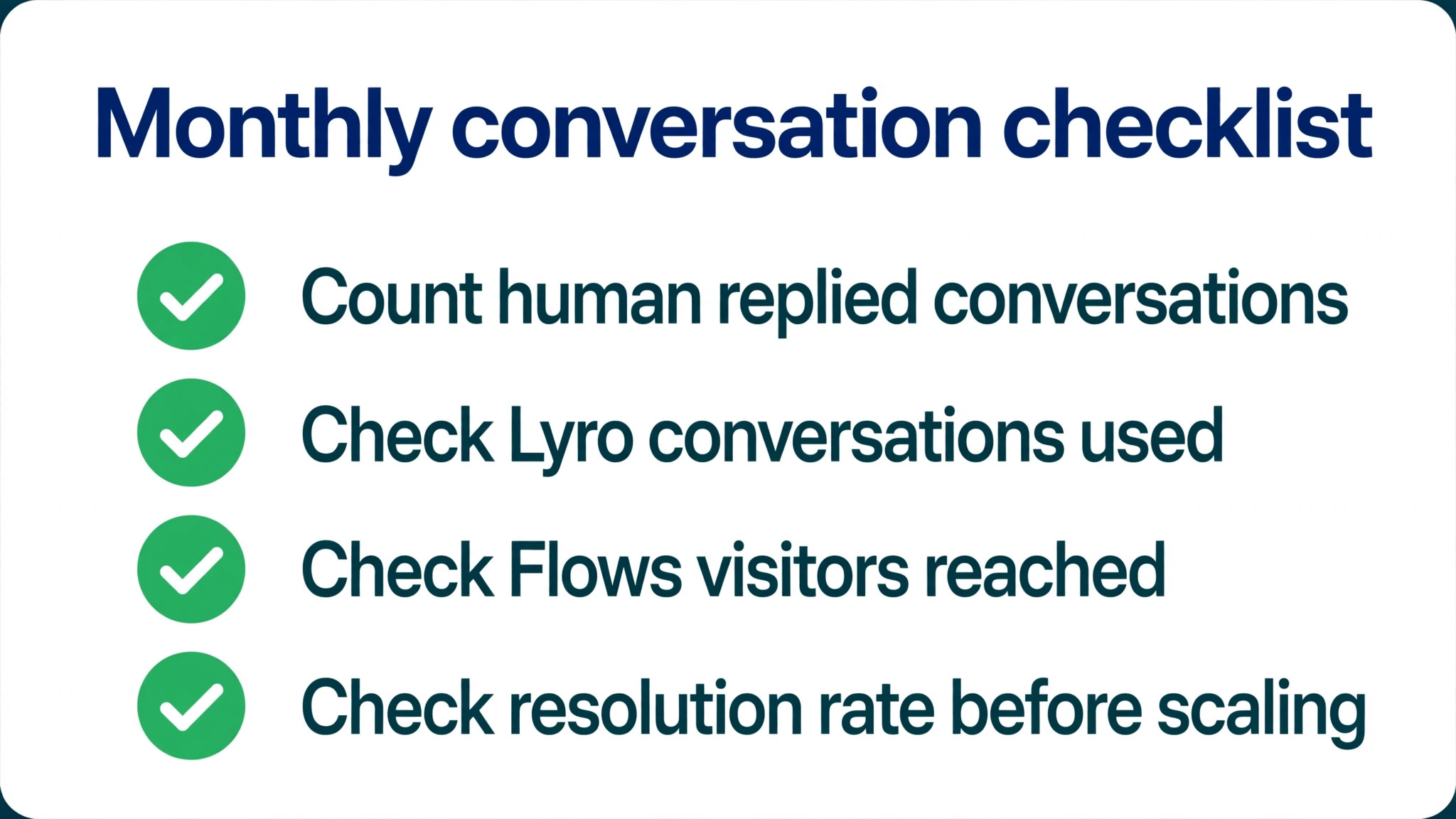
Count human replied conversations before choosing a tier, because that count, not total messages, decides the plan rung. Review the last three months of human replied conversations, find the typical month and the busy month, and size Growth for the typical busy month, not for the average. A tier sized for the average will auto upgrade in every busy month, while a tier sized for a busy month will hold steady and will only auto upgrade in an exceptional month. That sizing decision is the cheapest control on the plan line, because it prevents repeated auto upgrades that nobody planned for.
Switch off auto upgrade deliberately, or keep it on deliberately, but do not leave it as an accident. If the business cannot afford a conversation to stop mid month, keep auto upgrade on and budget for the next rung. If the business would rather pause new conversations than pay for an upgrade, switch it off and set an alert at 80 percent of the allowance. Either choice is valid, but an unexamined default is not a choice, and it is the default that produces surprise invoices. Write the decision into the billing note on day one, so a new team member does not reverse it without understanding why it was set.
Start Lyro small and measure resolution before scaling. Buy the 50 conversation quota, measure how many conversations Lyro resolves without human help, and calculate the agent minutes saved per resolved conversation. Scale to 500 conversations only when the resolution rate and the time saved justify the 350 dollar quota, and scale to 1,000 only when the 500 quota runs out regularly with a strong resolution rate. That staged approach is the most honest control on the cost of Tidio for small business monthly spending, because it ties every Lyro dollar to a resolved conversation, not to a hope that AI will help.
Finally, use Flows sparingly and count reach, not creation. Run one or two Flows that target high intent visitors, such as cart abandoners or pricing page visitors, rather than running Flows across the whole site. That targeting keeps visitors reached low, keeps the Flows line at the starting allowance, and produces better results, because a prompt shown to a high intent visitor converts better than a prompt shown to every visitor. Review Flows reach monthly, retire Flows that reach many visitors but produce few conversations, and keep only the Flows that earn their reach.
Frequently Asked Questions
How much does Tidio cost per month for a small business?
Starter costs 29 dollars a month on monthly billing, or about 24.17 dollars on annual billing, for 100 billable conversations. Growth starts from 59 dollars a month, or about 49.17 dollars on annual billing, for 250 billable conversations, and rises to 179 dollars a month for 1,000 conversations and 349 dollars a month for 2,000 conversations. Plus starts from 300 dollars a month plus usage, and Premium is priced by quote. Lyro and Flows cost extra on top of those plan prices.
Does Tidio charge per agent seat?
No, self-serve plans include up to 10 seats, so the price follows conversation volume, not headcount, up to that cap. A team that grows past 10 seats must move to Plus, with custom limits and seats priced by quote. That seat inclusion makes Tidio cheap for a team with many part time agents, and dearer in relative terms for a solo operator who uses only one seat.
What is a billable conversation on Tidio?
A billable conversation is any chat, ticket, email, or social media conversation that includes a reply from a human agent. Unanswered messages and ignored spam do not count, and many messages in one thread count as one conversation. Replies from Lyro and Flows do not count as agent replies, so they use their own quotas instead of the billable conversation allowance.
How much does Lyro AI cost on top of the plan?
A Lyro quota costs 39 dollars a month for 50 conversations, 350 dollars a month for 500 conversations, and 700 dollars a month for 1,000 conversations on monthly billing. On annual billing, those quotas work out at about 32.50 dollars, 291.67 dollars, and 583.33 dollars a month respectively. The 50 Lyro conversations included with a new account are a lifetime batch, not a monthly allowance, so a monthly quota is needed once that batch runs out. Add that quota to the plan price whenever you state the cost of Tidio for small business monthly totals, because the plan price alone understates the AI bill.
Does Tidio automatically upgrade my plan when I exceed the limit?
On standard monthly plans, Tidio automatically upgrades the conversation tier when an account reaches 95 percent of its allowance, and that setting is on by default for new accounts. It can be switched off, and annual and Plus plans do not auto upgrade in the same way. Check the setting on day one, and budget for the next rung if auto upgrade stays on.
Can a small business pay annually for Tidio?
Yes, annual billing gives two months free, so an annual buyer pays for ten months and receives twelve. Starter works out at about 24.17 dollars a month on annual billing, Growth from about 49.17 dollars a month, and a 1,000 conversation Lyro quota at about 583.33 dollars a month. Pay monthly first until conversation volume is stable, then switch to annual billing on the rung that fits.
No, pay per resolution billing exists only on Premium, which starts from 3,000 Lyro conversations and carries a guaranteed 50 percent Lyro resolution rate. On every self-serve plan, Lyro is billed per conversation whether it resolves the query or not. A small team that wants pay per resolution should either grow to Premium volume or choose a rival that offers that model at a lower volume.
Verdict
Start on Starter or Growth for human conversations, add Lyro only after measuring resolution on the smallest quota, and keep Flows targeted to high intent visitors. That staged approach keeps the bill close to the plan price, and it prevents the most common Tidio surprise, which is a Lyro quota that costs more than the chat plan itself. Switch off auto upgrade or budget for it deliberately, plan the Plus move before the team passes 10 seats, and confirm the live pricing page before you commit.
Priced that way, Tidio is a strong value for a small team with modest conversation volume, and a dear tool for a team that buys AI volume before it has proven that AI resolves. The difference is not the tool. It is whether conversations are counted, resolution is measured, and each of the three meters is budgeted as its own line.
More Reading on Stratilyze
– Switch Freshdesk to Zendesk for a Support Team – Switch Calendly to YouCanBookMe for Small Business – Best CRM for Independent Car Dealers – Cost of Zapier for Small Business Monthly – Best Booking Software for Nail Salons