

For most small businesses, mixed bundling is the right starting point, because it lets customers buy the bundle at a saving or buy items separately at full price, which protects choice while still lifting average order value. That verdict holds when the items in the bundle genuinely go together, when the bundle discount is modest, and when you have checked the margin before you launch. It does not hold when the bundle forces customers to buy something they do not want, or when the discount quietly wipes out the profit on your best seller. A bundle pricing strategy small business owners can trust starts with that verdict, then proves it with margin maths before a single bundle goes on sale.
Bundling is simply selling two or more products or services together for one combined price, usually lower than the sum of the separate prices. The saving is what attracts the buyer, and the larger order is what benefits the seller, but the deal only works when both sides gain. A bundle that only benefits the seller, because it hides a weak product inside a strong one, will be spotted quickly and will damage trust. A bundle that only benefits the buyer, because the discount exceeds the margin, will sell well and lose money, which is worse.
The reason bundling can raise profit, even at a discount, is that customers value items differently. One customer values your main service highly and your add-on a little, while another customer values the add-on highly and the main service a little. Sold separately, each customer buys only what they value highly. Sold as a bundle at a sensible combined price, both customers may buy both items, and total profit rises. That difference in valuations is the engine of bundling, and it is why bundles work best when items complement each other rather than duplicate each other.
The Three Bundle Types and When Each Fits
Pure bundling sells items only as a package, with no option to buy them separately. It fits fixed offers where the package is the product, such as a starter kit, a course with materials, or a service package where every part is needed for the result. Pure bundling simplifies choice and operations, but it loses customers who want only one part, so it should only be used when the parts truly belong together and the combined price is clearly fair.
Mixed bundling sells items both separately and as a discounted bundle, and it is the safest default for most small businesses. Customers who want everything get a saving, customers who want one item are not forced into a larger purchase, and you can see from sales data which route customers prefer. Mixed bundling also lets you test the bundle price without removing the standalone prices that existing customers rely on, which makes it the easiest type to reverse if the test fails.
Tiered bundling, sometimes called good, better, best packaging, offers two or three bundles at different price points, such as a basic bundle, a standard bundle, and a premium bundle. It fits businesses where customers differ in budget and ambition, because each tier gives a clear next step up. The risk is confusion, so tiers must differ in obvious ways, with one or two meaningful upgrades per step, not a long list of small differences that buyers cannot compare.
| Bundle type | How it works | Best fit | Main risk |
|---|---|---|---|
| Pure bundling | Items sold only as a package | Fixed kits and complete packages | Loses buyers who want one item only |
| Mixed bundling | Bundle plus separate prices | Most small businesses as a starting point | Discount may pull standalone buyers down |
| Tiered bundling | Two or three bundles at different prices | Businesses with varied budgets | Too many tiers confuse buyers |
Choose the type by asking one question, which is whether a customer who wants only one item should still be able to buy it. If the answer is yes, mixed bundling is your type. If the answer is no, because the result genuinely needs every part, pure bundling may fit. If customers clearly split into budget groups, tiered bundling may fit, but start with two tiers, not three, until you have sales data to justify a third.

The Margin Maths You Must Do Before Launch
Every bundle decision starts with margin, not with the discount that looks attractive in an advert. Margin is the selling price minus the direct cost of delivering that item, including materials, direct labour, payment fees, and any cost that rises with each sale. If you do not know the margin on each item, you cannot know whether a bundle helps or hurts, and no amount of sales volume will fix a bundle that loses money on every order.
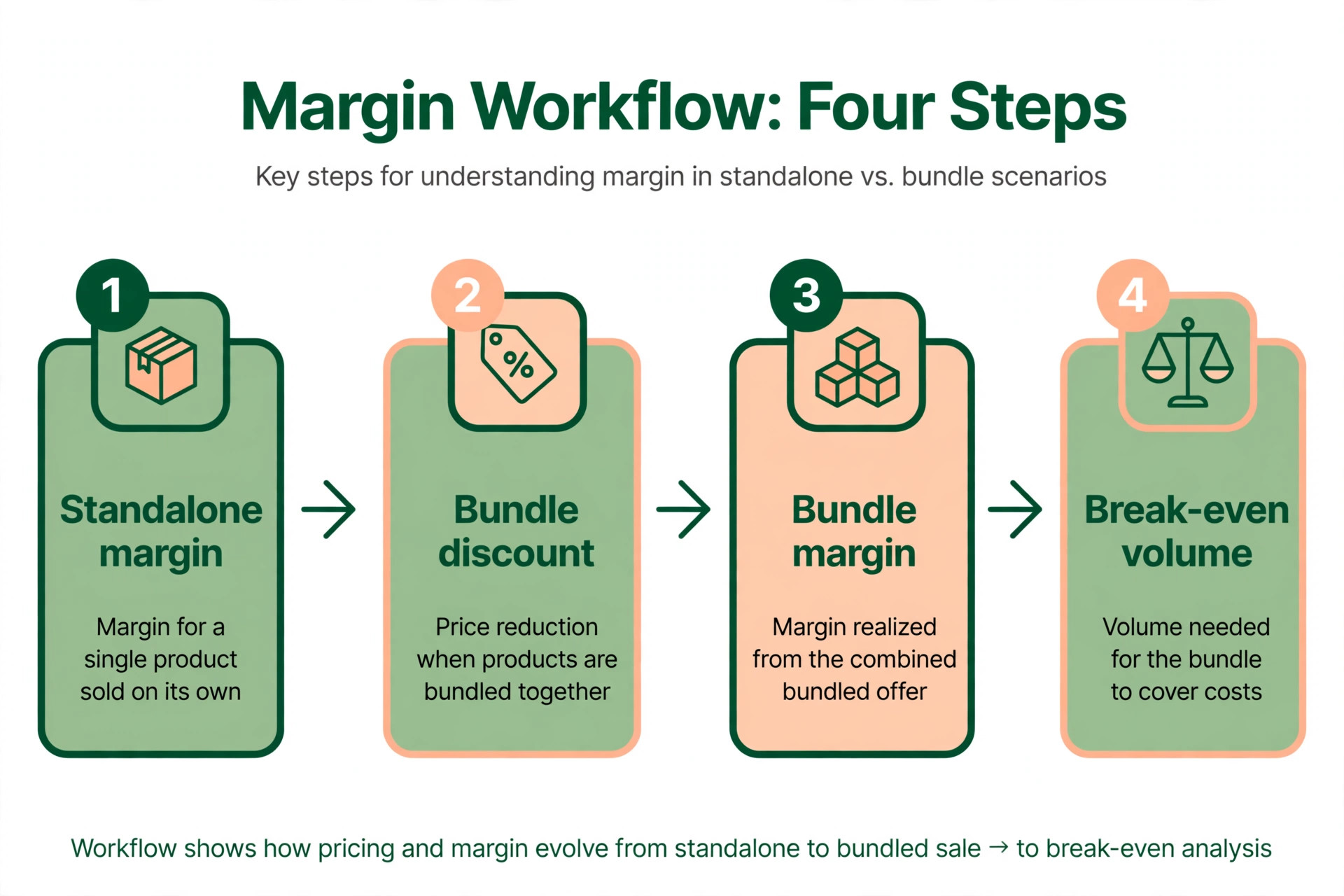
Work through the bundle in four steps. First, list each item, its standalone price, and its direct cost, and calculate its standalone margin. Second, set a trial bundle price and calculate the bundle margin by subtracting the combined direct costs from that price. Third, estimate how many existing standalone buyers might switch to the bundle, and what margin you lose on each switch. Fourth, estimate how many extra bundle sales you need to cover that lost margin, which is your break-even bundle volume. If that volume looks unrealistic, the discount is too deep or the bundle mix is wrong.
A worked example with illustrative numbers shows how the maths behaves. Suppose item A sells for 100 with a direct cost of 40, giving a margin of 60, and item B sells for 60 with a direct cost of 25, giving a margin of 35. Sold separately to one customer each, the combined margin is 95.
A bundle priced at 140 has a combined cost of 65 and a margin of 75, which is lower per customer than 95, but the bundle only needs to attract customers who would not otherwise have bought both items to be worthwhile. If the bundle brings in a second item sale that would not have happened, the extra margin of 75 on a new bundle sale easily covers the switch cost on existing buyers, provided enough new bundle sales arrive. These numbers are illustrative, so replace them with your own prices and costs before deciding anything.
The break-even question deserves a plain answer before launch. Divide the total margin lost to switching by the margin on one bundle sale, and the result is the minimum number of bundle sales needed just to stand still. Write that number down, compare it with your realistic monthly sales, and only launch if the break-even volume is comfortably below what you expect. A bundle that needs heroic sales to break even is not a strategy. It is a hope with a discount attached.
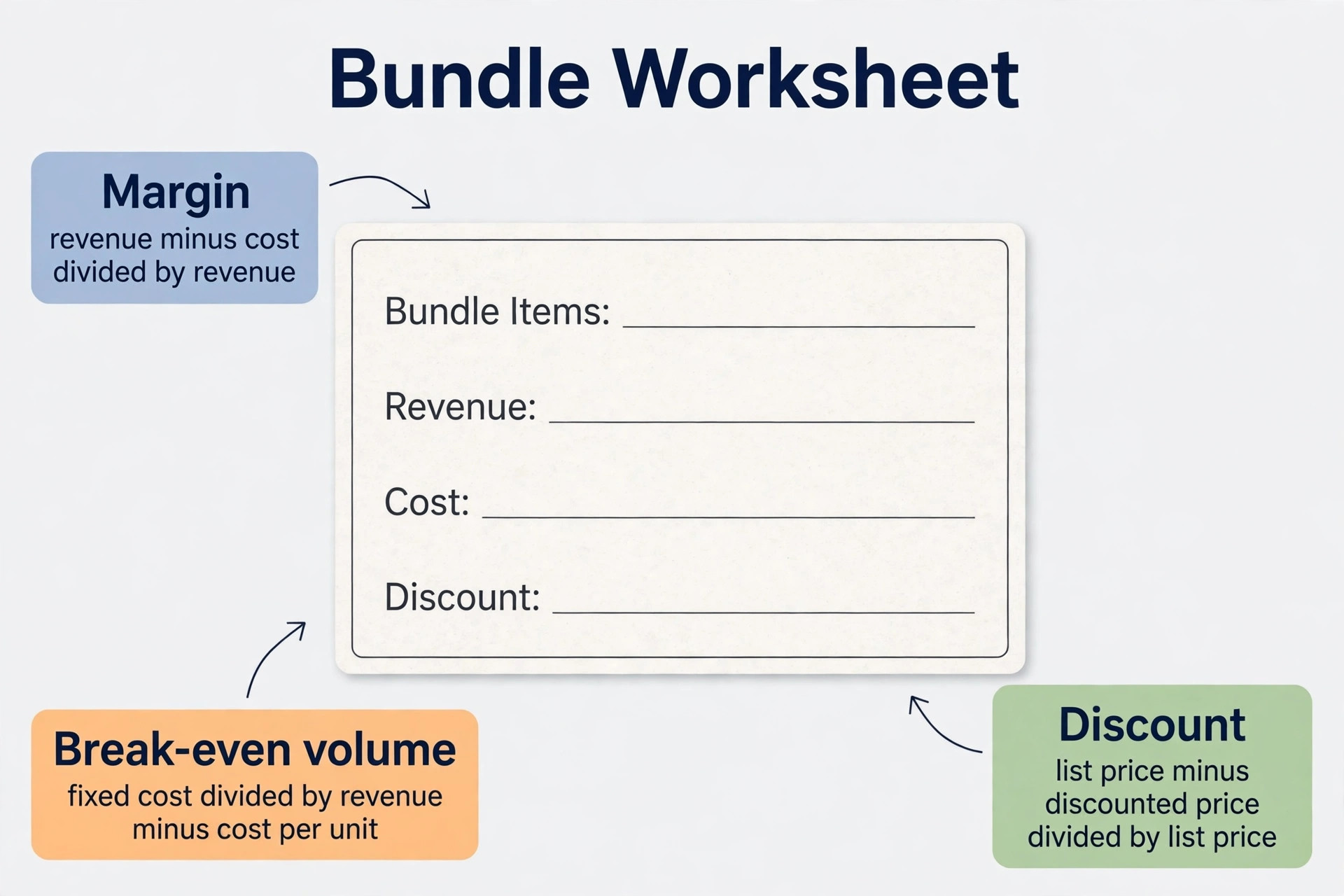
Bundle Pricing Strategy Small Business Worksheet
Use this worksheet for every bundle you consider, and keep one completed copy per bundle so pricing decisions stay visible and revisable. Fill it with your real numbers, not with estimates from memory, and check the direct costs with whoever delivers the work, because owners often understate labour time on services.
| Worksheet line | Your number |
|---|---|
| Item one standalone price | Fill in your price |
| Item one direct cost | Fill in your cost |
| Item one standalone margin | Price minus cost |
| Item two standalone price | Fill in your price |
| Item two direct cost | Fill in your cost |
| Item two standalone margin | Price minus cost |
| Combined standalone price | Sum of both prices |
| Trial bundle price | Fill in your trial price |
| Bundle discount in money terms | Combined price minus bundle price |
| Bundle discount as a share of combined price | Discount divided by combined price |
| Combined direct cost | Sum of both costs |
| Bundle margin | Bundle price minus combined cost |
| Margin lost per switching buyer | Combined standalone margin minus bundle margin |
| Break-even bundle sales needed | Total lost margin divided by bundle margin |
| Expected bundle sales per month | Fill in your realistic estimate |
A bundle pricing strategy small business owners run well treats this worksheet as a gate, not as paperwork. If the worksheet shows a margin below your minimum acceptable margin, change the bundle before launch, by raising the bundle price, swapping an item, or reducing a costly component. Never launch a bundle that fails the worksheet in the hope that volume will save it, because volume multiplies a margin problem instead of fixing it.
The Margin Checklist Before Any Bundle Goes Live
Use this checklist as the final gate before a bundle is offered to customers, and do not skip a step because the bundle feels obvious. Obvious bundles are the ones that most often hide a margin surprise.
– Confirm the direct cost of every item, including labour time, materials, fees, and delivery, with the person who delivers it. – Calculate the bundle margin and confirm it sits above your minimum acceptable margin for that product line. – Calculate the break-even bundle volume and confirm it is comfortably below realistic monthly sales. – Check that the bundle discount is modest, usually a clear saving without approaching the margin itself. – Confirm that every item in the bundle is something the target buyer actually wants, not a slow seller hidden inside a strong offer.
– Check that standalone prices stay available for mixed bundling, so no customer is forced into the bundle. – Confirm that staff can explain the bundle, the saving, and the standalone alternative in one sentence each. – Set a review date, usually 30 days after launch, to judge the bundle on margin and sales, not on launch week excitement alone.
A checklist that blocks a bad bundle is doing its job, even when it disappoints someone who loved the bundle idea. The cheapest time to fix a bundle is before customers buy it. The most expensive time is after a month of discounted sales has already eroded margin and trained customers to expect the bundle price as the normal price.

Choosing Items That Belong Together
The best bundles group items that solve one job together. A camera with a memory card and a case solves the job of starting photography. A design service with a logo and a social template set solves the job of launching a brand. A cleaning service with a deep clean and a monthly maintenance visit solves the job of keeping a home in order. In each case, the buyer can see why the items belong together without an explanation, and that instant sense is the test for bundle fit.
Avoid grouping items only because one of them sells slowly. That temptation is the most common failure in a bundle pricing strategy small business owners build in a hurry, because it treats the bundle as a clearance route instead of a value offer. Customers recognise a clearance bundle, and they value the bundle at the level of its weakest item. If a slow seller needs help, discount it openly, improve it, or retire it, rather than hiding it inside a bundle that punishes buyers who wanted the strong item alone. Bundling should raise the value of every item in it, not rescue one item at the expense of the others.
Consider timing as well as fit. Items used together at the same time bundle better than items used months apart, because the buyer feels the saving immediately. A starter bundle used on day one works. A bundle that pairs a day-one item with an item needed in six months feels like a prepayment, not a saving, and buyers will resist it unless the future item is clearly explained and fairly priced. When timing differs, consider a staged offer, such as a discount on the second item when the time comes, instead of forcing both items into one purchase.

Setting the Bundle Discount
Discount depth is where most bundles go wrong, because owners set the discount by what looks generous rather than by what the margin allows. A modest discount, in the range that still leaves a healthy bundle margin after the worksheet check, usually outperforms a deep discount, because it attracts buyers who want the combination while preserving profit on every sale. A deep discount attracts bargain hunters who would not have bought at full price and who leave when the discount ends, which is the worst kind of bundle customer.
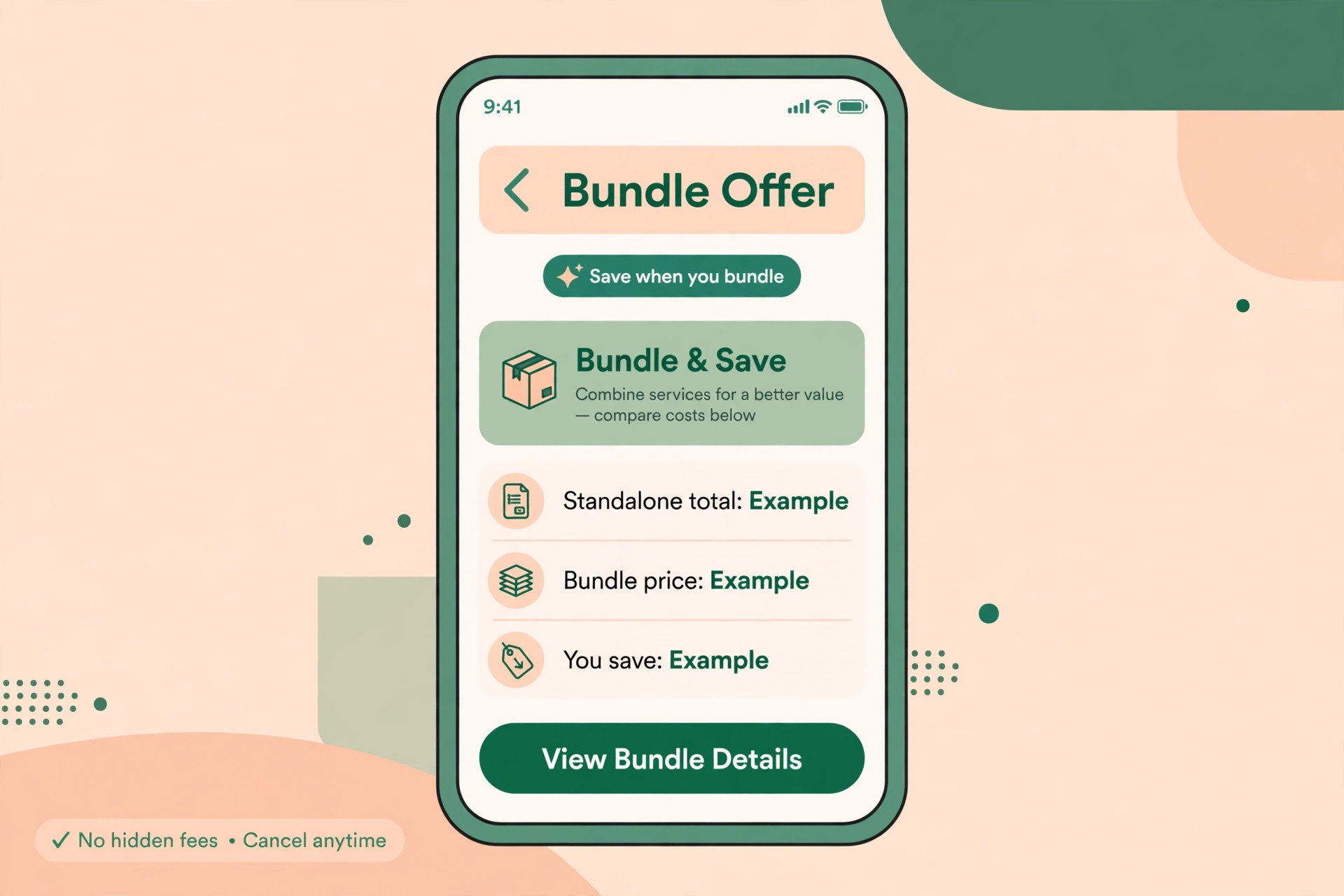
Present the saving in money terms as well as a share, because buyers understand money saved more easily than a percentage. A bundle that saves 25 in money terms feels concrete, while the same saving expressed only as a percentage feels abstract. Show the standalone total, the bundle price, and the saving on the same page, so the buyer can verify the deal without doing arithmetic. Transparency here builds trust, and trust sells the next bundle too.
Avoid stacking discounts on top of bundles unless the worksheet has been redone for the stacked price. A bundle discount plus a sale discount plus a loyalty discount can quietly erase margin, even when each discount looked small alone. Set a rule that only one discount applies to a bundle at a time, and state that rule plainly at the point of sale, so staff and customers share the same understanding.
Testing a Bundle Before Committing to It
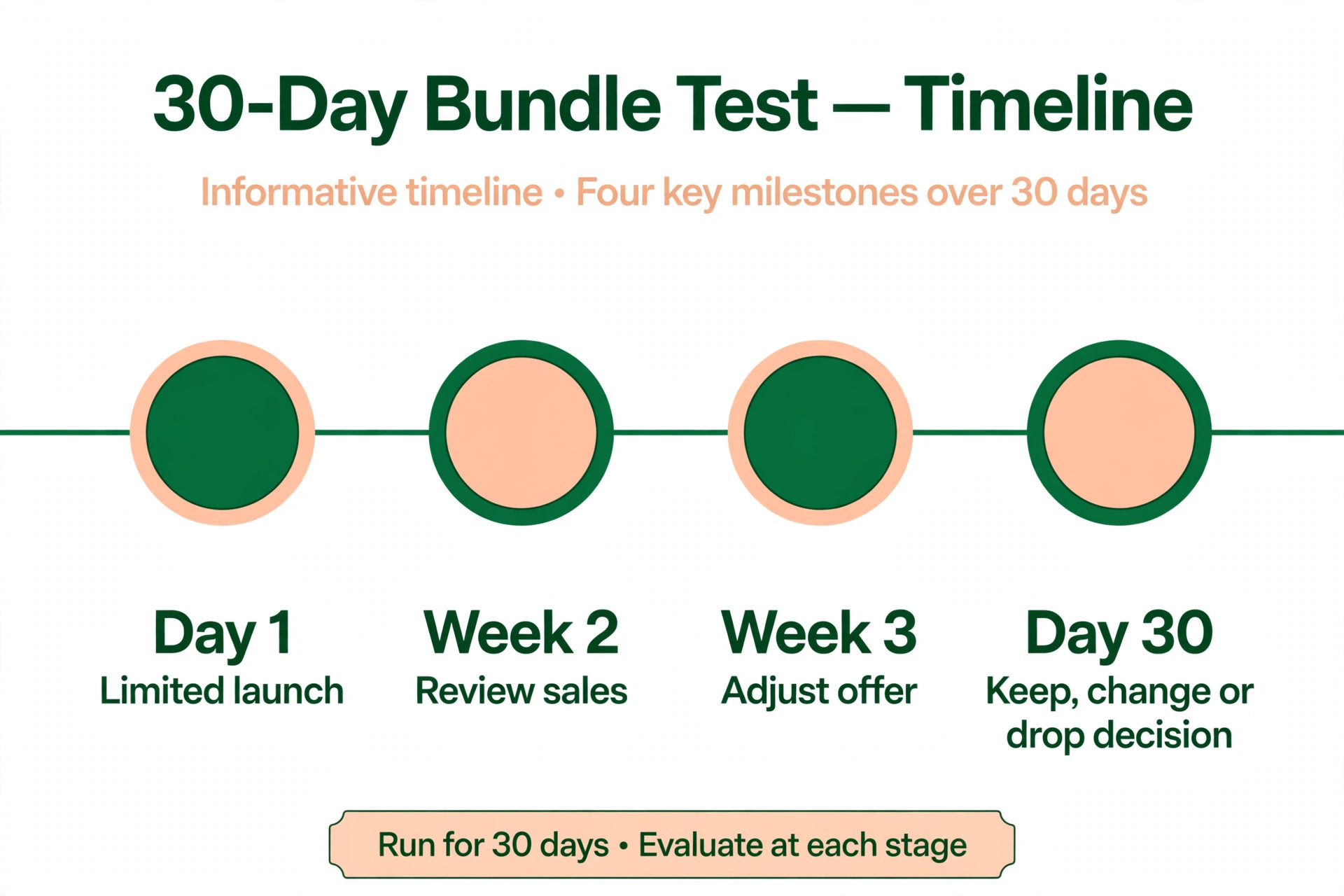
Test one bundle at a time, for a fixed period, with a clear success rule written before the test starts. That discipline is what separates a bundle pricing strategy small business owners can learn from from a bundle that simply runs until someone notices the margin. A 30-day test with a rule such as break-even volume reached and bundle margin held is enough to judge most small business bundles. A test without a pre-written rule will be judged by feelings, and feelings after a busy launch week will almost always say to keep a bundle that the numbers say to drop.
Test with a limited audience first, such as existing customers or waitlist members, before offering the bundle to everyone. A limited test limits the damage if the price is wrong, and it gives you real buyer language for the wider launch. Watch three numbers during the test, which are bundle sales, switching from standalone purchases, and bundle margin per sale. If switching is high and new bundle sales are low, the bundle is cannibalising profit. If new bundle sales are high and switching is low, the bundle is creating genuine extra sales.
End the test with a decision, not a drift. Keep the bundle if it met its rule, change the price or mix if it came close, and drop it if it missed by a wide margin. A bundle that drifts on after a failed test becomes the expected price, and removing it later feels like a price rise to customers who grew used to it. Decisive testing protects both margin and customer trust.
Bundling by Business Type
Product businesses should bundle complementary items used together, such as a main product with its consumables or accessories, and they should watch stock levels closely, because a bundle that sells well can empty the stock of one item and leave the bundle unfulfillable. Set bundle stock rules before launch, and pause the bundle rather than substituting a lesser item without telling buyers.
Service businesses should bundle services delivered in one engagement or in a planned sequence, such as an initial session with follow-up sessions, or a design deliverable with its templates. Price the bundle on the time and expertise involved, not only on the hourly rate, and state what counts as a revision versus a new request inside the bundle, so scope stays clear. A service bundle without scope rules will expand quietly until its margin disappears.
Subscription and membership businesses should bundle access levels or add-ons into tiers, with a clear upgrade path from one tier to the next. The entry tier should deliver real value alone, or members will feel trapped into the higher tier. The premium tier should add benefits that cost little to deliver but mean a lot to members, such as priority booking or extra content, rather than benefits that strain delivery every month.
Food, retail, and local service businesses should bundle around occasions and routines, such as a weekly box, a family meal set, or a seasonal maintenance package. Occasion bundles sell because they remove a decision, which is a real benefit for busy buyers. Keep occasion bundles simple, with one clear price and one clear serving or scope, so buyers can order without asking questions.
Mistakes That Turn Bundles Into Margin Leaks
The first mistake is discounting before doing the margin maths, which produces bundles that sell fast and lose money steadily. Margin first, discount second, is the order that protects the business, and any bundle idea that cannot survive the worksheet should be changed or dropped, no matter how popular it sounds in a planning meeting.
The second mistake is bundling to hide a weak product, which buyers detect and which lowers the perceived value of the strong product beside it. A bundle should make every item look better, not make one item look like a burden. If an item cannot stand beside a strong product without apology, fix the item or remove it from the bundle.
The third mistake is forgetting switching, which is the margin lost when existing standalone buyers move to the discounted bundle without buying anything extra. Switching is the hidden cost of every bundle, and it is why the break-even volume matters more than the launch week sales total. A bundle that looks successful on sales alone may be failing on profit once switching is counted.
The fourth mistake is stacking discounts, where a bundle discount, a sale discount, and a loyalty reward combine into a price the business never intended. One discount per bundle, stated plainly, prevents this quiet erosion, and staff should be trained on the rule before the bundle goes live.
The fifth mistake is leaving a failed bundle running because removing it feels awkward. A bundle that missed its test rule should be changed or dropped on schedule, with a clear message to customers about what replaces it. Customers accept a changed offer far more easily than they accept a business that quietly loses money on every bundle sale until it has to raise prices sharply to recover.
Measuring Bundle Success After Launch
Review the bundle at 30 days, using the same worksheet numbers updated with real sales. Compare actual bundle sales with break-even volume, actual bundle margin with the planned margin, and the switching rate with your estimate. Those three comparisons tell you whether to keep, change, or drop the bundle, and they remove opinion from a decision that owners often make emotionally.
Watch average order value and customer lifetime value alongside bundle sales, because a bundle that raises order value but lowers repeat buying may be pushing customers toward a one-time large purchase instead of a lasting relationship. The healthiest bundles raise both order value and repeat buying, because they introduce customers to a second item they genuinely keep using. A bundle that raises order value once and then loses the customer has not built anything durable.
Record what you learned from each bundle, including the mix, the price, the discount, and the switching rate, so the next bundle starts from evidence rather than from scratch. After three bundles, you will have a pricing pattern for your own business, showing which combinations sell, which discounts hold margin, and which items should never be bundled together. That pattern is the real asset, because it makes every future bundle faster to price and safer to launch.
When Not to Bundle
Not every product or service should be bundled, and recognising the no-bundle cases protects margin as surely as any worksheet. Do not bundle when the items serve different buyers, because the bundle will feel irrelevant to both groups and will sell to neither. A bundle aimed at everyone is aimed at no one, and the discount spent on it buys no loyalty from either group.
Do not bundle when one item is bought rarely and the other is bought weekly, because the buyer will feel forced to prepay for something they do not yet need. In that case, a future discount or a loyalty credit for the second purchase works better than a combined price, since it rewards the return visit without forcing the timing. A bundle pricing strategy small business owners trust knows when a staged offer beats a combined price, and it does not force a bundle shape onto a timing problem.
Do not bundle when you cannot deliver both items to the same standard at the same time. If one item depends on a supplier, a season, or a specialist who is often unavailable, the bundle will create fulfilment problems that damage the reputation of the strong item too. Wait until delivery is reliable, or bundle only the items you control fully, and offer the uncertain item as an optional add-on instead.
Do not bundle as a way to avoid a pricing conversation. If a standalone price is too low, raising it openly and explaining the value is better than hiding the rise inside a bundle, because customers notice hidden rises and trust the business less afterwards. Bundling should be a genuine saving on a genuine combination, not a disguise for a price increase that the business was unwilling to state plainly.
Finally, do not bundle everything at once. A business with five bundles and no clear standalone prices confuses buyers and staff alike, and the confusion costs sales. Start with one bundle, prove it with the worksheet and the test, and only then consider a second. A bundle pricing strategy small business owners can maintain is a small set of proven bundles, not a catalogue of hopeful combinations.
Frequently Asked Questions
What is the difference between pure bundling and mixed bundling?
Pure bundling sells items only as a package, with no separate purchase option, while mixed bundling sells items both separately and as a discounted bundle. Mixed bundling is the safer starting point for most small businesses, because it gives buyers a choice and lets you test the bundle without removing standalone prices. Pure bundling fits only when every part is genuinely needed for the result.
How large should a bundle discount be?
The discount should be whatever the margin worksheet allows while keeping the bundle margin above your minimum acceptable level, presented as a clear money saving alongside the standalone total. A modest discount that preserves margin usually outperforms a deep discount, because deep discounts attract bargain hunters and erode profit on every sale. Never set the discount by what looks generous in an advert before checking the maths.
How do you stop a bundle from cannibalising standalone sales?
Measure switching during a limited test, and compare actual bundle sales with the break-even volume needed to cover lost standalone margin. If switching is high and new bundle sales are low, raise the bundle price, change the mix, or limit the bundle to new buyers or to a specific occasion. Mixed bundling with a modest discount, rather than a deep one, also reduces switching pressure.
Should services be bundled the same way as products?
Services bundle well when the services form one engagement or a planned sequence, but the price must reflect time and expertise, and scope rules must state what counts as a revision versus a new request. Product bundles are judged mainly on price and fit, while service bundles are also judged on scope clarity, because unclear scope expands until margin disappears. State scope inside the bundle offer, not after the sale.
How long should a bundle test run?
Thirty days is enough for most small business bundles, provided a success rule is written before the test starts, such as break-even volume reached and bundle margin held. Test with a limited audience first, watch bundle sales, switching, and margin per sale, and end with a keep, change, or drop decision on schedule. A test without a pre-written rule drifts, and a drifting bundle becomes the expected price.
Can a bundle work if one item has a low margin?
A low-margin item can sit in a bundle only when the combined bundle margin still clears your minimum, which usually means pairing it with a high-margin item and keeping the discount modest. If the combined margin fails the worksheet, change the mix, raise the bundle price, or remove the low-margin item. Bundling does not fix a low-margin item. It spreads its problem across the bundle.
The Pricing Decision to Make This Week
Pick one bundle candidate where the items clearly belong together, complete the worksheet with real prices and costs, and run the margin checklist before offering anything to customers. Launch with mixed bundling, a modest discount, and a 30-day test with a pre-written success rule, then judge the bundle on break-even volume, margin held, and switching, not on launch week excitement.
That disciplined sequence is what makes a bundle pricing strategy small business owners can repeat with confidence, because each bundle teaches you something measurable about your own prices, your own buyers, and your own margins. For related pricing reading, see the premium pricing strategy guide, the guide on how to raise prices without losing clients, and the home cleaning pricing packages guide.