

A coach who runs a practice on spreadsheets and messaging apps usually discovers the gap when a client asks for their programme, their progress, and their next payment in one place, and the coach has to assemble it from three tools. A coach who hires a developer usually discovers the opposite gap, when the app takes months to build, costs thousands, and still needs changes the moment the first clients use it. The best ai app builders for coaches close both gaps, and the choice between the two approaches decides whether the app ships this month or stays a plan for next year.
The split comes down to what the app has to do. A fitness coach needs workout plans, progress tracking, and habit check-ins that clients open daily. A business coach needs a client portal with resources, session notes, and payment links. A life coach needs a simple branded app with programmes, messaging, and community. Each of these is a different app, and the tools below build them in different ways.
This guide compares eight live systems on coaching work, not on generic app-builder checklists. Prices are list prices as published by the vendors in late 2026, before tax. Where a vendor charges by usage or by workload units, the guide states the basis honestly, since the real cost depends on how many clients use the app and how often.
Programmes, Progress, and the Client Who Opens the App Daily
A coaching app earns its place when clients open it every day, and that only happens when the app carries the programme, the progress, and the next step in one place. A fitness client wants today’s workout, a way to log it, and a view of the last four weeks. A business client wants this week’s action, the resource that explains it, and a note from the last session. A tool that only shows static content will be opened once and forgotten, while a tool that tracks progress becomes part of the client’s routine.
Glide and Softr are built for this shape, turning a spreadsheet or a database into an app where each client sees their own programme, their own progress, and their own messages. Bubble goes further, building a full custom app with accounts, payments, and logic, while Adalo and FlutterFlow build native apps that live on the client’s phone. The difference shows up in the first week, since a client who has to open a browser link will use the app less than a client who taps an icon on their home screen.
Test this with five real clients in the trial. Give each one a programme, a progress tracker, and a message, then count how many open the app on three days out of five. The best ai app builders for coaches will show real usage in the first week, while a tool that clients ignore is only a prettier spreadsheet. The usage number is the trial result that matters most, since an unused app helps nobody.
Payments, Programmes, and the Business Behind the App
A coaching app has to handle money cleanly, since the app is where the client pays, renews, and upgrades. A coach who sells a twelve-week programme needs a payment link, a subscription, and a receipt, all without leaving the app. A coach who sells ongoing coaching needs monthly billing that continues until the client cancels, with a clear record of who has paid and who is overdue. A tool that handles payments poorly will push the coach back to invoices and bank transfers, which defeats the purpose of the app.
Bubble and Softr both handle payments through Stripe, with subscriptions and one-off charges, while Glide offers payments on higher plans. Adalo and FlutterFlow rely on in-app purchases and payment integrations, which need more setup. The coach should check whether the plan they buy includes payments, since the cheapest plan often excludes them, and the upgrade to add payments can double the monthly cost.
Check the client onboarding flow in the trial, since the first hour decides whether a client stays. A new client should be able to join, pay, and see their programme in under ten minutes, without an email from the coach. If the flow takes longer or needs manual steps, the coach will spend the first week of every programme doing admin instead of coaching.
AI Generation, Templates, and the App That Ships This Month
AI app builders promise an app from a description, and for a first version they deliver. The coach describes the app, the AI builds the screens, the data, and the logic, and the result is a working prototype in an afternoon. The problem is that the prototype is rarely the finished app, since the coaching logic, the programme structure, and the client flow all need the coach’s judgement. The AI draft is a starting point, and the coach should budget a week to shape it into something clients will pay for.
The better tools in this list pair AI generation with real control. Glide generates from a prompt or a spreadsheet, Softr builds from templates on existing data, and Bubble offers AI help inside a full visual builder. FlutterFlow and Adalo offer AI features too, but their strength is the native app and the visual editor rather than the generation. The test is whether the coach can change the AI draft easily, since a tool that locks the generated structure is a template with a new name.
Use the AI draft to start, then spend a week reshaping it with real client content. Add a real programme, real progress tracking, and real payment links, then give it to five clients and watch them use it. If the tool allows that reshaping without code, the AI is a helper, and if it fights back, the coach should build from a template instead.
The 8 Tools at a Glance
The table below gives the short version of the best ai app builders for coaches, with each tool, its main job, and its starting price.
| Tool | Main job | Best for | Starting price |
|---|---|---|---|
| Glide | Spreadsheet-to-app builder | Internal apps and client tools | From $25 per month |
| Softr | Client portals on data | Portals and membership apps | From $19 per month, billed annually |
| Bubble | Full no-code web and mobile apps | Custom coaching platforms | From $32 per month, billed annually |
| Adalo | Native mobile apps | Simple native apps | From $52 per month, billed annually |
| FlutterFlow | Native apps with code export | Apps with code export | From $39 per month |
| Thunkable | Drag-and-drop native apps | Simple mobile apps | Pricing on the vendor site |
| Appy Pie | No-code app builder | Fast simple apps | Pricing on the vendor site |
| Draftbit | Native apps with code export | Custom native apps | From $12 per month, billed annually |
Best Pick by Job
This table matches the best ai app builders for coaches to the job it fits, so a fitness coach and a business coach do not end up buying the same system.
| Job type | First pick | Second tool | Why this pair works |
|---|---|---|---|
| Client portal fast | Softr | Glide | Softr builds the portal on existing data while Glide turns a spreadsheet into an app |
| Fitness programmes daily | Glide | Adalo | Glide tracks programmes simply while Adalo puts the app on the phone |
| Full custom platform | Bubble | FlutterFlow | Bubble builds the whole platform while FlutterFlow adds native apps with code export |
| Native app on a budget | Draftbit | Adalo | Draftbit starts cheap with code export while Adalo offers flat pricing |
| Simple app, no code | Appy Pie | Thunkable | Appy Pie builds fast while Thunkable offers drag-and-drop control |
| App with code export | FlutterFlow | Draftbit | FlutterFlow exports real code while Draftbit offers a cheaper start |
How to Choose the Best AI App Builders for Coaches
The best ai app builders for coaches prove themselves on a real programme, not on a demo with sample data. Take one real coaching programme, with its sessions, its resources, and its payment, and build it in the trial. Then give it to five real clients and count how many open it on three days out of five. The tool that clients actually use is the one worth paying for, and the tool that clients ignore is only a prettier spreadsheet.
Check the store question next, since it decides whether the app lives on the client’s phone or in their browser. Adalo, FlutterFlow, Thunkable, and Draftbit publish native apps to the App Store and Google Play, while Glide and Softr build web apps that install to the home screen. A native app costs more and needs store review, while a web app is faster to ship and easier to update. A coach should choose on how clients will use the app, not on which sounds more impressive.
Price the whole year, including the plan tier that holds payments, since the cheapest plan often excludes them. Glide Basic at $25 a month, Softr Basic at $19 a month billed annually, and Bubble Starter at $32 a month billed annually all cover a small practice, while Adalo Builder at $52 a month billed annually and FlutterFlow Basic at $39 a month cover native apps. Add the Apple Developer fee of $99 a year and the Google Play fee of $25 once for a native app, then choose on the twelve-month total.
The 8 Tools in Detail
1. Glide
Glide turns a spreadsheet, a prompt, or a file into a web app that clients can install to their phone’s home screen, starting from $25 a month on Basic. Its strength is speed, since a coach can build a client app in an afternoon from a programme spreadsheet, with progress tracking, messaging, and payments on higher plans. It suits internal tools and client apps that need to ship fast.
The honest drawback is that Glide apps are web apps, not native store apps, so a client cannot find them in the App Store, and the branding and limits depend on the plan. A coach who wants a native app with store presence will need another tool, and the per-user limits on lower plans can bite as the client list grows.
It suits coaches who want a client app this week, especially fitness and business coaches with a programme spreadsheet already built. A coach with fifty clients will get the most from it, while a coach who needs a native store app will not.
Build a real programme in the trial from a spreadsheet, give it to five clients, and count how many open it on three days out of five. If the usage is real, the speed is paying off, and if it is not, the app needs a native home.
2. Softr
Softr builds client portals, internal tools, and membership apps on existing data, starting from $19 a month billed annually on Basic. Its strength is the portal, since a coach can build a branded client area with programmes, resources, session notes, and payments, all on top of Airtable or Google Sheets, with no code. It suits a coach who already keeps client data in a spreadsheet or a database.
The honest drawback is that Softr apps are web apps, not native store apps, so a coach who wants App Store presence will need another tool. The pricing also rises fast through the tiers, with Pro at $99 a month billed annually, and the features a growing practice needs often sit in that tier.
It suits business and life coaches who want a client portal fast. A coach with a resource library and a client list will get the most from it, while a coach who needs a native app will find it the wrong shape.
Build a client portal in the trial from real client data, with a programme, a resource, and a payment link, then invite five clients. If they find their programme without help, the portal is doing its job.
3. Bubble
Bubble is the most complete no-code platform in this list, building full web apps and mobile apps with accounts, payments, logic, and a database, starting from $32 a month billed annually on Starter. Its strength is depth, since a coach can build a whole coaching platform, with custom programmes, progress logic, messaging, and subscriptions, without writing code. It suits a coach building a real business on the app.
The honest drawback is complexity and usage pricing. Bubble runs on workload units, which measure server resources, and a popular app can burn through the Starter allowance of 175,000 units a month faster than expected. The learning curve is also the steepest here, and a coach without time to learn it will need help.
It suits coaches building a full custom platform, especially those planning to scale beyond a handful of clients. A coach with a clear vision and time to build will get the most from it, while a coach who wants an app this week will find it too slow.
Build one programme flow in the trial, from sign-up to payment to first session, and watch the workload units it uses. If the flow works cleanly and the units stay within the plan, the depth is worth the learning curve.
4. Adalo
Adalo is a drag-and-drop native app builder starting from $52 a month billed annually on Builder, with native iOS and Android apps from one project, plus web apps. Its strength is flat pricing with no usage-based fees, and the native publishing means the app lives in the App Store and Google Play. It suits a coach who wants a simple native app without surprises on the bill.
The honest drawback is price and depth. At $52 a month billed annually, Adalo costs more than Glide or Softr for a similar app, and the builder is simpler than Bubble or FlutterFlow, so a coach who wants complex logic will find limits. The free plan is for building and testing only, with no live deployment.
It suits coaches who want a simple native app at a flat price. A fitness coach who wants clients to download the app from the store will get the most from it, while a coach who wants deep custom logic will not.
Build a simple native app in the trial with a programme and a progress tracker, then publish a test version to a phone. If the app installs cleanly and the tracker works, the flat price is paying for store presence.
5. FlutterFlow
FlutterFlow is a visual builder for native iOS, Android, web, and desktop apps from one project, starting from $39 a month on Basic, with code export on paid plans. Its strength is the code, since it is the only tool here that hands the coach the real Flutter code, which means the app can leave the platform. It suits a coach who wants a native app and an exit route.
The downside is the learning curve and the price structure. FlutterFlow is more complex than Adalo or Glide, and the Pro plan at $80 a month for the first seat adds up for a team. A coach who wants a quick simple app will find it more than it needs, and the AI features are thinner than the marketing suggests.
It suits coaches who want a native app with code export, especially those planning to grow the app beyond the builder. A coach with a developer friend or a long-term plan will get the most from it, while a coach who wants an app this week will not.
Build a native app in the trial with a programme and a payment link, then download the code and check it builds. If the code is clean and the app runs well, the export is a genuine safety net.
6. Thunkable
Thunkable is a drag-and-drop native app builder with a free plan for learning, building iOS and Android apps without code. Its strength is the visual builder, since a coach can drag screens together and test on a phone quickly, and the community offers templates for common app shapes. It suits a coach who wants to learn app building while shipping a simple app.
The trade-off is the missing price and the shallow logic. Thunkable’s paid pricing is not published plainly on the vendor site, so budgeting means a conversation, and the builder is simpler than FlutterFlow for complex logic. A coach who needs payments and subscriptions will need to check what the paid plans include.
It suits coaches who want a simple native app and are willing to learn the builder. A coach with a straightforward programme app will get the most from it, while a coach who needs deep logic or clear pricing will find it frustrating.
Build a simple app in the trial with a programme and a check-in, then test it on a real phone. If the app works cleanly and the builder feels easy, the learning curve is fair.
7. Appy Pie
Appy Pie is a no-code app builder that builds simple apps fast, with templates, a drag-and-drop editor, and publishing to the App Store and Google Play. Its strength is speed and simplicity, since a coach can build a basic app in an afternoon from a template, with programmes, content, and contact features. Pricing is on the vendor site.
The honest drawback is depth and price clarity. Appy Pie is built for simple apps, so a coach who needs custom logic, progress tracking, or complex payments will find limits, and the pricing is not published plainly. A coach who outgrows the templates will need to rebuild elsewhere.
It suits coaches who want a fast simple app without learning a complex builder. A coach with a basic programme and a small client list will get the most from it, while a coach who needs custom logic will not.
Build a basic app in the trial from a template with a real programme, then test it on a phone. If the app works and the template fits, the speed is genuine, and if it does not, the coach should use a deeper tool.
8. Draftbit
Draftbit is a native app builder starting from $12 a month billed annually on Standard, with code export and a visual editor for iOS and Android apps. Its strength is price, since it is the cheapest native builder with code export in this list, and the visual editor is clean enough for a coach to learn. It suits a custom native app on a budget.
The honest drawback is scale and support. Draftbit is a smaller vendor than FlutterFlow or Adalo, so the template library and the community are thinner, and a coach who needs help may wait longer for an answer. The builder is also less proven at scale than its larger rivals.
It suits coaches who want a custom native app cheaply with code export. A coach on a tight budget who wants store presence will get the most from it, while a coach who wants a large community and many templates will not.
Build a native app in the trial with a programme and a progress tracker, then download the code. If the code builds cleanly and the app runs well on a phone, the low price is genuine value.
What a Coaching App Costs in the First Year
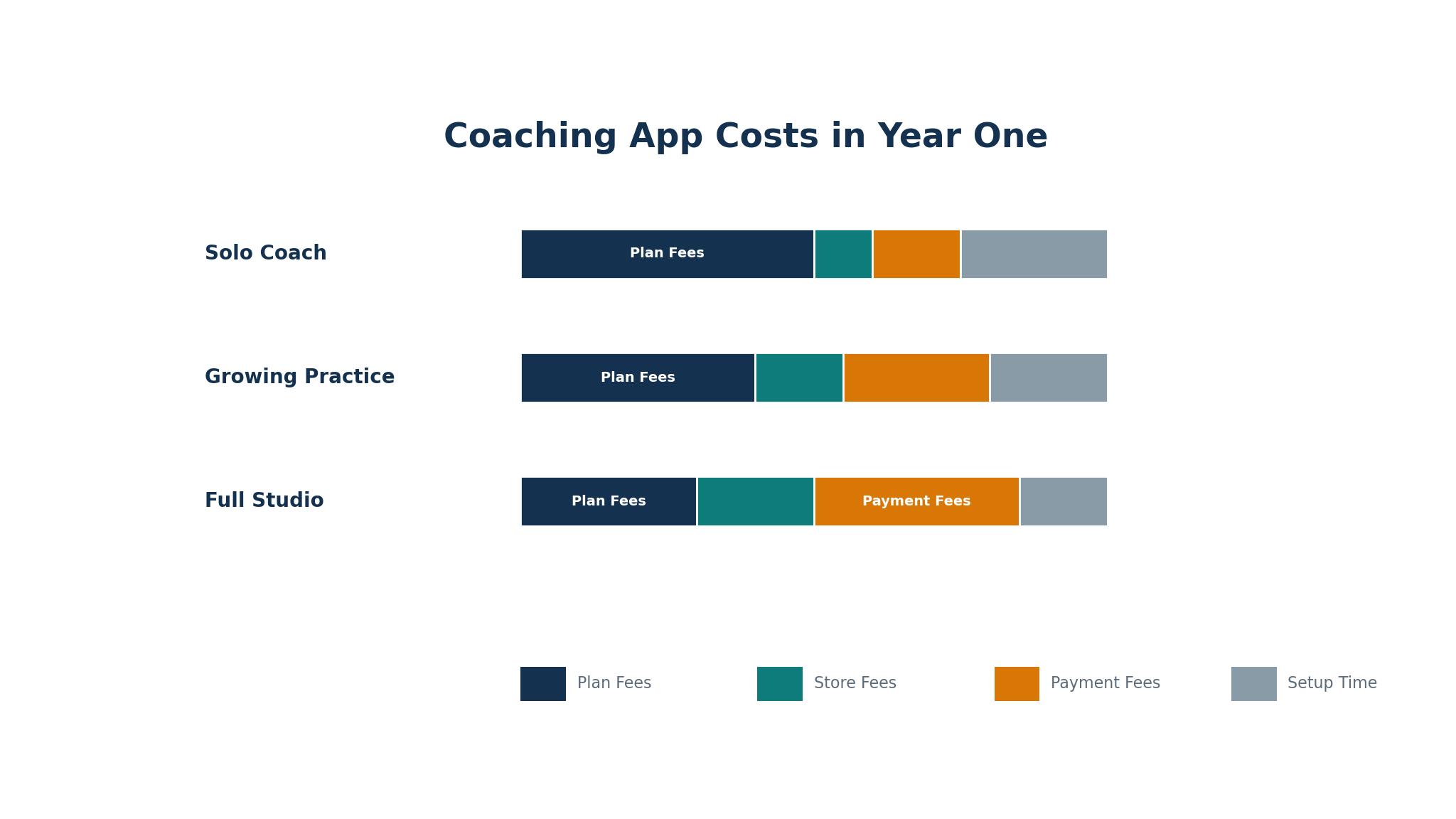
The plan price is only the first line for the best ai app builders for coaches, since store fees, payment fees, and the coach’s time all add up. Glide Basic at $25 a month costs $300 a year, Softr Basic at $19 a month billed annually costs $228, and Bubble Starter at $32 a month billed annually costs $384, all before Stripe fees of around 2.9 percent plus $0.30 per payment. A native app adds the Apple Developer fee of $99 a year and a one-time Google Play fee of $25, plus the time to pass store review.
Usage pricing is the hidden cost on Bubble, since workload units measure server resources and a popular app can exceed the Starter allowance. A coach should watch the usage dashboard in the first month and budget for the Growth tier at $119 a month if the app takes off. Adalo’s flat pricing avoids that surprise, which is why some coaches prefer it despite the higher headline price.
Work out the twelve-month total, including the plan, the store fees, and the payment fees on the coach’s actual revenue. Then compare it with the revenue from clients who stay because the app keeps them engaged. An app that keeps five clients paying $100 a month pays for any tool in this list many times over, while an app nobody opens costs the subscription and the time.
Keeping Clients Opening the App Every Week
An app built with the best ai app builders for coaches that clients open once and forget is a cost, not a tool, and the fix is a weekly reason to return. A new workout each Monday, a new resource each Wednesday, and a check-in each Friday give the client three reasons to open the app every week, and the coach should build that rhythm into the programme from the start. A tool that supports scheduled content and reminders will make the rhythm easy, while a tool that only shows static pages will not.
The coach should watch the usage numbers weekly, not monthly. Count how many clients opened the app, how many logged a workout or a check-in, and how many messaged, then ask the quiet ones what would bring them back. Their answers will tell the coach what to change, and the change is usually a simpler flow or a clearer next step, not a new feature.
Start with one programme and ten clients, not the whole practice at once. A pilot that shows real usage in a month will win over the sceptics and give the coach a real retention number to judge the full rollout on. A coach who launches to everyone at once will spend the first month fixing problems for a hundred clients instead of learning from ten.

Frequently Asked Questions
Which app builder is best for a fitness coach?
Among the best ai app builders for coaches, Glide is the strongest answer for a fitness coach, since it turns a programme spreadsheet into a client app in an afternoon, with progress tracking and messaging, starting from $25 a month. Adalo is the best answer when the coach wants a native app in the store, and Softr is the best answer for a client portal with resources. The choice comes down to whether the coach values speed, store presence, or a portal most.
Does a coach need a native app or a web app?
A coach needs a native app when clients expect to find it in the App Store and tap an icon on their phone, which suits fitness and habit apps that clients open daily. A coach needs a web app when speed and easy updates matter more, since a web app ships in days and updates instantly without store review. Glide and Softr build web apps, while Adalo, FlutterFlow, and Draftbit build native apps, and the usage pattern decides between them.
How much should a coach pay for an app builder?
Most coaches in this guide pay between $19 and $52 a month, with Softr at $19 a month billed annually, Glide at $25, Bubble at $32, and Adalo at $52. A coach building a native app should add the Apple Developer fee of $99 a year and the Google Play fee of $25 once. The twelve-month total, including payment fees, is the number that matters, and five retained clients paying $100 a month cover any tool here.
Can AI really build a coaching app?
AI can draft an app from a description in an afternoon, and Glide, Bubble, and FlutterFlow all offer AI help, but the draft is a starting point that needs a week of reshaping with real programme content. The AI does not know the coaching method, the client flow, or the payment structure, and the coach has to add all three. A tool whose AI draft needs hours of fixing is slower than a good template, and the coach should judge the AI on the first draft from real content.
What happens if the coach wants to leave the builder?
A coach can leave cleanly when the tool exports code, which FlutterFlow and Draftbit both do, since the app code can be taken elsewhere. Glide, Softr, and Bubble keep the app on their platform, so leaving means rebuilding, and the coach should export the client data regularly. A coach who plans to grow should choose a tool with code export or accept that the app lives on the platform for its life.
Should a coach hire a developer or use an app builder?
A coach should use an app builder when the app is a programme, a portal, or a tracker, since the tools in this guide build those in days for $19 to $52 a month. A coach should hire a developer when the app needs custom logic, unique integrations, or a level of polish no builder offers, which costs thousands and takes months. Most coaches should start with a builder, prove the app with ten clients, and hire a developer only when the builder cannot do what the clients need.
The Verdict for Coaches Choosing an App Builder in 2026
Glide is the best pick for most coaches, since it turns a programme into a client app in an afternoon at a clear price. Softr is the best pick for a coach who wants a client portal on existing data, and Bubble is the best pick for a coach building a full custom platform. Adalo is the best pick for a simple native app at a flat price, and Draftbit is the best pick for a native app with code export on a budget.
Build one real programme in the trial, give it to five clients, and count how many open it on three days out of five. The tool that clients actually use is the right one for the coach, and the rest is marketing.