

A founder who writes a business plan from a blank page usually discovers the gap when the lender asks for a cash-flow forecast and the document has only words. A founder who buys a template pack usually discovers the opposite gap, when the plan looks finished but the numbers do not connect, and one changed assumption breaks nothing because nothing was linked in the first place. The best ai business plan generators for small businesses close both gaps, and the choice between the two approaches decides whether the plan survives its first meeting with a bank.
The split comes down to what the plan has to do. A founder applying for an SBA loan needs a lender-ready document with linked financials, while a founder testing an idea needs a quick canvas and a reality check before spending money. A consultant writing plans for clients needs white-label output and team seats, while a solo founder needs a guided builder that asks the right questions in order. A lender document, a validation canvas, and a white-label output are three separate jobs, and the shortlist is organised around them.
This guide compares fifteen live systems on planning work. Prices are list prices as published by the vendors in late 2026, before tax. Where a vendor sells by quote, the guide says so, and where a plan offers a lifetime deal, the guide states it.
The Financial Model, Not the Template
A business plan is a financial model with words around it, and the model is the part a lender reads first. A real model links the income statement, the cash-flow statement, and the balance sheet, so changing one assumption moves all three together. LivePlan is built this way, with a true three-statement forecast and more than 550 sample plans, which is why lenders and accountants keep recommending it.
An AI generator that only writes prose is a faster way to produce a weak plan. The AI text sounds confident, the market section reads well, and the numbers underneath are guesses that no lender will accept. Upmetrics pairs AI drafting with forecasting, which is stronger, while Bizplanr and IdeaBuddy lean toward speed and idea validation. The test is whether the tool asks for real inputs, such as pricing, costs, and hiring plans, before it writes a word.
Ask each vendor to show a forecast built from sample inputs, then change the price by ten percent and watch the statements move. The best ai business plan generators for small businesses will update income, cash, and balance together, while a template tool will leave the numbers frozen. A plan whose numbers do not move is a document, not a model, and a lender will spot the difference in minutes.
AI Drafting, Sources, and the Lender Test
AI drafting saves hours on the first version, but it creates a new problem, since the AI invents market figures, competitor claims, and customer numbers that sound real and are not. A lender who asks for a source will find none, and the plan loses credibility at the exact moment it needs it most. The founder has to replace every AI-generated fact with a real one, and the tool should make that easy rather than hiding it.
LivePlan’s AI assistant works inside a guided structure with benchmarks, which keeps the numbers grounded, while Upmetrics offers AI writing plus forecasting at a lower price. The founder should treat AI output as a draft to verify, not as a finished section, and should keep a list of every claim that needs a source before the plan goes out. A plan with three verified numbers beats a plan with thirty invented ones.
Test this with one section from a real idea. Let the AI draft the market section, then check every figure against a real source. Count how many claims survive and how many need replacing. The tool that produces the most verifiable claims is the one worth paying for, and the tool that invents the most is a liability dressed as a shortcut.
Pitch Decks, One-Page Plans, and What Comes After
A full plan is rarely the first document a founder needs. An investor asks for a pitch deck, a partner asks for a one-page summary, and a lender asks for the full plan with financials. The better tools in this list produce all three from the same inputs, so the numbers agree across every version. LivePlan includes a pitch builder, Upmetrics includes a pitch deck builder, and several others export a summary that matches the full plan.
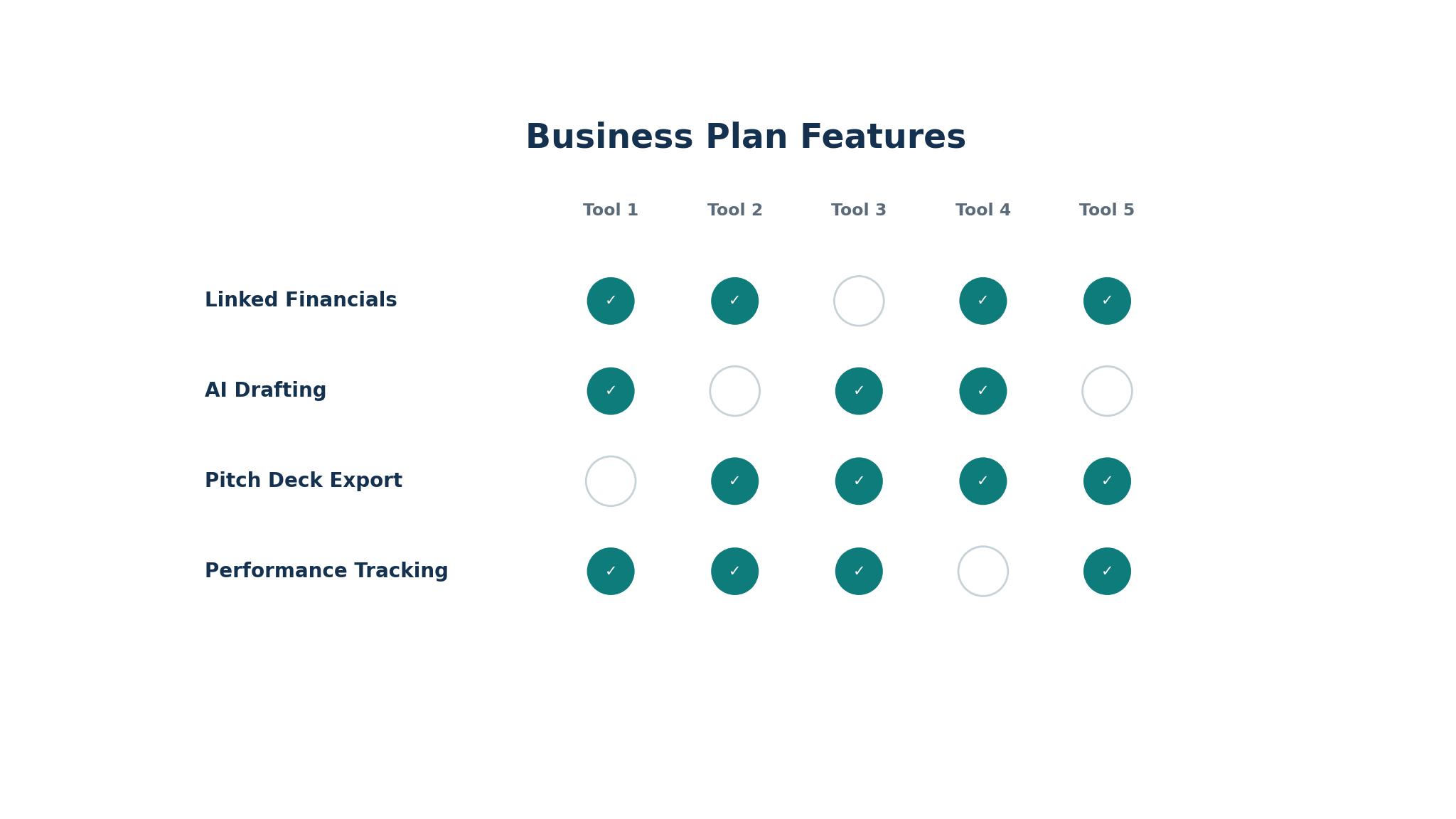
The plan also has to live after it is written. A founder who tracks actuals against the forecast each month will spot a cash problem early, while a founder who files the plan and forgets it will not. LivePlan and Upmetrics both offer performance tracking, comparing real results with the plan, and that tracking is the feature that separates a planning tool from a writing tool.
Check the export options in the trial, since the plan has to leave the tool in a form a lender accepts. A clean PDF, a Word export, and a spreadsheet of the financials cover most needs, while a tool that only exports its own format will trap the plan inside it. Export a full plan in the trial and open it on another computer to check it reads cleanly.
The 15 Tools at a Glance
The table below gives the short version of the best ai business plan generators for small businesses, with each tool, its main job, and its starting price.
| Tool | Main job | Best for | Starting price |
|---|---|---|---|
| LivePlan | Guided plans and forecasting | Lender-ready plans | From $15 per month, billed annually |
| Upmetrics | AI plan writing and forecasting | AI drafting at a low price | From $7 per month, billed annually |
| Bizplan | Visual plan builder | Fundraising stories | From $29 per month |
| IdeaBuddy | Idea validation and planning | Testing an idea early | Free plan, paid from $6 per month |
| PlanPros | AI business plan generation | Fast AI-generated plans | Custom quote |
| Enloop | Automated plan writing | Quick automated plans | Custom quote |
| StratPad | Business planning and strategy | Step-by-step planning | Pricing on the vendor site |
| GoSmallBiz | Planning plus business tools | Planning with web tools | From $15 per month |
| Cuttles | Startup planning and validation | Early-stage founders | Custom quote |
| Bizplanr | Free AI plan generation | Free AI plans | Free, $99 one-time for premium |
| PlanGuru | Financial planning and analysis | Deep financial modelling | From $83 per month |
| Business Sorter | Idea sorting and planning | Organising a new idea | Custom quote |
| VentureKit | Guided business planning | Step-by-step guided plans | Custom quote |
| Bplans | Sample plans and templates | Free templates and examples | Free |
| Growthink | Planning with expert help | Plans with human support | Custom quote |
Best Pick by Job
This table matches the best ai business plan generators for small businesses to the job it fits, so a loan applicant and an idea tester do not end up buying the same system.
| Job type | First pick | Second tool | Why this pair works |
|---|---|---|---|
| SBA loan or investor plan | LivePlan | Upmetrics | LivePlan leads on lender trust while Upmetrics adds AI speed |
| AI drafting on a budget | Upmetrics | Bizplanr | Upmetrics drafts cheaply while Bizplanr starts free |
| Idea validation first | IdeaBuddy | Cuttles | IdeaBuddy tests the idea while Cuttles structures the plan |
| Lifetime deal | Bizplan | LivePlan | Bizplan sells lifetime access while LivePlan adds forecasting depth |
| Free plan to start | Bizplanr | Bplans | Bizplanr generates free while Bplans offers free templates |
| Deep financial modelling | PlanGuru | LivePlan | PlanGuru models deeply while LivePlan keeps the plan readable |
| Planning with human help | Growthink | GoSmallBiz | Growthink adds expert support while GoSmallBiz adds business tools |
| Step-by-step guidance | StratPad | VentureKit | StratPad guides strategy while VentureKit guides the plan |
How to Choose the Best AI Business Plan Generators for Small Businesses
The best ai business plan generators for small businesses prove themselves on a real idea, not on a demo with sample data. Take one real business idea, with real pricing, real costs, and a real hiring plan, and build it in the trial. Then change the price by ten percent and check whether income, cash, and balance all move together. The tool that links the statements is the one a lender will trust, and the tool that leaves them frozen is a template with AI on top.
Check the template library next, since the examples show what a good plan looks like. LivePlan offers more than 550 sample plans, Upmetrics offers more than 400, and Bplans offers free templates across many industries..
Price the whole year, including the cost of the tier that holds the features the founder actually needs. LivePlan Standard at $15 a month covers most founders, Premium at $30 adds accounting links, and Upmetrics Premium at $14 a month covers AI drafting with forecasting. A founder should buy the tier that includes the pitch deck and the tracking, since those are the features that matter after the plan is written.
The 15 Tools in Detail
1. LivePlan
LivePlan is the most established business planning platform, with guided step-by-step plans, a true three-statement forecast, and more than 550 sample plans. Standard costs $15 a month billed annually, Premium costs $30, and both include a pitch builder, benchmarks, and performance tracking. Its strength is lender trust, since banks and accountants know the format.
The honest drawback is AI depth. LivePlan’s AI assistant helps with writing but does not draft a whole plan the way Upmetrics does, and the price is higher than the budget tools. A founder who wants full AI drafting will find it slower.
It suits founders applying for an SBA loan or presenting to investors.
Build a full plan in the trial from a real idea, then change one assumption and watch the statements move. If income, cash, and balance move together, the model is real.
2. Upmetrics
Upmetrics combines AI business plan writing with financial forecasting and performance tracking, starting from $7 a month on Starter billed annually, with Premium at $14 and Professional at $37. Its strength is value, since it offers AI drafting, more than 400 templates, a pitch deck builder, and forecasting for less than LivePlan. It suits founders who want AI to shoulder the first draft.
The honest drawback is model depth. Upmetrics guides forecasting rather than building interconnected accounting logic, and its AI market copy needs checking against real sources. A lender may ask harder questions about the numbers than about a LivePlan forecast.
It suits budget-conscious founders who want AI drafting plus forecasts.
Let the AI draft a full plan in the trial, then verify every market claim against a real source. If most claims survive, the drafting is useful, and if few do, the founder is doing the research anyway.
3. Bizplan
Bizplan offers a simple visual plan builder with a financial dashboard and access to funding education, priced at $29 a month, $249 a year, or $349 once for lifetime access. Its strength is the lifetime deal, since a founder who plans several businesses pays once and keeps the tool. It suits serial founders and fundraisers.
The honest drawback is AI depth. Bizplan has almost no AI features in 2026, so a founder who wants AI drafting will find it behind Upmetrics and LivePlan. The financial tools are also simpler than LivePlan’s linked model.
It suits founders who want a visual builder and a lifetime deal.
Build a plan in the trial and check the financial dashboard against a spreadsheet. If the dashboard matches and the lifetime price fits, the deal is fair.
4. IdeaBuddy
IdeaBuddy focuses on the earliest stage, shaping and testing an idea before the founder commits money. It offers a free tier covering one business plan, with paid tiers from $6 a month, and includes a business model canvas, step-by-step guidance, and AI help. Its strength is idea validation, since it scores and tests the concept first.
The honest drawback is depth. IdeaBuddy is an idea tool rather than a full planning platform, so a founder who needs a lender-ready plan will outgrow it. The financial tools are lighter than LivePlan or Upmetrics.
It suits first-time founders testing an idea.
Test a real idea in the trial and check the validation score against your own judgement. If the score highlights a real weakness, the tool is adding value.
5. PlanPros
PlanPros is an AI business plan generator that builds a full plan from a short questionnaire, sold by quote. Its strength is speed, since a founder can go from idea to draft in an afternoon, and the output is structured for investors. It suits founders who want a fast first draft.
The honest drawback is price transparency and verification. PlanPros sells by quote, so budgeting means a sales conversation, and the AI output needs the same fact-checking as any AI draft. A founder should not submit it without verifying every claim.
It suits founders who want a fast AI-generated plan and are willing to verify it.
Generate a plan in the trial from a real idea and check every market figure against a real source. If the structure is strong and the facts are fixable, the speed is worth it.
6. Enloop
Enloop automates business plan writing, generating text and financial projections from the founder’s inputs, with a free trial and paid plans by quote. Its strength is automation, since it writes the plan and builds the financials with little manual work. It suits founders who want a quick automated draft.
The honest drawback is depth and price transparency. Enloop’s financials are simpler than LivePlan’s linked model, and the quote-based pricing makes comparison slow. A founder facing a strict lender will need more than Enloop produces.
It suits founders who want a fast automated plan for an internal decision.
Run a real idea through Enloop in the trial and check the financial projections against a spreadsheet. If the numbers are close, the automation is useful.
7. StratPad
StratPad is a business planning and strategy tool with step-by-step guidance, covering the plan, the strategy, and the financials in one place. Pricing is on the vendor site. Its strength is the strategic view, since it links the plan to the strategy rather than treating the plan as a document alone.
The honest drawback is AI depth and price clarity. StratPad is a guided tool rather than an AI generator, so a founder who wants AI drafting will find it slower, and the pricing is not published plainly. A founder should check the price before committing time.
It suits founders who want strategy with their plan.
Work through the strategy section in the trial with a real idea and check whether it changes any decision. If it does, the strategic view is adding value.
8. GoSmallBiz
GoSmallBiz offers business planning with industry templates, multi-year projections, tutorials, and web presence tools, starting from $15 a month on Basic and $49 on Essentials. Its strength is breadth, since the plan sits alongside tools for running the business, not just writing about it. GoSmallBiz suits entrepreneurs who want planning plus digital tools.
The honest drawback is focus. GoSmallBiz is a general small-business toolkit, so its planning tools are less deep than LivePlan, and the AI drafting is thinner than Upmetrics. A founder who only needs a plan will pay for tools they never open.
It suits entrepreneurs who want planning plus a website and business tools in one subscription.
Build a plan in the trial and check the multi-year projections against your own spreadsheet. If they match, the breadth is a bonus, and if they do not, the founder should use a specialist.
9. Cuttles
Cuttles is a startup planning tool that helps early-stage founders move from a rough idea to a structured plan, with templates, guidance, and validation. Pricing is by quote. Its strength is the early-stage focus, since it asks the questions a new founder needs to answer before writing a full plan.
The honest drawback is depth and price transparency. Cuttles is lighter than LivePlan on financials, and the quote-based pricing makes comparison slow. A founder who needs a lender-ready plan will outgrow it.
It suits early-stage founders structuring a first idea.
Structure a real idea in Cuttles in the trial and check whether the plan reads clearly to a colleague. If it does, the early-stage focus is working.
10. Bizplanr
Bizplanr is an AI-first business plan generator with a free tier and a $99 one-time premium, offering AI generation of a full plan without a subscription. Its strength is the free start, since a founder can generate a plan without paying, and the one-time premium is cheap against a monthly subscription. It suits founders on a tight budget.
The honest drawback is depth. Bizplanr generates quickly but its financials are simpler than LivePlan’s linked model, and the AI output needs verification. A founder facing a lender will need to strengthen the numbers.
It suits founders who want a free AI plan to start.
Generate a plan in the trial from a real idea and check the financials against a spreadsheet. If the structure is sound, the free start is genuine value.
11. PlanGuru
PlanGuru is a financial planning and analysis platform starting from $83 a month, with deep budgeting, forecasting, and reporting. Its strength is modelling depth, since it handles multi-year forecasts, consolidations, and scenario analysis that the plan-writing tools cannot. It suits businesses that plan financially first.
The honest drawback is price and purpose. At $83 a month, PlanGuru costs far more than the plan builders, and it is a modelling tool rather than a plan writer, so a founder still needs to write the narrative elsewhere. A small founder will find it too dear and too deep.
It suits businesses with a finance lead who needs deep modelling.
Build a three-year forecast in the trial and run two scenarios against it. If the scenarios show the risk clearly, the modelling depth is worth the price.
12. Business Sorter
Business Sorter is a planning tool that helps a founder sort and organise a new idea, with structured templates and guidance for shaping the concept before writing. Pricing is by quote. Its strength is clarity, since it forces the founder to organise the idea before drafting the plan.
The honest drawback is depth and price transparency. Business Sorter is an organising tool rather than a full planning platform, so a founder who needs financials will need another tool, and the quote-based pricing makes comparison slow.
It suits founders with a messy idea that needs organising.
Organise a real idea in Business Sorter in the trial and check whether the structure makes the plan easier to write. If it does, the organising step is worth it.
13. VentureKit
VentureKit is a guided business planning tool with step-by-step templates and financial models for funding rounds. Pricing is by quote. Its strength is the funding focus, since it builds the documents a funding round needs, including the plan and the financial model behind it.
The honest drawback is price transparency and AI depth. VentureKit sells by quote, and its AI drafting is thinner than Upmetrics, so a founder who wants a fast AI draft will find it slower. A founder should check the price before committing.
It suits founders preparing a funding round.
Build the funding documents in the trial from a real idea and check whether an investor would accept the format. If they would, the funding focus is paying off.
14. Bplans
Bplans offers free sample business plans and templates across many industries, with no subscription needed. Its strength is the library, since a founder can read real plans in their own industry before writing, and the templates are free. It suits founders who want to learn from examples.
The honest drawback is that it is a library, not a builder. Bplans does not generate a plan or link financials, so the founder still has to write and model everything. A founder who wants guidance will find it too passive.
It suits founders who want free examples before writing.
Read two sample plans in your industry on Bplans and note the structure and the financials. If the samples clarify what a good plan looks like, the library has done its job.
15. Growthink
Growthink is a business planning service with expert help, offering planning tools plus human support for founders who want guidance. Pricing is by quote. Its strength is the human element, since a founder can talk to a planner rather than only using software, and the plans are built with professional input.
The honest drawback is cost and speed. Human help costs more than software alone, and the process takes longer than an AI generator. A founder on a tight budget will find it dear, and a founder in a hurry will find it slow.
It suits founders who want expert help with a high-stakes plan.
Talk to a planner in the trial about a real idea and check whether the advice changes any decision. If it does, the human help is worth the price.
What a Business Plan Really Costs to Build
The subscription is the smallest part of the cost for most founders using the best ai business plan generators for small businesses. LivePlan Standard at $15 a month costs $180 a year, Upmetrics Premium at $14 costs $168, and Bizplan at $29 a month costs $348, while Bizplanr costs $99 once and Bplans costs nothing. The real cost is the founder’s time, since a plan takes twenty to forty hours to build well, and a tool that saves ten of those hours is worth far more than its subscription.
Lifetime deals change the maths for serial founders. Bizplan at $349 once beats $29 a month after a year, and Bizplanr at $99 once beats any monthly plan within months. A founder who plans several businesses should buy lifetime, while a founder who plans once should buy annually and cancel when the plan is done. The wrong choice is paying monthly for a year for a plan that took a month to write.
Work out the total cost, including the founder’s hours, before choosing. A tool that costs $15 a month but saves twenty hours is cheap, while a tool that costs nothing but needs forty hours of manual work is dear. The founder should price the time, not just the subscription.
Tracking the Plan After the Money Arrives
A plan built with the best ai business plan generators for small businesses that is filed and forgotten is a wasted plan, and the tracking is where the value sits. LivePlan and Upmetrics both compare actual results with the forecast each month, showing whether revenue, costs, and cash are on plan or off it. A founder who reviews that comparison monthly will spot a cash problem while there is still time to fix it, while a founder who never looks will find out from the bank.
The monthly review should take an hour, not a day. Enter the actuals, read the variance report, and note the three numbers that moved most, then decide what changes next month. A tool that makes that review easy will get used, while a tool that buries the variance in a dozen reports will not.
Set a reminder for the first Monday of each month and treat the review as a meeting with yourself. The plan is a promise the founder made to the business, and the review is where the promise gets checked.

Frequently Asked Questions
Which business plan tool is best for an SBA loan?
Among the best ai business plan generators for small businesses, LivePlan is the strongest answer for an SBA loan, since it offers a true three-statement forecast, more than 550 sample plans, and a format lenders and accountants know. Upmetrics is the best budget alternative, with AI drafting and forecasting for less. A founder should read two sample plans in their industry before writing, since the samples show the detail a lender expects.
Is Upmetrics really cheaper than LivePlan?
Yes, Upmetrics Premium costs $14 a month billed annually against LivePlan Standard at $15, and Upmetrics Starter costs $7 a month. The difference is small on price and larger on depth, since LivePlan’s linked financial model is stronger and its lender trust is higher. A founder should choose on the lender’s needs, not on a dollar a month, since the loan is worth far more than the subscription difference.
How much should a founder pay for a business plan tool?
Most founders in this guide pay between $7 and $30 a month on the annual rate, with Upmetrics from $7, LivePlan from $15, and Bizplan at $29. A founder testing an idea should pay nothing and use Bizplanr or Bplans free, while a founder applying for a loan should pay for LivePlan or Upmetrics. The cost per hour saved is the number that matters.
Can AI write a business plan on its own?
No, AI can draft a plan, but it invents market figures and competitor claims that a lender will check, and the founder has to verify every fact before submitting. The best use of AI is a first draft that the founder corrects with real sources, real pricing, and real costs. A plan submitted with invented figures will lose credibility at the exact moment it needs it most.
What is the difference between a plan and a pitch deck?
A business plan is the full document with the narrative, the market analysis, and the linked financials, while a pitch deck is a short visual summary for investors. LivePlan and Upmetrics both produce a deck from the same inputs as the plan, so the numbers agree across both. A founder should build the plan first and the deck from it, rather than building a deck with numbers that do not match the plan.
Should a founder buy a lifetime deal or subscribe?
A founder should buy a lifetime deal when they plan several businesses, since Bizplan at $349 once beats $29 a month after a year. A founder should subscribe when they plan once, since LivePlan at $15 a month for a few months costs less than a lifetime deal.
The Verdict for Small Businesses Choosing a Business Plan Generator in 2026
LivePlan is the best pick among the best ai business plan generators for small businesses for most small businesses, since it pairs a true financial model with lender trust and more than 550 sample plans. Upmetrics is the best pick for a founder who wants AI drafting at a low price, and Bizplan is the best pick for a serial founder who wants a lifetime deal. Bizplanr is the best free pick for testing an idea, and IdeaBuddy is the best pick for validating a concept before committing money.
Build a real idea in the trial, change the price by ten percent, and watch the statements move. The tool that links income, cash, and balance together is the right one for the business, and the rest is marketing.