

The best AI business plan generator isn’t the one that writes the prettiest executive summary — it’s the one whose financials survive follow-up questions from a banker or investor. Any AI can produce ten pages of confident narrative. What separates the tools below is the unglamorous stuff: are the projections internally consistent? Is the market analysis sourced or invented? Can you export a pitch that matches the numbers in the plan?
So we ran a controlled test: we created a plan for the same fictional startup in LivePlan, Upmetrics, PrometAI, and Venturekit, then graded each plan on financial depth, market analysis quality, and pitch export. The winner for a bank loan wasn’t the winner for a seed round — and the cheapest tool had a billing caveat you should know about before entering your card.
Quick Answer
| Tool | Entry price (Oct 2026) | Financials grade | Market analysis grade | Best for |
|---|---|---|---|---|
| LivePlan | $20/mo ($15/mo annual) | A | A− (sourced data) | Bank loans & SBA lenders |
| Upmetrics | $19/mo ($14/mo annual) | B+ | B | Best AI first draft at lowest price |
| PrometAI | Free to start; paid $55/mo | A− | B+ | Equity raises & valuation |
| Venturekit | Free; Pro $19/mo or $96/yr | B | B− | Founders who want plan + deck + research cheap |
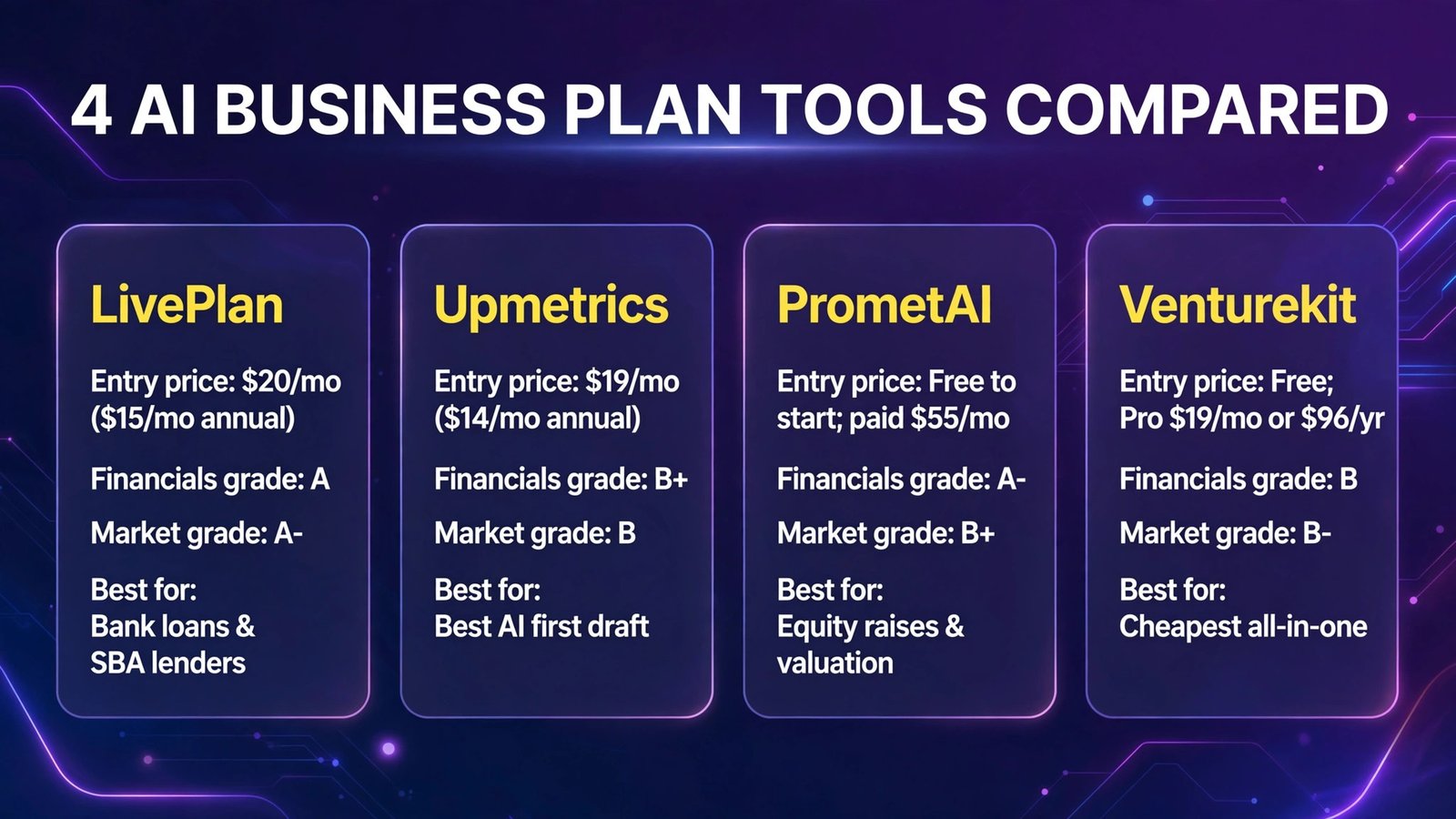
Bottom line: LivePlan is the best AI business plan generator for anything a lender will read — a true three-statement financial model and sourced market data. PrometAI is the pick for equity fundraising, with valuation and unit economics built in. Upmetrics delivers the best AI-assisted drafting at the lowest serious price. Venturekit is the cheapest all-in-one, but read the billing terms before you pay.
The Test Startup: One Idea, Four Plans
Every tool received the identical fictional business:
Compost Crew — a subscription food-scrap composting pickup service for urban households. $24/month per household, weekly curbside pickup, compost returned to customers twice a year. Launch city: Austin, Texas. Year 1 target: 800 subscribers. Seeking $150,000 to buy two collection vehicles and hire three drivers.

We entered the same assumptions everywhere: the $24 price, the 800-subscriber target, the same startup costs, and the same funding ask. Then we graded the output on three axes — financials (are the statements real and consistent?), market analysis (specific and sourced, or generic?), and pitch export (does the one-pager/deck match the plan’s numbers?).
1. LivePlan — Best for Lender-Ready Plans
What it is: LivePlan is the veteran of this category — business planning software from Palo Alto Software (the Business Plan Pro people) that pairs step-by-step guidance and 550+ sample plans with a genuine financial forecasting engine and an AI writing assistant. Its methodology is the one SBA lenders and loan officers recognize.
2026 pricing (verified): Standard $20/month ($15/month billed annually) — AI writing assistant, full financial forecasting, lender-ready statements, sample plan library, pitch builder. Premium $40/month ($30/month annual) adds industry benchmark data, forecast scenarios, performance dashboards, and QuickBooks/Xero sync for plan-vs-actual tracking. Plans come with a 35-day money-back guarantee. No free tier.
Our test grades: Financials A, Market A−, Pitch A−. LivePlan was the only tool whose Compost Crew plan came out with a true three-statement model — P&L, cash flow, and balance sheet that actually interlock, so changing the subscriber price flowed correctly through revenue, vehicle capacity, and cash. That’s the difference between a forecast and a story. Its market section pulled from 50+ verified sources with attributable citations rather than generating unsourced claims, and the built-in Plan Review flagged our (deliberately thin) staffing assumptions before we exported. The one-page pitch was clean and matched the plan’s numbers exactly. The AI writing assistant is the most conservative here — it drafts solid, lender-appropriate prose rather than flashy startup copy, which is exactly what you want for a bank.

Pros:
- True interconnected three-statement financial model — lender-grade
- Market research drawn from verified sources with citations
- Plan Review check + 550+ sample plans to benchmark against
- QuickBooks/Xero sync for plan-vs-actual tracking after you launch
Cons:
- No free plan or free tier — you pay from day one (mitigated by the 35-day guarantee)
- AI writing is solid but the least flashy — less generative “wow” than Upmetrics
- Design/layout customization of the exported plan is limited
Verdict: The best AI business plan generator for bank loans, SBA applications, and any reader who will stress-test your numbers.
2. Upmetrics — Best AI Drafting at the Lowest Price
What it is: Upmetrics is an AI-powered business planning workspace aimed squarely at modern founders: an AI plan writer, guided financial forecasting, strategic frameworks (SWOT, Lean Canvas, Business Model Canvas), a pitch deck builder, and plan-vs-actual tracking — all in one linked workspace where changing a financial assumption can update the deck.
2026 pricing (verified): Two plans. Premium $19/month ($14/month billed annually) — AI plan writing and assistance, 7-year financial forecasting, pitch deck creator, exports to PDF/DOC/PPT and Excel, 400+ sample plans. Professional $49/month ($37/month annual) adds multiple workspaces, 10-year forecasting, custom templates, and accounting integrations — built for consultants running several client plans. A 15-day money-back guarantee applies; there’s no free plan or free trial per current listings.
Our test grades: Financials B+, Market B, Pitch A. Upmetrics produced the best first draft of the four. Feed it Compost Crew and you get a complete, well-structured plan in minutes, with AI rewriting tools that let you adjust tone and depth section by section — faster and more flexible drafting than LivePlan. The pitch deck export was the best-looking here, and it stayed consistent with the plan because the two live in the same workspace. Where it lost marks: forecasting is guided rather than LivePlan’s interconnected accounting logic — our statements were plausible and clearly presented, but a sharp lender could poke holes in how assumptions linked together; and the market analysis, while specific to Austin composting, was AI-generated without source citations, so you’d need to verify the numbers before showing them to anyone serious.
Pros:
- Best AI writing workflow — fastest path to a complete, editable first draft
- Plan, forecast, and pitch deck linked in one workspace (numbers stay consistent)
- Lowest serious entry price: $14/month billed annually
- Strategic planning frameworks (SWOT, Lean Canvas) built in
Cons:
- Financial model lacks LivePlan’s three-statement interconnectivity
- Market analysis is AI-generated without citations — verify before investor use
- No free plan or trial; multiple client plans require the $49 Professional tier
- Less institutional recognition with traditional lenders than LivePlan
Verdict: The best AI business plan generator for founders who want AI to do the heavy drafting at the lowest price — then verify the market numbers before you send it anywhere.
3. PrometAI — Best for Equity Raises and Valuation
What it is: PrometAI is the finance-heavy option in this comparison: an AI business plan generator that builds valuation modeling, unit economics, and market sizing directly into the plan — aimed at founders raising equity, applying for startup visas, or preparing immigration-program business plans, where the numbers matter as much as the narrative.
2026 pricing (verified): Free Explore tier (1 plan, 25 AI requests/month) to test the product. Application-Ready $55/month and Investor-Grade $145/month, with substantial discounts on quarterly or annual billing. That makes it the priciest paid option here — but also the most finance-dense.
Our test grades: Financials A−, Market B+, Pitch B+. PrometAI’s Compost Crew plan was the only one that included a valuation model and unit economics as first-class citizens: customer acquisition cost, lifetime value, and payback math for the $24 subscription were computed and explained, not asserted. For an equity investor, that framing is worth more than another page of market narrative. The financial statements were strong — deep scenario tools and cash-flow modeling — though the writing itself was more analyst than storyteller. Export to PDF and Word worked cleanly. The downside is scope: this is a finance tool wearing a business-plan hat, not a full planning workspace. It won’t track plan-vs-actuals like LivePlan or Upmetrics, and at $55–$145/month it’s a fundraising-period expense, not a permanent subscription.

Pros:
- Built-in valuation model and unit-economics analysis — unique here
- Deep financial modeling: P&L, balance sheet, cash flow, scenarios
- Free Explore tier (1 plan, 25 AI requests/month) for real evaluation
- Formats suited to equity raises and startup-visa/immigration applications
Cons:
- Most expensive paid tiers ($55–$145/month) — hard to justify outside fundraising
- Not a full planning workspace: no plan-vs-actual tracking, weaker ongoing tools
- Writing is analyst-grade rather than persuasive; expect editing
- Overkill for a simple bank loan, where LivePlan’s lender format wins
Verdict: The best AI business plan generator for founders raising equity or needing a defensible valuation — a specialist tool worth its price during a raise.
4. Venturekit — Cheapest All-in-One (With a Billing Caveat)
What it is: Venturekit is an AI business plan generator that bundles the plan, financial forecast, pitch deck, market research, and a competitor-tracking “Radar” feature in one workflow — positioned as the investor-focused, low-cost option. Its hook is the free tier: genuinely unlimited light plans to explore the tool before paying.
2026 pricing (verified): Free — unlimited light/preview business plans. Pro $19/month or $96/year (equivalent to $8/month annual), including 3 full-plan credits per billing cycle with financials, pitch deck, research, and AI assistant. Agency $49/month ($456/year) with 20 credits for consultants. Credits unlock one company each and do not roll over.
Our test grades: Financials B, Market B−, Pitch B. Venturekit’s Compost Crew output was complete and impressively bundled: a full plan, a pitch deck, and market research from a single input flow, at a fraction of the rivals’ prices. The financials were adjustable after generation and stayed internally consistent for a simple model. The catch was depth: because Venturekit asks for less detail upfront, our market section read generic in places — correct in outline, missing the specifics an investor would probe — and needed the most editing of the four before we’d show it to anyone. Two billing notes worth knowing: independent reviews report surprise charges (one source’s Trustpilot rating was suspended over guideline issues, and multiple users describe being charged without realizing they’d signed up), so read the billing terms carefully and confirm the plan-credit mechanics before entering your card. This isn’t disqualifying — but it’s not the tool to buy in a hurry.
Pros:
- Cheapest path to plan + deck + research in one product ($8/month effective on annual)
- Unlimited free light plans for exploring before you pay
- All sections rewritable with the AI writing assistant; financials adjustable
- Competitor tracking and pitch deck included at the entry price
Cons:
- Output needs the most editing — thin upfront inputs produce generic sections
- No collaboration tools for co-founders or advisors
- Reported billing complaints and Trustpilot issues — check terms carefully before paying
- Credit-based model (3 full plans per cycle) can bite if you iterate a lot
Verdict: The best budget AI business plan generator if you read the billing terms first — great value for a complete plan-plus-deck, with honest editing required.
Pricing Table
| LivePlan | Upmetrics | PrometAI | Venturekit | |
|---|---|---|---|---|
| Entry price (monthly) | $20/mo | $19/mo | $55/mo | $19/mo |
| Entry price (annual) | $15/mo | $14/mo | Discounted quarterly/annual | $8/mo ($96/yr) |
| Free tier | None (35-day guarantee) | None | Explore: 1 plan, 25 AI req/mo | Unlimited light plans |
| Top tier | $40/mo ($30 annual) | $49/mo ($37 annual) | $145/mo Investor-Grade | $49/mo Agency |
| Financials | Three-statement model | Guided forecasting | Valuation + unit economics | Adjustable forecasts |
| Market research | 50+ cited sources | AI-generated, uncited | Market sizing built in | Included, generic |
| Pitch export | Pitch builder | Linked deck (best-looking) | PDF/Word | Deck included |
| Money-back | 35-day guarantee | 15-day guarantee | Check current terms | Check current terms |
How to Make Any of These Plans Investor-Ready
Whichever generator you choose, AI output is a draft, not a document — here’s what turns it into something a funder takes seriously:

- Reconcile the three statements yourself. Pull the P&L, cash flow, and balance sheet and trace one assumption (like your price) through all three. If the numbers don’t move together, fix or replace the forecast before anyone sees it — LivePlan does this natively; with the others, do it by hand.
- Replace every uncited market claim. “The global composting market is growing” is worthless; a cited figure for municipal organics programs in your launch city is evidence. Upmetrics and Venturekit outputs need this pass most; LivePlan and PrometAI do more of it for you.
- Make the pitch deck match the plan. Investors read decks, not 40-page plans — and a deck number that contradicts the plan number kills credibility instantly. Upmetrics’ linked workspace handles this; everywhere else, check manually.
- Write the risk section like you believe it. AI-generated risk sections are puff — “we may face competition.” Replace them with the three things that could actually kill you and what you’d do about them. This paragraph is what separates fundable plans from filler.
- Get a human review before submission. A scorecard from a local SBDC advisor (free in the US), your accountant, or a founder who’s raised before will catch the assumptions you stopped seeing. Most of these tools offer an export or share link for exactly this.
Full Comparison Table
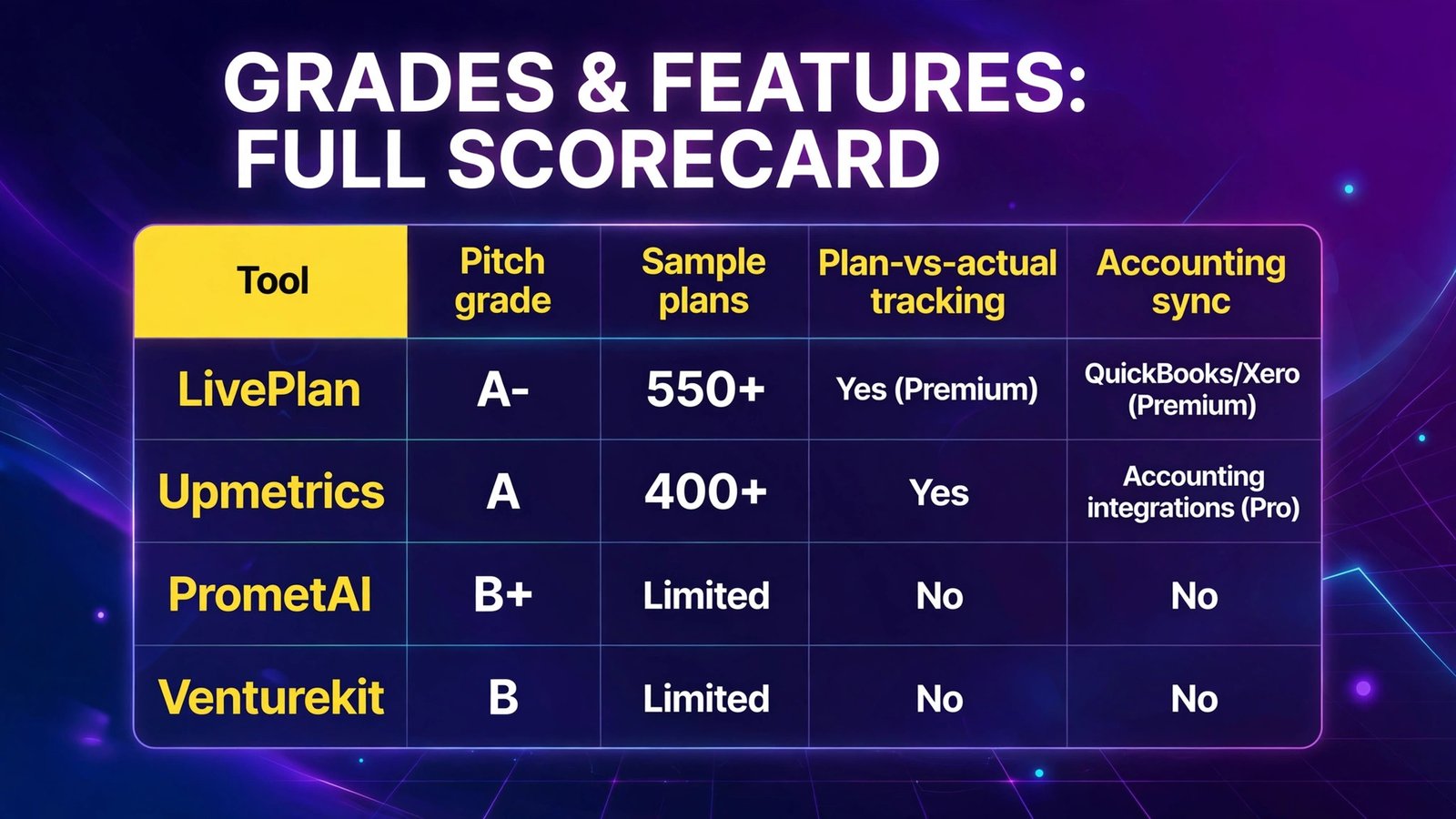
| LivePlan | Upmetrics | PrometAI | Venturekit | |
|---|---|---|---|---|
| Best for | Bank loans & SBA | AI-first drafting | Equity & valuation | Budget all-in-one |
| Our financials grade | A | B+ | A− | B |
| Our market grade | A− | B | B+ | B− |
| Pitch export grade | A− | A | B+ | B |
| Entry price (annual) | $15/mo | $14/mo | $55/mo+ | $8/mo |
| Sample plans | 550+ | 400+ | Limited | Limited |
| Plan-vs-actual tracking | Yes (Premium) | Yes | No | No |
| Accounting sync | QuickBooks/Xero (Premium) | Accounting integrations (Pro) | No | No |
How to Choose
- Start from your reader, not the feature list. Bank or SBA lender → LivePlan. Angel/VC seed round → PrometAI. Validating the idea with partners → Upmetrics. Tightest budget for plan + deck → Venturekit.
- Price the fundraising period, not the year. PrometAI at $55–$145/month is expensive as a subscription and cheap as a 3-month fundraising cost. LivePlan and Upmetrics at $14–$15/month annual are the affordable year-round tools.
- Test with the free options first. PrometAI’s Explore tier and Venturekit’s free light plans let you evaluate real output before paying; LivePlan and Upmetrics rely on money-back guarantees instead.
- Grade financials before prose. During any trial, change one core assumption (your price, your growth rate) and watch what updates. Tools that propagate it through statements and decks are earning their keep; tools that don’t are word processors.
- Budget editing time, not just subscription money. Venturekit needed the most editing in our test, Upmetrics the least. A $96/year tool that needs 10 hours of your editing is not cheaper than a $180/year tool that needs two.
Frequently Asked Questions
What is the best AI business plan generator in 2026?
It depends on your reader. LivePlan is the best overall for lender-ready plans — a true three-statement financial model, cited market research, and methodology banks recognize. PrometAI is best for equity raises, with valuation and unit economics built in. Upmetrics is best for fast AI-assisted drafting at the lowest price ($14/month annual). Venturekit is the cheapest complete option, at about $8/month on annual billing.
How much does AI business plan software cost?
Entry pricing runs from $0 to $20/month: Venturekit has a free tier and a Pro plan at $19/month (or $96/year), Upmetrics starts at $19/month ($14 annual), LivePlan starts at $20/month ($15 annual), and PrometAI’s paid plans run $55–$145/month. One-time options exist (15MinutePlan from $69, PlanPros $97 for 12 months, BizPlanner AI from $4.99–$9.99 one-time), but subscriptions generally offer deeper financial modeling.
Can an AI business plan get me a bank loan?
The plan alone doesn’t — the numbers do. Banks care about cash flow, collateral, and realistic assumptions, not prose. LivePlan is the strongest fit here because its financial model is genuinely lender-grade and its format is SBA-familiar. Whichever tool you use, run the “Investor-Ready” checklist above and have your accountant review the financials before submission.
Is Venturekit legitimate? I saw complaints about billing.
Venturekit is a real product with real free and paid tiers — and multiple independent reviews report billing problems, including users being charged without realizing they’d signed up, with its Trustpilot rating suspended at one point over guideline issues. Our advice: read the billing terms carefully before entering your card, confirm how plan credits work, and use a card with good dispute protections if you proceed.
Do these tools write the whole plan for me?
They generate a complete draft — but “for you” is doing heavy lifting. In our test, every plan needed human editing: uncited market claims needed sourcing, generic risk sections needed replacing, and at least one tool’s market numbers needed verification. Budget 2–5 hours of your own editing per plan, and always check the financials yourself before showing them to anyone.
Can I export my plan to PDF or Word?
Yes — all four export finished plans. LivePlan, Upmetrics, and Venturekit also generate pitch decks or one-page pitches from the plan; Upmetrics keeps the deck linked to the plan’s numbers so updates propagate. PrometAI exports to PDF and Word with its valuation tables included.
Conclusion
The best AI business plan generator in 2026 is really four different tools for four different jobs. LivePlan remains the safest bet for anything a bank will read: interconnected financials, cited research, and lender-tested methodology. PrometAI is the specialist for equity raises — the only one here that speaks valuation and unit economics natively. Upmetrics is the best value for founders who want AI to shoulder the drafting burden and keep the deck in sync. Venturekit is the cheapest complete package, with a genuine free tier — as long as you read the billing terms first.
Our honest take after grading four plans for the same startup: the generator matters less than what you do next. Every AI plan we produced needed the same three human steps — reconciling the financials, sourcing the market claims, and writing an honest risk section. Do those, and any of these four becomes a plan worth reading. Skip them, and the most expensive tool won’t save you.
Next step: pick the tool that matches your reader, run its free tier or guarantee with our Compost Crew-style test (same numbers, three statements), and change one assumption — the tool that updates everything correctly is the one to keep.