
Roughly 40 percent of the largest Shopify brands run their support on Gorgias, and the reason is simple. Phone calls about an order are the hardest support conversations a store handles, because the customer is usually worried, the answer lives in three different systems, and the call costs more per minute than any other channel. The best ai call center tools for ecommerce stores exist to make those calls shorter, calmer and cheaper without making the customer feel handled by a machine.
The phone is not going away. A shopper will accept a chatbot for a tracking link, but a missing delivery, a damaged item or a refund over a hundred dollars still goes to a phone call. The stores that handle those calls well keep the customer. The stores that keep a caller on hold for nine minutes lose the customer and the review.
This guide compares eight tools that put AI on the phone for an online store. Prices come from vendor pages and 2026 comparison guides checked in November 2026, and every figure below is the starting price a buyer can verify on the vendor site. Where a vendor does not publish a price, this guide says so plainly. The verdict at the end names one pick for a Shopify store and one for a store where phone is the main channel.
A store does not need the biggest contact center on the market. It needs the one that shows the order on the screen before the agent says hello. That single screen decides whether a call takes two minutes or ten, and over a thousand calls a month the difference is a full-time salary.
What a Store Call Actually Needs
Order context comes first. When a customer calls about order 4821, the agent should see the items, the tracking status, the payment state and the past conversations before the greeting ends. The best ai call center tools for ecommerce stores put that data on the call screen automatically, so the agent never asks the caller to spell an order number twice or to wait while someone opens a second tab.
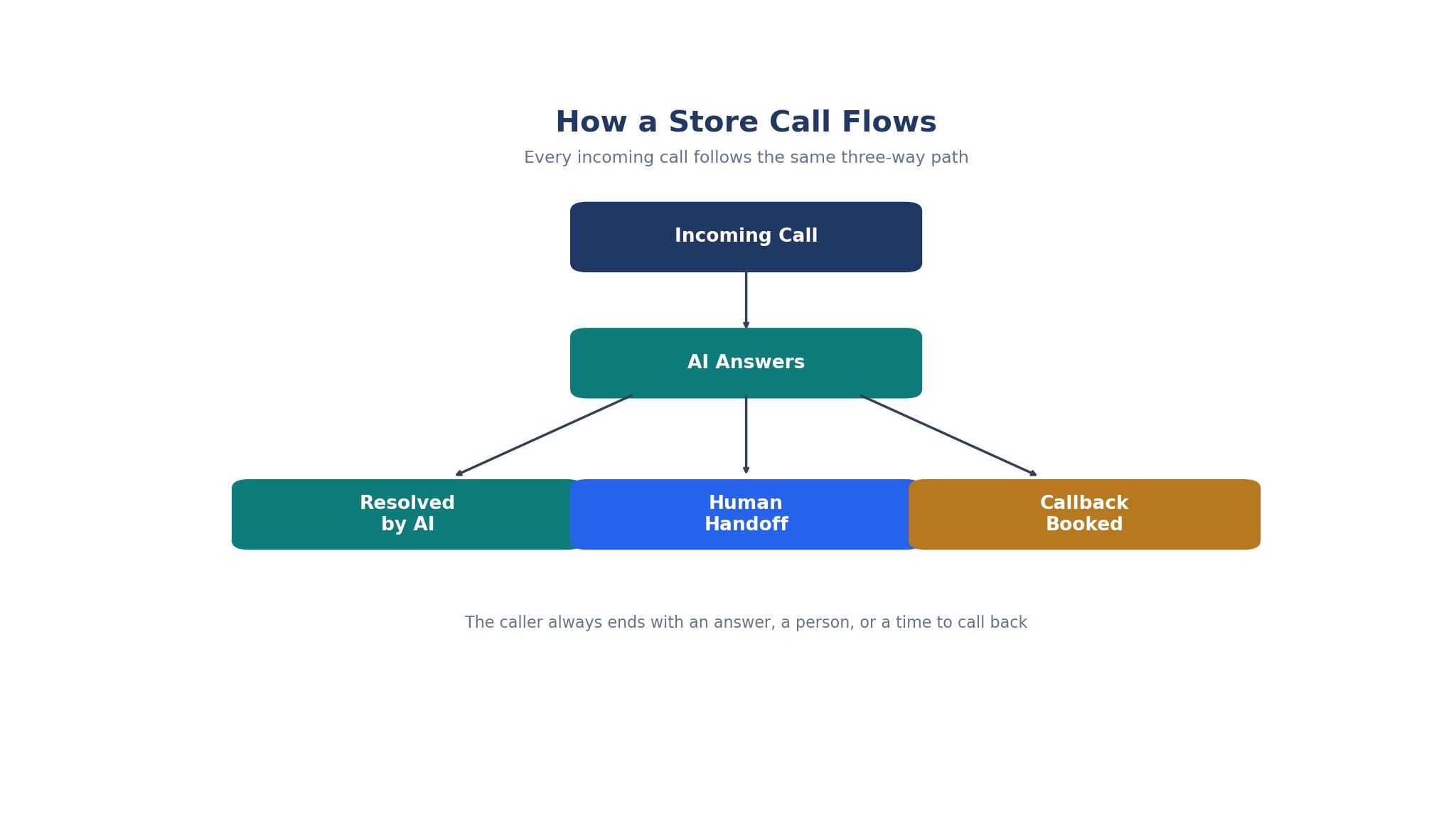
Second, the AI should do the routine work before a human is involved. A voice agent that can confirm a delivery date, check a return window or take a callback request will resolve a large share of calls without an agent. The calls that reach a person should be the ones that need judgment, like a damaged shipment or a loyal customer asking for an exception.
Third, the system has to handle the rush. A sale weekend, a shipping delay or a viral post can triple call volume in an afternoon, and a phone system that caps the queue or drops calls under load will fail exactly when the store needs it most. Buyers should ask every vendor what happens at three times the normal volume, and get the answer in writing.
Fourth, the call record has to survive the call. A transcript, a summary and a recording attached to the order mean the next agent starts from knowledge rather than from zero, and the owner can review a difficult call without asking the agent to retell it. Stores that review five random calls a week catch training problems early, while stores that never listen to a call only learn about problems from bad reviews.
Per-Seat or Per-Conversation, the Bill Is the Decision
Phone pricing splits into two models, and the model matters more than the starting price. Per-seat tools like Dialpad charge 15 dollars per user per month on Standard and 25 dollars on Pro, while Aircall charges 30 dollars per license with a three-seat minimum. The bill grows with headcount, which is predictable and easy to budget, but a seasonal team pays for seats that sit empty in January.
Per-conversation tools flip the math. Gorgias charges by ticket, starting at 10 dollars a month for 50 tickets, with Voice as an add-on from about 70 dollars a month, so a store pays for the work done rather than the chairs filled. An AI voice agent like Ringly charges 99 dollars a month for the first 50 conversations and then 1.99 dollars per conversation. A store with wild seasonal swings pays less on this model, while a store with steady volume may pay more.
The honest comparison is a month of real volume. Take last November, count the calls, the seats and the tickets, and price each tool on those numbers. A tool that looks cheap at 100 calls a month can look expensive at 2,000, and the only way to know is to run the actual numbers instead of comparing headline prices.
The 8 Tools at a Glance
The table below gives the short version of the best ai call center tools for ecommerce stores, with the starting price each vendor lists. Read it as a shortlist, then use the detailed sections to check the Shopify connection and the AI voice quality before choosing.
| Tool | Main job | Best for | Starting price |
|---|---|---|---|
| Gorgias | Helpdesk with Voice | Shopify stores, phone as one channel | $10 per month |
| Aircall | Cloud phone system | Support teams wanting order context | $30 per user per month |
| Dialpad | AI-first business phone | Small teams wanting built-in AI | $15 per user per month |
| CloudTalk | AI call center | Ecommerce teams wanting a full phone system | $29 per user per month |
| Nextiva | Unified communications | Teams wanting phone plus AI employee | $15 per user per month |
| JustCall | All-in-one contact center | Teams wanting calling, SMS and WhatsApp together | $29 per user per month |
| RingCentral | Cloud communications | Larger teams needing reliability | $25 per user per month |
| Five9 | Enterprise contact center | High-volume stores with complex routing | Custom quote |
Best Pick by Job
No single phone system fits every store, so the table below matches the best ai call center tools for ecommerce stores to the five most common buying situations. Find the row that describes the store, then test the two tools named there with real order calls before paying.
| Job type | First pick | Second tool | Why this pair works |
|---|---|---|---|
| Shopify store, phone as one channel | Gorgias | Aircall | Gorgias keeps phone inside the helpdesk, while Aircall adds a stronger phone layer |
| Phone is the main channel | Dialpad | Aircall | Dialpad gives AI transcripts at the lowest seat price, while Aircall adds deeper helpdesk links |
| Small team, tight budget | Dialpad | Nextiva | Dialpad starts at 15 dollars per user with AI included, while Nextiva adds a full suite |
| High-volume store, seasonal spikes | Gorgias | CloudTalk | Gorgias charges by ticket so seasonal spikes cost less, while CloudTalk adds dialer power |
| Team wanting AI to answer calls | Nextiva | Gorgias | Nextiva adds an AI employee for routine calls, while Gorgias keeps the human handoff close |
How to Judge the Best AI Call Center Tools for Ecommerce Stores
Judging the best ai call center tools for ecommerce stores starts with a real order call. Place a test order, call the number as a customer, and ask where the parcel is. The good tools show the agent the order, the tracking and the history in one screen, and the agent answers in under a minute. The weak ones make the agent ask for the order number, then put the caller on hold while the order loads.
Next, test the AI voice agent on the five most common calls, which are delivery status, return requests, damaged items, address changes and refund timing. Count how many the AI resolves without a human and how many it mishandles. An AI that resolves four out of five routine calls is saving real money. An AI that mishandles one in five is creating angry customers.
Finally, check the recording and the summary. Every call should produce a transcript and a short summary the next agent can read in ten seconds, because a customer who calls twice should never have to retell the story. The tools that do this well make the second call feel like a continuation, not a restart.
The 8 Tools in Detail
Each entry below covers what the tool does best, where it falls short, and who it fits, plus a practical test to run during the trial. The order follows the glance table, and the prices are the starting figures from the best ai call center tools for ecommerce stores shortlist above.
1. Gorgias
Gorgias is the default helpdesk for Shopify stores, and its Voice add-on brings phone into the same inbox as email, chat and social messages. An agent sees the order history, the fulfillment status, the tracking number and the past notes beside the call, and can refund, cancel or edit an order without leaving the conversation. Pricing is ticket-based rather than per-seat, starting at 10 dollars a month for 50 tickets, with Voice from about 70 dollars a month, so seats are unlimited on most plans.
The drawback is that phone is an add-on, not the core. The dialer and call features are lighter than a dedicated phone platform, and the AI call summaries come through partner apps rather than built in. A store where phone is the main channel may outgrow the Voice add-on.
Gorgias suits a small or mid-size Shopify store where phone is one channel among several and the team already lives in the helpdesk. It is the strongest pick for a store that wants order context on every call.
To test it honestly, take five real calls from last week, replay them as test calls, and check that the agent can refund one order and check tracking on another without opening Shopify separately. The integration is the product here.
2. Aircall
Aircall is a cloud phone system built for support and sales teams that share one number set. Its Shopify app puts order data on the call, with the customer name, email, previous orders, payment status and tracking numbers visible to the agent, and calls log against the customer record. Essentials starts at 30 dollars per license with a three-user minimum, so the real floor is 90 dollars a month before add-ons.
The drawback is the add-on stack. AI features cost 9 dollars per user extra, advanced analytics cost 15 dollars per user extra, and the bill climbs fast once the team adds the features that make the tool shine. The three-seat minimum also hurts a two-person store.
Aircall suits a support team that treats phone as a serious channel and wants deep helpdesk and CRM integrations. It fits a store with three or more agents who spend most of the day on calls.
To test it honestly, run a full day of real calls through the trial, and check the call logs at the end of the day for any call that failed to attach to the right customer. Logging errors are silent, and they corrupt the record the team relies on.
3. Dialpad
Dialpad puts AI at the center of everything, with real-time transcription, live coaching and sentiment analysis built in rather than sold as add-ons. Standard starts at 15 dollars per user per month on annual billing, Pro at 25 dollars, and the AI summaries and transcripts come with the plan. For a small team watching cash, it is the value play in this guide.
The drawback is dialing depth. Dialpad dialing is generally single-line rather than multi-line, so a team that needs a power dialer for outbound volume will find it slow. The Shopify integration is also newer and lighter than Aircall or Gorgias, with customer matching and up to three recent orders rather than full order status.
Dialpad suits a small team that wants AI transcription and summaries on every call without paying for add-ons. It fits a store where the phone team is small and the budget is tight.
To test it honestly, make ten calls and read the AI summaries the next morning, checking each one against the recording for a wrong name, a wrong order number or a missed promise. A summary that invents a detail is worse than no summary at all.
4. CloudTalk
CloudTalk is a full AI call center for ecommerce teams that want a real phone system with broad number coverage and strong dialing. It offers power and parallel dialing on up to five lines, AI voice agents triggered from workflows, and an AI receptionist as an add-on. The Essential plan starts at 29 dollars per user per month, with API access included for teams that connect it to Shopify through Flow or automation tools.
The drawback is the Shopify connection. There is no Shopify app for new stores, so the integration runs through API, Shopify Flow, Make or Zapier, which needs setup. A store that wants a plug-and-play Shopify phone will find Gorgias or Aircall easier.
CloudTalk suits an ecommerce team with international customers, high call volume and a need for real dialer power. It fits a store that already runs automation and can wire the integration once.
To test it honestly, set up the Shopify connection in the trial, place a test order, and call in to see whether the order data reaches the agent screen. If the wiring takes a week, the team should know before paying.
5. Nextiva
Nextiva combines a full business phone system with an AI employee that can answer routine calls, starting at 15 dollars per user per month for the Core plan. The AI employee costs about 1.50 dollars per conversation on top, and it can read orders, tracking, customers and inventory through its Shopify connector. That combination makes Nextiva the most interesting AI pick in this guide for a store that wants the phone answered around the clock.
The drawback is that the AI employee is a separate product with its own setup, and the phone system itself is a general unified communications platform rather than an ecommerce specialist. A store that wants deep order workflows may find the ecommerce features thinner than Gorgias.
Nextiva suits a store that wants a phone system, an AI agent and a full communications suite in one contract. It fits a team that already uses Nextiva for other channels.
To test it honestly, let the AI employee handle twenty routine calls in the trial, and count how many it resolves and how many it hands off badly. The handoff quality is the test, because a bad handoff loses the customer the AI was meant to save.
6. JustCall
JustCall is a broader contact center that bundles calling, SMS and WhatsApp into one interface, with native AI coaching and sentiment analysis layered on top. It starts at about 29 dollars per user per month, and it suits a team that talks to customers across three channels and wants one queue for all of them. The AI coaching flags a struggling agent in real time, which helps a small team train faster.
The drawback is that it is a general contact center rather than an ecommerce specialist. The Shopify depth is thinner than Gorgias, and the price sits above Dialpad while the AI features overlap heavily with it. A store that only needs phone and email will pay for channels it never opens.
JustCall suits a team that sells and supports across phone, SMS and WhatsApp, especially a store with an international customer base. It fits a business where the same agent handles all three channels in one shift.
To test it honestly, run one day with the same agent handling phone, SMS and WhatsApp from the single queue, and check whether any message waits longer than the phone calls. A shared queue that starves one channel is not a shared queue.
7. RingCentral
RingCentral is the reliability pick, with a 99.999 percent uptime claim and a full unified communications suite behind the phone system. It starts at 25 dollars per user per month, and it covers voice, video, messaging and contact center features in one platform. For a larger store where a phone outage costs real money, that reliability record matters more than any single feature.
The drawback is ecommerce depth. RingCentral is a general platform, and the Shopify and order-context features are lighter than the ecommerce specialists in this guide. The AI features are solid but not as store-focused as Gorgias or Nextiva.
RingCentral suits a larger store or a team that already runs RingCentral for the whole company and wants the phone inside the same system. It is a safe enterprise-grade choice rather than a sharp ecommerce tool.
To test it honestly, check the call quality on a busy afternoon from the actual office network, and confirm the failover behavior if the internet drops. Reliability claims are only proven under load.
8. Five9
Five9 is an enterprise contact center with the deepest routing, the strongest outbound dialing and the most serious AI voice capabilities in this guide. It handles high-volume stores with complex queues, skills-based routing and compliance requirements that the smaller tools cannot touch. Pricing is custom quote, which reflects the enterprise sales process.
The drawback is the obvious one. Five9 is built for volume and complexity, and a small store will pay an enterprise price for features it never opens. Implementation takes weeks, and the team needs real training to run it well.
Five9 suits a high-volume ecommerce operation with hundreds of calls a day, multiple teams and strict routing rules. It is the wrong tool for a store with two agents and a hundred calls a week.
To test it honestly, ask the vendor to model the routing rules for the three busiest call types, then run a simulated peak hour through the demo. The routing is the product, and a demo that cannot show it is a warning.
What a Store Pays in the First Year
Price a three-agent store at 1,000 calls a month and the differences sharpen. Dialpad Standard at 15 dollars per user is 45 dollars a month, with AI transcripts included, which makes it the cheapest real phone system in this guide. Aircall Essentials at 30 dollars per license with a three-seat minimum is 90 dollars, plus 9 dollars per user for AI, taking it to 117 dollars. Gorgias on a mid-tier plan with Voice runs a few hundred dollars a month, but the ticket model means the price tracks the work rather than the headcount.
Nextiva at 15 dollars per user is 45 dollars for three seats, plus the AI employee at about 1.50 dollars per conversation, so a month with 300 AI-handled calls adds 450 dollars. That sounds steep until the store counts the agent hours saved, because 300 resolved calls is roughly a week of agent time. The AI employee only earns its price when it genuinely resolves calls rather than just answering them.
The lesson is to price the month of November, not the month of February. A store that signs a per-seat annual contract in a quiet month and then triples volume for the holidays will either pay overage or run short of seats. The best ai call center tools for ecommerce stores are the ones whose pricing model matches the store seasonal curve, not the ones with the lowest headline price.
One more cost hides in the phone numbers themselves. Toll-free and international numbers, call recording storage and SMS replies each carry their own fee on some plans, and a store with customers in several countries can see those lines add up. Ask each vendor for the full list of metered charges before signing, and compare the total for a peak month rather than the subscription alone.

Mistakes That Waste the First Quarter
The most common mistake is buying a phone system before fixing the order data. If the agent cannot see the order, the tracking and the history, the best AI in the world will still put the customer on hold. Connect the store first, test the order screen on real calls, and only then judge the AI features.
The second mistake is letting the AI answer calls it cannot handle. A voice agent that guesses at a refund policy or invents a delivery date will create more damage in one afternoon than a month of saved agent hours is worth. Give the AI a short list of calls it may resolve, and route everything else to a person from the start.
The third mistake is forgetting the callback. A customer who waits on hold for ten minutes and hangs up is a lost sale and a bad review. Every tool in this guide offers callbacks, queue position messages or both, and a store that does not turn them on is paying for features it never uses.
Frequently Asked Questions
Which call center tool is best for a Shopify store?
Gorgias is the best pick for most Shopify stores, because phone, email, chat and social messages live in one helpdesk and the agent sees the full order on the call screen. Pricing starts at 10 dollars a month for 50 tickets, with Voice from about 70 dollars a month. A store where phone is the main channel should also test Aircall, which gives a stronger phone layer with a Shopify app.
How much does AI call center software cost for a small store?
A three-agent store can run Dialpad Standard at 45 dollars a month with AI transcripts included, or Aircall Essentials at 90 dollars a month before AI add-ons. Gorgias charges by ticket rather than by seat, so a small store with low volume can start near 10 dollars a month plus the Voice add-on. The real cost depends on call volume, AI usage and the season, so buyers should price a peak month before signing.
Can an AI voice agent really answer customer calls?
Yes, for routine calls. An AI agent can confirm a delivery date, check a return window, take a callback request and answer opening-hours questions without a human. It struggles with damaged shipments, angry customers and anything that needs judgment or an exception. The best setup lets AI resolve the routine half and hands the rest to a person with the full transcript attached.
What is the difference between Gorgias Voice and Aircall?
Gorgias Voice adds phone to a helpdesk the store already uses, so the agent sees orders, tickets and chat history in one screen and pays by ticket. Aircall is a dedicated phone system with deeper calling features, a Shopify app and stronger dialing, and it charges per license with a three-seat minimum. A store that wants phone inside the helpdesk should pick Gorgias, while a store that lives on the phone should pick Aircall.
Do these tools work with Shopify?
Yes, with different depths. Gorgias has the deepest Shopify connection, with order history, fulfillment status and tracking on the call screen. Aircall has a Shopify app with order context. Dialpad and Nextiva connect through a native widget or connector with lighter order data. CloudTalk connects through API or automation tools rather than a Shopify app. Buyers should test the connection with a real order before paying.
Should a small store buy Five9?
No, not unless the store handles hundreds of calls a day with complex routing needs. Five9 is an enterprise contact center with custom pricing and a weeks-long implementation, built for volume a small store does not have. A three-agent store will get far more value from Dialpad, Gorgias or Aircall at a fraction of the price and the setup time.
Our Verdict for an Ecommerce Store Buying Phone Software in 2026
For most Shopify stores, Gorgias is the pick. It keeps the phone inside the helpdesk, shows the order before the agent speaks, and charges by ticket so seasonal spikes cost less. A store where phone is the main channel should buy Dialpad instead, because the AI transcripts come included at 15 dollars per user and the phone system is stronger.
The decision rule is simple. Make five real order calls through each finalist, count how many the agent answers without asking for an order number, and price a peak month before signing. The tool that passes those two checks is the right one, and the store should retest the AI voice agent every quarter, because the models improve fast and the call mix changes with the seasons.