

A sales rep opens Monday with forty new leads, calls the ten with the biggest company names, and learns by Friday that the deals that actually closed came from the small accounts she never reached. The big names were curious, the small ones were ready, and the week was spent on the wrong list. That wasted week is the everyday problem behind this guide, and the best ai lead scoring tools for b2b sales teams exist to put the ready buyers at the top of the list.
Lead scoring is not a spreadsheet trick. It is the difference between a rep who calls the right ten people and a rep who calls forty and hopes. A good model looks at who the lead is, what they did on the website, how they engaged with email, and what similar buyers did before them, then ranks the list so the team works the best leads first. A bad model ranks by company size alone and sends the team chasing logos that never buy.
This guide compares twelve tools on what they do for a B2B sales team with a real pipeline, real reps, and a real quota. Prices quoted are the vendor list prices as checked in November 2026. The goal is a ranked list your reps trust enough to follow, because a score nobody follows is just a number on a screen.
Why Sales Teams Chase the Wrong Leads First
Sales teams chase the wrong leads first because the obvious signals are the wrong ones. A big company name, a senior title, and a downloaded whitepaper look like a hot lead, yet none of them shows intent. The big company may be researching for next year, the senior title may have delegated the task, and the whitepaper may have been downloaded by an intern. The team calls the obvious leads and misses the quiet ones who visited the pricing page three times this week.
The second reason is the lead list itself. Marketing hands over every form fill in one pile, with no ranking, and the reps work it from the top down. The top of the pile is usually the newest lead, not the best one, so the rep spends the morning on yesterday’s curiosity while last week’s ready buyer goes cold.
The third reason is the model nobody checks. A scoring model built once and never reviewed will drift as the market changes, and the reps will notice before the manager does. When the top-scored leads stop converting, the reps stop trusting the score, and the team goes back to calling the biggest names.
What a Scoring Model Has to Prove Before It Is Trusted
A scoring model has to prove three things before a rep will follow it. First, it has to explain itself. A rep who sees a score of 87 should be able to see why, whether it is the company size, the pricing page visits, or the email replies, because a score with no reason is a score the rep will ignore. The tools that show the reasons behind each score earn trust faster than the ones that hide them.
Second, it has to be right more often than the rep’s gut. That is a test, not a claim, and it needs real data. Take the last hundred closed deals and the last hundred lost ones, run them through the model, and see whether the winners scored higher. If the model cannot tell the winners from the losers on your own history, it will not do better on next month’s leads.
Third, it has to stay right. A model trained on last year’s deals may fail on this year’s market, so the team should review the scores every month, compare the top-scored leads with the ones that actually closed, and adjust the weights. The tools on this list differ on how easy that review is, and the easy ones are the ones that stay accurate.
The 12 Tools at a Glance
The table below gives the short version of the best ai lead scoring tools for b2b sales teams. Every price shown is a starting monthly price unless stated, and the main job column states what each tool is built to do first.
| Tool | Main job | Best for | Starting price |
|---|---|---|---|
| HubSpot | CRM-native predictive scoring | Teams already running HubSpot | From $90 per seat per month |
| Salesforce Einstein | Predictive scoring inside Salesforce | Enterprise teams on Salesforce | From $165 per user per month |
| 6sense | Account intent and predictive scoring | Enterprise ABM teams | Pricing on the vendor site |
| Demandbase | Account-based scoring and orchestration | Enterprise ABM teams | Pricing on the vendor site |
| Warmly | Signal-based scoring with action | Mid-market teams that want signals | From $799 per month |
| Apollo | Prospecting with scoring built in | Teams that score while they prospect | From $49 per user per month |
| ZoomInfo | Data and intent scoring | Teams that need deep company data | Pricing on the vendor site |
| Pocus | Product-usage scoring for PLG | Product-led teams scoring usage | Pricing on the vendor site |
| Factors.ai | Account scoring for B2B teams | Teams that score accounts from behaviour | Pricing on the vendor site |
| Breadcrumbs | Purpose-built scoring with explainability | Teams that want clear score reasons | From $1,999 per month |
| Toplyne | Scoring for product-led growth | PLG teams that score free users | Pricing on the vendor site |
| Leadspace | Data enrichment with scoring | Teams that need clean data first | Pricing on the vendor site |
Best Pick by Job
The table below matches each sales pattern to a first pick and a backup from the best ai lead scoring tools for b2b sales teams, so a small team and an enterprise department can each see their own answer at once.
| Job type | First pick | Second tool | Why this pair works |
|---|---|---|---|
| Team already on HubSpot | HubSpot | Breadcrumbs | HubSpot scores inside the CRM and Breadcrumbs explains each score |
| Team already on Salesforce | Salesforce Einstein | 6sense | Einstein scores in the CRM and 6sense adds account intent |
| Enterprise ABM team | 6sense | Demandbase | 6sense predicts the account stage and Demandbase runs the plays |
| Mid-market team that wants signals | Warmly | Apollo | Warmly layers live signals and Apollo scores while prospecting |
| Product-led team scoring usage | Pocus | Toplyne | Pocus scores product behaviour and Toplyne ranks free users |
How to Choose the Best AI Lead Scoring Tools for B2B Sales Teams
Choosing starts with the data you already have. A scoring model is only as good as the history it learns from, so count your closed deals, your lost deals, and the months of data behind them. The best ai lead scoring tools for b2b sales teams need at least a few hundred closed deals to learn from, and a team with a thin history should start with a rules-based model and grow into a predictive one.
Then check where the scoring lives. A score inside the CRM, on the lead record the rep already opens, will be used every day. A score in a separate dashboard will be checked once a week if at all. The tools that write the score back into HubSpot or Salesforce earn their place by meeting the rep where she already works.
Finally, test the model on your own history before you pay. Ask the vendor to score your last hundred closed deals and your last hundred lost ones, then compare the two groups. If the winners score clearly higher, the model understands your buyers. If the two groups overlap, the model is guessing, and no amount of features will fix that.
The 12 Tools in Detail
1. HubSpot
HubSpot is the obvious pick for a team already running its CRM and marketing on the platform, because the scoring lives where the reps already work. Manual scoring is available on Professional, while predictive scoring needs Enterprise, and the model learns from the deal history already in the CRM. Sales Hub Professional starts from $90 per seat per month, with Enterprise higher.
The weak point is the tier wall. Predictive scoring sits on Enterprise, which starts at a much higher price with a seat minimum and onboarding fees, so a small team pays a lot for the AI part. The model is also limited to HubSpot data, so a team with buying signals outside the CRM will miss them.
It suits a team already on HubSpot that wants scoring without a new system. For that team, the native score on every lead record is worth more than a cleverer model in a separate tool.
Test it by asking HubSpot to score your last hundred closed deals and your last hundred lost ones, then comparing the two groups. If the winners score clearly higher, the model knows your buyers, and if the groups overlap, start with the manual rules on Professional and grow into the predictive tier later.
2. Salesforce Einstein
Salesforce Einstein brings predictive lead scoring to teams already on Sales Cloud, and its strength is the depth of the data it can use. The model learns from every field, activity, and deal in the org, and the score appears on the lead record the rep already opens. Sales Cloud Enterprise runs $165 per user per month, plus the Einstein add-on from $50 per user per month.
The catch is the cost and the setup. The add-on, the implementation, and the training time add up, and a small team will find the total bill hard to justify. The model also needs a solid history of closed deals to learn from, and a new org with thin data will get weak scores at first.
It suits a large Salesforce org with a deep deal history that wants scoring without leaving the CRM. For that team, Einstein is the path of least resistance.
Evaluate it by running the model on your own history and checking whether the top-scored leads from last quarter were the ones that actually closed. If the match is strong, the model has learned your market, and if it is weak, the data may need cleaning before the model can help.
3. 6sense
6sense is the account-intent leader, and its strength is seeing the whole account, not just one lead. It tracks which companies are researching your category, predicts their buying stage, and scores both the account and the contacts inside it. The price is quote-only, with typical deployments running $60,000 a year or more, and the free plan was discontinued in August 2026.
The downside is the price and the operating model. A team needs an account-based motion to use it well, with target account lists, coordinated plays, and the budget to act on the intent signals. A small team without that motion will pay enterprise money for signals it cannot use.
It suits an enterprise team running account-based marketing with thousands of target accounts. For that team, the intent data is the difference between calling a cold account and calling one that is already shopping.
Test it by giving 6sense your target account list and asking which accounts are in market right now, then checking those accounts against your own CRM activity. If the in-market accounts match the ones your reps already sense are warm, the intent data is real, and if the list looks random, the model is not seeing your market.
4. Demandbase
Demandbase is the other enterprise ABM platform on this list, with account scoring, intent data, and orchestration in one system. It scores accounts, runs advertising and sales plays against them, and measures which plays moved the account forward. Pricing is quote-only and enterprise level, similar to 6sense.
The trade-off is the same as 6sense, which is that the tool needs an ABM operating model to earn its price. A team that buys Demandbase without target account lists, coordinated plays, and the budget to act will get a dashboard full of scores nobody uses. The setup is a project, not an afternoon.
It suits an enterprise team that wants scoring and orchestration in one platform, with the staff to run account-based plays. For that team, the single system is worth the enterprise price.
Judge it by asking for a pilot on fifty target accounts, with the plays run for one quarter and the results measured against a control group. If the pilot accounts moved further than the control group, the platform earns its place.
5. Warmly
Warmly is the signal tool on this list, built to layer live buying signals onto a score and then act on them in real time. It watches website visits, job changes, funding news, and engagement, then scores the lead and routes it to the right rep with the context attached. Plans start from $799 a month, rising to $1,999 a month for larger teams.
The flaw is the price for a small team and the signal noise. Not every signal means intent, and a team that chases every alert will burn rep time on false positives. The tool needs a clear rule for which signals trigger action, and that rule takes a month of tuning to get right.
It suits a mid-market team that wants live signals and fast routing, with the discipline to tune the rules. For that team, the signal layer is the difference between a lead that arrives tomorrow and one that arrives today.
Try it by running Warmly on your live traffic for two weeks, then comparing the leads it flagged with the ones your reps would have called anyway. If the flagged leads converted at a higher rate and arrived faster, the signals are working, and if they did not, the rules need tuning before the team trusts them.
6. Apollo
Apollo is the prospecting tool with scoring built in, and its strength is that the score arrives with the contact. A rep can search for accounts, see the score beside each one, and start outreach without switching tools. Plans run from $49 to $149 per user per month, which makes it the most affordable way into scored prospecting on this list.
The limit is the depth. Apollo scores on data and engagement, but the model is lighter than a dedicated platform, and a team that needs a rich predictive model will outgrow it. The data quality is good but not perfect, so the team should verify the key fields before a campaign.
It suits a team that prospects every day and wants a score on every contact it finds. For that team, the built-in scoring saves a tool and a step.
Test it by scoring a list of five hundred accounts you already know well, then checking whether the top-scored ones match the accounts your best reps would have picked. If the match is strong, Apollo understands your market, and if it is weak, use it for prospecting and score elsewhere.
7. ZoomInfo
ZoomInfo is the data platform, and its strength is the depth of the company and contact data behind the score. A team gets firmographics, technographics, intent signals, and contact details in one place, and the score can draw on all of it. Pricing is quote-only and enterprise level, with the cost rising with the size of the data licence.
The snag is the price and the data hygiene. A large licence is expensive, and the data needs regular cleaning, because people change jobs and companies change stacks. The scoring is strong, but it is only as good as the data underneath it, and a team that never cleans its data will get confident scores built on stale facts.
It suits a team that needs deep company data as well as scoring, with the budget for an enterprise licence. For that team, the data is the product and the score is the bonus.
Evaluate it by checking a sample of one hundred records against your own CRM, counting how many titles, emails, and company details are correct. If the accuracy is high, the score rests on solid ground, and if it is low, the data needs work before the scoring can be trusted.
8. Pocus
Pocus is the product-usage scoring tool, built for product-led teams that need to score free users on what they do inside the product. It watches feature adoption, usage frequency, and team size, then ranks the accounts most likely to convert to paid. No public price is listed, so the purchase runs through a sales conversation.
The part to weigh is the narrow fit. Pocus only makes sense for a team with a self-serve product and meaningful usage data, and a sales-led team with no product signal will get nothing from it. The setup needs product instrumentation, which takes developer time, and the model needs a history of conversions to learn from.
It suits a product-led team that wants to know which free accounts are ready for a sales conversation. For that team, the usage score is the best predictor of a deal.
Try it by scoring your free accounts from last quarter and comparing the top-scored ones with the accounts that actually converted. If the top of the list converted at a much higher rate, the model understands your product.
9. Factors.ai
Factors.ai scores accounts from behaviour across the website, ads, and CRM, and its strength is the account view for a B2B team. It stitches together the touches from every contact at one company, scores the account as a whole, and shows the journey that led to the score. The vendor does not publish a price, and buying runs through its sales team.
The thing to watch is the visibility. Factors.ai is a smaller vendor than the leaders here, and the pricing, the roadmap, and the support all need checking directly. The account view is strong, but a team that needs a proven enterprise platform may prefer a larger name.
It suits a B2B team that wants account-level scoring without an enterprise ABM price. For that team, the stitched journey is the feature that matters.
Judge it by asking Factors.ai to score fifty accounts you already know, then checking whether the top-scored ones match the accounts your reps call first. If the match is strong and the journey view explains why, the tool understands your buyers.
10. Breadcrumbs
Breadcrumbs is the purpose-built scoring tool, and its strength is explainability. Every score comes with the reasons attached, so a rep can see exactly which signals raised the score and which lowered it. Plans start from $1,999 a month, which makes it a mid-market purchase for a team that wants a dedicated model.
The weak spot is the price for a small team and the narrower feature set. Breadcrumbs scores well, but it does not prospect, enrich, or run ABM plays, so a team will need other tools alongside it. The value is the clarity of the score, and a team that does not need that clarity will find cheaper options.
It suits a team whose reps do not trust a black-box score and need to see the reasons before they call. For that team, the explanation is the product.
Test it by showing the top ten scored leads to your best reps, with the reasons attached, and asking whether they would call them first. If the reps agree with the ranking and the reasons make sense, the model has earned their trust.
11. Toplyne
Toplyne scores free users for product-led growth, ranking the accounts most likely to convert based on usage, team behaviour, and engagement. It suits teams with a self-serve funnel, and its strength is the focus on conversion from free to paid. Pricing is not published, so a buyer talks to the sales team for a quote.
The trouble is the same narrow fit as Pocus, which is that it only works for a product-led motion. A sales-led team will get nothing from it, and the model needs a solid history of free-to-paid conversions to learn from. The vendor is smaller than the leaders, so the roadmap and support need checking.
It suits a product-led team that wants a ranked list of free accounts to hand to sales. For that team, the conversion ranking is the whole job.
Evaluate it by scoring last quarter’s free accounts and comparing the top of the list with the accounts that actually converted. If the top converted at a much higher rate, the model is working.
12. Leadspace
Leadspace is the data-first tool, built to clean, enrich, and score the data before the model touches it. It matches leads to accounts, fills in missing fields, and scores on clean data rather than on the messy records most CRMs hold. There is no published price, and the purchase is arranged through sales.
The honest drawback is that Leadspace is a data platform first and a scoring tool second, so a team that wants a ready-made model may find it heavier than needed. The value appears when the data is dirty, and a team with clean data already will get less from it.
It suits a team whose CRM data is messy and whose scores suffer because of it. For that team, the clean data is the fix, and the scoring improves as a result.
Try it by taking a sample of five hundred leads, running them through Leadspace, and counting how many records were fixed, enriched, or matched to the right account. If the fix rate is high, the data was the problem, and the score will improve with it.
A Scoring Week That Keeps the Pipeline Honest
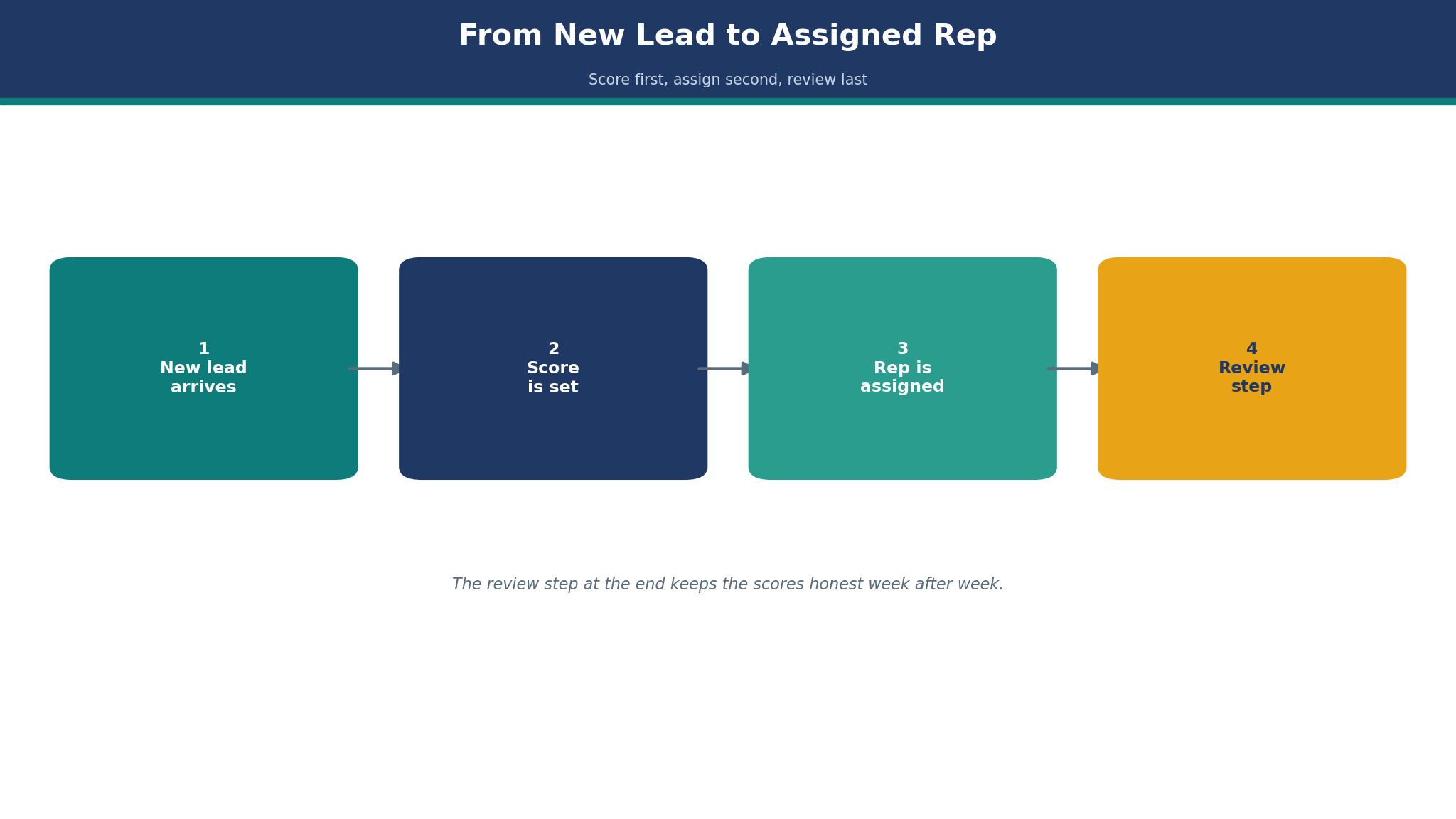
A good scoring week has a shape. Monday is for the list, when the tool ranks the new leads and the reps take the top ten each. Tuesday and Wednesday are for the calls, when the reps work the ranked list and log the outcome of every call, so the model learns from real results. The best ai lead scoring tools for b2b sales teams all promise a ranked list, yet the test is whether the reps actually work it in order.
Thursday is for the review, when the manager compares the scores of the leads that converted with the scores of the ones that did not, and checks whether the model is still separating the two. Friday is for the tune, when the weights are adjusted, a new signal is added, or a stale signal is removed, so the model stays honest for the next week.
The week works because it treats the model as a living thing, not a one-time setup. A model that is reviewed every week will stay accurate as the market changes, while a model that is built once and forgotten will drift, and the reps will notice the drift before anyone else does.

Scoring Mistakes That Starve a Pipeline
The first mistake is scoring on company size alone. A large company that is not buying is a worse lead than a small company that visited the pricing page yesterday, yet size is the easiest signal to score and the one most teams overweight. The model should weigh behaviour and intent at least as heavily as firmographics.
The second mistake is the model nobody reviews. A scoring model built in January and never checked again will be wrong by June, and the reps will stop following it. Review the scores monthly, compare the top-scored leads with the ones that closed, and adjust the weights.
The third mistake is scoring without a handoff rule. A lead that scores high but sits uncalled for three days is a wasted score, so the team needs a rule that routes a hot lead to a rep within the hour and measures whether that happened.
Frequently Asked Questions
How many closed deals does a predictive model need to learn from?
Most vendors say a few hundred closed deals, with a similar number of lost ones, is the minimum for a useful model. The best ai lead scoring tools for b2b sales teams learn from your history, so a team with fifty deals should start with rules and grow into a predictive model as the history builds. A model trained on thin data will guess, and the reps will notice.
Should the score decide who gets called first?
Yes, with one condition, which is that the score has been tested on your own history and the reps trust it. A tested score should set the order of the day, and a rep who skips the top of the list should be able to say why. The score is a guide, not a chain, but a team that ignores it every day does not need it.
What is the difference between lead scoring and account scoring?
Lead scoring ranks individual people, while account scoring ranks whole companies based on every contact and signal from that account. A B2B team usually needs both, because a hot account with a cold contact still needs a way in, and a hot contact at a cold account may never get budget. The enterprise tools on this list score both, and the smaller tools usually score one.
How often should I retrain or review the model?
Review the scores monthly and retrain when the market shifts, a new product launches, or the conversion pattern changes. A monthly check that compares the top-scored leads with the ones that closed takes an hour and keeps the model honest. A model that is never reviewed will drift, and the drift shows up as reps ignoring the list.
Can a small team afford AI lead scoring?
Yes, if the team is already on HubSpot or Apollo, because the scoring comes with the platform. A dedicated platform like Breadcrumbs or Warmly starts at $799 or $1,999 a month, which is a mid-market price. A small team should start with the CRM-native score, prove that ranking helps, and only then pay for a dedicated model.
What do I do when reps do not trust the score?
Show them the reasons. A score with the reasons attached, tested on the team’s own history, earns trust faster than any dashboard. Run the model on last quarter’s deals in front of the team, show that the winners scored higher, and let the reps challenge the ranking. A model that survives a challenge from the best rep is a model the team will follow.
The Scoring Setup That Fits Your Pipeline
For most teams already on HubSpot, the native score is the safest first step, because it lives in the CRM and costs nothing extra on Professional. A Salesforce team should test Einstein the same way, and a mid-market team that wants live signals should trial Warmly. An enterprise team running account-based marketing should pilot 6sense or Demandbase on fifty accounts before committing. The best ai lead scoring tools for b2b sales teams all rank leads, yet the winner is the one your reps follow every Monday morning.
Pick two tools, test each on your own history, and keep the one whose top-scored leads are the ones that actually closed. That test takes a week, and it will save your reps a quarter of wasted calls.