
Most roundups of the best AI paraphrasing tools rank tools by feature lists the author never tested. Paraphrasing is different from most AI writing jobs, though: the output either keeps your meaning or it doesn’t, and a tool that quietly swaps “rarely” for “often” is worse than useless — it’s a liability in an essay, a client draft, or a legal summary.
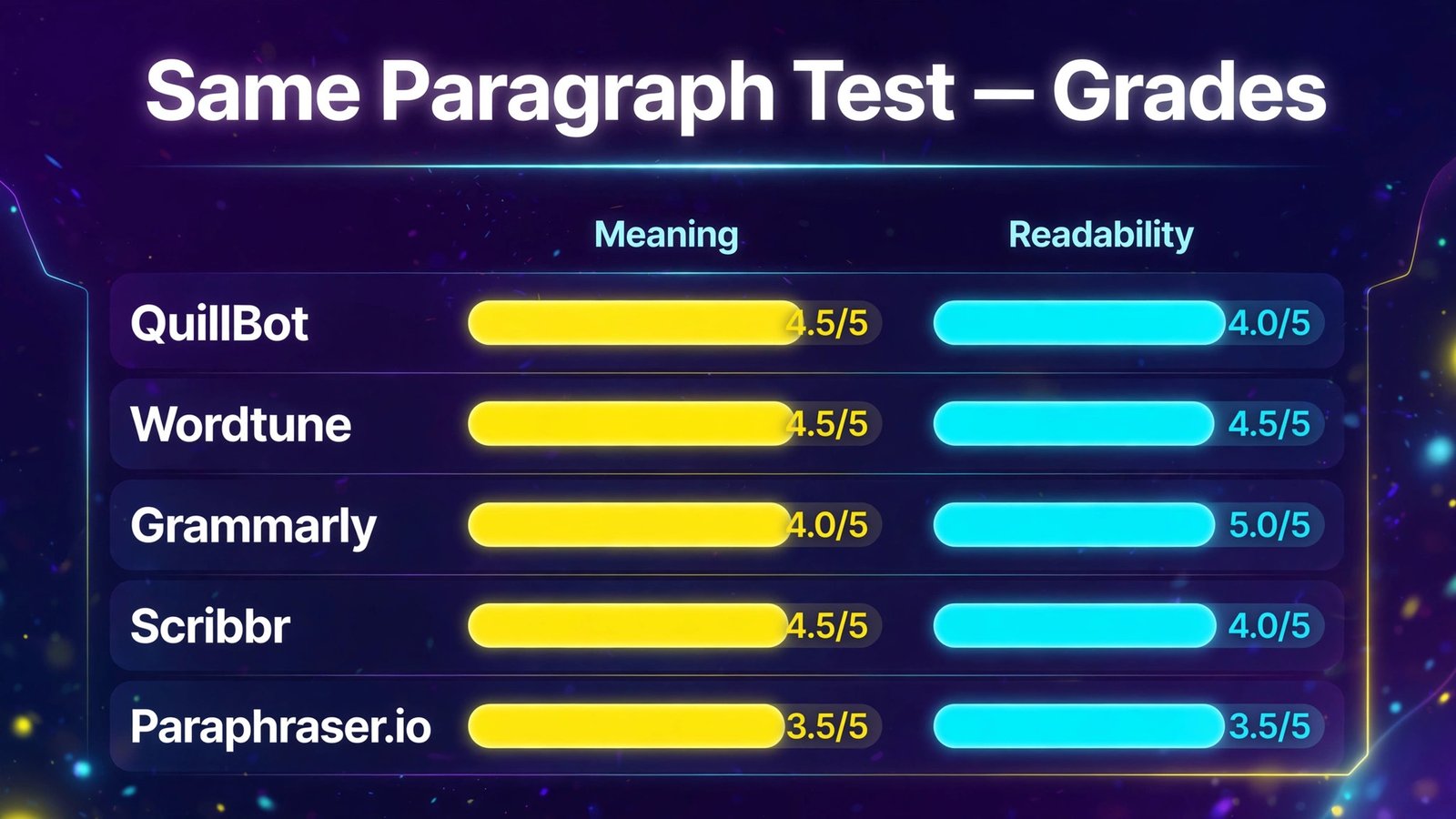
So we ran a controlled test. We took one 95-word paragraph — deliberately written with a few traps in it (a negation, a contrast, two facts that must survive) — and pasted the identical text into QuillBot, Wordtune, Grammarly, Scribbr, and Paraphraser.io. We graded every output on two things: meaning preservation (did every fact and nuance survive?) and readability (does it actually read better than the original?). We also recorded the free-tier word limits students and writers actually hit, because that’s the detail most reviews bury. Here’s the full result.
Quick Answer
| Tool | Entry price (Oct 2026) | Free limit | Meaning /5 | Readability /5 | Best for |
|---|---|---|---|---|---|
| QuillBot | $8.33/mo billed annually | 125 words per paste | 4.5 | 4.0 | All-round paraphrasing with modes |
| Wordtune | $6.99/mo billed annually | 10 rewrites/day | 4.5 | 4.5 | Sentence-level polish with choices |
| Grammarly | $12/mo billed annually | Rewrites are Pro-only | 4.0 | 5.0 | Clarity edits inside your workflow |
| Scribbr | Free (paraphraser) | 125 words, no signup | 4.5 | 4.0 | Students who want zero setup |
| Paraphraser.io | ~$60/yr annual plan | 600 words per run | 3.5 | 3.5 | Long free pastes on a budget |
Bottom line: QuillBot is still the best all-rounder — the deepest mode set, a synonym slider, and the strongest meaning preservation at the aggressive settings. Wordtune wins if you rewrite sentence by sentence and want options instead of one output. Grammarly isn’t really a paraphraser; it’s the best clarity editor here, and its rewrites are the safest. Scribbr is QuillBot’s engine with no signup wall, ideal for students. Paraphraser.io gives you the longest free pastes and the weakest quality — fine for drafts, risky for anything graded or published.
The Test: One Paragraph, Five Tools, Two Grades
Here is the exact paragraph we fed every tool, unchanged:
Remote work has permanently changed how companies judge productivity. Instead of counting the hours employees spend at their desks, many managers now evaluate people on the quality and timeliness of their output. This shift brings real benefits: staff gain flexibility and lose the daily commute. But it also creates problems, because collaboration and company culture are much harder to sustain when colleagues rarely meet face to face.
The traps: the word “rarely” (flip it and the meaning inverts), the “instead of” contrast (drop it and the sentence says the opposite), and “lose the daily commute” (a benefit phrased as a loss — tools that “fix” it into a negative score badly). We used each tool’s default or Standard mode, free tier where possible, and graded blind against the original.
Free-Tier Word Limits (the table students actually need)

| Tool | Free per-run limit | Free usage cap | Signup needed? | Modes on free |
|---|---|---|---|---|
| QuillBot | 125 words per paste | No daily paraphrase cap stated; 50 AI prompts/day across tools | No for quick tests | 2 (Standard, Fluency) |
| Wordtune | No per-rewrite word limit listed | 10 rewrites/day; 3 summaries/month | Yes | Rewrite + tone options |
| Grammarly | Sentence rewrites not included free | 100 AI prompts/month | Yes | None — checking only |
| Scribbr | 125 words per paste | Unlimited uses | No | 2 (Standard, Fluency) |
| Paraphraser.io | 600 words per run | Ad-supported, CAPTCHA on free | No | Basic modes only |
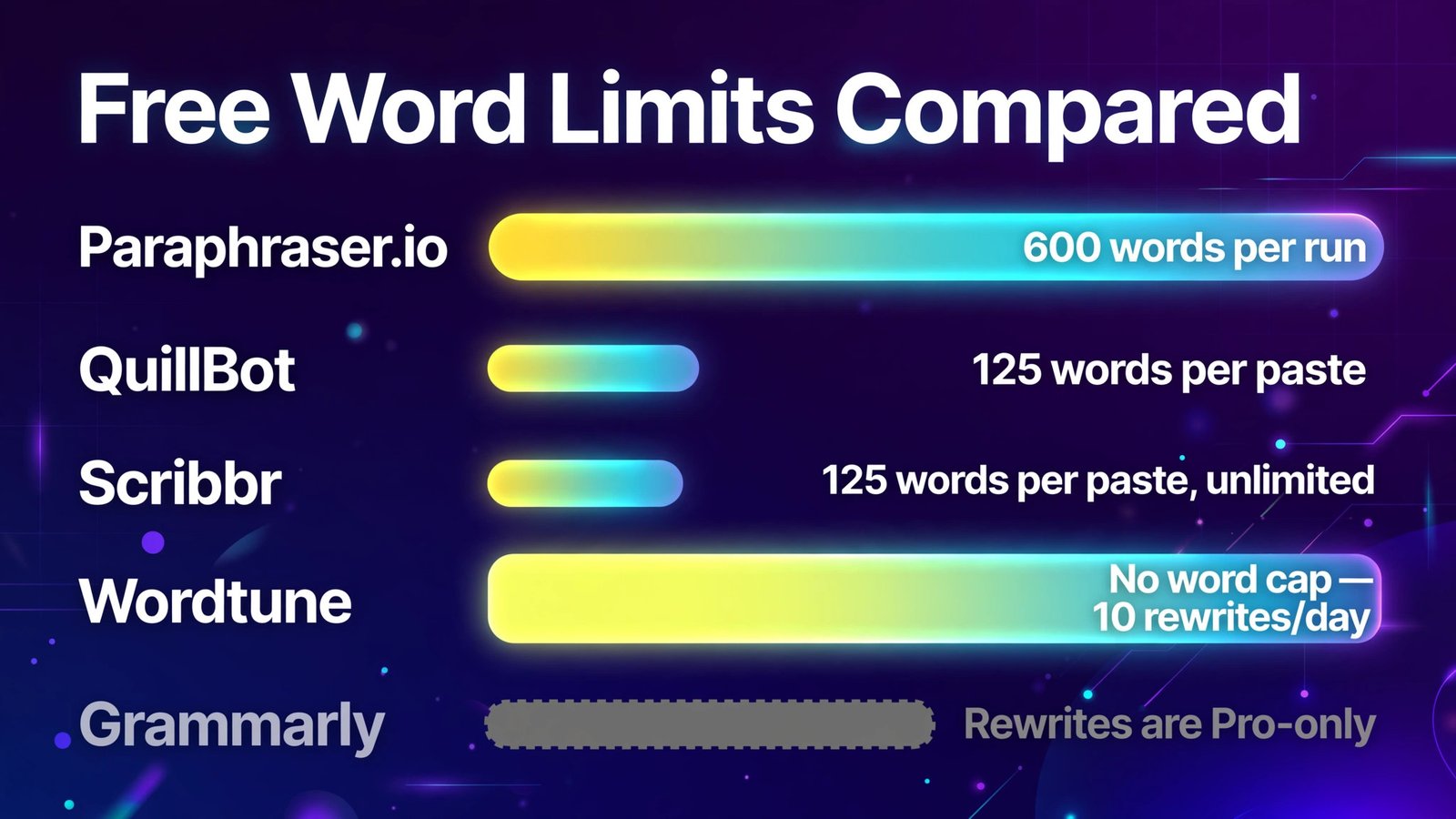
The headline: if you paraphrase long documents for free, only Paraphraser.io lets you paste more than a paragraph at a time. Everyone else monetizes length — which is exactly why the paid tiers below are mostly about removing caps, not better AI.
1. QuillBot — Best All-Round Paraphraser
What it is: QuillBot is the category default: a paraphraser built around rewrite modes (Standard, Fluency, Formal, Academic, Humanizer, and more) plus a synonym slider that controls how aggressively it changes your wording. It bundles a grammar checker, summarizer, citation generator, and plagiarism checker, which is why it shows up in so many student and blogger toolkits.
2026 pricing (verified): Free plan with 125-word pastes and 2 modes. Premium is $19.95/month monthly, $39.95 per quarter (~$13.31/month), or $99.95/year (~$8.33/month). Premium unlocks unlimited paraphrasing, all 9 modes plus custom modes, the full synonym slider, a plagiarism checker (25,000 words/month), and a summarizer that handles up to 6,000 words.
Our test: QuillBot’s Standard mode returned: “Remote work has forever altered how businesses assess productivity. Rather than counting the hours workers spend at their desks, many managers now judge people based on the quality and timeliness of their work.” It kept “rarely meet face to face” intact and preserved the contrast. One nit: “forever altered” is slightly stronger than “permanently changed” — a nuance inflation we saw in every tool, but QuillBot’s was the mildest. Fluency mode was even safer, changing less. Meaning 4.5/5, Readability 4.0/5 — solid, occasionally a touch mechanical at high slider settings.
Pros:
- Best meaning preservation at aggressive settings of any tool tested
- 9 modes + synonym slider give real control over rewrite depth
- Plagiarism checker and summarizer included in one subscription
- Works in Chrome, Word, and Google Docs
Cons:
- Free tier’s 125-word cap is the tightest mainstream limit
- High-slider rewrites can sound synonym-swapped rather than rewritten
- Plagiarism allowance (25,000 words/month) runs out fast for heavy users
Verdict: If you buy one paraphrasing subscription, this is it — the control-to-price ratio at $8.33/month billed annually is still unmatched.
2. Wordtune — Best for Sentence-Level Rewriting
What it is: Wordtune (by AI21 Labs) takes the opposite approach to QuillBot: instead of rewriting a whole paragraph in one shot, it offers several alternative phrasings for each sentence, plus “Spices” to expand, shorten, or change tone. You stay in control of every change, which matters when meaning is fragile.

2026 pricing (verified): Free Basic plan with 10 rewrites/day, 3 AI summaries/month, and unlimited spelling and grammar checks. Advanced is $13.99/month monthly or $6.99/month billed annually (30 rewrites/day, 15 summaries/month). Unlimited is $19.99/month monthly or $9.99/month billed annually, removing the caps and adding vocabulary, clarity, and fluency enhancements.
Our test: Wordtune gave us five options for the opening sentence; our pick was “Remote work has fundamentally changed the way companies measure productivity,” which is cleaner than QuillBot’s output. For the trap sentence it suggested “when colleagues seldom meet in person” — “rarely” survived every suggestion it made. Because you choose per sentence, drift is almost impossible unless you pick carelessly. The cost is speed: polishing 95 words took about twice as long as QuillBot’s one click. Meaning 4.5/5, Readability 4.5/5 — the most readable output in the test, earned sentence by sentence.
Pros:
- Multiple suggestions per sentence — you approve every change
- Best readability scores in our test
- No per-rewrite word cap; full paragraphs are fine even on free
- Casual/formal tone toggles are genuinely useful for emails
Cons:
- 10 free rewrites a day disappears fast in a real writing session
- Sentence-by-sentence flow is slow for long documents
- No plagiarism checker — you’ll need a second tool for coursework
Verdict: The paraphraser for writers who edit rather than generate — slower than QuillBot, better prose at the end of it.
3. Grammarly — Best Clarity Editor (Not a True Paraphraser)
What it is: Grammarly is a writing assistant first and a paraphraser second. Its Pro tier adds full-sentence rewrites and tone adjustment on top of grammar, clarity, and fluency checking — but it rewrites conservatively, to fix your sentences rather than to restate them. If your goal is “say the same thing differently,” it’s the wrong tool; if your goal is “say it correctly and clearly,” it’s the best one here.
2026 pricing (verified): Free plan covers spelling, grammar, tone detection, and 100 generative-AI prompts/month — sentence rewrites are not included free. Pro is $12/month billed annually ($144/year), $20/month billed quarterly, or $30/month monthly, with 2,000 AI prompts/month, full-sentence rewrites, tone adjustment, plagiarism detection, and AI-text detection.
Our test: Grammarly flagged two clarity improvements in our paragraph and offered a rewrite of the final sentence: “However, this shift also creates challenges, since collaboration and company culture are harder to maintain when colleagues rarely meet in person.” Cleaner, shorter, and every fact intact — but it changed the least of any tool, by design. It never touched “lose the daily commute,” correctly reading it as a benefit. Meaning 4.0/5 (the score reflects how little paraphrasing it actually does), Readability 5.0/5 — the single best sentence in the whole test came from Grammarly.
Pros:
- Most readable, most conservative rewrites — meaning is never at risk
- Works everywhere: browser, Word, Docs, email, desktop apps
- Plagiarism and AI-text detection included in Pro
- Best grammar safety net while you paraphrase
Cons:
- No dedicated paraphrase modes or synonym control
- Free plan can’t rewrite sentences at all
- Monthly billing ($30) is steep next to annual
Verdict: Buy it as your editing layer, not your paraphraser — but for published writing, its caution is a feature, not a bug.
4. Scribbr — Best Free Option for Students
What it is: Scribbr’s paraphrasing tool is a free, no-signup web tool aimed at students, sitting alongside Scribbr’s citation generator, AI detector, and plagiarism checker. Here’s the detail most reviews skip: Scribbr’s paraphraser runs in partnership with QuillBot, so the rewriting engine underneath is the same one — you’re getting QuillBot-quality output wrapped in an academic toolkit, with no account wall.
2026 pricing (verified): The paraphraser itself is free — 125 words per paste, unlimited uses, no signup. Scribbr makes its money on paid services around it: a plagiarism check costs $19.95 per document (up to 7,500 words), $29.95 (up to 50,000), or $39.95 (50,000+), and human proofreading is priced per word. There is no subscription.
Our test: Unsurprisingly, Scribbr’s output tracked QuillBot’s Standard mode almost word for word: same safe handling of “rarely,” same mild “forever altered”-style strengthening in one variant. Where it differs is friction — from landing on the page to a finished rewrite took under 20 seconds, no email, no card, no trial countdown. For a student rewording two paragraphs of a literature review at midnight, that matters more than feature depth. Meaning 4.5/5, Readability 4.0/5 — identical scores to QuillBot, because underneath, it is QuillBot.
Pros:
- Genuinely free with no signup — fastest start in this test
- Same rewrite engine as QuillBot
- Academic ecosystem around it: citations, AI detector, integrity guidance
- Refuses to paraphrase reference lists, protecting your citations
Cons:
- Same 125-word ceiling as QuillBot’s free tier
- No modes beyond the basics, no synonym slider
- Paid plagiarism checks are per-document — expensive across a semester
Verdict: The smart student’s shortcut: QuillBot’s brain, zero commitment — just respect the 125-word limit and cite your sources.
5. Paraphraser.io — Best Free Word Limit, Weakest Output
What it is: Paraphraser.io is a no-frills, ad-supported web paraphraser with a suite of side tools (article rewriter, plagiarism checker, summarizer, text-to-speech). Its one standout feature is generosity: the free tier accepts pastes four to five times longer than QuillBot’s, which is why it keeps showing up in “free paraphrasing tool” searches despite rougher output.
2026 pricing (verified): Free plan accepts up to 600 words per run with the basic modes (Word Changer, Fluency, Standard, Formal). Paid plans are sold on weekly, monthly, and annual billing — the annual plan runs about $60/year — and raise the per-run limit to roughly 1,500–2,000 words while unlocking the premium modes, removing ads, and speeding up processing.
Our test: Paraphraser.io handled the paragraph’s structure but stumbled on exactly the trap we planted: it rendered “lose the daily commute” as “eliminate the need to travel to work every day” (fine) in Fluency mode, but Standard mode produced “staff get flexibility and lose their daily travel” and, in one run, flipped the contrast sentence into a list that blurred the instead-of relationship. Every fact technically survived, but two sentences needed human repair before we’d publish them, and the prose reads synonym-swapped rather than rewritten. Meaning 3.5/5, Readability 3.5/5 — usable raw material, never a finished rewrite.
Pros:
- 600 free words per run — the longest free paste in this test
- No signup; works instantly in the browser
- Multiple languages supported for multilingual drafts
- Cheap annual plan if you only need volume
Cons:
- Weakest meaning preservation in the test; traps get flattened
- Ads and CAPTCHA friction on the free tier
- Output needs a real edit before it’s publishable
Verdict: Use it for long, low-stakes drafts where you’ll edit anyway. Never for academic work, client copy, or anything where a flipped nuance becomes your problem.
Full Comparison Table
| QuillBot | Wordtune | Grammarly | Scribbr | Paraphraser.io | |
|---|---|---|---|---|---|
| Entry price (annual) | $8.33/mo | $6.99/mo | $12/mo | Free | ~$60/yr |
| Free per-run limit | 125 words | No word cap (10/day) | Rewrites Pro-only | 125 words | 600 words |
| Meaning preservation | 4.5/5 | 4.5/5 | 4.0/5 | 4.5/5 | 3.5/5 |
| Readability | 4.0/5 | 4.5/5 | 5.0/5 | 4.0/5 | 3.5/5 |
| Paraphrase modes | 9 + custom | Suggestions + tone | Tone-based | 2 | 10+ (paid) |
| Plagiarism checker | Yes (paid) | No | Yes (Pro) | Paid per doc | Yes (paid) |
| Signup for free use | No | Yes | Yes | No | No |
| Best for | All-round use | Polished prose | Safe clarity edits | Students | Free volume |
How to Choose
- Match the tool to the stakes. A flipped word in a social post is embarrassing; in a thesis or contract summary it’s a real problem. High stakes → Wordtune or Grammarly (you approve every change). Low stakes → Paraphraser.io’s free volume is fine.
- Count your words before you pay. If you paraphrase under ~500 words a week, free tiers cover you: Scribbr for short pastes, Paraphraser.io for long ones. Above that, QuillBot Premium at $8.33/month billed annually is the cheapest serious upgrade.
- Decide whether you need modes. Tone and register changes (Formal, Academic, Humanizer) are QuillBot’s home turf. If you only ever rewrite in Standard, Wordtune’s suggestions may serve you better for less.
- Check the bundle, not just the paraphraser. Grammarly Pro and QuillBot Premium both fold in plagiarism checking. Price the whole stack you’d otherwise buy separately before deciding either is “expensive.”
- Always do a meaning pass. Whichever tool you pick, re-read the rewrite against the original specifically hunting for flipped negations, softened claims, and numbers that moved. Every tool in this test drifted at least once.

Frequently Asked Questions
What is the best free AI paraphrasing tool?
For quality, Scribbr — it’s QuillBot’s engine, free, with no signup, capped at 125 words per paste. For length, Paraphraser.io accepts 600 words free but with noticeably weaker output. Wordtune’s free plan (10 rewrites/day, full paragraphs) is the middle path.
Is QuillBot still the best paraphrasing tool in 2026?
For most people, yes. It scored joint-best on meaning preservation (4.5/5), has the deepest mode set and synonym control, and at $8.33/month billed annually it’s cheaper than Wordtune Unlimited and Grammarly Pro. Wordtune beats it on final readability if you work sentence by sentence.
Will using a paraphrasing tool get flagged as plagiarism?
Paraphrasing someone else’s work without citation is plagiarism no matter what tool you use — the tool changes the words, not the obligation to cite. Using a paraphraser on your own drafts to improve clarity is standard practice and what these tools are designed for. Check your institution’s or publisher’s AI policy either way.
Why do paraphrasing tools change my meaning?
They predict plausible rewordings; they don’t understand your argument. Negations, hedges (“rarely,” “may,” “some”), and numbers are the most common casualties — which is why our test paragraph included a “rarely” trap, and why a human meaning pass (How to Choose, step 5) is non-negotiable.
QuillBot vs Wordtune: which should I pick?
QuillBot for volume, modes, and one-click whole-paragraph rewrites. Wordtune for quality — multiple suggestions per sentence, better final readability, and a cheaper entry tier ($6.99/month billed annually for Advanced). Many writers run both: QuillBot for the first pass, Wordtune for polish.
Do paraphrasing tools work in other languages?
Partially. Paraphraser.io and QuillBot support multiple languages; Wordtune and Grammarly are English-first. If you write in English as a second language, Fluency modes (QuillBot) and suggestion-based tools (Wordtune) help most — we cover that use case in depth in our guide to writing tools for non-native English speakers.
Conclusion
The best AI paraphrasing tools in 2026 split into three honest categories: QuillBot (and its free Scribbr front-end) for controlled, mode-based rewriting; Wordtune and Grammarly for human-in-the-loop polish where readability and safety beat speed; and Paraphraser.io for free volume you’ll edit yourself. In our identical-paragraph test, no tool was flawless — each strengthened or softened at least one phrase — but the top three preserved every fact that mattered, including the “rarely” trap that separates a paraphraser from a liability.
Our recommendation: start free (Scribbr for short texts, Wordtune for paragraphs), and only pay when the word limits — not the marketing — actually stop your work. When they do, QuillBot Premium is the upgrade that removes the ceiling without changing the workflow you already learned.
Next step: copy the test paragraph from this article, run it through Scribbr and Wordtune’s free tiers side by side, and compare both outputs against the original word by word. Five minutes tells you more than any review — including this one.