

Third-party marketplaces take 15 to 30 percent of every order a ghost kitchen sends out, and that cut decides whether a delivery-only kitchen makes money at all. The best food delivery software for ghost kitchens in this guide was picked to cut that commission bill, pull every marketplace order into one screen, and let one kitchen run several virtual brands without hiring an extra dispatcher.
Cuboh leads for kitchens that need every marketplace in one feed, Deliverect leads for kitchens that already run a point of sale and want the integration layer, and Sauce leads for kitchens that want direct ordering with no commission at all. The ten tools below are ordered by the job each one does best, so a single-brand kitchen, a three-brand operation and a multi-location group each get a different winner.
Vendor pricing pages checked in November 2026 list Cuboh entry from about 119 dollars a month, so confirm the figure on the vendor page before you pay. A low headline figure rarely tells the whole story, because transaction fees, driver dispatch and marketplace fees all move the monthly bill.
How to Judge the Best Food Delivery Software for Ghost Kitchens
Start with the commission question, because it dwarfs every other cost in this category. A kitchen doing 2,000 orders a month at 25 dollars an order pays 10,000 to 15,000 dollars a month to the marketplaces at 20 to 30 percent, so a tool that shifts even a fifth of those orders to a direct channel pays for itself many times over. The best food delivery software for ghost kitchens is judged first on how much of that commission it removes, and only second on how pretty its dashboard looks.
Next, count the brands. A ghost kitchen running three virtual brands from one kitchen needs one menu system that keeps the brands separate, one inventory view that does not double-count the same chicken, and one order screen that shows which brand each ticket belongs to. A tool built for a single restaurant will force the operator to run three accounts, and that is where orders get missed.
Finally, test the bad night, not the good one. Friday at 7pm with four marketplaces firing at once is the real test, and the tools in this guide were ranked on whether orders flow into one screen, whether the kitchen display shows the right brand, and whether a failed tablet stops the whole kitchen or just one channel.
The 10 Tools at a Glance
Read the table as a map of trade-offs, then read the detail entries for the two or three tools that match how many brands you run and where your orders come from.
| Tool | Best for | Starting price |
|---|---|---|
| Cuboh | kitchens that need every marketplace in one feed | from about 119 dollars a month |
| Deliverect | kitchens that already run a point of sale | from about 119 dollars a month for up to 350 orders |
| Otter | small kitchens that want fast setup | from about 149 dollars a month |
| ChowNow | kitchens that want direct ordering plus aggregation | from about 119 dollars a month |
| Sauce | kitchens that want zero commission on direct orders | 149 dollars a month flat |
| Flipdish | kitchens that want a branded app | from about 149 dollars a month |
| KitchenHub | multi-brand kitchens on a budget | from about 69 dollars a month per location |
| Lunchbox | groups scaling to many locations | quote only |
| OrderOut | kitchens that want to start free | free to about 129.99 dollars a month |
| Restroworks | cloud-kitchen groups that need operations depth | quote only |
One comparison row cannot choose the tool for you, because a buyer chasing one job and a buyer chasing another need different strengths. Read the two or three detail entries that match the work, and skim the rest. The best food delivery software for ghost kitchens that fits is the one that matches the job, not the one with the longest list.
Best Pick by Job
The second tool in each row covers what the first leaves open for food delivery software for ghost kitchens. Read both names in the food delivery software for ghost kitchens pair, not just the first.
| Job type | First pick | Second tool | Why this pair works |
|---|---|---|---|
| Run several brands from one kitchen | Cuboh | KitchenHub | One feed for every marketplace plus brand separation covers the multi-brand job end to end |
| Cut marketplace commission fast | Sauce | ChowNow | Flat direct ordering plus a commission-free storefront covers the margin job from two angles |
| Connect delivery to an existing point of sale | Deliverect | Otter | An integration layer plus an order manager covers the point-of-sale job without replatforming |
| Keep the monthly bill low | KitchenHub | OrderOut | A low per-location price plus a free tier covers a new kitchen honestly |
| Scale to many locations | Lunchbox | Flipdish | Enterprise ordering plus branded apps covers growth from one kitchen to a group |
A kitchen that needs the best food delivery software for ghost kitchens to stop paying marketplace commission on every order should start with Sauce for direct orders and Cuboh for the marketplace feed, because that pair covers both sides of the margin problem. A kitchen that already runs a point of sale should start with Deliverect, because the integration layer only works when the till it connects to is the one the kitchen already uses.
The 10 Tools in Detail
The ten tools below are the ones that matter for a working ghost kitchen in 2026. Every entry sets out the tool’s strongest job, its price, and the place where it falls short, so you can match the tool to your brand count and your order volume. The best food delivery software for ghost kitchens that fits your commission problem matters more than the one with the longest feature list, so read the entries for your job first and skim the rest.
1. Cuboh
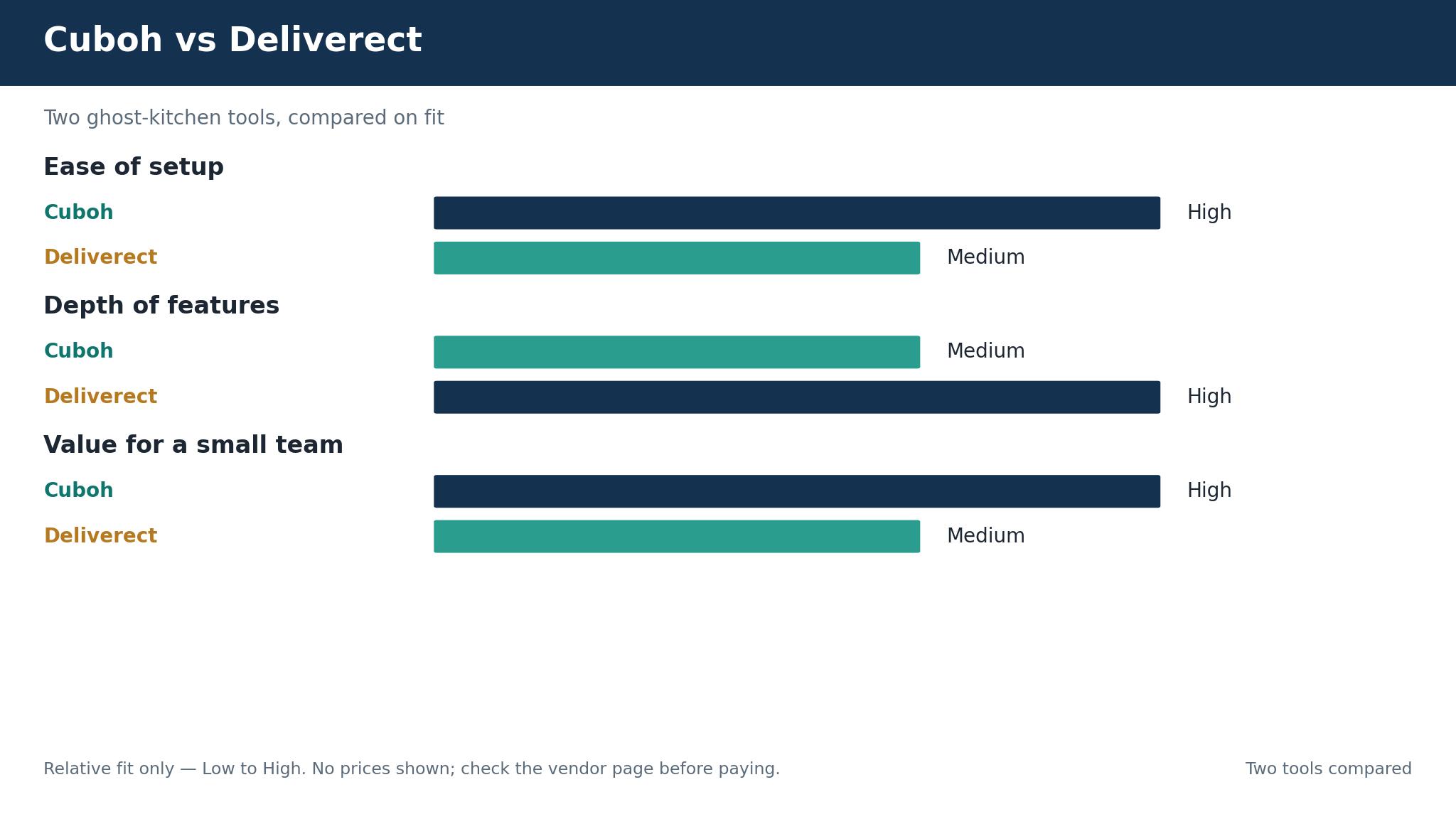
Uber Eats, DoorDash, Grubhub and more land on a single order screen in Cuboh, with one menu to update across them all. Kitchens that need every marketplace in one feed get the most from it, because the single screen does real work every day instead of sitting on a feature list.
The entry plan opens at about 119 dollars a month. Prices shift often, so open the vendor pricing page and read the current figure for the plan you actually need before you hand over any payment.
The entry tier caps order volume, so a busy kitchen outgrows it and pays more. For operators sizing up delivery software for ghost kitchens, that cap is a smaller concern than the fit, which is why Cuboh sits at number 1 in this ranking.
Run Cuboh on live orders for a fortnight and watch whether the team still opens it on the third morning, because an unopened tool is a cost whatever the price. Work out what Cuboh is worth from the hours the trial gives back, not from the list price.
2. Deliverect
Kitchens that already run a point of sale get the strongest match from Deliverect, which connects more than 300 point-of-sale systems to the marketplaces, so menus and orders stay in sync without retyping. The point-of-sale job shaped how Deliverect was put together, rather than being added to it afterwards.
Deliverect opens at about 119 dollars a month for up to 350 orders. That number is the lowest you will pay, not the final one, so look one plan up before you decide, because the features that matter usually live there, not on the entry tier.
The price rises in order bands, so a kitchen that grows past 750 orders a month jumps a tier. When that jump hits the everyday work, Deliverect drops off the list, and the tool below deserves the look instead. When the volume stays inside the band, the sync is worth it.
Work out what Deliverect is worth from the hours the trial gives back, not from the list price. The honest check is a busy Friday night of genuine orders, so run ten of them through it before the trial ends and judge the result on those orders alone.
3. Otter
Small kitchens that want fast setup should look at Otter first, because its order manager is live in days and the tablet-free setup keeps the pass clear on a Friday night. The fast-setup job is the one Otter was made for.
Otter opens at about 149 dollars a month. Start with the plan that handles the main job, then price the next step up while the trial is still running, so the upgrade never surprises you.
Deeper analytics and dispatch features sit on higher tiers. Hold that gap up against the speed of the setup. Otter still takes third place for operators weighing delivery software for ghost kitchens, because getting live in days still outweighs the missing analytics.
Judge Otter on a packed Friday rather than a demo, running ten genuine orders through it before the trial clock runs out. The trial that matters is the one run on live work, and Otter should be judged on whether the team reaches for it on the third morning without being reminded.
4. ChowNow
Kitchens that want direct ordering plus aggregation should put ChowNow on the list. Its commission-free direct ordering comes with a branded storefront, the Grow plan adds marketplace aggregation, and it holds up across a busy week.
ChowNow opens at about 119 dollars a month. Before you pay, check the vendor site itself for the live price on the day you buy, because the number quoted here can move with billing terms and add-ons.
Aggregation is not on the entry plan, so the cheapest tier does not solve the multi-channel problem. ChowNow keeps fourth place for operators sizing up delivery software for ghost kitchens, because commission-free direct ordering with a branded storefront still carries the ranking, with the gap kept in full view.
Run ChowNow on real orders for a fortnight and watch whether anyone still opens it on the third morning. Count the hours it saved during the trial before judging what it costs each month, since a subscription only pays for itself in time given back.
5. Sauce
One flat fee with no commission is the Sauce offer, and it plugs delivery drivers into direct orders from the kitchen website. Kitchens that want zero commission on direct orders get the most from it, because the flat fee does real work every day instead of sitting on a feature list.
Sauce charges 149 dollars a month flat. Read the opening figure as a minimum and price the next tier as well, since the capability you actually need often sits a step above the entry plan you started with.
Sauce is a direct-ordering tool first, so marketplace aggregation is not its strength. If that gap is part of the daily routine, Sauce is the wrong call, and the comparison continues one entry down. When direct orders are the priority, the flat fee is easy to defend.
Sauce justifies what it charges each month through the hours the trial gives back, so count those hours before deciding anything. Run it on the busiest night in the diary, not the quietest, and let ten genuine orders decide whether the trial turns into a subscription.
6. Flipdish
Kitchens that want a branded app get it from Flipdish, whose white-label website and app keep the customer on the kitchen brand instead of the marketplace brand. The branded-app job shaped how Flipdish was put together, rather than being added to it afterwards.
Flipdish opens at about 149 dollars a month. Pick the entry tier that covers the core work and find out what the move up costs before the trial period closes.
The branded app tier costs about 249 dollars a month, so the full package is a bigger commitment. Measure that cost against the strength of keeping the customer on the kitchen brand. Flipdish still takes sixth place for operators weighing delivery software for ghost kitchens, because the branded experience still comes out ahead once the price is counted.
Before the trial ends, Flipdish should have carried ten genuine orders on a busy night, because the demo never shows the failure modes that matter. A trial that matters starts with real orders on the first day, and by the end you will know whether the team still reaches for it or has quietly stopped.
7. KitchenHub
Multi-brand kitchens on a budget should look at KitchenHub first, because it was made for virtual brands, with one kitchen running several concepts from a single location. The budget multi-brand job is the one KitchenHub was built for.
The entry plan runs from about 69 dollars a month per location. Confirm the current price on the vendor page first, since list prices change and the plan that fits usually carries extras the headline figure leaves out entirely.
It is a newer platform, so its integration list is shorter than the established aggregators. KitchenHub still takes seventh place for operators weighing delivery software for ghost kitchens, because it was made for virtual brands, with one kitchen running several concepts from a single location, and that fit still counts for more than the shorter list.
Hand KitchenHub live orders, not sample data, and watch the third morning: if the team opens it without prompting, the trial has answered the question. Add up the hours the trial saved, and let that total judge the monthly price.
8. Lunchbox
Groups scaling to many locations should put Lunchbox on the list. Its enterprise ordering, loyalty and dispatch cover a group that has outgrown single-kitchen tools, and it holds up across a busy week.
Lunchbox pricing is quote only. Read that as the floor, and price the tier above the entry level before judging the starting figure, because the features that matter usually sit there.
Pricing is quote-based, so a small kitchen cannot model the cost without a sales conversation. When that gap lands on the daily work, the next tool down serves operators sizing up delivery software for ghost kitchens better than Lunchbox does. When the group is the reality, the enterprise depth is worth the conversation.
Before judging what Lunchbox costs each month, count the hours the trial saved, because a subscription only pays for itself in time given back. The test Lunchbox has to pass is a packed Friday night, so load it with ten genuine orders and see what breaks before the trial ends.
9. OrderOut
New kitchens that want to start free get a genuine free tier from OrderOut, which lets a kitchen aggregate orders before committing to a monthly fee. The free-start job is where OrderOut shows its value in the daily routine, not in a feature list.
OrderOut runs from free to about 129.99 dollars a month. The cheapest plan that does the job is the right place to begin, but learn the upgrade price early, while you still have trial days left.
The free tier is limited, and the paid tiers add up once several marketplaces are connected. Compare that limit with the free start. OrderOut still takes ninth place for operators weighing delivery software for ghost kitchens, because starting free still outweighs the limits once the kitchen grows.
Try OrderOut the way the work actually happens, on a busy night with ten genuine orders, and the decision at the end of the fortnight will make itself. A trial only proves itself when OrderOut handles live orders on a busy evening, with ten orders as the smallest sample worth trusting.
10. Restroworks
Cloud-kitchen groups that need operations depth get it from Restroworks, whose cloud-kitchen management covers orders, inventory and operations in one system. The fit comes from a workflow made for the group job, not adapted to it, and the ranking measures that fit.
Pricing is quote only. Get the price in writing and keep it, because sales-led vendors repackage plans without warning and the quoted figure is only the beginning of what you will actually pay.
Pricing is quote-based and the platform is heavier than a kitchen running one or two brands needs. Restroworks still takes tenth place for operators weighing delivery software for ghost kitchens, because its cloud-kitchen management covers orders, inventory and operations in one system, and that depth still counts for more than the weight.
Run Restroworks on live orders for a fortnight and see whether the team still opens it on the third morning, because an unopened tool is a cost whatever the price. Judge the price on the hours the trial returned, not on the number on the pricing page, because time given back is the only honest measure.
What a Three-Brand Kitchen Actually Pays Each Month
For a kitchen doing 1,500 orders a month at 25 dollars an order, marketplace commission at 25 percent is 9,375 dollars a month. That number is the budget the software has to beat. A 149 dollar flat tool that moves a fifth of orders direct saves about 1,875 dollars a month, which is why the commission question comes before the subscription question.
The best food delivery software for ghost kitchens in this guide includes one genuine free tier in OrderOut, which is why a new kitchen should not pay for aggregation before the brands exist. Add the subscription, the transaction fees and the driver dispatch cost together before you compare two tools, or the comparison is fiction.
| Cost band | What it covers | Who it fits |
|---|---|---|
| Commission only | No software, marketplaces take their cut | A kitchen testing one brand |
| Flat direct ordering | About 149 dollars a month plus processing | A kitchen moving orders to its own site |
| Aggregation tier | About 119 to 199 dollars a month plus fees | A kitchen on several marketplaces |
| Enterprise stack | Quote-based, several hundred a month | A group running many locations |
Four Ghost-Kitchen Mistakes That Eat the Margin
The first mistake is paying marketplace commission on orders the kitchen could have taken direct. A regular who orders through an app every Friday will order through the kitchen website if the link is on the bag and the first direct order carries a small discount. Every order that stays on the marketplace is a fifth of the ticket given away.
The second mistake is running three brands on three separate accounts. The kitchen ends up updating the same menu three times, the inventory counts drift, and a ticket from one brand gets cooked under another brand name. One system with brand separation is not a luxury, it is how a multi-brand kitchen stays accurate.
The third mistake is buying the enterprise tier before the volume exists. A kitchen doing 400 orders a month does not need dispatch, loyalty and multi-location reporting, and the quote-based price locks the kitchen into a contract it cannot use. Start on the flat tier, prove the brands sell, and only then buy the bigger stack.
The fourth mistake is ignoring the failed-tablet night. When the aggregation tablet dies on a Friday, the kitchen either keeps cooking from the marketplace apps or it stops taking orders. Test the fallback before the busy night, because the tool that recovers in two minutes is worth more than the tool with the prettier dashboard.
Direct Orders, Driver Dispatch and the Brand That Customers Remember
Direct ordering is the only part of this category that changes the economics instead of organising them. A marketplace order costs 20 to 30 percent of the ticket, while a direct order costs the processing fee and the driver. The kitchens that win in this guide are the ones that treat the marketplace as a discovery channel and the direct channel as the profit channel, with the software moving regulars across.
Driver dispatch is the second half of the direct-order job. A kitchen that takes direct orders still needs a driver, and the tools that plug into a national driver network save the kitchen from hiring riders. Check whether dispatch is included in the flat fee or charged per delivery, because a per-delivery fee on a 25 dollar order adds up fast across a month.
Brand memory is the part operators forget. A customer who orders from three virtual brands in one kitchen does not know they share a kitchen, and that is fine, but the packaging, the menu voice and the delivery time all have to feel like three different restaurants. Software that keeps brands separate on the ticket and the label protects that illusion, and software that mixes them breaks it in one night.
One Trial Week With Cuboh
One real week with Cuboh shows whether the best food delivery software for ghost kitchens in this guide fits the daily work. Load ten real orders from last week into Cuboh on day one and run the whole workflow through it instead of the demo data, because demo data never shows the edge cases. By day three the team will know whether Cuboh fits the work or fights it, and that answer is worth more than any feature list in this guide.
Price the week as well, adding the subscription, the per-seat fee and the add-ons the trial actually used, then compare that total with what the old way cost in time. A tool that saves three hours a week pays for itself at almost any price in this guide, and Cuboh should be judged on that arithmetic. Keep the notes from the trial week with Cuboh, because the same notes decide the renewal in a year.
Your First Fortnight With the New Delivery Stack
Do these steps in order, on real work from your own week, before you pay for a second month of the best food delivery software for ghost kitchens in this guide.
- List every marketplace the kitchen sells on and connect each one to the trial account.
- Build one menu per brand and check that a price change lands on every channel.
- Run ten real orders through the single screen on a busy evening.
- Put the direct-order link on every bag and test the first-order discount.
- Price one month of commission against one month of the flat fee.
- Test the driver dispatch on a real direct order, not a demo.
- Check what happens when one marketplace tablet goes offline.
- Pay for the tool the team kept using and cancel the one nobody opened twice, which is the last step of the fortnight with Cuboh.
Frequently Asked Questions
Which delivery tool is best for a ghost kitchen running three brands from one kitchen?
Cuboh is the best first pick for a multi-brand kitchen, because it pulls every marketplace into one screen and keeps brands separate on the ticket. Cuboh lists entry from about 119 dollars a month. KitchenHub is the budget alternative for a kitchen that wants brand support from the start.
How much commission can a ghost kitchen save by moving orders direct?
A kitchen doing 1,500 orders a month at 25 dollars an order pays about 9,375 dollars a month in commission at 25 percent. Moving a fifth of those orders direct saves about 1,875 dollars a month, which is far more than any flat-fee tool in this guide costs.
Is Sauce really free of commission for ghost kitchens?
Sauce charges a flat 149 dollars a month with no commission on direct orders, and it plugs delivery drivers into orders from the kitchen website. Processing fees still apply, and marketplace aggregation is not its strength, so pair it with an aggregator if the kitchen still sells on the marketplaces.
Does Deliverect work with the point of sale a ghost kitchen already runs?
Deliverect connects more than 300 point-of-sale systems, so most kitchens keep the till they already use. Pricing starts from about 119 dollars a month for up to 350 orders and rises in order bands, so check the band the kitchen actually sits in before signing.
What does KitchenHub cost a single-location ghost kitchen?
KitchenHub lists its Core plan at about 69 dollars a month per location, which is the lowest published starting price in this guide. It was built for virtual brands, so a kitchen running several concepts from one location gets brand support that the general aggregators charge more for.
Should a new ghost kitchen start on a free delivery tool?
Yes, if the brands are unproven. OrderOut offers a free tier that lets a new kitchen aggregate orders before paying a monthly fee. Once the kitchen passes a few hundred orders a month, the paid tier with full marketplace coverage and driver dispatch is the better buy.
Keep the Commission Low and the Brands Separate
The best delivery software for a ghost kitchen is not the one with the most integrations. It is the one that moves orders off the marketplaces, keeps three brands straight on one pass, and keeps cooking when a tablet fails. Cuboh is that tool for most multi-brand kitchens, Sauce is the margin pick for direct orders, and Deliverect is the choice for kitchens that already run a point of sale.
List the marketplaces this week, price one month of commission against one month of the flat fee, and let the margin decide the purchase. The orders are already arriving, and the ticket the kitchen keeps is the one it took direct.