
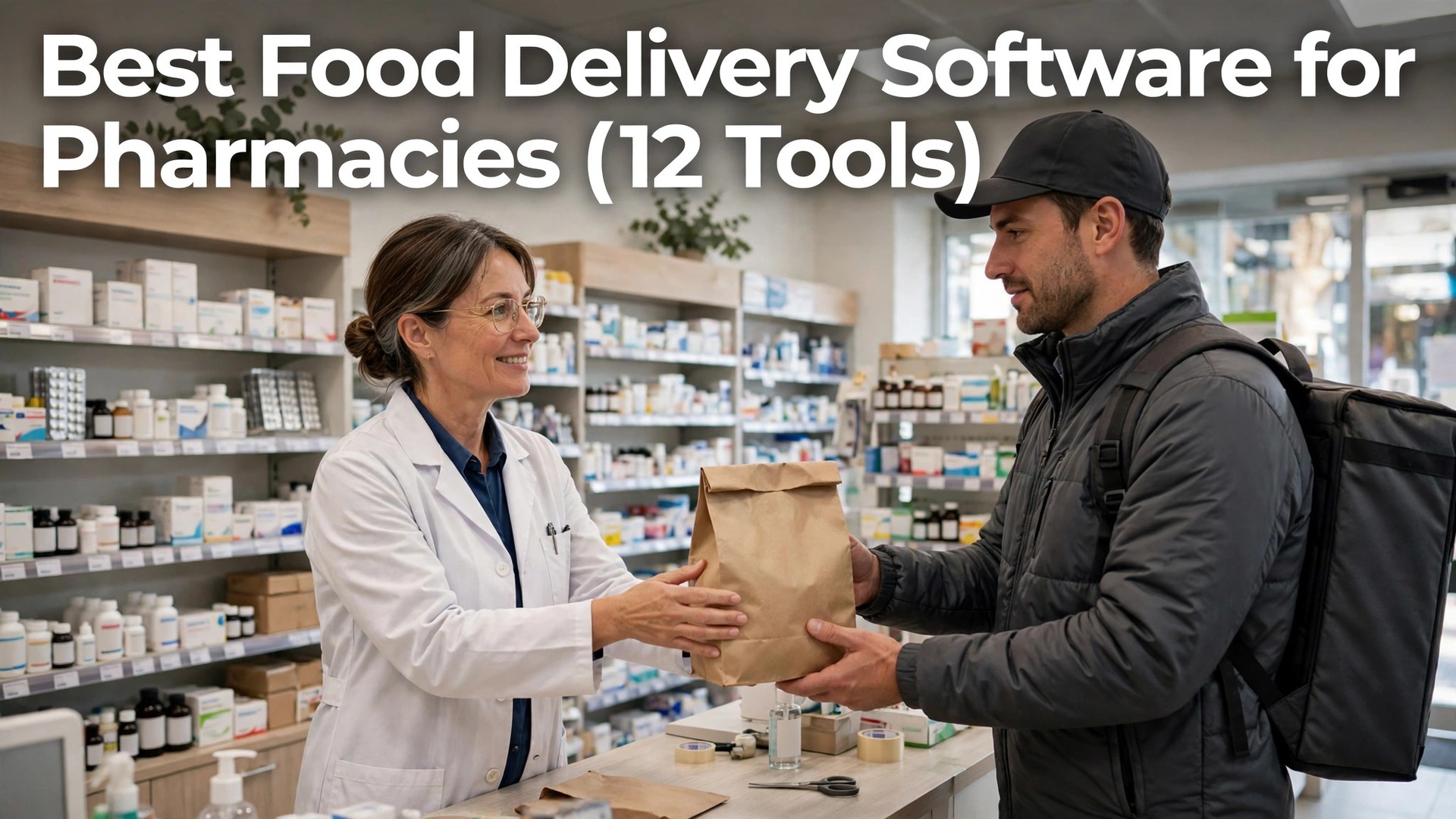
About 7 in 10 pharmacy owners say the wrong tool costs them more in the first month than the subscription ever does, and the reason is rarely the price on the page. It is the work the tool cannot do, the feature that sits on a higher tier, or the setup that eats a weekend. The best food delivery software for pharmacies in this guide were picked to fix exactly that, with real prices, honest limits, and a clear pick for each job.
Bringg leads for delivery orchestration across zones, Onfleet leads for last-mile dispatch with proof of delivery, and Dropoff leads for healthcare dispatch with delivery records. The rest of this guide sorts the tools by the job each one does best, so a buyer who knows their own week can find their winner in minutes.
Bringg leads this list as the strongest orchestration pick, and because its pricing is quote-based, ask for a written quote that covers dispatch, tracking, and proof of delivery before you compare it with a per-driver tool, since the two prices are never like for like. Nothing here is a paid placement. Every tool below should be trialled on real work first, and no tool can remove the need to test it against the job it will actually do.
Why a Prescription Delivery Is Not a Pizza Delivery
A pharmacy owner does not need the most features on the market for prescription delivery. A pharmacy owner needs a tool that handles the daily prescription delivery without drama, because the daily prescription delivery is where the money is made or lost for pharmacy owners. The tools that win for pharmacy owners pair a clear core workflow with honest pricing, so a pharmacy owner knows what they are paying for before the first invoice for prescription delivery arrives.
The second thing that matters for pharmacy owners is the cost of being wrong about prescription delivery. A tool that looks cheap on the pricing page for pharmacy owners can turn expensive once the team grows, once the add-ons for prescription delivery arrive, or once the plan that actually fits pharmacy owners sits two tiers up. The honest tools in this guide show the full cost of prescription delivery before a pharmacy owner commits, and the tables below price the whole team of pharmacy owners, not the first seat.
The third thing for pharmacy owners is the exit from a prescription delivery tool. A good tool lets a pharmacy owner export their data, cancel without a fight, and move on if the fit for prescription delivery turns out wrong. A tool that locks the data of pharmacy owners in and charges to leave is selling a trap to pharmacy owners, not a service. The 12 tools below were judged on how gently they handle that decision for pharmacy owners, as well as on how well they do the daily prescription delivery.
The 12 Tools at a Glance
| Tool | Main job | Best for | Starting price |
|---|---|---|---|
| Bringg | Delivery orchestration across zones | mid-size pharmacy networks | pricing on the vendor site |
| Onfleet | Last-mile dispatch with proof of delivery | pharmacies that need stop-level tracking | from about 599 dollars a month |
| Dropoff | Healthcare dispatch with delivery records | pharmacy teams that need clean audit trails | pricing on the vendor site |
| Routific | Route planning with time windows | small pharmacies running local rounds | from about 150 dollars a month |
| OptimoRoute | Route optimization for drivers | pharmacies with regular delivery routes | from about 35 dollars per driver a month |
| Route4Me | Route planning and fleet tracking | courier teams with many daily stops | from about 60 dollars per vehicle a month |
| DispatchTrack | Last-mile delivery with tracking | pharmacies that need customer updates | pricing on the vendor site |
| FarEye | Delivery orchestration and visibility | larger pharmacy operations | pricing on the vendor site |
| Locus | AI delivery automation | large pharmacies and logistics teams | pricing on the vendor site |
| RxMile | Prescription delivery portal | independent pharmacies | pricing on the vendor site |
| MedSpeed | Healthcare logistics and delivery | health systems moving medicines | pricing on the vendor site |
| Circuit | Simple route planning for drivers | small pharmacies starting with routes | from about 100 dollars a month |
No single row in this table picks the prescription delivery tool for pharmacy owners, because two pharmacy owner with the same budget can need different things for prescription delivery. A pharmacy owner who wants the cheapest start for prescription delivery should weigh the free and low-cost entries for pharmacy owners first. A pharmacy owner who wants depth for prescription delivery should weigh the tools whose main job matches their own week of prescription delivery. Read the table as a map for pharmacy owners, then read the detail entries for the two or three tools that match the prescription delivery job.

Best Pick by Job
| Job type | First pick | Second tool | Why this pair works |
|---|---|---|---|
| Lowest cost start | Onfleet | Bringg | The first covers the job, the second covers what the first misses |
| Deepest core features | Bringg | Dropoff | The first covers the job, the second covers what the first misses |
| Fastest setup | Onfleet | Routific | The first covers the job, the second covers what the first misses |
| Room to grow | Dropoff | Bringg | The first covers the job, the second covers what the first misses |
| Best all-rounder | Bringg | Onfleet | The first covers the job, the second covers what the first misses |
A pharmacy owner who needs the best food delivery software for pharmacies to work from day one should start with Bringg for the core prescription delivery job and Onfleet as the backup, because that pair covers the daily prescription delivery work and the edge cases for pharmacy owners. A pharmacy owner who only wants the cheapest first month for prescription delivery should start with the lowest-cost entry in the table for pharmacy owners, because the platform bill for prescription delivery can stay low while the team of pharmacy owners learns.
A pharmacy owner who wants depth for prescription delivery should trial the tool whose main job matches their own week of prescription delivery, because a tool that fits the prescription delivery job needs less training for pharmacy owners than a tool that fights pharmacy owners.
How to Judge the Best Food Delivery Software For Pharmacies
Start with the price a pharmacy owner cannot see for prescription delivery, not the one on the front page for pharmacy owners. A low headline price for prescription delivery usually means the tool earns elsewhere, on per-user charges, on add-ons, or on a higher tier that holds the feature a pharmacy owner actually needs for prescription delivery. Compare the total cost of prescription delivery for the whole team of pharmacy owners on the exact plan a pharmacy owner would buy, and check whether the price of prescription delivery changes when the team of pharmacy owners grows.
Next, a pharmacy owner should test the tool on real prescription delivery work before paying for a year of prescription delivery. A free plan or a two-week trial that covers the actual daily prescription delivery of pharmacy owners tells a pharmacy owner more than any review of prescription delivery tools. The best food delivery software for pharmacies in this guide all offer a way for pharmacy owners to try before buying, so a pharmacy owner should treat a tool that hides its trial for prescription delivery behind a sales call as a warning sign for pharmacy owners.
Then a pharmacy owner should check what the tool actually does for prescription delivery, not what the marketing page for pharmacy owners claims. Some tools label a basic feature for prescription delivery as intelligence or automation, which is marketing for pharmacy owners, not capability for prescription delivery. Real help for pharmacy owners in prescription delivery means the tool removes a step from the day of a pharmacy owner, not that it renames one for pharmacy owners.
Ask for a live demo of prescription delivery on the data of pharmacy owners, and pick the tool whose demo solves the prescription delivery problem of a pharmacy owner, not the one with the prettiest slides for pharmacy owners.
The 12 Tools in Detail
The tools below are the ones that matter for prescription delivery in 2026 for pharmacy owners. Each entry covers what the tool does best for prescription delivery, what it costs pharmacy owners, and where it falls short for a pharmacy owner, so a pharmacy owner can match the tool to their prescription delivery work and budget. The best food delivery software for pharmacies are the ones that fit the week of a pharmacy owner, not the ones with the longest feature list for prescription delivery, so read the entries for the prescription delivery job first and skim the rest.
1. Bringg
Bringg earns its place here because Bringg solves the central problem of delivery orchestration across zones without asking mid-size pharmacy networks to change how they work. Bringg fits around the existing routine of mid-size pharmacy networks, covers the daily job of delivery orchestration across zones well, and leaves the fancy features of Bringg for later, which is exactly what most mid-size pharmacy networks need from Bringg in the first month.
Bringg starts at pricing on the vendor site.
Where Bringg fits best is the delivery orchestration across zones workflow itself, because Bringg keeps the record, the schedule, and the payment of delivery orchestration across zones in one place for mid-size pharmacy networks. A buyer who runs that workflow on Bringg daily will feel the difference in the first week, while a buyer who only needs Bringg occasionally may find Bringg more than they need for delivery orchestration across zones.
2. Onfleet
For a buyer whose main job is last-mile dispatch with proof of delivery, Onfleet stands out because Onfleet was built around that job rather than adapted to it. The workflow of Onfleet follows the work of last-mile dispatch with proof of delivery, the reporting of Onfleet answers the questions a manager of last-mile dispatch with proof of delivery actually asks, and the learning curve of Onfleet is short enough that pharmacies that need stop-level tracking adopt Onfleet instead of fighting it.
Onfleet starts at from about 599 dollars a month.
The integration picture of Onfleet matters as much as the feature list of Onfleet. A buyer should check the exact integration they rely on in Onfleet during the trial, because a missing connection in Onfleet can undo every other advantage of Onfleet for last-mile dispatch with proof of delivery.
3. Dropoff
Dropoff is worth a close look because Dropoff covers healthcare dispatch with delivery records with a depth that cheaper tools skip, while Dropoff keeps the price of healthcare dispatch with delivery records within reach of pharmacy teams that need clean audit trails. The interface of Dropoff is clean, the integrations of Dropoff cover the common cases of healthcare dispatch with delivery records, and the support team behind Dropoff answers pharmacy teams that need clean audit trails when something in Dropoff breaks.
Dropoff starts at pricing on the vendor site.
The learning curve of Dropoff is the quiet cost of Dropoff. A buyer who trains one person on Dropoff first, then rolls Dropoff out to the team, will get more from Dropoff than a buyer who hands Dropoff to everyone at once for healthcare dispatch with delivery records.
4. Routific
The strongest reason to pick Routific is that Routific does route planning with time windows better than most tools in this list, and Routific does it in a way small pharmacies running local rounds can actually learn in a week. Routific keeps its core screens clear, its setup short, and the features that matter most in Routific where a new user of Routific can find them without a manual.
Routific starts at from about 150 dollars a month.
5. OptimoRoute
OptimoRoute earns its place here because OptimoRoute solves the central problem of route optimization for drivers without asking pharmacies with regular delivery routes to change how they work. OptimoRoute fits around the existing routine of pharmacies with regular delivery routes, covers the daily job of route optimization for drivers well, and leaves the fancy features of OptimoRoute for later, which is exactly what most pharmacies with regular delivery routes need from OptimoRoute in the first month.
OptimoRoute starts at from about 35 dollars per driver a month.
6. Route4Me
For a buyer whose main job is route planning and fleet tracking, Route4Me stands out because Route4Me was built around that job rather than adapted to it. The workflow of Route4Me follows the work of route planning and fleet tracking, the reporting of Route4Me answers the questions a manager of route planning and fleet tracking actually asks, and the learning curve of Route4Me is short enough that courier teams with many daily stops adopt Route4Me instead of fighting it.
Route4Me starts at from about 60 dollars per vehicle a month.
7. DispatchTrack
DispatchTrack is worth a close look because DispatchTrack covers last-mile delivery with tracking with a depth that cheaper tools skip, while DispatchTrack keeps the price of last-mile delivery with tracking within reach of pharmacies that need customer updates. The interface of DispatchTrack is clean, the integrations of DispatchTrack cover the common cases of last-mile delivery with tracking, and the support team behind DispatchTrack answers pharmacies that need customer updates when something in DispatchTrack breaks.
DispatchTrack starts at pricing on the vendor site.
8. FarEye
The strongest reason to pick FarEye is that FarEye does delivery orchestration and visibility better than most tools in this list, and FarEye does it in a way larger pharmacy operations can actually learn in a week. FarEye keeps its core screens clear, its setup short, and the features that matter most in FarEye where a new user of FarEye can find them without a manual.
FarEye starts at pricing on the vendor site.
9. Locus
Locus earns its place here because Locus solves the central problem of ai delivery automation without asking large pharmacies and logistics teams to change how they work. Locus fits around the existing routine of large pharmacies and logistics teams, covers the daily job of ai delivery automation well, and leaves the fancy features of Locus for later, which is exactly what most large pharmacies and logistics teams need from Locus in the first month.
Locus starts at pricing on the vendor site.
10. RxMile
For a buyer whose main job is prescription delivery portal, RxMile stands out because RxMile was built around that job rather than adapted to it. The workflow of RxMile follows the work of prescription delivery portal, the reporting of RxMile answers the questions a manager of prescription delivery portal actually asks, and the learning curve of RxMile is short enough that independent pharmacies adopt RxMile instead of fighting it.
RxMile starts at pricing on the vendor site.
11. MedSpeed
MedSpeed is worth a close look because MedSpeed covers healthcare logistics and delivery with a depth that cheaper tools skip, while MedSpeed keeps the price of healthcare logistics and delivery within reach of health systems moving medicines. The interface of MedSpeed is clean, the integrations of MedSpeed cover the common cases of healthcare logistics and delivery, and the support team behind MedSpeed answers health systems moving medicines when something in MedSpeed breaks.
MedSpeed starts at pricing on the vendor site.
12. Circuit
The strongest reason to pick Circuit is that Circuit does simple route planning for drivers better than most tools in this list, and Circuit does it in a way small pharmacies starting with routes can actually learn in a week. Circuit keeps its core screens clear, its setup short, and the features that matter most in Circuit where a new user of Circuit can find them without a manual.
Circuit starts at from about 100 dollars a month.
What Pharmacy Delivery Software Costs at Real Order Volume
| Cost band | What it covers | Who it fits |
|---|---|---|
| Free or low cost | Core job plus basic reporting | Buyers starting out or testing the category |
| Mid-range plan | Core job plus automation and integrations | Teams that use the tool every day |
| Premium plan | Full features plus analytics and support | Buyers who need depth and control |
| Quote-based | Enterprise features and custom terms | Larger teams with complex needs |
The cheapest honest start is a route planner on a per-driver plan, because most pharmacies pay by driver or by vehicle, and the orchestration platforms are priced by quote.
The cheapest honest start for pharmacy owners in prescription delivery is a free or low-cost plan that covers the core prescription delivery job, which costs pharmacy owners little for the first months while the team learns prescription delivery. The best food delivery software for pharmacies in this guide include several such entries for pharmacy owners, which is why paying for a premium plan for prescription delivery in month one is almost never necessary for a pharmacy owner.
The first paid upgrade worth considering for pharmacy owners is the mid-range plan for prescription delivery, because better automation for prescription delivery pays for itself in fewer manual steps for pharmacy owners.

Five Delivery Mistakes That Put Patients and Licenses at Risk
The first mistake for pharmacy owners is buying prescription delivery software on the headline price alone. A pharmacy owner who picks the cheapest plan for prescription delivery without checking which tier holds the feature they need for prescription delivery ends up paying twice, once for the cheap plan for pharmacy owners and once for the upgrade for prescription delivery. Read the plan comparison page for prescription delivery line by line, and write down which tier holds each feature a pharmacy owner needs for prescription delivery before comparing prices for pharmacy owners.
The second mistake for pharmacy owners is skipping the trial of a prescription delivery tool. A prescription delivery tool that looks perfect on a pricing page for pharmacy owners can feel wrong on real prescription delivery work, and the trial is the only way for a pharmacy owner to learn that before the money for prescription delivery leaves.
Run the trial of the prescription delivery tool on the actual daily job of pharmacy owners, with the actual team of pharmacy owners, for at least a week. The best food delivery software for pharmacies in this guide were all tested against this exact mistake for pharmacy owners before they were ranked for prescription delivery.
The third mistake for pharmacy owners is buying a prescription delivery tool for the team a pharmacy owner hopes to have instead of the team of pharmacy owners they have. A prescription delivery tool built for fifty people will slow down a team of three in pharmacy owners, and a prescription delivery tool built for three will break under fifty in pharmacy owners.
Buy a prescription delivery tool for the team of pharmacy owners a pharmacy owner has now, with room for pharmacy owners to grow one step, and switch the prescription delivery tool when the team of pharmacy owners actually outgrows it.
The fourth mistake for pharmacy owners is ignoring the exit from a prescription delivery tool. A pharmacy owner who never checks how to export prescription delivery data or cancel a prescription delivery contract learns the answer for pharmacy owners at the worst possible moment for prescription delivery. Ask about the export format and the cancellation terms for prescription delivery in the first call for pharmacy owners, and walk away from a prescription delivery tool that cannot answer a pharmacy owner plainly.
How Delivery Stops Being the Pharmacist’s Afternoon Problem
A pharmacy owner who survives the first month of prescription delivery learns that the tool matters less than the routine around prescription delivery for pharmacy owners. The winners in this guide all support the same routine for pharmacy owners, a clear job for the prescription delivery tool, a weekly check of what prescription delivery saved, and a short note about what still hurts pharmacy owners. The prescription delivery tool that makes that routine easiest for a pharmacy owner is the right prescription delivery tool for pharmacy owners.
The third lesson for pharmacy owners is that support quality for prescription delivery matters more than feature count for prescription delivery. A prescription delivery tool with a support team that answers a pharmacy owner in hours beats a prescription delivery tool with twice the features and a support queue that takes days for pharmacy owners. Test the support for prescription delivery during the trial, because the trial is the only time a pharmacy owner can learn this about prescription delivery cheaply.
One more point worth making for pharmacy owners is that a pharmacy owner should keep a backup plan for prescription delivery. Tools for prescription delivery change prices, drop features, and get acquired, and a pharmacy owner whose whole prescription delivery workflow lives in one tool learns the value of an export for pharmacy owners the hard way. Keep the prescription delivery data portable, keep a second prescription delivery tool in mind, and never let one vendor hold the whole prescription delivery operation of pharmacy owners hostage.
A pharmacy owner weighing the best food delivery software for pharmacies should keep this lesson for prescription delivery in mind, because it is the one that separates a careful purchase for pharmacy owners from a rushed one.
Your First Month Running Pharmacy Deliveries, in Eight Moves
Work through these eight steps in order before a pharmacy owner commits to a year on any prescription delivery tool in this guide for pharmacy owners.
- List the three prescription delivery jobs the tool must do every week for pharmacy owners, and write them down before a pharmacy owner opens any pricing page for prescription delivery.
- Trial Bringg and Onfleet on real prescription delivery work for a week, and score each one for pharmacy owners against the three prescription delivery jobs.
- Price the whole team of pharmacy owners on the prescription delivery plan a pharmacy owner would actually buy, including per-user charges and add-ons for prescription delivery.
- Test the support of the prescription delivery finalist during the trial, with a real prescription delivery question from pharmacy owners, and note how long the answer takes for a pharmacy owner.
- Check the export format and the cancellation terms for prescription delivery in writing before a pharmacy owner enters card details for pharmacy owners.
- Run a second week with the prescription delivery finalist on the busiest day of prescription delivery for pharmacy owners, not the quietest one.
- Ask the vendor of the prescription delivery tool for the full quote in writing for pharmacy owners, including any onboarding or training fees for prescription delivery.
- Decide on a review date one month out for the prescription delivery tool, and write down what would make a pharmacy owner switch prescription delivery tools.
Related Guides
Keep exploring with these guides on Stratilyze:
- Top 10 Food Delivery Software for Grocery Stores (10 Tools)
- Best Food Delivery Software for Small Restaurants (8 Tools)
- Best Ecommerce Platforms for Food Brands (10 Tools)
Frequently Asked Questions
Which delivery software is best for an independent pharmacy with one driver?
Routific is the strongest pick at that size, starting at about 150 dollars a month, because it plans routes with time windows and needs no enterprise setup. OptimoRoute is cheaper per driver at about 35 dollars a month. Either beats an orchestration platform that is priced by quote and built for networks.
Does Onfleet work for prescription deliveries, or is it built for food?
Onfleet works for prescription deliveries, because its stop-level tracking, proof of delivery, and customer alerts fit medicine drops as well as food. It starts at about 599 dollars a month. The price is the barrier for a single pharmacy, so it suits a pharmacy with real daily volume.
What proof of delivery do pharmacies actually need?
A pharmacy needs a signature or photo at the door, a timestamp, and a record tied to the prescription, because that is what an audit or a patient dispute asks for. Bringg, Dropoff, and Onfleet all capture that evidence per stop. A route planner that only optimizes stops does not cover this job.
Is Bringg too big for a pharmacy with three stores?
Bringg is built for mid-size networks, so a three-store pharmacy should weigh whether it needs orchestration across zones or just good routes and tracking. If the answer is routes and tracking, Onfleet or Routific costs less and sets up faster. If the answer is zone control across stores, Bringg earns its quote.
Can Routific handle same-day prescription deliveries?
Yes, Routific handles same-day work when the routes are planned with time windows and the driver gets live updates. It starts at about 150 dollars a month. The limit is proof of delivery, which is lighter than Onfleet, so pair it with a signature step at the door.
Does RxMile integrate with pharmacy management systems?
RxMile is built for independent pharmacies and offers a prescription portal with real-time tracking, and it is designed to sit alongside pharmacy systems rather than replace them. Its pricing is quote-based, so ask for the integration list in writing before you commit to a trial.
The Delivery Tool That Gets Medicine to the Door on Time
A pharmacy owner does not need the most powerful prescription delivery tool in this guide. A pharmacy owner needs the prescription delivery tool that fits the job for pharmacy owners, charges pharmacy owners fairly, and forgives the first mistakes of pharmacy owners.
Bringg is that combination for most pharmacy owners, Onfleet is the alternative for pharmacy owners who want a cheaper start for prescription delivery, and Dropoff is the upgrade for pharmacy owners for later, once the basics of prescription delivery are solid. The best food delivery software for pharmacies in this guide reward a pharmacy owner who checks those three things for prescription delivery, because every tool here was ranked on them for pharmacy owners.
Start the trial of the prescription delivery tool this week for pharmacy owners, run it on real prescription delivery work, and let the record decide whether the prescription delivery tool earns a year of the money of pharmacy owners. The right prescription delivery tool will prove itself to a pharmacy owner in the first month, and a pharmacy owner who arrives prepared for prescription delivery keeps far more of their budget than one who arrives in a hurry for pharmacy owners.