
A catering company that runs events on a restaurant POS usually discovers the gap when a client changes the guest count on Thursday and the kitchen, the floor team, and the invoice all need to hear about it at once. A company that buys a pure catering suite usually discovers the opposite gap, when the venue asks for a floor plan and the software has never drawn one. The best restaurant management software for catering companies closes both gaps, and the choice between the two approaches decides whether a busy weekend runs on one system or on five spreadsheets.
The split comes down to where the work happens. An off-premise caterer lives in proposals, banquet event orders, and kitchen production sheets, and needs menu costing down to the plate. A restaurant with a private dining room lives in table management and floor plans, and needs the catering booking to feed the same kitchen as the dining room. A venue group lives in sales pipelines and contracts across several rooms.
This guide compares ten live systems on catering work, not on generic restaurant checklists. Every price here was read from the vendor’s own pricing page in late 2026, before tax. Where a vendor sells by quote, the guide says so, and where a plan charges per user or per venue, the guide states the basis.
Proposals, BEOs, and the Paper Trail That Feeds the Kitchen
A catering sale starts as a conversation and ends as a banquet event order, and every step in between has to stay linked. The proposal carries the menu and the price, the contract carries the terms and the deposit, and the BEO carries the timing, the room setup, and the dietary notes. When any of those three lives in a separate document, the kitchen gets an old version.
Caterease and Total Party Planner were built around this paper trail, and both generate BEOs, function sheets, and invoices from a single event record. Tripleseat and Perfect Venue handle the same flow with a stronger sales side, tracking leads and conversion alongside the documents. The difference shows up when a client changes the menu a week out, since a linked system updates the cost, the BEO, and the invoice together, while a loose system leaves the team to update each one by hand.
Test this with a real event from last season. Enter the original proposal, change the guest count from 120 to 150, swap one main course, and see what updates automatically. The best restaurant management software for catering companies will reprice the event, refresh the BEO, and flag the kitchen production change without anyone retyping a line. A system that cannot do that will cost the company a mistake on a busy weekend, and the mistake will be visible to the client.
Menu Costing Down to the Plate
A catering menu that looks profitable at the top line can lose money on one dish, and the only way to know is costing by recipe. The software should carry ingredient costs, portion sizes, and labour per item, then show the margin on each menu choice before the proposal goes out. Caterease and Total Party Planner both do this properly, with recipe costing and profit analysis built in, which is why caterers who cost menus seriously keep recommending them.
The costing has to survive the real world, where a supplier raises the price of salmon mid-season and the menu price was set in January. A good system flags the margin change when the ingredient cost moves, so the sales team can adjust the price or swap the dish before the event is booked. A system that stores costs as fixed numbers will quietly let the margin slide until the month-end accounts show it, which is too late to fix.
Ask the vendor to cost a three-course menu from your own supplier prices, then raise one ingredient by twenty percent and show the new margin. If the system flags the change and reprices the proposal, the costing is alive. If it does not, the company is costing menus in its head, and the software is only a filing cabinet with a nice cover.
Staffing, Production, and the Day of the Event
The day of the event is a logistics problem, and the software earns its price by keeping the right people in the right place. Kitchen production lists tell the chefs what to cook and when, packing lists tell the van what to load, and staffing schedules tell the floor team where to be. When those three lists come from one event record, they agree with each other. When they come from three separate tools, they disagree at the worst moment.
Caterease includes staffing and a kitchen display, Total Party Planner covers task and staff management with integrations for scheduling tools, and Tripleseat leans on its venue workflow rather than deep kitchen lists. The best restaurant management software for catering companies gives the event manager one screen on the day, with the timeline, the guest count, the dietary notes, and the staff list together, so a question from the client gets an answer in seconds rather than a phone call to the office.
Run a trial event end to end with a real team. Build the production list, the packing list, and the staff schedule from one booking, then change the start time by an hour and see what moves. If the lists update together, the system will hold up on a Saturday with three events running at once. If they do not, the company will be managing the day on printed sheets and group chats, which is how mistakes happen.
The 10 Tools at a Glance
The table below gives the short version of the best restaurant management software for catering companies, with each tool, its main job, and its starting price.
| Tool | Main job | Best for | Starting price |
|---|---|---|---|
| Caterease | Catering and event management | Full-service caterers | From $99 per month |
| Total Party Planner | Catering management, built by caterers | Menu costing and BEOs | From $119 per month |
| Tripleseat | Event sales for venues and restaurants | Restaurant groups and venues | From $375 per venue per month |
| Perfect Venue | Event and catering management | Restaurants with private dining | From $199 per month |
| Toast | Restaurant POS with catering tools | Restaurants adding catering | Custom quote |
| Square | POS and restaurant management | Small caterers starting out | Free plan, Plus from $69 per month |
| Lightspeed | Restaurant POS and management | Multi-site restaurant groups | From $89 per month |
| CaterZen | Online catering orders | Drop-off and corporate catering | Custom quote |
| Flex Catering | Catering management and orders | Caterers wanting flexible setup | Custom quote |
| Curate | Catering proposals and costing | Caterers costing menus precisely | Custom quote |
Best Pick by Job
This table matches the best restaurant management software for catering companies to the job it fits, so an off-premise caterer and a venue group do not end up buying the same system.
| Job type | First pick | Second tool | Why this pair works |
|---|---|---|---|
| Off-premise full-service caterer | Caterease | Total Party Planner | Caterease covers the whole event while Total Party Planner adds deeper menu costing |
| Restaurant with private dining | Perfect Venue | Tripleseat | Perfect Venue runs the room while Tripleseat scales the sales pipeline |
| Venue group, several rooms | Tripleseat | Perfect Venue | Tripleseat handles per-venue sales while Perfect Venue keeps each room organised |
| Small caterer, low budget | Square | CaterZen | Square costs little to start while CaterZen handles online orders cleanly |
| Corporate drop-off catering | CaterZen | Square | CaterZen is built for online orders while Square covers payment and POS |
| Restaurant adding catering | Toast | Lightspeed | Toast keeps the pass and catering on one POS while Lightspeed suits multi-site groups |
| Menu costing first | Total Party Planner | Curate | Total Party Planner costs recipes deeply while Curate adds proposal polish |
How to Choose the Best Restaurant Management Software for Catering Companies
The best restaurant management software for catering companies proves itself on a real event, not on a demo with sample data. Take one event from last season, with a proposal, a BEO, a production list, and an invoice, and rebuild it in the trial. Then change the guest count and one menu item, and check what updates. The system that reprices, refreshes the BEO, and flags the kitchen change is the one that will save the company on a busy weekend.
Check the client side next. A client who can view the proposal, approve changes, and pay the deposit online saves the office hours of chasing. Caterease, Total Party Planner, and Perfect Venue all offer client portals, and the quality shows in whether clients use them or still email changes.
Price the whole year, including per-user fees, setup fees, and payment processing. Caterease charges $28 a month per extra user plus a $200 launch fee per user, Total Party Planner charges $25 per extra user plus a $299 setup fee, and Tripleseat charges per venue rather than per user, so the same team can cost very different amounts on different tools. Work out the twelve-month total for your actual team size and event volume, then choose on that number rather than the headline price.
The 10 Tools in Detail
1. Caterease
Caterease is a catering and event platform covering leads, proposals, BEOs, contracts, invoices, staffing, and payments, with a kitchen display and event portals for clients. Plans run Express at $99, Standard at $149, and Professional at $199 a month billed annually, with $28 a month per extra user and a $200 launch fee per user.
The weak spot is the cost of growing the team. Each extra user adds $28 a month and a $200 launch fee, so a company with ten users pays far more than the headline price. The interface also carries years of features, and new staff need training before they work confidently.
It suits established caterers who want deep menu and recipe control and a single system for the whole event. A full-service company running weddings and corporate events every week will get the most from it, while a small drop-off caterer will find it more than it needs.
Rebuild a real wedding in the trial, from proposal to BEO to invoice, then add a second user and check what the added seat costs. Ask the kitchen lead to read the production list and say whether they would cook from it. If they would, the system is doing its job.
2. Total Party Planner
Total Party Planner is web-based catering software built by caterers, with proposals, BEOs, invoices, and order forms generated from one event, plus menu costing and profit analysis. Plans run Nibble at $119, Feast at $299, and Delicacy at $429 a month for one, two, and three users, with $25 per extra user and a one-time $299 setup fee. It has no free trial, offering a live demo and a 30-day money-back guarantee instead.
The catch is the user-based pricing. A small team pays $119 a month for one user, and the price climbs fast as the team grows, while the lack of a free trial means the company commits before trying it properly. The design is functional rather than modern, and some staff will find it plain.
It suits full-service caterers that need recipe costing and staff scheduling in one place. A company that costs menus carefully and runs events with a small team will find it a strong fit, while a larger team will feel the per-user cost quickly.
Cost three real menus in the trial and compare the margins against your own spreadsheet. Then generate the packing list for one event and hand it to the driver. If the margins match and the driver can load from the list alone, the costing is earning its price.
3. Tripleseat
Tripleseat is event management software for restaurants, hotels, and venues, starting from $375 a month per venue with unlimited users. It covers leads, proposals, contracts, BEOs, and payments, with add-ons for floor plans, direct booking, and ticketing. Its strength is the sales pipeline, and venue groups use it to track enquiries across several rooms.
The downside is the price and the catering depth. At $375 a month per venue, it costs far more than Caterease for a single site, and its kitchen production tools are thinner than a pure catering suite. A caterer without a venue will pay for venue features it never uses.
It suits established restaurant groups and venues with the budget for per-venue pricing and paid add-ons. A group with three rooms and a busy sales team will get the most from it, while a single-site caterer will find it expensive for what it does.
Run the sales pipeline in the trial with ten real enquiries from last month. Track each one from first contact to signed contract, then check the conversion report. If the pipeline shows where enquiries stall, the sales focus is paying off.
4. Perfect Venue
Perfect Venue is event and catering management for restaurants, venues, and caterers, starting at $199 a month per location billed annually, with unlimited users. It covers enquiry to signed proposal and deposit in one flow, with payments built in and card and ACH options on higher plans. Its strength is the single flow from first enquiry to paid deposit.
What holds it back is the per-location price. A group with three locations pays three times, and the $199 entry point is high for a small restaurant with one private room. The catering depth is also lighter than Caterease, with less recipe costing and no kitchen display.
It suits restaurants, breweries, and venues that want event and catering management together in one flow. A restaurant with a busy private dining room will get the most from it, while a pure off-premise caterer will find the venue features less useful.
Take five real enquiries through the trial from first message to deposit paid. Time how long each one takes, then check whether the client portal kept the client informed without a phone call. If the flow is fast and the client stays informed, the system is working.
5. Toast
Toast is a restaurant point-of-sale platform with catering tools, covering orders, payments, kitchen display, and reporting in one system. Its strength is the pass, since catering orders feed the same kitchen as the dining room, and the reporting shows catering against dining-room sales in one place. Pricing is by quote.
The honest drawback is that catering is an extension of the POS rather than the core product. The proposal and BEO workflow is thinner than a pure catering suite, and a caterer that lives in proposals will find gaps. The quote-based pricing also means the total depends on hardware and add-ons.
It suits restaurants adding catering to an existing dining operation, where the kitchen already runs on Toast. A restaurant that takes catering orders through the same till will get the most from it, while a pure caterer with no dining room will not need what Toast does best.
Enter a catering order and a dining-room order in the trial at the same time, then check the kitchen display and the end-of-day report. If both orders flow cleanly and the report separates catering from dining sales, the shared POS is paying off.
6. Square
Square offers a free point-of-sale plan with restaurant tools, and the Plus plan starts from $69 a month. It covers orders, payments, invoicing, and reporting, with a simple interface that a small team learns in an afternoon. Its strength is the low starting cost and the hardware, which is cheap and reliable.
The honest drawback is catering depth. Square has no BEO generation, no menu costing, and no kitchen production lists, so a caterer that grows will need a second system for the event side. The free plan also carries payment processing fees that add up as volume grows.
It suits small caterers starting out, food trucks adding catering, and market stalls taking orders. A small operation with simple events will find it enough, while a full-service caterer will outgrow it within a season.
Run a week of real orders through the trial, including one catering order and one walk-in order, then check the sales report. If the report separates the two cleanly and the invoices go out without retyping, Square is enough for now.
7. Lightspeed
Lightspeed is a restaurant point-of-sale and management platform starting from $89 a month, with orders, payments, inventory, and reporting across multiple sites. Its strength is multi-site management, since a group can see sales, stock, and staff across locations in one place.
The weakness mirrors Toast, in a different shape. Catering is a feature of the POS rather than the core, so proposals, BEOs, and menu costing are thin, and the price rises with add-ons. A caterer that needs deep event tools will find the gaps quickly.
It suits multi-site restaurant groups that add catering to several locations at once. A group with three restaurants and a shared kitchen will get the most from it, while a single-site caterer will find it more than it needs.
Set up two locations in the trial and enter catering orders at both, then check the consolidated report and the inventory view. If the group view shows both sites cleanly and the stock levels agree, the multi-site strength is real.
8. CaterZen
CaterZen is built for online catering orders, with priced orders, client accounts, and prep sheets that scale by guests and meals. It suits drop-off and corporate catering, where clients order online and the kitchen needs accurate prep quantities. Pricing is by quote, so budgeting means a conversation with the vendor.
The honest drawback is scope. CaterZen is an ordering system rather than a full event platform, so proposals, contracts, and BEOs for full-service events sit outside it. A company that runs weddings as well as drop-off orders will need a second tool for the full-service side.
It suits caterers focused on corporate drop-off, boxed lunches, and repeat online orders. A company with a steady stream of office orders will get the most from it, while a wedding caterer will find it the wrong shape.
Take ten real online orders through the trial and check the prep sheets against what the kitchen actually cooked. If the quantities scale correctly and the client accounts show order history cleanly, the ordering focus is paying off.
9. Flex Catering
Flex Catering is a catering management platform covering orders, events, and client management, with a flexible setup that suits caterers who want to shape the system around their own workflow. It handles proposals, invoices, and event details in one place, and its strength is adaptability rather than any single feature.
The trade-off is the hidden price and the thin feature set. Pricing is by quote, and the feature set is lighter than Caterease on recipe costing and kitchen display. A caterer that needs deep costing will find the gaps, and a caterer that wants a published price will find the sales conversation slow.
It suits caterers who want a flexible system and are willing to shape it to their workflow. A mid-size caterer with a clear idea of its own process will get the most from it, while a caterer that wants a ready-made catering suite will prefer Caterease or Total Party Planner.
Build one real event in the trial exactly as your team runs it, including the fields your current system uses. If Flex Catering can match the workflow without forcing changes, the flexibility is real, and if it cannot, the company should look elsewhere.
10. Curate
Curate is a catering platform focused on proposals, costing, and client communication, with tools that help a caterer price menus precisely and present them well. It suits caterers where the proposal is the sale, since a polished, accurate proposal wins work that a plain quote loses. Pricing is by quote.
The honest drawback is breadth. Curate is strongest on proposals and costing, and thinner on kitchen production, staffing, and the day-of-event workflow. A company that needs the full event operation in one system will pair it with another tool, which means two systems to learn.
It suits caterers who win work on the strength of their proposals and need costing they can defend. A boutique caterer competing on quality rather than price will get the most from it, while a high-volume drop-off caterer will find it the wrong shape.
Cost a real proposal in the trial and send it to a colleague as if they were the client. Ask whether the proposal reads clearly and whether the costing behind it is right. If both answers are yes, the proposal focus is earning its price.
What Catering Software Costs When the Team Grows
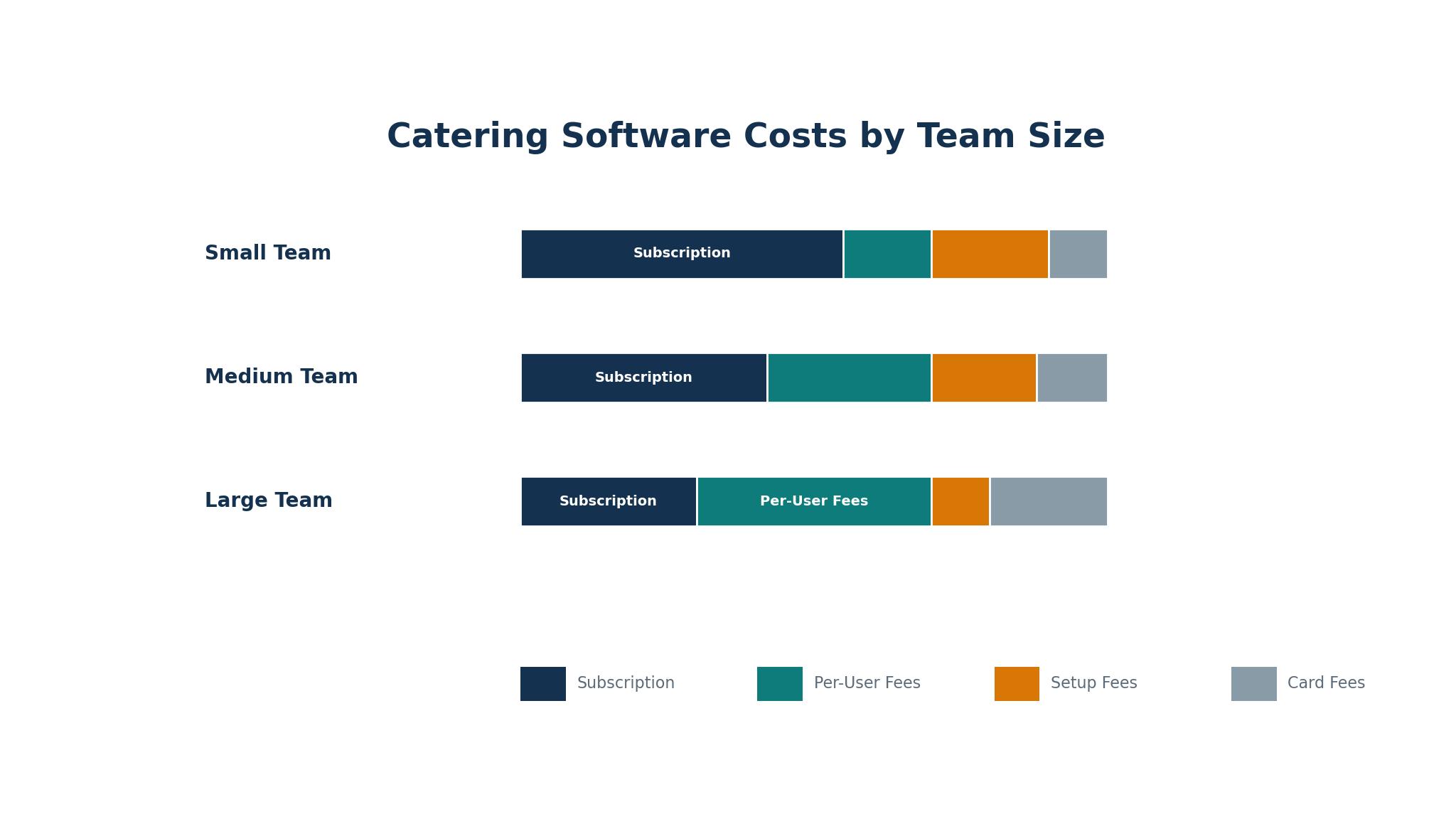
The headline price is rarely the price a catering company pays for the best restaurant management software for catering companies, because most tools in this list charge by user, by venue, or by location. Caterease at $99 a month becomes $211 a month with five users, once the $28 per extra user is added, and Total Party Planner at $119 a month becomes $219 a month with five users. Tripleseat at $375 a month per venue stays flat with more users, which makes it cheaper than Caterease for a large team at one venue and dearer for a small team.
Setup fees add to the first year. Total Party Planner charges a $299 setup fee, Caterease charges $200 per user as a launch fee, and Perfect Venue charges by location, so a group with three locations pays the entry price three times. Payment processing sits on top of all of it, usually around 2.9 percent plus $0.30 per card payment, which matters when deposits run into thousands.
Work out the twelve-month total for your actual team, venues, and event volume before signing. Add the subscription, the per-user charges, the setup fees, and the card fees on deposits. The cheapest headline is rarely the cheapest year, and the tool that looks dear at first can be the cheapest once a team of ten is counted.
Running Three Events on One Saturday
A busy Saturday is the real test of the best restaurant management software for catering companies, and it exposes every weakness at once. Three events, three kitchens or one kitchen feeding three rooms, three client contacts, and one team that has to be in several places. The software has to show all three events on one screen, with the timeline, the guest count, and the dietary notes for each, so the event manager can answer a question without opening three files.
The morning starts with the packing lists, and the lists have to agree with the production sheets. If the van leaves with the wrong count of chairs or the wrong dessert, the error is visible to the client within an hour. A system that generates both lists from one event record keeps them in agreement, while a system that needs manual lists will let them drift apart under pressure.
The evening ends with the invoices, and the invoices have to match what was actually served. A guest-count change, a bar tab that ran long, or a dietary plate that needed a special dish all change the final bill, and the software should carry those changes through without retyping. Run a trial Saturday with three real events, change one detail on each, and see whether the invoices come out right.
Frequently Asked Questions
Which catering software is best for a small caterer?
Among the best restaurant management software for catering companies, Caterease Express at $99 a month is the strongest answer for a small full-service caterer, since it covers proposals, BEOs, costing, and staffing in one system. Square is the cheapest honest start for a very small caterer, with a free POS plan and simple invoicing. The choice comes down to whether the company runs full-service events, which need Caterease, or simple drop-off orders, which Square can handle.
Does catering software handle menu costing properly?
Caterease and Total Party Planner both handle menu costing properly, with recipe costs, portion sizes, and profit analysis per dish. Curate adds strong proposal costing for boutique caterers. Tools built as a POS first, such as Toast, Square, and Lightspeed, do not cost menus to the same depth, so a caterer that lives on margins should choose a catering-built tool rather than a POS with catering added on.
How much does catering software cost per month?
Most catering companies in this guide pay between $99 and $375 a month for the software, before per-user fees, setup fees, and card fees. A small team on Caterease pays around $99 to $211 a month depending on users, a venue on Tripleseat pays from $375 a month per venue, and a small caterer on Square can start free. The twelve-month total, including users and setup, is the number that matters.
Can catering software replace spreadsheets completely?
Yes, when the whole event lives in one record, with the proposal, BEO, production list, packing list, and invoice all generated from it. Caterease and Total Party Planner both aim at that, and a company that commits to entering everything once can stop keeping parallel spreadsheets..
What is a BEO and why does it matter?
A BEO, or banquet event order, is the single document that tells the kitchen, the floor team, and the bar what to do, when to do it, and for how many guests. It carries the timing, the room setup, the menu, and the dietary notes, and it is the document the whole event runs on. Software that generates the BEO from the proposal keeps it accurate, while software that leaves it as a separate document invites errors.
Should a caterer buy a POS or a catering suite?
A caterer should buy a catering suite when events, proposals, and BEOs are the core work, which is most full-service and off-premise caterers. A caterer should buy a POS when the dining room is the core work and catering is an addition, which is most restaurants with a private room. Many companies end up with both, using a POS at the till and a catering suite for events, and that pairing works when the two share orders cleanly.
The Verdict for Catering Companies Choosing Software in 2026
Caterease is the best pick for most full-service caterers, since it covers the whole event from proposal to invoice at a clear price. Total Party Planner is the best pick for a caterer that costs menus carefully, and Tripleseat is the best pick for a venue group with several rooms. Square is the best starting point for a small caterer, and Perfect Venue is the best pick for a restaurant with a busy private dining room.
Rebuild one real event in the trial, change the guest count and one menu item, and check what updates. The system that reprices, refreshes the BEO, and flags the kitchen change is the right one for the company, and the rest is marketing.