
A church that sells retreat tickets through a concert platform is not saving money. It is paying for every fee on a free event, once in the money lost to the platform and once in the volunteer who gives up on the software at the door. The best ticketing software for churches in this guide was picked to make free events free, check-in fast and giving simple.
Planning Center leads for churches already in its ecosystem, Tithe.ly leads for churches that want registration tied to giving, and Eventbrite leads for public events that need to be found. The ten tools below are ordered by the job each one does best, so a small congregation and a large ministry finish with different winners instead of the same recommendation.
The prices in this guide were checked on vendor pricing pages in November 2026, and Planning Center opens the figures with its Registrations module from about 15 dollars a month, so confirm the figure on the vendor page before you pay. The monthly price is only the first line of the bill, because per-ticket fees, payment processing and setup charges all move the yearly total.
What Church Ticketing Has to Do That Concert Ticketing Never Does
Church ticketing has one job concert ticketing never thinks about, and it is the free event. A Sunday service, a youth night and a volunteer training are all free, and a platform that charges a per-ticket fee on a free registration is taxing the ministry for its own people. The tools in this guide were ranked on whether free events are truly free, not on how slick the checkout looks.
The second test is the volunteer. A church event is run by volunteers who have about fifteen minutes to learn the software, and a platform that needs a training session will be abandoned by the very people who run the door. Ask every vendor how fast a volunteer can check in a guest, and whether the check-in works on a phone with one bar of signal.
The third test is the giving link. A church that sells tickets, takes donations and manages members in three systems will lose people between them, while a platform that ties registration to giving and the member database keeps the whole congregation in one place. The tools that pair ticketing with giving cover the whole ministry, while a pure ticketing tool leaves the follow-up to someone else.
The 10 Tools at a Glance
Read the table as a map of trade-offs, then read the detail entries for the two or three tools that match how your events actually run.
| Tool | Main job | Best for | Starting price |
|---|---|---|---|
| Planning Center | Church management with registrations built in | Churches already in the Planning Center ecosystem | free plan, paid Registrations from about 15 dollars a month |
| Tithe.ly | Giving, app and events in one platform | Churches wanting giving tied to events | giving free, All-Access from about 119 dollars a month |
| Eventbrite | Public ticketing with marketplace discovery | Public events that need to be found | free for free events, paid tickets from about 1.79 dollars plus 3.7 percent |
| Churchteams | Church management with registration built in | Churches wanting management plus registration | from about 37 dollars a month |
| OneFold | Purpose-built events for churches, free for free | Churches wanting free events truly free | free for free events, paid tickets at Stripe rates |
| Ticket Tailor | Low-fee ticketing with a good-cause discount | Churches wanting low fees per ticket | from about 0.65 dollars per ticket, less with credits |
| Humanitix | Ticketing that gives profits to charity | Churches wanting a charity-rate fee | charity rate 1 percent plus 0.99 dollars per ticket |
| TixFox | Flat-fee ticketing with no subscription | Churches wanting the lowest flat fee | 0.39 dollars per ticket, 0.30 dollars under 5 dollars |
| Breeze | Simple church management with events | Small churches wanting simple software | from about 50 dollars a month |
| ChurchTrac | Budget church management with registration | Small churches on a tight budget | free tier, paid from about 6 dollars a month |
No single row picks your church ticketing, because a small congregation and a large ministry need different machines. A small church should weigh OneFold and Planning Center first. A church that wants giving and ticketing together should weigh Tithe.ly and Breeze. A public event that needs to be found should weigh Eventbrite and Humanitix.
Best Pick by Job
The congregation decides this category. Read each row as a pair, because the second name is the backup when the first charges too much.
| Job type | First pick | Second tool | Why this pair works |
|---|---|---|---|
| Keep free events free | OneFold | Planning Center | No per-ticket fees plus a modular system covers free events honestly |
| Tie tickets to giving | Tithe.ly | Breeze | Giving plus registration covers the whole ministry well |
| Reach the public | Eventbrite | Humanitix | Discovery plus a charity rate covers public events |
| Run camps and retreats | Churchteams | ChurchTrac | Registration plus member management covers multi-day events |
| Pay the lowest fee per ticket | TixFox | Ticket Tailor | A flat 39 cents plus pay-as-you-sell covers paid tickets cheaply |
A church that needs the best ticketing software for churches to stop paying fees on free events should start with OneFold for free events and Planning Center for the ecosystem, because that pair covers the two ways churches actually gather. A church that wants giving and ticketing together should start with Tithe.ly, because the giving only works when the whole ministry runs on one platform.
How to Judge the Best Ticketing Software for Churches
Start with your real event calendar, not a demo. Count last year events, note how many were free and how many were paid, and check what each platform would have charged for the free ones. A mid-sized church running twelve ticketed events a year, selling 150 tickets at 25 dollars each, moves 1,800 tickets, and the fee gap between the cheapest and dearest platform is about 2,650 dollars a year. The best ticketing software for churches in this guide was all tested against that question before it was ranked.
Next, test the check-in with a real volunteer, because a platform that needs a training session will be abandoned by the people who run the door. Hand a phone to a volunteer who has never used it, ask them to check in ten guests, and time it. The tool that works in fifteen minutes is the tool that works on Sunday morning.
Then check the fee on free events, because many platforms still charge per-ticket fees even when no money changes hands. OneFold charges nothing for free events, TixFox charges nothing for free events, and Ticket Tailor charges nothing for free events, while Eventbrite has crept toward charging on free registrations. The answer decides whether the ministry pays to gather its own people.
The 10 Tools in Detail
The ten tools below are the ones that matter for a church in 2026. Each entry below sets out what the tool does best, what it costs, and where it falls short, so you can match the tool to your events and your congregation. The best ticketing software for churches that fits your Sunday morning matters more than the ones with the longest feature list, so read the entries for your job first and skim the rest.
1. Planning Center
Planning Center is a widely used church software in North America, built around a modular pricing system where you only pay for the products you need. Registrations offers a free plan for up to five attendees per event, with paid plans from about 15 dollars a month for 20 attendees scaling to 239, and a 30-day free trial included.
Planning Center starts at free plan, paid Registrations from about 15 dollars a month. The bill that adds up is the stack: the full subscription stack adds up, because Events, People and the platform fee are billed separately. The number 1 place goes to Planning Center, because a church already in its ecosystem gets registrations, people and giving in one place, and a separate bill per module is the price of a system the whole ministry already runs on.
Pick Planning Center when churches already in the Planning Center ecosystem is the priority, and start on the free plan before paying.
2. Tithe.ly
Tithe.ly is a church platform widely used in North America, offering event registration alongside giving, people management, messaging and a dedicated church app. Giving is free, with card fees at 2.9 percent plus 30 cents, and the All-Access plan at about 119 dollars a month covers all five products in one plan.
Tithe.ly starts at giving free, All-Access from about 119 dollars a month. The young part is Events: the Events tool is a recent addition, so its ticketing is simpler than a dedicated platform. Tithe.ly is the number 2 pick here, because registration tied to giving is the job most churches actually need, and a simpler Events tool inside a giving platform beats a dedicated ticketing system the church has to wire into donations.
A strong pick for churches wanting giving tied to events, and the best value when the whole ministry runs on one vendor.
3. Eventbrite
Eventbrite is a general-purpose event ticketing platform, and it is genuinely good at high-volume paid events with broad public discovery. It is free to list events, and for paid events the fee runs about 1 dollar 79 plus 3.7 percent per ticket, which suits a church concert or conference that wants strangers to find it.
Eventbrite starts at free for free events, paid tickets from about 1.79 dollars plus 3.7 percent. The dearest part is the fee: the fees are the highest here, and per-ticket fees on free events have crept up over the years. That earns Eventbrite the number 3 spot: public discovery fills seats no church tool can match, and a public event that needs strangers to find it will pay the fee for an audience it could never reach alone.
Worth a trial if public events that need to be found is your main job, and the only pick here with a real marketplace.
4. Churchteams
Churchteams gives churches a dedicated management system with built-in registration, which suits a congregation that wants one system for members, groups and events. It starts at about 37 dollars a month, with a 30-day free trial, and it handles retreats, camps and recurring community events without a second vendor.
Churchteams starts at from about 37 dollars a month. The weaker side is discovery: its public discovery is weaker than Eventbrite, so a church that wants strangers to find its events will miss the marketplace. Churchteams holds on to number 4, because from about 37 dollars a month it ties ticketing to the member database a church already uses, and a congregation event needs its own people registered smoothly more than it needs strangers.
The right buy once churches wanting management plus registration becomes the daily work.
5. OneFold
OneFold is a purpose-built event platform for churches and ministries, and free events are completely free, with no per-ticket fees and no monthly subscription. Paid tickets are processed through Stripe at industry-standard rates, with donation tickets and pay-what-you-want pricing built in.
OneFold starts at free for free events, paid tickets at Stripe rates. The short list is integrations: it is a newer platform, so the integration list is shorter than Planning Center or Tithe.ly. OneFold settles at number 5, because free for free events and paid tickets at Stripe rates is the fairest deal in this list, and a church that runs mostly free events gets the ticketing it needs without paying for a platform it does not use.
Choose it when churches wanting free events truly free decides the purchase, and when the fee is the deciding factor.
6. Ticket Tailor
Ticket Tailor charges about 65 cents per ticket on its pay-as-you-sell model, with less when you buy credits and a discount for good causes. It charges nothing for free events, and it suits a church that sells paid tickets regularly and wants the fee to stay small.
Ticket Tailor starts at from about 0.65 dollars per ticket, less with credits. The fiddly part is the pricing model, which has grown more complex, with pay-as-you-sell and prepaid credits to compare. At number 6, Ticket Tailor wins its place: from about 0.65 dollars per ticket it undercuts every per-ticket rival here, and a church that reads the two options once will pick the cheaper one and forget the complexity.
A sensible first buy for churches wanting low fees per ticket, and the cheapest honest fee for regular paid events.
7. Humanitix
Humanitix is a ticketing platform that gives its profits to charity, and registered churches and nonprofits qualify for a charity rate of 1 percent plus 99 cents per ticket, against a standard rate of 2.1 percent plus 99 cents. It charges nothing for free events, and it suits a church that wants the fee to fund good work.
Humanitix starts at charity rate 1 percent plus 0.99 dollars per ticket. The timing matters: the standard rate applies until the charity status is confirmed, so a church should register early. Humanitix wins number 7, because a charity rate of 1 percent plus 0.99 dollars per ticket is the cheapest honest rate here, and a church that registers its charity status early pays almost nothing on every ticket after that.
Worth a trial if churches wanting a charity-rate fee is your main job, and the most mission-aligned pick here.
8. TixFox
TixFox charges 39 cents per ticket, or 30 cents for tickets under 5 dollars, with no monthly subscription and no minimum. It runs on Stripe Connect, so ticket revenue goes straight into the church own connected Stripe account as tickets sell, and it charges nothing for free events.
TixFox starts at 0.39 dollars per ticket, 0.30 dollars under 5 dollars. The missing seat map is the gap: reserved seating is still coming, so a church that needs assigned seats should check the roadmap. Number 8 goes to TixFox, because 0.39 dollars per ticket, 0.30 under 5 dollars, is the lowest per-ticket price in this list, and a church with open seating gets the cheapest ticket it will find anywhere.
The best fit when churches wanting the lowest flat fee is the priority, and the cheapest paid ticket in this guide.
9. Breeze
Breeze is a simple church management system that handles members, giving and event registration in one place, which suits a small church that wants software the volunteers can actually use. It starts at about 50 dollars a month, with no per-ticket fees on its own registration, and it fits a congregation that values simplicity over depth.
Breeze starts at from about 50 dollars a month. The basic side is ticketing: its ticketing is basic next to a dedicated platform, so a church with complex events will feel the gap. Breeze takes the number 9 position, because from about 50 dollars a month it gives a small church people, giving and simple events in one system, and a congregation that runs simple gatherings needs that unity more than a complex ticketing engine.
A strong pick for small churches wanting simple software, and the easiest to learn here.
10. ChurchTrac
ChurchTrac gives small churches member management, giving and event registration for a free tier, with paid plans from about 6 dollars a month. It suits a congregation that needs the basics without a 50-dollar monthly bill, and it covers the Sunday register, the small group and the fundraiser in one place.
ChurchTrac starts at free tier, paid from about 6 dollars a month. The dated feel is the interface, which feels older than the leaders, and the ticketing depth is lighter. The last slot, number 10, goes to ChurchTrac, because a free tier and paid plans from about 6 dollars a month make it the cheapest church system here, and a small congregation that needs people, giving and basic ticketing for six dollars will take an older interface over a dearer one.
The right buy once small churches on a tight budget becomes the daily work, and the cheapest paid plan here.
What a Church Actually Pays per Ticketed Event
For a mid-sized church running twelve ticketed events a year, selling 150 tickets at 25 dollars each, the honest yearly fee runs from about 472 dollars to about 3,124 dollars. TixFox at 39 cents a ticket costs about 472 dollars, Ticket Tailor at 65 cents costs about 787, Humanitix at the charity rate costs about 1,457, and Eventbrite at 1 dollar 79 plus 3.7 percent costs about 3,124. The best ticketing software for churches in this guide includes genuine free tiers in OneFold and Planning Center, which is why a small church should not pay for ticketing before the first event proves the habit.
The cost that surprises buyers is the fee on free events. Many platforms still charge per-ticket fees even when no money changes hands, so a church that runs twenty free events a year can pay hundreds of dollars to gather its own people. Add the per-ticket fee, the payment processing and the monthly subscription together before you compare two tools, or the comparison is fiction.
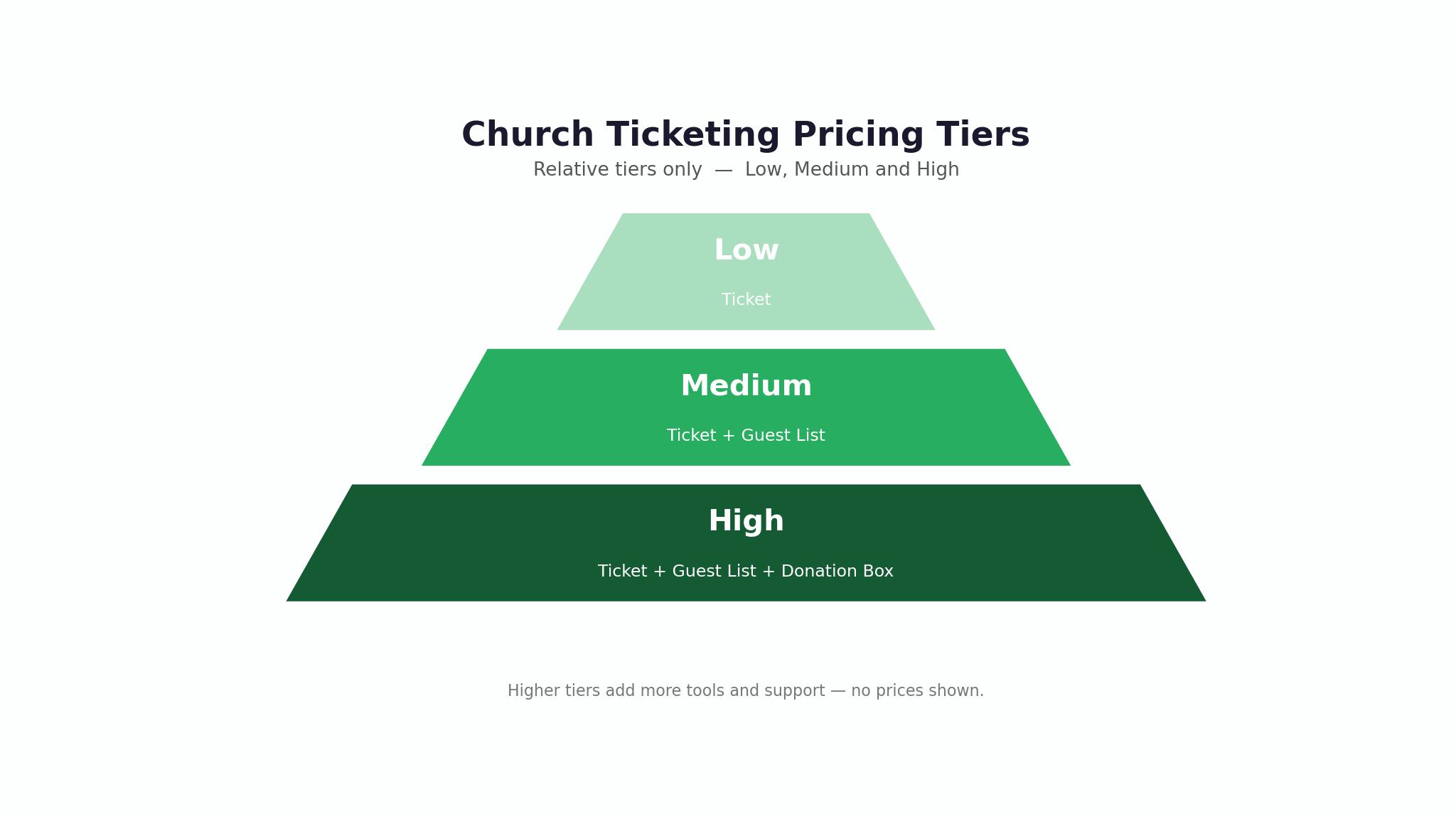
| Cost band | What it covers | Who it fits |
|---|---|---|
| Free for free events | Registration with no fees | Churches running mostly free events |
| Low flat fee | Paid tickets at 39 to 65 cents | Churches selling tickets regularly |
| Charity rate | Paid tickets at 1 percent plus fee | Registered nonprofits and churches |
| Marketplace fee | Paid tickets with discovery | Public events that need strangers |
A church selling 1,800 tickets a year pays about 472 dollars on TixFox and about 3,124 on Eventbrite, a gap of about 2,650 dollars. The dearer platform earns its price only when public discovery fills seats a free listing would miss, so count how many ticket buyers found you through the marketplace before you pay the fee. That is why the best ticketing software for churches in this guide was priced per ticket sold, not on the monthly plan alone.
Five Ticketing Mistakes That Frustrate a Congregation
The first mistake is paying fees on free events. A church that runs twenty free gatherings a year on a platform that charges per ticket will pay hundreds of dollars to gather its own people. Pick a platform where free events are truly free, and check the fine print before the first registration opens.
The second mistake is handing volunteers software they cannot learn in fifteen minutes. A church event is run by volunteers who have about fifteen minutes to learn the software, and a platform that needs a training session will be abandoned at the door. Test the check-in with a real volunteer before you buy.
The third mistake is splitting tickets, giving and membership across three systems. A church that sells tickets in one place, takes donations in another and manages members in a third will lose people between them. Pick a platform that ties registration to giving and the member database, or accept the manual work honestly.
The fourth mistake is forgetting the check-in line. A platform that sells tickets well and checks people in slowly will leave a queue at the door on Sunday morning, and a queue is the first thing a first-time guest remembers. Test the check-in on a phone with one bar of signal, and walk away if it stalls.
The fifth mistake is buying the marketplace when the congregation is the audience. A church whose events are mostly for its own people gains nothing from public discovery, while a church concert that wants strangers needs it. Count how many ticket buyers found you through the marketplace before you pay the marketplace fee.

Volunteers, Check-In Lines, and the Sunday Morning Test
The Sunday morning test is the only test that matters for church ticketing. A volunteer who has never used the software should be able to check in ten guests in fifteen minutes, on a phone with one bar of signal, while a queue forms at the door. The metric that matters is not how many features the platform lists, but how fast the line moves. The best ticketing software for churches in this guide all treat free events differently, so count the free ones before you sign.
Volunteers are the second test. A church event is run by people who give their time for free, and software that wastes their time will be quietly abandoned, no matter how good the dashboard looks. Ask the volunteers which tool they would use again, and believe the answer, because they are the ones who run the door.
The follow-up is the third test. A first-time guest who registers, attends and never hears from the church again is a guest lost, while a church that ties registration to the member database can welcome them properly. The ticketing that serves the ministry is the one that turns a registration into a relationship, not just a ticket.
The first-time guest is the person the ticketing should serve best. A guest who registers online, gets a warm welcome at the door and receives a follow-up message on Monday will come back, while a guest who queues for ten minutes and hears nothing will not. The registration is the start of the welcome, not the end of the admin.
The second habit is the volunteer rota. A church that rosters the same three volunteers for every event will burn them out by Easter, while a church that rotates the door team, the check-in team and the welcome team keeps people willing. Publish the rota a month ahead, train the new volunteers in pairs, and the Sunday morning test gets easier every week.
The third habit is the donation link. A guest who buys a ticket and sees a simple way to give will often add a donation, while a guest who has to find the giving page separately will not. Put the donation option on the ticket page, keep it optional, and the ministry gains without asking twice.
The fourth habit is the rehearsal. A church that runs one full check-in rehearsal before a big event, with real volunteers and real tickets, will find the slow spots before the guests do, while a church that skips it will find them at the door. Rehearse once, fix what breaks, and the event runs itself.
Nine Moves Before Your Next Church Event Goes on Sale
Do these nine steps in order, on one real event from your calendar, before you pay for a second month of any tool in this guide.
- Count last year events, note how many were free, and check what each platform would have charged.
- Hand a phone to a volunteer who has never used it, and time ten check-ins.
- Test the check-in on a phone with one bar of signal, and check the line keeps moving.
- Confirm free events are truly free, with no per-ticket fee in the fine print.
- Check whether registration ties to giving and the member database.
- Sell ten paid tickets through the trial, and count the fee per ticket.
- Ask the volunteers which tool they would use again, and why.
- Count how many ticket buyers found you through the marketplace, if any.
- Cancel the tool nobody trusted twice, and pay for the one the team kept using.
Frequently Asked Questions
Which ticketing software is best for a small church?
OneFold is the best first pick for a small church, because free events are completely free, with no per-ticket fees and no monthly subscription, and paid tickets go through Stripe at industry-standard rates. Planning Center is the alternative when the church already uses its ecosystem.
How much does Eventbrite cost a church selling 1,800 tickets a year?
Eventbrite costs about 1 dollar 79 plus 3.7 percent per ticket, so 1,800 tickets at 25 dollars each cost about 3,124 dollars in fees. TixFox at 39 cents a ticket costs about 472 dollars for the same tickets, a gap of about 2,650 dollars.
Is Planning Center Registrations really free?
Yes, Planning Center Registrations offers a free plan for up to five attendees per event, with paid plans from about 15 dollars a month for 20 attendees scaling to 239 dollars. The full subscription stack adds up, because Events, People and the platform fee are billed separately.
Can a church take donations through its ticketing software?
Yes, if the platform ties registration to giving. Tithe.ly offers donation tickets and pay-what-you-want pricing alongside its giving tools, and OneFold offers donation tickets too. A pure ticketing platform leaves donations to a separate system.
What is the difference between TixFox and Ticket Tailor fees?
TixFox charges a flat 39 cents per ticket, or 30 cents for tickets under 5 dollars, with no subscription, while Ticket Tailor charges about 65 cents per ticket on pay-as-you-sell, with less when you buy credits and a discount for good causes.
Should a church worry about per-ticket fees on free events?
Yes, because many platforms still charge per-ticket fees even when no money changes hands. OneFold, TixFox and Ticket Tailor charge nothing for free events, while Eventbrite has crept toward charging on free registrations, so check the fine print before you buy.
Pick the Ticketing That Serves the Ministry, Not the Fee
The best ticketing software for a church is not the one with the most features. It is the one that makes free events free, checks guests in fast, and ties registration to giving and the member database. OneFold is that tool for most churches, Planning Center is the ecosystem pick, and Eventbrite is the choice when public discovery fills the seats.
Count the free events this year, test the check-in with a real volunteer, and let the fee per ticket decide the purchase. The best ticketing software for churches in this guide rewards the church that prices the free events first. The congregation is already gathering, and the software should be serving them, not taxing them. The church that counts its free events first and picks the tool that keeps them free ends up with fuller rooms and a fuller offering plate.