

Nearly half of patients now check a dental practice online before they ever pick up the phone, and most of them decide within a minute whether the practice looks trustworthy. The best website builders for dentists win that minute. They put the phone number, the address, the booking button and the list of treatments where a nervous patient can find them without hunting, and they do it on a phone held in a car park outside the surgery. A builder that hides those four things behind a slideshow is not a design choice. It is a lost appointment.
The 10 Tools at a Glance
This table compares the best website builders for dentists on the facts that decide a purchase. The table lists the cheapest paid tier on yearly billing, cross-checked on vendor sites and in recent roundups during November 2026. When a vendor page and a roundup quoted different numbers, the guide names the gap.
| Tool | Entry paid plan | Free option | Best for |
|---|---|---|---|
| Wix | $17 a month | Yes | Most dental practices |
| Squarespace | $19 a month | 14-day trial | Design-led practices |
| WordPress.com | $4 a month | Yes | Content-led practices on a budget |
| Design.com | Free to start | Yes | Fast start with a matching logo |
| GoDaddy | $9.99 a month | Trial | Fastest first site |
| Hostinger | $2.99 a month | No | Lowest entry price |
| Duda | $19 a month | Trial | Multi-location practices |
| Webflow | $14 a month | Yes | Design control |
| Weebly | $10 a month | Yes | Simple single-surgery sites |
| Jimdo | $9 a month | Yes | Smallest practices |
What a Dental Patient Actually Needs From a Website
A patient arrives with a toothache, a question about cost, or a child who needs a check-up, and the site has one job before anything else. It must answer the question and offer a way to book, in that order. The treatments page matters, the team page matters, and the smile gallery matters, but none of them matters if the patient cannot find the phone number in five seconds. Put the number, the address, the opening hours and the booking button at the top of every page, and keep them there on mobile.
The second need is reassurance. Dentistry frightens a large share of adults, and a site that reads like a price list makes that fear worse. Short plain sentences, real photos of the actual surgery and the actual team, and a clear explanation of what happens at a first visit do more work than any stock photo of a model smiling at a mirror. A new patient form that can be filled in at home, before the visit, removes one more reason to delay. A page that explains nervous-patient care, sedation options and what to do in an emergency earns trust that a generic template never will.
The third need is local search. Almost nobody searches for a dentist by brand name. They search for a dentist near a place, and they click the result that looks open, near and well reviewed. A builder that handles local search properly, with a Google Business Profile link, a map, consistent name and address details on every page, and pages for each treatment and each location, brings in patients while the practice sleeps. A builder that makes local pages hard to build costs the practice its cheapest source of new patients.
Best Pick by Job
The table below matches each job to one of the best website builders for dentists, so you can skip the full comparison once you know your job.
| Job | Pick | Why it wins here |
|---|---|---|
| Single practice, most jobs | Wix | Booking, forms and payments in one place |
| Design-led private practice | Squarespace | Quiet layouts that flatter real photos |
| Blog-led practice on a budget | WordPress.com | Cheapest paid plan with a custom domain |
| New practice needing a brand fast | Design.com | Logo and site from the same start |
| Multi-location group | Duda | Shared templates across locations |
| Tightest budget | Hostinger | Lowest entry price by a wide margin |
| Fastest launch | GoDaddy | Guided setup that finishes in an afternoon |
How to Choose the Best Website Builders for Dentists
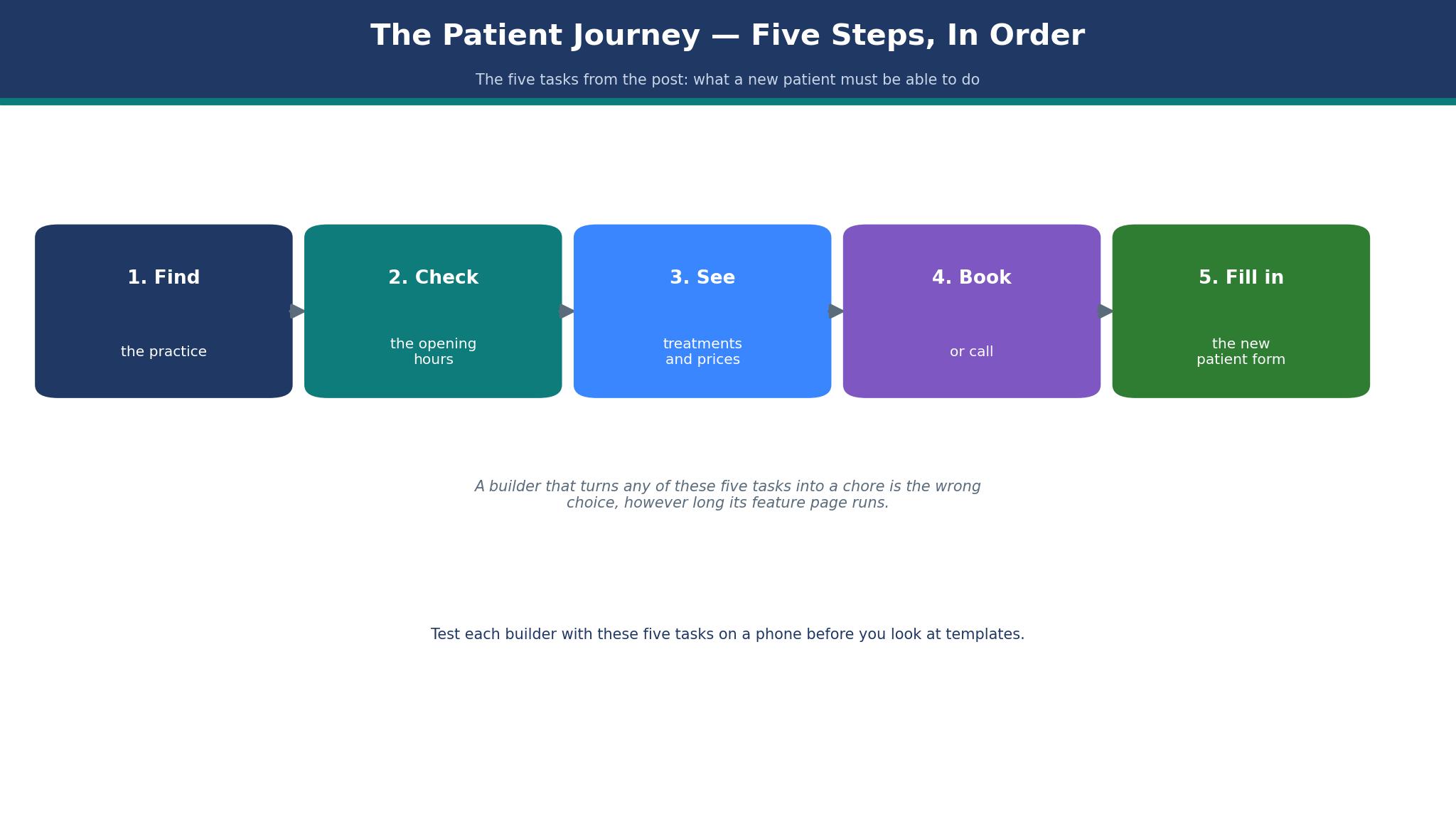
Start with the patient journey, not the feature list. Write down the five things a new patient must be able to do, in order. Find the practice, check the opening hours, see the treatments and prices, book or call, and fill in the new patient form. A builder that turns any of those five tasks into a chore is the wrong choice, however long its feature page runs. Test each one with those five tasks on a phone before you look at templates, because a pretty template cannot fix a booking button buried three clicks deep.
Judge a builder by what leaves the account monthly, not by the headline figure. The advertised tier is only the first line. Then allow for the domain renewal once the free first year ends, about $11 to $15 a year for a .com, plus a business inbox when the plan leaves that out. Add booking fees, payment fees, and any app the builder charges for separately. A $17 tier plus a $10 booking app ends up dearer than a $29 tier with bookings built in, and the difference widens with every month you pay.
Check who owns the work if you leave. Wix does not let you export a finished site to another host, and that lock-in is the price of its convenience.
The best website builders for dentists also need to handle the small jobs that fill a reception week. A patient who books online still phones to change the time, a new patient still asks for directions, and a parent still asks whether the practice sees children. A builder that lets the team update the hours, add a holiday notice and post a short answer to a common question without calling a developer saves the practice from paying for every small change. That everyday editing is the difference between a site the team keeps fresh and a site that quietly goes out of date.
Wix vs Squarespace for a Dental Practice
Wix wins on breadth. Its catalogue runs deeper on templates and add-ons, and the canvas lets a practice place text and buttons where they belong. A practice can add online booking, a new patient form, a price list and a small shop for products, all without leaving Wix. All that choice can stall a busy manager. A busy practice manager opens the editor, sees a hundred options, and spends an evening deciding instead of publishing. The Light plan at $17 a month on annual billing covers a brochure site with a custom domain, and Core at $29 a month adds payments and scheduling, which is the plan most trading practices actually need.
Squarespace wins on restraint. Its templates are fewer and better edited, and a site built on one looks considered rather than assembled. The editor gives you less freedom, and that limit is a gift for a practice that wants to finish. The Basic plan at $19 a month on annual billing includes a custom domain in the first year and a clean shop, while Core at $29 a month adds better selling tools. A few roundups quote Squarespace Basic lower, at $16 a month, but that number is second-hand rather than seen on the vendor page, so budget on the $19 figure.
The deciding test is simple. Build the same five pages on both free trials and time yourself, because that timed test is the fastest way to choose from the best website builders for dentists without trusting a feature list. If you finish faster on Wix and like the result, stay there. If Squarespace makes you feel calmer and the pages look better, pay the extra few dollars a month. The difference between $17 and $19 is $24 a year, which is less than one missed appointment.
The 10 Tools in Detail
This section tests the best website builders for dentists one at a time, against the same five patient tasks. A tool earns its place by making those tasks easy, not by having the longest feature list. Every price here is the entry paid tier on yearly billing unless stated otherwise, checked in November 2026.
1. Wix
No other builder on this list covers as many practice jobs in one account, which is why Wix leads it: booking, forms, payments and a small shop sit together without a hunt for add-ons. The editor lets a beginner drag text, images, and buttons into place, and the template library covers health and dental practices with real starting points rather than blank pages. A practice can publish a decent site in a weekend, then add bookings, payments, or a patient form later without rebuilding. That path matters, because most practices start small and add services as they grow.
Read past the big number and the pricing holds up. The Light tier runs $17 a month on yearly billing and covers a custom domain, an ad-free site and 2 GB of storage, which fits a brochure-only practice. Core at $29 a month adds payments, scheduling, and basic ecommerce, and that is the plan most trading practices end up on. The jump from $17 to $29 is $144 a year, so a practice that takes online bookings should budget for Core from the start rather than discovering the limit after launch.
A year-one example puts real numbers on it. A practice running Core pays $348 for the year, with roughly $12 more for the domain renewal once the free first year ends, landing near $360 for year one before payment fees. Payment processing adds roughly 2.9% plus 30 cents per sale, so a $150 hygiene visit paid online costs about $4.65 in fees. Those fees apply on every builder that takes cards, so they are not a reason to avoid Wix, but they belong in the budget.
The catch is that leaving means starting over. A Wix site cannot move to another host, so leaving means building it again from scratch. A new owner can lose a whole evening inside the editor, fiddling with details no patient will ever notice. Fix a finish date before the editor opens. Launch after two evenings of work, then refine a single page weekly. A live site beats a perfect site that never launches.
2. Squarespace
Squarespace is the pick for practices that sell on looks. A Squarespace template arrives with the decisions made, so the finished pages look considered, not patched together. A private practice, a cosmetic clinic, or an orthodontist benefits most, because patients judge the work by the frame around it. Squarespace limits where each block can sit, and that limit stops a rushed receptionist from wrecking a good layout. You trade freedom for taste, and for many practices that trade is worth it.
The pricing reads plainly. Basic at $19 a month on annual billing covers a site with a shop, while Core at $29 a month adds better selling tools. A practice selling whitening kits or electric toothbrushes online will notice the difference, because the higher plan removes transaction fees that eat into small orders. Add it all up before you sign, because a cheaper tier can cost more once booking fees join the bill.
The yearly maths makes the choice clearer. A practice on Basic pays $228 for the year, plus a domain renewal near $12 in year two, and no payment fees because it does not sell online.
Its year-one cost is $228, which is $120 less than Wix Core, and it never needs the features Core adds. The saving is real only because its job is simple. A practice that needs online booking should price the booking add-on before committing, because the combined bill can pass Wix Core. The blogging and gallery tools are excellent, and the analytics are clear enough for a non-technical manager. Pick Squarespace when the practice sells on looks and the brief is short. Choose Wix when the job list keeps growing.
3. WordPress.com
For a practice that publishes advice every week, WordPress.com is the lowest-priced honest route to a site on its own domain. The $4-a-month Personal tier takes away the ads, puts the practice on its own domain and gives it the familiar WordPress editor. Moving to Premium at $8 a month brings finer design control, and Business at $25 a month opens up plugins plus a full online shop. Each tier up buys a genuine new capability, not a cosmetic tweak.
The pricing reads kindly at the bottom and turns murky at the top. A practice that writes one useful article a week on Personal pays $48 for the year, which is less than two months of Wix Core. That saving buys a lot of content, and content is what brings search visitors looking for answers about implants, braces, or tooth pain. The catch is that online booking and selling need Business at $25 a month, or $300 a year, which costs more than Wix Core. A practice that starts on Personal to save money and then needs booking will pay more in the end than if it had started on Wix.
The numbers make the point plainly. A practice that publishes treatment guides on Personal spends $48 in year one and $60 in year two with a domain renewal. That buys search visibility, a proper address and an ad-free site for less than a dollar a week. A practice that needs a booking system on Business spends $300 in year one plus payment fees, and still has to choose a booking plugin. The same practice on Wix Core spends $348 and gets booking built in. The money gap is small, while the effort gap is wide.
4. Design.com
A new practice usually needs a mark and a website together, and Design.com earns its place here by starting both in one account. A practice can shape its own mark, match the colours to the surgery, and put a tidy site around them with no designer and no design software to learn. Its builder does less than Wix or Squarespace, and that is exactly the appeal for a practice that wants a neat web presence instead of a complicated one.
The ceiling here is how far the tool goes. Design.com handles a brochure site, a contact page, and a simple booking link, but it does not match Wix on bookings or Squarespace on design polish. A practice that outgrows it will move to a bigger builder, and that move means rebuilding. Think of it as a tidy first surgery website, not the one the practice keeps for a decade. For a practice still settling its name and colours, getting the mark and the site from one place is a real head start. When the list of jobs runs long, Wix is the better starting point.
The first step is free, and the paid tiers bring a custom domain plus extra features, so check the checkout total before paying, as the plans keep changing. What makes it worth it is the whole package arriving together, not any one piece. A new practice that needs a logo, a site, and appointment cards from one account will save time, and time is the resource a new practice has least of.
5. GoDaddy
For sheer speed to a live site, nothing in this list beats GoDaddy. Answer a handful of questions and the setup picks a template, drafts the wording and puts a working site live before the day ends. A practice that has delayed a website for a year will get one finished here, and that matters more than any feature comparison. The entry tier is $9.99 a month, and the builder bundles basic marketing tools that prompt the first email and the first update.
The cost stays low only while the job stays simple. GoDaddy adds fees and upsells for email, bookings, and selling tools, and each one is small on its own. Together they can pass the price of Wix Core within a year. Check the checkout total, not the headline plan, and decide whether the guided start is worth the extras. For a single-handed practice that needs a phone number and a contact form online by Friday, it is. For a group practice that will need online booking within six months, it is not.
6. Hostinger
Hostinger is the cheapest way in and the plainest to look at. At $2.99 a month on a long term, its entry tier is far cheaper than any other paid builder in this list, and its AI builder drafts a first site from a few prompts. A practice counting every dollar can still put a professional-looking site live for less than a coffee a month. Once the term ends the price leaps to a reported $10.99 a month, so work from that renewal number, not the first-year offer.
The builder is capable but plain, and its templates do not match Squarespace for looks. A practice that competes on appearance should look elsewhere. A practice that competes on price, speed, or local service will find Hostinger more than good enough. The trade-off is clear. You pay less and you get less design flair, and for many small practices that is a fair exchange.
7. Duda
Duda is made for people who build sites for other people, and the client tools prove it. Client management, white labelling, and team permissions are built in, which makes it the pick for a dental group with several locations or an agency that builds sites for local practices. The entry plan at $19 a month is not the cheapest, but the time it saves on managing several sites pays for itself quickly. A single practice will not use half of what Duda offers, and should not pay for it.
Duda also handles location pages well. A group with three surgeries can share one template, keep the branding consistent, and give each location its own hours, team and booking link. For a group, Duda earns its place. For a single surgery, it is overkill.
8. Webflow
Webflow gives a designer more control than any other tool in this list, and it asks for more skill in return. The Basic site plan at $14 a month on annual billing covers a simple site, and the CMS plan adds collections for blogs and listings. A practice with a designer on staff, or an owner who enjoys design, can build something genuinely distinctive here. A practice without design time will find Webflow slow and frustrating, and the result will look worse than a Squarespace template finished in half the time.
The trade-off is stark. Webflow exports clean code, loads fast, and handles animations and layouts that other builders cannot. It also has no built-in booking depth to match Wix, and its ecommerce plans cost more. Use Webflow when design is the product. Use Wix or Squarespace when the site is a tool for the practice rather than the practice itself.
9. Weebly
Weebly is the quiet option, and it suits a practice that wants a simple site and never wants to think about it again. The editor is easy, the templates are clean, and the free plan lets you try before you pay. The paid plan at $10 a month adds a custom domain and removes Weebly branding. A small single-surgery practice with five pages will find everything it needs here.
Growth is where it runs out of road. Weebly has changed hands, its development has slowed, and its app store is thin beside Wix. A practice that plans to add online booking, a patient portal, or a shop should start elsewhere. A practice happy to stay small will never feel the limits, and the plainness counts as a strength rather than a fault.
10. Jimdo
Jimdo is the smallest tool here, and it suits the smallest practices. Start free on a basic site, then the $9-a-month tier adds a custom domain and strips out the ads. Answer a few questions and the AI builder puts up a first site, in an editor a practice manager with no building experience can still use. A part-time practice, a single-handed surgery, or a new practice testing the water will find Jimdo enough.
What Does a Dental Practice Site Really Cost in Year One?
Total the real spend before you pick from the best website builders for dentists, because the headline tier is never the whole bill. On Wix Core a practice pays $348 for the plan, around $12 for the domain renewal in year two, and nothing further in year one while the first-year domain stays free. A practice on Squarespace Basic pays $228. A practice on WordPress.com Personal pays $48. Those three totals differ by $300, and the difference buys either booking, a design, or a year of writing, depending on the job.
Card fees are the third cost, and they catch new sellers off guard. A $150 hygiene visit paid online costs about $4.65 in card fees on most builders, and a practice taking $2,000 a month online pays about $70 a month in fees. Card fees barely differ between builders, so they do not pick the winner, yet they still belong in the year-one total. A practice that budgets $348 for the plan and forgets $840 in card fees has not budgeted at all.

A Launch Checklist for a New Dental Website
Use this checklist before you publish, because a dental site that launches with a missing phone number or a broken booking link loses patients on day one. Check the phone number on every page, on a real phone, by tapping it. Check the booking button from the home page, the treatments page and the contact page. Check the address against the Google Business Profile, letter by letter, so search engines see one consistent address. Check the opening hours, including Saturday hours and emergency cover. Check the new patient form by filling it in yourself, and confirm the message arrives where the reception team expects it.
Then check the words. Read the home page aloud and remove any sentence a patient would not understand.
Frequently Asked Questions
How much should a dental practice pay for a website builder?
A dental practice should budget $4 to $29 a month on annual billing for the plan, with about $12 a year more for the domain once the free first year ends. A brochure site sits at the low end, a site with online booking at the high end. If the monthly total crosses $40 before card fees, ask whether the extra features serve a job the practice actually does, because many practices pay for tools they never open.
Can patients book appointments directly through these builders?
Yes, on the right plan. Wix Core includes scheduling, and other builders add booking through an app or an integration with a practice system. Check that the booking tool sends a confirmation to the patient, shows the appointment in the reception diary, and handles cancellations without a phone call. A booking button that sends an email nobody reads is worse than no booking button at all.
Do I need a designer to build a dental practice site?
A first site does not need one. The builders in this guide are made for practice teams, and a careful manager can publish a good site in a weekend. A designer is worth the fee when the site has to stand apart, when the practice wins on looks, or when the team has no hours to spare. Bring a designer in for a year-two refresh, once the site has shown which pages matter, instead of before launch.
Is a free website builder plan good enough for a dental practice?
A free tier works for testing, and falls short for trading. Free plans show the builder’s branding, use a subdomain, and limit the features a practice needs, which tells patients the practice is not yet serious. Buy the cheapest tier that brings a custom domain and strips the ads, then move up when the job grows. The cost is less than one lost patient a month.
How long does it take to build a dental practice website?
Expect one weekend for a simple site, or ten to fifteen hours fitted around the working week. A site with online booking, patient forms and ten treatment pages takes two to three weeks, because each treatment needs accurate words, a price guide, and a photo. The words take longer than the build, so draft the copy before the builder opens. A site built in a rush with placeholder text stays a placeholder, while a site with real words earns bookings from the first week.
Which builder is easiest for a complete beginner?
GoDaddy finishes a first site fastest, because its guided setup decides most things for you. Wix grows with a practice best, because its editor forgives mistakes and its help answers plainly. Squarespace makes a site beautiful with the least effort, because its templates carry most of the design work. Choose the ease your practice lacks: finishing, growing, or looking polished.
The Verdict: Wix Takes It for Most Dental Practices
Wix wins this list of the best website builders for dentists because it covers the most jobs for the most practices, at a price a dental practice can afford. Squarespace is the better pick for a design-led practice with a short job list, and WordPress.com is the better pick for a practice built on writing. Hostinger is the pick when money is tight, and GoDaddy is the pick when the site must be live by Friday. Start with the patient, count the real year-one cost, and choose the editor your team will actually open. Patients book from a live, honest site that works on a phone, not from a prettier one that never launches.