
One developer quotes 800 dollars a month on a no-code builder. Another quotes 90,000 dollars for a custom build. Both can be honest, and that spread is why the cost of building a mobile app small business owners face feels impossible to pin down. The quotes differ because they buy different things. One buys a subscription and a ready-made starting point. The other buys weeks of design, coding, testing and store submission by a team. This guide puts real numbers on each route, so you can see what you get at each price and where the bill keeps growing after launch.
You do not need the cheapest app or the most powerful app. You need the cheapest route that does the job your customers actually need, without a monthly bill that quietly grows past the value the app brings in. A booking app, an ordering app and a loyalty app are different products with different price tags, even though all three are called a mobile app.
What the cost of building a mobile app small business actually includes
Most quotes hide half the bill. A build price is only the first line, and the full first-year cost has six parts. A quote that omits one of them is not cheaper. It is incomplete.
The first part is design, what each screen shows and how a customer moves from opening the app to booking, ordering or paying. No-code builders bundle basic design into templates, while a custom build charges for it as a discovery and design phase before coding starts. The second part is the build itself, the subscription on a no-code platform or the developer hours on a custom project. The third part is the backend, the database, user accounts, payments, notifications and any connection to your existing booking, ordering or stock system. Simple apps can run on the builder’s own database, while apps that must talk to another system need integration work, and that work is where small quotes grow.
The fourth part is store submission. Apple and Google both review apps before listing them, and Apple in particular rejects apps that crash, lack privacy information or look unfinished. Someone must prepare screenshots, descriptions, privacy details and test accounts, then handle rejection fixes, and freelancers sometimes price that separately, so ask. The fifth part is the store and payment cut, and the sixth is maintenance, the yearly cost of keeping the app working as phones and operating systems change.
No-code vs agency at a glance
The table below is the short version of this guide. It compares the three realistic routes for a small business, no-code, freelance custom build and agency custom build, on the numbers that matter for a first app.
| Route | Typical build cost | Typical monthly cost after launch | Time to launch | Best for |
|---|---|---|---|---|
| No-code builder, self built | 0 to 2,000 dollars of your time plus setup help if hired | 25 to 200 dollars for the platform, plus store fees | 2 to 8 weeks | Booking, ordering, loyalty and directory apps with standard features |
| Freelance custom build | 15,000 to 100,000 dollars for a first version | 500 to 2,000 dollars for hosting, fixes and small updates | 3 to 6 months | A specific workflow or design that no template covers well |
| Agency custom build | 50,000 to 300,000 dollars and more for complex apps | 1,250 to 5,000 dollars on a support plan, or 15 to 20 percent of build cost per year | 4 to 12 months | Multi-platform apps with payments, accounts, admin tools and growth plans |
Read the monthly column carefully. The cost of building a mobile app small business owners should budget for is the first-year total, not the build price. A no-code app at 100 dollars a month costs 1,200 dollars in a year, while a custom app at 50,000 dollars plus 15 percent maintenance costs 57,500 dollars in year one before store fees. They are simply not the same purchase.
No-code builder costs in detail
No-code builders are the right starting point for most small businesses, and their pricing is easier to verify because it is published on the vendor site. Prices below are starting paid tiers from current vendor and comparison pages, and they change often, so check the live pricing page before you commit. Every builder charges a monthly subscription, and the price rises with users, records, updates or published apps.
Adalo starts at 36 dollars a month on annual billing for a plan that publishes real native iOS and Android apps, with a built-in database and no per-record cap on that tier. That flat shape suits a booking or loyalty app where usage is steady, though a business app with heavy daily use should budget 50 to 100 dollars a month rather than the starter figure.
Glide starts at 25 dollars a month on some comparison pages, with its team tier listed at 60 dollars a month elsewhere. It builds web-style apps from spreadsheet data, which makes it fast for directories and catalogues, but it does not publish a native store app in the same way Adalo does.
Bubble starts at 29 dollars a month on annual billing for a web app builder with a visual editor and built-in database. It is powerful for complex web logic, but its pricing is usage based through workload units, and a customer-facing app with real traffic can add hundreds or even over 1,000 dollars a month in overages, according to vendor comparison pages. That makes it a poor default for a business that wants a predictable bill.
FlutterFlow starts at 39 dollars a month and builds native iOS and Android apps with code export, a real advantage if you later hire developers. Its pricing is per seat, so a two-person team pays twice the headline figure, and it needs an external database at a separate cost.
GoodBarber lists a native tier at 55 euros a month on annual billing, covering iOS, Android and a web app version. BuildFire lists a standard tier around 165 dollars a month, and Appy Pie lists prices from about 18 dollars a month per app. Three questions matter more than the spread between them. Does the plan publish to both stores. Does it include a database and push notifications. And does the price rise with users, records or actions in a way that could triple your bill in a good month.
Setup help is a separate cost many buyers miss. A builder subscription does not include someone designing your screens, writing your copy or setting up your booking rules. Hiring a no-code specialist for setup typically costs 500 to 5,000 dollars as a one-off, depending on screens and integrations, and it should sit in the year-one total.
A realistic no-code year one is a platform subscription at 36 to 100 dollars a month, or 432 to 1,200 dollars a year, plus developer accounts at 124 dollars. Setup help is 0 dollars if you build it yourself, or 1,000 to 3,000 dollars if hired. That puts a self-built app at roughly 550 to 1,350 dollars in year one, and a professionally set-up one at roughly 1,550 to 4,350 dollars, assuming no usage overages or paid integrations.
Freelance vs agency pricing
Custom builds are priced by hours, and hours are priced by location and seniority. Published rate guides for 2025 and 2026 put freelance developers at roughly 20 to 150 dollars an hour, with most experienced freelancers in North America at 50 to 150 dollars an hour, Western Europe at 80 to 160 dollars an hour, Eastern Europe at 40 to 120 dollars an hour, and India and South Asia at 15 to 50 dollars an hour. Agencies typically charge 70 to 250 dollars an hour or more, because the rate covers a designer, developers, a tester and a project manager.
Hourly rates alone do not set the project price. Scope does. One costing model based on a mid-level United States rate of 108 to 165 dollars an hour puts a basic first version at 150 to 250 hours, or 16,000 to 41,000 dollars, a medium complexity app with payments and an admin dashboard at 400 to 600 hours, or 43,000 to 99,000 dollars, and a complex app at 900 to 1,500 hours, or 97,000 to 248,000 dollars and more. Other agency guides put simple apps at 40,000 to 120,000 dollars and complex apps from 300,000 dollars upward, which shows how much estimates move with vendor, region and definition.
For a small business, a freelancer or small team building a focused first version with standard screens, accounts, booking or ordering and a simple admin view will typically quote 15,000 to 60,000 dollars. An agency building the same version with a full team, formal testing and handover will typically quote 50,000 to 120,000 dollars. Anything far below those ranges deserves a question about what is excluded.
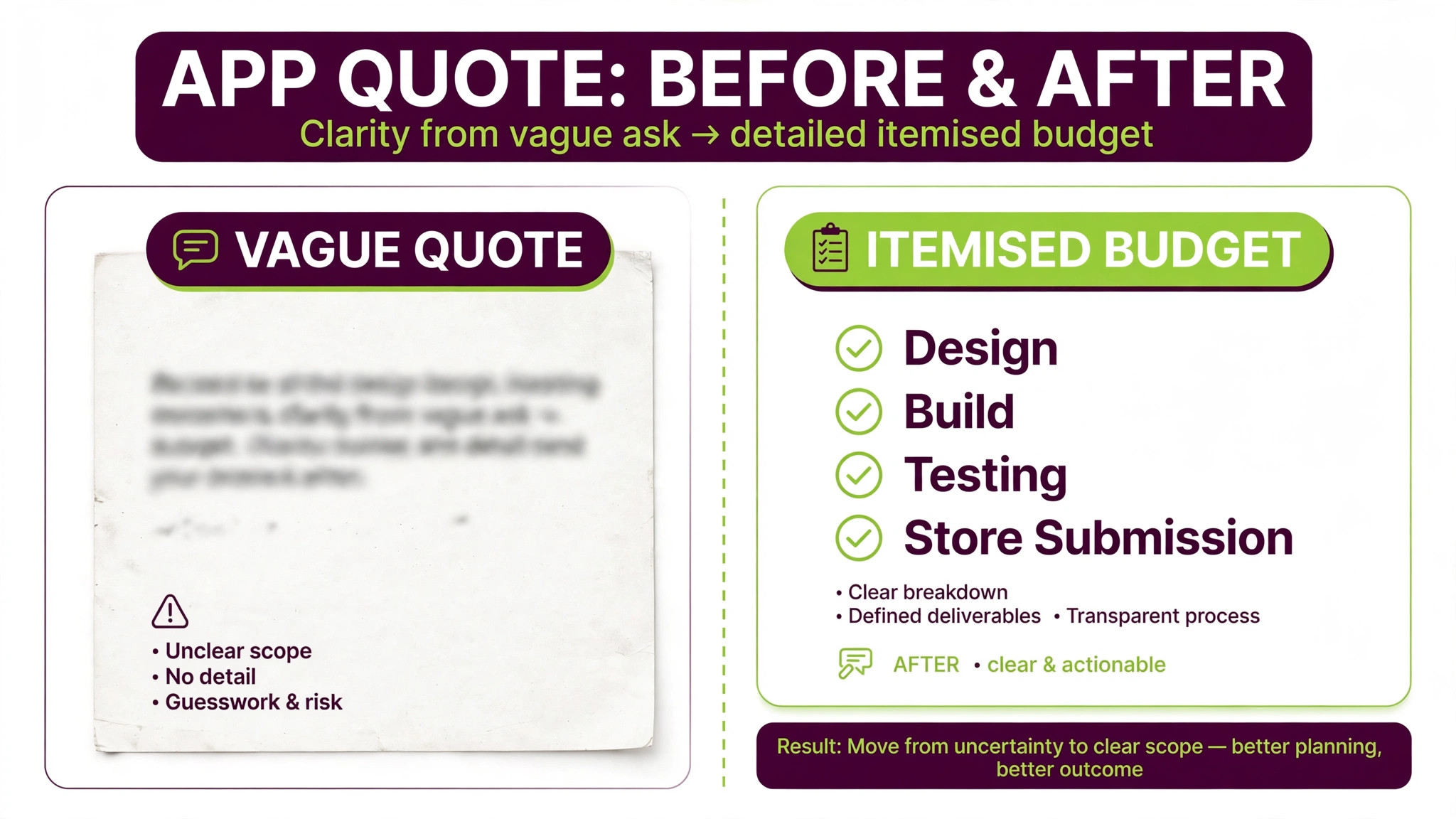
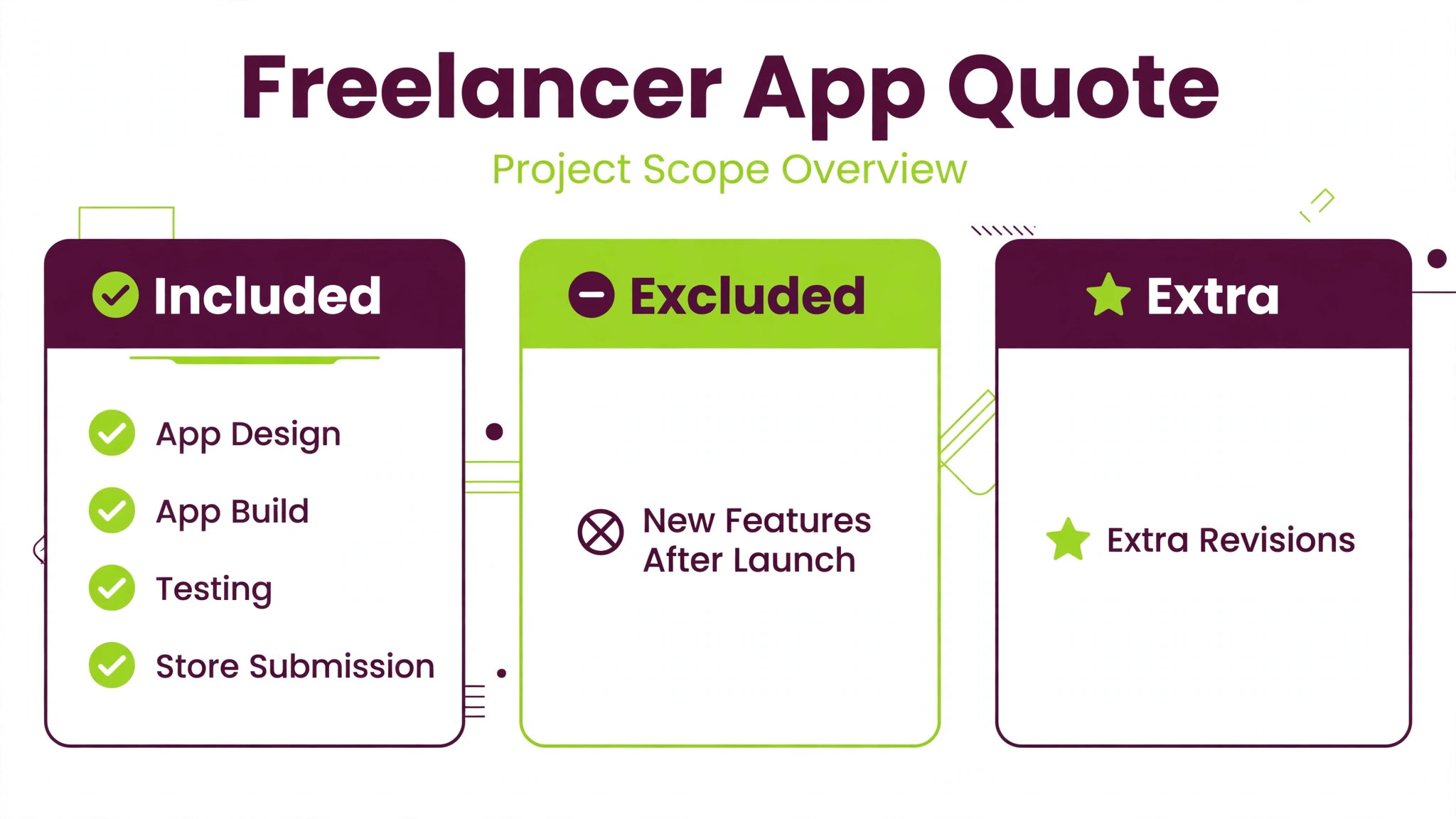
The cost of building a mobile app small business owners compare across freelancers and agencies should be judged on the same scope, platforms and support period. A freelancer quote that excludes design, testing and store submission can look half the price of an agency quote that includes all three, then cost the same once those lines are added. Ask every vendor to price design, build, testing, store submission and 90 days of bug fixes as separate lines.
Platform choice is the largest single lever on a custom quote. Building native iOS and native Android apps separately means building the same product twice. A cross-platform build with one codebase for both stores typically costs far less, and most small business apps do not need native-only features. Choose native only when a specific requirement, such as heavy device hardware use, justifies the second codebase. Otherwise cross-platform is the sensible default.
Location is the second lever. An offshore team can quote half the price of a local agency for the same scope. The risk is communication, time zones, availability for fixes and accountability if the project stalls. Judge offshore quotes on references from businesses like yours, a fixed scope with milestones, and code you own.
Feature tiers and what each tier adds
Features, not screens, drive custom cost. Each tier below adds a layer of work, and the jump between tiers is where quotes double. Place your app before you ask for a price.
Tier 1 is a brochure and information app. It shows services, prices, opening hours, photos, a map and a contact button, with no accounts and no payments. On no-code this is the cheapest build, often done in days, but as a custom build it is rarely worth a custom price, since a good mobile website does the same job for less.
Tier 2 is a booking and loyalty app. It adds user accounts, a booking flow, push notifications for reminders, a loyalty balance and a simple admin view where staff see bookings. This is the sweet spot for salons, clinics, gyms and cafes. On no-code it is a standard build at 36 to 100 dollars a month, and as a custom build it typically lands at 15,000 to 60,000 dollars freelance, or 50,000 to 120,000 dollars with an agency.
Tier 3 is an ordering and payments app. It adds a catalogue or menu, a basket, checkout, payment processing, order status updates and staff tools for managing orders. Payments bring security work, testing with real transactions, refund handling and compliance checks that Tier 2 does not need, so expect a clear price jump and detailed vendor questions about your payment provider, tax rules and refund policy.
Tier 4 is a marketplace or multi-role app. It adds more than one type of user, such as customers and sellers, plus search, reviews, messaging, payouts and a fuller admin dashboard. Messaging and payouts each add moderation, safety and financial work that small teams underestimate, which is why Tier 4 is where agency guides start quoting six figures.
Tier 5 is a custom backend app. It adds real-time features, heavy integrations, offline use, device hardware such as Bluetooth or cameras, or strict compliance needs in health or finance. Each of those can add tens of thousands of dollars on its own, and most small businesses do not need Tier 5 for a first app.
The cost of building a mobile app small business owners should therefore start from a tier, not from a headline average. Averages mix Tier 1 brochure apps with Tier 5 platforms, which is why published ranges run from a few hundred dollars to half a million. Your tier, your platforms and your integrations set your range. Everything else is detail.
| Tier | What customers can do | Typical no-code cost | Typical custom build range |
|---|---|---|---|
| Tier 1, information only | Browse services, prices, hours and contact details | 25 to 60 dollars a month | Rarely worth a custom build |
| Tier 2, booking and loyalty | Create an account, book, get reminders, earn rewards | 36 to 100 dollars a month | 15,000 to 120,000 dollars |
| Tier 3, ordering and payments | Browse a catalogue, order, pay and track an order | 60 to 200 dollars a month, plus payment fees | 40,000 to 200,000 dollars |
| Tier 4, marketplace or multi-role | Buy and sell, message, review, manage payouts | Often hits builder limits, test before committing | 100,000 to 300,000 dollars and more |
| Tier 5, custom backend or hardware | Use real-time features, offline mode or device hardware | Usually not suitable | 200,000 dollars and more, scoped per requirement |
When a feature is proposed, ask what it costs alone. A chat feature, a loyalty points engine and a delivery map are each a mini-project inside the app, and cutting one Tier 4 feature can move a quote back into Tier 3 pricing.
Store fees, commissions and payment processing
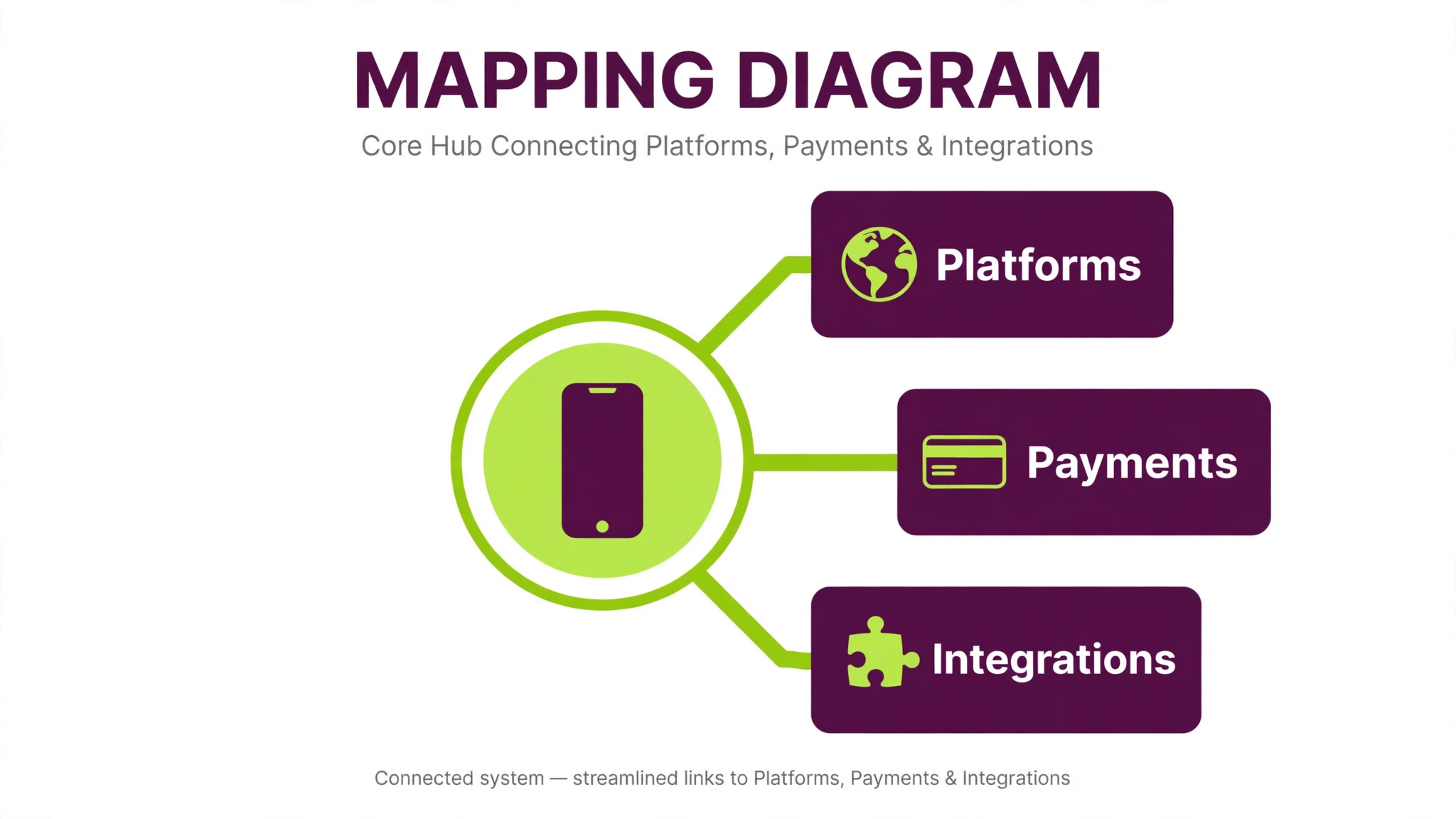
Store fees are the smallest headline cost in the cost of building a mobile app small business, and one of the largest long-term costs, because commissions scale with sales while account fees do not. Apple charges 99 dollars a year for an Apple Developer Program membership, per account rather than per app, and Google charges a one-time 25 dollar registration fee. In year one with both stores, developer accounts cost 124 dollars, and over five years with no revenue, Apple costs 495 dollars against Google’s 25 dollars.
Commissions matter far more once the app sells anything digital inside the app. Both stores headline at 30 percent, and both cut that to 15 percent for most smaller developers. Apple applies 15 percent under its Small Business Program for developers who earned up to 1 million dollars in proceeds in the prior calendar year, and for developers new to the store. Google applies 15 percent to the first 1 million dollars a developer earns each year, then 30 percent above that. Subscription rules differ in detail. Google charges 15 percent on auto-renewing subscriptions regardless of revenue, while Apple charges its standard rate in the first year and drops to 15 percent after 12 months for eligible developers.
Work the commission through on a simple example. An app selling 10,000 dollars a month of digital subscriptions inside the app at 15 percent pays 1,500 dollars a month to the store, or 18,000 dollars a year, and at 30 percent that doubles to 36,000 dollars a year. That difference alone is larger than a year of no-code platform fees. If your app sells physical goods, services or bookings rather than digital content, the store commission generally does not apply in the same way, because those purchases are typically processed outside the in-app purchase system. Confirm the rule for your exact product before you budget.
Payment processing adds another layer where you take card payments yourself through your own checkout. Card processing commonly costs around 2.9 percent plus 30 cents per transaction on standard provider pricing, though rates vary by provider, region and volume. On a 40 dollar order that is about 1.46 dollars, and on a 15 dollar order about 74 cents, a higher share of the sale. Small average orders therefore need higher margins or a minimum order value.
Ongoing maintenance and running costs
An app is not finished at launch. Apple and Google release major operating system updates every year, devices change, and security fixes never stop. The industry rule of thumb is to budget 15 to 20 percent of the original build cost per year for maintenance, with year one often higher, up to 35 to 50 percent in some guides, because real users find bugs that testing missed.
Apply that rule to real numbers. A 50,000 dollar app needs roughly 7,500 to 10,000 dollars a year in maintenance, a 100,000 dollar app needs roughly 15,000 to 20,000 dollars a year, and a 200,000 dollar app needs roughly 30,000 to 40,000 dollars a year.
No-code maintenance looks different. The platform handles operating system compatibility and much of the underlying upkeep inside the subscription, so your ongoing cost is mainly the subscription itself, plus your time for content changes and new screens. That bundled upkeep is one of the strongest arguments for no-code for a first app.
Running costs beyond maintenance include hosting and backend services for custom apps, which guides put at roughly 50 to 2,000 dollars a month for small to mid-size apps depending on users and data, plus notification, analytics and crash reporting services that often start free and grow with users. A vendor should show you how hosting scales with users rather than quoting a single flat figure.
The cost of building a mobile app small business owners carry into year two is therefore the maintenance percentage on a custom build, or the subscription renewal on a no-code build, plus store fees and hosting. Put those lines in the budget before you approve a build.
Three worked year-one totals
Worked totals turn the cost of building a mobile app small business from ranges into decisions. The three scenarios below use the figures from this guide, and each one states its assumptions so you can adjust it to your own quotes.
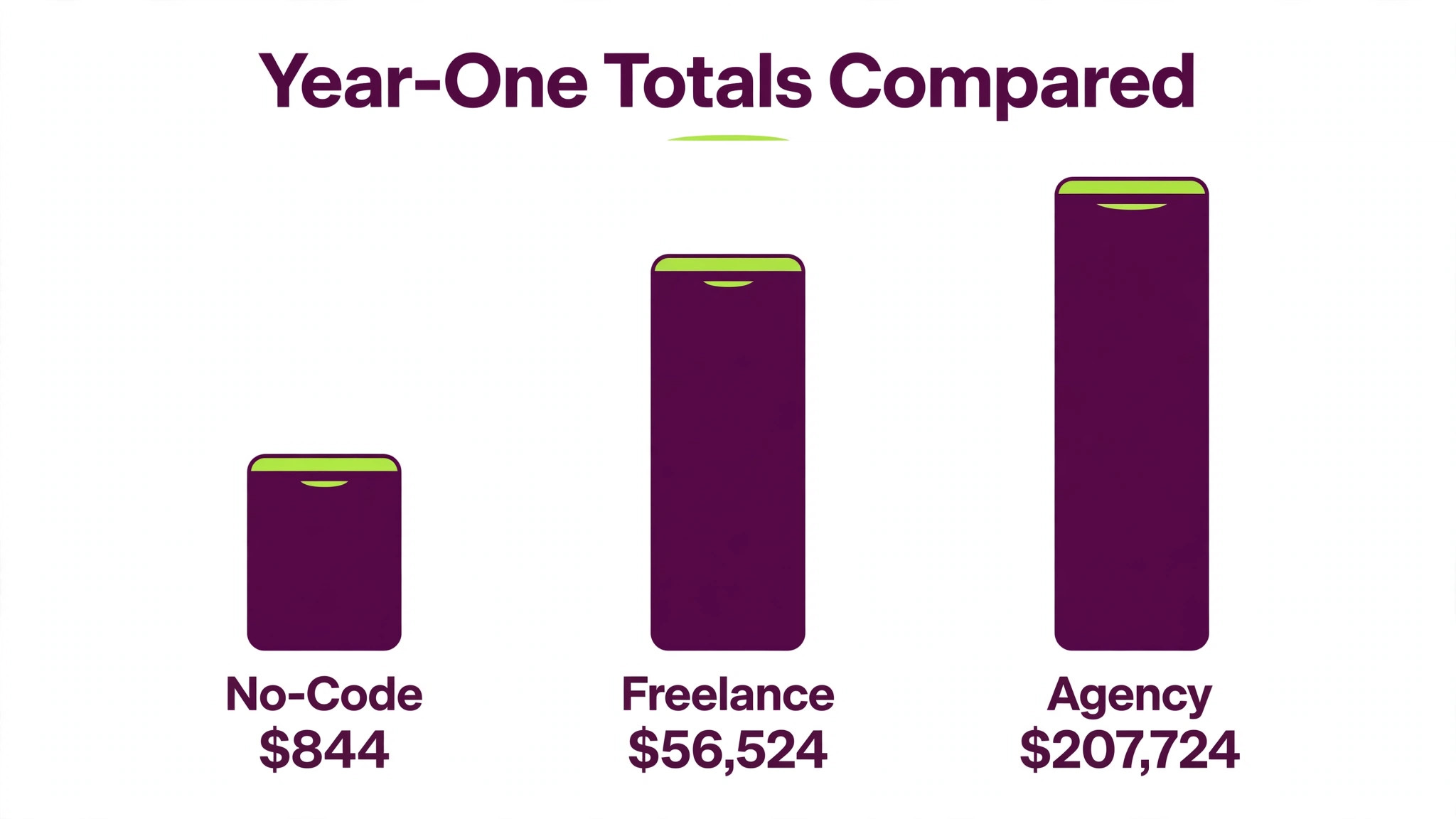
Scenario 1 is a salon booking and loyalty app built on no-code by the owner herself. Platform subscription at 60 dollars a month is 720 dollars a year, plus developer accounts at 124 dollars in year one, for a year-one total of 844 dollars. Hiring setup help at 2,000 dollars takes it to 2,844 dollars. No store commission applies to bookings paid in person.
Scenario 2 is a cafe ordering app built by a freelancer on a cross-platform codebase. Build cost is 45,000 dollars. Design and store submission are included. Maintenance in year one at 20 percent is 9,000 dollars, though some of that may be covered by a 90-day fix period in the contract. Developer accounts are 124 dollars. Hosting and backend services at 200 dollars a month are 2,400 dollars a year. Payment processing on 20,000 dollars a month of in-app orders at roughly 2.9 percent plus 30 cents, on an average 25 dollar order, is about 820 dollars a month, or 9,840 dollars a year. Year-one total before payment processing is about 56,524 dollars, and about 66,364 dollars with it.
Scenario 3 is a multi-role marketplace app built by an agency. Build cost is 150,000 dollars, maintenance at 20 percent is 30,000 dollars a year, developer accounts are 124 dollars, hosting and support tools at 800 dollars a month are 9,600 dollars a year, and store commission on 10,000 dollars a month of digital sales at 15 percent is 18,000 dollars a year. Year-one total is about 207,724 dollars before marketing and staff time, which is why a marketplace idea should start as a simpler Tier 2 or Tier 3 app and grow into Tier 4 only when revenue justifies it.
Compare those totals with the revenue the app must produce. A booking app that fills otherwise empty chairs can pay for itself quickly. The app that earns its cost fastest is usually the simplest one that solves one painful job well.
Mistakes that inflate the bill
The first mistake is building for both stores on day one when your customers mostly use one. If 80 percent of your customers use one platform, launch there, learn, and add the second store with revenue behind you.
The second mistake is paying for usage-based pricing without a usage forecast. A builder that charges per update, per record or per workload unit can look cheap at 29 dollars a month and cost ten times that in a busy month. Model a good month, not a quiet one, and ask what 1,000 monthly active users would cost on the plan you are buying.
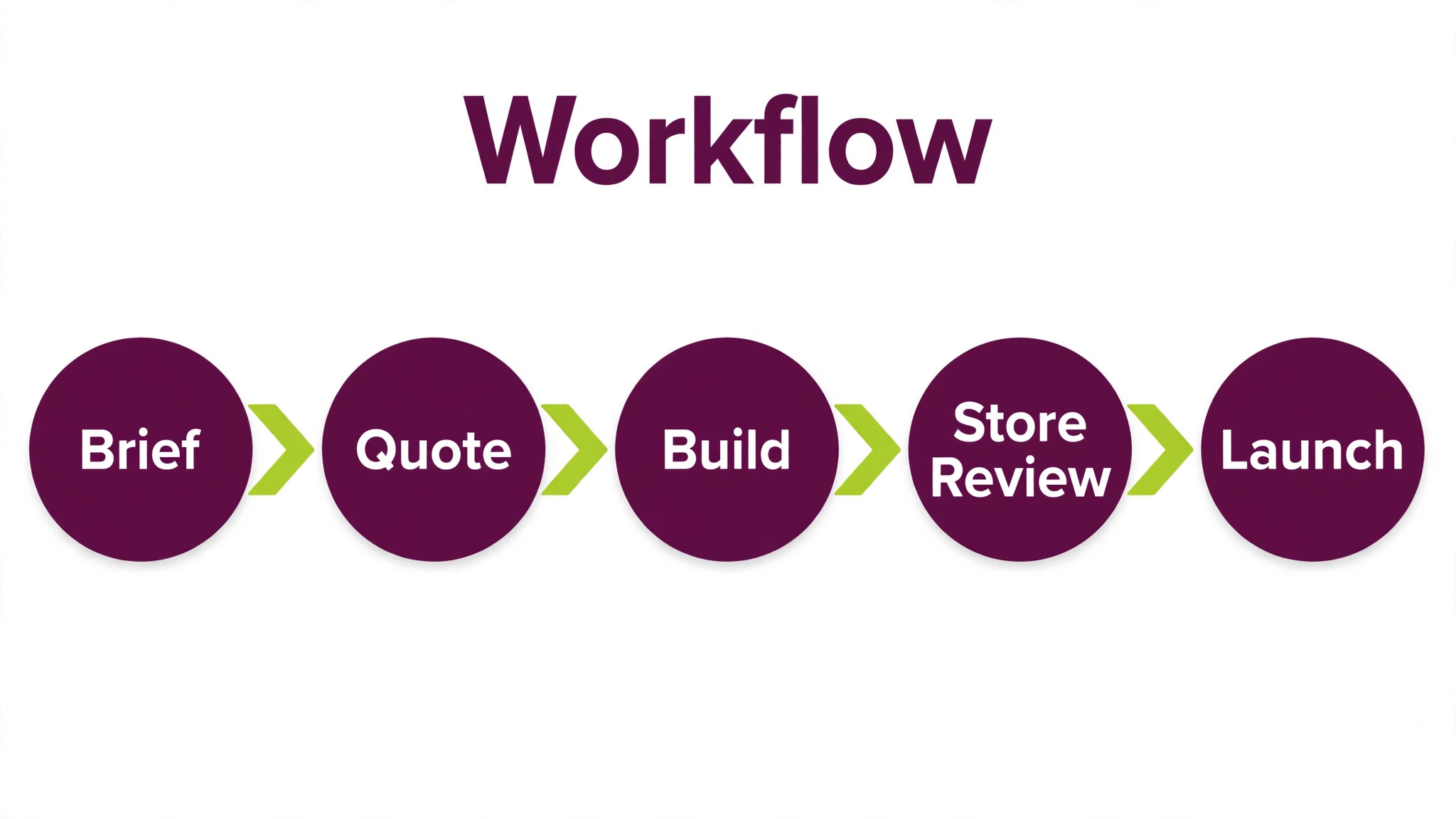
The third mistake is approving a fixed-price quote for a vague scope. Fixed prices protect you only when the scope is fixed too, and every feature added after signing is charged as extra work. Spend a week writing the brief and the acceptance tests, the exact actions a tester will check before you pay the final milestone.
The fourth mistake is forgetting who owns the code, the accounts and the data. On a custom build, the contract should state that your business owns the code, the store accounts are in your business name, and you can export your data at any time. On no-code, check export options before you build a customer list you cannot move.
The fifth mistake is launching without a plan for the first 90 days after release. Bugs found by real users, store review fixes and customer questions all arrive together, and a contract with no fix period turns small problems into paid emergency work. Keep at least 10 percent of the build budget unspent for post-launch fixes, or buy a support plan that covers them.
How to get quotes you can compare
Use the same brief for every vendor, and ask for the same lines in every quote. A comparable quote set answers eight questions.
- Which tier does this quote cover, and which features are explicitly excluded.
- Which platforms are included, one store, both stores, native or cross-platform.
- What design work is included, and how many revision rounds are allowed.
- What testing is included, on which devices and operating system versions.
- Who handles store submission, and how many rejection fix rounds are included.
- How long is the bug-fix period after launch, and what counts as a bug rather than a new feature.
- What are the yearly maintenance, hosting and third-party service costs after year one.
- Who owns the code, the accounts and the data, and how is everything handed over.
Ask for the total first-year cost, not just the build price. A vendor who quotes 30,000 dollars for a build and 12,000 dollars a year in maintenance is quoting 42,000 dollars in year one, while a vendor who quotes 40,000 dollars with first-year maintenance included is cheaper in year one. Compare totals, not headlines.
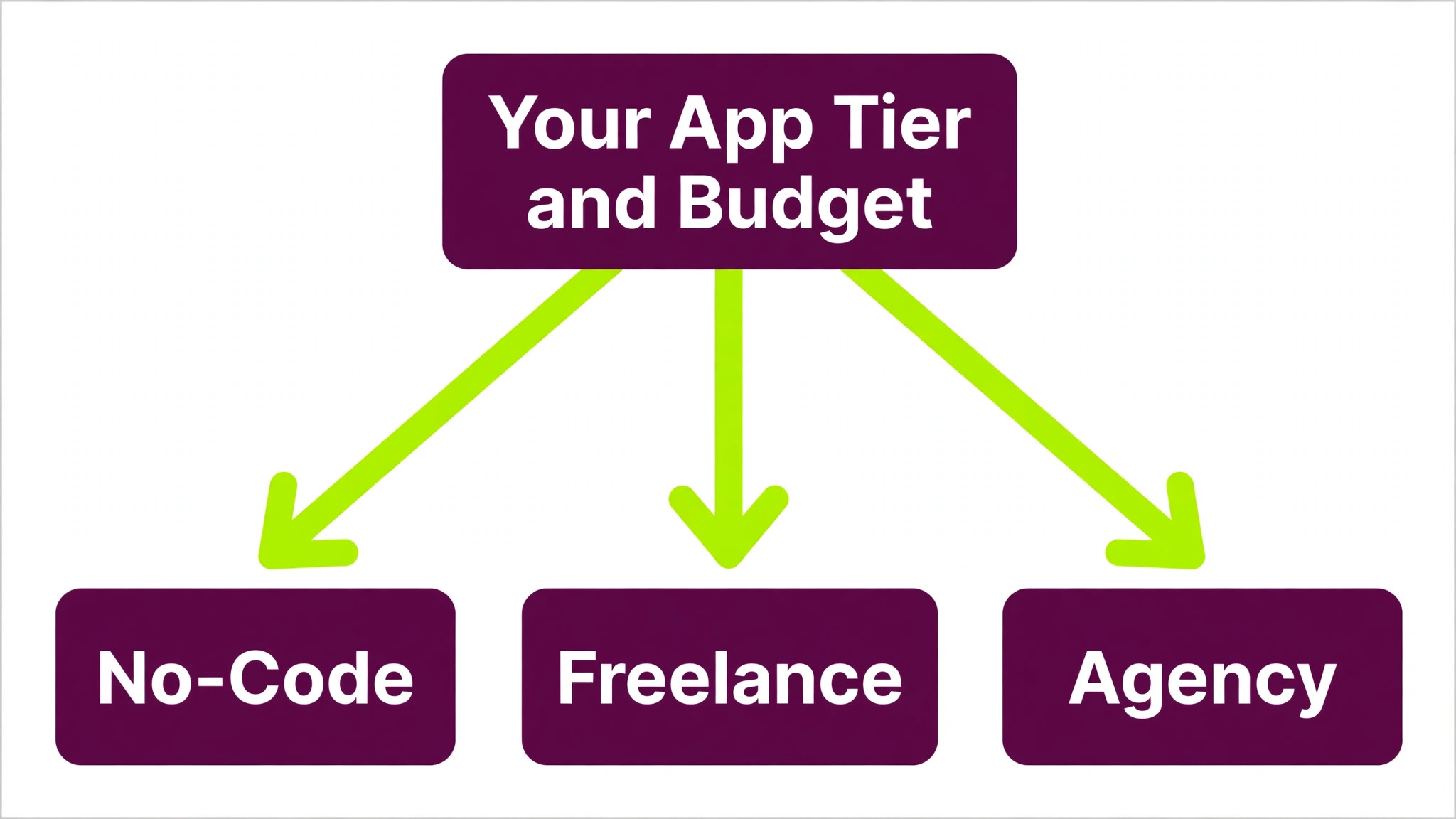
Get three quotes, and expect them to differ. For the cost of building a mobile app small business, a no-code quote, a freelance quote and an agency quote for the same brief will differ by an order of magnitude, and that difference is information, not confusion. It tells you what each route includes, what each route risks, and what you would pay for control you may not need yet. Choose the route whose total you can afford for two years, not one.
For related reading, see how a service business can plan its booking setup in small salon booking system setup guide, how messaging can sit beside an app for customer orders in WhatsApp Business for small shop orders, what a full monthly platform bill looks like in cost of running a Shopify store monthly, and how a restaurant can describe its offer clearly before building any ordering tool in AI for restaurant menu descriptions.
Frequently Asked Questions
How much does a simple app cost for a small business?
A simple booking or loyalty app on a no-code builder typically costs 25 to 100 dollars a month for the platform, plus 124 dollars in year one for both store developer accounts. A custom-built version typically costs 15,000 to 60,000 dollars from a freelancer, or 50,000 to 120,000 dollars from an agency, plus yearly maintenance.
Is a no-code app a real app customers can download?
Yes, when the builder publishes native apps. Adalo, FlutterFlow, GoodBarber and BuildFire publish apps to the App Store and Google Play, while some other builders publish web-style apps that customers open in a browser rather than downloading from a store. Check the publishing method on the plan you buy.
Why do agency quotes vary from 50,000 dollars to 300,000 dollars?
Agency quotes vary because they price different scopes, platforms and teams. A single cross-platform booking app is a different project from a two-platform marketplace app with messaging, payouts and a full admin dashboard. Location also moves the rate. Compare quotes only when the brief, the platforms and the support period match.
What are the ongoing costs after an app launches?
Ongoing costs include the platform subscription on no-code, or maintenance at roughly 15 to 20 percent of build cost per year on a custom app, plus Apple at 99 dollars a year, Google at a one-time 25 dollars, hosting, and store commission at 15 to 30 percent on digital sales inside the app. Payment processing on your own checkout adds roughly 2.9 percent plus 30 cents per transaction.
Do I need both iOS and Android versions at launch?
Not always. Launch on the platform most of your customers use, prove the app earns its cost, and add the second platform when demand justifies it. Cross-platform builds cover both stores from one codebase at a lower cost than two native builds.
Can I start no-code and move to a custom app later?
Yes, and it is often the smartest path. A no-code app proves which features customers use and what revenue the app produces, and that evidence makes a later custom brief far sharper. Choose a builder with code export, such as FlutterFlow, or with clear data export, if a later move matters to you.
Pick the Cheapest Route That Still Does the Job
The cost of building a mobile app small business owners should approve is not the lowest quote in the inbox. It is the lowest total for two years that covers the tier your customers need, the platforms they use, store submission, a fix period after launch and a maintenance plan that keeps the app working. For most small businesses that means starting no-code, at roughly 850 to 2,850 dollars in year one for a booking or loyalty app.
If your app takes orders, run the payment maths before you sign. Then get three comparable quotes on one brief, compare year-one totals rather than headlines, and keep 10 percent of the build budget for the fixes real users will find.