

The email arrives on a Friday afternoon. A good client needs work that normally takes ten days, and they need it on Monday. Your week is already full, your team has plans, and saying yes means moving other work, working late, or both. Saying no risks the relationship. That tension is the real problem behind pricing rush work, and it is why so many small businesses either charge nothing for urgency or invent a number in the moment that they later regret. Learning how to price a rush fee small business owners can defend starts with separating the price of speed from the price of the work itself, so the client can see both clearly.
This guide solves that problem with a written method. You will learn how to price a rush fee small business clients can understand before they need it, how to build urgency tiers that match your real capacity, and how to write a fee policy that removes negotiation from a stressful moment. The figures used for tiers come from published guides on freelance and service pricing, which commonly describe surcharges of 25 percent to 100 percent above the standard price depending on urgency. Those are guides, not rules, so this guide shows you how to test them against your own costs.
A rush fee is not a penalty for a difficult client. It is the price of reorganising your schedule, accepting higher error risk under pressure, and protecting the clients whose work you move. When that logic is written down and shared early, most clients accept it calmly. When it is invented during a crisis, it sounds like opportunism, even when the work genuinely costs you more.
What Counts as Rush Work in Your Business
Rush work is not every tight deadline. Some deadlines are tight because you quoted a short turnaround in the first place, and those are already priced into your standard rate. Rush work is work that shortens your normal turnaround, forces work outside normal hours, or requires you to move other committed work. That definition should be written in your policy, with examples from your own services, so staff and clients apply it the same way.
Start, when you work out how to price a rush fee small business clients will accept, by writing down your standard turnaround for each main service. A design revision, a repair, a report, and a booked service each have a normal window, and rush only makes sense against that baseline. If your standard window is ten working days, a five day request is faster, a three day request is much faster, and a same day request is a different job entirely. Without that baseline, every client request feels urgent, and every fee feels arbitrary.
Also decide what does not count. A client who books early for a genuinely urgent need that fits your normal fast service is not a rush case. A small change that takes minutes is not a rush case, even if the client is in a hurry. A request caused by your own delay is never a rush case, and charging for it will damage trust far beyond the fee. Put those exclusions in writing. They show clients that the fee is about capacity, not about extracting money from stress.
The Real Cost of Saying Yes Quickly
The cost of rush work is larger than the hours it takes, and that is the point most owners miss when they price it. First, there is displacement. Work moved to make room for a rush job still has to be done, often late, with apologies and sometimes with discounts. Second, there is overtime and fatigue. Evening and weekend work costs more in pay, in errors, and in staff goodwill, and that cost repeats if rush becomes normal. Third, there is error risk. Work done under pressure, with less review time, is more likely to need correction, and corrections on a rush job are even more urgent than the original.
There is also an opportunity cost that is easy to overlook. A rush job that fills your week may block a larger, better fitting project that arrives the next day. You cannot price that lost opportunity precisely, but you can recognise it in your tiers. The fastest tier should be priced high enough that you would rather take it than wait for the next normal job. If the fastest tier feels cheap, it is probably underpriced, because it does not cover displacement, fatigue, and risk together.
To price honestly, and to learn how to price a rush fee small business owners can repeat without guessing, list your capacity costs before you set a percentage. What does an evening of overtime actually cost in pay or in time off later. What does delaying another client cost in goodwill or in a concession you usually offer. What does a correction cost when it happens under a rush deadline. Those answers differ by business, which is why a copied percentage from another industry will mislead you. The worksheet later in this guide turns those answers into a number you can defend.
Urgency Tiers That Clients Can Choose Between
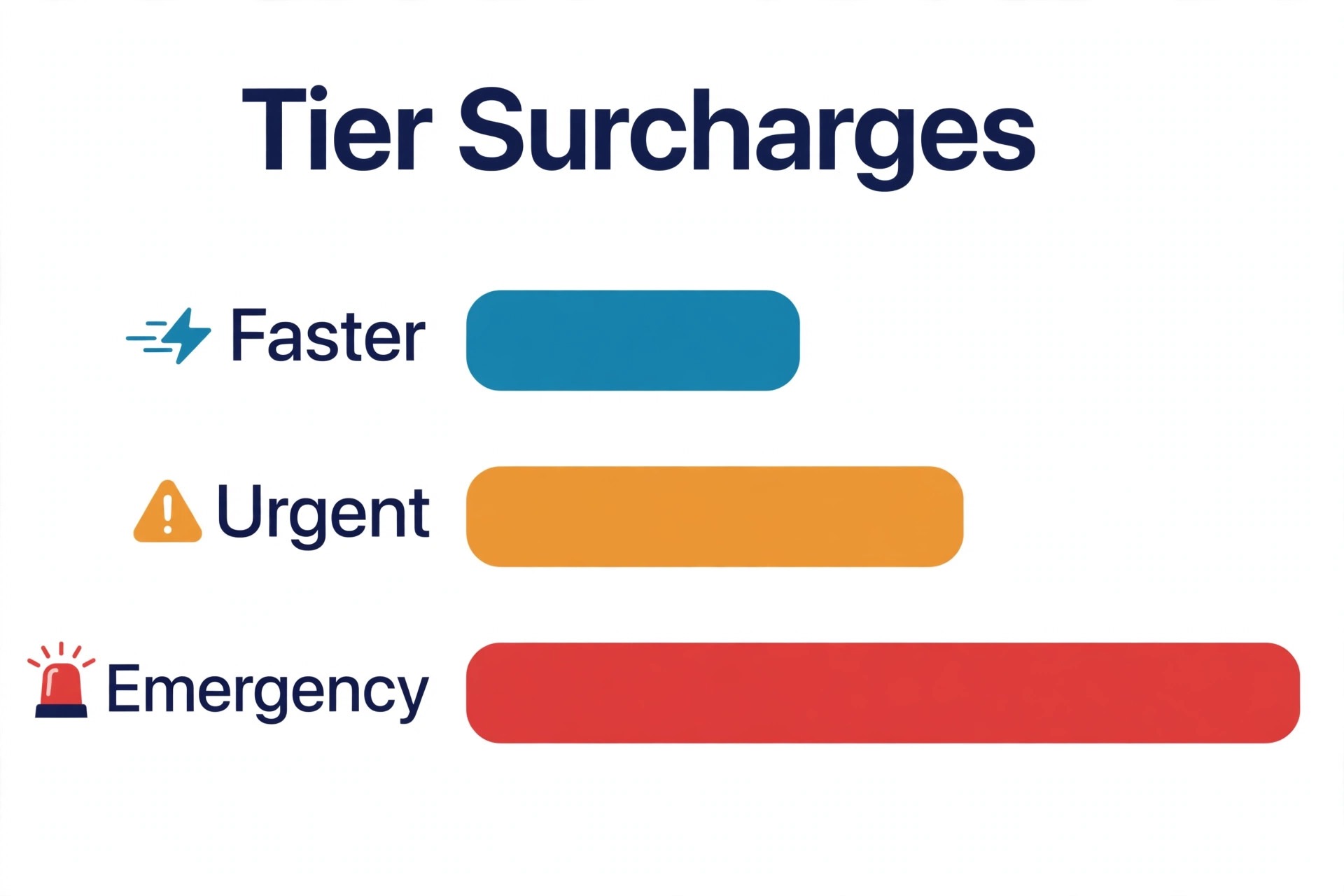
Tiers work better than a single rush fee, because they let the client choose how urgent the work really is. Published guides commonly describe a tiered pattern, with a modest surcharge for a moderately shortened timeline, a larger surcharge for about half the standard turnaround, and a surcharge at or near double for same day or weekend delivery. Per guides, 25 percent, 50 percent, and 100 percent are common reference points, and some providers go higher for extreme turnarounds. Use those as a starting range, then adjust to your capacity costs.
The value of tiers is not only revenue. Tiers reveal true urgency. A client who insists a job is an emergency often chooses a slower, cheaper tier when the fastest option costs double. That is useful information, not a lost sale. It means the deadline had more flexibility than the first message suggested, and your normal schedule survives. A single flat fee cannot do that, because it gives the client no cheaper honest option.
Keep the number of tiers small. Three tiers are enough for most small businesses. More tiers create confusion and invite haggling over boundaries. Name each tier by turnaround, not by a marketing label, so the client can compare them directly. State the turnaround in working days, state whether weekends count, and state the latest time a request can be accepted for that tier. A tier without a cutoff time will be tested at midnight, and you will wish you had written one.
| Tier | Turnaround compared with standard | Typical surcharge per guides | When it fits |
|---|---|---|---|
| Faster | About three quarters of standard time | Around 25 percent | Work can be reordered without overtime |
| Urgent | About half of standard time | Around 50 percent | Evenings or reordered work are required |
| Emergency | Same day or weekend delivery | Around 100 percent | Other work stops or weekend work is required |
Those surcharges are vendor reported and guide reported ranges, not a market price you must copy. If your capacity cost is higher, your tiers should be higher. If your work is highly standardised and easy to accelerate, your tiers can be lower. The test is simple. Would you accept the rush job at that price, knowing what it displaces, and would you still accept it next week if it happened again. If the answer is no, the tier is too low.
How to Price a Rush Fee Small Business Owners Can Calculate in Minutes
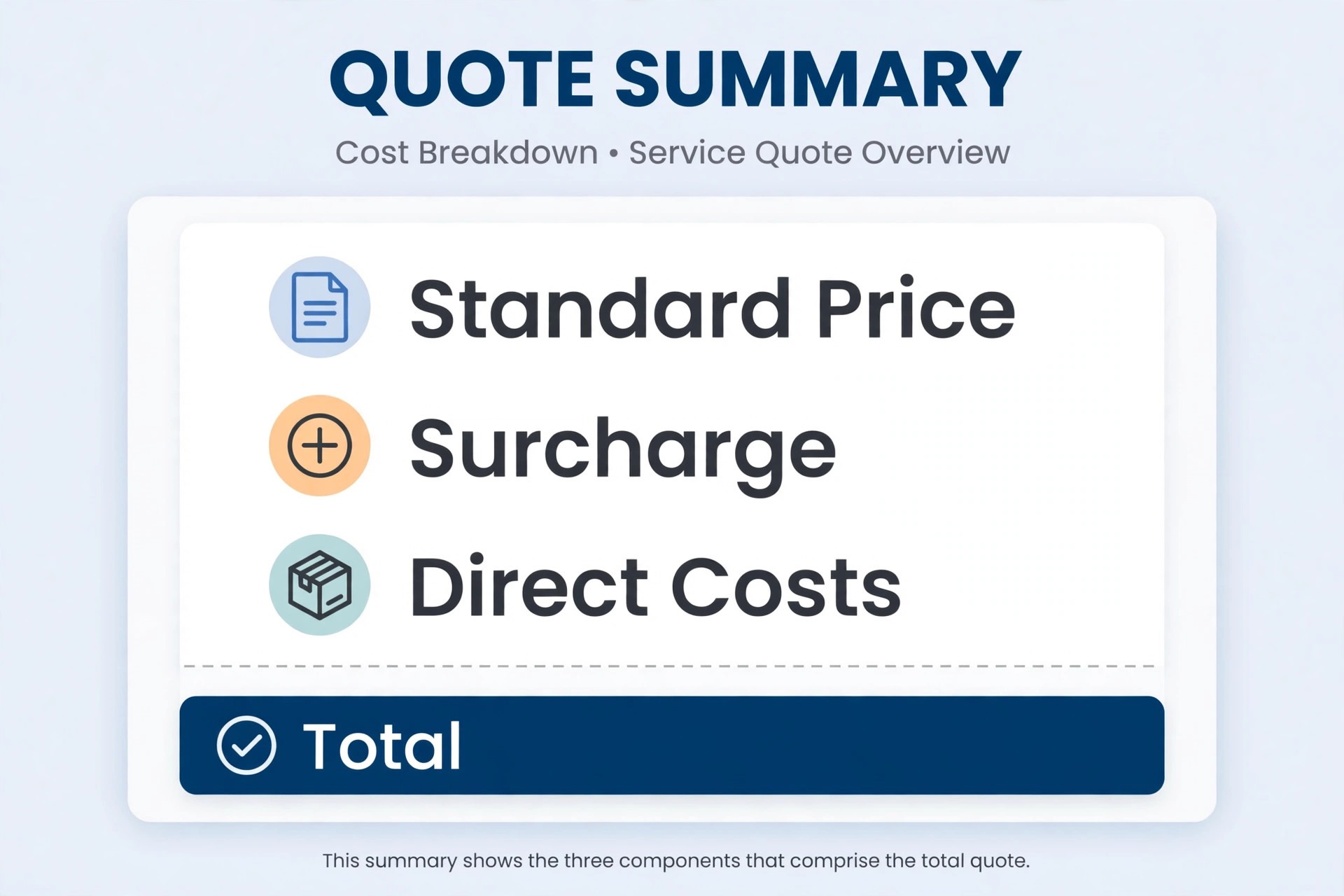
A workable method for how to price a rush fee small business owners can use without a spreadsheet degree has four steps. First, confirm the standard price for the job as if it were normal work. Second, identify the tier by comparing the requested turnaround with your standard turnaround. Third, apply the tier surcharge to the whole project price, not only to the extra hours. Fourth, add any direct costs that rush creates, such as courier charges, overtime pay, or a subcontractor premium, and show them separately.
Applying the surcharge to the whole price matters, because rush affects the whole job. Review, coordination, and delivery all happen under pressure, not just the production hours. Guides that calculate rush on extra hours alone tend to underprice the job, because they ignore displacement and risk. A whole price calculation is also easier to explain. The client sees a standard price, a tier surcharge, and any direct costs, with no hidden maths.
Work through a simple illustration, labelled as an illustration rather than a market rate. A project priced at 2,000 in standard terms, requested at half the normal turnaround, falls in the urgent tier at around 50 percent per guides. The surcharge is 1,000, the rush price is 3,000 before direct costs, and the client is asked to pay a larger deposit because the work starts immediately. If the same project is requested same day, the emergency tier at around 100 percent makes the rush price 4,000 before direct costs. Those numbers are examples to show the method, and your own tiers should reflect your own costs and your own market.
Flat fees have a place as a minimum, not as a replacement for tiers. A small job may produce a tiny percentage surcharge that does not cover the disruption of reordering your week. A minimum rush fee, such as the greater of your tier surcharge or a fixed minimum you set, solves that. State the minimum in your policy, and apply it consistently. A minimum that appears only for small clients will look unfair, while a published minimum looks like a business rule.

The Rush Fee Pricing Worksheet
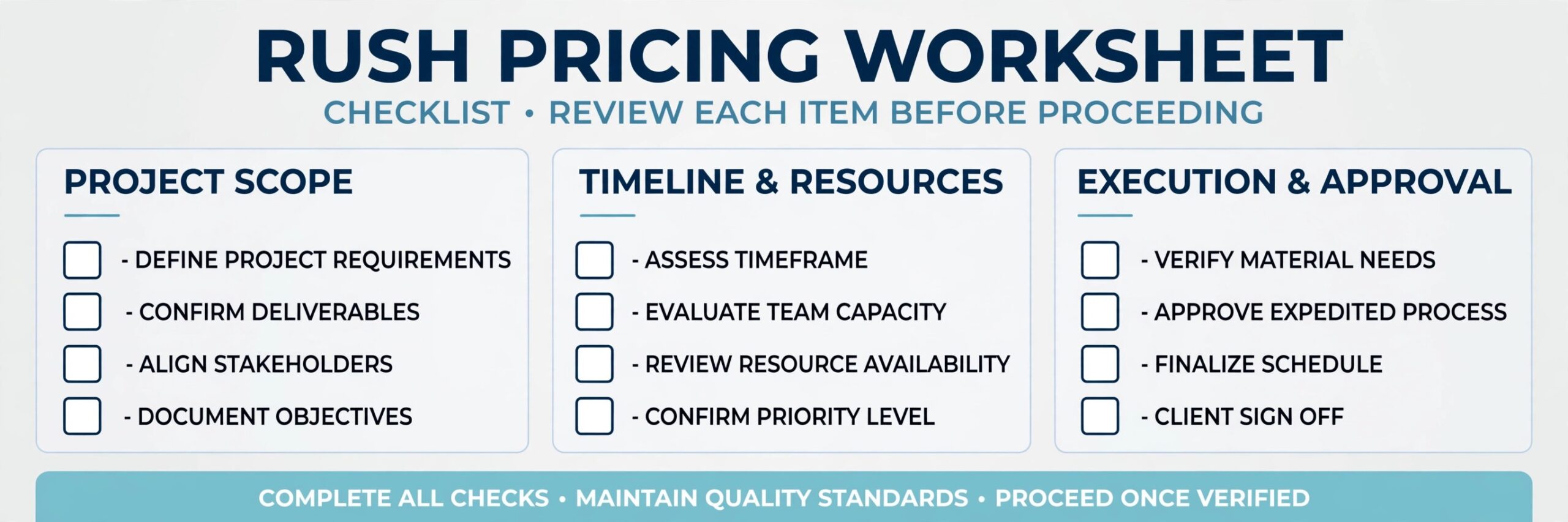
Copy the worksheet below for every rush request, and keep the completed copy with the quote. It forces the pricing decision to be based on capacity and cost, not on how stressed the request made you feel.
- Standard price for the job as normal work.
- Standard turnaround in working days.
- Requested turnaround in working days.
- Tier selected by comparing requested time with standard time.
- Tier surcharge as a percentage of the standard price.
- Rush surcharge amount, calculated on the whole project price.
- Direct rush costs, such as overtime, courier, or subcontractor premiums.
- Minimum rush fee check, using the greater of surcharge or minimum.
- Total rush price, including standard price, surcharge, and direct costs.
- Deposit required before rush work starts.
- Work that will be moved, and clients who must be told.
- Review step that will be shortened, and how risk will be handled.
- Decision maker who approved the rush job and the tier.
Use the worksheet even when you decide to decline. A declined rush job with a completed worksheet tells you whether your tiers were too low, whether your capacity was genuinely full, or whether the job was a poor fit. That record improves your next decision. A declined job with no record teaches you nothing, and the same pressure returns next month with the same confusion.
Writing a Fee Policy Clients Accept
A rush fee policy should be shared before a rush request arrives, in your terms, on your quote template, or on a short service page, because a method for how to price a rush fee small business clients trust is published before it is needed. A policy invented during a crisis feels arbitrary. A policy printed in your terms feels like how your business works, because it is. The policy needs only a few parts, and each part should be written in plain language that a busy client can understand in one reading.
State the definition of rush work, the standard turnarounds it is measured against, the tiers and surcharges, the minimum fee, the cutoff times, the deposit required, and what happens if the client changes scope during a rush job. Scope changes during rush work are common and expensive, because they restart work that is already under pressure. Your policy should state that a scope change during a rush job is priced as a new rush decision, not absorbed silently.
Also state what the fee does not cover. It does not guarantee an outcome that depends on a third party, such as a supplier, a platform, or an approval the client controls. It does not remove the need for client input on time. If the client is slow to approve a draft during a rush job, the deadline should move or the tier should be revisited, and that rule should be in the policy before it is needed. Clients accept rules they have seen. They resist rules they first meet during a dispute.
The Fee Policy Template
Copy the template below, fill in your own numbers, and publish it where clients see it before they book. Keep a copy with every quote that includes a rush tier, so the client is not asked to remember a policy they saw months earlier.
- Rush work means any request that shortens our standard turnaround, requires work outside normal hours, or requires us to move other committed work.
- Our standard turnaround for this service is stated on the quote.
- Faster tier applies when the requested time is about three quarters of standard time.
- Urgent tier applies when the requested time is about half of standard time.
- Emergency tier applies to same day or weekend delivery.
- Surcharges are calculated on the whole project price, not only on extra hours.
- A minimum rush fee applies, equal to the greater of the tier surcharge or our published minimum.
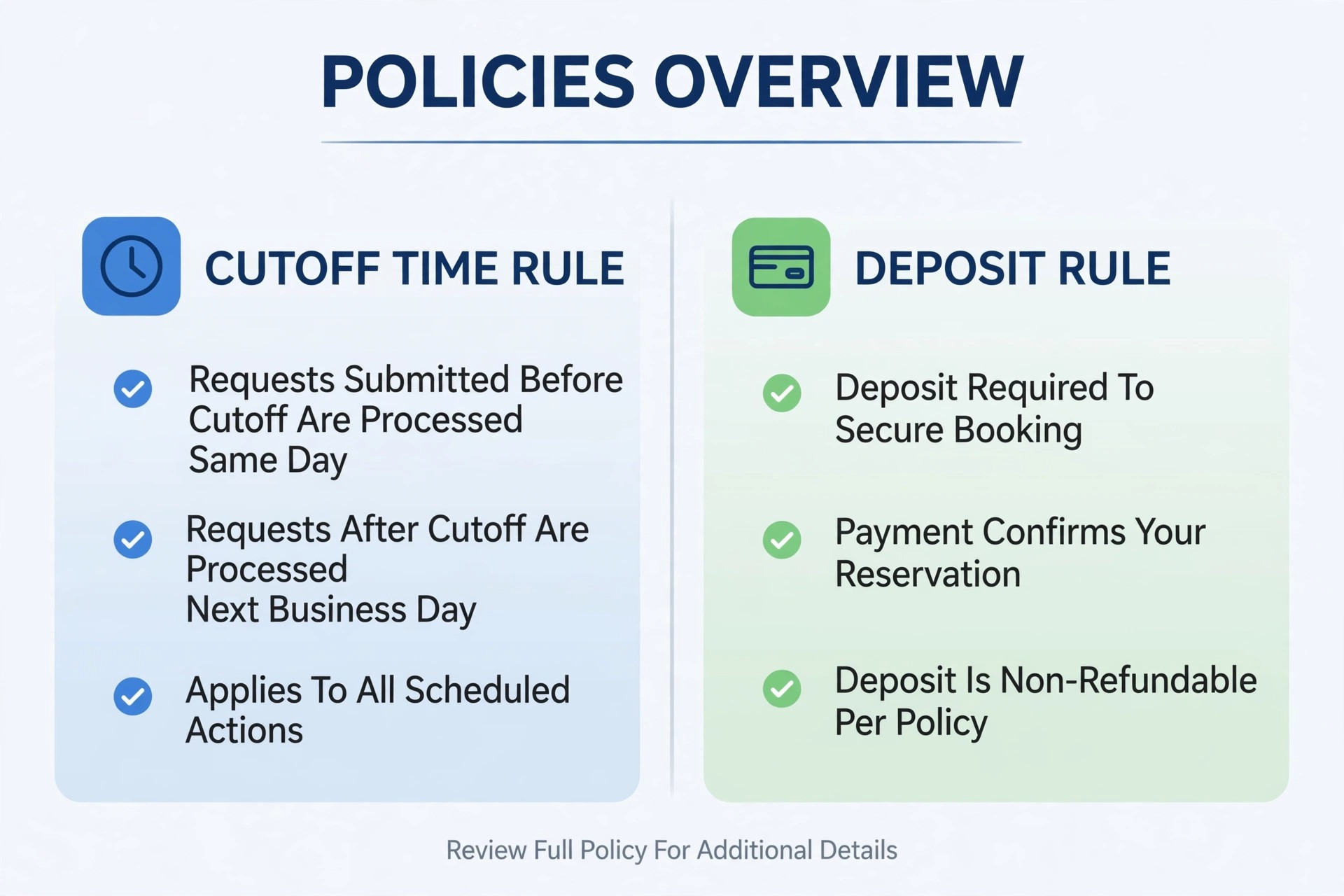
- Rush requests must be received before our published cutoff time for that tier.
- A larger deposit is required before rush work starts.
- Direct rush costs are shown separately from the surcharge.
- Scope changes during rush work are priced as a new rush decision.
- If client approval is delayed, the deadline moves by the same amount or the tier is revisited.
- Rush work does not guarantee outcomes that depend on third parties or client approvals.
- This policy is part of our terms and applies to every rush request, including requests from regular clients.
Consistency is the point of the template. Regular clients should pay the same tier as new clients for the same urgency, unless you have a written loyalty arrangement that says otherwise. A discount given quietly to one regular client will be discovered by another, and the policy will lose credibility. If you want to reward loyalty, do it through standard pricing or a written arrangement, not through secret rush discounts.
Telling the Client Without an Argument
How you tell the client matters as much as the number. Lead with the choice, not with the surcharge. Offer the standard turnaround at the standard price, the faster option at its tier price, and the emergency option at its tier price, with dates for each. That framing lets the client choose, and it makes the rush fee look like a service option rather than a penalty for asking.
Use plain, factual language. State the standard price, the tier, the surcharge, the total, the deposit, and the delivery date, and ask the client to confirm in writing. Avoid long justifications about how busy you are. Clients do not need your schedule. They need a clear price, a clear date, and a clear way to say yes. If the client pushes back, refer to the policy calmly and offer the slower tier. Do not negotiate a one off discount in the moment, because that discount becomes the new price the client expects next time.
When a rush request comes from a client you want to keep, it is tempting to waive the fee as a favour. A waived fee should be a deliberate decision, recorded as a waived fee with a reason, not a silent habit. If you waive fees often, your tiers are not real, and your schedule will fill with urgent work at standard prices. A better favour is a clear tier, a prompt start, and a clean delivery. That favour protects both the relationship and your capacity.
When to Decline Rush Work
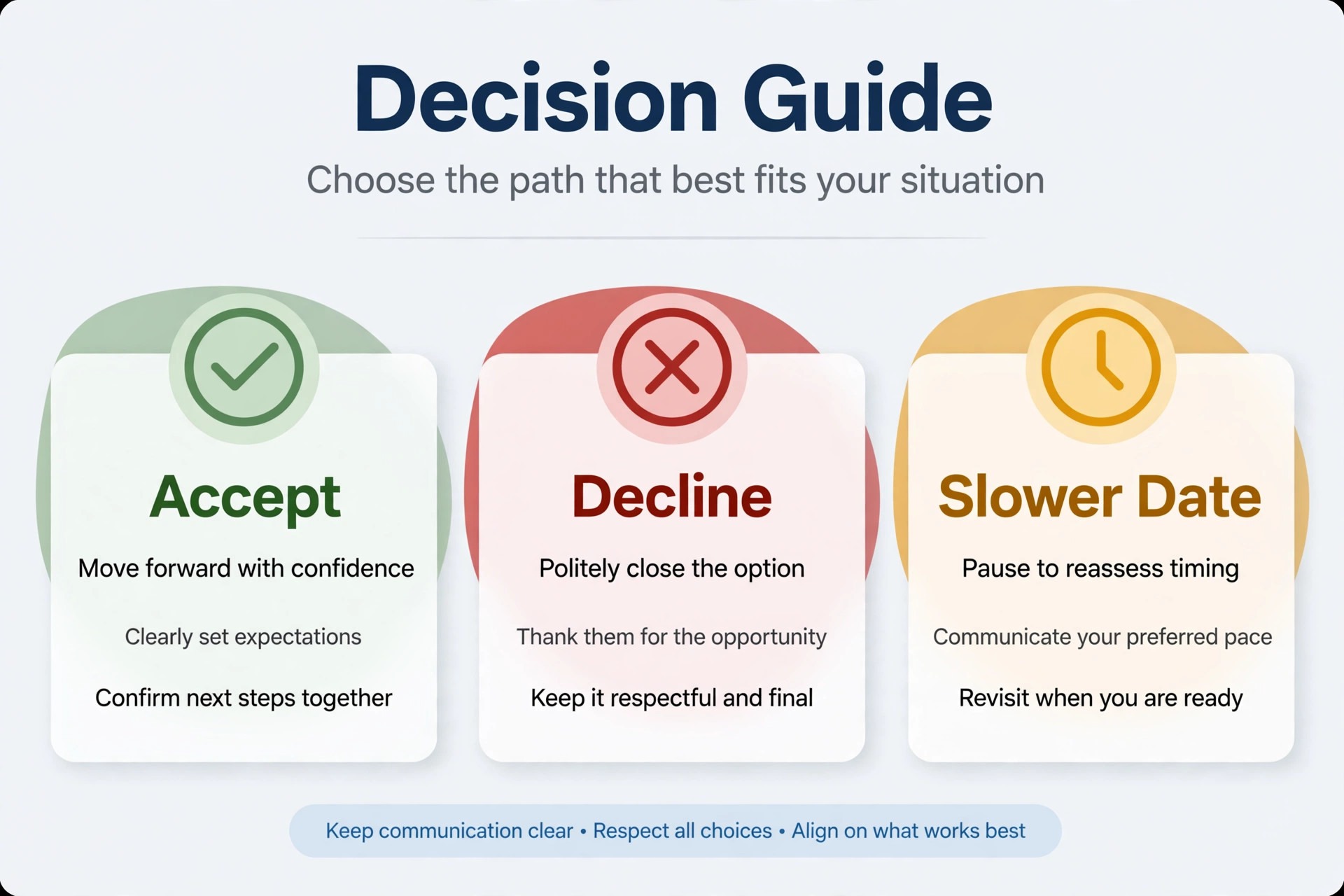
Declining is a pricing decision, not a failure. Decline when the job would displace a committed client you cannot fairly move, when the quality risk is too high for the time available, when a required input or approval cannot arrive in time, or when the work requires a skill or a tool you do not have under rush conditions. A declined job with a clear alternative, such as a slower date or a partial delivery, preserves the relationship better than an accepted job delivered badly.
Also decline when the client will not accept the tier or the deposit. A rush job without a deposit is a high risk job, because the work starts immediately and the client has little invested in the deadline they demanded. A client who refuses the policy is telling you how the rest of the engagement will go. Offer the standard turnaround instead, and let the client choose. That offer is respectful, and it keeps your schedule honest.
Track your declines. If you decline often for the same reason, your standard capacity, your staffing, or your standard turnaround may need attention. If you decline often because tiers are too high for your market, test a lower tier for the slower rush band and measure whether it fills without displacing normal work. Declines are data, and a small business that reads them will price better next quarter than one that simply works harder.
Common Pricing Mistakes
The first mistake is charging only for extra hours. That ignores displacement, fatigue, and error risk, and it leaves you resentful when the job takes over your week. The second mistake is inventing the fee during the request. That invites haggling and makes the fee look personal. The third mistake is applying rush fees inconsistently, with one price for a friendly client and another for a new one. Inconsistency destroys trust faster than a high price.
The fourth mistake is forgetting direct costs. Overtime, courier charges, and subcontractor premiums are real costs, and they should be shown separately so the client can see they are not part of the surcharge. The fifth mistake is promising a rush date without a review step. A rushed job still needs a check, even if the check is shorter or done by a second person. Build that check into the turnaround, or state plainly that the client accepts a reduced review. Never silently drop quality control to meet a date.
The sixth mistake is letting rush become normal. If more than a small share of your work is rush work, your standard turnaround is probably too long, your capacity is too tight, or your clients have learned that urgency gets priority. In that case, the fix is not a higher fee alone. It is a review of scheduling, staffing, and standard promises, so normal work stops being treated as slow work. A rush fee should protect normal work, not replace it.
Reviewing Your Tiers Every Quarter
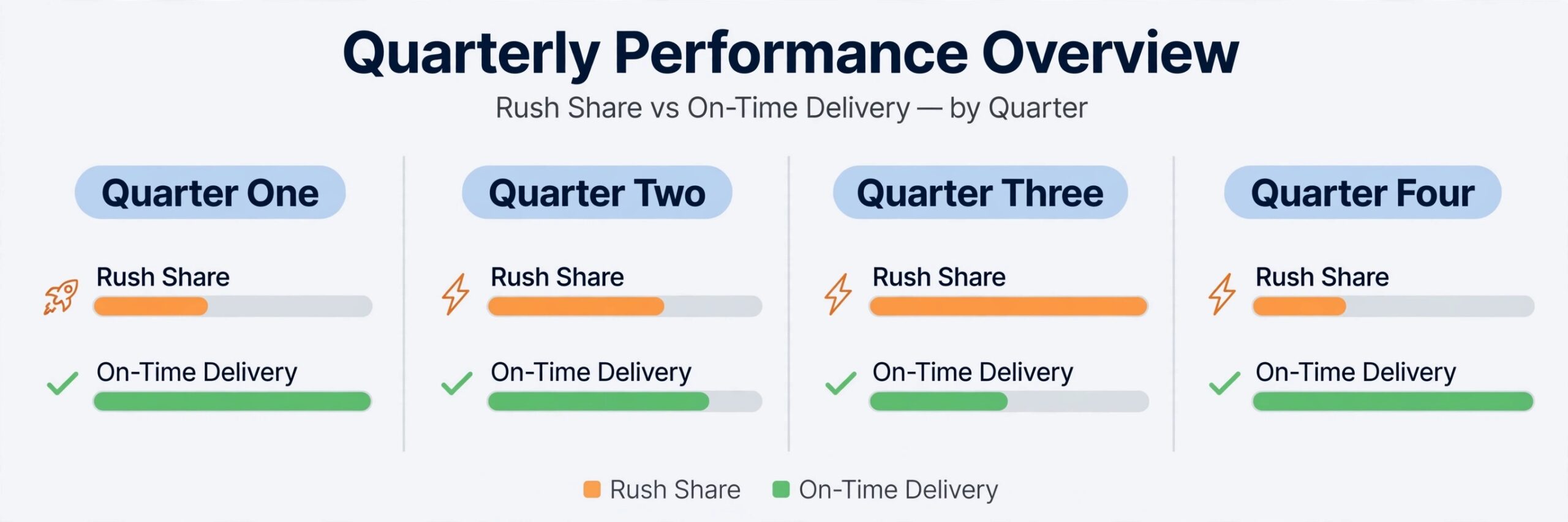
Tiers should be reviewed every quarter, using your own completed worksheets. Look at how many rush jobs fell in each tier, what they displaced, whether they were delivered on time, whether they needed correction, and whether clients accepted the tier or chose a slower option. Those answers tell you whether a tier is priced well, whether a cutoff time is realistic, and whether a minimum fee needs to change.
Also review the effect on normal clients. If normal delivery times slipped because rush jobs took priority, your tiers may be too low, because they are inviting too much rush work. If rush jobs are rare and always accepted happily, your tiers may be too low in a different way, because you are leaving money on the table. If rush jobs are always declined, your tiers may be too high for your market, or your capacity may genuinely be full. Either way, the worksheet record gives you evidence, not a feeling.
Change tiers in writing, with a date, and tell regular clients before the new tiers apply. A sudden price change during a rush request will feel like opportunism, even if the change was planned. A short notice message, sent with a normal invoice or a normal update, lets clients adjust their planning. That notice is part of professional pricing, and it costs nothing.
For related reading, see time tracking software, invoicing software, CRM software, proposal software and booking software. Those posts cover adjacent pricing, scheduling, and client work, and the same lesson applies when you work out how to price a rush fee small business clients will accept. Price the disruption, publish the tiers, apply them consistently, and let the client choose the speed they truly need.
Testing Your First Tiers With Real Jobs
A tier schedule only becomes reliable after it has been tested against real jobs, and the safest test is a small, dated trial. Choose a start date, publish the tiers to new quotes from that date, and run them for one quarter without making exceptions. Record every rush request, including the ones you decline, so the trial measures demand as well as revenue. At the end of the quarter, you will know whether clients chose the faster tier, the urgent tier, or the standard date, and that pattern is far more useful than any opinion about what clients might pay.
During the trial, watch for three signals. The first is acceptance. If almost every client accepts the emergency tier without hesitation, the tier is probably too low for the disruption it causes, and you should raise it at the next review. The second is displacement. If normal jobs regularly slip because rush jobs take priority, the tiers are inviting too much urgent work, even if clients pay happily. The third is quality. If rush jobs need more corrections than normal jobs, your review step may be too short, or your fastest tier may be too fast for the work involved.
Adjust one thing at a time when you review the trial, so you can tell what caused the change. If you raise every tier, shorten every cutoff, and add a new minimum at once, you will not know which change helped. A disciplined approach to how to price a rush fee small business owners can improve over time means changing the weakest tier first, then measuring again for another quarter. That patience is what turns a copied percentage into a pricing system that fits your capacity, your staff, and your clients.
A final trial rule is worth stating plainly. Do not test tiers on your most important client first. Test them on new quotes, where the policy can be presented as a normal part of your terms, and let regular clients see the policy in a normal update before it applies to them. That sequence protects relationships while you learn, and it gives you a clean record to show when a regular client asks why the new rule exists. Good pricing is learned in public, but it should be learned carefully.
Frequently Asked Questions
How much should a small business charge for a rush fee
There is no single correct figure. Published guides commonly describe surcharges of 25 percent to 100 percent above the standard price, depending on how much the timeline is shortened and how much disruption it causes. Start from that range, then adjust to your capacity costs, your overtime costs, and what your market will accept, and test the tiers against your own completed jobs.
Should a rush fee be a percentage or a flat fee
A percentage works best for varied project sizes, because it scales with the job. A flat minimum works best as a floor, so small jobs still cover the disruption of reordering your week. Most small businesses do well with both, using the greater of the tier percentage or a published minimum, with direct costs shown separately.
When should you not charge a rush fee
Do not charge when the deadline was your own standard turnaround, when a small change takes only minutes, or when a delay was caused by your own business. A rush fee should only apply when the client request shortens your normal turnaround, requires work outside normal hours, or forces you to move other committed work.
How do you tell a regular client about a new rush fee policy
Share the policy before it is needed, in your terms or on a quote, and explain it as a choice between standard and faster delivery with clear dates and prices. Regular clients should pay the same tier as new clients for the same urgency, unless you have a written loyalty arrangement. Consistency is what makes the policy feel fair.
What if a client refuses to pay a rush fee
Offer the standard turnaround at the standard price, and let the client choose. If the client needs the faster date but will not pay the tier, declining the rush job with a clear standard alternative preserves the relationship better than accepting urgent work at a standard price and resenting it.
Should rush work require a larger deposit
Yes, in most cases. Rush work starts immediately, displaces other work, and leaves little time to recover if the client changes their mind. A larger deposit, stated in your policy and confirmed in writing before work starts, protects your capacity and signals that the deadline is a serious commitment on both sides.