
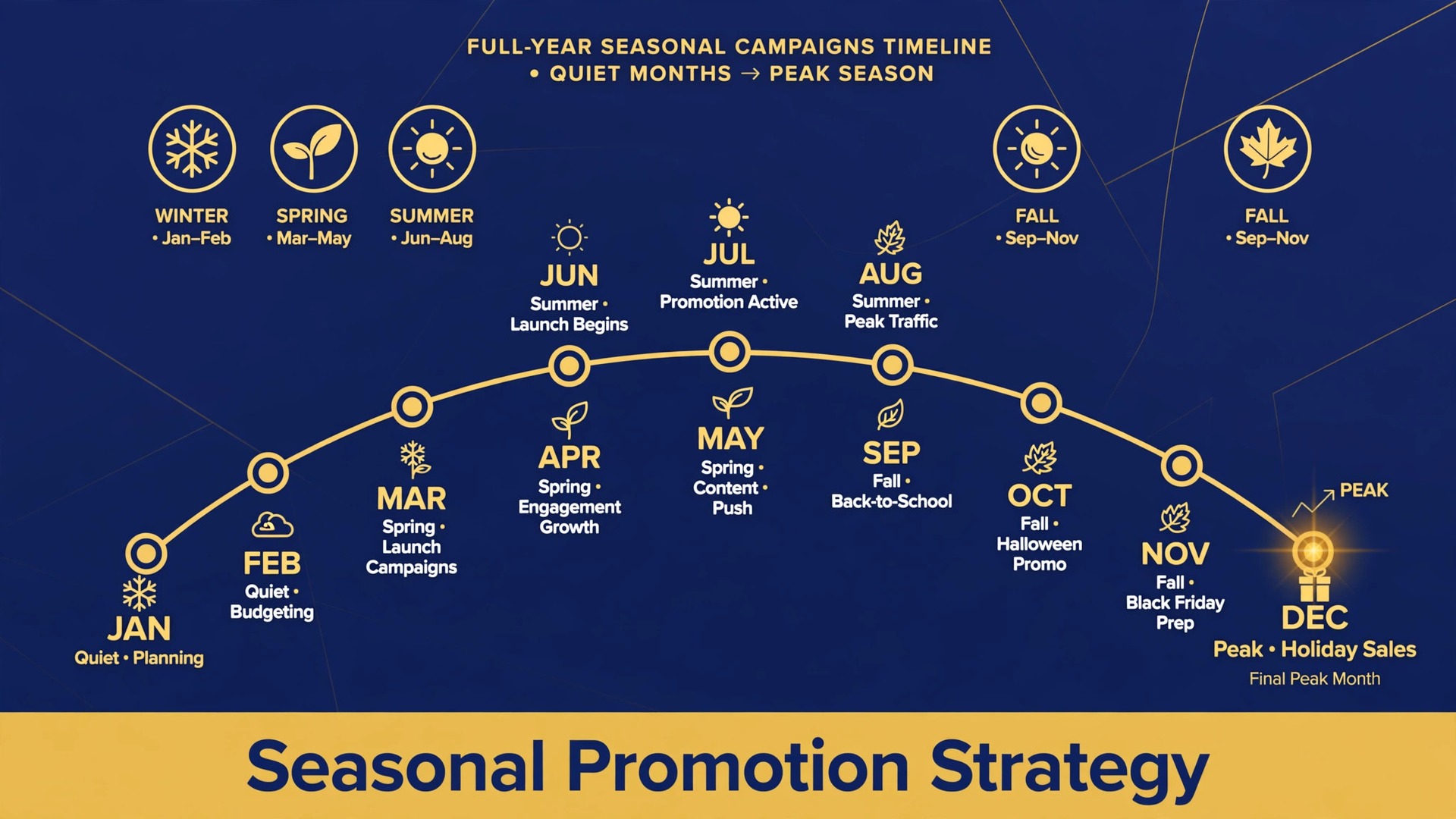
Four to six weeks. That is the lead time planning guides recommend for a major seasonal campaign, and it is also the lead time most small businesses fail to give themselves. The result is familiar. A holiday arrives, the owner invents a promotion the week before, stock is guessed, staff learn the offer on the day, and the promotion sells mostly to people who would have bought anyway. A seasonal promotion strategy small business owners plan in advance reverses that pattern, by turning predictable moments in the year into planned campaigns with stock, staffing, and follow up decided before the rush.
The numbers behind the rush explain why planning matters. Seasonal windows compress a large share of buying into a short period, which means a mistake in timing, stock, or offer costs more in December than the same mistake costs in a quiet month. Guides on holiday calendars stress assigning one job to each window, building the list early, launching big offers in late November, capturing last minute buyers in December, and converting gift card holders in January. A business that treats each of those jobs as a separate campaign, with its own offer and measure, will waste less money than a business that runs one long discount from November to January and hopes for the best.
This guide builds a full year approach, not just a holiday plan. You will learn how to map your own peaks and quiet months, choose four to six anchor campaigns, build an offer ladder that protects margin, staff for peaks without burning out the team, and review each campaign against the same weeks last year. It includes a seasonal calendar template, an offer ladder framework, a staffing guide, and a promotion review checklist. Figures here come from published planning guides and are presented as planning ranges to test, not as guarantees for any single business.
Seasonal Promotion Strategy Small Business Owners Build From Their Own Sales
Start with your own sales history, not with a generic holiday list. Pull monthly sales, bookings, or enquiries for the last twelve months, and mark your real peaks, your real dips, and any sharp changes that need explanation. A peak caused by a one off event, a press mention, or a competitor closure is not a seasonal pattern, and planning around it as if it repeats will mislead you. A peak that repeats in the same months for two years, even modestly, is a pattern worth building a campaign around.
Next, add the fixed dates that matter to your buyers. Public holidays, school breaks, local festivals, and industry moments, such as tax season for accountants or enrolment windows for course sellers, all belong on the same calendar. Then add your business specific moments, such as a product launch window, a service renewal season, or a local event you attend each year. The calendar that results is personal to your business, which is exactly why it beats a downloaded holiday list that treats every business alike.
Choose four to six anchor campaigns for the year, spread across the seasons, and give each one a clear theme, a real offer, and enough promotion time. Anchor campaigns are your biggest planned efforts, while smaller moments get lighter treatment, such as a single email and a social post rather than a full campaign. Chasing every holiday spreads budget and attention thin, and customers stop noticing offers that arrive every week. A smaller number of well prepared campaigns, each with a distinct reason to buy, will be remembered better than a constant stream of small discounts.

The Seasonal Calendar Template
Copy the template below into a spreadsheet or wall calendar, fill in one row per campaign, and keep it visible all year. Blank lines between items keep each row readable when printed.
- Campaign row fields.
- Season window and peak buying dates.
- Audience for this campaign and the job it must do.
- Offer and offer ladder level, from welcome to premium.
- Promotion start date, counting back four to six weeks for major campaigns.
- Stock, staffing, and content needed before launch.
- Success measure and comparison period from last year.
- Owner for the campaign and the date of the review meeting.
- Example year shape for a retail or service business.
- Late winter, a quiet month offer that rewards loyalty rather than cutting price.
- Spring, a launch or bundle campaign tied to a seasonal need.
- Early summer, a gift or experience campaign for gifting occasions.
- Back to school or autumn, a bundle campaign for returning routines.
- Late autumn, a list building and early access campaign before the peak.
- Peak season, a volume campaign with a clear deadline and gift solutions.
- Post peak, a redemption and rebooking campaign for new customers.
Work backwards from each peak date to set promotion start dates. For most seasonal moments, guides recommend starting promotion three to six weeks before, and about two months before Black Friday and Christmas, because shoppers start buying early. That lead time covers list building, content creation, photography, and stock ordering, none of which improves when rushed. If a campaign cannot be ready by its promotion start date, shrink the campaign rather than starting late with a half finished offer, because a late start compresses every later step.
Keep one version of the calendar, owned by one person, and update it at each campaign review. When dates shift, update the calendar the same day and tell anyone who works from it, because a team working from two versions will promote the wrong offer. At the start of each quarter, review the next two campaigns only, not the whole year, so planning stays detailed where it matters and flexible where the year is still distant.

The Offer Ladder That Protects Margin
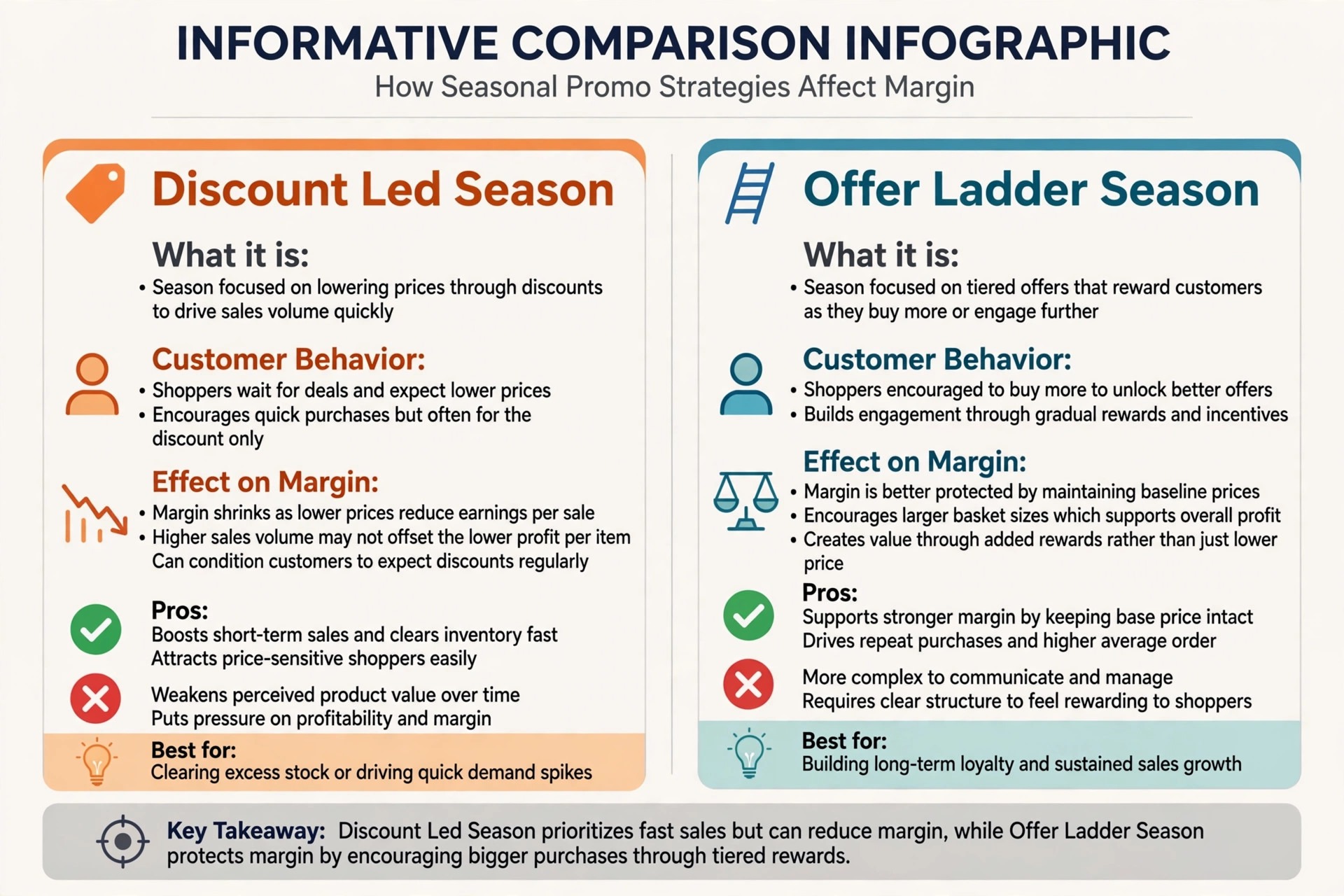
An offer ladder gives customers a path from a low cost first step to a higher value purchase, instead of a single discount that either works or does not. The bottom rung is a welcome or trial offer, cheap to deliver and easy to accept, such as a sample, a short consultation, or a small gift with purchase. The middle rung is the main seasonal offer, such as a bundle, a gift set, or a booking package, priced to protect margin after the cost of the welcome rung. The top rung is a premium option, such as a limited edition, a priority booking, or a full package, for buyers who want the best version rather than the cheapest.
Margin discipline sits at the centre of the ladder. Before any campaign launches, work out the cost of the offer if redemption runs twice as high as expected, and check that the campaign still makes sense at that level. Seasonal guides warn that festive demand is real, but so is the temptation to spend through it, and that discounting what would have sold anyway is the fastest way to lose the margin the season was supposed to deliver. A useful rule is to fund the strongest campaigns first, based on expected incremental margin, and to drop, shorten, or test the weakest campaigns in a few locations rather than defending them because they are traditional.
Offer types should match the season job. Early windows suit list building offers, such as early access or a subscriber only preview, because the goal is audience rather than volume. Peak windows suit gift solutions, bundles, and gift cards, because buyers need help choosing quickly. Last minute windows suit convenience offers, such as same day pickup or digital gifts, because speed matters more than price. Post peak windows suit redemption and rebooking offers, because the goal is turning a gift recipient or first time buyer into a repeat customer. One offer per window, clearly dated, beats three overlapping offers that confuse staff and customers alike.
| Season job | Offer that fits | Measure first |
|---|---|---|
| Build the list early | Early access or subscriber preview | New subscribers from that window |
| Drive peak volume | Bundle, gift set, or gift card | Incremental sales versus the same weeks last year |
| Capture last minute buyers | Same day pickup or digital gift | Conversion in the final days of the window |
| Convert new customers | Rebooking or return offer in January | Repeat visits within thirty days |
| Fill a quiet month | Loyalty or experience offer, not a deep cut | Bookings or visits that would not have happened |
Timing, Channels, and Content for Each Window
Timing a campaign means timing its waves, not just its launch date. A strong pattern is a teaser wave that builds the list and announces the date, a launch wave that presents the offer clearly, a reminder wave midway through the window, and a final wave that states the deadline plainly. Each wave should add new information, such as a gift guide, a bundle detail, a customer story, or a last order date, rather than repeating the same announcement. A campaign announced once and never repeated will be missed by most of its audience, while a campaign repeated without new information will be ignored as noise.

Channels should follow where your buyers already are, and a seasonal promotion strategy small business owners run well will put owned channels first for most windows. Email reaches subscribers you own, and it suits detailed offers, gift guides, and deadline reminders. Social media suits visual proof, such as photos of bundles, preparation, and customers using the product. Local listings and your shopfront suit foot traffic, through window signs, a clear offer board, and staff who can explain the offer in one sentence. Paid ads, if used, should support the strongest campaign only, not every seasonal moment, because spreading a small ad budget across many campaigns produces no measurable result anywhere.

Content for a seasonal campaign should answer buyer questions in order. What is the offer, who is it for, when does it end, and how do I buy or book it, in that order, on every page and post that mentions the campaign. Gift guides work well in peak windows because they solve a choosing problem, not just a price problem. A guide that groups products by recipient, budget, or need helps a buyer decide faster, and a guide that only lists discounted items helps them compare prices and leave. Photograph the actual bundle or gift set, not a generic seasonal image, because buyers trust a photo of what they will receive.
Staffing and Stock for Peak Windows
Staffing for a peak window starts with a forecast, not with a rota copied from a quiet month. Estimate foot traffic or bookings from last year, adjusted for the campaign size and any change in opening hours, then plan staffing in shifts that match the busy hours rather than spreading staff evenly across the day. Brief every staff member on the offer, its terms, its end date, and the answer to the most likely questions, before the campaign launches. A staff member who hesitates over terms at the till will slow the queue and undermine confidence in the offer.
Stock planning follows the same logic. Order for the campaign, not for the month, and separate campaign stock from everyday stock so a campaign sellout does not empty the core range. For service businesses, the equivalent of stock is appointment capacity, so open extra slots, set a clear last booking date, and protect time for existing customers who should not be displaced by a promotion. Build a small reserve for the final days of a peak window, because last minute buyers are often the most valuable, and a stockout on the final day loses sales that cannot be recovered in January.
A seasonal promotion strategy small business teams staff well also protects the team itself. Peak windows are tiring, and a team that works every peak day without breaks, clear roles, or thanks will not staff the next peak willingly. Rotate the busiest roles, schedule breaks before the rush rather than hoping for a quiet moment, and thank staff by name after the campaign. Keep a short note of what staffing level actually worked, versus what was planned, so next year starts from evidence rather than optimism.
Quiet Months as Campaigns, Not Gaps
Quiet months are often treated as gaps to survive, but they are also the cheapest time to build the audience for the next peak. A loyalty campaign in a quiet month, such as an experience, a workshop, a preview, or a subscriber only offer, keeps the business visible without discounting the core range. Quiet month content can also prepare buyers for the peak, by teaching them about a product, sharing behind the scenes preparation, or collecting early interest for a limited edition. That preparation means the peak campaign launches to a warm audience rather than a cold one.
Quiet months are also the right time for maintenance that peaks make impossible. Update product photos, refresh the website offer pages, clean the email list, review supplier terms, and train staff on the next campaign. A business that uses quiet months for preparation will launch peak campaigns faster and with fewer errors, because the groundwork is already done. Treat each quiet month as having one job, such as list building, content creation, or staff training, and give that job the same calendar slot and owner as a peak campaign.
Pricing in quiet months deserves care in any seasonal promotion strategy small business owners want to sustain. A deep discount in a quiet month may fill a week but train customers to wait for the next quiet month discount, which deepens the next dip. A value added offer, such as a bundle, an experience, or a bonus service, fills the month without resetting price expectations. If a discount is genuinely needed to clear stock, limit it clearly in time and quantity, and explain the reason, such as a seasonal clearance, so customers understand it as an exception rather than a new normal.

Budgeting and Stop Rules for Seasonal Spend
A seasonal budget set before the calendar is filled will always be more disciplined than a budget assembled from individual campaign requests. For a seasonal promotion strategy small business owners can defend to themselves, start with a total promotion budget for the year as a share of expected seasonal revenue or seasonal margin, agreed before any single campaign is designed. Then split that total across the four to six anchor campaigns, with the largest share going to the campaigns with the strongest expected incremental margin. Reserve a portion as an in season fund, released only when early results justify it, rather than spending the full budget before the first campaign has reported.
That reserve is what stops a weak campaign from consuming the budget for a strong one. If an early campaign underperforms, the reserve stays unspent and can support a later campaign that is working, or be saved entirely. If an early campaign outperforms, the reserve can extend a winning offer, add a channel, or fund a second wave to the same audience. Without a reserve, every campaign decision becomes a yes or no under pressure, and pressure usually produces yes. With a reserve, the default is to wait for evidence, which is a calmer and cheaper way to run a season.
Stop rules should be agreed before launch, in writing, alongside the budget. A stop rule is a trigger that ends, shrinks, or changes a campaign, such as a discount cost ceiling, a minimum signup rate, a stock level, or a date after which an offer cannot be extended. Write the trigger, the action, and the person who can call it, before the campaign starts, because a rule invented mid campaign will be argued about, while a rule agreed in advance can simply be followed. A campaign that hits its stop rule is not a failure of planning. It is planning working as intended, by preventing a weak campaign from becoming an expensive one.
Channel budgets need the same discipline as offer budgets. Decide in advance how much each campaign may spend on paid promotion, printing, photography, and content, and track spend weekly during the campaign rather than discovering the total afterwards. Paid promotion deserves special care in seasonal windows, because auction costs rise when many businesses advertise at once, and a small budget spread across many campaigns will rarely reach enough buyers to be measured. Concentrate paid spend on the one or two campaigns where an extra buyer is most valuable, and let owned channels, email, shopfront, and local listings, carry the rest.
Small businesses often overlook the hidden costs of a seasonal campaign, and those costs belong in the budget too. Staff hours for preparation, overtime during peak days, returns and exchanges after a promotion, and the cost of honouring gift cards or vouchers in January all reduce the true margin of a December campaign. A seasonal promotion strategy small business owners review honestly will count those costs in the review, even when they fall in a different month from the sales. A campaign that looks profitable in December and unprofitable in January, once redemptions and returns are counted, should be judged on the full picture, not on the December snapshot alone.
Finally, protect the price of the core range while the seasonal budget is spent. A campaign budget that is spent entirely on discounts teaches customers to expect discounts, which raises the cost of every future campaign. A budget split across welcome offers, bundles, experiences, content, and list building, rather than price cuts alone, builds assets that last beyond the season, such as a larger list, better photos, and a clearer sense of which offers work. That asset building is the quiet return on seasonal spending, and it is the reason a well budgeted season keeps paying after the decorations come down.
The Promotion Review Checklist
Review each campaign within two weeks of its end, while details are fresh, and compare it with the same weeks last year rather than the week before, because seasonal comparisons only make sense against the same season. Blank lines between items keep the checklist usable in a meeting.
- Results to record.
- Sales, bookings, and incremental margin versus the same period last year.
- New subscribers, gift card sales, and redemptions from the campaign.
- Return visits or rebookings within thirty days of the campaign.
- Cost of the campaign, including discount cost and staff hours.
- Judgement questions.
- Did the offer sell to new buyers or mostly to people who would have bought anyway.
- Did stock and staffing match demand, and where did queues or stockouts occur.
- Which channel produced the most engaged buyers, not just the most clicks.
- What should be repeated, shortened, dropped, or tested differently next year.
- Actions for the next campaign.
- Update the calendar template with the review date and the decision.
- Retire or refresh any offer that underperformed twice.
- Brief staff on the one change that matters most for the next window.
A review that produces no decision is a report, not a review. End each review meeting with three decisions, one campaign to repeat, one to change, and one to drop or test differently. Write those decisions into the calendar template, so next year planning starts from decisions rather than from a fresh debate. Over two or three years, that record becomes the most valuable part of the seasonal plan, because it shows which seasons, offers, and channels actually work for your business.
For related operational help, read the guide on fixing a discount code that fails during a promotion before a peak sale, and the guide on moving a store platform if a seasonal rush exposes platform limits.
Keep the review record with the calendar itself, not in a separate folder that nobody opens, so the next planner inherits decisions rather than guesses. A single page that shows last year results, the three decisions from each review, and the dates for the next two campaigns will do more for next season than a thick report that is filed and forgotten.
Local foot traffic campaigns can borrow from event promotion ideas for a local venue, while correct listing details support every seasonal search. Appointment heavy seasons also benefit from booking software for service businesses, which helps manage peak capacity.

Frequently Asked Questions
How many seasonal campaigns should a small business run?
Four to six anchor campaigns a year works well for most small businesses, spread across the seasons, with lighter treatment for smaller moments. More campaigns spread budget, staff time, and customer attention too thin, while fewer campaigns leave long gaps with no reason for buyers to return. Choose anchors from your own sales peaks and buyer moments, not from a generic holiday list, and give each anchor enough lead time to be prepared properly.
How far ahead should I start promoting a seasonal offer?
Plan major campaigns four to six weeks ahead, and start promoting most seasonal moments three to six weeks before, with about two months of lead time for Black Friday and Christmas, per planning guides. Smaller campaigns need two to three weeks. That lead time covers stock ordering, photography, email and social content, and staff briefing, none of which improves when rushed. If a campaign cannot be ready by its start date, shrink it rather than launching late.
Should every seasonal campaign include a discount?
No, and a seasonal promotion strategy small business owners run profitably usually mixes offer types rather than discounting every season. Use early access and list building offers early, bundles and gift solutions at peak, convenience offers for last minute buyers, and rebooking offers after the peak. Reserve deep discounts for genuine clearance, limited in time and quantity, so customers do not learn to wait for the next cut.
How do I measure a seasonal campaign fairly?
Compare the campaign with the same weeks last year, not with the week before, and measure incremental margin alongside sales. Record new subscribers, gift card redemptions, and repeat visits within thirty days, as well as discount cost and staff hours. A campaign that produces high sales but mostly to existing buyers at a deep discount may be weaker than a smaller campaign that brings in new buyers who return.
What if a seasonal campaign fails?
Treat a failed campaign as data, not as a reason to stop planning seasonally. Check whether the problem was the offer, the timing, the stock, the staffing, or the channel, using the review checklist, and change one variable for the next attempt. An offer that underperforms twice should be retired or substantially changed. A single failure in a new season is often a timing or audience problem, not proof that seasonal planning does not work.
How do I staff a peak without burning out the team?
Forecast from last year, staff to busy hours rather than evenly across the day, brief everyone on offer terms before launch, and rotate the busiest roles. Schedule breaks before the rush, protect time for existing customers in service businesses, and thank staff by name after the campaign. Record what staffing level actually worked, so next year starts from evidence rather than optimism.
A Closing Judgement on Seasons, Not Discounts
Seasons reward preparation more than generosity. A business that plans four strong campaigns, staffs them well, and reviews them honestly will usually outperform a business that discounts constantly and hopes the calendar does the work. The calendar gives you the moments, but the plan decides what each moment is for, who it serves, and how you will know whether it worked. That discipline is the difference between a busy season and a profitable one.
Start with this quarter only. Pull last year numbers for the next season, choose one anchor campaign, write its offer ladder and promotion start date into the template, and assign one owner. Run it, review it within two weeks, and let that review shape the following season. A year of that rhythm will leave you with a calendar you trust, offers you can defend on margin, and a team that knows what each season asks of them before it arrives.