

Cut a price by 40 percent on a product that cost 30 units out of a 100 unit price, and the margin falls from 70 units to 30 units before fees, shipping, and returns take their share. That single piece of arithmetic decides whether a flash sale is a triumph or a loss, and most small shops never run it before announcing the sale. This guide shows how to run a flash sale small online shop owners can control, from margin guardrails and stock caps to the announcement sequence and the post sale review that decides whether to repeat it.
A flash sale is a short, sharp price event on a small group of products, usually lasting hours or a few days, with a clear end time customers can see. It is not a permanent discount, not a site wide clearance, and not a weekly habit. The power comes from the combination of a real saving and a real deadline. Remove either half and the event weakens. A deep discount with no deadline gets postponed. A deadline with a shallow discount gets ignored. The discipline of a flash sale is keeping both halves honest, which means the deadline must be real and the saving must be funded by margin you have actually checked.
Small shops run flash sales for different reasons, and the reason must be chosen before the discount is set. Clearing slow stock, winning first time buyers, reactivating dormant customers, lifting average order value, and growing an email list are all valid goals, but each one points at different products and different discounts. A clearance sale should feature slow movers at deeper cuts. A buyer acquisition sale should feature a hero product with healthy margin and a clear path to a second purchase. A sale that tries to do all five at once usually discounts the wrong products and learns nothing.
How to Run a Flash Sale Small Online Shop Owners Can Control
The controlled sequence is short. Pick one primary goal, set margin guardrails per product, cap the stock on offer, choose a believable window, build the announcement sequence, load test checkout, run the sale with live monitoring, and review within a week. Every step exists to prevent a specific failure. Guardrails prevent a loss making discount. Caps prevent overselling. A believable window prevents deadline extensions that teach customers to wait. A load test prevents a checkout crash at the exact moment demand peaks. Skip a step and you accept the failure it was designed to prevent.
Write the goal and the guardrails on one page before any creative work starts. That page is the contract for the sale. If a product cannot meet the guardrail, it does not go in the sale, however photogenic it is. If the stock cap is reached, the product comes off sale, however strong demand looks. If the end time passes, the price returns, however many emails ask for an extension. Shops that hold those three lines run sales customers trust. Shops that bend them train customers to expect the next bend, and each bend costs more than the last.

Pick One Goal Before You Pick a Discount
One primary goal shapes every later decision, so name it in a sentence and let secondary goals stay secondary. A clearance goal is measured in units of slow stock moved and warehouse space freed. An acquisition goal is measured in first time buyers and their second purchase rate over the next ninety days. A reactivation goal is measured in dormant customers who buy again. A list growth goal is measured in new subscribers who stay subscribed after the sale. Each measure implies a different product choice, a different audience, and a different definition of success, which is why trying to optimise for all of them produces a muddled sale.
Match the audience to the goal. Recent buyers respond fastest, because the shop is fresh in their minds. Cart abandoners respond to a reason to finish a purchase they already considered. Dormant customers need a stronger reason and a reminder of what they bought before. Segment even a small list into three groups, recent buyers, abandoners, and dormant customers, and tailor the first line of each message to that group.
Set a success threshold before launch, not after, because that discipline is the first lesson in how to run a flash sale small online shop owners can repeat. Decide the minimum units, revenue, or new buyers that would make the sale worth repeating, and write it down. Without a threshold, every sale feels successful on the day, because revenue spikes, and disappointing a month later, when returns arrive and repeat purchase rates stay flat. With a threshold, the post sale review has a verdict to deliver instead of a feeling to debate. That discipline is what turns a one off event into a repeatable tactic.
Margin Guardrails. Price the Sale Before You Announce It
Margin guardrails are the heart of how to run a flash sale small online shop owners can repeat without regret. For each product, calculate the sale price, subtract product cost, payment fees, packaging, and an allowance for shipping and returns, and confirm a positive margin remains. Do this per product, not on average, because an average hides the one product that loses money on every unit. A sale where nine products profit and one product bleeds can still lose money overall if the bleeding product is the one customers actually buy.
Use a break even check for any product where the discount is deep. The break even sale price is the product cost divided by one minus the discount rate, expressed in the same currency, and any planned sale price below the cost floor after fees needs a different plan. The worked examples here are illustrative planning examples, not market claims, and you should replace them with your own costs. Suppose a product costs 30 units and normally sells for 100 units.
At a 40 percent discount the sale price is 60 units, leaving 30 units before fees. At a 50 percent discount the sale price is 50 units, leaving 20 units before fees. Both are positive before fees, but the second leaves far less room for shipping, returns, and payment costs, which is why deep discounts need the full cost check, not just the headline margin.
Tier discounts by product role instead of applying one flat cut to everything. Slow stock that must move can take the deepest cut, because the alternative is storage cost and eventual markdown anyway. Hero products that draw traffic should take a smaller cut, because their job is to bring visitors who also buy full price items. New products should take the smallest cut, because their job is introduction, not clearance. Bundles can carry a larger effective discount than single items, because the bundle lifts average order value and moves a slower item alongside a popular one. A tiered structure protects margin while still giving customers a headline saving to notice.
Watch the hidden costs that only appear after the sale. Free shipping thresholds set too low can erase margin on small orders. Returns on sale items, if allowed, return the product but not the payment fee or the shipping cost in many setups. Discount stacking, where a flash price combines with a welcome code or a loyalty reward, can push a product below cost without anyone noticing until the accounts are done. Decide each of these rules before launch, write them on the sale page, and test a stacked cart yourself to confirm the final price behaves as intended.

Choose Products and Cap the Stock
Product choice follows the goal and the guardrail, in that order. For clearance, choose slow movers with real stock depth, not one unit curiosities that sell out in minutes and frustrate everyone else. For acquisition, choose a proven bestseller with healthy margin and available stock, because the first purchase should be a good experience, not a wait for a restock. For reactivation, choose products related to what dormant customers bought before, where your order history allows that targeting. In every case, exclude products you cannot restock or fulfil quickly, because a flash sale that creates backorders creates support tickets instead of fans.
Cap the stock on offer and say so plainly. A cap is a number of units per product, or per customer, set before launch and enforced by the shop system. Practitioner guides commonly suggest capping the sale allocation at a modest share of total stock, so the shop keeps reserve stock for full price buyers and for replacements. Treat that guidance as a starting point for your own judgement, not as a rule. A shop with deep stock can offer more. A shop with thin stock should offer less. The principle is constant. Never offer more discounted units than you can ship on time, and never let one buyer clear the entire allocation while others are still reading the announcement.
Set a per customer limit where abuse is likely, such as two or three units of a hero product, and display it on the product page. Stock discipline is the quiet half of how to run a flash sale small online shop customers trust. Limits protect genuine customers from resellers and from a single bulk buyer emptying the sale. They also protect the shop from a fulfilment spike it cannot staff. If a product sells out, replace it with a clear sold out message and a related full price suggestion, not with a silent price rise or a waitlist that nobody monitors. A clean sold out page preserves trust. A confusing one spends it.
Prepare fulfilment before the announcement, not after the first orders land. Count the capped stock physically where possible, confirm packaging and labels are in hand, and brief whoever packs orders on the expected volume and the ship by date. A flash sale compresses a week of orders into a day, and the bottleneck is usually packing, not selling. If packing capacity covers fifty orders a day and the sale might bring two hundred, plan extra hands, longer hours, or a longer ship by promise stated honestly on the sale page. Customers accept a stated delay. They do not accept a promised speed that fails.

Set a Window Customers Believe
Duration is a trade off between urgency and reach. Very short windows, such as a few hours, create maximum urgency but exclude customers who do not see the announcement in time. Longer windows, such as three days, reach more people but weaken urgency and strain operations for longer. Practitioner guides commonly describe flash windows from a day to three days for small shops, with shorter windows for single product drops. Choose based on your audience habits. A list that opens email quickly can support a shorter window. A social driven audience that discovers posts slowly needs a longer one.
Start the sale at a time your customers are actually shopping, not at midnight because it looks tidy. Check past order times and email open times for your own shop, and pick a start hour inside the busiest band. Announce the start time in the customer local time where your audience spans time zones, and show a countdown on the sale page that matches the real end time. A countdown that resets, extends, or disagrees with the email end time destroys the trust the next sale will need. The single most important rule of flash timing is that the end time is final.
Never extend a deadline that customers were told was final. Deadline discipline is the part of how to run a flash sale small online shop owners find hardest to hold. Extensions teach the exact lesson you do not want taught, which is that waiting is rewarded and urgency is theatre. If stock remains at the end, move it to a different mechanism, such as a bundle, a loyalty reward, or a later clearance event with its own honest deadline, rather than stretching the current one. The short term revenue from an extension is almost always smaller than the long term cost of customers who learn to ignore your deadlines. Protecting the deadline protects every future sale.
Frequency matters as much as duration. Shops that run flash sales every week train customers to never buy at full price, because another sale is always days away. Shops that run them rarely, tied to a real reason such as a season change or a clearance need, keep the event feeling special. A practical rhythm for most small shops is one flash sale every few months, with non discount events in between. Space creates anticipation. Saturation creates indifference.
Build the Announcement Sequence
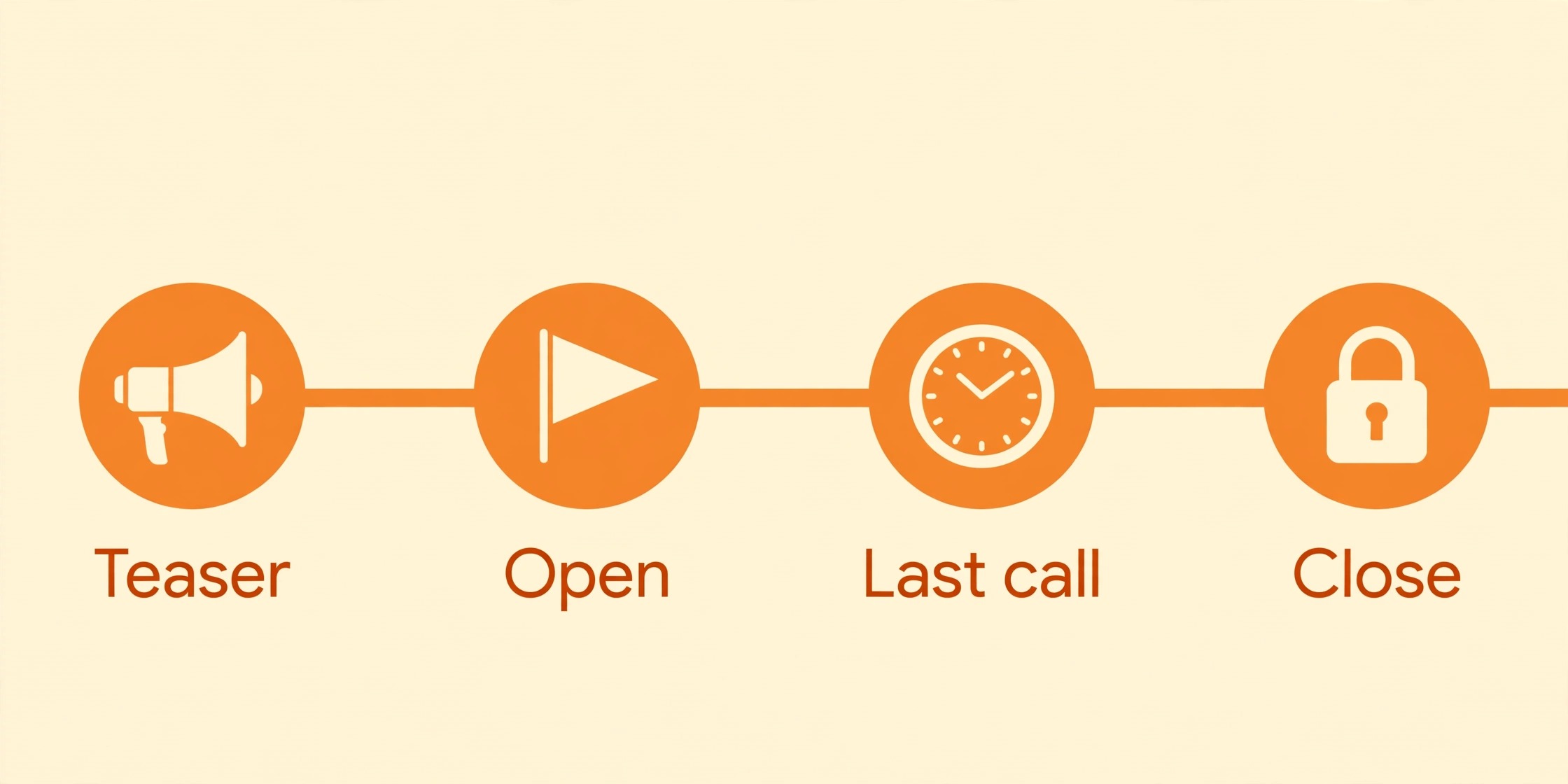
The announcement sequence is how to run a flash sale small online shop customers actually hear about, because a sale nobody sees is just a price cut with extra work. Plan four messages at minimum, a teaser, a launch, a last day reminder, and a last call. The teaser goes out a day or two before launch, names the date and time, and withholds the full details to create anticipation.
The launch message gives the full offer, the hero product, the saving, and the end time in the first lines. The last day reminder adds genuine social proof, such as stock running low on a specific product, only if it is true. The last call goes out a few hours before close and says so plainly.
Write the launch message for scanners, not readers. Headline with the saving and the deadline, show the hero product with its before and after prices, and put one clear button to the sale page. Everything else, such as secondary products and terms, belongs below the button, not above it. On mobile, which is where most small shop customers will read it, the button must be reachable without scrolling through paragraphs. Test the message on your own phone before sending, and click every link, because a broken sale link at launch hour is a failure no discount can rescue.
Use more than one channel, but respect each channel rules. Email carries the full offer. Social posts carry the hero product and the deadline, with a link to the sale page. SMS, where customers have opted in, carries only the launch and the last call, because frequent sale texts drive opt outs fast. Keep the wording consistent across channels, especially the end time and the hero saving, because inconsistent details create support questions at the worst moment.
Prepare the sale page before the first message goes out. The page should show the end time, the discounted products with clear before and after prices, stock status, shipping terms, and return terms for sale items. After the sale ends, redirect it to a related collection rather than leaving a dead page that old links keep finding. Customers who arrive late should find something useful, not an error.

Load Test Checkout Before Launch Day
Checkout load is the technical guardrail, and it deserves the same seriousness as margin. A flash sale concentrates traffic into a short window, and a shop that handles normal daily traffic comfortably can still struggle when hundreds of visitors arrive at once. Test before launch by walking the full checkout path on mobile and desktop, with a discount applied, a shipping address entered, and a payment method selected, exactly as a customer would. Test with the sale products in the cart, not with a generic test product, because sale specific discount rules and stock caps are where failures hide.
Check the discount behaviour in edge cases, because testing is the technical half of how to run a flash sale small online shop owners can run without a launch day crisis. Test a cart just below a free shipping threshold, exactly at it, and just above it. Test a cart that mixes sale and full price items. Test a cart where the stock cap is reached during checkout. Test a sale code combined with any other active code, if stacking is possible in your setup. Each edge case that fails in testing is a support ticket avoided on sale day. Each edge case discovered by a customer on sale day is a lost sale plus a public complaint.
Coordinate with your platform and payment provider where volume is expected to spike sharply. Confirm that no fraud filter or manual review threshold will block a surge of legitimate orders, and know the support route if it does. Prepare a simple status message for the sale page and social channels in case checkout slows, telling customers honestly what is happening and when to retry. Silence during a checkout problem reads as indifference. A short honest update preserves patience while the problem is fixed.

Flash Sale Run Checklist
Use this checklist in order, and do not announce the sale until every item is ticked. It is the overview proof for this guide, because flash sales fail on details decided too late.
1. Margin guardrails set per product, with sale price, product cost, fees, packaging, shipping, and a returns allowance checked, and any product below the guardrail removed. 2. Stock cap set per product and per customer where needed, counted physically where possible, with reserve stock held back for full price buyers and replacements. 3. Announcement sequence written and scheduled, covering teaser, launch, last day reminder, and last call, with consistent end times and hero savings across email, social, and site banner. 4. Checkout load check completed, covering the full mobile and desktop path with sale products, discount edges, threshold edges, stock cap behaviour, and code stacking behaviour. 5. Post sale review booked within seven days of close, with a named owner, a success threshold written before launch, and a report covering units, revenue, margin after returns, new buyers, and repeat purchase tracking. 6. Fulfilment plan ready, with packing capacity, ship by date, and a sold out page plan for products that reach their cap. 7. End time fixed and final, with a countdown that matches the announcement and a clean plan for the sale page after close.
During the Sale. Watch These Numbers Live
Only a few numbers need watching while the sale runs. Watch orders per hour against the fulfilment plan, stock remaining against the cap, checkout completion rate, and support contacts about price or stock. If orders run ahead of packing capacity, pause promotion rather than extending fulfilment silently. If a product hits its cap, mark it sold out promptly and shift promotion to a product with stock remaining. If checkout completion drops sharply, check the discount and payment path immediately, because a technical fault during a short sale costs more per hour than at any other time.
Resist mid sale changes to price or terms. Changing a discount halfway through creates two groups of customers, and the first group will notice. If a genuine error is found, such as a price that loses money, fix it transparently and honour orders already placed at the published price where possible, because honouring a mistake costs less than the damage of cancelling orders. Mid sale changes should be rare, documented, and communicated, never quiet.
Keep social proof honest throughout. Stock counters, sold out messages, and order counts should reflect real numbers from the shop system, not invented urgency. A true statement, such as a specific product having limited units left under its cap, is persuasive enough without exaggeration. Honest urgency builds the audience for the next sale.

After the Sale. Review, Restock, and Win Back
The post sale review is where a flash sale earns its next run, and it should happen within seven days, while details are fresh. The review is the part of how to run a flash sale small online shop owners most often skip. Report units sold per product, revenue, margin after fees, shipping, and returns, new buyers acquired, dormant buyers reactivated, average order value compared with normal weeks, and fulfilment performance against the promised ship by date.
Compare each figure with the success threshold written before launch. A sale that cleared stock but lost margin is not a success. A sale that made margin but acquired no repeat buyers is a different kind of result, and the next sale should be designed differently because of it.
Handle returns and support contacts promptly, because sale buyers judge the shop on the post purchase experience, not on the discount. Confirm return terms clearly in the post purchase email, process refunds without delay, and reply to stock or delivery questions with specific information. A buyer acquired through a discount who receives excellent service is a future full price customer. A buyer who receives slow service after a discount learns that the shop is cheap in both senses of the word.
Win back new buyers deliberately over the next month. Send a thank you message that is not another discount, followed by useful content about the product they bought, such as care guidance or complementary uses. Invite them to join a loyalty or email programme with a clear benefit, and only then, after a genuine interval, offer a modest reason to return. Buyers who only ever hear discount messages will only ever buy on discount.
Mistakes That Turn a Flash Sale Into a Loss
The first mistake is discounting without a margin check. A headline saving that looks exciting in an email can lose money on every order once fees, shipping, and returns are counted. The fix is unglamorous and effective. No product enters a sale until its guardrail maths is written down and checked by a second person where possible. Excitement is not a substitute for arithmetic.
The second mistake is overselling stock you do not have. Selling units beyond the cap creates cancellations, refunds, and complaints that outweigh the extra revenue, because cancelled customers rarely return. The fix is a hard cap enforced by the system, a physical stock count before launch, and a sold out plan that is ready before it is needed. Hope is not a stock control method.
The third mistake is extending the deadline. An extension feels kind in the moment and teaches customers that deadlines are negotiable. The next sale then needs a deeper discount to create the same urgency, and the cycle continues until full price sales collapse. The fix is a final end time, a countdown that matches it, and a different mechanism for leftover stock. Protecting the deadline is protecting the business model.
The fourth mistake is running sales too often. Weekly or monthly flash sales convert a special event into the normal price, and customers learn to wait. The fix is a calendar that spaces flash events by months, ties each one to a real reason, and fills the gaps with non discount events. Scarcity of events creates the urgency that frequency destroys.
The Flash Sale Verdict for a Small Online Shop
A profitable flash sale is a controlled event, not a panic discount. One goal, margin guardrails per product, a stock cap that is actually enforced, a believable window with a final deadline, an announcement sequence customers hear, a checkout path tested before launch, and a review within a week that judges the sale against a threshold set in advance. That structure sounds like more work than a quick price cut, and it is, but the extra work is exactly what separates a sale that builds a customer base from a sale that burns margin and trust.
Start with the smallest version that still teaches you something. One hero product, one clear goal, a modest discount inside a checked guardrail, and a one day window to a segmented list. Run the checklist, watch the live numbers, review honestly, and let the result decide the next sale.
Frequently Asked Questions
How long should a small shop flash sale last?
Match duration to how quickly your audience sees messages. Practitioner guides commonly describe windows from a day to three days for small shops, with shorter windows for single product drops. A list that opens email quickly can support a shorter window. A social driven audience that discovers posts slowly needs a longer one. Whatever you choose, make the end time final and show a countdown that matches it.
How deep should a flash sale discount be?
Deep enough for customers to notice and shallow enough to keep a positive margin after fees, shipping, packaging, and a returns allowance. Tier the discount by product role, with deeper cuts for slow stock that must move and smaller cuts for hero products that draw traffic. No product should enter a sale until its guardrail maths is written down and checked, because a discount that loses money on every order is not a promotion.
How often can a small shop run flash sales without training customers to wait?
Rarely enough that each sale still feels like an event, tied to a real reason such as a season change, a clearance need, or an anniversary. A practical rhythm for most small shops is one flash sale every few months, with non discount events in between, such as new product launches or member early access. Weekly or monthly flash sales convert the sale price into the expected price, and full price sales fall as customers learn to wait.
What should a shop do if a flash sale product sells out early?
Mark it sold out promptly, shift promotion to a product with stock remaining, and do not quietly raise the price or promise stock you do not have. Offer a related full price suggestion on the sold out page, and note the product for a future restock message where customers ask for it. A clean sold out page preserves trust for the next sale, while a confusing one spends it.
Should a flash sale include free shipping?
Only if the shipping cost has been included in the guardrail maths for the orders you expect. A free shipping threshold set too low can erase margin on small orders, especially when the product itself is already discounted. Test carts just below, exactly at, and just above the threshold before launch, and consider a threshold that encourages a larger basket rather than subsidising single small orders.
How do you measure whether a flash sale actually worked?
Compare the result with the success threshold written before launch, covering units, revenue, margin after returns, new buyers, dormant buyers reactivated, average order value, and fulfilment against the promised ship by date. Track new buyers over the next ninety days to see whether they buy again at fuller prices. A sale that cleared stock but lost margin, or made margin but won no repeat buyers, should change how the next sale is designed.
More Reading on Stratilyze
– Best Email Marketing Software for Ecommerce Stores – Fix Shopify Checkout Not Working for a Small Store – Best Payment Software for Service Businesses – How to Automate a Small Business with AI