
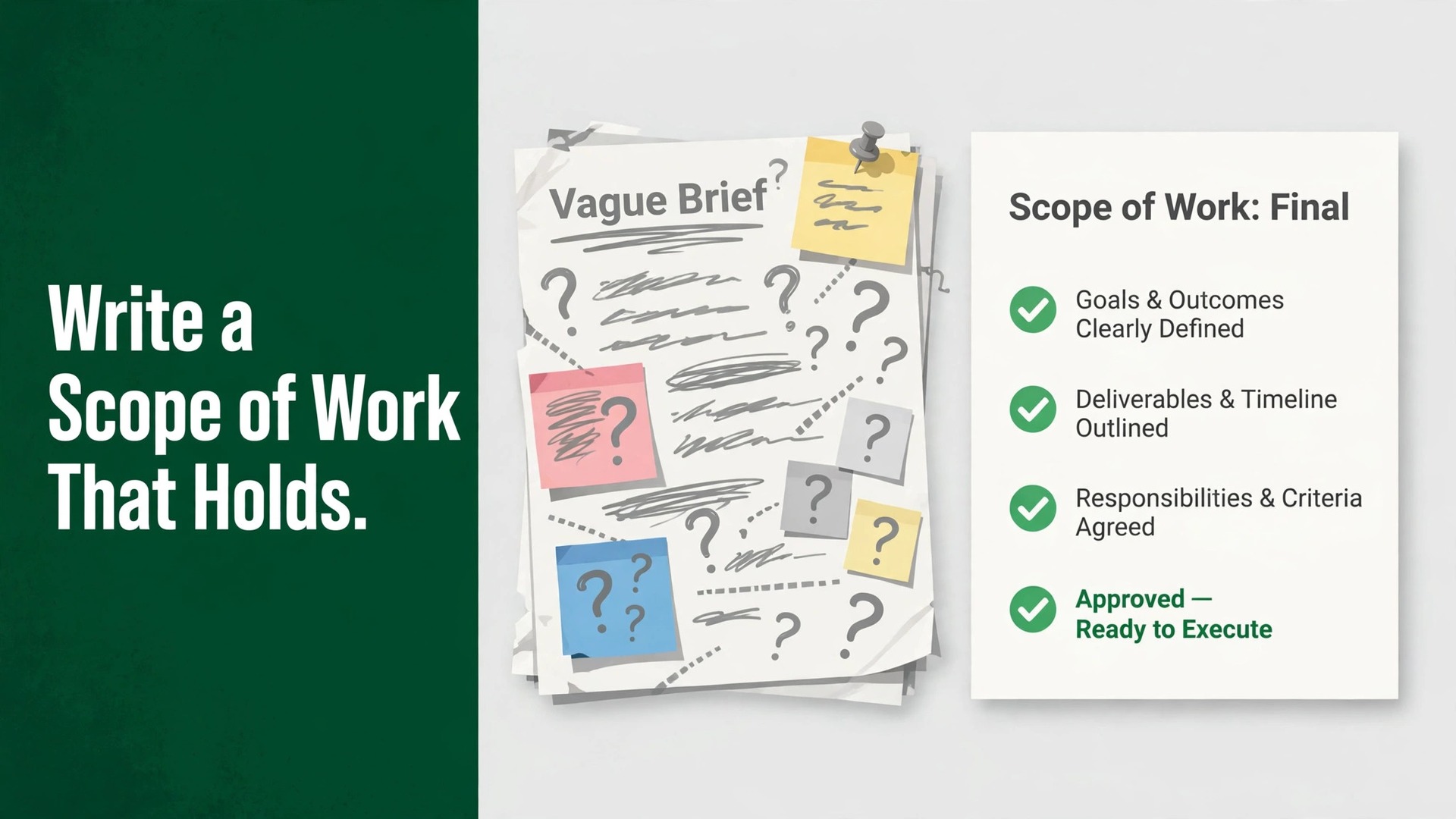
Seven sections decide whether a project runs smoothly or drifts into unpaid extra work. Deliverables, exclusions, timeline, price, revisions, change process, and sign off sound like paperwork, but together they answer the only questions that cause most project disputes, which are what is included, what is not included, when it is due, what it costs, and what happens when someone asks for more. This guide explains how to write a scope of work small business owners can use on real projects, with a template structure you can copy, adapt, and send with confidence.
A scope of work is not a proposal, and it should not read like one. A proposal sells the outcome and persuades the client to choose you. A scope defines the boundary and protects both sides once the client has chosen you. The two documents can live in the same file, but they must not be the same paragraphs, because persuasive language creates the very ambiguity a scope exists to remove. Words like comprehensive, full support, and ongoing help belong in marketing, not in a boundary document, unless they are defined with numbers, dates, and limits.
The test for every sentence in a scope is simple. Can a stranger read it and tell exactly what is included, what is excluded, and what happens when someone asks for more? If the answer is no, the sentence needs a number, a date, a name, or a limit. “A website” fails that test. “Seven pages, which are home, about, services, contact, blog index, and two post templates, delivered as a live site with mobile responsive layout” passes it, because it can be counted, checked, and signed off. That level of precision is the whole job of a scope, and it takes less time to write than the arguments a vague scope creates later.
How to Write a Scope of Work Small Business Owners Start With Deliverables
Start with deliverables, because everything else in the document hangs off that list. Translate the client conversation into counted outcomes, each with a format, a quantity, and a delivery method. Instead of writing content, write eight posts, each between 800 and 1,000 words, delivered as documents for review, then published on the client site after approval. Instead of writing design, write a logo in two file formats, a colour guide with named values, and a one page usage note. Numbers are enforceable. Adjectives are not, and a client who later claims a deliverable was missing will be answered by the list itself, not by memory.

Give every deliverable an owner and a due date where the project allows it, and separate your deliverables from the client deliverables. Client inputs, such as copy, photos, approvals, and access, are part of the scope too, because a project that waits for client material is a project whose timeline has already moved. State what the client must provide, by when, and in what form, and state what happens to the timeline if it arrives late. A simple line that the timeline moves by the same number of business days as a late input prevents the most common timeline argument, which is a client who supplied material late and still expects the original date.
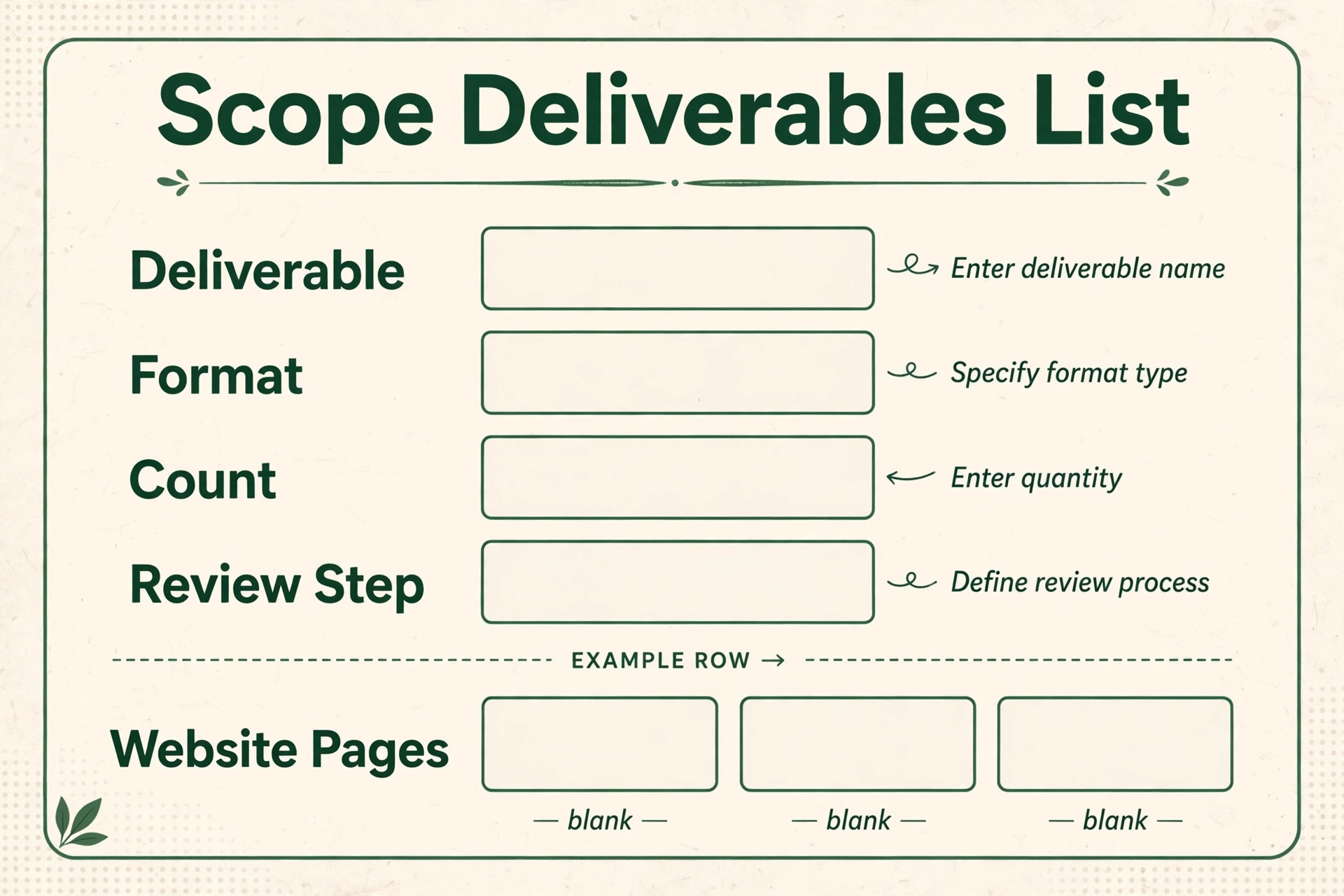
Use the deliverables list to test the rest of the document as you write it. Every exclusion should name something a reader might assume is a deliverable. Every milestone should group deliverables that are finished together. Every revision round should apply to named deliverables, not to the project in general. When those links are visible, the scope reads as one coherent agreement rather than a set of disconnected clauses, and the client can sign it with genuine understanding instead of vague trust. That understanding is a practical part of how to write a scope of work small business clients actually read and follow.
Exclusions That Prevent Most Scope Arguments
Exclusions are the section most owners skip, and practitioner guides consistently call them the most valuable section, because if something is not excluded, a client can reasonably assume it is included. Write exclusions by asking what a client in this project is likely to assume, then naming those items plainly. Common examples include copywriting where only design is included, photography where only layout is included, third party licence fees, ongoing maintenance after handover, and training beyond a stated session. Your list should be specific to the project, not a generic paragraph copied from another scope, because generic exclusions are easy to miss and hard to defend.
Phrase exclusions as facts, not as warnings. “Copywriting is not included” is clear. “Anything not listed is not included” is also useful as a closing line, but it should never replace the named list, because a client cannot reasonably be expected to guess every item you had in mind. Name the top five to eight likely assumptions for the project, then add the closing line as a safety net. That combination covers the predictable misunderstandings and the unpredictable ones, without turning the scope into a long legal document that no client will read.
Exclusions also protect the client, not just you. A client who knows at the start that maintenance is excluded can budget for it, choose a maintenance option, or arrange another provider, rather than discovering the gap at handover when it is too late to plan. Present exclusions in that spirit, during the conversation as well as in the document, by walking through them briefly before asking for a signature. A client who has heard the exclusions explained is far less likely to dispute them later than a client who only saw them buried on page three.
Review exclusions after every project, and add the items that caused friction last time. If a client assumed social captions were included in a design project, add social captions to the exclusion list for the next similar project. If a client assumed two rounds of revisions meant unlimited small changes, add a definition of a revision round to the revision section. A scope template that learns from real projects becomes stronger with each use, and after a few projects it will cover most assumptions before they are even raised. That learning habit is a key part of how to write a scope of work small business owners improve over time.

Milestones, Timeline, and Dependencies Written Honestly
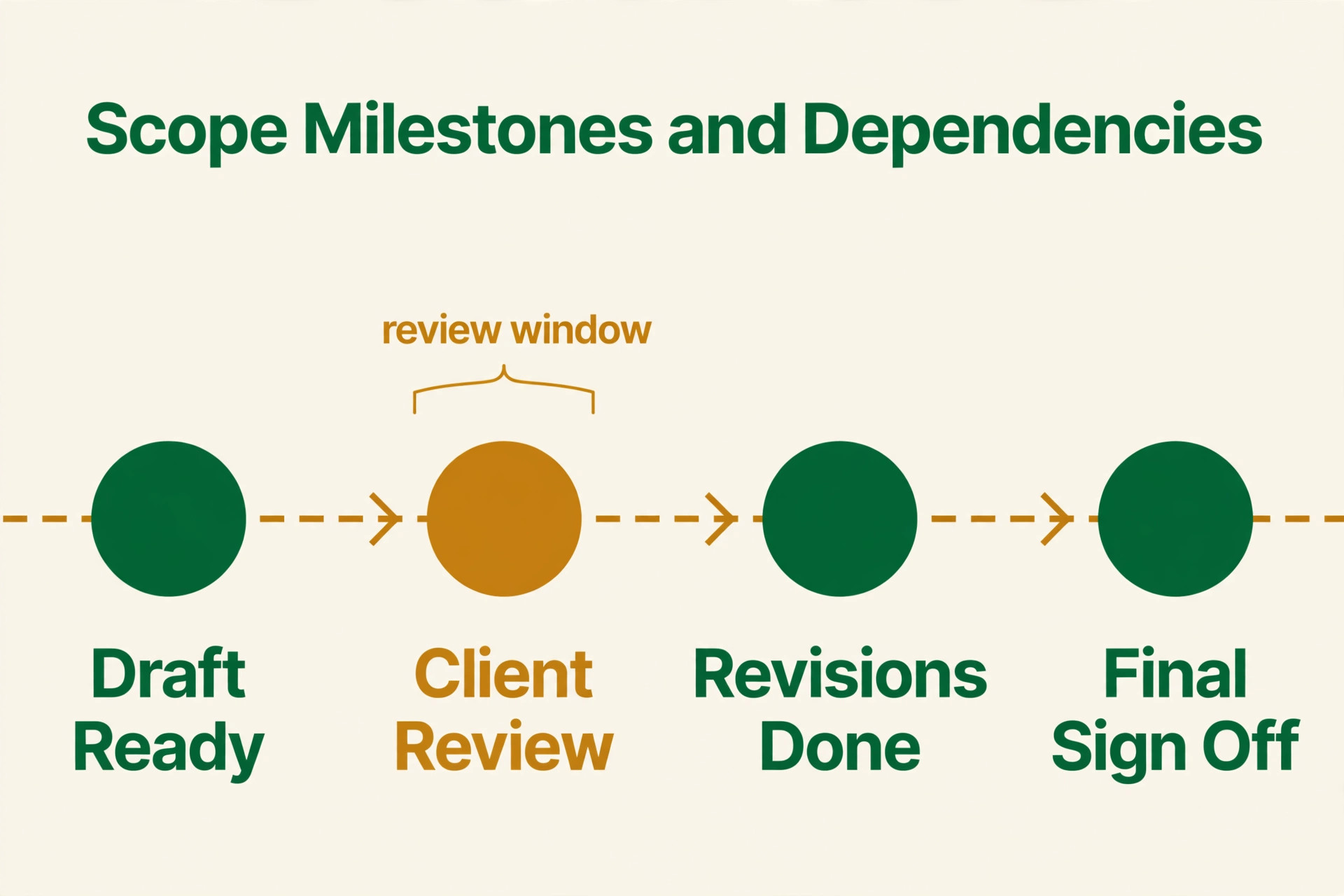
A timeline without dependencies is a promise you cannot keep on your own, because most project delays come from inputs, approvals, or third parties outside your control. Write milestones as groups of deliverables with a target date, and write the dependency beside each milestone in plain language. For example, a first draft milestone can state that it assumes feedback within three business days, and that a later feedback date moves the next milestone by the same delay. That sentence turns a delay into a documented consequence, rather than a favour you are doing or a failure you must explain.
Keep milestones few and meaningful. Three to five milestones suit most small business projects, because each milestone should represent a point where the client can see real progress and where payment can sensibly be tied to delivery. Too many milestones create approval bottlenecks, where the project waits for sign off on small pieces. Too few milestones leave the client uncertain for weeks and leave you without a payment point if the project stalls. Tie each milestone to a deliverable group, a review window, and a payment amount where payment is staged, so progress, approval, and money move together.
State the review window for each milestone, and state who approves it. A project with three stakeholders who each hold a veto has effectively unlimited revisions, even when the scope says two rounds, because each stakeholder can restart the round. Name one approver, or a small approval group that returns consolidated feedback, and state that feedback after the window counts as a new round or a change request. That rule sounds strict, but it protects the client schedule as well, because consolidated feedback produces a cleaner next draft than a trickle of messages over two weeks.
Build a small buffer into the timeline, and say so honestly, rather than promising the earliest possible date and then missing it. Clients prefer a realistic date met on time to an optimistic date missed by a week, and a scope that meets its dates builds the trust that makes the next project easier to sell. If a date depends on a third party, such as a platform approval or a supplier delivery, name that dependency, so a delay from that source is understood as a shared risk, not as your failure to plan.
Price, Payment Schedule, and What Counts as Extra
Price in a scope should be a total, a schedule, and a rule for extra work, not just a single number. State the total fee, what it covers by reference to the deliverables list, the deposit or first payment and its due date, and each later payment tied to a milestone or a date. A common small business pattern is a deposit before work begins and a balance before final delivery, with staged projects using milestone payments instead, but the exact pattern matters less than its clarity.
A client should be able to read the payment section and know, without asking, how much is due, when, and for what. That clear schedule is a key part of how to write a scope of work small business owners can enforce.
Define extra work in the same section, with a simple change process that is followed every time. Additional work is quoted separately, approved in writing, and billed at an agreed rate or as a fixed quote, before the work starts. That one process converts most scope arguments into a form, because the question changes from whether extra work is fair to whether it was quoted and approved. Keep a running log of change requests, with the request, the quote, the approval, and the effect on timeline, so the final invoice never contains a surprise. A change log also helps you price future projects, because it shows which extras recur and should be included or priced differently next time.
Be careful with taxes, third party costs, and expenses, because those are frequent sources of invoice surprise. State whether the total includes or excludes taxes as local rules require, list third party costs that are passed through at cost or with a stated markup, and state any expense policy for travel or materials. If a cost is an estimate rather than a fixed figure, say so, and state the cap or the approval step that applies before it is incurred. Clients accept pass through costs they were told about. They dispute pass through costs they first meet on an invoice.
Payment terms should also state what happens on late payment, in plain language consistent with your agreement and local rules. A simple statement that work pauses if a milestone payment is overdue by a stated period, and resumes on payment, is clearer and fairer than a vague threat, and it protects the project from drifting into debt. Keep the tone businesslike, not punitive, because payment terms are part of the client experience, and a scope that reads as hostile will cost you projects that a clear, calm scope would have won.
Revision Limits That Clients Can Actually Follow
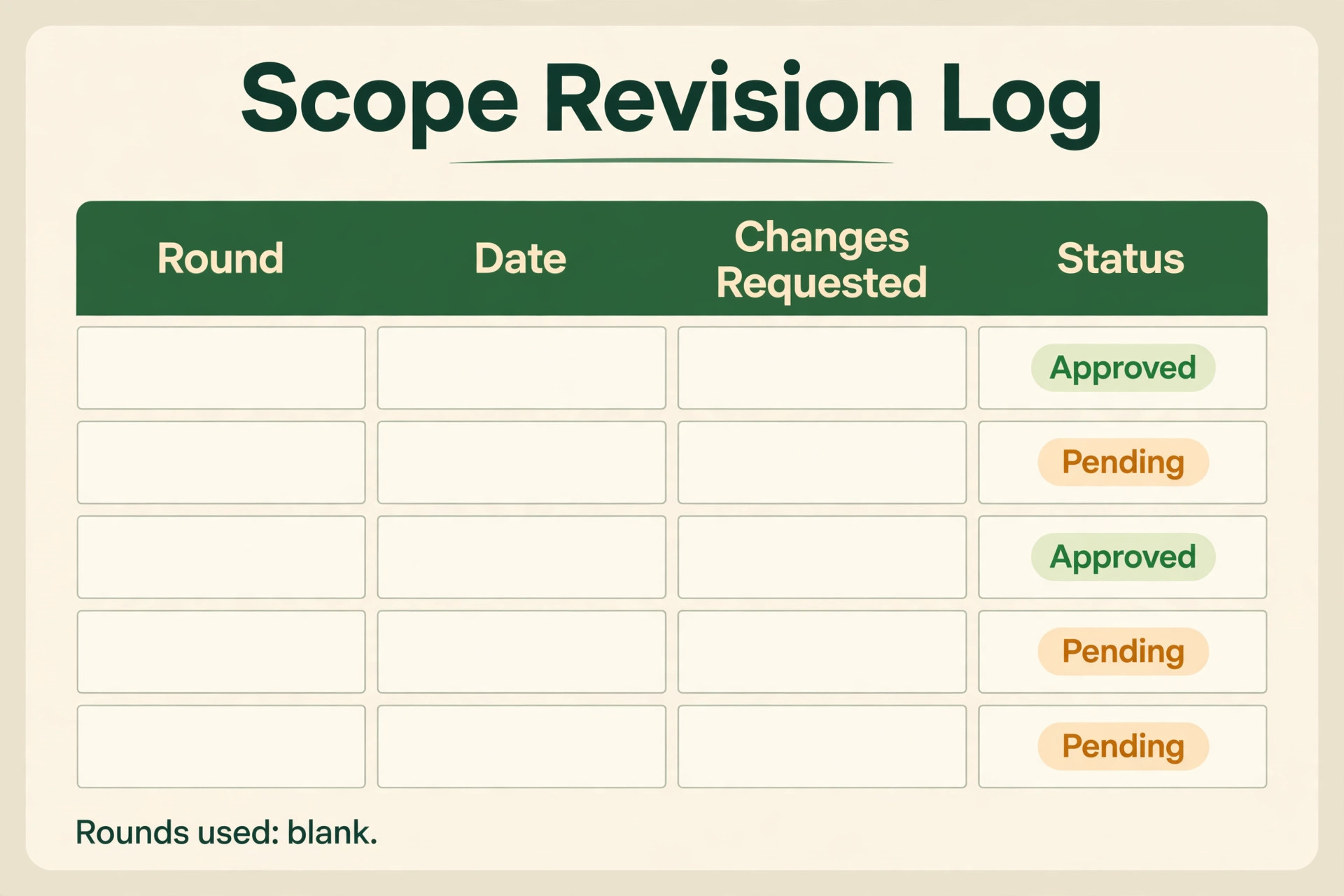
Revision limits only protect you if the client understands what a round means, how it is counted, and what happens after the included rounds are used. Define a round as one set of consolidated feedback, returned by the stated approver within the stated window, covering the named deliverables. State how many rounds are included, commonly one or two for small business projects, and state that additional rounds are billed as extra work under the change process.
That definition prevents the common drift where a round becomes a trickle of messages over weeks, each treated as a small tweak rather than a round. That counted log is a core part of how to write a scope of work small business owners should use.
Log each round as it happens, with the date requested, the feedback received, and whether it counts toward the included rounds. Share that log with the client when the included rounds are used, so the next request can be discussed factually. A message that states this was round two of two, and that further rounds are handled as additional work, is far easier to send when the log supports it, and far easier for the client to accept. Without a log, the same message feels like an opinion, and opinions about revisions are where scope relationships break down.
Distinguish revisions from corrections and from new work, because clients reasonably expect errors you made to be fixed without counting against their rounds. State that corrections to deliverables that do not match the agreed scope are fixed at no charge, while changes of direction, new content, or additions beyond the scope count as a round or as extra work. That distinction is fair, it builds trust, and it prevents the revision limit from feeling like a trap. When you do make an error, fix it promptly and note it as a correction, not as a round, because that honesty makes the limit credible when it is later applied to genuine changes.
Give clients a good revision process, not just a limit. Ask for consolidated feedback in one document or message, with changes marked clearly, and give a short guide on how to review a draft, such as checking facts first, then structure, then wording. Clients who know how to give feedback give better feedback, and better feedback means fewer rounds are needed in the first place. A scope that teaches the client how to review well is doing more than protecting you. It is improving the project itself, and that improvement is visible in the quality of the final deliverable.
Sign Off Block That Lets a Project Actually Close
A project without a defined sign off never truly ends, because there is always one more tweak that could be requested, one more file that could be questioned, and one more invoice that could be disputed. Define sign off as a written acceptance that the deliverables listed in the scope have been received and meet the agreed standard, with a date and a name. State the review period for final delivery, for example five business days, after which delivery is treated as accepted if no written issues are raised, where your agreement and local rules allow that treatment. That rule gives the client a fair window to check the work, and gives you a clear close.
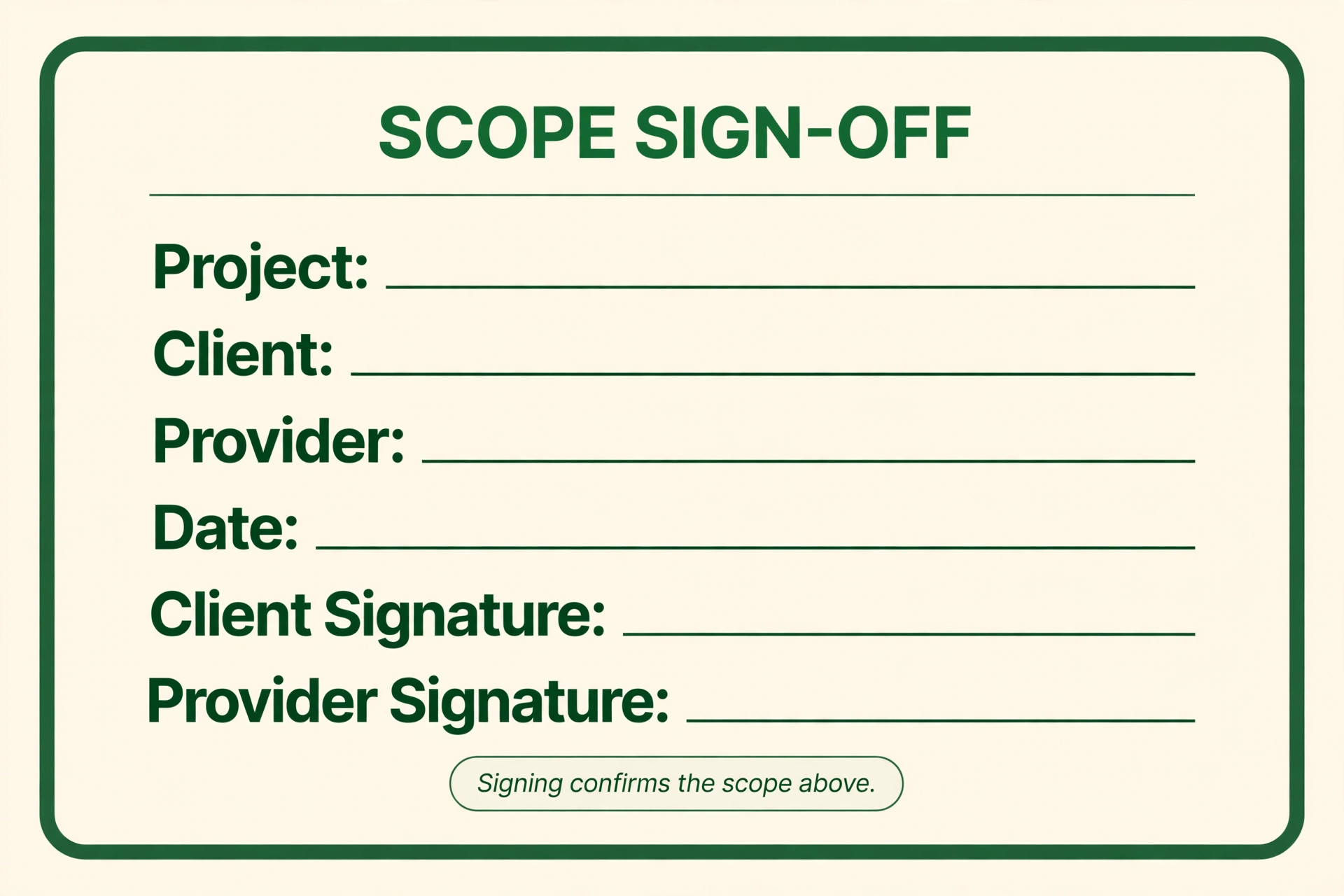
The sign off block itself should be short and placed at the end of the scope, where it is easy to find and sign. It should name the project, the parties, the total fee, the deliverables accepted, and the date, with a signature line for each party. For email based scopes, a written reply confirming acceptance can serve the same purpose, provided the reply clearly states that the scope is accepted as written. Keep the signed scope, or the acceptance reply, with the project file, together with the change log and the final invoice, so the close of the project is documented as clearly as its start.
Sign off should also cover handover and support, because those are the items most often assumed after a project closes. State what files will be handed over, in what format, and by when, and state what support is included after handover, for example a short period for fixing errors in the delivered work, and what support is excluded or available as a separate service. A client who knows the support window at the start will use it well. A client who discovers it at the end will feel that support was withdrawn, even when the scope always intended that limit.
Use sign off as a learning moment as well. After the client signs, note what was easy to agree, what needed explanation, and what caused friction, and update your template accordingly. A scope that is signed quickly and without confusion is a sales asset, because it signals a business that is organised, transparent, and easy to work with. A scope that causes a long negotiation every time is a signal that the template, not the client, needs work, and that signal is worth acting on before the next project starts.
Scope Template You Can Copy and Adapt
The template below is an original structure you can adapt for each project. Replace the bracketed parts, delete any section that does not apply, and keep the order, because the order helps the client read the document from outcome to boundary to close.
Project summary, one or two sentences on the outcome the project will produce and who it is for. Deliverables, a numbered list of counted outcomes, each with format, quantity, and delivery method. Client inputs, what the client must provide, by when, and in what form. Exclusions, the named items not included, plus a closing line that anything not listed is not included. Milestones and timeline, three to five milestones, each with deliverables, target date, dependency, and review window.
Price and payment, total fee, deposit, milestone payments, tax treatment, third party costs, and late payment handling. Revisions, number of included rounds, definition of a round, correction policy, and billing for additional rounds. Change process, how extra work is quoted, approved in writing, and logged, with its effect on timeline. Support and handover, files, formats, dates, and the support window after delivery. Sign off block, project name, parties, total fee, acceptance statement, date, and signature lines.
Before sending, read the draft scope as a stranger would, and ask three questions. What will the client assume is included that is not written here. What happens if the client changes direction in the middle of the project. If you had to defend the final invoice to a stranger, could you do it from this document alone. If any answer is uncomfortable, that sentence belongs in the exclusions, the change process, or the payment section, and it should be added before sending, not after the problem arises.
That ten minute review is the most valuable step in the whole process, and it is the step most often skipped under deadline pressure. That stranger test is a final part of how to write a scope of work small business owners should never skip.
Send the scope with a short covering note that invites questions and states the next step, such as approval by a stated date so work can start on schedule. Do not send a scope with no covering note and no deadline, because a document without a next step sits unread while the project start slips. When the client returns questions, answer them by updating the scope itself, not only by email, so the signed document reflects the final agreement.
Mistakes That Make a Good Scope Fail
The first mistake is writing the scope as marketing, with persuasive adjectives and vague promises that cannot be counted. A scope that reads like a sales page will be held to its promises, and vague promises are held to the most generous reading, which is rarely yours. The second mistake is skipping exclusions, which leaves the client free to assume the most, and leaves you with no document to point to when the assumption surfaces. The third mistake is leaving revision rounds undefined, which turns a stated limit into an open negotiation in the middle of the project.
The fourth mistake is a timeline with no dependencies, which promises dates that depend on client inputs, approvals, and third parties as if they were entirely within your control. When those dates slip, the scope makes it look like your failure, even when the cause was a late input. The fifth mistake is a price with no change process, which means every extra request becomes a personal negotiation, with all the awkwardness and inconsistency that implies. A written change process removes the personal element, and clients usually prefer a clear process to a case by case argument, even when the process costs them more.
The sixth mistake is never updating the template. A scope written once and reused unchanged will miss the lessons of every project since it was written, and it will keep causing the same friction. Review the template after each project, add the exclusions and definitions that would have prevented the last friction, and remove language that clients consistently misunderstand. A template that improves with use is a business asset. A template that never changes is a record of the first project you wrote it for, and it will fit later projects less well with each use. That habit of updating is a steady part of how to write a scope of work small business owners keep improving.
Scope of Work Checklist
Use this checklist as the overview proof for the whole process, and work through it before sending any scope.
1. List deliverables as counted outcomes, with format, quantity, and delivery method. 2. List client inputs, with due dates, formats, and the timeline effect of late delivery. 3. Name exclusions specific to the project, plus a closing line for anything not listed. 4. Set three to five milestones, each with deliverables, target date, dependency, and review window. 5. State total price, payment schedule, tax treatment, third party costs, and late payment handling. 6. Define revision rounds, count them, and state how additional rounds are billed. 7. Write the change process, with written quote, written approval, and a running change log. 8. Define handover, support window, and what support after handover costs as a separate service. 9. Add the sign off block, with project, parties, total, acceptance statement, date, and signatures. 10. Read the draft as a stranger, and fix any sentence that a stranger could not enforce.
Keep this checklist with your template, and use it as a final review before every send. A scope that passes all ten items is not guaranteed to prevent every dispute, because no document can do that, but it will prevent the common ones, and it will make the uncommon ones far easier to resolve, because both sides can point to the same clear agreement.

Frequently Asked Questions
How long should a scope of work be?
Long enough to define the project clearly, and short enough that the client actually reads it. Most small business scopes fit in two to four pages, with the deliverables, exclusions, milestones, price, revisions, and sign off all covered. If your scope runs much longer, check whether legal clauses, marketing copy, or unrelated terms have crept in, because those belong in separate documents. Clarity matters more than length, and a short scope that is precise beats a long scope that is vague.
Is a scope of work legally binding?
A scope can form part of a binding agreement when it is accepted as part of a contract, but whether a particular document is binding depends on its wording, how it was accepted, and the rules that apply where the parties are based. Treat a scope as a serious business agreement, keep the signed copy or acceptance reply, and take professional advice for large, regulated, or high risk projects, rather than assuming a scope alone covers every legal question. This guide is general business information, not legal advice.
What is the difference between a scope of work and a proposal?
A proposal persuades the client to choose you, by presenting the outcome, the approach, and the value. A scope defines the boundary once the client has chosen you, by listing deliverables, exclusions, milestones, price, revisions, and sign off. The two can live in the same file, but they should be separate sections, because persuasive language in a scope creates ambiguity, and boundary language in a proposal makes the pitch harder to read. Keep each section doing its own job.
How many revision rounds should I include?
One or two rounds suit most small business projects, provided a round is defined as one set of consolidated feedback from the named approver within the stated window. The right number depends on the work, because a design project may need two rounds while a straightforward delivery project may need one. Whatever number you choose, define it, count it, and state how additional rounds are billed, because an undefined limit is no limit at all, no matter how small the number sounds.
What should I do when a client asks for work outside the scope?
Log the request, quote it separately, and get written approval before starting the extra work, following the change process in the scope. State the effect on price and timeline in the quote, so the client can choose with full information. Do not start the extra work on a verbal promise, and do not quietly absorb it, because both habits teach the client that the scope does not hold. A calm, written change process keeps the relationship professional and the project profitable.
Can I reuse the same scope template for every client?
Reuse the structure, not the details. A good template keeps the section order, the definitions, and the checklist stable, while the deliverables, exclusions, milestones, price, and dates change for each project. Copying a previous client scope without updating those details is a common source of errors, because a deliverable or exclusion from the last project can slip into the next one unnoticed. Update the template from each project, and review the draft as a stranger before sending.
The Verdict on Writing a Scope That Holds
A scope of work is the cheapest dispute prevention a small business can buy, because it costs an hour of careful writing and saves weeks of argument, unpaid work, and damaged relationships. Count the deliverables, name the exclusions, tie milestones to dependencies, price with a change process, define revision rounds, and close with a sign off block that lets the project end cleanly. That structure is how to write a scope of work small business owners can send with confidence, because it answers the questions that cause disputes before those questions are asked.
Start with your template, update it after every project, and review each draft as a stranger before sending. Clients respect a scope that is clear, because clarity signals a business that knows its work, its limits, and its price. That respect, earned before the project starts, carries through the project itself, and it is the reason a well written scope is not paperwork. It is a sales asset, a delivery plan, and a protection for both sides, all in one short document.
More Reading on Stratilyze
– Best Quote Software for Trades Businesses – Best Project Management Software for Construction Teams – Best CRM Software for Consultants – Automate Small Business with AI