

The verdict is blunt. If your price is built from the wage you want to earn, it is too low. A trades price must carry loaded labour, materials, overhead and profit, in that order, and most underpricing comes from leaving one of those out. This guide shows how to set service prices trades business owners can sustain, using one formula, tested on a half day job and a full day job, so every quote after this one starts from arithmetic instead of instinct.
Underpricing rarely announces itself. The diary looks full, customers seem happy, and the bank balance rises after a busy week, yet the business slowly falls behind because unpaid owner time, vehicle costs, insurance, quoting time and callbacks were never in the price. The owner then works longer to cover the gap, which creates more unpaid time, which widens the gap again. Breaking that cycle starts with a formula that counts everything, even the costs that do not appear on a job sheet.
Before you price anything, gather four inputs. Your loaded hourly labour cost, meaning wage plus taxes, benefits, insurance and non billable time. Your materials cost at supplier prices, with waste and sourcing time included. Your overhead rate, meaning fixed business costs spread across billable hours or jobs. Your target margin, meaning profit as a share of the final price, not as a markup on cost. With those four inputs, pricing becomes a calculation you can repeat, defend and adjust, and this guide walks through it step by step.
How to Set Service Prices Trades Business Owners Can Build From a Formula
The method runs from true hourly cost to the margin formula, then worked prices, then rate structures, quoting discipline, and a profitability check. Each step uses the previous one. The true hourly cost tells you what an hour of work really costs. The formula turns that cost plus materials and overhead into a price. The worked examples show the formula on a half day and a full day job. The later sections show how to present, defend and review that price without giving margin away.
The core formula is simple. Job cost equals labour plus materials plus overhead. Price equals job cost divided by one minus target margin. That division matters, because margin and markup are not the same number. A 20 percent markup on cost gives a 16.7 percent margin on price, while a 20 percent margin on price needs a 25 percent markup on cost. Owners who add a percentage to cost while thinking in margin terms underprice every job by that gap, and the gap compounds across a year of quotes. Divide for margin, multiply only if you deliberately mean markup, and state which one you used in your own notes.
Work the formula with your own numbers, not with numbers copied from a guide. Labour rates, material prices, vehicle costs and insurance vary widely by trade and town, and a formula filled with someone else numbers produces someone else price. The worked examples below are ILLUSTRATIVE only, using round example figures to show the arithmetic, not claims about market rates. Local rates vary, so check local competitors and build from your own costs before quoting. The formula is the transferable part. The example figures are not.
| Formula part | What it includes | Common error |
|---|---|---|
| Labour | Loaded hourly cost times hours on the job | Using take home wage instead of loaded cost |
| Materials | Supplier price plus waste, delivery and sourcing time | Forgetting small items, fixings and consumables |
| Overhead | Share of fixed business costs per job or per hour | Leaving overhead out entirely, or double counting it |
| Margin | Profit as a share of final price | Confusing margin with markup on cost |

Find Your True Hourly Cost Before You Quote
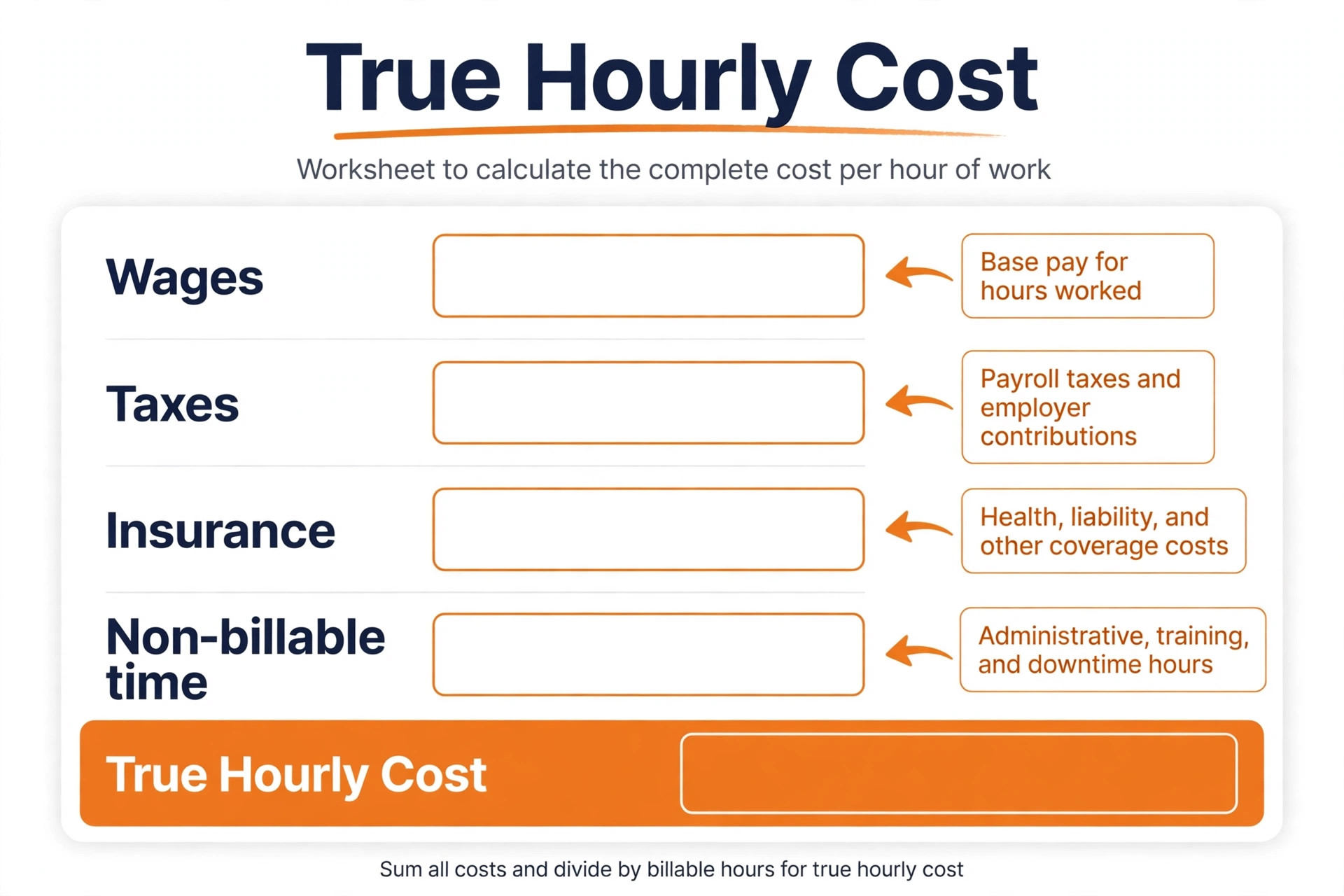
Your true hourly cost is the foundation of every price, and it is almost always higher than owners expect. Start with the wage, then add payroll taxes and benefits, workers compensation or equivalent insurance, training time, sick time, and the paid time spent quoting, travelling, loading, and handling callbacks. That total is the loaded labour cost per hour worked, and it is the figure that belongs in the formula. Quoting from the wage alone is the single most common reason trades businesses look busy and earn little.
Next, count billable hours honestly, not calendar hours. A tradesperson rarely bills 40 hours a week, because travel, quoting, admin, downtime and callbacks all consume time that no customer pays for directly. Many owners find their realistic billable total sits around 25 to 30 hours a week, or roughly 1,200 to 1,500 hours a year, once holidays and non billable work are counted. Dividing target income plus overhead by realistic billable hours, rather than by 2,080 calendar hours, gives a rate the business can actually live on. That honesty is uncomfortable and necessary.
Add overhead as a rate per hour or per job, and choose one method consistently. The hourly method divides monthly fixed costs, such as vehicle payments, fuel, insurance, phone, software, marketing, accounting and tool replacement, by monthly billable hours. The per job method divides annual overhead by expected annual jobs. Either method works if applied consistently, but mixing them double counts overhead and inflates prices, while applying neither leaves overhead to be paid from profit. Pick one method, write it down, and use it on every quote until your costs or volume change materially.
Test the hourly cost against a real month before publishing rates. Take last month jobs, apply the loaded rate to hours worked, add materials and overhead, and compare the total with what was charged. If charges sit below that total on several jobs, those jobs lost money even when cash flow looked healthy, because the shortfall was covered by unpaid owner time or deferred costs. That test shows exactly which job types need a price rise, and gives you evidence to make that rise without guilt. A price rise backed by cost data is a business decision, not a gamble, and it is the first practical step in learning how to set service prices trades business owners can defend.
The Margin Formula, Worked Without Mystery
Margin is profit as a share of the final price. Markup is profit as a share of cost. The distinction is worth learning properly, because it decides whether your target profit actually arrives. On a job costing 1,000 dollars, a 20 percent markup gives a 1,200 dollar price and 200 dollars profit, which is 16.7 percent of price. A 20 percent margin on the same job gives a 1,250 dollar price, because 1,000 divided by 0.80 equals 1,250, and 250 dollars profit is 20 percent of price. Same job, same cost, different price, different profit, and the difference is purely the maths.
Choose a target margin deliberately, and write it down. Published trade pricing guides commonly describe healthy net margins around 15 to 25 percent for many trades, with higher figures for specialist, emergency, or high demand work, and lower figures for large commercial work where volume compensates. Those ranges are a sanity check, not a prescription for your trade or town. A business with high overhead, expensive insurance, or costly callbacks needs a higher margin to survive than a low overhead solo operator, and a business in a competitive market may need efficiency gains before it can hold its target margin. Set the margin from your costs and goals, then test it against local prices.
Apply the formula in the same order every time. First, add labour at loaded cost, materials at supplier price plus waste and sourcing, and overhead at your chosen rate. That sum is job cost. Second, divide job cost by one minus target margin to get price before tax. Third, round the price sensibly for presentation, and check that rounding did not quietly cut margin below target on a small job. Fourth, compare the result with local competitor prices and with what the customer receives, such as warranty, response time, and workmanship quality, and adjust scope or efficiency before adjusting margin. Cutting margin to win a job should be a conscious exception, not a habit.
Keep markup and margin separate in your quoting notes, even if customers only ever see the final price. Note the job cost, the target margin, and the resulting price on every quote, so a later review can see whether margin was held or given away. That record is also what makes annual rate reviews honest, because it shows whether rising costs were passed through, absorbed, or offset by efficiency. A business that tracks margin per job can raise prices selectively, while a business that only tracks revenue must guess. That record keeping is part of how to set service prices trades business owners keep honest over years, not just on one quote.

Worked Illustrative Prices for a Half Day Job and a Full Day Job
The examples below are ILLUSTRATIVE only, using round example figures to demonstrate the formula. They are not market rates, and local rates vary with wages, material prices, overhead and competition. Readers should replace every example figure with their own loaded labour cost, supplier material prices, overhead rate and target margin before quoting. The arithmetic is the lesson. The figures are placeholders.
For the half day job, assume four hours of labour at an illustrative loaded cost of 50 dollars per hour, which gives 200 dollars of labour. Assume materials of 150 dollars, including fixings and consumables, and overhead of 100 dollars for the half day share. Job cost is therefore 450 dollars. At an illustrative target margin of 20 percent, price equals 450 divided by 0.80, which is 562.50 dollars before tax, rounded sensibly to 565 dollars for presentation. At a 25 percent markup instead, price would be 562.50 dollars as well in this rounding, but the margin maths differs, so always state which method you used in your notes and check the resulting margin, not just the price.
For the full day job, assume eight hours of labour at the same illustrative loaded cost of 50 dollars per hour, which gives 400 dollars of labour. Assume materials of 400 dollars, including larger items and waste allowance, and overhead of 200 dollars for the full day share. Job cost is therefore 1,000 dollars. At the same illustrative target margin of 20 percent, price equals 1,000 divided by 0.80, which is 1,250 dollars before tax. The full day job earns 250 dollars of profit at that margin, against 112.50 dollars on the half day job at the same margin, which shows why margin, not just daily revenue, should guide which jobs to prioritise.
Compare the two examples to see what the formula protects. Both jobs use the same labour rate, the same overhead method, and the same target margin, so both earn the same margin percentage even though their prices differ greatly. A business that prices by instinct often earns a healthy margin on large jobs and a thin or negative margin on small jobs, because small job overhead and travel are forgotten. The formula prevents that drift, because overhead and margin are applied to every job, large or small, in the same way. Consistency is the protection, and it is why owners learning how to set service prices trades business quotes need should start with the formula, not with a competitor price.
| Illustrative example | Labour plus materials plus overhead | Job cost | Price at 20 percent margin |
|---|---|---|---|
| Half day job, 4 hours | 200 plus 150 plus 100 dollars | 450 dollars | 562.50 dollars before tax |
| Full day job, 8 hours | 400 plus 400 plus 200 dollars | 1,000 dollars | 1,250 dollars before tax |
| Half day job, material heavy variant | 200 plus 300 plus 100 dollars | 600 dollars | 750 dollars before tax |
| Full day job, labour heavy variant | 600 plus 200 plus 200 dollars | 1,000 dollars | 1,250 dollars before tax |

Choose a Rate Structure That Fits the Work
Rate structures package the formula for different job types, and choosing the right one prevents the most common quoting errors. Day rate pricing suits work where the scope is a block of time, such as a full day of general repairs, because the customer buys a day of skilled labour plus materials. Job rate pricing suits defined work, such as installing a named item or completing a listed repair, because the customer buys an outcome, not hours. Hourly rate pricing suits diagnostic, investigative, or uncertain work, where time cannot be known in advance. Use the structure that matches what the customer is actually buying.
Set a minimum charge for small jobs, and state it clearly. A one hour repair that involves travel, diagnosis, setup, parts sourcing and invoicing can cost the business several hours of paid time, even when the repair itself takes one hour. A minimum charge, such as a call out fee plus the first hour, or a fixed small job rate, protects those jobs and discourages bookings that cost more to serve than they earn. Customers generally accept a minimum when it is explained as covering travel, diagnosis and setup, rather than presented as an arbitrary fee.
Price materials with a transparent method, and apply it consistently. Some trades add a handling percentage to supplier prices to cover sourcing, storage, waste and warranty on materials, while others charge materials at cost and recover handling through overhead. Either method works if the total price still carries margin, but mixing methods across quotes creates inconsistency and hidden losses. State on the quote whether materials are charged at supplier price plus handling, or at a listed price, and keep a simple material price list for common items so quotes do not depend on memory.
Handle variations and extras in writing, before the work is done. A customer who adds a task mid job, changes a material choice, or reveals hidden damage that changes the scope should receive a written variation price before that extra work proceeds, even when the variation is small. Verbal extras are the most common source of payment disputes in trades work, because both sides remember a different version of what was agreed. A short written variation, with price and scope, protects the customer from surprise and protects the business from unpaid work. Written variations are an underrated part of how to set service prices trades business owners actually collect in full.
Quoting Discipline That Protects Margin After the Price Is Set
A good price can still be lost by a weak quote process, so treat quoting as part of pricing, not as admin after pricing. Visit or inspect where the job depends on site conditions, because hidden damage, access problems, awkward layouts and existing poor workmanship all change time and materials. Where a visit is not possible, use a detailed questionnaire with photos, and state clearly that the price is subject to confirmation on site. A quote built on accurate site information holds up, while a quote built on a phone description often does not.
Write quotes with scope, materials, exclusions, warranty, payment terms and validity period all stated. Scope states what is included. Exclusions state what is not, such as decorating after repair, waste removal beyond a stated amount, or work on unrelated systems. Warranty states what is covered and for how long, in plain terms. Payment terms state deposit, stage payments and final payment timing. Validity period states how long the price holds, which protects the business when material prices move. A quote missing any of those invites a dispute that costs more than the time saved by writing a short quote.
Follow up quotes promptly and professionally, without discounting by default. A follow up call or message that asks whether the scope is clear, whether the timing works, and whether any questions remain often wins the job without a price cut, because it shows reliability. Discounting on follow up teaches customers that the first price was inflated, and it trains the business to start high and cut, which erodes trust and margin together. If a discount is genuinely needed to win a valuable job, give it as a scope change, such as a reduced warranty period or a customer supplied material, rather than as a silent margin cut.
Track quote conversion and margin together, not conversion alone. A high conversion rate with thin margins means prices are too low, while a low conversion rate with healthy margins may mean prices are too high, the scope is unclear, or the follow up is weak. Review both numbers monthly, by job type, and adjust the factor the data points to, rather than cutting prices across the board because conversion dipped. That disciplined review is what turns quoting from a guessing game into a managed process.

Common Pricing Mistakes That Quietly Erase Profit
The most common mistake is pricing from take home wage instead of loaded cost, which underprices every job by taxes, insurance, training and non billable time. The second mistake is confusing markup with margin, which underprices every job by the gap between the two percentages. The third mistake is forgetting overhead, travel, quoting time and callbacks, which turns profit into a fund for unpaid work. Any one of those mistakes alone can erase a healthy margin. Together, they explain why many busy trades businesses struggle despite full diaries.
Another costly mistake is pricing to match the cheapest competitor without knowing whether that competitor is profitable. A competitor may be new and underpricing to win work, may have lower overhead, may be cutting corners on warranty or insurance, or may simply be losing money. Matching that price without matching those conditions imports their problem into your business. Compete on scope, reliability, warranty and communication where you are stronger, and let price reflect the full service, not just the headline labour hour.
A related mistake is giving margin away in small, unrecorded ways. A free extra task here, a waived call out fee there, a material upgrade absorbed without a variation, and a discount to close a sale each seem small alone, but together they can cut annual profit by a large amount. Record every discount, waiver and free extra on the job sheet, and review them monthly. Visibility alone usually reduces them, because owners stop giving away margin they can see, and start charging properly for extras they used to absorb silently.
The final mistake is freezing prices while costs rise. Wages, fuel, insurance, materials and software all move over time, and a price set two years ago quietly becomes unprofitable as each cost climbs. Review rates at least annually, using the same formula with updated inputs, and communicate rises with scope and cost explanations, plus a validity period on new quotes. Regular small rises are easier for customers and healthier for the business than a large rise after years of frozen prices, which feels like a shock even when it only restores the original margin. Annual reviews are the habit that keeps owners who learn how to set service prices trades business rates need from slowly pricing themselves out of profit.
How to Prove Your Prices Stay Profitable
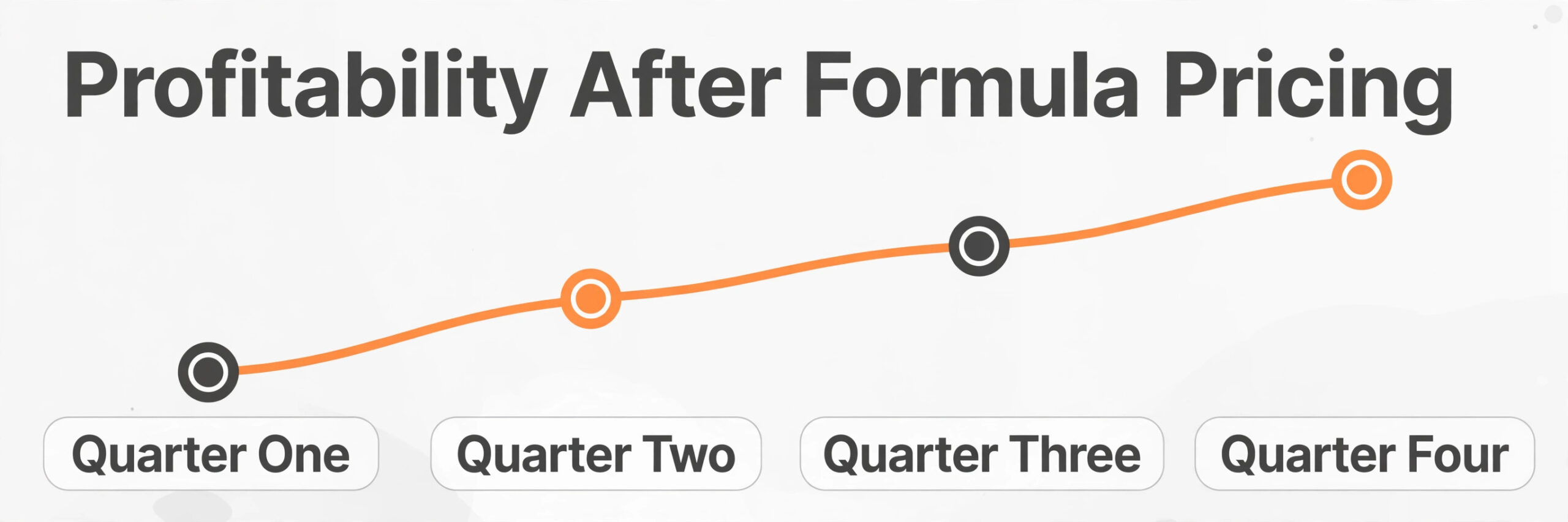
A price is only proven profitable by tracking actual cost and margin per job over weeks, not by a single good month. Track labour hours at loaded cost, materials at actual supplier cost, overhead share, variations, callbacks, and final price for each job, and calculate margin per job. A job type that consistently earns below target margin needs a price rise, a scope change, or an efficiency improvement, while a job type that consistently beats target may have room for a competitive adjustment. That tracking is the proof pricing works, and it is the data for the next round of quotes.
Review profitability by job type and by customer segment, not just overall. Small repair jobs, large installation jobs, emergency call outs and contract maintenance each have different time, travel, material and callback patterns, so a blended average can hide a loss making segment behind a profitable one. If emergency work is profitable but small repairs are not, that finding should change the minimum charge, the call out fee, or the marketing focus, rather than prompting a blanket price rise that damages profitable work too. Segment data makes sharper decisions than overall revenue alone.
Watch for quiet margin erosion that never appears as a single large loss. A supplier price creeping up without a quote update, a route gradually lengthening, a callback rate rising on one job type, or a team member gradually adding unpaid extras can each erode margin slightly per job, adding up to a large loss over a year. Review supplier prices, routes, callback rates and variation records quarterly, and treat a gradual rise in cost per job as a pricing event. Small quarterly corrections prevent large crisis corrections, and they keep the formula honest.
The Pricing Verdict for Trades Businesses
Profitable trades prices are calculated, not guessed. Find the loaded labour cost, count realistic billable hours, add materials and overhead consistently, and divide by one minus target margin to get price. Test the result on a half day and a full day job, check it against local competitors, and quote it in writing with scope, exclusions, warranty and payment terms stated. That method is how to set service prices trades business owners can sustain, because it protects margin on small jobs as well as large ones.
Start with true hourly cost, apply the formula the same way every time, and review rates annually and costs quarterly. Record discounts and variations, track margin per job, and let segment data guide the next adjustment. Done that way, pricing becomes a routine that supports growth, rather than a guess that undermines it, and a full diary finally means a profitable business, not just a busy one.

Frequently Asked Questions
Should I price trades work by the hour, by the day, or by the job?
Use the structure that matches what the customer is buying. Hourly pricing suits diagnostic or uncertain work where time cannot be known in advance. Day rate pricing suits a block of general work. Job rate pricing suits defined work with a clear outcome, such as installing a named item. Many businesses use all three, choosing per job, and stating scope and exclusions clearly whichever structure applies.
What is the difference between markup and margin?
Markup is profit as a share of cost, while margin is profit as a share of final price, and confusing them underprices work. On a 1,000 dollar job cost, a 20 percent markup gives a 1,200 dollar price and 16.7 percent margin, while a 20 percent margin gives a 1,250 dollar price, because 1,000 divided by 0.80 equals 1,250. To hit a target margin, divide cost by one minus margin, and record which method you used on every quote.
How do I calculate overhead for a trades business?
Add up monthly fixed costs, such as vehicle payments, fuel, insurance, phone, software, marketing, accounting and tool replacement, then divide by monthly billable hours for an hourly overhead rate, or by expected annual jobs for a per job rate. Use one method consistently on every quote, and update it when costs or volume change materially. Overhead left out of the price is paid from profit, which means it is paid by the owner. Getting overhead right is a core step in how to set service prices trades business owners calculate, because it is the cost most often forgotten entirely.
Should I charge a call out fee or a minimum charge?
Yes, for small jobs, because travel, diagnosis, setup, parts sourcing and invoicing can cost several hours of paid time even when the repair itself takes one hour. A call out fee plus the first hour, or a fixed small job rate, protects those jobs and discourages bookings that cost more to serve than they earn. Explain it as covering travel, diagnosis and setup, and customers generally accept it as fair.
How often should I raise my trades prices?
Review rates at least annually, using the same formula with updated labour, material and overhead inputs, and review supplier prices and callback rates quarterly. Give customers notice, explain what changed in scope or costs, and offer a scope choice where possible. Regular small rises tied to costs are easier to accept than a large rise after years of frozen prices, which feels like a shock even when it only restores the original margin.
What should I do if a customer says my quote is too high?
Explain what the quote covers, including loaded labour, materials, overhead, warranty, and the defined scope, and offer a choice rather than a silent discount. A reduced scope, a customer supplied material, or a different timing option lets the customer control cost without forcing the business below its margin. If the customer still wants a price below your cost floor, declining that job protects the business for customers who value the full service.
More Reading on Stratilyze
– Best Website Builder for Tradespeople – Best Quote Software for Trades Businesses – Best Estimating Software for Contractors – Best Field Service Management Software for Electricians