
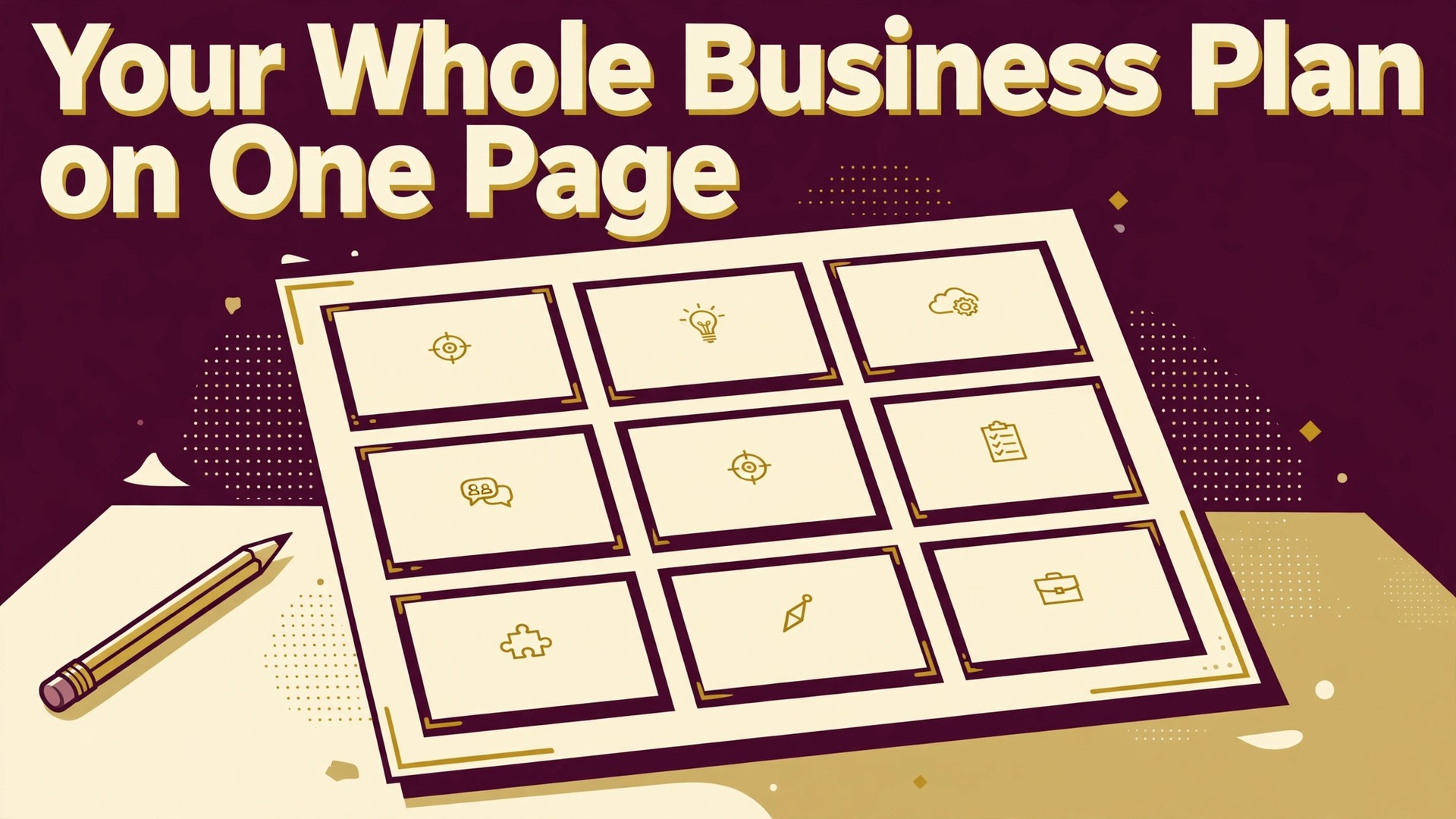
Most small business plans fail before anyone reads them, because they are written as fifty page documents that nobody opens twice. The owner knows the business in their head, the document sits in a folder, and decisions keep getting made from memory instead of from a plan. This guide shows how to write a business plan one page small business owners can actually finish, use, and update, with nine short sections, a numbers block that fits in a table, a milestone row, and a pitch version you can speak aloud.
A one page plan is not a shorter version of a bank plan. It is a different tool for a different job. A full plan exists to persuade a lender or investor with detailed forecasts and appendices. A one page plan exists to keep the owner honest about customers, costs, and next steps, and to give a partner, employee, or adviser the whole business on a single sheet. If you need funding from a lender, you will likely need the longer document too, and the one page version becomes the outline that makes writing it far easier. If you need clarity for yourself, the one page version is the whole job.
The discipline of one page is the point. A page forces choices. You cannot list twelve target markets, eight channels, and twenty features on one page without the page becoming unreadable, so you must pick the first market, the first channel, and the core offer. Those picks are the strategy, and writing them down exposes gaps that a long document hides. A vague customer becomes visible when you must name them in one line. A missing price becomes visible when the numbers block demands it. A plan with no next step becomes visible when the milestone row stays blank.
How to Write a Business Plan One Page Small Business Owners Can Finish in an Afternoon
Set aside ninety minutes, gather your real numbers, and fill the sections in a strict order. Customer first, then problem, then solution, then market, then channels, then money, then milestones, then team. That order prevents the classic error of designing a product before naming who will pay for it. Work on paper or in a simple document, not in a design tool, because formatting too early slows thinking. You can make it look tidy after the words are right.
Write in short phrases, not paragraphs. Each section gets two to four lines, and each line must earn its place by changing a decision. A line that only sounds impressive gets deleted. A line with a number, a name, or a date stays, because numbers, names, and dates are what make a plan testable. If a section cannot be written in four lines, the thinking behind it is not finished yet, and that is useful information, not a failure. Note the gap, move on, and return to it after the easier sections are done.
Keep two versions of the page from the start. The working version holds your honest notes, including assumptions marked as assumptions and risks stated plainly. The sharing version holds the same content cleaned up for a partner, adviser, or lender, with assumptions still labelled but phrased professionally. Never share a version that presents guesses as facts, because a single discovered guess damages the credibility of the whole page. Honesty about what you do not know yet is a strength in a plan, not a weakness, provided the page also says how you will learn it.

Start With the Customer, Not the Product
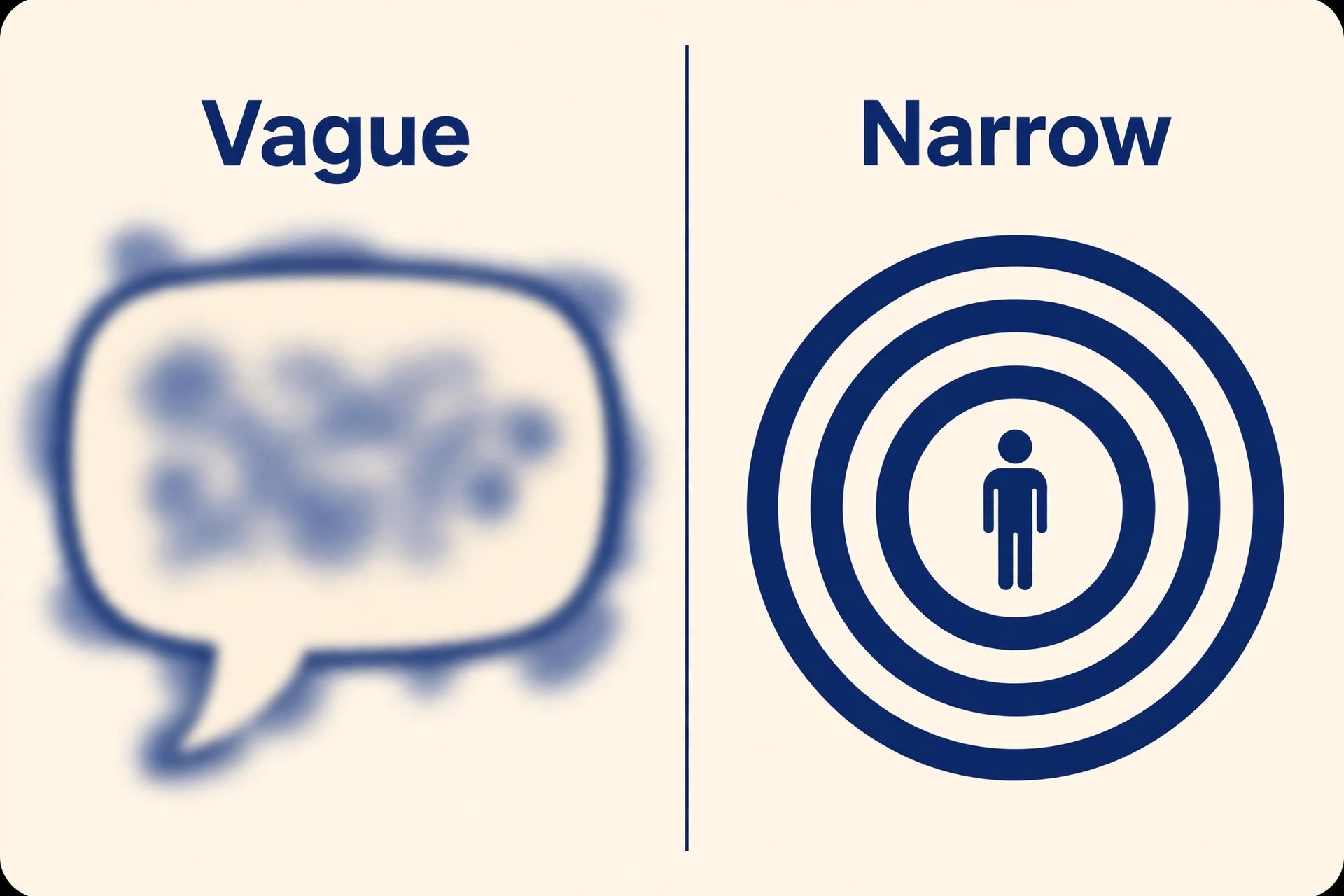
Name the first narrow group you intend to serve, in one line that a stranger could act on. Independent accountants managing more than twenty monthly clients is a usable customer line. Small businesses is not, because it names everyone and therefore no one. Include the situation that makes them relevant, such as a trade, a location, a life stage, or a recurring task they already pay for. The narrower the first group, the easier it is to reach them, serve them well, and learn from them. You can widen later from a position of proof, but widening first only dilutes the message.
Describe the customer problem as an observed event with a frequency and a consequence. What happens today, how often does it happen, what does it cost in time or money, and what do customers currently use instead. A problem connected to observed behaviour is credible. A problem stated as a general frustration is not. Talk to at least five people in the target group before finalising this section, and write down their exact words where possible, because customer language makes the solution section far easier to write and far more persuasive to readers.
State the solution as the smallest version that delivers the central outcome, not as the product you might build in five years. Describe what a customer could realistically try first, what result they get, and what they pay for it. Then state the value proposition in one sentence, which is why a customer would choose this option over the current alternative. Focus on a valuable improvement, such as less time, lower risk, better access, higher revenue, or a noticeably easier experience. If the value proposition needs a paragraph, it is not finished yet. Cut it until it fits one sentence that a customer would recognise as true.
That customer first order is the habit at the centre of how to write a business plan one page small business owners can defend in a conversation. When a reader challenges any later section, the answer should trace back to a named customer and an observed problem, not to enthusiasm for the product. If it cannot, the challenged section needs rewriting, not defending.
The Market and the Competition
Market analysis on one page means three facts and one judgement. The facts are who the customers are, how they currently solve the problem, and how many of them you can realistically reach in your first year through your chosen channels. The judgement is whether that reachable group is large enough to support the business at your planned price. Avoid grand market size claims copied from reports about a whole industry, because a global or national total says nothing about your reachable customers. A small, reachable, well defined market beats a huge, unreachable one every time.
List direct competitors and existing alternatives separately. Direct competitors sell a similar offer to the same customers. Existing alternatives include the spreadsheet, the manual workaround, the generalist provider, and doing nothing, which is often the strongest competitor of all. For each one, note a strength and a weakness in plain language, and then state your competitive advantage as a specific difference customers will notice, not as a claim to be better in general. A difference in speed, specialisation, price structure, or service model is testable. A claim to higher quality is not, because every competitor claims it.
Be honest about what competitors do better. Market honesty is part of how to write a business plan one page small business owners can trust, because a reader who spots one flattering exaggeration will doubt the numbers too. A page that claims superiority on every point reads as naive to any experienced reader, and it hides the real strategic question, which is where you will win and where you will deliberately not compete. Choosing not to compete on a dimension is a valid strategy, provided the page says so and explains what you offer instead. That honesty also protects the owner, because it prevents spending scarce resources trying to beat a competitor on their strongest ground.
How Customers Find You and How You Earn
Channels on one page means one or two realistic routes to the first customers, not a list of every platform that exists. Channel choice is where how to write a business plan one page small business owners often go wrong, by listing everything instead of choosing. Search, partnerships, direct outreach, communities, marketplaces, referrals, local presence, and existing audiences each require different messages and different economics, so pick the channels that match where your named customers already look. A trade business whose customers ask peers for recommendations needs a referral and local presence plan, not a viral social plan. An online service whose customers search for a solution needs a search and content plan, not a trade show plan.
Revenue on one page means who pays, what they pay for, and whether revenue is one time, recurring, usage based, or project based. Add a price or a price range only where you have evidence, and label it as an assumption to test where you do not. State the pricing test plainly where the price is unproven, such as offering a small set of price points to a set number of prospects and recording conversion by price. A price presented as a guess dressed as a fact will mislead every later calculation on the page, so the label matters more than the number.
Costs on one page mean the fixed costs that run every month and the variable costs tied to each sale, in two short lines. Fixed costs include rent, software, insurance, and any salaries that do not vary with sales. Variable costs include materials, payment fees, delivery, and contractor time per job. Keep the cost lines short but complete enough that the numbers block can be built from them without inventing a new figure. If a major cost is missing from this section, the numbers block will look profitable while the business loses money, which is the most dangerous kind of plan error.
The Numbers Block
The numbers block is the section readers trust most and owners fear most, because it turns words into arithmetic. Keep it to six numbers and one break even line, all in a small table on the page. The six numbers are starting costs, monthly fixed costs, price per sale, variable cost per sale, sales needed per month to cover fixed costs, and cash available at start.
The break even line states how many sales per month cover costs at the planned price, and how that compares with realistic channel capacity. If the required sales exceed what your channels can plausibly deliver, the plan has a problem that must be fixed by changing price, costs, or channels, not by hoping for better luck.
Worked planning examples make the block concrete. The figures here are illustrative planning examples for a fictional service business, not market claims, and you should replace them with your own numbers. Suppose a bookkeeping service charges 200 currency units per client per month, with a variable cost of 40 units per client for software and review time, leaving 160 units per client. If monthly fixed costs are 3,200 units, the service needs twenty clients to break even.
If the owner starts with eight clients and can realistically add two per month through referrals, break even arrives in about six months, provided no clients leave. That single paragraph of arithmetic tells the owner more than a page of optimism, because it sets a hiring, spending, and marketing timeline tied to a real number.
State funding needs and uses in two lines where funding is needed. How much is needed, what it will be spent on, and what happens if only part of it is raised. A funding line that says only a total, with no uses, invites the obvious question and wastes the reader trust the rest of the page built. A funding line that allocates the money to specific uses, such as equipment, initial stock, or six months of fixed costs, shows the owner has thought past the raise to the spending. If no funding is needed, say so in one line, because a plan that omits funding entirely leaves readers guessing whether it was forgotten or genuinely unnecessary.
The numbers habit is what separates how to write a business plan one page small business owners can use from how to write a page that only looks like a plan. A page without numbers is a pitch. A page with a break even line is a management tool, because it gives the owner a monthly target to check against reality.

The One Page Template
Use this template as the overview proof for this guide. The template is the practical core of how to write a business plan one page small business owners can finish without a consultant, because it turns a blank page into twelve small decisions. Copy the sections into a document, fill each one in order, and keep the whole page to a single sheet when printed. The template works for service and product businesses alike, with the numbers block adapted to your cost structure.

| Section | What to write | Test it passes |
|---|---|---|
| Identity | Business name, offer in one sentence, owner and legal shape | A stranger understands what you sell |
| Target customer | First narrow group plus the situation that makes them relevant | You could list ten real examples |
| Problem | Observed event, frequency, consequence, current alternative | Five customers would recognise it |
| Solution | Smallest first version, result for the customer, price or price test | A customer could try it now |
| Market and competition | Reachable customers, direct rivals, alternatives, your difference | You name where you will not compete |
| Channels | One or two routes to first customers, with the message for each | Each channel matches where customers look |
| Revenue and costs | Who pays, price basis, fixed and variable costs in short lines | Numbers block can be built from them |
| Numbers block | Starting costs, fixed costs, price, variable cost, break even sales, cash at start | Break even is within channel capacity |
| Milestone row | Three dated milestones with a number and an owner for each | Each milestone is checkable on its date |
| Team and partners | Key roles, gaps, partners and resources you depend on | Gaps are named, not hidden |
| Pitch version | A sixty second spoken version of the page, written out | You can say it without notes |
| Review cadence | Monthly check date, quarterly rewrite date, named reviewer | Dates are in a calendar, not just on the page |
Write the milestone row with numbers and dates, not aspirations. A milestone that says grow the business is not a milestone. A milestone that says reach twenty paying clients by a specific date, with the owner named, is checkable on that date and forces a decision if it is missed. Set three milestones, one for three months, one for six months, and one for twelve months, covering customers, revenue, and a capability such as a channel or a hire. Three milestones keep the page focused. Ten milestones turn it into a project plan that nobody reviews.

Write the pitch version last, in spoken language, and test it aloud. Sixty seconds is enough for the customer, the problem, the solution, the price basis, and the next step you want from the listener, such as a trial, a referral, or a meeting. If the pitch runs longer, cut the market section first, because listeners care about the customer and the offer before they care about market context. A pitch that cannot be spoken without notes is a pitch that will not be used, and a plan that is not used is decoration.
Worked Example. A Page Filled In
A filled example shows how short the finished page really is. The business below is a fictional illustration, with illustrative figures, included so you can see the level of detail each section needs. Replace every line with your own facts before using the template.
Identity. A mobile bookkeeping service for independent tradespeople, run by a sole owner. Target customer. Plumbing, electrical, and building firms with one to five staff in one county, where the owner still does paperwork in the evening. Problem. Owners spend several evenings a month on invoices and receipts, fall behind on tax records, and discover cash problems only when a bill arrives. Current alternatives are a general accountant visited once a year, a spreadsheet updated irregularly, or nothing at all.
Solution. A monthly service that collects invoices and receipts by phone photo, reconciles them weekly, and sends a one page cash summary every month. Price test. Two price points offered to twenty prospects, with conversion recorded by price, before a single price is fixed. Market and competition. Reachable customers are the trades firms in the county that already pay for at least one business service. Direct rivals are local bookkeepers with office hours. The difference is a mobile, trade focused service with weekly reconciliation instead of annual catch up.
Channels. Referrals from trade suppliers and a local trade association, plus a simple search page answering the exact questions owners ask about receipts and tax. Revenue and costs. Monthly recurring revenue per client, with variable cost per client for software and review time, and fixed costs for insurance, software, and transport. Numbers block. Starting costs, monthly fixed costs, price per client, variable cost per client, break even client count, and cash at start, all in one small table. Milestones.
Ten paying clients by month three, twenty by month six, and a part time assistant by month twelve, each with the owner named. Team. Owner plus a bookkeeper reviewer on call, with a gap noted for marketing help. Pitch version. A sixty second spoken version covering the customer, the problem, the service, and the next step, which is a free trial month for one firm. Review cadence. Numbers checked monthly, page rewritten quarterly, with a mentor as reviewer.
Notice what the example leaves out. No market size claim, no five year forecast, no feature list, and no claim to beat every competitor. Every line names a customer, a number, a channel, or a date, which is why the page fits on one sheet and why it can be checked. Your page should pass the same test. If a line cannot be checked, questioned, or acted on, it probably does not belong there yet.
Review Cadence That Keeps the Page Alive
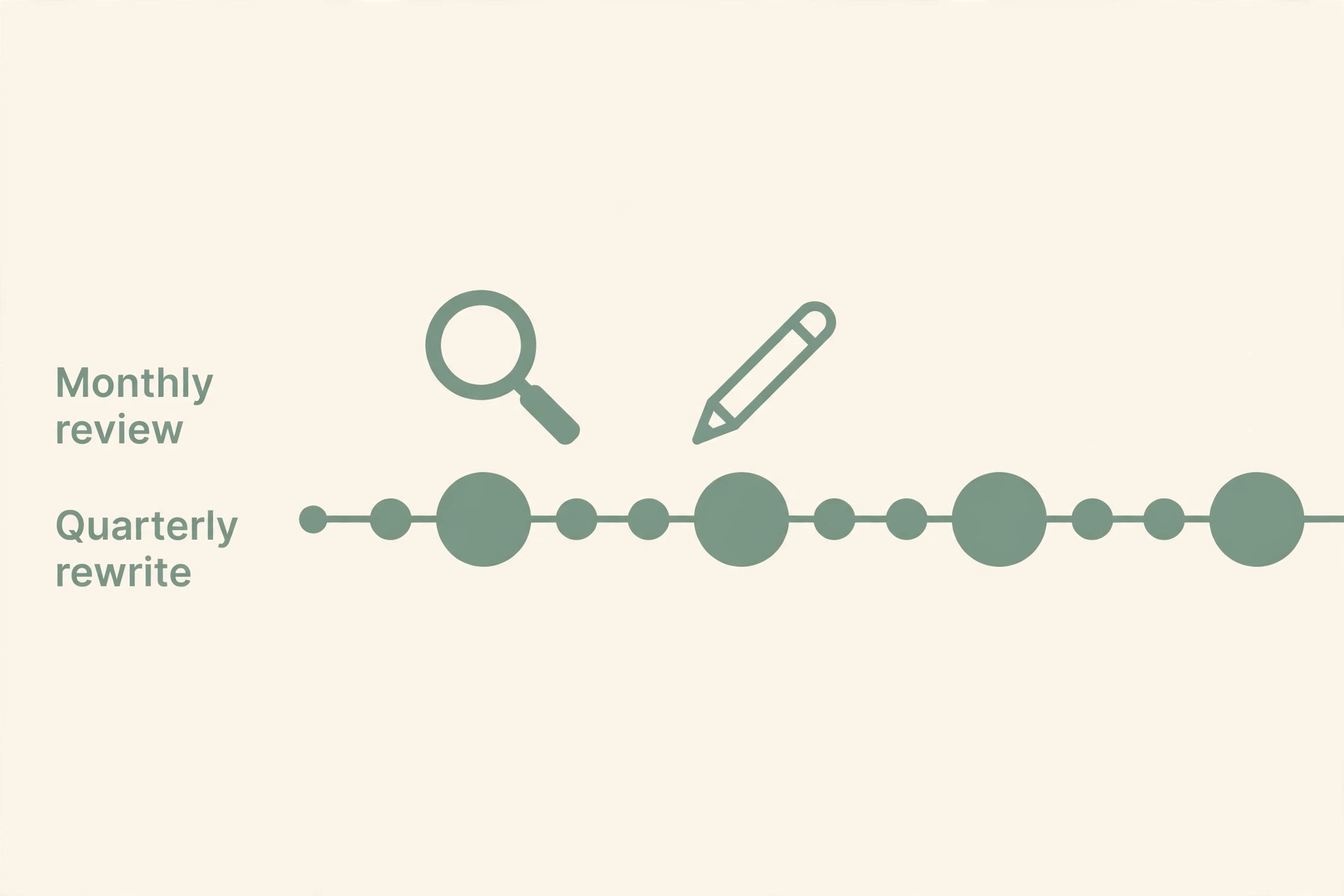
A one page plan dies when it is written once and filed. Set a review cadence before you finish the first draft, and put the dates in a calendar. Review the numbers monthly, comparing actual sales, costs, and client counts with the numbers block, and note the variance in one line on the page. Rewrite the page quarterly, updating the customer, channel, and milestone sections from what you actually learned. A quarterly rewrite takes an hour once the habit exists, and it keeps the page aligned with reality instead of with the optimism of launch week.

Assign a reviewer even if you run the business alone. The reviewer can be a bookkeeper, a mentor, a business partner, or a peer owner who reads the updated page and asks two questions. What changed since last quarter, and what will you stop doing because of it. Those two questions prevent the common failure where a plan accumulates new ideas without ever removing old ones. A page that only grows is a page that has stopped making choices, and choices are the whole purpose of the exercise.
Treat a missed milestone as information, not as a verdict on the business. If a milestone is missed, the review should decide among three responses. Change the milestone date with a stated reason, change the approach while keeping the target, or change the target because the original assumption was wrong. Each response is legitimate, but only if it is chosen deliberately and written on the page. Silently ignoring a missed milestone teaches the owner that the plan does not matter, and the next plan will be ignored even faster.
The review habit is the quiet half of how to write a business plan one page small business owners return to. A beautiful first draft that is never reviewed is worth less than a plain draft that is updated every quarter, because the updated draft reflects a business that has learned something.
Mistakes That Quietly Ruin One Page Plans
The pattern behind most failures in how to write a business plan one page small business owners abandon starts with the first mistake, which is writing for an imagined reader instead of for yourself. Plans written to impress a lender with grand language and huge market claims usually fail both audiences, because lenders see through them and owners cannot use them. Write the working version for yourself first, in plain language, with assumptions labelled. Then adapt a sharing version from it, without changing the numbers or hiding the gaps. A plan that is useful to the owner is usually persuasive to a reader, because it shows a mind that has made real choices.
The second mistake is a missing price. A plan without a price cannot produce a break even line, cannot set a sales target, and cannot judge whether a channel is worth its cost. If the price is genuinely unknown, the plan must contain a pricing test with a deadline, not a blank space. A blank price is a postponed decision, and postponed pricing decisions usually get made under pressure from the first customer who asks, which is the worst time to set a price.
The third mistake is too many priorities. A page that lists five target markets, six channels, and eight milestones has not made a strategy. It has listed options. Cut until the page holds one first market, one or two channels, and three milestones, and move the other options to a separate ideas list for later quarters. Saying no on paper is easier than saying no to a real opportunity later, and the discipline of the page is exactly that practice.
The fourth mistake is confusing a plan with a forecast. A forecast predicts the future with false precision, such as revenue to the nearest unit three years out. A one page plan states current beliefs, labels assumptions, sets checkable milestones, and updates quarterly. Precision beyond what the evidence supports does not make a plan stronger. It makes it brittle, because the first variance discredits the whole document. Round numbers, state ranges where honest, and let the quarterly review replace guesses with evidence.
The One Page Verdict for a Small Business
A one page business plan earns its place when it fits on a single sheet, names a real customer, states a real problem, offers a testable solution, shows a break even line, and carries three dated milestones with a review cadence. That page will not impress anyone who wants fifty pages of appendices, and it is not meant to. It is meant to be opened weekly, updated quarterly, and quoted in decisions, which is more than most long plans ever achieve.
Start this week with ninety minutes and the template above. Fill the sections in order, mark every assumption, run the numbers block with your own costs, and set the first review date before you close the document. Then speak the pitch version aloud to one person in your target group and watch what confuses them. Fix that confusion on the page, not in your head. Done that way, a single page becomes the most used document in the business, because it is short enough to read, honest enough to trust, and alive enough to stay true.
Frequently Asked Questions
How long should each section of a one page business plan be?
Two to four short lines per section, written in phrases rather than paragraphs. A section that needs more space usually means the thinking behind it is not finished, so note the gap and return to it after the easier sections are done. The whole plan must fit on one printed page, which forces the choices that make the plan a strategy rather than a list.
Can a one page plan replace a full business plan for a bank loan?
Usually not on its own, because lenders typically expect detailed forecasts, financial statements, and supporting documents. The one page plan still helps enormously, because it becomes the outline for the longer document and forces the core choices to be made first. Write the one page version, then expand each section with the detail the lender requires, keeping the numbers consistent between both versions.
What if I do not know my price yet?
Put a pricing test in the plan instead of a blank space or a guessed price. State the price points you will offer, the number of prospects you will test them with, and the date by which you will record conversion by price. A test with a deadline is a plan. A blank price is a postponed decision that usually gets made under pressure from the first customer who asks.
How often should a one page business plan be updated?
Review the numbers monthly against actual sales, costs, and client counts, and rewrite the page quarterly from what you actually learned. Put both dates in a calendar when you finish the first draft, and assign a reviewer, even if you run the business alone, to ask what changed and what you will stop doing. A plan that is never reviewed quickly becomes decoration.
Should a one page plan include competitors I cannot beat?
Yes, and it should name where competitors are stronger and where you will deliberately not compete. A page that claims superiority on every point reads as naive to experienced readers and hides the real strategic choice. Naming a competitor strength and your different ground for winning shows judgement, and it prevents spending scarce resources on a contest you are unlikely to win.
What makes a milestone useful on a one page plan?
A useful milestone has a number, a date, and a named owner, so it can be checked on its date without debate. Reach twenty paying clients by a specific date is a milestone. Grow the business is not. Set three milestones, for three, six, and twelve months, covering customers, revenue, and a capability, and decide deliberately what to do when one is missed.
More Reading on Stratilyze
– Best CRM Software for Consultants – Best Accounting Software for Restaurants – How to Automate a Small Business with AI – Best Customer Feedback Software for Small Business