
Verdict first: AI can help you finish a book, but it cannot decide what your book should say, and that decision is the book. If you want to learn how to write a book with AI, start from that verdict and work backwards. A finished manuscript comes from a clear promise to a specific reader, a structure that carries that promise from first chapter to last, and a drafting habit that survives busy weeks and low motivation days. AI accelerates research, outlining, first drafts, and revision checks, and it can be an excellent sounding board for structure and clarity.
What it cannot replace is your experience, your point of view, your stories told with permission and accuracy, and your judgment about what belongs in the book and what should be cut. Writers who understand that split finish books. Writers who ask AI to invent the book for them end up with long, smooth, forgettable manuscripts that no reader finishes.
This guide covers fiction and nonfiction, because the core process is shared even though the details differ. You will choose a book idea that can sustain 40,000 to 80,000 words, build an outline that prevents mid book collapse, draft in a system that protects your voice, revise in layers rather than endless tinkering, and prepare a manuscript for self publishing or for submission to agents and publishers. It also covers originality, fact checking, copyright and disclosure questions you should understand before you publish, and the tools that actually help at each stage.
The verdict in practice: what AI should and should not do in how to write a book with AI
Use AI for speed and structure, not for authorship of ideas you have not thought through. Good uses include: turning your notes into a chapter outline, summarising research sources you have read, generating alternative chapter titles and openings for you to choose from and rewrite, drafting a rough section from your detailed outline and examples, checking a chapter for repetition, gaps, and unclear transitions, and helping you test whether your argument or plot holds together. In each case, you supply the idea, the evidence, or the story, and AI helps you shape and expand it faster.
Poor uses include: asking AI to invent a book concept from nothing and then writing whatever it suggests, pasting AI output as final prose without rewriting, inventing quotes, case studies, statistics, or historical details, and using AI to mimic another author’s distinctive voice or to reproduce copyrighted text. Those shortcuts create three risks. First, quality risk: generic prose that readers abandon.
Second, accuracy risk: invented facts that damage credibility, especially in nonfiction. Third, rights and disclosure risk: publishers, readers, and platforms increasingly expect transparency about AI use, and undisclosed, unchecked AI content can create problems after publication. Keep a simple record of how you used AI in your process, so you can answer questions honestly if an agent, publisher, or reader asks.
Your voice is also a practical asset, not just an artistic one. Readers follow a voice they recognise: your sentence rhythm, your examples, your way of explaining a difficult idea, your humour or seriousness. AI output tends toward a middle, neutral voice that sounds competent and forgettable. Protect your voice by drafting key sections yourself first, even roughly, before asking AI for help.
Write the opening of each chapter in your own words, write the core argument or scene from your notes, and only then use AI to expand, tighten, or check. That order matters. If AI drafts first, you will spend revision time trying to sound like yourself again. If you draft first, AI helps you sound more like yourself, more clearly.
Choose a book idea that can last 200 pages
A book idea needs three qualities: a clear reader, a clear promise, and enough material to sustain length without repetition. For nonfiction, the promise might be: “After reading this book, a small business owner will be able to set prices, find clients, and manage cash flow with confidence.” For fiction, the promise might be: “A reader who loves slow, character driven mystery will follow a reluctant investigator through a small town secret that changes how she sees her own family.” If you cannot state the reader and the promise in one or two sentences, the idea is not ready for outlining.
It may be a good article idea, but a book needs a larger question or journey that unfolds over chapters.
Test the idea before you commit months to it. Write a one page book proposal for yourself: reader, promise, why you are the right person to write it, competing books and how yours differs, and a chapter list with one sentence per chapter. Then write the first chapter, or the first three chapters for fiction, and read them after a week away. Do you still care about the question?
Can you see the next five chapters clearly? Can you name ten specific examples, stories, or scenes that belong in the book, not just general topics? If the answer is no, revise the idea or choose a narrower version. Narrow books finish. Vague books stall at chapter four, where the initial excitement runs out and structure must carry you.
Research the market honestly, but do not let market research kill a good idea. Look at competing books, read their tables of contents and reviews, and note what readers praise and complain about. Complaints are valuable: readers often ask for more examples, clearer steps, deeper stories, or a different angle. Your book can answer those gaps, provided you have the material to do so.
For nonfiction, also list your sources and experts early. A book built on interviews, case material you have permission to use, and primary sources will be stronger and easier to revise than a book built only on general knowledge. For fiction, list your story world rules, character motivations, and central conflict early, because those decisions prevent plot contradictions later.
Consider length and format early, but do not obsess over word counts at the idea stage. A practical nonfiction book might be 40,000 to 60,000 words. A novel is often 70,000 to 90,000 words, with genre variation. A memoir or narrative nonfiction book sits between those ranges depending on scope. Choose a target range, then design chapters to fit it: for example, twelve chapters of about 4,000 words each for a 48,000 word nonfiction book. That simple math turns a large goal into weekly drafting targets, which is essential for finishing.

Outline before you draft: the structure that prevents collapse
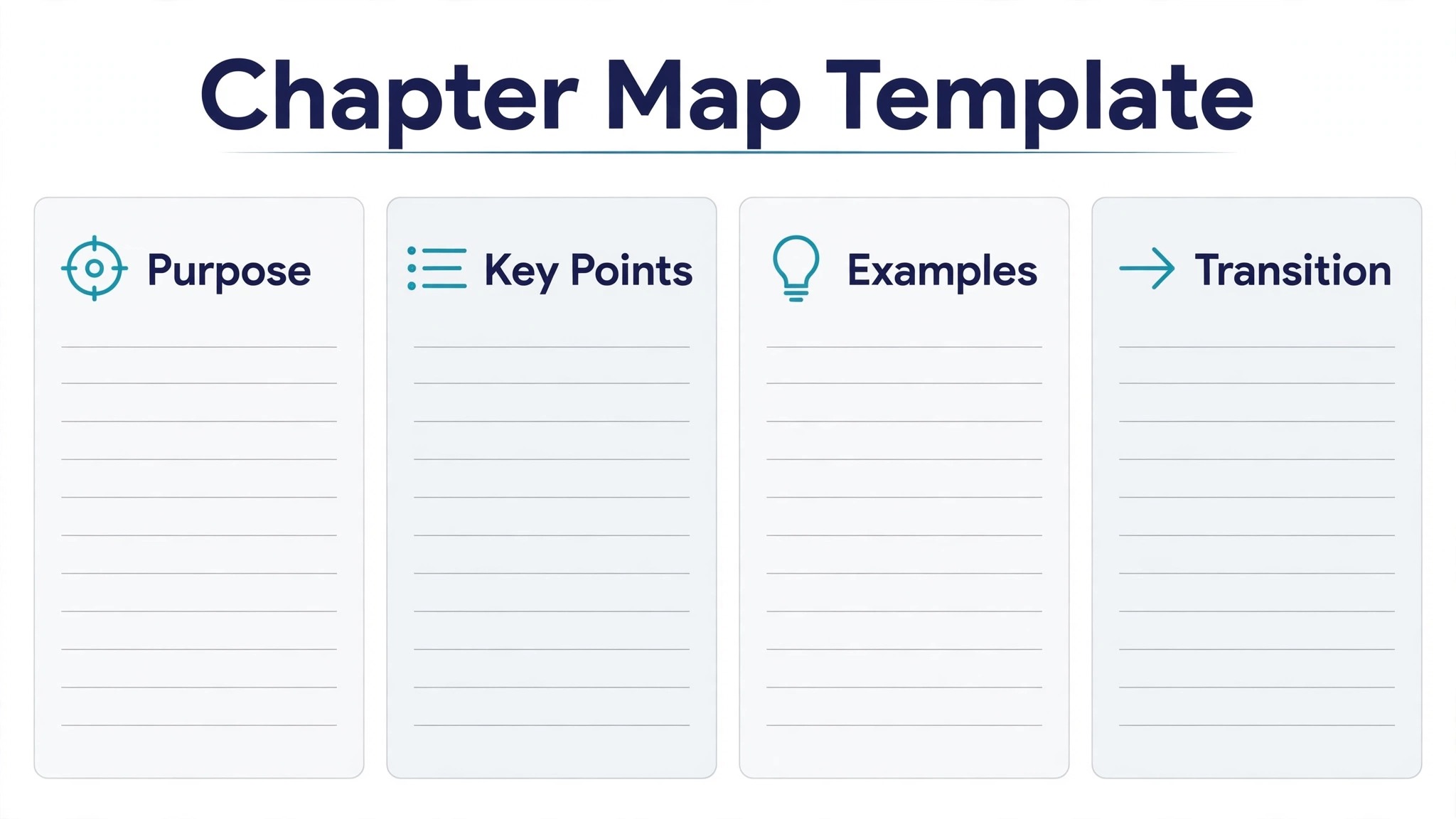
Outlining is where AI provides the most value with the least risk, provided you control the ideas. Start with a chapter map: for each chapter, write the purpose (what the reader learns or experiences), the key points or scenes, the examples or evidence, and the transition to the next chapter. For nonfiction, each chapter should answer a question the reader actually asks, in order, from foundation to advanced application. For fiction, each chapter should advance character, conflict, or stakes, and end with a reason to continue, whether a revelation, a decision, or a complication.

Use AI to stress test the outline. Ask it to identify chapters that overlap, chapters that lack examples, places where the argument jumps, and sections where a reader might get lost. Ask it to suggest alternative chapter orders and to summarise the whole outline back to you in one paragraph. If that summary does not match your intended promise, the outline needs work before drafting begins.
This check takes an hour and can save months of rewriting a structurally weak manuscript. Keep the outline living: update it as you draft, note where chapters grew or shrank, and keep a separate list of ideas that belong in later chapters or in an appendix, so good tangents do not derail the current chapter.
For fiction writers, add a story bible alongside the outline: character sheets with goals, fears, and voice notes, a timeline of major events, a setting guide, and a list of promises made to the reader in early chapters that must be paid off later. AI can help you check consistency across that bible, for example by flagging a character trait that changes without explanation or a timeline contradiction. For nonfiction writers, add a research file per chapter: source notes, quotes with full citations, interview notes, and a list of claims that still need verification. That file makes fact checking and revision far faster, and it protects you if a reader or editor questions a claim.
Drafting from a strong outline feels different from drafting from a vague idea. You know what each chapter must do, so you can write a rough version quickly, even on a low energy day, and revise it later. Without an outline, every drafting session becomes a decision session about what to write, which drains willpower and slows output. Invest two to four weeks in outlining for a full book. That time is not delay. It is the work that makes drafting possible.
Draft in layers: messy first, clear second, polished last
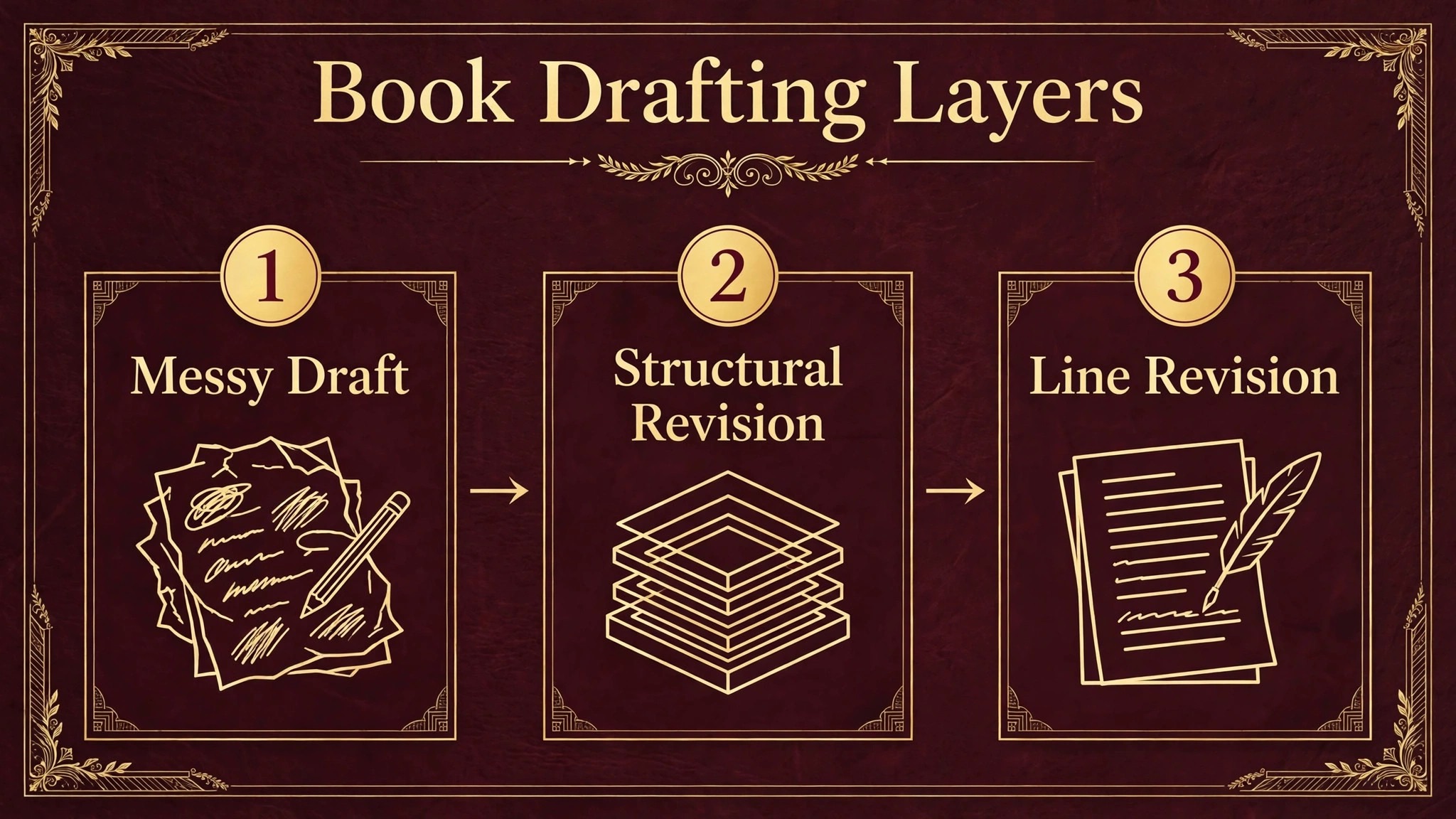
Many writers stall because they try to write a polished final draft in one pass. That standard is impossible and discouraging. Draft in layers instead. Layer one is a messy draft: get the ideas, scenes, or arguments down in order, without worrying about perfect sentences. Aim for a daily word target you can actually meet, such as 500 to 1,000 words on writing days, and protect that habit over perfection.
AI can help at this stage by expanding your bullet notes into paragraphs you will rewrite, or by helping you continue a scene when you know what should happen but struggle to start the paragraph. Keep those AI assisted passages marked for revision, so you do not mistake a rough expansion for finished prose.
Layer two is a structural revision, chapter by chapter. Read each chapter and ask: does it fulfil its outline purpose, does it contain specific examples or scenes, does it repeat material from another chapter, and does it lead naturally to the next chapter? Cut or move material that does not serve the chapter purpose, even if you like the writing. Books improve more from cutting and restructuring than from polishing weak sections. Use AI as a structural reader here: ask it to summarise each chapter, list its main points, and flag repetition or gaps. Compare its summary with your intended purpose. Where they differ, revise.
Layer three is line revision: sentences, rhythm, clarity, and voice. Read chapters aloud, or use text to speech, and mark sentences that sound flat, tangled, or generic. Replace vague claims with specific ones, vary sentence length, and check that dialogue sounds like speech, not exposition, in fiction. In nonfiction, check that each key claim is supported by an example, a source, or a clear reasoning step, not just asserted. This is also the stage to check for AI tells: overly balanced phrasing that says nothing, lists that repeat the same idea in different words, and transitions that sound smooth but carry no meaning. Rewrite those passages in your own voice, with a specific detail only you can provide.
Tools compared: outlining, drafting, and revision
| Job | Good options | Best for | Watch out for |
|---|---|---|---|
| Outlining and notes | Notion, Scrivener, Obsidian | Chapter maps, research files, story bibles | Overorganising; outline should serve drafting, not replace it |
| Book drafting | Scrivener, Google Docs, Word, Atticus | Long manuscripts, chapter navigation | Version chaos; keep one master file and dated backups |
| AI drafting help | ChatGPT, Claude | Outline expansion, structural checks, clarity passes | Generic voice; always rewrite key passages yourself |
| Editing and grammar | Grammarly, ProWritingAid | Consistency, readability, repeated words | Overcorrection of fiction voice and dialogue |
| Book formatting | Atticus, Vellum, Kindle Create | Print and ebook layout | Check official pricing and format support before buying |
For book specific software, this guide to the best AI book writing software compares tools by outlining, long manuscript handling, and AI assistance, which are the features that matter most when a project grows beyond a short document. If your current writing tool feels limited for long work, reviewing ChatGPT alternatives can also help you find a better drafting partner, but keep your manuscript in one main tool to avoid version confusion. For organising research and chapter notes, this overview of Notion alternatives can help you choose a workspace that fits how you actually write, whether you prefer folders, databases, or a simple document tree.
Backups deserve a rule, not a hope. Keep your manuscript in at least two places, such as a cloud drive and a local backup, with dated versions after each major revision. Name files clearly: book title, draft version, and date. A lost manuscript is a preventable disaster, and a clear version system also helps when you send chapters to beta readers or editors, because everyone works from the same version.
How to choose: self publish, hybrid, or traditional submission
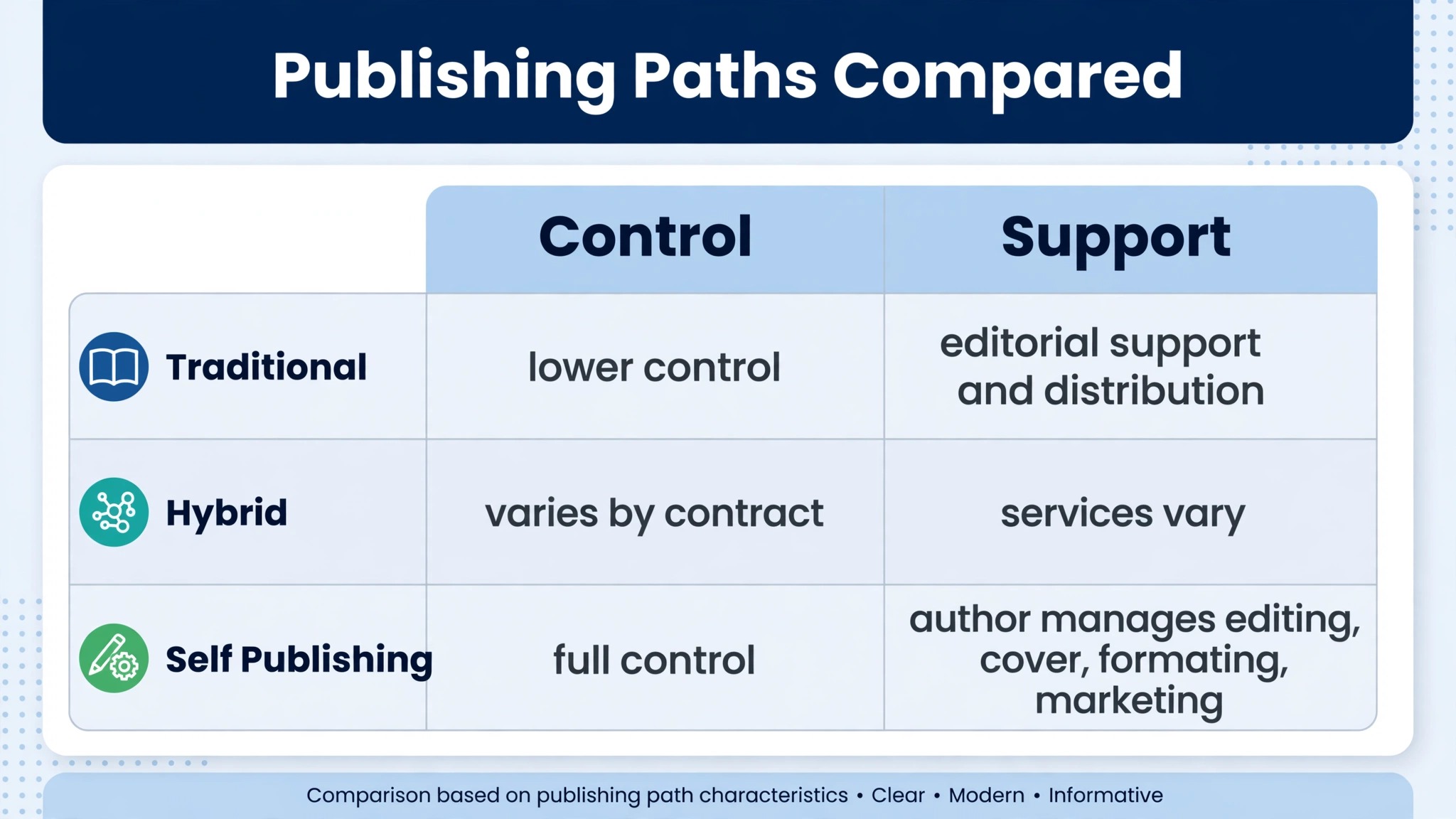
Publishing choice should follow your goals, not trends. Traditional publishing suits writers who want distribution, editorial support, and bookstore presence, and who are willing to query agents, wait months for responses, and accept less control over cover, price, and timeline. Self publishing suits writers who want control, faster publication, higher royalty share per sale, and a direct relationship with readers, and who are willing to manage or pay for editing, cover design, formatting, and marketing. Hybrid options vary widely in cost and services, so check contracts carefully, including who owns rights, what services are actually included, and what happens if you want to leave.

For nonfiction, a traditional proposal often matters more than a finished manuscript. Agents and publishers usually want a proposal with reader analysis, competing books, chapter outline, sample chapters, and author platform. AI can help you draft and tighten a proposal, but the platform evidence, audience, and expertise must be real. For fiction, agents usually want a query letter, a synopsis, and sample chapters, with a complete manuscript ready on request. Polish those materials with the same care as the book itself, because they are the first test of whether the book is ready.
Self publishing requires a production checklist: developmental edit or beta reader feedback, copy edit, proofread, cover design, interior formatting for ebook and print, ISBN decisions (which vary by country and platform), metadata (title, subtitle, description, categories, keywords), and a launch plan. Do not skip professional editing and cover design to save money if you want readers to take the book seriously.
A strong cover and a clean interior signal professionalism before a reader reads a single page. If you plan to sell related products later, such as a course or a workbook based on the book, this guide on how to create a digital product with AI shows how to extend a book into a product without diluting the book itself.
Choose your path after the first full draft, not before you start writing. Early publishing debates distract from drafting. Write the book, revise it to a standard you are proud of, get feedback from trusted readers, and then decide which path fits the finished work and your goals. A good book with a clear reader can succeed on either path. A rushed book will struggle on both.
Beta readers, editors, and the revision you cannot skip
AI feedback is useful, but it is not a substitute for human readers. Beta readers, ideally readers who match your target audience, will tell you where they got bored, confused, or sceptical, and where they wanted more. Give them specific questions: Where did you lose interest? Which chapter felt too long or too thin? What did you expect to learn or experience that the book did not deliver? Vague feedback (“I liked it”) is pleasant but not useful. Specific feedback, even when uncomfortable, is what improves a manuscript.
Editors work at different levels, and it helps to know which you need. A developmental editor focuses on structure, argument, character, and pacing. A copy editor focuses on clarity, consistency, and language. A proofreader focuses on final errors before publication. Many writers need developmental help first, even if they think they need only proofreading. Budget for editing early, check official rates and sample edits from editors you consider, and agree scope, timeline, and revision rounds in writing. For freelance writing skills that transfer to book editing and revision, this guide to the best AI tools for freelance writers shows how professional writers organise revision checklists, which you can adapt for your own manuscript.
Handle feedback with a cooling off period. Read all feedback, note patterns (if three readers flag the same slow chapter, it is slow), and then revise in a separate session, not while you are still reacting. Not every suggestion should be accepted, but every pattern deserves attention. Keep a revision log: what you changed, why, and what you deliberately kept. That log helps you stay consistent across chapters and helps an editor understand your decisions.

Launch and find readers without shouting
A finished book still needs readers, and launch planning should start before publication, not on publication day. Build a simple launch list while you revise: early readers who will give honest feedback, people in your field who might mention the book, communities where your reader already gathers, and a short list of topics you can talk about in interviews, articles, or podcast appearances. Those topics should come from the book itself: a surprising finding, a useful framework, a story that illustrates a larger point, or a question the book answers differently from competing books. Prepare three talking points you can use in any interview, so you are never caught without something specific to say.
Your book description is a sales tool, not a summary. It should state the reader, the promise, what is inside, and why your approach differs, in short paragraphs that a browser can scan in thirty seconds. Use the first lines to carry the strongest promise, because many stores show only the opening before a reader clicks to expand. Include a brief author note that explains your relevant experience in plain terms, without overstating credentials. Readers trust specific experience more than vague authority claims.
Reviews and early momentum help, but they should be earned honestly. Ask early readers to leave a review if they genuinely liked the book, and do not pay for fake reviews or trade reviews in ways that violate platform rules. A small number of specific, honest reviews beats a large number of generic ones. After launch, keep the book alive with useful related content: articles that expand on a chapter, short talks, newsletter excerpts, and answers to reader questions.
A book is a long term asset. The launch week matters, but the next twelve months of steady, useful visibility matter more. Plan for both, and keep a simple record of what actually brings readers, so your second book launch starts from evidence, not guesswork.
Mistakes that leave books unfinished or forgettable
The first mistake is starting without an outline or a reader promise, then discovering at chapter five that the book has no direction. Outline first, even a simple chapter map, and test it before drafting deeply.
The second mistake is polishing chapter one for months while later chapters remain unwritten. A book is finished by drafting the whole manuscript roughly, then revising the whole manuscript. Perfecting early chapters before the rest exists wastes time and often requires rework when later chapters change the story or argument.
The third mistake is letting AI voice replace your voice. If a reader could not tell your book from ten other AI assisted books on the same topic, the book needs more of your examples, your decisions, and your phrasing. Add a specific story, a hard choice you made, or a viewpoint you are willing to defend, and rewrite generic passages around it.
The fourth mistake is inventing facts, quotes, or case studies. In nonfiction, invented material destroys trust and can create legal problems. Verify every claim, keep source notes, and cut anything you cannot verify. In fiction, invented material is expected, but it must be internally consistent and clearly fictional, not presented as real research or history.
The fifth mistake is skipping human feedback. AI can check structure and clarity, but it cannot tell you how a real reader feels at page 120. Beta readers and editors catch boredom, confusion, and emotional flatness that automated checks miss. Budget time for at least one full human read before publication.
The sixth mistake is rushing publication to meet an arbitrary date. A book that is published too early, with weak editing or a poor cover, is hard to relaunch. It is better to delay by a month and publish a book you are proud to promote for years than to publish quickly and spend years apologising for it.
Frequently asked questions
Is it ethical to use AI to write a book?
Ethics depend on how you use it. Using AI for research summaries, outlining help, drafting support from your own notes, and revision checks, with human authorship, fact checking, and final decisions, is widely accepted as a writing aid, provided you are transparent where transparency is required by a publisher or platform. Presenting unchecked AI output as your own original research, inventing sources, or copying copyrighted text is not ethical, regardless of the tool used. Keep records of your process and follow publisher and platform disclosure rules for your specific project.
How long does it take to write a book with AI?
Time varies by length, genre, research needs, and daily writing time. A focused writer with a strong outline and a daily habit may complete a first draft in three to six months, with revision taking another two to four months. AI can shorten research and drafting time, but it does not remove the need for thinking, revision, and human feedback. Set a weekly word target you can sustain, rather than a heroic daily target you abandon after two weeks.
Will publishers reject a book written with AI help?
Publishers vary, and policies are evolving. Most publishers care about quality, originality, accuracy, and rights, and they may ask how AI was used. Be prepared to explain your process honestly, show your outline, notes, and revision history, and follow the specific disclosure requirements of any agent or publisher you approach. If a publisher requires no AI use in a specific project, respect that requirement or choose a different path for that book.
Do I need to disclose AI use to readers?
Disclosure expectations vary by genre, publisher, and platform. In nonfiction, transparency about research methods and AI assistance is good practice, especially where accuracy matters. In fiction, readers generally care more about story quality, but publisher contracts may still require disclosure. Check your contract and platform rules, and when in doubt, include a brief, honest note about your process in the book front matter or author note.
Can AI help with fiction plot and characters?
Yes, as a brainstorming and consistency partner. AI can suggest plot complications, test character motivations, flag timeline issues, and help you explore alternative endings. Keep creative decisions with yourself, because the most memorable plots come from choices that reflect your themes and your characters, not from generic story formulas. Use AI suggestions as options to consider, not as decisions to accept automatically.
What is the best first step if I have never written a book?
Write a one page reader and promise statement, then a chapter map with one sentence per chapter, then a sample chapter. Share that sample with two trusted readers and ask where they got confused or bored. That small test tells you whether the idea can sustain a book, before you commit to months of drafting. If the sample works, commit to a weekly drafting schedule and a simple revision plan.
Final assessment: finish the book only you can write
AI will keep getting better at drafting smooth prose, which means smooth prose alone will keep getting less valuable. What remains valuable is a book with a clear promise, specific material, a distinctive voice, and a structure that respects the reader’s time. That is the book you should write: the one that uses your experience, your research, and your decisions, with AI as a fast, tireless assistant for outlining, drafting support, and revision checks.
Start this week with three documents: a reader and promise statement, a chapter map, and a research or story file. Draft roughly, revise structurally, then revise for voice and clarity, and get human feedback before you publish. If you do that, AI will not make your book generic. It will help you finish a book that is unmistakably yours, on a schedule you can actually keep. That is the real advantage, and it is available to any writer willing to outline first and revise honestly.