

A traveler who spends 20 minutes a day for six weeks before a trip, learning the phrases that actually get used, saves hours of confusion at stations, markets and hotel desks, and the top 10 ai language learning tools for travelers exist to make those 20 minutes count. Duolingo leads this guide because its free tier is genuinely usable and its daily habit loop keeps a traveler practising when motivation fades, with Super at 12.99 dollars a month for an ad-free experience with offline lessons.
Babbel follows for travelers who want structured lessons built around real conversation, since its courses explain the grammar behind the phrases instead of only drilling them, and it costs about 15 dollars a month on longer plans, reported.
Pimsleur sits close behind for travelers who learn by listening, because its audio lessons teach speaking from the first lesson, and All Access costs 20.95 dollars a month. The remaining seven tools cover visual learning, speaking practice, vocabulary and live conversation, and each one earns its place by solving a specific traveler problem better than the generalists do. The ten apps below were all live in November 2026. Prices come from vendor list pages or widely reported figures, and they change often, so confirm the figure on the vendor site before subscribing.
A traveler does not need fluency. A traveler needs twenty phrases delivered well, the confidence to use them, and the ears to understand the answer. The tools in this guide were judged on that test, because an app that teaches a thousand words a traveler never says is less useful than one that teaches twenty phrases perfectly. The goal is to order food, ask directions, handle a problem and be polite, all without opening a translation app in a panic.
20 Phrases That Carry a Trip
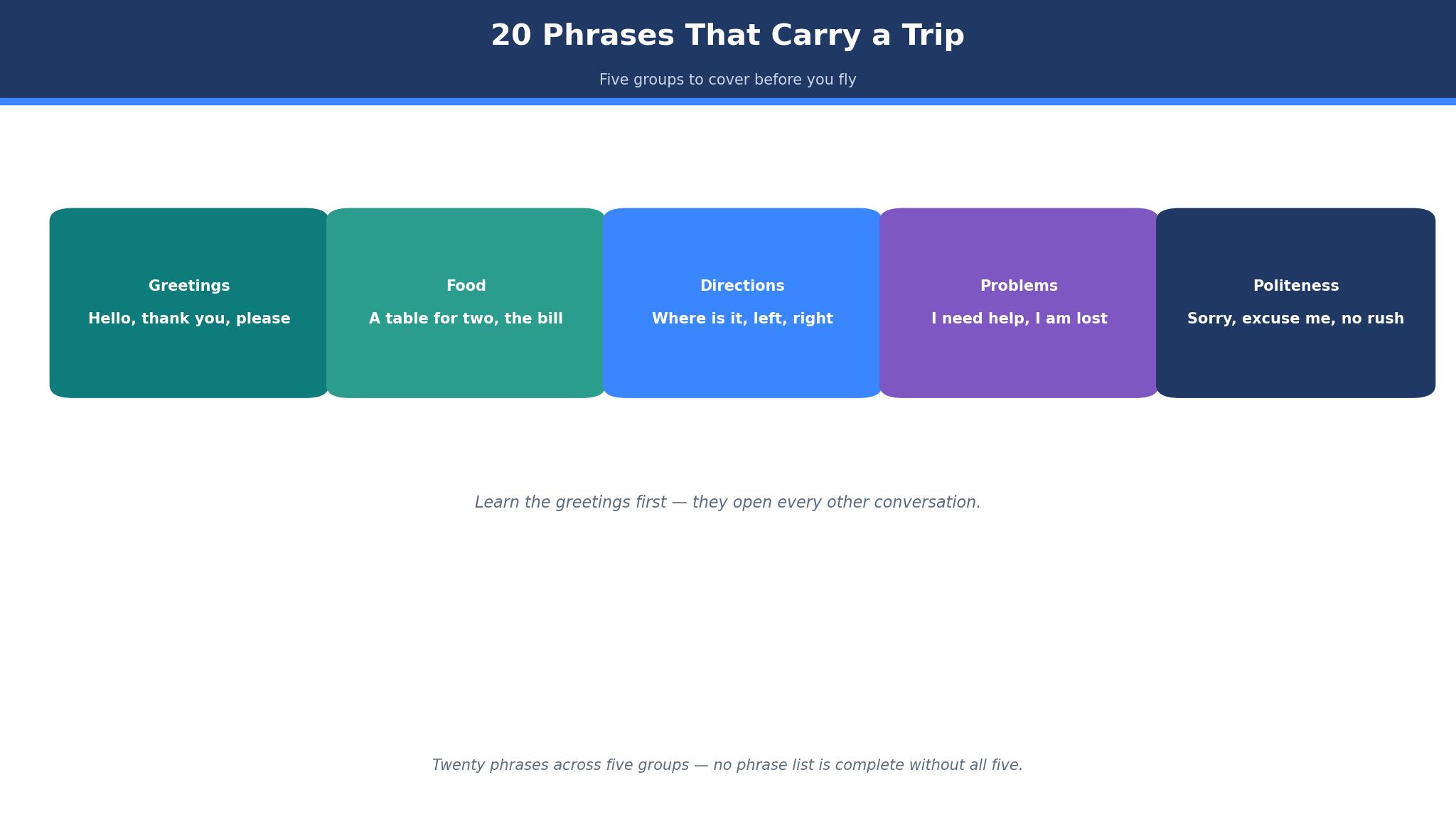
Twenty phrases carry most of a trip. A greeting, a thank you, a request for the bill, a question about the price, a direction to the station, a way to say you do not understand, and a polite way to ask someone to speak slowly will cover the situations a traveler actually meets. A traveler who can say those twenty phrases clearly will get help, patience and smiles, while a traveler who knows two hundred nouns and no verbs will stand silent at the counter.
The top 10 ai language learning tools for travelers in this guide were scored on how fast they teach those twenty phrases. Pimsleur teaches them by speaking, Babbel teaches them inside real dialogues, and Drops teaches the vocabulary behind them in five-minute bursts. The detail sections below call out which tools build speaking confidence and which ones only build recognition, because a phrase you can recognise but cannot say will not help you at a market stall.
The second test is the answer. A traveler who asks for directions must understand the reply, and that needs listening practice with real voices at real speed. Memrise uses video of real people speaking, LingQ uses real texts and audio, and HelloTalk lets a traveler practise with native speakers. A tool that only teaches the traveler to speak, and never to listen, will leave them nodding at a reply they did not understand.
Why Gamified Apps Stall at Ordering Coffee
Gamified apps stall at ordering coffee for a simple reason. They reward the streak, not the sentence, so a traveler can keep a 100-day streak without ever speaking a full sentence to a real person. The owl, the gems and the leaderboard keep the traveler opening the app, and the traveler mistakes opening the app for learning the language. The streak becomes the goal, and the trip becomes an afterthought.
The fix is to pair the game with a real test. A traveler who practises for 20 minutes a day should also speak one sentence aloud each day, record it, and compare it with the native audio. The tools in this guide that carry speaking practice, such as Pimsleur, Babbel and Mondly, make that test natural, because the lesson itself asks the traveler to speak. The tools that only ask for taps will need the traveler to invent the speaking test themselves.
The decision table in this guide is built around that pairing. It matches each tool to the job it finishes fastest for a specific kind of traveler, because a backpacker with six weeks needs different preparation than a business traveler with six days. A traveler who picks by the trip, not by the app store ranking, will arrive ready to speak.
The 10 Tools at a Glance
| Tool | Main job | Best for | Starting price |
|---|---|---|---|
| Duolingo | Free gamified daily practice | Building a daily habit | Free, Super from 12.99 dollars a month |
| Babbel | Structured conversation courses | Grammar and real dialogues | About 15 dollars a month, reported |
| Pimsleur | Audio-first speaking lessons | Learning while commuting | 20.95 dollars a month |
| Rosetta Stone | Immersion without translation | Visual learners | About 12 dollars a month, reported |
| Memrise | Real-person video phrases | Understanding real speech | About 25 dollars a month, reported |
| Busuu | Structured courses with feedback | Learners who want corrections | About 14 dollars a month, reported |
| LingQ | Reading and listening to real content | Intermediate travelers | 12.99 dollars a month |
| Mondly | Short daily lessons with speech | Quick daily practice | 9.99 dollars a month |
| Drops | Five-minute vocabulary bursts | Learning words fast | 9.99 dollars a month, reported |
| HelloTalk | Language exchange with natives | Real conversation practice | 6.99 dollars a month, reported |
Best Pick by Job
| Job type | First pick | Second tool | Why this pair works |
|---|---|---|---|
| Building a daily habit | Duolingo | Drops | Duolingo keeps the streak and Drops adds vocabulary fast |
| Speaking before the trip | Pimsleur | Babbel | Pimsleur teaches speaking by ear and Babbel adds grammar |
| Understanding real people | Memrise | HelloTalk | Memrise shows real speakers and HelloTalk adds live practice |
| Structured course learner | Babbel | Busuu | Babbel explains the rules and Busuu adds corrections |
| Visual immersion learner | Rosetta Stone | LingQ | Rosetta Stone teaches without translation and LingQ adds real texts |
Six weeks to speaking and six days to reading signs are different trips. A traveler who must speak soon needs audio lessons, while one who must read signs and menus needs vocabulary and visual learning, and an app that covers both halves halfway still fails the traveler on the phrases it needs most. Let the trip itself choose the first app, and keep the other one ready for the skills the first cannot teach.
Measure the price against one airport meal. A traveler with six weeks can justify 12.99 dollars a month for Duolingo Super or 20.95 dollars for Pimsleur, because the cost is less than one airport meal and the speaking confidence lasts the whole trip. A traveler with six days should start free on Duolingo, learn the twenty phrases, and skip the subscription entirely. The top 10 ai language learning tools for travelers are judged here on the speaking confidence they build, not on the number of languages they list.
How to Judge the top 10 ai language learning tools for travelers
Start with the twenty phrase test, because that is where a language app either earns its fee or wastes it. Pick the twenty phrases you will actually use, open the app, and see how fast it teaches them and whether it makes you say them aloud. An app that teaches the phrases in a week with speaking practice will prepare you, while one that teaches them as a word list will leave you silent at the counter. Check whether the app works offline, since a traveler on a plane or a train without signal still needs to practise.
Next, test the listening. Play a native speaker at normal speed and see whether you can follow the answer to a simple question, such as where the station is. Look for video of real people, real dialogues and adjustable speed, because a traveler who only hears slow studio audio will struggle with a real reply. The top 10 ai language learning tools for travelers that use real voices will prepare you for real answers, and the ones that use only synthetic voices will not.
Then check the speaking feedback. Say a phrase aloud and see whether the app scores your pronunciation, shows where it differs, and lets you try again. A tool that listens and corrects will build confidence, while one that only shows a tick for tapping the right answer will not. Look for a free trial, since a week of real use before the trip will tell you more than any review.
The 10 Tools in Detail
Speaking confidence sets the order below, so the tool that gets a traveler talking first leads the list.
1. Duolingo
Duolingo is the most downloaded language app in the world, and its free tier is the reason. The full course is available with ads, and Super at 12.99 dollars a month removes ads, adds offline access and unlimited hearts, with a family plan reported at 119.99 dollars a year. The daily streak, the gems and the leagues keep a traveler opening the app every day, which is the hardest part of learning before a trip.
The drawback is the speaking gap. Duolingo builds a habit and teaches vocabulary well, but a traveler can finish months of lessons without ever holding a conversation, because the app rarely asks for a full sentence spoken to a real person. The energy limit on the free tier caps daily lessons, and the Max tier with an AI tutor costs about 29.99 dollars a month, which is steep for a trip.
Duolingo suits travelers building a daily habit before a trip. It fits a backpacker with six weeks to prepare, a traveler who needs a free start, and anyone who learns by small daily steps. The free tier is the feature that matters, because a traveler who can start today for nothing will actually start.
Learn the twenty phrases in one week, saying each one aloud before tapping the answer. If you can say them without looking by day seven, Duolingo will carry the habit half of your preparation.
2. Babbel
Babbel is the strongest structured curriculum for travelers, and its conversation first lessons are the reason. Lessons last ten to fifteen minutes, explain the grammar in plain words, and build dialogues around real situations such as ordering food and asking directions. It costs about 15 dollars a month on longer plans, reported, with a twelve-month plan reported near 107 dollars for all languages.
The drawback is the price opacity and the language count. Babbel covers fourteen languages, so a traveler heading somewhere less common may find no course at all. The monthly price varies by plan and region, so the figure quoted here is reported rather than a fixed vendor list price, and the free tier covers only the first lesson of each course. A traveler who wants a rare language will need a different tool.
Babbel suits travelers who want the rule behind the phrase. It fits an adult learner who likes grammar explained, a traveler preparing for Europe, and anyone who wants structured lessons rather than a game. The dialogue lessons are the feature that matters, because a traveler who practises a real conversation will use it at the restaurant.
Learn one dialogue a day for two weeks, repeating the lines aloud until they flow. If you can run the restaurant dialogue without notes, Babbel will carry the speaking half of your preparation.
3. Pimsleur
Pimsleur is the audio-first method in this guide, and its timed recall is the reason. Lessons are thirty minutes of audio, with speaking from the first lesson and pronunciation built in, so a traveler learns while commuting or walking. All Access costs 20.95 dollars a month, with a single language Premium plan reported near 19.95 dollars a month and a seven-day trial.
The drawback is the reading gap and the price. Pimsleur teaches speaking and listening well, but reading and writing get little attention, so a traveler who needs to read signs and menus will need a second tool. At about 21 dollars a month it is the most expensive audio option here, and the lessons follow a fixed pace that a fast learner cannot skip.
Pimsleur suits travelers who learn while moving. It fits a commuter with six weeks before a trip, a traveler who wants to speak from day one, and anyone who learns by ear rather than by screen. The audio method is the feature that matters, because a traveler who can speak without looking at a screen can speak while walking through a market.
Do one lesson a day for two weeks, speaking every prompt aloud before the answer plays. If you can answer the prompts without pausing, Pimsleur will carry the speaking half of your preparation.
4. Rosetta Stone
Rosetta Stone is the immersion method in this guide, and its picture-based learning is the reason. It teaches without translation, matching words to images and sounds, so a traveler learns to think in the language rather than translate from their own. It costs about 12 dollars a month on longer plans, reported, with a lifetime option reported near 199 dollars.
The drawback is the slow start and the reported price. Immersion feels slow for the first two weeks, because the traveler gets no translations to lean on, and the price varies by plan and promotion, so the figure quoted here is reported rather than a fixed vendor list price. The speaking practice is thinner than Pimsleur, and a traveler who needs phrases fast may find the pace frustrating.
Rosetta Stone suits visual learners who want immersion. It fits a traveler with time to prepare, a learner who remembers pictures better than word lists, and anyone who wants to think in the language rather than translate. The immersion method is the feature that matters, because a traveler who thinks in the language will respond faster at the counter.
Do one unit a day for two weeks and say each new word aloud as the picture appears. If the words start coming without translation, Rosetta Stone will carry the visual half of your preparation.
5. Memrise
Memrise is the real-people video tool in this guide, and its video phrases are the reason. Paid tiers show video of real speakers using the phrases in real situations, so a traveler learns how people actually talk, not only how a textbook writes. Pro is reported at about 25 dollars a month billed monthly, with annual billing bringing the monthly equivalent lower.
The drawback is the reported price and the depth. At about 25 dollars a month billed monthly it is one of the pricier options here, and the figure is reported rather than a fixed vendor list price, so it should be confirmed before buying. The course structure is looser than Babbel, and a traveler who wants a strict curriculum will find it scattered. The free tier covers limited video.
Memrise suits travelers who need to understand real speech. It fits a traveler who worries about understanding replies, a learner who remembers faces and voices, and anyone who wants video beside the vocabulary. The real-person video is the feature that matters, because a traveler who has heard a phrase spoken by a real person will recognise it at the market.
Watch ten video phrases a day for two weeks, repeating each one after the speaker. If you start recognising the phrases in new videos, Memrise will carry the listening half of your preparation.
6. Busuu
Busuu is the structured course tool with feedback in this guide, and its community corrections are the reason. Learners submit writing and speaking exercises and get corrections from native speakers, so a traveler learns what they actually said wrong instead of guessing. Premium is reported at about 14 dollars a month, with a free tier covering basic lessons.
The drawback is the reported price and the smaller course list. The monthly figure is reported rather than a fixed vendor list price, and Busuu covers fewer languages than Duolingo, so a traveler heading somewhere less common may find no course. The feedback depends on other users, so corrections can be slow at quiet hours. A traveler who wants instant feedback will find the wait frustrating.
Busuu suits learners who want corrections from real people. It fits a traveler who likes structured courses with homework, a learner who improves by being corrected, and anyone who wants a study plan with a clear path. The community feedback is the feature that matters, because a traveler who knows their mistakes will fix them before the trip.
Submit one speaking exercise a day for two weeks and read every correction. If the corrections change how you say the phrases, Busuu will carry the feedback half of your preparation.
7. LingQ
LingQ is the real content tool in this guide, and its library is the reason. Travelers read and listen to real texts, podcasts and videos in the target language, clicking unknown words to save them, so the vocabulary comes from real use rather than a word list. Premium costs 12.99 dollars a month, with a free tier covering limited lessons.
The drawback is the beginner gap. LingQ suits intermediate learners far better than absolute beginners, because real content is hard when the traveler knows twenty words. The interface is busy, and a traveler who wants a guided course will find the freedom confusing. The speaking practice is thin, so a traveler who needs to talk will need a second tool.
LingQ suits intermediate travelers who want real content. It fits a traveler who already knows the basics, a learner who likes reading and listening to real material, and anyone who wants vocabulary from real use. The real content library is the feature that matters, because a traveler who reads real menus and signs will not be surprised by them.
Read one short real text a day for two weeks, saving every unknown word. If the saved words start appearing in new texts, LingQ will carry the reading half of your preparation.
8. Mondly
Mondly is the quick daily lesson tool in this guide, and its short sessions are the reason. Lessons last a few minutes, cover real situations, and include speech recognition and a chatbot for conversation practice, so a busy traveler can fit a lesson between other tasks. Premium costs 9.99 dollars a month, with a free tier covering daily lessons.
The drawback is the depth. Mondly teaches phrases and vocabulary well, but the grammar explanations are thin, and a traveler who wants to understand the rules will need Babbel beside it. The chatbot conversation feels scripted, and the course depth is lighter than Babbel or Rosetta Stone. A traveler preparing for a long stay will outgrow Mondly fast.
Mondly suits travelers who want quick daily practice. It fits a busy traveler with ten minutes a day, a learner who likes short lessons with speech practice, and anyone who wants a low cost start. The short lesson format is the feature that matters, because a traveler who can finish a lesson in five minutes will finish one every day.
Do the daily lesson every morning for two weeks, speaking every answer aloud. If the phrases stick without extra study, Mondly will carry the daily practice half of your preparation.
9. Drops
Drops is the five-minute vocabulary tool in this guide, and its speed is the reason. Sessions last five minutes, teach words with beautiful illustrations, and focus on the vocabulary a traveler actually needs, such as food, transport and numbers. Premium is reported at 9.99 dollars a month, with a free tier covering five minutes a day.
The drawback is the reported price and the narrow scope. The monthly figure is reported rather than a fixed vendor list price, and Drops teaches words, not sentences, so a traveler who knows a hundred nouns and no verbs will still stand silent at the counter. The grammar is absent, and the speaking practice is thin. A traveler who needs conversation will need Pimsleur or Babbel beside it.
Drops suits travelers who need vocabulary fast. It fits a traveler with days rather than weeks, a learner who remembers pictures, and anyone who wants to learn the words for food, numbers and directions quickly. The five-minute session is the feature that matters, because a traveler who can learn in five minutes will learn every day.
Do one five-minute session a day for two weeks, focusing on food, numbers and directions. If you can name twenty foods and count to one hundred, Drops will carry the vocabulary half of your preparation.
10. HelloTalk
HelloTalk is the language exchange tool in this guide, and its real conversation is the reason. Travelers chat with native speakers, correct each other, and practise voice messages, so the speaking practice is real rather than scripted. VIP is reported at 6.99 dollars a month, with a free tier covering basic exchange.
The drawback is the reported price and the uneven quality. The monthly figure is reported rather than a fixed vendor list price, and the exchange depends on finding a good partner, so a traveler who matches with an unreliable partner will get little practice. There is no structured course, so a beginner with no phrases will struggle to start a conversation. A traveler who needs a curriculum should pair it with Duolingo or Babbel.
HelloTalk suits travelers who want real conversation practice. It fits a traveler who already knows the twenty phrases, a learner who improves by talking to real people, and anyone who wants cultural tips beside the language. The real conversation is the feature that matters, because a traveler who has chatted with a native speaker will not freeze at the counter.
Find one exchange partner a week before the trip and send three voice messages a day. If the partner replies and corrects you, HelloTalk will carry the conversation half of your preparation.
A Six-Week Plan Before You Fly
A six-week plan works when the traveler studies 20 minutes a day and speaks every day. Week one and two build the twenty phrases with Duolingo or Pimsleur, week three and four add listening with Memrise and conversation with HelloTalk, and week five and six practise the real situations, ordering food, asking directions and handling a problem, until the phrases come without thinking. The top 10 ai language learning tools for travelers support that plan, because each one covers a different week of it.
The plan fails when the traveler studies for three hours on Sunday and nothing for the rest of the week. Language learning needs daily contact, and a 20-minute daily session beats a weekend binge every time. Set the app reminder for the same time each day, keep the streak alive, and test yourself by speaking the twenty phrases aloud on the last day before the flight. A traveler who can say them without notes is ready.

Frequently Asked Questions
Which language app is best for a traveler?
Duolingo is the best starting point among the top 10 ai language learning tools for travelers for a traveler building a daily habit, because its free tier is genuinely usable and Super costs 12.99 dollars a month. Pimsleur is the better pick when the traveler needs to speak before the trip, at 20.95 dollars a month. A traveler should pick by the trip date, not by the app store ranking.
Can a traveler learn a language in six weeks?
A traveler can learn the twenty phrases that carry a trip in six weeks, with 20 minutes of daily practice and speaking aloud every day. Fluency takes years, but ordering food, asking directions and handling a problem takes weeks. A traveler who practises daily and tests themselves by speaking will arrive ready.
Is Duolingo enough for travel?
Duolingo is enough for the habit and the vocabulary, but not for speaking confidence on its own. A traveler who pairs Duolingo with Pimsleur for speaking and HelloTalk for real conversation will arrive far more ready than one who uses Duolingo alone. The free tier covers the habit, and the paid tools add the speaking.
How much should a traveler pay for a language app?
A traveler should pay between zero and 21 dollars a month, with Duolingo free to start, Super at 12.99 dollars a month, and Pimsleur at 20.95 dollars a month. A traveler with six days should pay nothing and learn the twenty phrases free. A traveler with six weeks can justify one paid app that teaches speaking.
Do language apps work offline?
Most paid tiers offer offline lessons, including Duolingo Super and Pimsleur, while free tiers usually need a connection. A traveler should download the lessons before the flight, since a plane, a train and a rural road will all break the signal. Offline access is worth checking before paying.
Which app is best for understanding real speech?
Memrise is the best pick for understanding real speech, because its paid tiers show video of real people using the phrases in real situations. HelloTalk is the better pick for live conversation, since the traveler practises with native speakers. A traveler who worries about understanding replies should start with Memrise.
The Verdict on AI Language Learning for Travelers
Duolingo takes the top spot among the top 10 ai language learning tools for travelers because it is the tool a traveler is least likely to abandon. The free tier is genuinely usable, the daily habit loop keeps the traveler practising, and Super at 12.99 dollars a month removes the friction. The speaking gap is real, but a traveler who pairs Duolingo with Pimsleur for speaking will arrive ready to talk.
Babbel is the pick for structured learners, Pimsleur is the pick for speaking first, and Memrise is the pick for understanding real speech. Choose by the trip date first, the learning style second and the price third. Learn the twenty phrases on the top two choices, test yourself by speaking them aloud, and keep the daily habit alive until the flight. A traveler who picks this way will spend less time staring at a translation app and more time talking to the people they travelled to meet.