

The problem is familiar to every concrete contractor. The quote looked profitable on paper, the client accepted, and then the job ate the margin one surprise at a time. The slab needed more base than expected, the pump could not reach, the weather turned, and the crew stayed an extra day that nobody had priced. None of those surprises is unusual, and all of them were predictable with a better estimating process. The decision to use AI for concrete contractor quote estimates is a decision about whether those surprises get priced before the client signs or discovered after the concrete truck leaves.
Concrete is unforgiving as a product. Once it is poured, it cannot be returned, reworked cheaply, or argued about without expensive removal. That finality makes the quote more important than in trades where a mistake can be fixed with a second visit. A quote that misses site preparation, reinforcement, finishing, curing, or disposal will not merely reduce profit, and it can turn a job into a loss that takes three good jobs to recover. Contractors know this, yet many still quote from memory, from a rival’s price, or from a per square foot figure that hides more than it reveals.
This guide fixes that with a disciplined workflow. It covers a seven step quote process, a complete quote template with exclusions, a comparison of real estimating tools, and the margin guardrails that keep a good quote good when site conditions change. Tool details come from vendor pages and comparison guides checked at writing time. Where a price is reported rather than published on the vendor’s own page, the text says so, and you should confirm the current price on the vendor page before buying.
Why Concrete Quotes Go Wrong
Most bad concrete quotes fail in the same three places, and none of them is the concrete price itself. The first failure is measurement. A contractor paces a driveway, guesses at thickness, and forgets that an uneven subgrade needs extra material to reach a level finish. The second failure is scope. The quote says “driveway” without saying whether it includes removal of the old slab, base preparation, reinforcement, control joints, finishing, sealing, or cleanup, so the client assumes everything and the contractor priced only the pour. The third failure is labour. A crew’s speed varies with access, weather, finish type, and crew size, yet many quotes carry a single labour figure copied from a different job.
The per square foot shortcut makes all three failures worse. A single rate per square foot hides thickness, reinforcement, access, and finish, so two jobs with the same area and wildly different costs get the same price. One of them will be overpriced and lost to a rival, and the other will be underpriced and won at a loss. Contractors who use AI for concrete contractor quote estimates usually abandon the single rate first, because the estimating flow forces them to enter dimensions, thickness, materials, and labour separately, and the true cost becomes visible before the client ever sees a total.
There is also a trust cost to vague quotes. Homeowners compare quotes, and a vague quote invites comparison on price alone, because there is nothing else to compare. A detailed quote with line items, quantities, and exclusions lets the homeowner see what they are paying for, and it lets the contractor defend a higher price with specifics rather than with a shrug. Detailed quotes win fewer jobs on price and more jobs on confidence, and confidence is what keeps a contractor out of a race to the bottom.
How to Use AI for Concrete Contractor Quote Estimates Without Underpricing the Job
To use AI for concrete contractor quote estimates safely, treat the AI as a calculator and a checker, not as a price setter. The contractor enters measurements, site conditions, material choices, and crew details, and the AI computes volumes, applies the waste factor, prices each line from the contractor’s own price book, and totals labour from crew hours and burdened rates. The contractor then reviews the result against the site visit notes before anything is sent. That order matters, because an AI that guesses site conditions will produce a confident wrong number, while an AI that computes from the contractor’s own inputs produces a number the contractor can defend.
The price book is the heart of the system. It holds the contractor’s own unit prices for ready mix, reinforcement, base material, forms, pump hire, finishing, sealing, and disposal, updated when supplier prices change. AI that prices from a generic national average will misprice every local job, because ready mix and disposal costs vary sharply by region and by plant. AI that prices from the contractor’s own price book reflects the contractor’s real costs, and the quote stays accurate as long as the price book stays current. Update the price book monthly, or after any supplier price change, and the system will repay that discipline on every quote.
The second guardrail is the site visit record. Photos of access, slope, existing slab condition, drainage, and obstacles should attach to the quote file, and the AI should prompt for any missing site factor before the quote is finalised. A quote built from a phone description alone is a gamble, and AI cannot remove that gamble, it can only compute it faster. Visit the site, record what you saw, and let the AI do the arithmetic. That split, human eyes plus machine maths, is what separates a quote that holds from a quote that unravels.

The Seven Step Quote Workflow
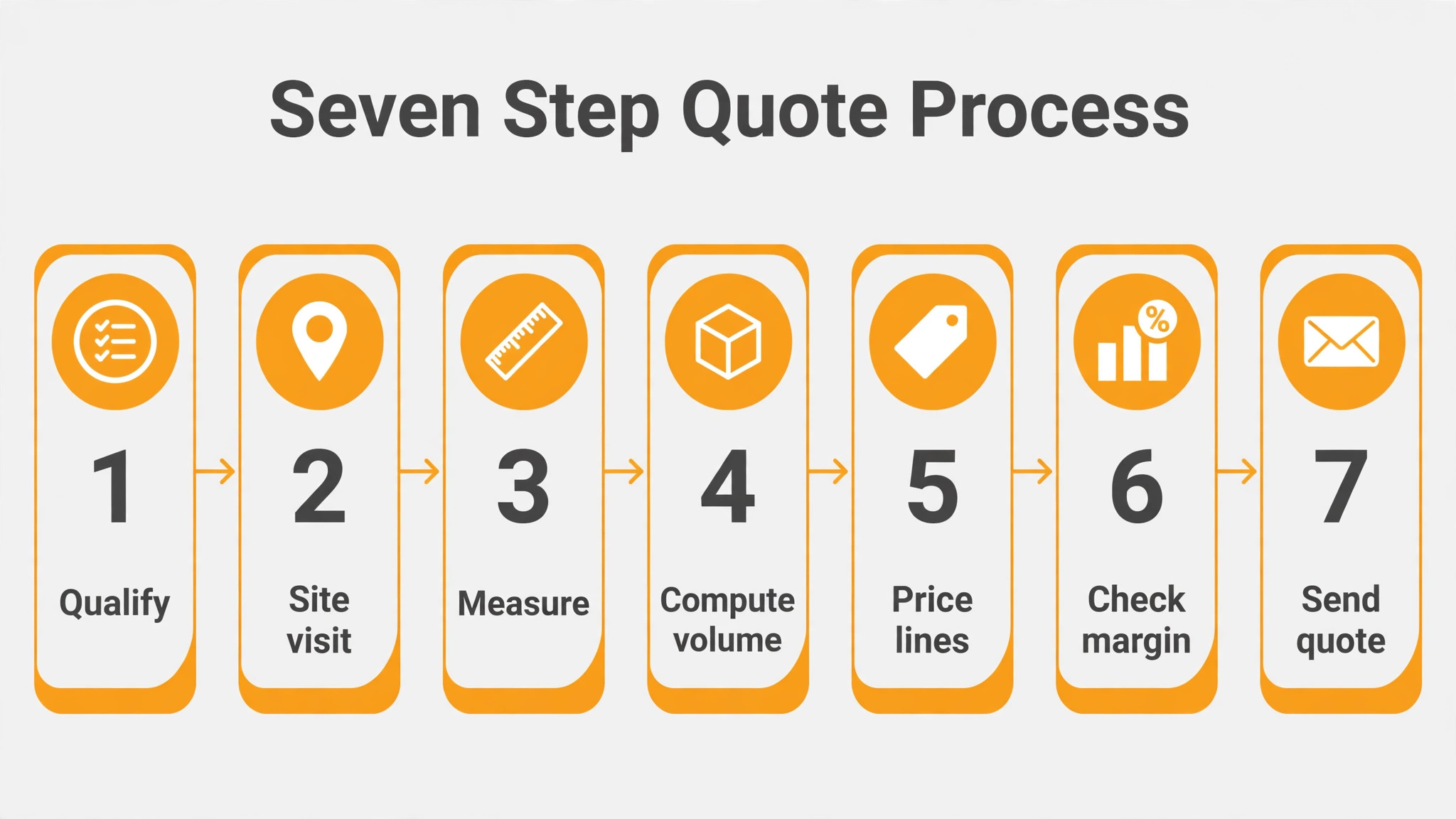
The workflow below runs from enquiry to signed quote, and it is designed so that no quote leaves the office with an unpriced scope item hiding inside it.
- Qualify the enquiry before visiting. Record the job type, location, approximate size, purpose, timeline, and budget range if the client will share it. Filter out jobs outside the contractor’s service area or capability early, and book a site visit for the rest. A visit booked without qualification wastes half a day on a job the contractor would never take, while a visit skipped for a qualified job produces a quote built on guesses.
- Visit the site and measure properly. Measure length, width, and required thickness, note the existing surface and its removal needs, check access for trucks and pumps, photograph slope and drainage, and record any obstacle such as trees, utilities, or tight gates. Measure twice where the shape is irregular, breaking it into rectangles and adding the parts, rather than guessing a single area figure. Site notes and photos become part of the quote file, so a later dispute can be answered with evidence.
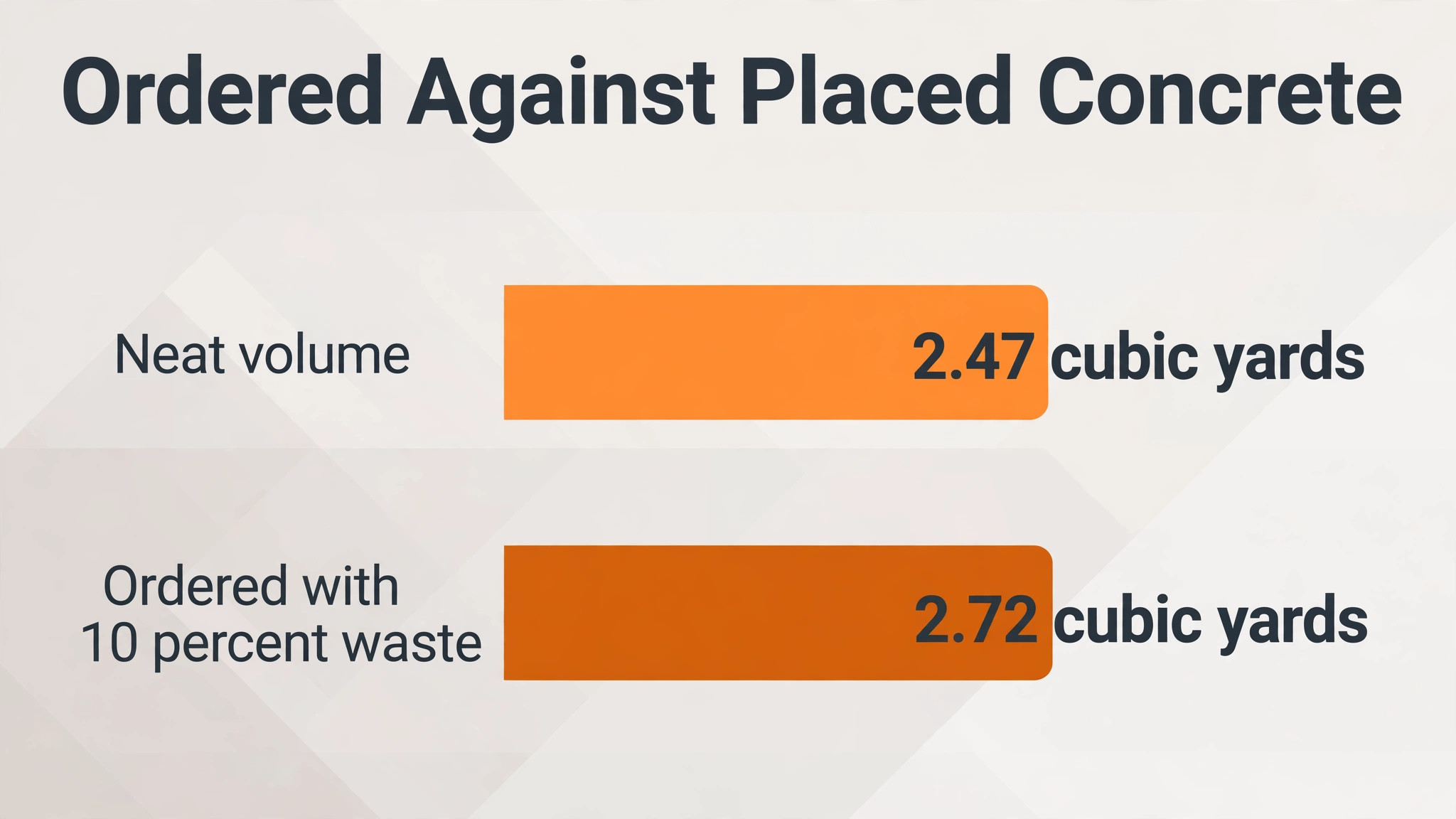
- Compute volume with waste included. Convert dimensions to cubic yards using the standard volume maths, cubic feet divided by 27, and apply the waste factor the contractor sets from experience with that job type and site. A worked example makes the maths plain. A 20 foot by 10 foot driveway at 4 inches thick gives about 66.7 cubic feet, which is about 2.47 cubic yards before waste, and about 2.72 cubic yards with a 10 percent waste allowance used as the example assumption. State the waste assumption on the quote, so the client sees why the ordered quantity exceeds the neat volume.
- Price every line from the price book. Build the quote from line items for ready mix, reinforcement, base, vapour barrier, forms, pump, labour, finishing, sealing, and disposal, each with quantity, unit, unit price, and amount. Price labour from crew hours and burdened rates, not from a guess, using crew productivity the contractor has tracked on past jobs. A quote with visible lines can be adjusted line by line when the client asks what changes if the finish changes, while a lump sum quote cannot.
- Add margin, tax, and validity deliberately. Apply markup to direct cost to reach the bid price, show gross margin before sending, and check it against the contractor’s target for that job type. Apply sales tax to the taxable lines according to local rules, and state the quote validity period, deposit requirement, and payment schedule on the document. A quote without a validity date invites the client to accept months later at stale material prices, which is a loss the contractor volunteered for.
- State exclusions in plain language. List what the quote does not include, such as permits, engineering, soil testing, utility relocation, landscaping restoration beyond the work area, and winter protection where relevant. Exclusions are not small print to hide, and they are the clearest protection a contractor has against scope creep. A client who reads exclusions before signing argues less after the pour, because the boundary was visible from the start.
- Send, follow up, and learn from every outcome. Send the quote as a PDF the client can sign, track whether it was opened, follow up once with a helpful question rather than a discount, and record won or lost with the reason. Review lost quotes monthly for price, scope, or speed patterns, and update the price book or the template where a pattern appears. A quote system that never learns from losses will repeat them, whatever tool it runs on.
The Concrete Quote Template
The template below is the structure every concrete quote should follow, whether it is built in software or in a spreadsheet. Contractors who use AI for concrete contractor quote estimates should map this template into their tool before the first live quote, because a tool without the template will produce fast quotes with missing sections.
| Section | What it contains | Why it matters |
|---|---|---|
| Job details | Client, job address, quote number, date, valid until date, prepared by | Anchors the quote and its expiry |
| Dimensions | Length, width, thickness, square feet, cubic yards after waste | Makes volume checkable by anyone |
| Materials | Ready mix, reinforcement, base, vapour barrier, forms, pump | Shows what the client pays for |
| Labour | Form, pour, finish hours at burdened rates | Prices crew time honestly |
| Other costs | Delivery, short load fee, disposal, sealing, curing | Catches the forgotten charges |
| Totals | Subtotal, tax on taxable lines, quote total, deposit, balance | Leaves no arithmetic doubt |
| Terms | Payment schedule, schedule estimate, warranty, exclusions | Prevents the post pour argument |
| Acceptance | Client signature, date, contractor signature | Turns the quote into an agreement |
Exclusions deserve their own paragraph on every quote, because they are where most post job disputes begin. Common exclusions include permits and inspections, engineering design, unsuitable soil replacement beyond a stated allowance, hidden utilities, dewatering, cold or hot weather protection beyond standard practice, and restoration of lawns or planting outside the work area. The contractor should add or remove exclusions per job rather than copying a generic list blindly, because an exclusion that does not fit the job confuses the client, while a missing exclusion that does fit the job costs money.
Payment terms belong on the quote too, not in a separate conversation after acceptance. State the deposit due on acceptance, the balance due on completion or in stages for larger jobs, and the payment methods accepted. Contractors who state terms upfront collect faster and argue less, because the client agreed to the schedule when they were happiest with the price. A quote that hides payment terms until the invoice arrives starts the job with a disagreement already booked.

Estimating Tools Compared
Estimating tools for concrete contractors range from spreadsheet templates to full field service platforms. A contractor planning to use AI for concrete contractor quote estimates should choose based on how much of the business needs to live in one system, because that choice matters more than any single feature.
| Tool | Type | Reported position | Best fit |
|---|---|---|---|
| Jobber | Field service platform | Core plan reported at 49 dollars a month for one user | Crews that want quoting plus scheduling plus invoicing |
| Housecall Pro | Field service platform | Basic plan reported at 79 dollars a month billed monthly | Firms that want a price book and proposal tool |
| KlipPack template | Spreadsheet template | Dimensions, volume with waste, price book included | Contractors who want a fast consistent slab quote |
| BuildWorkPro template | Spreadsheet and document template | One page fixed price quote with quote log | Small jobs that need a clean one page quote |
| InvoiceOwl and Bookipi | Estimate and invoice apps | Templates with materials, labour, tax, discounts | Solo contractors who want quick mobile estimates |
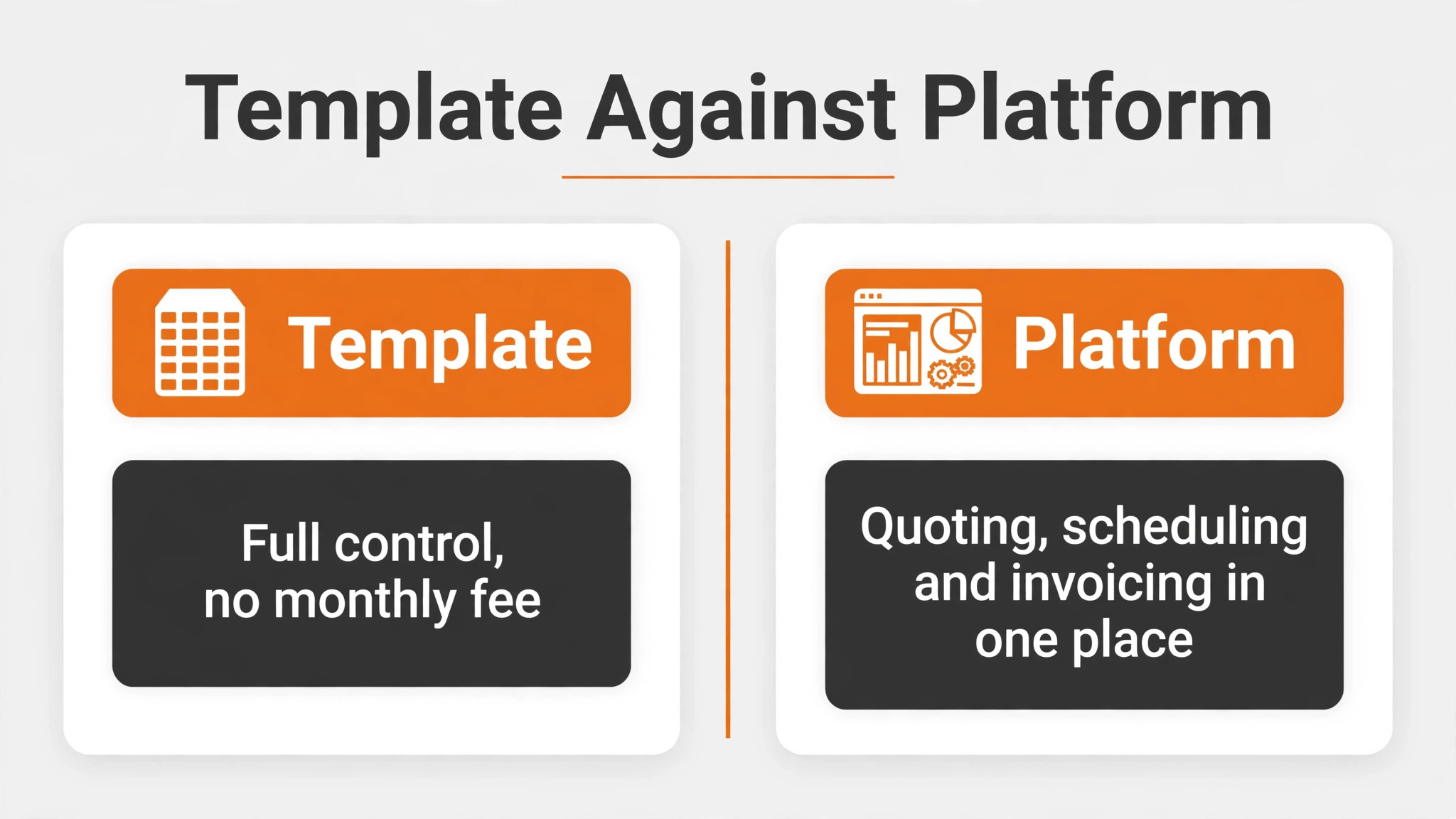
Jobber suits contractors who want quoting, scheduling, client management, and invoicing in one place, with a concrete estimate template that can be customised, sent by email or text, and converted to an invoice when the job is won. Its reported Core price of 49 dollars a month for one user comes from comparison guides, with higher tiers for larger teams, so confirm the current price on the vendor page and model the team size honestly rather than buying a tier for staff who will never log in. Its weakness for concrete specialists is that it is a general field service tool, so the price book and waste maths need careful setup before the first quote.
Housecall Pro suits firms that value a structured sales proposal tool with pricing tiers and a price book, plus scheduling, invoicing, and payments in the same system. Its reported Basic price of 79 dollars a month billed monthly, or lower on annual billing according to comparison guides, puts it above Jobber for a solo user, so the extra cost must be justified by the proposal and follow up features the firm actually uses. Firms that already run on Housecall Pro for scheduling should quote inside it rather than in a separate spreadsheet, because a quote that lives outside the job system will drift from the job record within weeks.
Spreadsheet templates suit contractors who want full control without a monthly fee, and the KlipPack concrete template is a strong example, with dimensions to cubic yards, a waste factor built into the volume formula, seven material lines, tax, labour from crew productivity, and a price book of twelve concrete line items. BuildWorkPro offers a one page fixed price quote with optional items priced separately so upsells never inflate the total, plus a quote log that tracks status and win rate. Templates are only as good as their upkeep, so a contractor using one should update unit prices monthly and back the file up, or the template will quietly go stale and misprice jobs with confidence.

Site Prep, Waste and Weather. The Three Quiet Margin Killers
Site preparation is the largest hidden cost in concrete work, because the ground rarely matches the assumption. An old slab may be thicker than expected, the subgrade may be soft, or the area may need more base to reach a level finish. Contractors who use AI for concrete contractor quote estimates should still price site prep as its own section with its own quantities, rather than burying it in the concrete line, because a separate section can be adjusted when the site visit reveals more work, while a buried allowance cannot. Photograph the existing surface and note its condition, so a client who questions the prep charge can see the reason.
Waste is the second killer, and it is entirely normal. Spillage, uneven subgrade, form leakage, and the concrete left in the pump all consume material that never becomes slab, which is why templates apply a waste factor before the plant is called. The right factor varies by job type, access, and crew experience, and it should be set from the contractor’s own job history rather than copied from a template default. Track ordered versus placed quantities for a month, and the contractor’s true waste rate will appear, usually with one job type standing out as the worst offender.
Weather is the third killer, and it is the one contractors control least. Rain delays a pour, heat accelerates setting and can ruin a finish, and cold requires protection that costs labour and materials. The quote should state what happens on a weather delay, who decides to postpone, and whether protection measures are included or charged separately. A weather clause agreed before the pour prevents the argument that otherwise happens in the rain, when nobody is in a mood to negotiate fairly.
Following Up a Quote Without Chasing the Client Away
Most contractors follow up too little or too much, and both errors lose jobs. Too little means the quote sits unread while the client books a rival who called back. Too much means the client feels pressured and chooses the quieter contractor out of irritation. The workable pattern is one follow up within two to three working days, with a helpful question rather than a discount, such as asking whether the scope and exclusions are clear or whether the client wants a different finish priced. That question reopens the conversation without devaluing the price, and it often reveals the real objection, which is rarely the total alone.
AI can help follow up without making it feel automated. It can track whether the quote was opened, remind the contractor at the right interval, and draft a follow up message in the contractor’s own tone, but the contractor should send it personally and adjust it to the client. A follow up that reads like a system message will be treated like one, while a short personal message that references the actual job, such as the driveway slope or the patio finish discussed on site, reminds the client that a human visited and understood the job. Follow up is a relationship task with a scheduling aid, not a scheduling task with a relationship pretence.
Lost quotes deserve a monthly review, not a shrug. Record whether each loss was price, timing, scope, or simply a client who never replied, and look for patterns before changing prices. A contractor losing on price to one rival repeatedly may need to sharpen the price book, while a contractor losing on timing may need faster quotes rather than cheaper ones. AI estimating that produces a quote in hours instead of days is often worth more than a small price cut, because clients in a hurry choose the contractor who replies first with a clear quote.

When to Reprice and When to Walk Away
Every contractor faces the quote that changes after it is sent, because the client adds scope, the site reveals a problem, or material prices move before acceptance. The rule should be simple. Reprice promptly, in writing, with the changed lines highlighted, and never absorb a scope change silently in the hope of goodwill. Goodwill earned by absorbing cost is rarely repaid, while a clear revised quote is usually accepted without argument when the reason is visible.
Contractors who use AI for concrete contractor quote estimates can reprice in minutes, because the quote is built from lines rather than from a lump sum. Change the thickness, add a pump line, or extend the base preparation, and the total updates with margin intact. That speed matters, because a revised quote sent the same day keeps the job moving, while a revised quote sent a week later lets the client shop the new price around. Keep the original quote on file alongside the revision, so both contractor and client can see what changed and why.
Walking away is the harder discipline, and it matters more. A job that needs a price below direct cost plus a fair margin, a client who refuses written exclusions, or a site with risks the contractor cannot price should be declined politely and quickly. Declining one bad job protects the crew’s week for a good job, and it protects the contractor’s reputation, because a bad job done at a loss usually ends with corners cut and a dissatisfied client anyway. Firms that use AI for concrete contractor quote estimates can see the loss before signing, which makes walking away a calculation rather than a guess.
The monthly review should include declined jobs as well as lost quotes. If the firm declines the same job type repeatedly, the price book, the crew setup, or the service area may need a change rather than the client. Declines are data, just like wins and losses, and a contractor who reads them will find the job types where the firm is genuinely competitive and the ones where a rival with different equipment will always win.
The Quote That Wins Without Cutting Margin
The quote that wins is rarely the cheapest, and it is almost always the clearest. It shows dimensions the client can check, lines the client can understand, exclusions the client can accept, and terms the client can plan around. It arrives quickly, it looks professional, and it is followed up once with a genuine question. Contractors who build that quote with AI assistance, from their own price book and their own site notes, will find that margins hold even when material prices move, because the quote reflects real costs rather than a guessed rate.
Start with the template in this guide, even in a spreadsheet, and move to a platform when quote volume or team size makes the spreadsheet hard to control. Contractors who use AI for concrete contractor quote estimates from their own price book and their own site notes will find that margins hold even when material prices move, because the quote reflects real costs rather than a guessed rate.
More Reading on Stratilyze
For a related estimating comparison, read best estimating software for tree care companies and best quoting software for pressure washing companies. For a different contractor workflow, see best invoicing software for mobile mechanics.
Frequently Asked Questions
How do contractors calculate concrete volume for a quote
Multiply length by width by thickness in consistent units to get cubic feet, then divide by 27 to get cubic yards, then apply a waste factor set from experience with that job type and site. A 20 foot by 10 foot slab at 4 inches thick gives about 2.47 cubic yards before waste, and about 2.72 cubic yards with a 10 percent waste allowance used as the example assumption. State the waste assumption on the quote so the client understands why ordered quantity exceeds neat volume.
What should a concrete quote include
A complete quote includes job details, dimensions, material lines with quantities and prices, labour, delivery and disposal, subtotal, tax, total, deposit and payment schedule, validity period, warranty, exclusions, and a signature block. The most commonly missed items are removal of the old slab, base preparation, pump hire, finishing, sealing, and cleanup, so check each one explicitly before sending any quote.
Should a concrete contractor use AI estimating software or a spreadsheet template
A spreadsheet template suits a solo contractor with low quote volume who will update unit prices monthly and back the file up, while a platform suits a growing crew that needs quoting, scheduling, and invoicing in one system with a shared price book. The deciding factor is volume and team size, not feature count, because a platform nobody updates misprices jobs just as confidently as a stale spreadsheet does.
How do contractors avoid underpricing a concrete job
Price from measured dimensions, a current price book, and crew hours at burdened rates, rather than from a per square foot guess or a rival’s price. Visit the site, photograph access and existing conditions, price site preparation as its own section, apply a waste factor from job history, and check gross margin before sending. A quote that passes those checks can still lose money to weather, but it will not lose money to arithmetic.
What exclusions belong on a concrete quote
Common exclusions include permits and inspections, engineering design, unsuitable soil replacement beyond a stated allowance, hidden utilities, dewatering, weather protection beyond standard practice, and restoration outside the work area. Add or remove exclusions per job rather than copying a generic list blindly, because a missing exclusion that fits the job costs money, while an irrelevant exclusion confuses the client.
How long should a concrete quote stay valid
Most contractors set validity between 14 and 30 days, long enough for the client to decide and short enough to protect against material price movement. State the validity date on the quote, and reprice the material lines if the client accepts after expiry rather than honouring a stale price out of politeness. A validity period is a normal business term, and clients accept it readily when it is visible from the start.