

A pitch deck is judged in the first 30 seconds, and most decks fail that test by starting with the product instead of the problem. Investors see dozens of decks weekly, and a deck that buries its pain, market and traction behind feature slides gets skimmed and forgotten. When you use Gamma for sales pitch decks startups get a fast way to build a clean, narrative deck, but the narrative still has to be right before design can help it.
This guide builds an eight to ten slide pitch that investors can follow. It covers the slide order that works, the content each slide must carry, the design rules that keep decks readable, and an objection checklist that prepares founders for the questions that follow the pitch.
What Changes When It Is Organised
Narrative beats features in fundraising. Investors fund a painful problem, a large market and a team that can execute, in that order, while features matter only as proof of the solution. A deck structured as problem, solution, market, product, traction, business model, team and ask tells that story in the order investors think.
Gamma speeds the design half of that work. Text prompts generate structured slides, layouts stay clean without design skill, and edits take minutes instead of hours. That speed matters for founders, because a deck that takes a week to update gets updated rarely, while one that takes an hour stays current with traction.
The third gain is focus under pressure. A deck limited to ten slides forces choices about what matters, and those choices sharpen the pitch itself. Founders who cannot fit the story into ten slides usually do not yet know which part matters most, and the deck constraint reveals that gap early.
How to Use Gamma For Sales Pitch Decks Startups
This section shows how to use Gamma for sales pitch decks startups in practice, starting from the setup decisions that matter most and ending with a routine you can repeat weekly.
Start with the problem slide, written from the customer perspective, with a specific pain and a cost. A problem slide that says businesses struggle with marketing says nothing, while one that names who loses what, how often and at what cost gives the investor a reason to keep reading.
Then write the ask slide before designing anything else. Knowing how much is raised, what it funds and what milestone it buys shapes every earlier slide, since traction, market and team all argue toward that milestone. A deck without a clear ask is a story without an ending.
Success in the first month looks ordinary, which is a good sign. The system is built, the first entries are real, the weekly review happens on schedule, and the numbers start to tell a story. If the first month feels messy, that usually means the system is being used honestly, since a tidy system with no real entries helps nobody.
Picking the Right Tool for the Job
The main tool here is Gamma, and the table below compares it with two other routes to the same result. Start with the option that fits your current setup, run it for a month, and only add a second tool when a clear gap appears, because stacking tools before the routine is settled creates confusion that no software can fix.
| Option | What it does | Best for |
|---|---|---|
| Gamma | an AI deck builder with clean layouts and fast edits | a founder who wants a strong deck quickly |
| PowerPoint | a full presentation tool with total control | a founder who needs precise custom design |
| Canva | a designer with pitch templates and brand tools | a founder who wants template variety and brand control |
Gamma
Gamma wins on speed and clean structure. Prompt to slide generation, consistent layouts and fast edits suit founders iterating weekly. Its limit is deep customisation, since highly bespoke designs need a full editor, so use Gamma for narrative decks and a full editor for brand showcase decks.
PowerPoint
PowerPoint wins on control, since every element can be placed exactly and animations are mature. Its cost is time, since a polished deck takes days of design work, so it suits founders with design help or an established brand system.
Canva
Canva wins on templates and brand kits, with many pitch designs and easy sharing. Its weakness is narrative structure, since templates encourage filling slides rather than shaping a story, so pair Canva design with the slide order in this guide.
Cost alone rarely decides well here, because the cheapest tool that nobody uses costs more than a pricier one that runs daily. Price the time of the person who maintains the setup alongside the subscription, since maintenance is the cost most budgets forget. A tool that needs a keeper should be compared honestly with one that runs itself, and the keeper cost belongs in the total.
The Setup Sequence
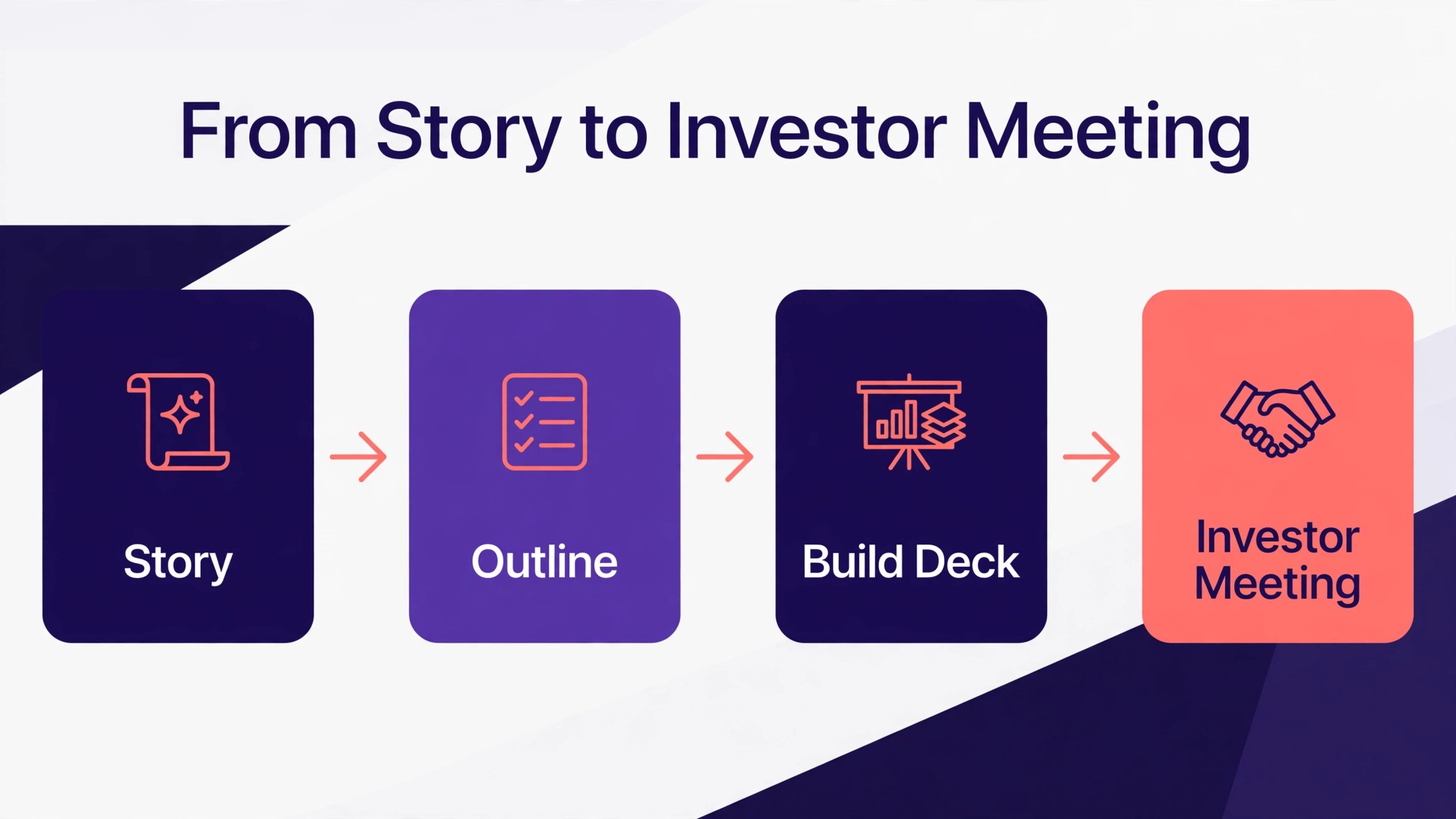
Use this workflow to use Gamma for sales pitch decks startups in order, because the order matters. Skipping ahead to extras before the basics are recorded creates work that has to be redone, while following the steps in order means each step builds on a finished earlier step. Tick each step off, and do not move on until the current step works with a real task.
- Write the one sentence story first. State the problem, the customer and the outcome in one sentence, and test it on someone outside the business. If they cannot repeat it back, the story is not clear yet, and no design will fix a story the listener cannot repeat.
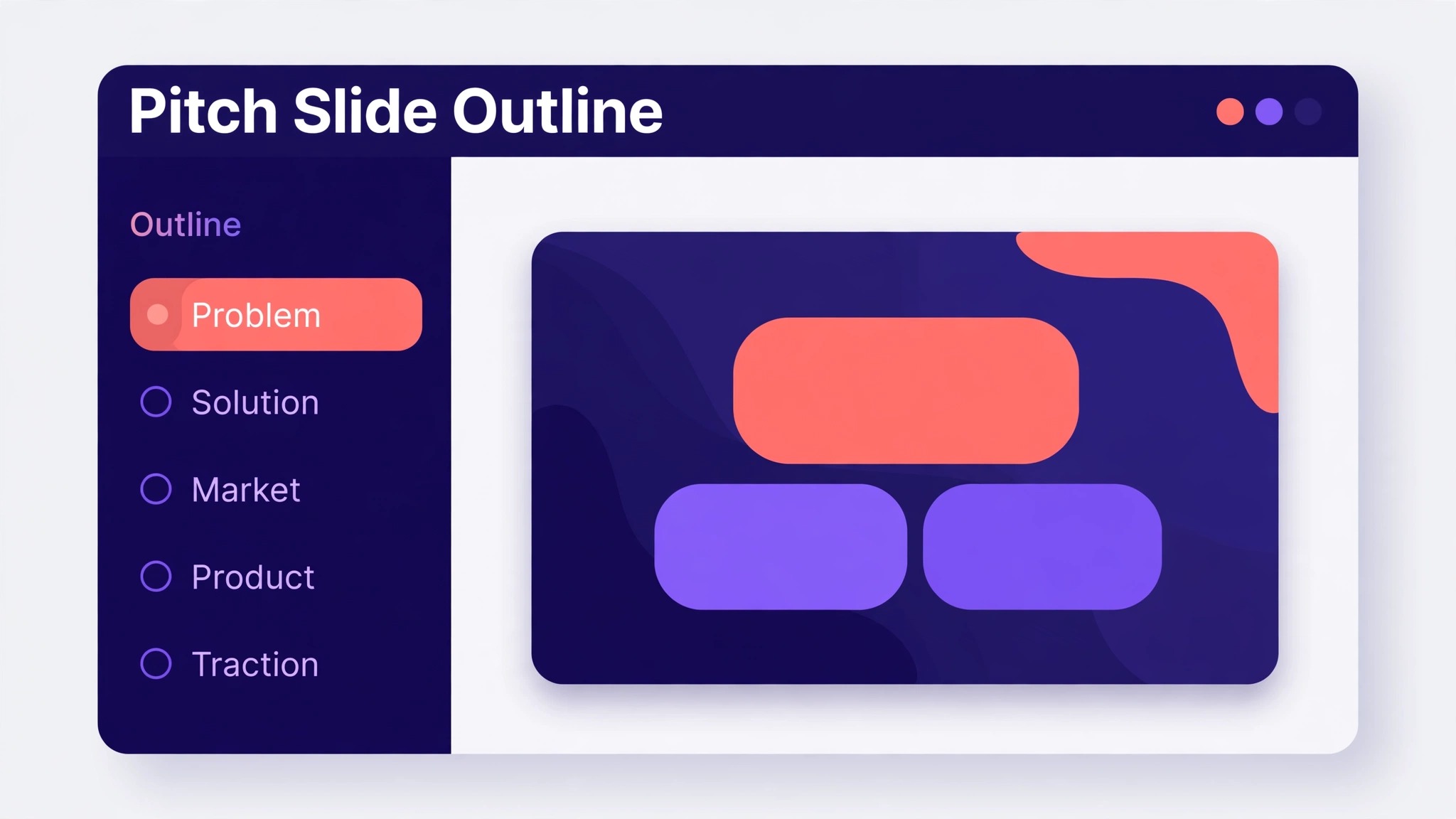
- Draft the eight to ten slide outline. Use problem, solution, market, product, traction, business model, competition, team and ask, cutting to ten slides maximum. An outline agreed before design prevents the common failure where slides multiply to twenty and the narrative disappears.
- Build the problem and solution slides. Make the problem specific with a cost, and the solution a direct answer to that problem, shown in one visual. A solution slide that lists features instead of answering the problem loses the thread the problem slide started.
- Add market, product and traction slides. Size the market honestly with a bottom up estimate, show the product in use rather than in diagrams, and put real traction numbers, users, revenue or pilots, on their own slide. Traction without numbers is a claim, not evidence.
- Add business model, competition and team slides. State how money is made, show competition on a simple positioning view, and present the team by relevant experience, not by biography. Investors fund teams with an edge for this problem, so show that edge plainly.
- Design for readability at a distance. Use large type, one idea per slide and charts that read in five seconds. A slide that needs explaining aloud is a slide that fails when sent ahead, since most decks are read alone before any meeting happens.
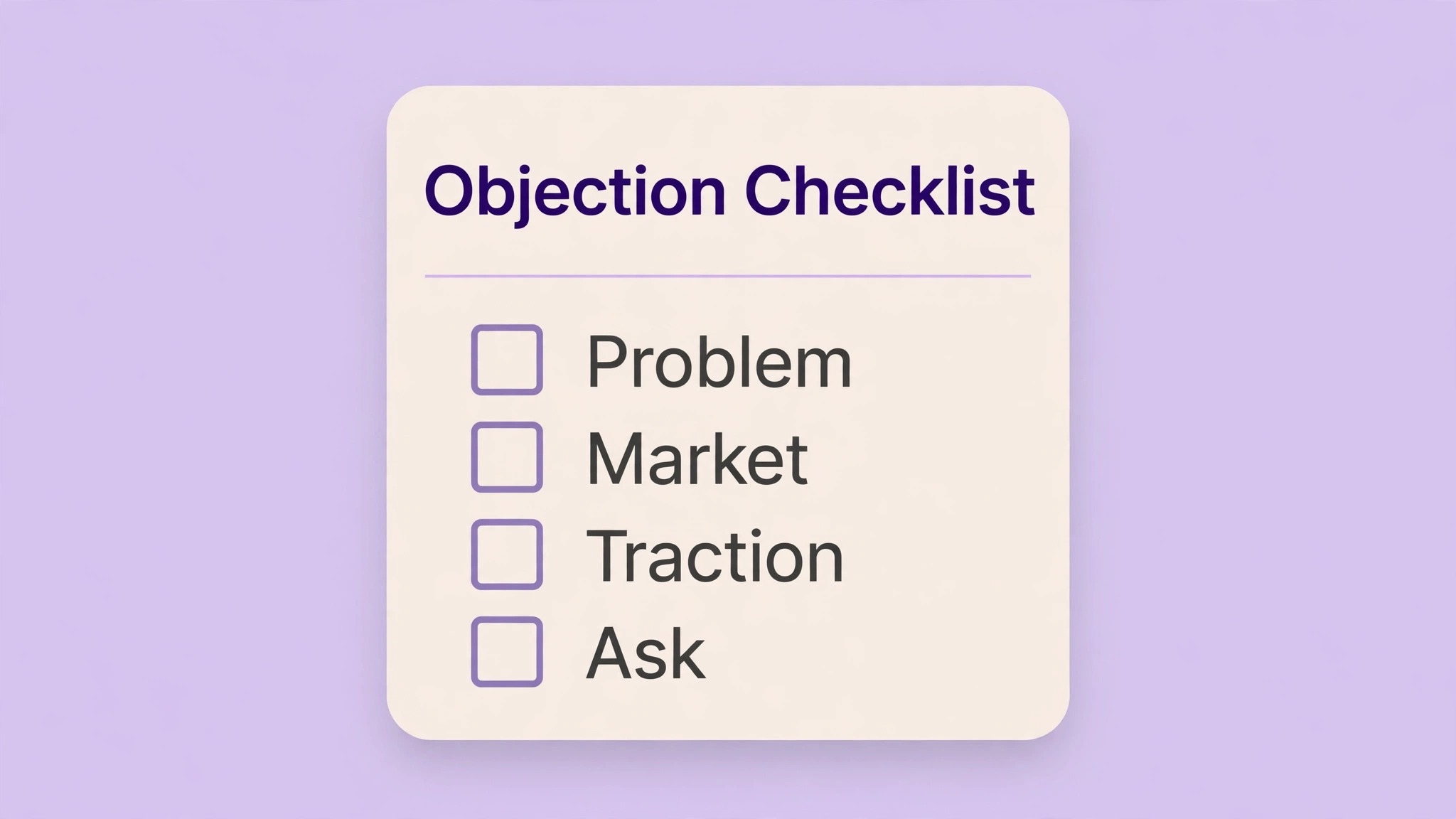
- Rehearse objections with the checklist. Work through the objection checklist in this guide with a critical friend, and prepare one slide or one sentence per objection. Objections handled calmly signal preparation, while objections that surprise signal a founder who has not stress tested the story.
- Send, present and iterate from feedback. Send the deck ahead where appropriate, present the story rather than reading slides, and update the deck after every serious meeting. A deck that never changes is a deck that never learned from investors.
An Example Week With the System
Take a concrete Monday as the starting point. The week begins with the current state visible in one place, so the first decision of the week is about priorities, not about finding information. That shift sounds small, but it changes the whole week, because decisions made from visible facts are faster and calmer than decisions made from searching inboxes and asking colleagues what is live. Speed and calm compound across a month of Mondays.
Wednesday usually brings the surprise, a late request, a changed deadline or a new item that does not fit the plan. A good system absorbs surprises by giving them a place, a status and a next action within minutes, instead of letting them float as a worry. The surprise still needs handling, but it no longer needs remembering, and that distinction frees attention for the handling itself, which is the work that actually matters.
Friday ends with a short honest audit. What moved, what stalled, what was dropped deliberately, and what the numbers say about the week. Deliberate drops deserve celebration, since a system that cannot say no to low value work will say yes to everything and finish nothing. That Friday audit, repeated weekly, is how a routine becomes a habit and a habit becomes a standard.
Your Template, Ready to Fill In
Use this template when you use Gamma for sales pitch decks startups without starting from a blank page each time. Copy it, fill it in with your own details, and keep the filled version where the people who use it can see it. A template that lives in a drawer helps nobody, while one that sits beside the work becomes the way the job actually gets done.
| Item | What to write down |
|---|---|
| Slide order | problem, solution, market, product, traction, model, competition, team, ask |
| Problem slide | specific customer pain with a cost, in customer words |
| Traction slide | real numbers only, users, revenue or pilots, dated |
| Ask slide | amount, use of funds, milestone bought, timeline |
| Objection prep | one answer per likely objection, rehearsed |
Fill the table in with real details from your own setup, not with guesses, because a plan filled with guesses gives confident answers that are wrong. If a detail is unknown, write unknown and find it before you act on that row, since a single guessed cost or time can undo an otherwise sound plan. Review the filled version every month for the first quarter, then every quarter after that, and update it when prices, people or suppliers change.
Keep the filled version where the work happens, whether that is a shared folder, a printed page or the tool itself, and name one person who owns updating it. Ownership matters because a template without an owner goes stale within a quarter, while one with a named keeper stays current through staff changes and price changes alike. When the owner changes, hand the template over explicitly, like any other responsibility.
- The deck is eight to ten slides, no more
- The problem slide names a specific pain with a cost
- The market slide uses a bottom up estimate, not a giant top down claim
- Traction numbers are real, dated and sourced
- The business model slide states plainly how money is made
- The team slide shows relevant edge, not biography
- The ask slide states amount, use and milestone
- Every likely objection has a prepared answer

When to Change the Template
Ask three questions before adding anything to the template. Does this field change a decision, does someone fill it in every week, and would the work suffer without it. If the answer to any question is no, leave the field out, since every field costs attention at entry time and at review time. Templates grow by addition and improve by subtraction, and the subtraction habit is the one most owners never develop.
When a field is removed, say why in a short note beside the template, so nobody re-adds it next month out of habit. Institutional memory lives in such notes, and a template with a short change history teaches new users faster than a template that simply appears. Good templates carry their reasoning with them, not just their fields.
Budget, Limits and Honest Trade-Offs
Before you commit money or time, write down the costs of the current way of working, because when you use Gamma for sales pitch decks startups you need a baseline to judge the new way against. Count the time spent, the errors made and the opportunities missed under the old way, then compare that total with the same total after one month of the new routine. If the new total is not lower, or the experience is not clearly better, change one thing and measure again rather than adding more tools.
Gamma offers a free tier that covers basic deck creation, with paid tiers adding more AI credits, exports and collaboration, so check the vendor pricing page before paying and start free. For a founder iterating a deck weekly, the paid tier pays if it saves design hours, which it usually does within the first deck.
Time cost is the real budget. Expect a day to write the story and outline well, then a few hours to build and refine the deck. A deck built in an afternoon without a clear story will cost far more in lost investor meetings than the design time saved.
Watch for the cost that appears only after launch, such as extra seats as a team grows, premium features on higher tiers, or the time spent maintaining a setup that looked simple at first. Read the pricing page for the tier you will actually land on in six months, not the starter tier you land on today, because a tool that is cheap at small volume and expensive at larger volume can punish growth. Set a calendar reminder to review the bill every quarter, and compare it with the time saved, since a subscription that no longer saves time should be renegotiated or dropped.
Traps That Look Like Shortcuts
The mistakes below are common because each one feels reasonable at the time, and when you use Gamma for sales pitch decks startups it helps to name them before they happen. Read the list with anyone who will use the routine, agree which mistake your setup is most likely to make, and put one guard in place against it, because a named mistake is far easier to avoid than a vague warning to be careful.
- Starting with the product instead of the problem. Investors fund pain and markets, not features.
- Claiming a giant market with no bottom up maths. A trillion dollar market claim signals naivety, not ambition.
- Hiding weak traction behind adjectives. Adjectives without numbers are claims, and investors discount claims.
- Building twenty slides. Ten slides force choices, while twenty slides hide the story.
- Reading slides aloud in the meeting. Present the story, let slides support it, and never read them.

Signs the System Is Paying Off
Pick a small set of numbers and track them monthly, because when you use Gamma for sales pitch decks startups you need evidence, not a feeling, about whether the change is paying. Choose numbers you can collect without extra admin, such as meetings booked per deck sent, questions per meeting, deck version iterations and time to update deck, and record them in one place on the same day each month. A trend over three months tells you far more than a single good or bad week.
Track meetings booked per deck sent, questions asked per meeting and deck iterations. If meetings stay low, the problem or traction slides need work, not the design. If meetings happen but questions cluster on one topic, that topic needs its own slide or a stronger answer, and the objection checklist should grow accordingly.
Also track update time. If updating the deck takes a day, it will not stay current, so simplify the design system until updates take an hour. A current deck beats a beautiful stale one, since investors read traction dates carefully.
When a number moves the wrong way, change one element and watch the next period before changing anything else. Changing five things at once feels decisive, but it destroys the evidence, since nobody can tell which change helped. Single changes, measured honestly, are slower to announce and faster to learn from, which is the trade that matters over a year.
The Ninety Day Picture
After ninety days, a healthy setup shows up in small, boring ways, such as meetings booked per deck sent, questions per meeting, deck version iterations and time to update deck trending in the right direction without heroic effort, and fewer messages asking where things stand. Nobody celebrates a routine that simply works, which is why it is worth naming those signs when they appear, so the people involved recognise the payoff and keep funding the habit.
The warning sign is different, and it is worth watching for, which is when people start working around the setup instead of through it. Workarounds usually mean one step no longer fits reality, so ask what changed, fix that step, and prune anything the workaround replaced. A setup that adapts to one real change survives, while one that demands loyalty to an outdated step gets quietly abandoned.
Set the ninety day review now, with a named owner and a date in the calendar. Without a named owner and a date, reviews slip, and a slipped review means a system that slowly stops matching the reality it was built for. The review itself need not take long, since one hour with the numbers and the honest answers is enough to decide what to keep, what to change and what to stop.
Getting Through Month One
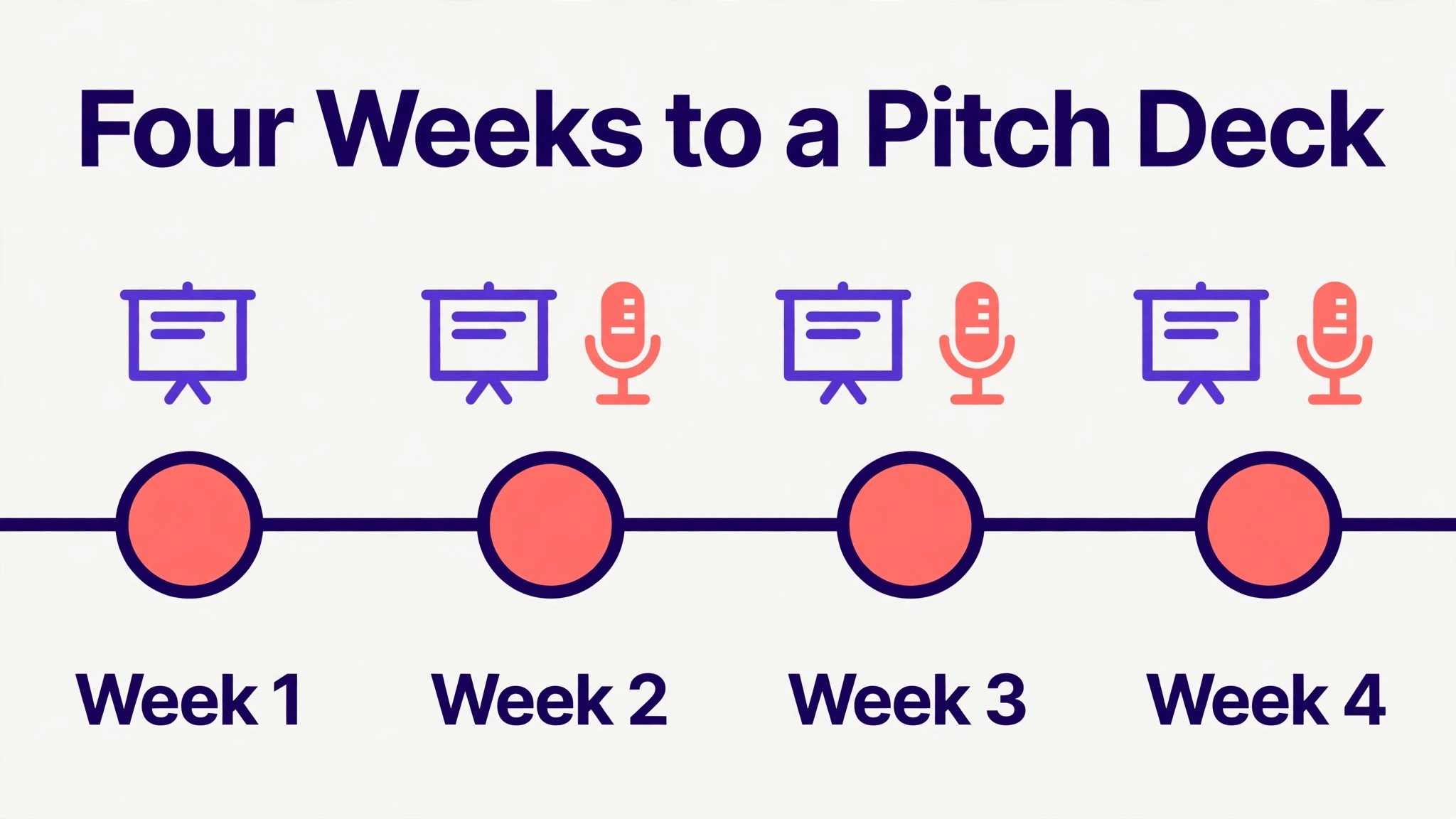
Week one is story and outline. Write the one sentence story, draft the ten slide outline, and test it on outsiders before any design. Do not open a design tool until the story survives retelling by someone else.
Weeks two to four are build and rehearse. Build the deck in Gamma, rehearse objections with a critical friend, send to friendly reviewers and iterate. By month end, the deck should be ten slides, readable alone, and ready for real investor meetings.
If the first month feels messy, resist the urge to rebuild the system from scratch, since the fault usually sits in one step rather than in the whole approach. Return to the numbers you tracked, find the step where results diverged from the plan, and change that step alone. System swaps feel decisive, but they reset learning to zero, while a single step fix preserves everything that already worked.
Day by Day in Week One
On day one, build the template and import what is already live, without redesigning anything. The goal for day one is a working system with real entries, not a beautiful system with sample data, since real entries reveal the flaws that sample data hides. End the day by checking that every live item has a status and a next action.
On day two, use the system for new work as it arrives, and note every moment of friction. Friction notes are gold, because they point at the exact field, step or view that needs fixing, while general complaints about the system point nowhere. Keep the notes short, one line each, and review them at the end of the week.
On day three, fix the single biggest friction from the notes, and leave the rest alone. One fix per week is the pace that improves a system without destabilising it, and a system that changes daily never gets learned properly by anyone, including its owner. Stability for a week beats improvement every day.
On day four, share the system with anyone else who touches the work, and watch them use it without help. Watching a second person reveals instructions that only made sense to the author, and those instructions need rewriting before the system can survive a holiday or a handover. A system that only its author understands is not yet a system.
On day five, run the first weekly review, record the numbers, and decide one change for next week. The review closes week one with evidence instead of feelings, and that evidence becomes the baseline for month one. A week that ends with a review has already succeeded, whatever the numbers say, because the habit is the achievement.
Fixing the Common Stall Points
When reviews are the problem, shrink the review rather than skipping it. A five minute review that happens beats a thirty minute review that does not, so cut the review to the three most important checks and protect its slot on the calendar. Pairing the review with an existing habit, such as Friday coffee or Monday planning, also helps, since a review attached to a habit survives while a review floating free gets postponed.
When results stay flat after a month of honest use, check whether the system measures the right thing. A tracker that counts activity while the goal is outcome will show busy weeks and flat results, which feels like failure even when effort is real. Revisit the metrics, pick one outcome number that matters, and let that number drive the next change. If the outcome number still does not move after a further month, the approach itself, not the system, needs rethinking.
A stalled system usually fails at one of three points, which are entry, review or follow through, and diagnosing the right point saves a rebuild. If entries lag, the template is too heavy or entry takes too long. If reviews get skipped, the review is too long or it has no fixed slot. If actions do not follow, the numbers are not connected to decisions. Name the failing point plainly before changing anything, since a fix aimed at the wrong point adds complexity without restoring momentum.
More Reading on Stratilyze
More Reading on Stratilyze. For the systems around this one, read the best ai pitch deck generators guide, the gamma alternatives guide, the best crm software for small business guide. Read the guide that matches your next bottleneck first, because fixing the biggest bottleneck next gives a larger gain than polishing a part of the setup that already works well.
Frequently Asked Questions

How many slides should a pitch deck have?
Eight to ten for a standard investor pitch, covering problem through ask. Longer decks dilute the story and rarely get read fully, while shorter decks often skip traction or business model, which investors need to see.
Should I send the deck before the meeting?
Often yes, since many investors read decks alone before deciding to meet. Design slides to read standalone, with large type and one idea each, so the deck works both sent ahead and presented live.
What traction counts if I have no revenue yet?
Pilots, waitlists, letters of intent, user growth and engagement all count, provided numbers are real and dated. State what the traction is honestly, since inflated traction collapses under one diligence question.
Is Gamma free enough for a pitch deck?
The free tier covers basic deck creation, which suits a first version. Paid tiers add AI credits and exports that help iterating founders, so start free and upgrade when deck iteration becomes weekly.
How do I handle a question I cannot answer?
Say so plainly, note it, and follow up with the answer within a day. A calm admission signals honesty, while a bluffed answer signals risk, and investors remember which founders bluffed.
Should the deck or the founder tell the story?
The founder tells the story and the deck supports it. Slides carry evidence and structure, while the founder carries conviction and answers, so rehearse the narrative, not just the slide order.
The Bottom Line on Pitch Decks
Investors fund a painful problem, a large reachable market and a team with an edge, told in that order with real traction as proof. When you use Gamma for sales pitch decks startups get the design speed to tell that story cleanly, provided the story is written and stress tested before design begins. Design amplifies a clear story, it cannot rescue a vague one.
Write the one sentence story this week, outline ten slides, and build the deck around problem, traction and ask. Rehearse every objection with a critical friend, then send the deck and let investor questions teach you the next iteration. A deck that learns from meetings is a deck that raises.