

Academic literature search fails when it returns either too much or too little, a flood of vaguely related pages or a handful of sources that miss the key debate. When you use Perplexity for academic literature search, cited answers give a fast map of a topic, with sources attached to claims, so you can move quickly from a broad question to the specific papers, authors, and disagreements that matter. That speed is valuable, provided every cited claim is checked against its original source before it enters your own writing.
This guide builds a literature search workflow that uses Perplexity for discovery and human judgment for verification. You will frame questions, use focus modes, check sources, organise findings, and avoid citation errors. Perplexity pricing checked at draft time lists a free plan with cited answers and limited daily Pro searches, Pro at 20 dollars per month or 200 dollars per year with far more Pro searches and file uploads, and an education Pro option at 10 dollars per month for verified students and educators. Confirm current pricing on the official page.
Why This Approach Works
Literature search is not about collecting papers, it is about understanding a field, including its main findings, its methods, its disagreements, and its gaps. A search tool that returns answers with citations helps at the discovery stage, because it shows which sources support which claims and where sources disagree, in a form that can be explored further. Perplexity’s academic focus mode narrows search toward papers and scholarly sources, which reduces the noise of general web results, while follow up questions in the same thread let a broad topic narrow gradually without starting a new search each time. Used that way, the tool accelerates the early, exploratory phase of research, which is often the slowest part for students and new researchers.
Citations do not guarantee accuracy, and that warning matters more in academic work than anywhere else. A cited answer can misread a source, quote a secondary summary as if it were primary evidence, or miss context that changes a claim’s meaning. The workflow in this guide therefore treats Perplexity as a starting point for source discovery, never as a final authority, and it requires opening original sources, checking publication details, and recording exactly what each source does and does not support. Research that follows that discipline will be slower than copying cited answers, but it will also be defensible, which is the standard academic work must meet.

How to use Perplexity for academic literature search Step by Step
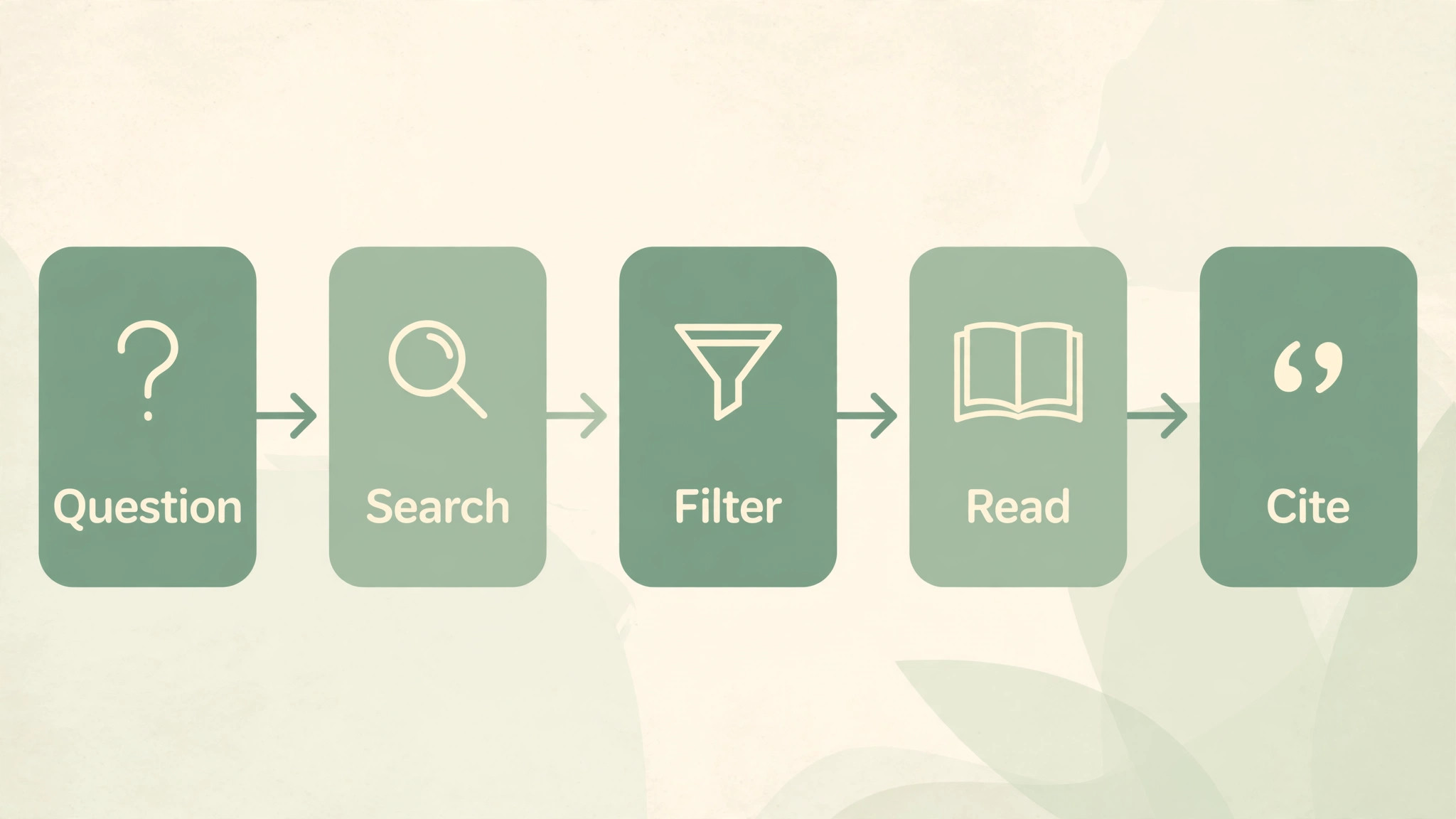
Search in the order below, starting with a precise question, not with a broad topic. When you use Perplexity for academic literature search, a narrow, well framed question produces useful sources, while a vague question produces a vague answer that looks comprehensive but teaches little.
- **Frame a precise research question.** Write the question in one sentence, naming the population, intervention or phenomenon, comparison, and outcome where relevant, plus the time period or context. A precise question guides search terms, focus mode, and source selection, while a vague question such as a broad topic name returns sources that cannot be compared fairly. Refine the question after an initial search, and record the refined version for your methods note.
- **Choose academic focus and search terms.** Select academic focus where available, and build search terms from key concepts, synonyms, and author names, rather than from a single phrase. Run several variations, noting which terms return relevant papers and which return noise, and keep a search log of terms tried and results found. A search log makes the literature search reproducible, which matters for dissertations and systematic work.
- **Read cited answers as a map, not as evidence.** Use the cited answer to identify candidate sources, key authors, and areas of agreement or disagreement, but do not copy its claims into your writing without checking. Note which claims have strong source support and which rest on a single source or a weak source, because that distinction guides where to read deeply. Treat the answer as a map of the field, and the original papers as the territory itself.
- **Open and check every important source.** Open each candidate source, check title, authors, journal or publisher, date, and method, and read the abstract and, where needed, the full text. Verify that the source actually supports the claim attributed to it, and note any limits, such as small samples, specific populations, or older data. A source that is opened and checked is evidence, while a source that is only cited from a summary is a risk.
- **Organise findings by theme and debate.** Group sources by theme, finding, or position in a debate, rather than listing them in search order, and note agreements, disagreements, and gaps for each theme. A themed organisation reveals the structure of the field, which is what a literature review must convey, while a chronological list often hides the argument. Use a simple table or document with source, claim, evidence strength, and your note for each entry.
- **Follow citations forward and backward.** From each key paper, follow its references backward to earlier foundational work, and search forward for later papers that cite it, using scholarly databases where available. Forward and backward citation following finds papers that keyword search misses, especially older foundational work and recent responses. Record the chain, so the search can be explained and repeated by a supervisor or reviewer.
- **Draft with citations to original sources.** Write from your organised notes and original sources, citing the papers themselves, not the search tool’s summary. Quote sparingly, paraphrase accurately, and distinguish your interpretation from a source’s claim. A literature review written from original sources will read as an argument about the field, while a review written from summaries will read as a list of other people’s sentences.
- **Run a final citation and accuracy check.** Check every citation in the draft against its source for author names, dates, titles, and claim accuracy, and remove any citation that cannot be verified. Check that all cited works appear in the reference list and vice versa, using your institution’s required style. A final check takes time, but it prevents the citation errors that undermine otherwise good academic work.
After the final check, save the search log, the themed notes, and the reference list together, so the literature search can be revisited, extended, or defended later. Research is rarely finished in one pass, and a well organised search archive makes the next pass far faster, whether for a revision, a new chapter, or a follow up study.
Options Compared
Literature search tools suit different stages, and Perplexity should be used where it excels, which is fast, cited discovery. When you use Perplexity for academic literature search, the table below compares the main approaches, so the tool is not asked to do work that belongs in a scholarly database or a reference manager.
| Search approach | Best for | Watch out for |
|---|---|---|
| Perplexity academic focus | Fast cited discovery and mapping | Citations need original checking |
| Scholarly databases | Systematic, reproducible searches | Slower, needs search skill |
| Reference managers | Organising and citing sources | Only as good as entries added |
| Citation following | Finding foundational and recent work | Can drift from the question |
| Supervisor and peer advice | Key authors and debates | Limited to personal knowledge |
Use Perplexity for the exploratory map, scholarly databases for systematic searches, citation following for depth, and a reference manager for organisation. No single tool covers all stages well, and a workflow that combines them, with human checking at each stage, will produce a literature review that is both efficient and defensible. Choose tools by stage, not by habit, and record which tool served which purpose in your search log.

Costs and Tools to Budget For
Budget for literature search in tool cost and time. Perplexity lists a free plan with cited answers and limited daily Pro searches, which suits occasional discovery, while Pro at 20 dollars per month or 200 dollars per year adds far more Pro searches, file uploads, and model choice. Education Pro at 10 dollars per month for verified students and educators halves the Pro cost for eligible users. Confirm current pricing and education eligibility on the official page, because limits and verification rules change.
Time is the larger cost, and it should be budgeted by stage, with discovery fastest, source checking slowest, and writing in between. A literature search that rushes source checking to save time will cost more later, when errors must be fixed under deadline or after supervisor feedback. Protect checking time explicitly in the research plan, and treat it as part of the search, not as an optional extra that can be cut when time is short.
Template and Checklist
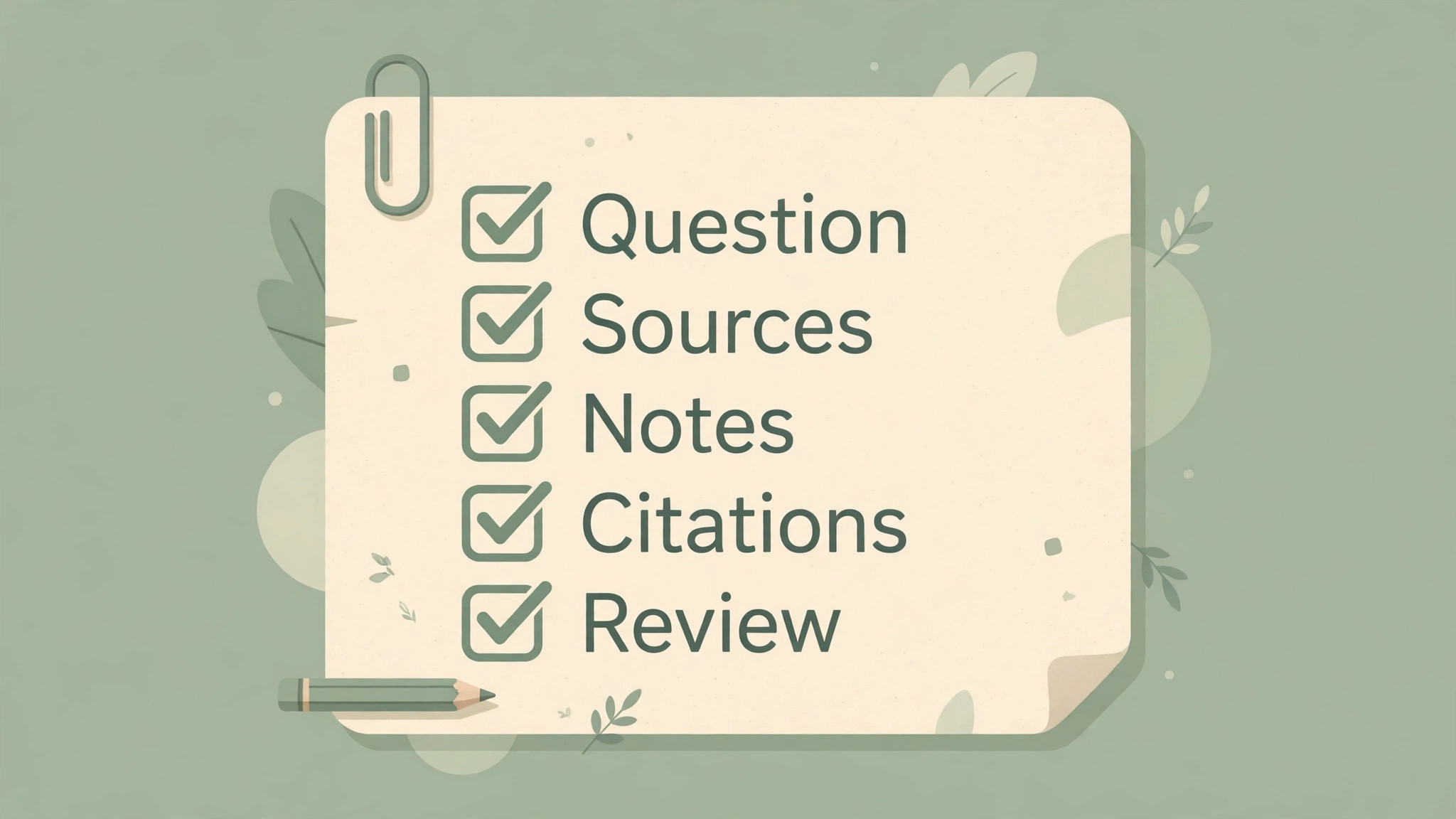
Run this checklist before citing any source found through a search tool. When you use Perplexity for academic literature search, the checklist is the gate that stops misread citations, weak sources, and unverified claims from entering academic writing.
- The research question is written precisely, with scope and context stated.
- Academic focus is used, with search terms and variations logged.
- Cited answers are treated as a map, not as evidence for writing.
- Every important source is opened and checked for title, authors, date, and method.
- Each source is verified to actually support the claim attributed to it.
- Findings are organised by theme and debate, with agreements and gaps noted.
- Citation following is used forward and backward from key papers.
- Draft citations point to original sources, not to search summaries.
- Quotes are short, accurate, and distinguished from paraphrase and interpretation.
- Every citation is checked against its source for names, dates, and accuracy.
- Reference list and in text citations match completely in the required style.
- Search log, themed notes, and reference list are saved together.
Keep the completed checklist with the search log, so a supervisor or reviewer can see how sources were found, checked, and used. A transparent search process strengthens a literature review, because it shows that conclusions rest on checked evidence rather than on convenient summaries. Documentation of method is part of academic quality, not an administrative burden.
Mistakes to Avoid
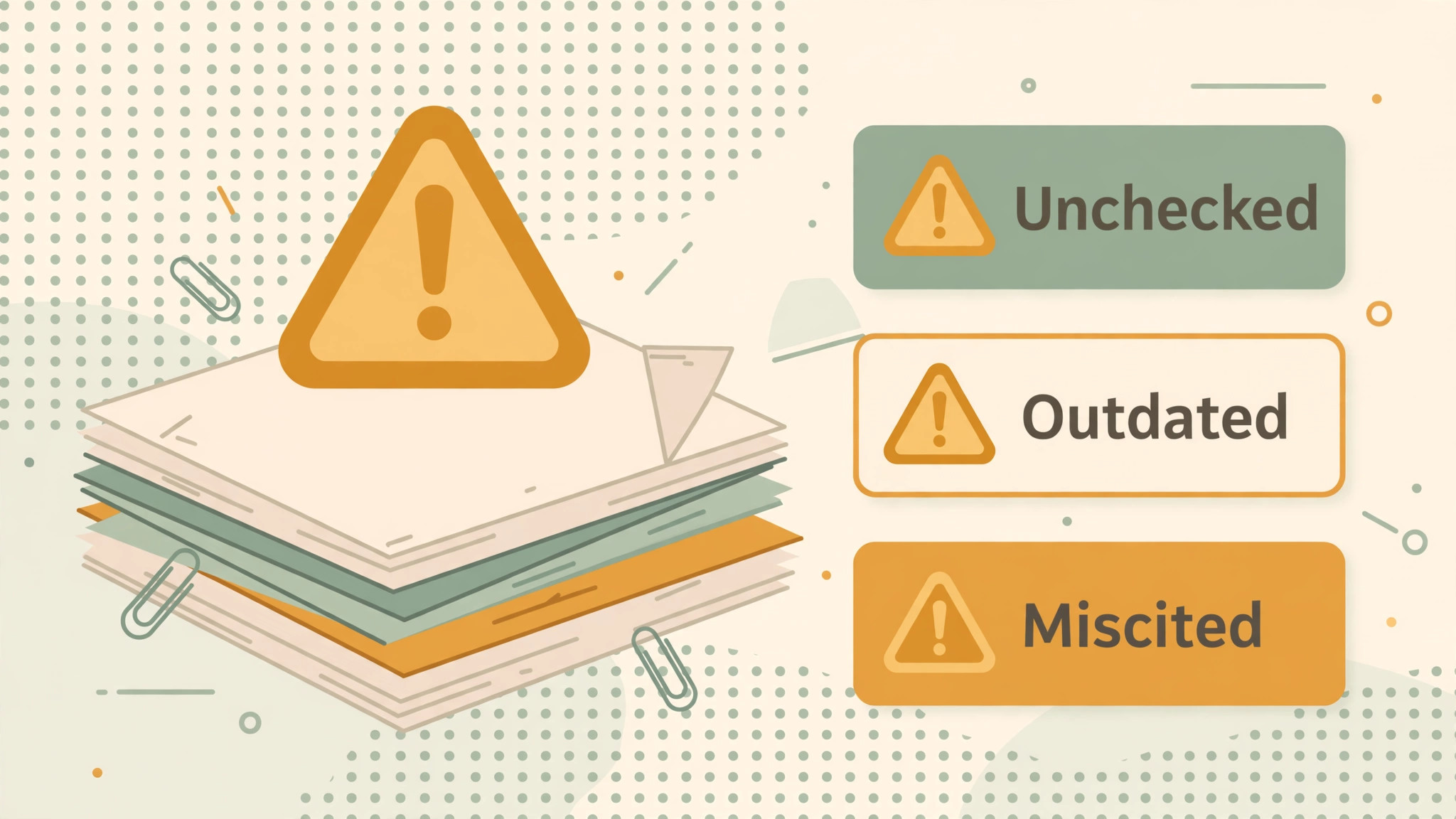
Academic search mistakes usually come from trusting summaries over sources. When you use Perplexity for academic literature search, watch for these five mistakes, because each one can undermine a literature review, a dissertation chapter, or a research proposal.
- **Copying cited answers as writing.** Copying a search tool’s answer, even with its citations, produces writing that may misread sources and lacks original argument. Write from organised notes and original papers, using the tool only for discovery. Original writing from checked sources is the standard that academic work must meet, and no tool can substitute for it.
- **Trusting citations without opening sources.** A citation beside a claim does not prove the claim, because the source may be weak, outdated, or misread. Open every important source, check its method and limits, and verify the claim in context. A literature review built on unopened sources will fail under supervisor or peer scrutiny.
- **Searching with one phrase only.** A single search phrase returns a narrow slice of a field and misses synonyms, older terms, and key authors. Run several term variations, log them, and follow citations forward and backward. A reproducible search with varied terms is far stronger than a single lucky query.
- **Listing sources without themes.** A literature review that lists papers in search order, without grouping by theme or debate, reads as a bibliography with sentences, not as an argument. Organise sources by theme, finding, or position, and note agreements, disagreements, and gaps. The structure of the review should reflect the structure of the field.
- **Ignoring source quality and limits.** Treating all sources as equal, regardless of method, sample, date, or publication venue, weakens any conclusion drawn from them. Note evidence strength and limits for each key source, and weigh stronger, more relevant sources more heavily. A review that acknowledges limits is more persuasive than one that pretends all evidence is equal.
If a literature review feels thin despite many sources, the cause is usually missing themes or missing debates, not missing papers. Reorganise existing sources by theme, identify where sources disagree or where evidence is absent, and search specifically for those gaps. A targeted search for a known gap will improve a review far more than a general search for more papers on the same topic.
A Worked Example
A masters student starting a dissertation chapter on remote work and team trust began with a broad question and received a broad answer, a tidy summary that named a few sources but taught little about where researchers disagreed. The question was reframed into one sentence naming the population, remote teams, the phenomenon, trust between team members, the comparison, office based teams, and the outcome, trust over time. That single sentence changed the search, because it set the search terms, the scope, and the standard for which sources counted as relevant.
With academic focus selected, the student ran several term variations built from key concepts, synonyms, and author names, and kept a search log of terms tried and results found, noting which terms returned relevant papers and which returned noise. Cited answers were read as a map, not as evidence, and the map showed a genuine disagreement, with some sources reporting trust forming more slowly in remote teams and others finding no lasting difference once communication habits settled. Neither side was copied into writing, because a cited answer can misread a source or quote a secondary summary as if it were primary evidence.
Every important source was opened and checked for title, authors, journal or publisher, date, and method, and each claim attributed to a source was verified in context, with limits noted, such as small samples or specific populations. From two key papers, citations were followed backward to earlier foundational work and forward to later papers that cited them, using scholarly databases, which found an older study on team formation that keyword search had missed. Findings were grouped by theme, trust building, communication frequency, and manager practices, with agreements, disagreements, and gaps noted for each theme, instead of being listed in search order.
Drafting used the organised notes and the original papers, with citations pointing to the papers themselves, short quotes kept accurate, and the student interpretation kept distinct from each source claim. A final check matched every citation against its source for author names, dates, titles, and claim accuracy, and confirmed that all cited works appeared in the reference list and vice versa in the required style. The search log, themed notes, and reference list were saved together, so the search could be revisited for the next chapter, extended for a revision, or explained to a supervisor without reconstructing it from memory.

Advanced Tips Worth Trying
Once the basic search habit works, five refinements make a literature search stronger without adding days to the project. The first is treating the search log as a research record, not as scratch paper, with every term variation, every result, and every scope decision written down, because a reproducible search is what a dissertation or systematic review must be able to show.
- Run follow up questions in the same thread to narrow a broad topic gradually, instead of starting a new search each time, because the thread carries the context that makes each narrower question sharper than the last.
- Vary terms deliberately with synonyms, older terms, and author names, and log which variations returned relevant papers and which returned noise, so the next search starts from knowledge rather than from guessing.
- Follow citations forward and backward from two key papers, not one, because a single chain can drift from the question, while two chains reveal whether a theme is widely shared or rests on one research group.
- Record evidence strength and limits for each key source, such as sample, population, and date, and weigh stronger and more relevant sources more heavily, because a review that acknowledges limits is more persuasive than one that treats all sources as equal.
- Decide scope explicitly in the log, naming what is deliberately excluded and why, so a supervisor can challenge the boundary early, when it is cheap to change, instead of at submission, when it is not.
A final refinement is protecting checking time in the research plan as its own stage, not as an optional extra to be cut when time is short. Discovery is the fastest stage, checking is the slowest, and a search that rushes checking to save time will cost more later, when errors must be fixed under deadline or after supervisor feedback. A log that records failures as well as successes is the difference between a search that improves and one that repeats itself.
How to Measure Success
Judge a literature search by four measures, recorded monthly in the search log during a project. The first is sources found, counted from the log of searches run. The second is sources checked in full, counted as sources opened, verified for title, authors, date, and method, and confirmed to support the claim attributed to them. The third is themes covered, counted as planned themes that hold at least one checked source with its agreements and gaps noted. The fourth is gaps remaining, counted as themes where checked sources are thin or where sources disagree without a resolution.
A fifth useful number is citation errors caught in the final check, counted before submission, because it shows whether checking is working or being rushed.
Track time by stage as well, with discovery, source checking, and writing logged separately, because the balance between stages reveals more than a total. A search with fast discovery and slow checking is healthy, while a search with fast checking usually means sources are being trusted from summaries, which is the exact failure this workflow guards against. Compare each measure with the previous month, and look for themes where checked sources stay thin across two reviews, because those themes need targeted searching with new terms or citation chains from a different key paper.
Act on patterns rather than totals. A rising count of sources found alongside flat themes covered usually means searching is expanding without deepening, so stop general searching and target the known gaps. A rising count of citation errors caught at the final check usually means earlier checking was skipped, so move the check earlier, verifying each source as it enters the notes. Keep the measurement habit inside the log itself, so it survives busy weeks, because a log maintained across a whole project is the methods record a supervisor or reviewer will ask to see.
Review and Next Steps
Review literature searches monthly during a project, with the four measures, sources found, sources checked in full, themes covered, and gaps remaining, plus time by stage. Compare each measure with the previous month, and look for themes where checked sources are thin, because those themes need targeted searching before writing, not more general searching after a draft exists. If gaps persist across two reviews, adjust search terms, follow citations from a different key paper, or ask a supervisor for key authors in that area, and record the decision in the log.
Keep a search log note with the four measures, search terms tried, and decisions made about scope. When you use Perplexity for academic literature search on a regular monthly cycle, that log becomes the methods record for a dissertation or paper, and it helps a supervisor understand what was searched, what was deliberately excluded, and what remains unchecked. Share the log at supervision meetings, because a transparent search process invites useful guidance that a hidden process cannot receive, and early guidance is cheaper than late correction.
Use the monthly review to plan the next stage, not only to judge the last one. A theme with thin checked sources gets a targeted search with new term variations and a fresh citation chain. A theme where sources disagree gets a deeper read of the original papers, with evidence strength and limits compared side by side, before any drafting leans on one side. A scope decision that no longer fits the emerging argument gets rewritten in the log with its reason, so the change is visible rather than silent.
Let the review change how the next search is run, not only what it covers. A search that returned noise from one term variation gets that variation retired in the log, with a note about why it failed, so the next researcher does not repeat it. A theme that stayed thin after two targeted searches gets a different entry point, such as a new key paper, a supervisor suggestion, or a scholarly database search with formal inclusion criteria, rather than a third run of the same terms.
A source that was checked and rejected gets its reason recorded, such as a sample too small for the claim or a population too narrow for the question, so a later draft does not quietly reintroduce it. A scope decision that excluded a whole body of work gets revisited once, at the review, with the reason for keeping or lifting the exclusion written down, because an exclusion nobody re-examines can silently narrow a review that should have been broader.
Before submission, run the final citation and accuracy check as its own stage, matching every citation against its source for author names, dates, titles, and claim accuracy, and confirming that cited works and reference list entries match completely in the required style. Remove any citation that cannot be verified, however useful its claim looked in a summary. After submission, archive the search log, themed notes, and reference list together, so the search can be extended for a revision, reused for a follow up study, or defended without being reconstructed from memory.
For related reading on Stratilyze, the guide to market research with Perplexity shows cited search for business questions, and the guide to daily news research with Perplexity covers fast, current source checking. Read the market research guide first if your literature search includes industry sources, because source quality habits there transfer directly, and the method here for use Perplexity for academic literature search shares the same verification discipline.
Frequently Asked Questions
Can I cite Perplexity in academic work?
Cite the original sources that Perplexity helps you find, not the search tool’s summary, because academic citation points to evidence, not to a search interface. Use Perplexity for discovery and mapping, then open, check, and cite the papers themselves. Check your institution’s guidance on AI tools, and disclose tool use where required.
Which Perplexity plan suits academic search?
The free plan suits occasional cited discovery, while Pro at 20 dollars per month or 200 dollars per year suits regular research with far more Pro searches and file uploads. Verified students and educators may qualify for education Pro at 10 dollars per month. Start free, and upgrade when daily search limits actually block research.
How do I check a Perplexity citation?
Open the cited source, verify title, authors, date, and method, and confirm that the source actually supports the claim in context. Read the abstract and, where needed, the full text, and note any limits such as sample size or population. A citation that survives that check can be used, while one that does not should be dropped or replaced.
What is academic focus mode in Perplexity?
Academic focus narrows search toward papers and scholarly sources, reducing general web noise for research questions. It is a useful starting filter, but it does not replace scholarly databases for systematic searches, nor does it guarantee that every returned source is strong. Use it for discovery, then verify sources individually.
How many sources does a literature review need?
There is no fixed number, because a review needs enough sources to cover themes, debates, and gaps in the field, not a target count. A narrow question may need fewer, well chosen sources, while a broad field needs more. Judge completeness by theme coverage and by whether key debates and gaps are addressed, not by total count.
How do I use Perplexity for academic literature search for a systematic literature review?
Use Perplexity only for early mapping, then run systematic searches in scholarly databases with logged terms, inclusion criteria, and screening records. Systematic reviews require reproducibility that a chat style search cannot provide alone. Record the full search strategy, so the review can be repeated and defended.
Research You Can Defend
A literature search that can be defended starts with a precise question, uses cited answers only as a map, opens and checks every important source, organises findings by theme and debate, and cites original papers in the final writing. Keep a search log, note evidence strength and limits, and run a final citation check before submission. When you use Perplexity for academic literature search in that disciplined way, speed and rigour combine, because the tool accelerates discovery while human checking protects accuracy, which is exactly what academic work requires.