
A five day close is the right target. A small business should close its books in three to five business days after month end, using the same sequence every month, and locking the period before anyone sends a report out. That target comes from accounting guides that put a straightforward service business at two days and a business with inventory or several locations at up to a week. If you are learning how to do month end close small business books on a reliable rhythm, that sequence is the whole game, and this guide gives it to you step by step.
A month end close is the routine that turns a pile of transactions into numbers you can trust. Without it, the profit figure in your software is a guess, because unreconciled bank lines, missing bills, and unrecorded payroll accruals all sit inside it. With it, you know what you earned, what you owe, what customers owe you, and how much cash you actually hold. That knowledge drives pricing, hiring, tax payments, and loan conversations, and it removes the year end scramble that costs small firms far more than a few days of monthly discipline.
The close also protects you from slow drift. A miscategorised expense in January looks small. The same error repeated for twelve months becomes a tax return problem, a lender question, or a pricing decision built on wrong margins. A monthly close catches the error while the receipt is still findable and the memory is still fresh. That is why the order matters as much as the checklist. Reconcile before you review, adjust before you report, and lock before you share.
This guide follows a five stage workflow. Reconcile, review, adjust, lock, and report. Each stage has a named owner, even if that owner is you for every stage, and each stage ends with a check you can tick. The workflow draws on published month end checklists from accounting guides, including a twelve step checklist that runs from recording sales to locking the period, and on timing guidance from those same guides, which is flagged where it comes from a guide rather than a vendor page, so confirm timing claims against your own software and adviser before you set a hard deadline.
How to Do Month End Close Small Business Owners Can Finish in Five Days
The fastest way to learn how to do month end close small business work is to run the same list in the same order every month. Do not rearrange the steps to suit the week, because the order is what catches errors. Bank reconciliations come before profit review, because a profit review built on unreconciled cash is fiction. Adjustments come after review, because you need to see the anomaly before you can correct it. Locking comes last, because a locked period is a promise that the numbers will not change under the report you just sent.
Set a close calendar before the month ends, because a calendar is the backbone of how to do month end close small business routines reliably. Pick a cutoff date for invoices and bills, a reconciliation day, a review day, and a lock day, and tell anyone who sends you bills or expense claims about the cutoff. A supplier invoice that arrives on the fifth of the next month for work done last month still belongs to last month, and the close calendar needs a rule for it. Record it as an accrual if you know the amount, or as an open item if you do not, and never let it drift silently into the next month unrecorded.
Assign one owner per task, even in a one person business. The owner is the person who signs off that step, not necessarily the person who did the typing. In a one person firm, that means you review your own bookkeeping with fresh eyes on review day, using a checklist rather than memory. In a firm with a bookkeeper, the owner reviews the bookkeeper work and the bookkeeper does not mark their own review complete. That separation catches the transposed number, the duplicate bill, and the receipt filed under the wrong vendor.
Keep a close file for each month. Save the bank reconciliation reports, the profit and loss statement, the balance sheet, the aging reports, and a short note of exceptions and open items. That file is what your accountant asks for at year end, what a lender asks for during a loan review, and what you consult when a number looks wrong three months later. A close without a file is a close you will have to redo, because nobody can prove what was checked.

Stage One, Reconcile Every Cash Account
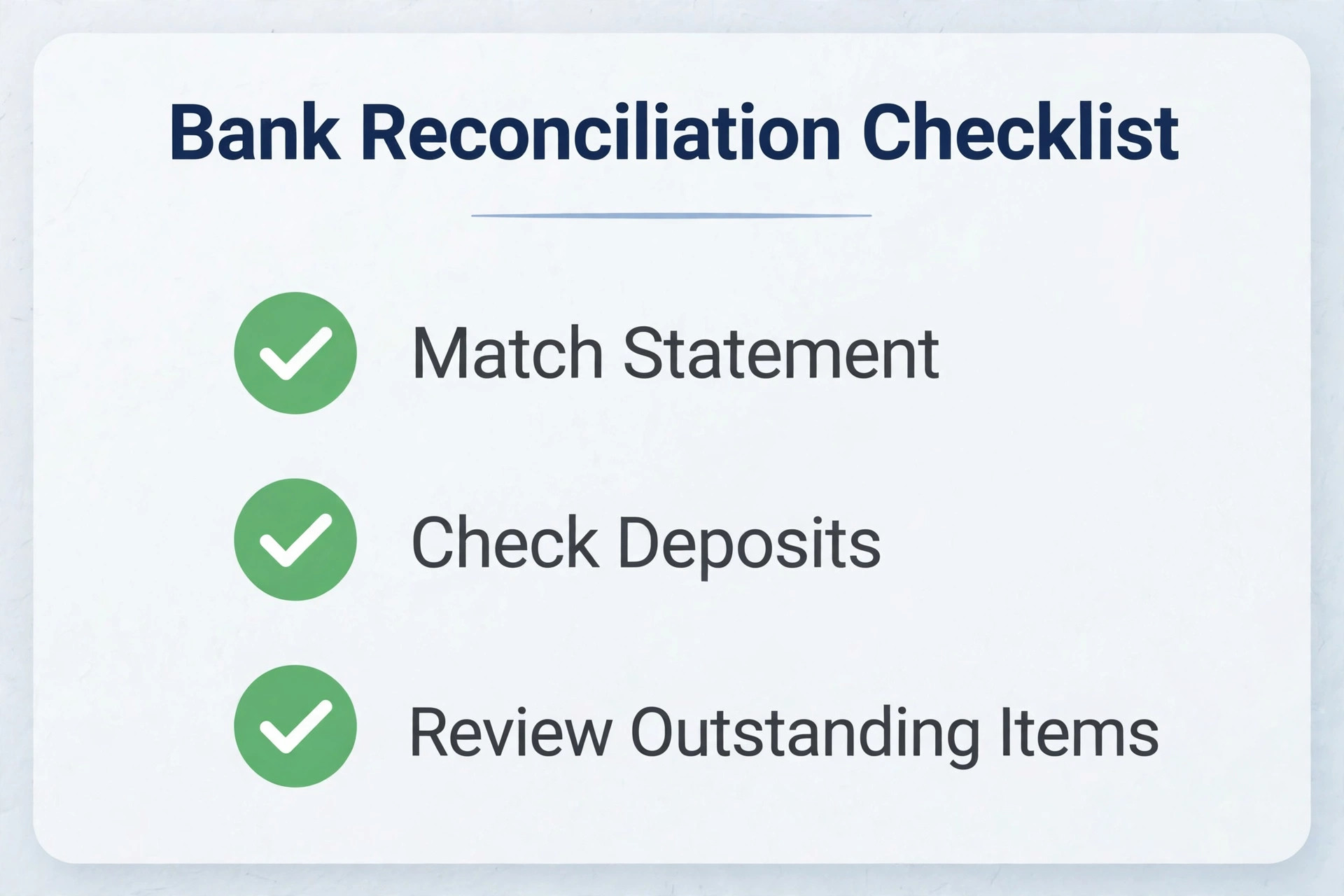
Reconciliation is the foundation of how to do month end close small business books, and accounting guides consistently call bank and card reconciliation the most critical step, because if cash is wrong, the rest of the statements are hard to trust. Start with every bank account, then every credit card, then payment processor accounts such as Stripe or Square, and tie each one to its statement balance for the month. A reconciliation that does not tie to the statement is not finished, even if the difference looks small.
Work the differences, not just the matches. An outstanding deposit, an outstanding check, a bank fee, a duplicate import from a bank feed, and a personal transaction that slipped into the business account are the usual suspects. Investigate old outstanding items first, because an item outstanding for ninety days is rarely a timing difference. It is usually an error, a missing record, or a transaction recorded in the wrong account, and it will still be outstanding next month if you carry it forward without a note.
Tie payment processor activity to deposits. A processor payout rarely equals one day of sales, because it nets fees, holds reserves, and batches several days together. Match each payout to the sales it covers, record the fees separately, and investigate any payout that does not match a batch. Businesses that skip this step often overstate sales by the fee amount or understate sales by the reserve amount, and the error compounds every month until someone reconciles the processor account properly.
Reconcile loans and other balance sheet accounts with regular activity at the same time. Split each loan payment into interest and principal, confirm the remaining balance matches the lender statement, and check that any new loan draw or fee is recorded. Do the same for sales tax payable, payroll liabilities, and any account that moves every month. A balance sheet account that is never reconciled will eventually produce a number nobody believes, and the close is the moment to catch it while the statement is at hand.
Stage Two, Review Receivables, Payables and Inventory
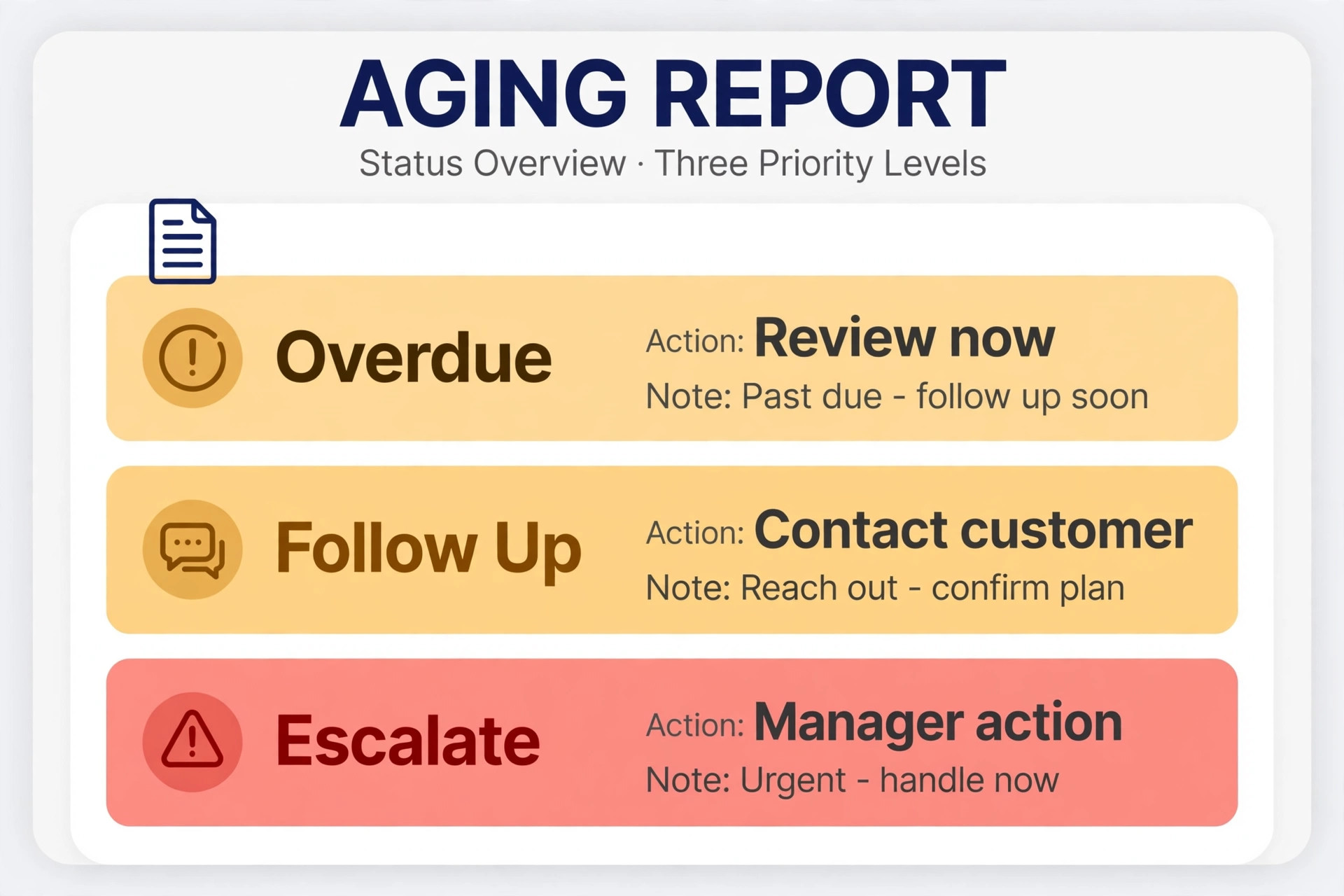
With cash reconciled, the next lesson in how to do month end close small business reviews is to turn to what customers owe you and what you owe suppliers. Review the accounts receivable aging report line by line. Follow up overdue accounts, check for invoices that were never sent, and consider whether any balance looks doubtful enough to note for your adviser. An invoice that was never sent is revenue that never existed in your books, and the close is the last reliable moment to catch it before the customer forgets the work too.
Review accounts payable aging with the same care. Look for duplicate bills, credits not applied, and bills recorded twice under slightly different vendor names. Check supplier statements against your records for any bill the supplier shows that you do not, because a missing bill understates expenses and overstates profit. If a bill is disputed, record the dispute as an open item with the amount and the date, so the next close starts from a note instead of a rediscovery.
Update inventory if you carry stock. Count what you hold, compare it with the ledger, and adjust for shrinkage, damage, and obsolete items. For a service business this stage is short, but for a product business it is where gross margin is decided. An inventory count skipped for three months turns cost of goods sold into an estimate, and an estimated margin cannot support a pricing decision. Record the count, the adjuster, and the reason for any adjustment in the close file.
Review prepaid expenses and fixed assets in the same pass. A prepaid insurance payment covers future months, so only the current month portion belongs in this month expenses. A fixed asset depreciates each month, so the monthly charge belongs in the close even when no cash moved. These non cash items are easy to skip because no bank line prompts them, which is why the checklist names them explicitly. A close that only records cash movement is a cash report, not a set of books.
Stage Three, Post Adjustments and Accruals
Adjustments turn a reconciled cash record into an accurate monthly picture, and they are the technical heart of how to do month end close small business accounting. Record accruals for expenses incurred but not yet billed, such as utilities, professional services billed in arrears, and rent for a period that straddles the month end. Record revenue earned but not yet invoiced in the same way, where your accounting method requires it. Accruals are estimates in some cases, so note the basis for each one, and reverse or replace it when the real bill arrives, so the same cost is never recorded twice.
Post payroll accruals for any pay period that straddles the month end. If the pay period ends on the third of next month but covers work done in the closing month, the wages for the closing month portion belong in the closing month. Reconcile the payroll liability to what is actually due, including withheld taxes and employer contributions, and confirm the payroll report matches the accounting record. A payroll liability that drifts from the payroll report is a common close error, and it grows with every pay run that is not tied back.
Record depreciation and amortisation for fixed assets and intangibles, and amortise prepaid expenses to the current month. These entries need no new document each month once the schedule is set, but they need a monthly check that the schedule is still correct. An asset sold or retired during the month should leave the schedule, and a new asset should join it. A depreciation schedule that nobody updates will quietly charge for assets the business no longer owns.
Post deferred revenue adjustments where customers paid in advance. A customer who paid for a year of service in January has not bought twelve months of revenue in January. Each month earns one twelfth, and the rest sits as a liability until earned. The same logic applies to deposits and retainers. Getting this right matters for tax, for refunds, and for any buyer or lender who asks what the business actually earned in a given month, rather than what cash it collected.
Have a second person review significant adjusting entries where possible. In a one person firm, that review means stepping away and rechecking the entry against its source document the next morning, rather than posting and moving on. Adjusting entries are where judgement lives, and judgement benefits from a pause. Note the source, the amount, and the reason on each entry, so a future reviewer can follow the logic without asking you to reconstruct it from memory.

Stage Four, Review the Statements for Anomalies
Run a trial balance and scan it for unusual balances before you produce any report. Look for negative asset balances, revenue accounts with a debit balance, expense accounts that suddenly doubled, and any account with a large round number that suggests a plug rather than a real entry. The trial balance review is the step that catches the miscoded transaction, the duplicated import, and the account that was never meant to hold that kind of entry.
Compare the profit and loss statement with last month, with the same month last year, and with budget where you have one. Investigate any variance above a threshold you set in advance, such as ten percent or a fixed amount that matters to your business. A variance is not necessarily an error, and seasonal businesses will show real swings, but every large variance deserves a one line explanation in the close file. That explanation is what turns a set of numbers into a management story you can act on.
Review the balance sheet with the same discipline. Check that bank balances match reconciliations, that receivables and payables match aging reports, that loan balances match lender statements, and that retained earnings moved only as expected. A balance sheet that does not tie to its supporting schedules is a warning, not a report, and it should not leave the business until the tie is fixed. Most balance sheet errors are small and fixable at this stage, and most become large when they are carried forward for quarters.
Prepare a short management commentary for any significant variance. Note what changed, why it changed, and what action follows, if any. A commentary that says revenue rose because a new client started, or that software cost rose because a renewal landed, gives the owner a decision in one paragraph. A report without commentary leaves the owner to guess, and guessing from a profit figure is how a firm hires against a one off month or cuts spending against a timing difference.

Stage Five, Lock the Period and Report
Locking the period is the step that makes how to do month end close small business work permanent. Close the month in your accounting software so completed months cannot be changed accidentally, and route any later correction into the next period with a clear note. Accounting guides are unanimous on this point. An open period invites late edits, and late edits break every report already sent. If a correction is truly needed in a locked month, your adviser should approve the reopening, and the reopening should be logged.
Produce the final reporting packet after locking, not before. The packet normally holds the profit and loss statement, the balance sheet, the cash flow statement, and the aging reports, plus the reconciliation reports and the exception note. Save the packet in the close file and share it with whoever needs it, whether that is a partner, a lender, or your accountant. A packet produced before locking can be silently invalidated by a late entry, which is why the order is lock first, then report.
Note exceptions and open items for next month in the packet itself. Every close leaves a few items unresolved, such as a disputed bill, a missing receipt, or a payroll question awaiting an answer. Listing them with an owner and a due date turns them into next month starting tasks instead of forgotten items. The next close should open by clearing last month exceptions before it starts new work, because an exception carried for three months is usually an error that has been normalised.
Set the date for next month close before you finish this one. A close that ends with a calendar entry for the next cutoff, reconciliation day, and lock day is a routine. A close that ends with relief and no next date is an event that will be late again next month. The routine is the achievement, more than any single month numbers, because a firm that closes on time every month has numbers it can trust every month.

How Long the Close Should Take and Who Should Own It
Timing guides differ, so treat published timelines as guides rather than promises, and confirm the timeline that fits your volume with your own adviser. One accounting guide reports that most small businesses complete the close in three to five business days with proper organisation, while another guide puts the range at five to ten business days, and a straightforward service business may finish in two days. The honest reading is that volume, inventory, and how current daily bookkeeping stays during the month decide the timeline, not the checklist length.
If your close regularly takes longer than ten business days, the problem is usually capture, not closing. Transactions recorded late, receipts filed late, and bank feeds left uncategorised for weeks all arrive at the close at once, and no checklist can process a month of backlog in a day. Fix capture during the month by categorising bank feeds weekly, chasing missing bills weekly, and recording payroll promptly, and the close will shorten without any change to the checklist itself.
Ownership matters as much as timing. In a firm with a bookkeeper, the bookkeeper owns posting and reconciliation, and the owner owns review and lock. In a firm that outsources bookkeeping, the outsourced accountant owns the technical steps, and the owner still owns review, because nobody else can explain why revenue moved or whether a new vendor is legitimate. In a one person firm, you own every step, so build the review pause into the calendar and treat it as a separate task, not as a glance at the screen before locking.
Measure the close each month. Record the lock date, the number of exceptions, and the time spent, and watch the trend. A close that shortens by a day each quarter is a process improving. A close that lengthens is a signal that volume grew, that a new account was added without a reconciliation routine, or that capture slipped. Measuring turns the close from a chore into a process you can manage, and management is the point of the whole exercise.

Tools for a Faster Close
QuickBooks, Xero, and FreshBooks all support the close workflow, with bank feeds, reconciliation reports, and period locking, though the exact screen names and locking controls differ by plan, so confirm the locking steps on the vendor page for your plan before close day. The choice between them matters less than the discipline of using one consistently, because a close routine built in one system and half moved to another will miss steps in the gap. Pick the system your bookkeeper knows, and keep it.
Bench and similar outsourced bookkeeping services suit firms that want the technical close handled externally, with the owner retaining review and lock decisions. That split works well when the owner is honest about review time. Outsourcing the close without reviewing the reports saves time and loses the management value, because the owner never learns why margins moved. If you outsource, diary a review meeting within two days of receiving the packet, and ask for the exception list at that meeting, not at year end.
Automation helps most at the capture stage. Bank feed rules that categorise recurring transactions, receipt capture that attaches a photo to the transaction, and recurring journal entries for depreciation and prepaids all reduce close week work. Set those rules up during a quiet week, not during a close, and test each rule against a month of real transactions before relying on it. A bad automation rule creates more close work than manual entry, because it miscategorises silently for a month before anyone notices.
Avoid adding a new tool during a close. A tool migration, a chart of accounts change, or a new integration should land in the first week of a month, with the full month to settle before the next close. Changes made in close week collide with reconciliation and review, and the resulting errors are blamed on the tool when the timing was the real cause. Schedule change separately from closing, and the close will stay boring, which is exactly what a good close should be.
Mistakes That Stretch the Close Into Weeks
The first mistake in how to do month end close small business closes is starting with review instead of reconciliation. Reviewing a profit figure built on unreconciled cash wastes the review, because every variance you investigate may be a reconciliation error in disguise. Reconcile first, every month, without exception, and review only the reconciled numbers. That single ordering rule removes the most common reason closes drag on.
The second mistake is leaving the period open. An open period invites well meaning edits, such as a bookkeeper tidying last month while this month is already reported, and each edit invalidates a report someone already used. Lock promptly, log any reopening, and route corrections forward. A firm that locks on time has one version of the truth. A firm that does not has as many versions as there are edits.
The third mistake is skipping the exception list. Unresolved items carried silently forward become next month mysteries, and a mystery that survives three closes is usually written off or forgotten rather than resolved. List every exception, assign an owner and a date, and open the next close by clearing the list. That habit alone can cut a close by a day, because the close stops rediscovering the same problems.
The fourth mistake is closing alone without a review pause. A single person who posts, reconciles, reviews, and locks in one sitting will miss their own errors, because the brain sees what it expects to see. Build a pause between posting and review, even an overnight one, and review from the printed reports rather than from the entry screens. Fresh eyes catch the transposed number that tired eyes approved an hour earlier.
The fifth mistake is treating the close as a tax task rather than a management task. A close done only for the accountant produces numbers nobody in the business uses, and a process nobody uses will be late, because nothing depends on it. Use the packet to set next month spending, to chase overdue customers, and to check pricing against real margins, and the close will earn its time every month, because decisions will start depending on it being on time.
Frequently Asked Questions
How long should a month end close take for a small business
Accounting guides report a range rather than a single number, so treat any figure as a guide and confirm it with your adviser. One guide reports three to five business days for most small businesses with proper organisation, while another reports five to ten business days, and a straightforward service business may finish in two days. Volume, inventory, multiple locations, and how current daily bookkeeping stays during the month decide where in that range your business lands.
What is the most important step in a month end close
Bank and credit card reconciliation is usually the most critical step, because if cash accounts are wrong, the rest of the financial statements become harder to trust. Reconcile every bank account, every card, and every payment processor account to its statement before you review profit or produce reports. A close built on unreconciled cash is a report built on a guess, however tidy the rest of the checklist looks.
Should a small business lock the period every month
Yes. Lock the period in your accounting software so completed months cannot be changed accidentally, and route later corrections into the next period with a note. Accounting guides agree that an open period invites late edits, and late edits break reports already sent to partners, lenders, or advisers. If a correction in a locked month is truly needed, have your adviser approve the reopening and log it in the close file.
What should I do if my close regularly takes more than two weeks
Fix capture during the month before you change the checklist. Categorise bank feeds weekly, chase missing bills weekly, and record payroll promptly, so the close processes a week of work instead of a month of backlog. Also check whether a new account, a new location, or inventory was added without a reconciliation routine, because unowned accounts are a common reason a close lengthens even when transaction volume stays flat.
Do I need an accountant to close the books each month
Not necessarily for the routine steps, but an adviser adds value on adjustments, tax provisions, and any entry that needs judgement. Many small firms handle posting and reconciliation in house and use an accountant for review, for year end, and for questions that arise during the close. The key split is that the owner always reviews the packet, whether the technical work was done in house or outsourced, because only the owner can explain why the numbers moved.
What reports should a month end packet contain
A useful packet holds the profit and loss statement, the balance sheet, the cash flow statement, the receivables and payables aging reports, the bank reconciliation reports, and a short exception note listing open items with owners and dates. Save the packet in the close file for the month, and share it with partners, lenders, or your accountant as needed. A packet without the exception note looks complete and hides the items that will cause next month problems.
More Reading on Stratilyze
For related money workflows, read cost of FreshBooks for small business monthly and cost of Xero for small business monthly. For a payroll problem that often surfaces during a close, see fix payroll direct deposit failed small business.