
Start with a short handbook that every employee actually reads, rather than a long document that sits unread in a drawer. That is the verdict after years of small business practice. A handbook earns its keep when it answers everyday questions in plain language, states the same rule for everyone, and gives a manager a written reference when a difficult decision arrives. If you want to learn how to create employee handbook small business owners can defend and use every week, build it around decisions you have already made, not around a template you have never read.
A handbook is not a contract, and it should say so in plain words on an early page. Its job is to record expectations, explain benefits and procedures, and show that rules were applied consistently. When two employees ask the same question and get different answers, trust falls. When a manager handles leave, overtime, or discipline from memory, small differences grow into claims of unfair treatment. A written handbook removes much of that guesswork, for the owner as well as for the team.
This guide shows how to create employee handbook small business owners can finish, walking through the whole build in order. It covers the decisions to settle before you write, the sections a small business handbook normally needs, wording you can adapt, a complete acknowledgement form, tools that help a small team keep the document current, and a rollout plan that gets signatures without turning day one into a paperwork lecture. It is general information for small employers, not legal advice for a specific state or situation. Employment rules vary by state and by city, and they change, so have a local employment lawyer or a qualified HR adviser review your final draft before you issue it.
How to Create Employee Handbook Small Business Owners Can Actually Use
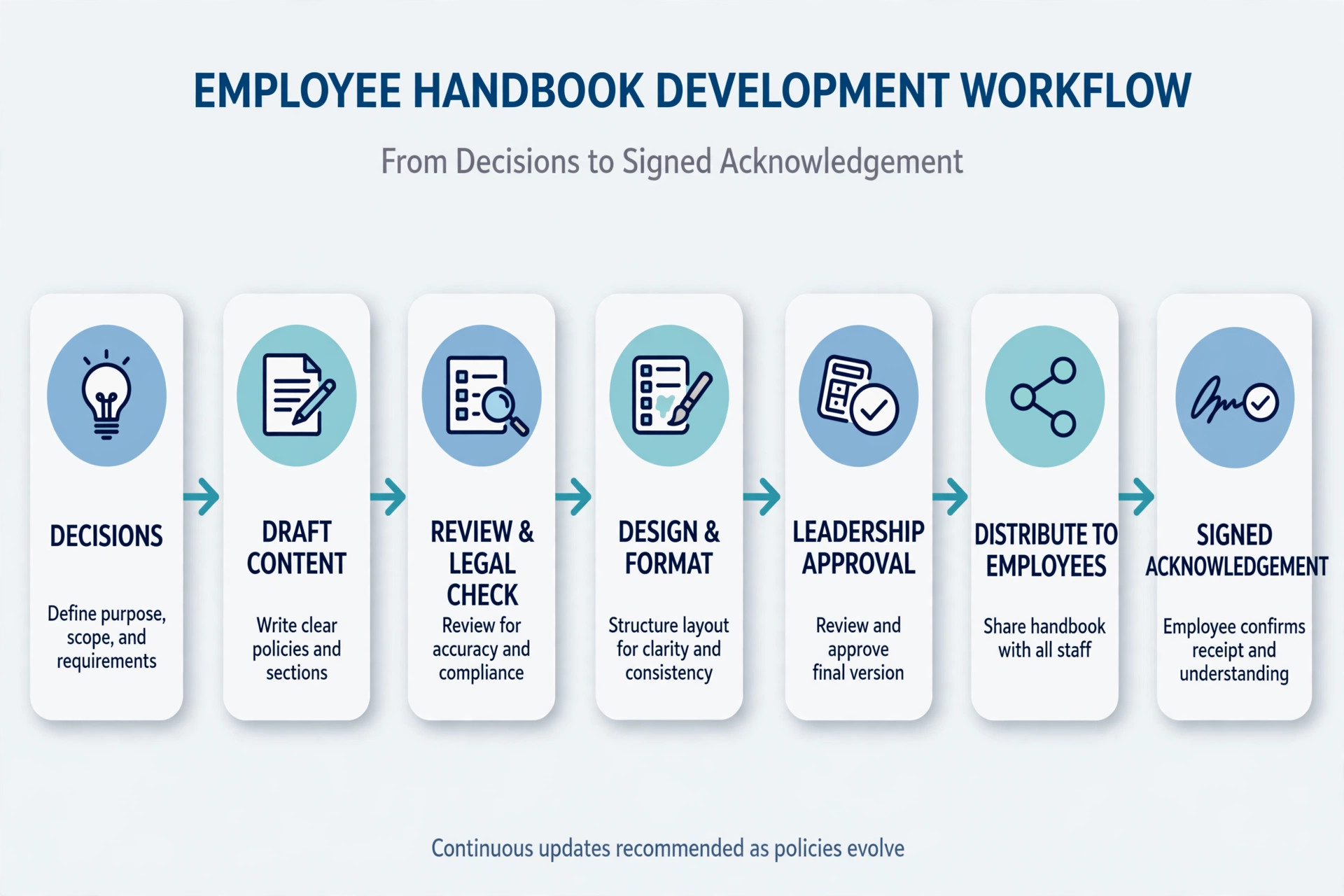
A usable handbook follows five steps, and the order matters. Skipping ahead to a template before you settle pay, hours, and leave rules is how contradictions enter a handbook. Write the decisions first, then put them into sections, then review them for consistency, then issue the book with a signed acknowledgement.
- List the decisions you must make first, including pay day, work hours, overtime, time off, remote work if any, and how requests are approved.
- Gather the facts that change by location, including minimum wage, paid sick leave, final pay timing, and any city ordinance that applies to your staff.
- Draft one section at a time in plain language, and test each rule by asking what a new hire would do after reading it once.
- Have the draft reviewed for state and local rules, for promises you did not mean to make, and for conflicts between sections.
- Issue the handbook, collect a signed acknowledgement from every employee, store the signed forms, and set a review date.
That sequence keeps the project small enough to finish. Many owners stall because they try to write a perfect book in one sitting. A handbook that covers the real rules and is issued this month beats a perfect draft that is still unfinished at the end of the year. You can add sections later through a dated update, and the acknowledgement form in this guide is written to allow for that.
Start With Decisions, Not a Template
A template can save time, but when you learn how to create employee handbook small business rules from scratch, it cannot decide your policies for you. Before you open one, answer the questions your employees will actually ask. How are hours recorded, and when does the work week start. Who approves overtime, and what happens when overtime is worked without approval. How much paid time off do employees earn, when can they use it, and what happens to unused time when someone leaves. Those answers become the handbook. Without them, a template fills the gaps with someone else’s rules, and you may not notice until a dispute forces you to read your own book closely.
Settle pay and hours first
Pay and hours cause the most confusion in a small team, because they touch every paycheck. Decide the pay period and pay day, the method for recording time, the meal and rest break practice, and the overtime rule for your state. State the rule that nonexempt employees must record all hours worked, including time spent answering messages or finishing a task after the shift, because unrecorded time is a common source of wage claims. Decide who may approve schedule changes, and write down how a shift swap is requested, so a verbal agreement between two employees does not leave a shift uncovered.
Decide leave before you promise it
Leave is the section employees read most carefully, and it is also the section where vague wording causes the most trouble. Decide each leave type separately, rather than writing one paragraph that tries to cover everything. Paid time off, sick leave, parental leave, bereavement leave, jury duty, and military leave have different rules, different eligibility, and in some states different legal minimums. Write the eligibility, the amount, the accrual or grant method, the request process, and the carryover rule for each type.
Be careful with carryover and payout on departure, because those two sentences decide real money. If unused time is lost at year end, say so. If it carries over up to a stated limit, state the limit. If unused time is paid out when employment ends, say so, and if it is not, say that too. Employees who learn a payout rule only at departure feel misled, even when the rule itself was fair. The same care applies to sick leave, where many states and cities set a minimum accrual rate and a permitted use, so confirm the current rule for each work location before you finalise the numbers.
Welcome, Mission and Employment Basics
The opening pages, in any plan for how to create employee handbook small business new hires read, set the tone for the whole book. A new hire should finish them knowing what the business does, who to ask for help, and what kind of workplace you intend to run. Keep the welcome short. One page of genuine description beats five pages of slogans, and a new hire who has just started work does not need a history lesson before learning how to request time off.
Write a welcome that helps a new hire
Open with a welcome from the owner, a one paragraph description of the business and its customers, and a list of the first week contacts. Name the person who handles scheduling, the person who handles pay questions, and the person who handles safety concerns, with a phone number or email for each. New hires often stay silent about a simple question because they do not know whom to ask, and a named contact removes that barrier. Add the location of the handbook itself, whether it is a printed copy, a shared drive folder, or a tool your team already uses, so an employee can find it again without asking.
Include the employment basics on the same opening pages. State the employment relationship as it applies in your state, and in most United States states that means at will employment, where either side may end the relationship at any time for a lawful reason. State clearly that the handbook is not a contract and does not promise employment for a set period, and that the business may change policies when business needs or the law require it. Those sentences protect both sides, because they prevent a handbook from being read as a promise it was never meant to make.
Equal opportunity and anti harassment in plain words
Every small business handbook needs an equal opportunity statement and an anti harassment policy, written in language an employee can act on. The equal opportunity statement should say that hiring, pay, promotion, and other employment decisions are made without regard to characteristics protected by law, and it should list the characteristics your state and local law protect. Do not copy a list from another state without checking it, because protected characteristics differ by location.
The anti harassment policy needs more than a statement that harassment is prohibited. It must name the behaviour covered, give more than one reporting route, and promise that reports will be handled promptly and without retaliation. An employee who can only report harassment to the person causing it will not report at all, so name a second route, such as the owner or an outside HR contact. State that retaliation for reporting or for taking part in an investigation is prohibited, and state what happens after a report, in general terms, so employees know the report will not disappear into silence.
Pay, Hours and Time Off in Detail
This is the working heart of the handbook, and in learning how to create employee handbook small business payroll rules, it deserves the most careful drafting. Employees will return to it before they ask a manager, and managers will return to it before they answer. Write it as a reference, with short sections and exact numbers, rather than as an essay about how much you value the team.

Pay day, deductions and wage questions
State the pay schedule, the pay day, and how pay is delivered, whether by direct deposit or another method. Explain lawful deductions in general terms, and tell employees whom to contact about a pay question, with a promise that questions will be answered without penalty. Add a sentence that employees should report a pay error promptly, and that the business will correct a verified error as soon as practical. That sentence matters, because a pay error that is reported early is cheap to fix, while one discovered months later can grow into a formal complaint.
Time off, sick leave and holidays
Write time off as a table of facts, even when the handbook itself is written in paragraphs. For each leave type, give the eligibility date, the amount, how it is earned, how it is requested, how far in advance a request is needed, and what happens to unused time. Add the business holidays you observe, and state whether holiday pay applies to part time staff, to new hires still in their first months, and to employees who work on the holiday itself. Those details are the ones employees ask about, and they are the ones most handbooks leave out.
Sick leave deserves its own paragraph, because state and city rules often set the accrual rate, the permitted uses, and the documentation an employer may request. Some jurisdictions allow an employer to ask for documentation only after a stated number of consecutive days, and some cap the total accrual. Confirm the current rule for every location where your employees work, including employees who work remotely from another state, and write the rule that applies to each group if the rules differ. A single national sentence that is wrong in one state is worse than two short paragraphs that are right in both.
Conduct, Safety and Everyday Workplace Rules
Conduct rules work best, in a guide to how to create employee handbook small business conduct rules, when they describe the behaviour you expect, not only the behaviour you forbid. Employees follow a rule they understand, and they test a rule that reads like a list of threats. Write the expected standard first, then the process that follows when the standard is not met, so the handbook reads as a fair workplace guide rather than a warning letter.
Standards of conduct and progressive discipline
Cover attendance and punctuality, dress and appearance where it matters for safety or customer contact, use of business equipment and systems, confidentiality, conflicts of interest, and outside employment that could clash with the job. For each area, state the standard in one or two sentences, then state how a problem is handled. Most small businesses use a progressive approach, starting with a verbal conversation, then a written warning, then a final warning, then separation, while reserving the right to move faster for serious misconduct such as theft, violence, or a serious safety breach.
Write the discipline section so a manager can follow it without improvising. State who may issue each step, whether the employee may respond in writing, and where the record is kept. Add a sentence that the business will apply the process consistently, and that the steps are a guide rather than a promise of a set number of warnings before separation in every case. That balance gives managers room to act on serious cases, while giving employees a clear picture of how ordinary problems are handled.
Safety, injury reporting and workplace security
Safety rules must be specific to your workplace, because a generic safety page helps no one. List the hazards your team actually faces, the protective equipment provided, the training required before a task, and the procedure for reporting an unsafe condition. State that employees must report any work injury immediately, no matter how minor it seems, and give the name of the person who receives the report and the form or system used. Early reporting protects the employee, because some injuries worsen over days, and it protects the business, because a workers compensation claim filed weeks late is harder to verify.
The Required Sections Checklist
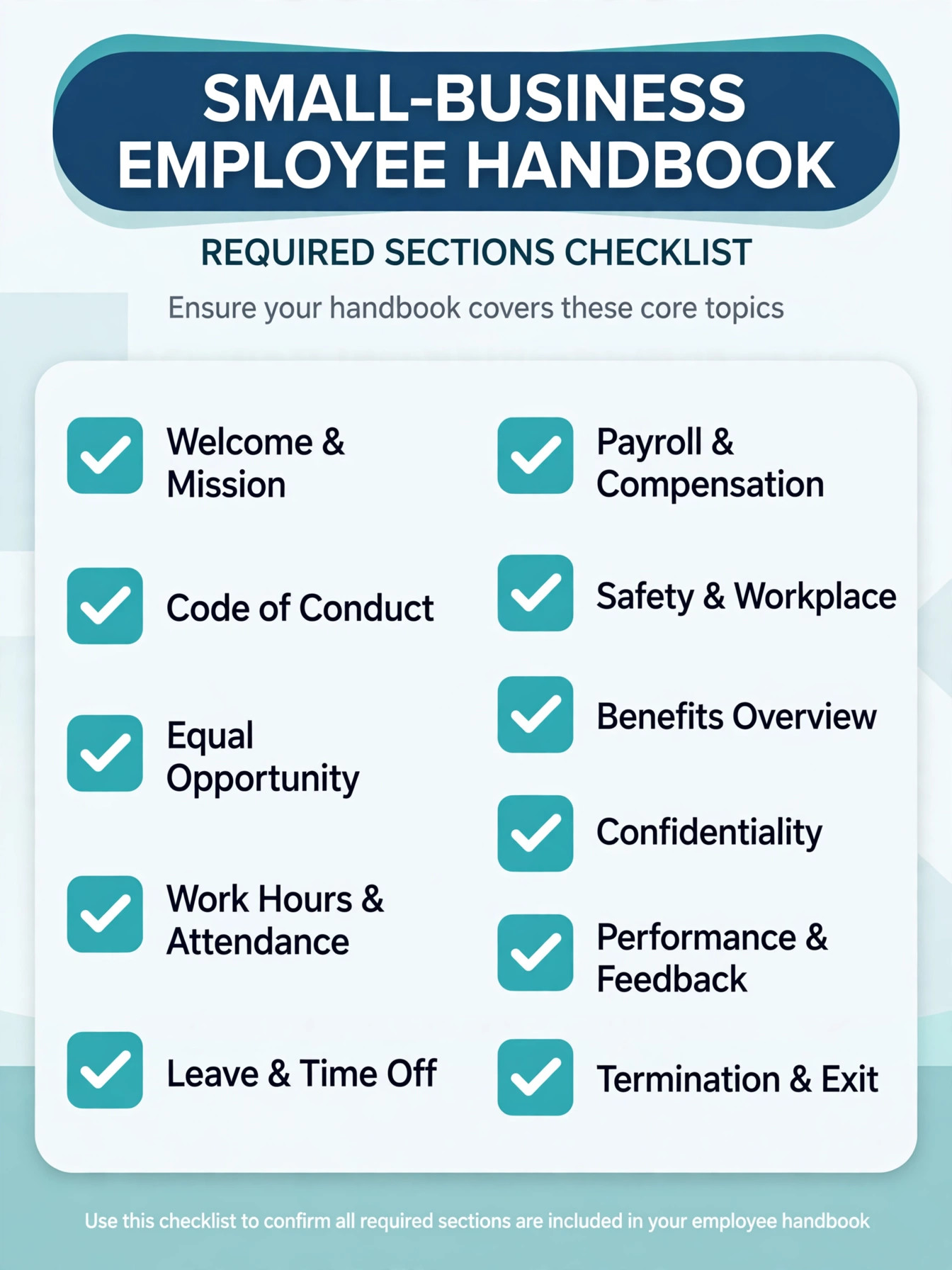
This checklist is the overview proof element for this guide. Use it as a build list, and tick off each section only when the wording is final and reviewed. A small business handbook that covers every item below answers the questions employees ask most, and it gives a manager a complete reference for everyday decisions.
- Welcome, mission, and first week contacts, including where to find the handbook and whom to ask about scheduling, pay, and safety.
- Employment basics, including the at will statement where it applies, the statement that the handbook is not a contract, and the right to change policies.
- Equal opportunity statement, with the protected characteristics that apply in each work location.
- Anti harassment and anti retaliation policy, with at least two reporting routes and a description of how reports are handled.
- Pay schedule, pay day, time recording, overtime, deductions, and the contact for pay questions.
- Hours, scheduling, breaks, meal periods, remote work rules if any, and the shift swap process.
- Time off, including paid time off, sick leave, holidays, parental leave, bereavement leave, jury duty, and military leave, each with eligibility and carryover rules.
- Benefits summary, including health coverage if offered, retirement if offered, and the eligibility dates and enrolment windows for each benefit.
- Conduct standards, including attendance, dress, equipment use, confidentiality, conflicts of interest, and social media use during work.
- Discipline process, including the steps used, who may issue them, the employee response, and where records are kept.
- Safety and injury reporting, including hazards, protective equipment, training, and the immediate reporting rule for any work injury.
- Separation, including notice expectations, final pay timing under state law, return of property, and benefits continuation information where required.
- Acknowledgement form, signed and stored for every employee, with the handbook version and effective date recorded on the form.
Policy Wording You Can Adapt
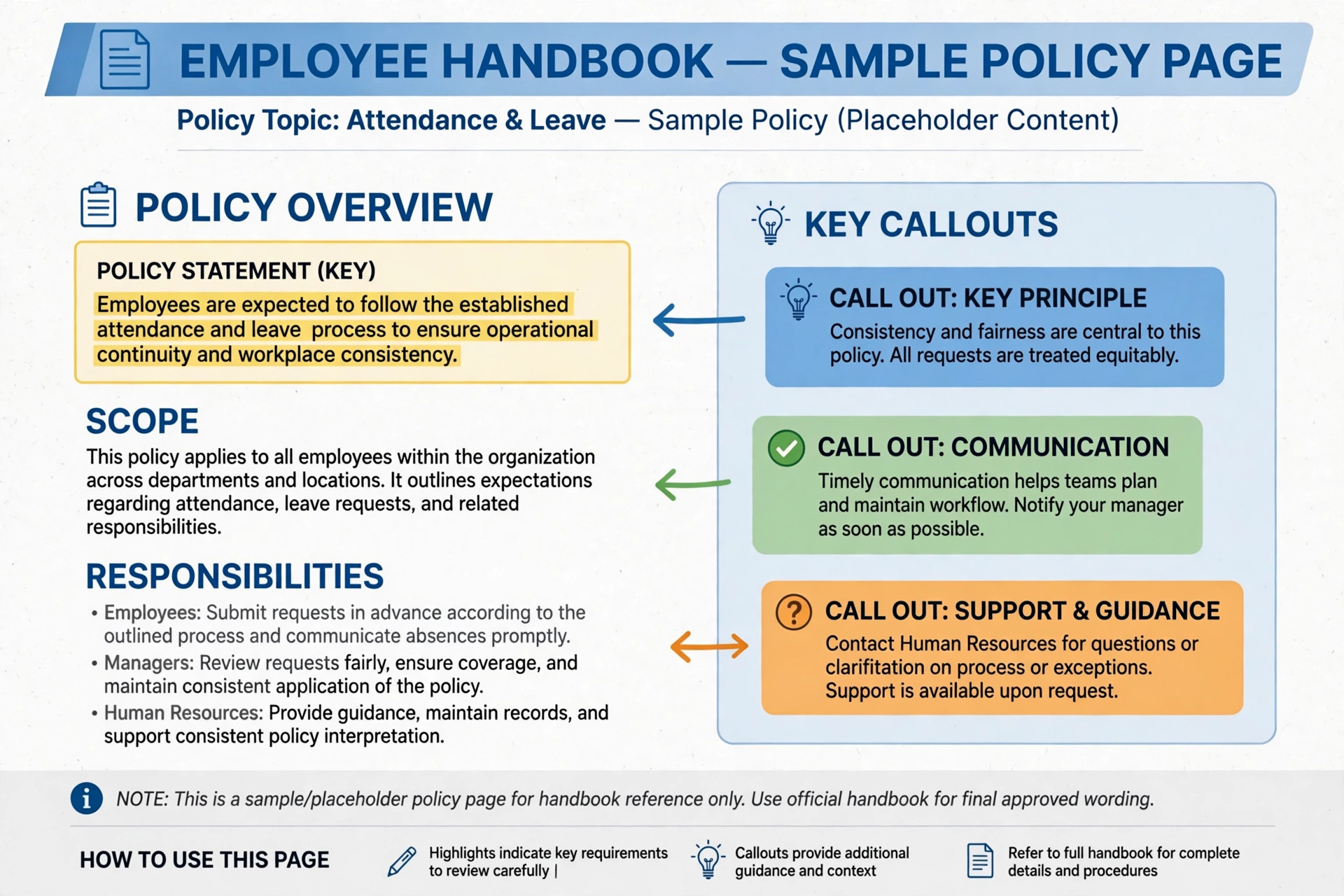
The wording below is a starting point, not a finished legal document. Adapt the names, dates, and state specific sentences, then have the result reviewed. Good handbook wording is short, direct, and free of promises the business does not intend to keep, and each paragraph below follows that pattern.
Use this wording for the employment relationship. This handbook is not a contract of employment, and it does not promise employment for any set period. Employment with this business is at will where the law allows it, which means either the employee or the business may end the employment relationship at any time, for any lawful reason, with or without advance notice. No manager may change the at will relationship except through a written agreement signed by the owner.
Use this wording for policy changes. The business may change, add, or remove any policy in this handbook at any time, when business needs or the law require it. Employees will be told about changes that affect them, and they will be asked to acknowledge material changes in writing. The current version of the handbook, as issued by the business, is the version that applies, and earlier versions do not continue to apply after a new version is issued.
Use this wording for harassment reporting. Any employee who experiences or witnesses harassment should report it promptly to a manager, to the owner, or to the designated HR contact named in this handbook. Reports will be reviewed promptly and fairly, and the business will take appropriate action based on the facts found. No employee will face retaliation for making a good faith report, or for taking part in a review of a report, and any retaliation should itself be reported at once.
Use this wording for time recording. Nonexempt employees must record all time worked accurately, including time worked before or after the scheduled shift. Employees must not work off the clock, and managers must not ask or allow an employee to work off the clock. Any employee who believes time was not recorded correctly should report it to the pay contact named in this handbook, so the record can be corrected.
The Acknowledgement Form Template
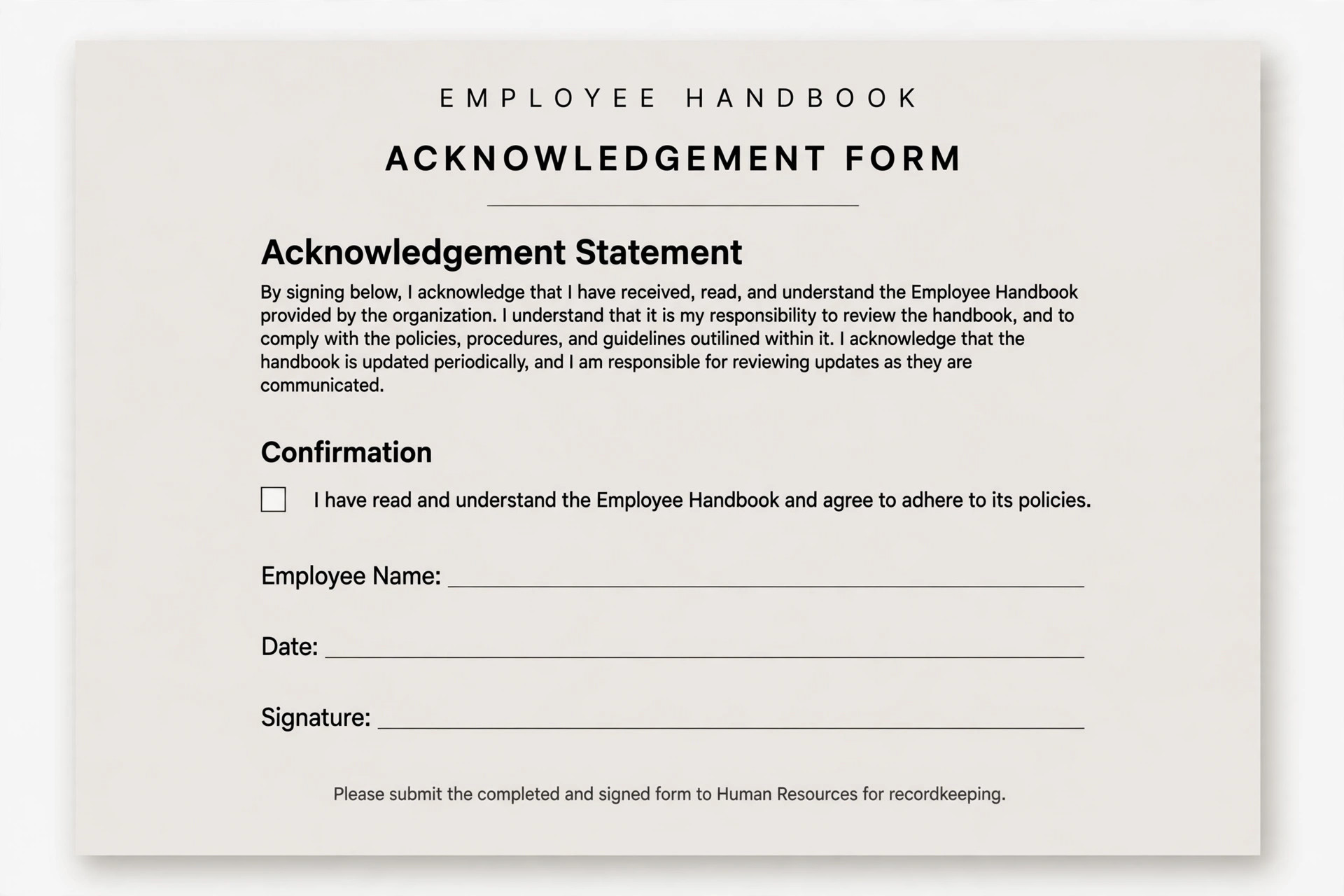
The acknowledgement form is the page that turns a handbook into a record. Every employee signs one, including the owner if the owner also works under the same rules, and a new signed form is collected whenever a new version is issued. Keep the form to one page, use plain language, and file it where it can be found years later, because the form is most valuable when a dispute arises long after the handbook was issued.
- I acknowledge that I have received a copy of the employee handbook, version and effective date stated below, and that I have had the opportunity to read it and to ask questions about it.
- I understand that I am responsible for following the policies in the handbook, and for asking a manager or the named HR contact when a policy is unclear.
- I understand that this handbook is not a contract of employment, and that it does not promise employment for any set period.
- I understand that my employment is at will where the law allows it, and that either side may end the employment relationship at any time, for any lawful reason, with or without advance notice.
- I understand that the business may change, add, or remove policies in this handbook, and that I will be told about changes that affect me and asked to acknowledge material changes.
- I understand the anti harassment policy, the reporting routes named in the handbook, and the prohibition on retaliation for a good faith report.
- I have had the opportunity to ask questions, and my questions have been answered to my satisfaction, or I have noted my outstanding questions below.
Add the fields every form needs, and leave no field blank. The employee prints a full name, signs, and dates the form. The manager or HR contact who received the form also signs and dates it, and records the handbook version and effective date. A notes line allows the employee to record an outstanding question, which the manager should answer in writing and attach to the form. File the signed form with the employee record, give the employee a copy, and log the version acknowledged in your HR system, so a later update can be checked against the version each employee actually signed.
Tools That Help a Small Team Stay Current
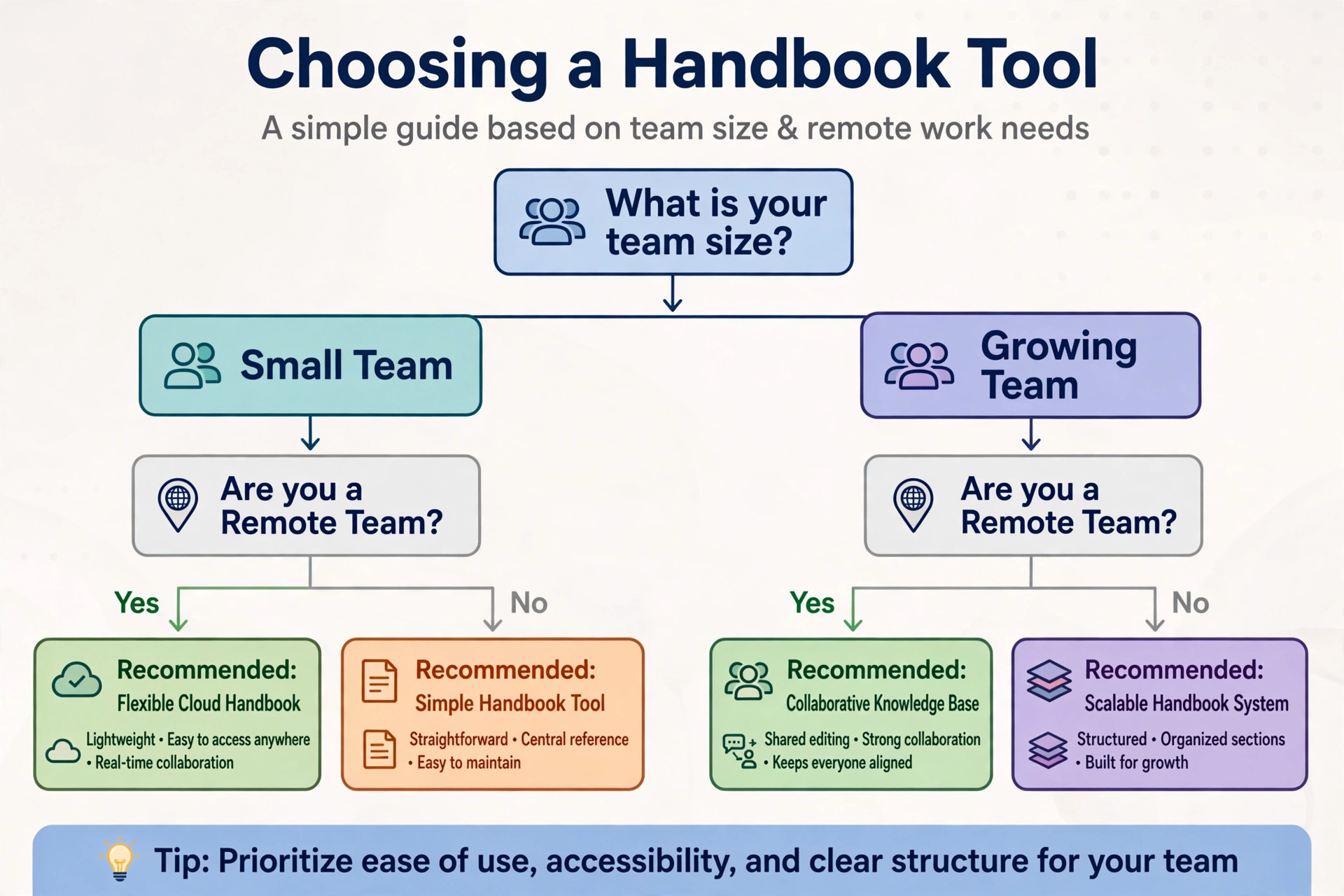
Software does not write your policies, but for owners learning how to create employee handbook small business systems that stay current, it does solve the distribution problem that defeats many small handbooks. A printed book goes out of date the day a policy changes, and a shared drive folder is forgotten until someone needs it. The tools below are named because small teams commonly use them for handbook distribution and acknowledgement tracking, and their current features and prices should be confirmed on the vendor page before you buy.
BambooHR is commonly used by small and mid sized teams to store employee records, distribute documents, and track signed acknowledgements in one place. Its value for a handbook project is the audit trail, because you can see who signed which version and when, without searching email or paper files. Rippling is commonly used by teams that want HR, payroll, and device management in one system, and it can push a handbook update to employees and collect the acknowledgement electronically. That matters when part of the team works remotely, because a paper form cannot reach them on day one.
Mineral is commonly used by small businesses that want HR guidance and handbook templates alongside compliance updates, which helps an owner who does not have an in house HR team. Its templates are a starting point, not a finished handbook, and the same state review rule applies before issue. Gusto is commonly used by small teams for payroll and onboarding, and it can include a handbook in the onboarding packet so a new hire receives it with the other first day documents. Choose the tool your team will actually open, because a powerful system that no one checks is worse than a simple folder that a manager reviews every month.
Rollout, Updates and Common Mistakes
Rollout decides, for anyone learning how to create employee handbook small business teams actually read, whether the handbook is read or filed away unread. Issue it on a normal workday, give employees paid time to read it, and hold a short meeting to walk through the sections that affect daily work, such as scheduling, time off, and reporting. Answer questions in the meeting, note any question you cannot answer, and follow up in writing. Do not ask employees to sign the acknowledgement in the same meeting before they have had time to read the book, because a signature collected under time pressure is a weak record and a poor start to the relationship.
The common mistakes are avoidable once you know them. The first is promising more than you intend, such as a guaranteed review, a fixed bonus, or a set number of warnings before any separation. The second is writing different rules in different sections, such as a leave amount in one place and a different amount in a summary table. The third is issuing a handbook and never updating it, so the book slowly stops matching the business. The fourth is collecting acknowledgements and then losing them, which removes the record the form was meant to create. A short annual review, done by one named person, prevents all four.

Frequently Asked Questions
Do I legally need an employee handbook for a small business
No single federal law requires every small business to have a handbook, but several laws require specific written policies and notices, and a handbook is the practical way to deliver them consistently. State and city laws may require written policies on harassment, paid sick leave, or other topics, and the requirements depend on your size and location. Even where no law demands a full handbook, a written book reduces disputes, because it proves what employees were told and when. Treat the handbook as a risk reduction tool, not as optional paperwork.
How long should a small business employee handbook be
For most small teams, a handbook of fifteen to thirty pages covers the required sections without burying the reader. A book under ten pages usually leaves out a leave rule, a reporting route, or a safety procedure that will be needed later. A book over forty pages usually repeats itself, and employees stop reading it. Aim for completeness first, then cut every paragraph that does not help an employee decide what to do, and move detailed benefit booklets and safety manuals to separate documents that the handbook points to.
Should employees sign the handbook itself or a separate acknowledgement form
Employees should sign a separate acknowledgement form, not the handbook. The form records the version and effective date, the at will and non contract statements, and the employee signature, while the handbook itself remains a reference document that can be updated without collecting a signature on every page. Keep the signed form with the employee record, give the employee a copy, and collect a new form for each new version. That separation is also why the form in this guide is written as a one page record.
How often should a small business update its employee handbook
Review the handbook at least once a year, and update it whenever the law changes, benefits change, or the business changes how it schedules, pays, or manages remote work. Each update should carry a new version number and effective date, a summary of the changes, and fresh acknowledgements from affected employees. A handbook that is reviewed on a schedule stays close to the real business, while a handbook that is only updated after a problem has already drifted away from it.
Can a handbook create a contract by accident
Yes, and that is why the non contract and at will statements matter. Wording that promises a job for a set period, a guaranteed raise after a review, or a fixed sequence of warnings before any separation can be read as a promise, even when the owner meant it only as a general practice. Avoid absolute promises, use language that describes a general approach rather than a guarantee, and have a lawyer review any section that describes job security, pay, or discipline. The review is cheaper than a dispute about what the handbook promised.
What should I do if an employee refuses to sign the acknowledgement form
Do not force a signature, and do not treat a refusal as misconduct on its own. Ask what part of the handbook concerns the employee, answer the question, and record in writing that the handbook was provided, the date it was provided, and that the employee declined to sign. Have a witness sign that record, give the employee a copy, and store the record with the employee file. The handbook still applies as a statement of workplace rules, and the written record of delivery preserves much of the value of the signature itself.
More Reading on Stratilyze
For related small business operations, read fix payroll direct deposit failed for a small business and best scheduling software for home care agencies. For a different team workflow, see best case management software for small law firms and how to ask customers for Google reviews as a small business.